
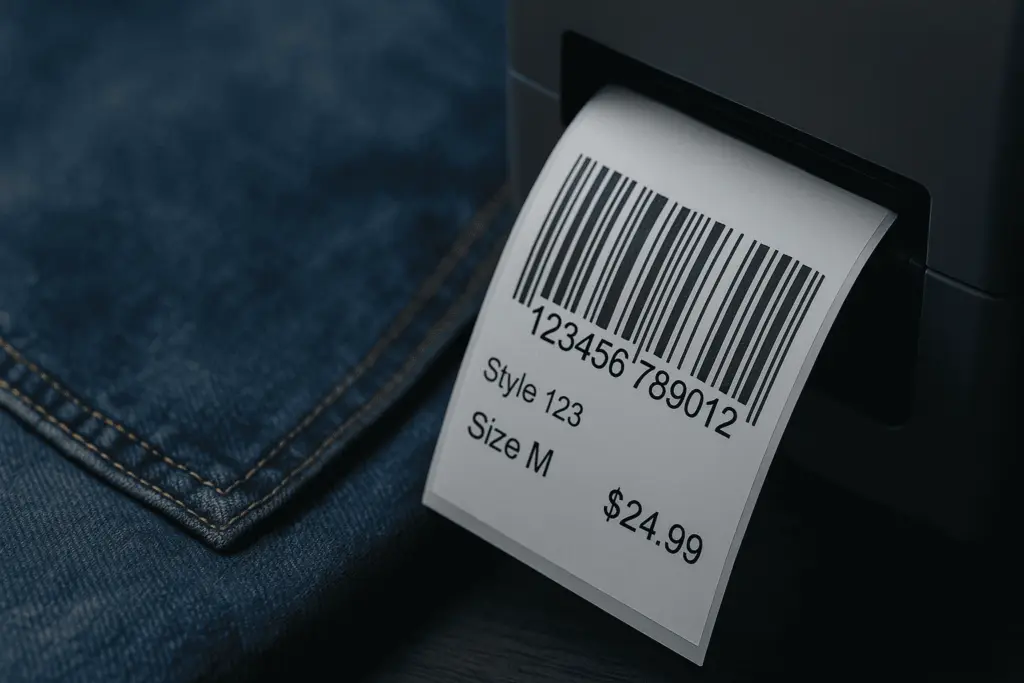
A mid-size apparel brand with 60 styles, 3 colorways per style, and 5 sizes per color needs 900 unique barcodes for a single season. Managing that manually — in spreadsheets, through email, across factories in different countries — is where barcode errors compound into inventory disasters. This guide covers every step: which barcode format to use, how to register with GS1, how to structure your SKUs, where labels go on garments, and how PLM software handles the assignment and tracking at scale.
Key Takeaways
UPC (US) and EAN (international) are the retail-standard formats — GS1 registration starts at $250/year for 10 barcodes. A SKU is your internal code; a barcode is the machine-readable version retailers and warehouses scan. A brand with 60 styles in 3 colors and 5 sizes needs 900 unique barcodes per season. PLM software auto-generates and assigns barcodes at the variant level, eliminating the duplicate and missing-code errors that manual spreadsheet tracking produces.
What Are Barcodes for Clothing and Why Does Every Brand Need Them?
A clothing barcode is a machine-readable code that links a physical garment to its digital record in your inventory, logistics, or retail system. Without it, every transaction — from factory receiving to retail checkout — requires manual entry, which multiplies errors at scale. According to GS1, the global supply chain standards body, barcodes reduce checkout errors by more than 99% compared to manual data entry, and the apparel industry accounts for one of the highest barcode scan volumes of any retail category.
For a growing brand, barcodes do four things. They make inventory counts fast and accurate. They let retailers scan your products at point of sale without custom setup. They give your warehouse team a way to pick and ship the right variant without visual inspection. And they create a data trail that connects every unit from production through to sale — the kind of traceability that buyers, retailers, and increasingly, regulatory bodies require.
The GS1 “Sunrise 2027” initiative is pushing the industry toward 2D barcodes (QR and Data Matrix) by 2027, which store far more data than traditional linear barcodes and enable product passports, care instructions, and sustainability data at the point of scan. Brands that set up their barcode infrastructure correctly now will be ready for that shift without a full system overhaul.
What Is the Difference Between a SKU and a Barcode?
This is the question that trips up most founders setting up their product system for the first time. The two terms are related but not interchangeable — and confusing them leads to real operational problems.
A SKU (Stock Keeping Unit) is an internal identifier your brand creates. It encodes the attributes of a specific product variant: style, color, size. You define the format. A typical apparel SKU looks like TOP-1820-BLK-M — readable by humans on your team. SKUs live inside your ERP, PLM, or inventory system and are not scanned by external partners.
A barcode is the machine-readable representation of a number — printed as vertical lines (1D) or a 2D pattern — that external systems can scan. The number encoded in a retail barcode is a GTIN (Global Trade Item Number) assigned by GS1. Your internal SKU maps to a GTIN; the barcode is how that GTIN gets scanned at a retailer’s dock or checkout. One SKU = one GTIN = one barcode.
| SKU | Barcode (GTIN) | |
|---|---|---|
| Who creates it | Your brand | GS1 (assigned to your brand prefix) |
| Who reads it | Your internal team | Retailers, warehouses, logistics partners |
| Format | Human-readable (e.g. TOP-1820-BLK-M) | Machine-readable (e.g. 012345678905) |
| Uniqueness scope | Internal to your brand | Globally unique across all brands |
| Lives in | PLM, ERP, inventory system | GS1 registry, retailer systems, your product database |
In Wave PLM, the SKU and barcode are both attached to the same variant record in your bill of materials. When a new colorway is added to a style, the system generates the SKU and prompts for GTIN assignment — keeping the two systems in sync without a separate spreadsheet.
What Types of Barcodes Do Apparel Brands Use?
The barcode format you need depends on where the garment is going and who is scanning it. Using the wrong format for a retail partner is one of the most common causes of vendor compliance chargebacks — penalties retailers charge brands for shipments that don’t meet labeling requirements.
| Barcode Type | Digits | Used For | Required By |
|---|---|---|---|
| UPC-A | 12 | Retail point-of-sale in the US and Canada | Most US and Canadian retailers |
| EAN-13 | 13 | International retail, global distribution | European and most international retailers |
| Code 128 | Variable | Internal production, warehouse, and logistics tracking | Internal use — not required by retailers |
| QR code | Variable (2D) | Consumer-facing: care instructions, product stories, sustainability data | Not currently retail-required; GS1 Sunrise 2027 compliance target |
| Data Matrix | Variable (2D) | Small items where space is limited; GS1 Sunrise 2027 target | Some fashion categories, moving toward requirement |
Worth noting: UPC and EAN encode the same GTIN — a UPC-A (12 digits) is simply an EAN-13 with a leading zero added. If you register a GTIN with GS1, you can generate both formats from the same number. You don’t need two separate registrations for US and international retail.
How to get a barcode for clothing?
To obtain barcodes for your clothing brand, start by registering with GS1, which is the global authority for barcode standards. Once registered, you will be assigned a unique company prefix that will be used to create your barcodes. After that, you can generate UPC or EAN codes according to your market needs. It’s essential to ensure that each product variation has its own unique barcode to avoid confusion in inventory management. Additionally, keep in mind the upcoming GS1 Sunrise 2027 deadlines for adopting newer barcode formats like QR codes and Data Matrix for enhanced consumer engagement.
How to Get Barcodes for Your Clothing Brand: GS1 Registration
The only source for globally valid retail barcodes is GS1 — the international organization that manages the barcode numbering system. Third-party barcode resellers exist, but most major retailers verify GS1 registration and will reject products with resold codes that don’t trace to your brand’s GS1 prefix. Buying barcodes from a reseller works fine for small craft sellers, but creates compliance problems as soon as you start working with wholesale buyers.
GS1 US registration (gs1us.org) works as follows. You register your company and receive a GS1 Company Prefix — a unique number that serves as your brand identifier in every barcode you issue. Annual membership fees as of 2026:
| GS1 US Annual Membership | GTINs Included | Suitable For |
|---|---|---|
| $250/year | Up to 10 | Very small brands, limited SKU count |
| $750/year | Up to 100 | Small brands, 1-2 seasons of product |
| $1,500/year | Up to 1,000 | Growing brands, multiple categories |
| $3,500/year | Up to 10,000 | Mid-market brands, full seasonal lines |
A brand with 60 styles in 3 colors and 5 sizes needs 900 GTINs per season — and if those styles carry over across seasons, you reuse the same GTINs. The $1,500/year tier covers most growing mid-market brands comfortably. If you sell internationally, GS1 US registration is recognized globally — you don’t need to register separately with GS1 in each country.
Step-by-Step: How to Create Barcodes for Clothing
Once you have your GS1 Company Prefix, barcode creation follows a clear sequence. The steps below reflect the process for a brand setting up barcodes for a new season’s line.
Step 1 — Build your SKU structure. Define a consistent internal format before you generate any barcodes. A clear structure makes every downstream step faster. A standard apparel SKU format: [Category]-[StyleCode]-[Color]-[Size] — for example, TOP-1820-BLK-M. The structure should be readable by your team, sortable, and consistent across all styles. Once set, don’t change it — a SKU restructure mid-season breaks your inventory history. In PLM, the spec sheet for each style is where the SKU originates, tied to the style’s colorway and size run.
Step 2 — Assign GTINs to each variant. For each unique SKU (each style-color-size combination), assign a unique GTIN from your GS1 Company Prefix. Keep a master list — your GTIN registry — that maps every SKU to its GTIN. This registry is the source of truth for every barcode you print.
Step 3 — Generate the barcode image. Use a barcode generator to convert each GTIN into a printable barcode image. GS1 US provides a barcode generator tool for members. Third-party tools like Barcode Generator (barcodelookup.com) or software like Adobe Illustrator’s barcode plugin work for production-ready output. Export as vector (SVG or EPS) for scalable printing — raster formats lose quality at small sizes.
Step 4 — Design and print labels. Embed the barcode image in your hang tag or label design. Minimum print size for a UPC is 1.5 inches wide × 1.02 inches tall at 100% magnification — do not reduce below 80% of the nominal size or scanners may fail to read it. Print on thermal or laser printers with a resolution of at least 203 DPI. Test-scan every new label design before ordering a production run.
Step 5 — Apply during production. Attach labels at the factory before shipment. Hang tags go on before garments are packed. Polybag barcodes should be applied by the factory with the garment inside. Inner labels (woven or printed) are sewn in during production. When factories in different countries are producing the same style, send the barcode specifications as part of your tech pack and production documentation — a consistent label spec prevents variant errors across factories. This is especially important in multi-factory production where the same SKUs are manufactured in parallel.
Where Should Barcodes Go on Clothing?
Placement matters because different scanning environments have different access constraints. A hang tag that’s readable at retail checkout can’t be found in a sealed polybag at a warehouse dock. Most brands use two to three placement types per garment, each serving a different point in the supply chain.
| Placement | Label Type | Scanned By | Notes |
|---|---|---|---|
| Hang tag | Printed paper or card, attached with pin or loop | Retail checkout, stock receiving | Primary retail barcode — must be scannable without removing tag |
| Inner label | Woven or printed, sewn into neck or side seam | Warehouse stock check, returns processing | Survives washing; needed when hang tag is removed after purchase |
| Polybag sticker | Adhesive label on outer packaging | Factory receiving, warehouse pick and pack | Must be scannable through or on the polybag without opening |
| Iron-on label | Heat-applied fabric label | Laundry operations, uniform rental, hospitality | Washable; required for garments that go through industrial laundry |
Retailer compliance guides specify exactly which placements they require. Before finalizing your label spec, download the vendor compliance guide from each of your key retail partners. Chargebacks for non-compliant labeling typically run $25–$100 per unit — catching a placement error before production is far cheaper than correcting it after shipment.
What Are the Most Common Barcode Mistakes Apparel Brands Make?
Barcode errors are expensive because they surface at the worst possible moments — at a retailer’s receiving dock, at point of sale, or during an inventory audit. The mistakes below are consistent across brands at every stage of growth.
Using resold GTINs. Third-party barcode resellers sell numbers that are technically valid but don’t trace to your brand’s GS1 prefix. As major retailers implement GS1 verification, these barcodes fail compliance checks. The only long-term solution is a direct GS1 registration in your brand’s name.
Reusing a GTIN on a different product. A GTIN is permanently associated with a specific product variant. If a style is discontinued and you reuse its GTIN for a new style, any retailer with the old product in their system will misidentify the new one. GTINs should be retired, never reassigned.
Inconsistent SKU structures. Changing your SKU format mid-season — or letting different team members apply different conventions — breaks inventory reporting and makes barcode-to-SKU mapping unreliable. Define the format once and enforce it in your PLM or ERP.
Wrong barcode size or quiet zone. Barcodes need white space (called the quiet zone) on both sides to scan reliably. Cramming a barcode into too-small a space, or printing over the quiet zone with other design elements, causes consistent scan failures. Test every new label layout with a scanner before approving artwork for production.
No barcode on the polybag. Brands that only put barcodes on hang tags find that warehouse teams can’t scan garments during picking without opening the packaging. A polybag label matching the hang tag barcode is standard practice for wholesale shipments.
Duplicate barcodes across variants. Using the same GTIN for a black medium and a navy medium because “they’re basically the same product” makes inventory reporting meaningless. Every distinct style-color-size combination needs its own unique GTIN. A brand with 60 styles in 3 colors and 5 sizes needs 900 GTINs, not 60.
How Does PLM Manage Barcodes Across Hundreds of SKUs?
Manual barcode management — maintaining a master GTIN registry in a spreadsheet, separately from your tech packs, separately from your fabric and sourcing data — is sustainable at 20 SKUs and breaks at 200. The problem isn’t the spreadsheet itself: it’s that the barcode data lives in a different place from the product data, so every change to a style requires a manual update in multiple places.
In Wave PLM, barcode assignment is part of the product record. When a new style is created with its colorway and size run, the system generates SKUs following your defined structure and prompts for GTIN assignment from your GS1 prefix. The barcode is attached to the variant record alongside the tech pack, BOM, and costing data — not stored separately.
Our finding: Brands managing barcodes in standalone spreadsheets report an average of 3–5 barcode errors per season that reach the factory floor — wrong GTIN on a label, duplicate code across two colorways, or a missing size. Each error caught at a retailer’s receiving dock triggers a compliance chargeback. PLM-connected barcode management catches these mismatches before production labels are printed, because the system validates uniqueness automatically against the existing GTIN registry.
When a style ships to multiple factories — a common scenario in multi-factory production — PLM sends the same barcode specification to all factories automatically. There’s no risk of one factory printing last season’s label because they’re working from a cached email attachment. And when a retailer requires a specific label format for supply chain compliance, the spec lives in the system where every team member — sourcing, production, QC — can see it without requesting access.
For brands evaluating PLM for the first time, barcode and SKU management is often the first workflow that demonstrates concrete ROI — because the cost of a compliance chargeback or a misshipment from a duplicate barcode is measurable. Book a Wave PLM demo to see how barcode assignment works across a full seasonal line.
Frequently Asked Questions
How do I get a barcode for my clothing brand?
Register with GS1 US at gs1us.org to receive a GS1 Company Prefix and globally unique GTINs. Annual membership starts at $250 for up to 10 barcodes, $750 for 100, and $1,500 for 1,000. GS1 registration is required for selling through major US retailers — most buyers verify GS1 ownership and will not accept barcodes from third-party resellers.
What is the difference between a SKU and a barcode?
A SKU is an internal code your brand creates to identify a specific product variant — typically combining style, color, and size. A barcode is the machine-readable version of a GTIN (assigned by GS1) that retailers and logistics partners scan. Your SKU is for internal tracking; the barcode is for external scanning at checkout, warehouses, and shipping docks.
What types of barcodes do clothing brands use?
The four main types are UPC-A (12 digits, standard in the US and Canada), EAN-13 (13 digits, required for international retail), Code 128 (internal warehouse and production tracking), and QR codes (consumer-facing digital content). Most brands selling to US retailers need UPC; international retail requires EAN. Both formats can be generated from the same GS1 GTIN.
Where do barcodes go on clothing?
Most wholesale brands use at least two placements: a hang tag (for retail scanning at checkout and stock receiving) and a polybag sticker (for warehouse scanning without opening the garment). Inner woven or printed labels are added when the garment needs to remain traceable after the hang tag is removed. Iron-on labels are used for uniforms and rental garments that go through industrial laundry.
Incorporating barcodes for clothing can lead to innovative solutions for retail challenges. Integrating barcodes for clothing helps reduce labor costs associated with inventory management. Barcodes for clothing contribute to better customer insights, allowing for tailored marketing strategies.
Utilizing barcodes for clothing enhances collaboration with logistics partners for improved distribution. Barcodes for clothing are vital in ensuring that promotional campaigns run smoothly and efficiently. Using barcodes for clothing can lead to enhanced accuracy in financial reporting related to inventory costs. Barcodes for clothing ensure a seamless experience for consumers both online and offline.
With barcodes for clothing, brands can track their inventory in real-time, reducing the likelihood of stockouts. Implementing barcodes for clothing simplifies logistics and enhances the customer experience at retail locations. Barcodes for clothing are essential for every apparel brand to ensure accurate inventory management and efficient sales processes.


Leave a Reply