

Pricing decisions drive success in the fashion industry. Every brand relies on a clear pricing strategy to survive highly competitive markets and constant price changes. Designers, merchandisers, and business leaders often confuse cost, price, wholesale price, and profit margin. This confusion leads to weak collections, increased prices at the wrong time, and missed sales targets. Many fashion companies fail not because of poor design, but because they set prices without structure, data, or long-term planning.
A strong pricing strategy affects every part of the business. It influences how fashion products are designed, how they are sourced, how they are sold, and how customers perceive the brand. Without clear price points, teams work without limits. Costs rise, discounts increase, and brand perception weakens over time.
This guide explains price points in fashion using simple language and real-world logic. It shows how fashion brands set prices, how different price points shape products, and how an apparel pricing strategy supports long-term business growth. The focus stays practical and operational. You can apply these ideas to individual products, full clothing lines, and seasonal assortment planning across the global fashion market.
What Are Price Points in Fashion?
Price points in fashion describe the retail price level at which a fashion product is sold. A price point answers a direct business question. How much will customers pay for this item in today’s market?
Each price point reflects consumer demand, perceived value, market demand, and brand positioning. Fashion companies use price points to guide fashion design, sourcing decisions, line planning, and production planning. A clear price point helps teams control cost, protect profit margin, and reduce last-minute price changes that disrupt production.
A price point does not equal actual cost. It also does not equal profit margin. The price point represents the final retail price that consumers see online, in department stores, or at fashion retailers. Everything else must align to that number.
Simple definition
A fashion price point is the planned retail price of a product, based on pricing analysis, market conditions, consumer expectations, and brand image.
Common Fashion Price Point Categories
Most fashion brands operate across defined apparel price point categories. Each price point category serves a specific segment of the fashion market and sets clear expectations for quality, value, distribution, and customer experience. Together, these categories form a pricing spectrum that ranges from mass market apparel to haute couture.
Understanding apparel price point categories helps brands plan collections that feel consistent and competitive.
Budget and Mass Market
Mass market fashion focuses on affordability, scale, and fast sales cycles. Brands in this segment target consumers who prioritize low price, accessibility, and frequent purchases. Retailers depend on competitive pricing, high volume, and frequent discounts to drive sales and clear inventory.
Typical traits include:
- Low retail price
- High unit volume sold
- Simple clothing construction
- Tight control of goods sold and overhead costs
- Strong reliance on penetration pricing and competitive pricing
Mass market apparel often appears in discount chains, large retailers, and close outs. These brands operate in highly competitive markets where small price differences impact sales.
Mid-Range and Contemporary Category
Mid-range brands serve customers who want better quality without luxury pricing. This contemporary category includes many apparel brands sold through department stores, specialty retailers, and direct to consumer channels.
Typical traits include:
- Moderate retail price
- Better quality fabrics and trims
- Seasonal collections with clear line structure
- Balanced profit margin targets
- Careful pricing analysis and competitor pricing review
Brands like Jones New York often operate in this price point category. These brands balance value, style, and consistency across multiple fashion products.
Premium and Higher Price Point
Premium fashion brands target customers who pay more for better quality, fit, and brand perception. These fashion brands focus on storytelling, materials, craftsmanship, and consistent brand positioning across collections.
Typical traits include:
- Higher priced fashion products
- Premium materials and finishes
- Skilled manufacturing partners
- Controlled production volumes
- Strong focus on perceived value
Brands such as Ralph Lauren use this higher price point to reinforce their brand’s image and maintain customer loyalty over time.
Luxury Market and High Fashion
Luxury brands operate at the top of the pricing spectrum. In the luxury market, price reflects exclusivity, craftsmanship, emotional value, and heritage rather than production cost alone.
Typical traits include:
- Very high retail price
- Exceptional materials and detailing
- Craft-focused construction methods
- Limited distribution and controlled sales channels
Haute couture and designer labels such as Donna Karan and Betsey Johnson define this segment of high fashion. Luxury brands rely less on discounts and more on brand perception and scarcity.
Fashion price point overview
|
Price Point Category |
Typical Retail Price |
Target Market |
Key Focus |
|---|---|---|---|
|
Mass market |
Low |
Price-sensitive consumers |
Volume and speed |
|
Mid-range |
Medium |
Value-driven customers |
Balance |
|
Premium |
Higher price point |
Quality-focused buyers |
Detail and fit |
|
Luxury market |
Highest |
Status-driven consumers |
Exclusivity |
How Brands Decide Their Fashion Price Points
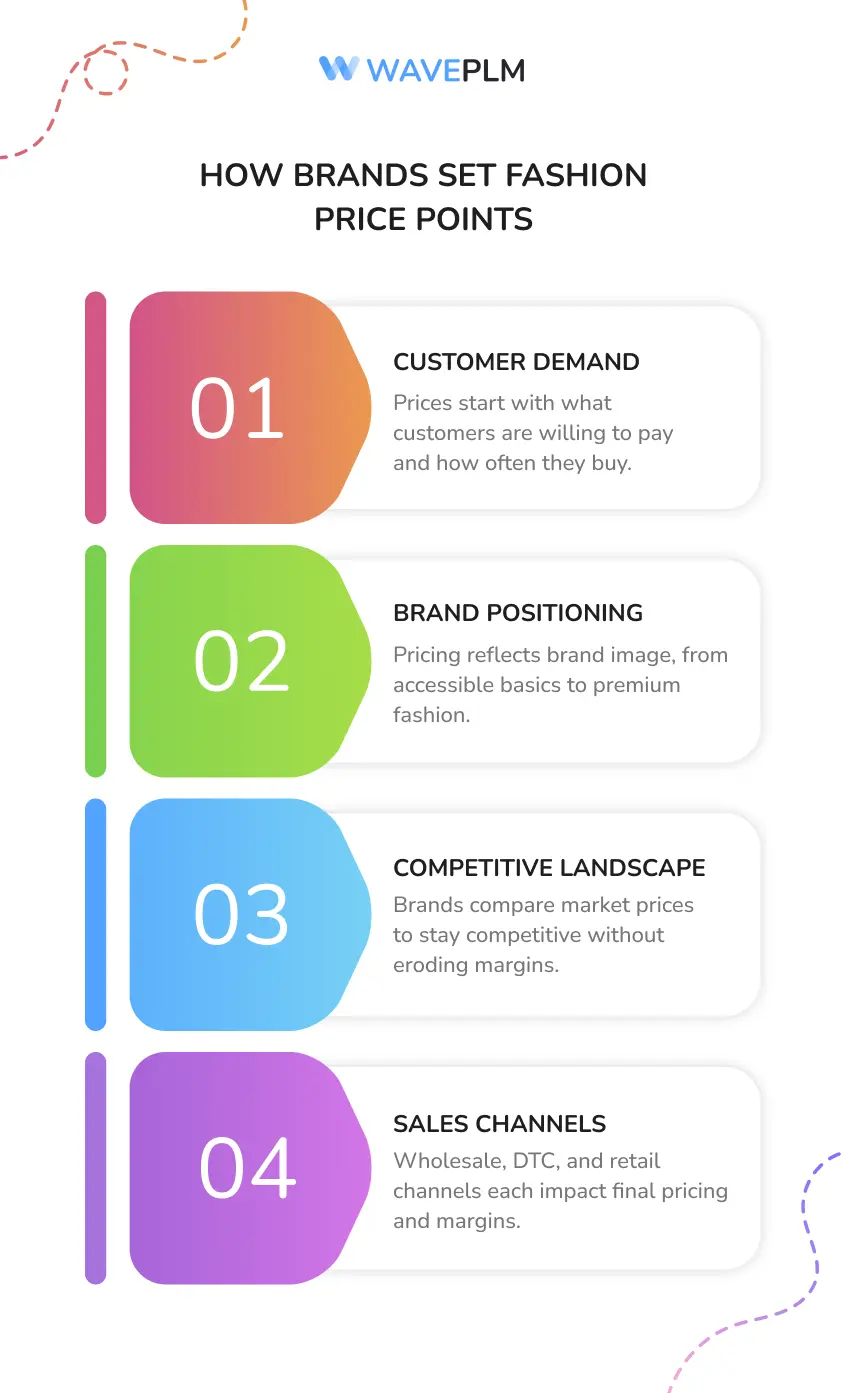
Fashion brands use structured pricing methods to set prices consistently. A strong fashion pricing strategy balances consumer demand, competitor pricing, brand positioning, and internal business goals. Successful brands define each price point before design begins.
Target customer and consumer demand
Every pricing strategy starts with customers. Brands analyze consumer demand, shopping habits, price sensitivity, and willingness to pay. Market demand defines acceptable price ranges and long-term sales potential.
Key questions include:
- How much do customers pay for similar clothing?
- How often do consumers purchase this type of product?
- What value do customers expect at this price point?
Clear answers reduce pricing risk and protect margins.
Brand positioning and perceived value
Brand positioning determines where a brand sits within the fashion industry. Price supports brand perception and signals quality, exclusivity, or accessibility. A higher price point communicates status and craftsmanship.
Fashion brands must align set prices with their brand’s image. Misalignment confuses consumers, weakens trust, and reduces long-term value.
Competitive pricing and competitor pricing
Competitive pricing requires constant review of competitor pricing across similar fashion products. Brands study different price points to identify gaps, overlaps, and opportunities.
This pricing analysis helps brands:
- Compete in highly competitive markets
- Avoid unnecessary discounts
- Respond to market demand shifts
- Maintain stable sales performance
Distribution channel impact
Distribution strongly influences price. Wholesale price structures differ from direct to consumer models and affect margins and discounts.
Common channels include:
- Wholesale partnerships with fashion retailers
- Direct to consumer ecommerce
- Department stores and specialty shops
Each channel changes the final retail price and profit margin.
Price Point vs Cost vs Margin
Confusion between cost, price, and margin creates serious pricing problems. Clear definitions protect the business and support better decision-making.
Cost and actual cost
Cost includes direct costs and indirect costs. Direct costs cover materials, labor, and manufacturing. Indirect costs include overhead costs such as logistics, development, administration, and quality control.
Typical cost components include:
- Fabrics, trims, labels, and packaging
- Labor and goods sold
- Freight, duties, and handling
Price and retail price
Price refers to the retail price consumers pay. Price reflects perceived value, brand strength, competitive pricing, and market conditions.
Price points in fashion focus on this visible number, not internal expenses.
Profit margin
Profit margin shows how much money remains after goods sold and operating expenses. Healthy margins support reinvestment in fashion design, marketing, sourcing, and future collections.
Comparison table
|
Term |
Meaning |
Purpose |
|
Cost |
Production expense |
Control spending |
|
Price |
Retail price |
Drive sales |
|
Margin |
Profit level |
Sustain business |
A disciplined pricing strategy starts with the price point and works backward to cost control.
Pricing Strategies Used in Fashion
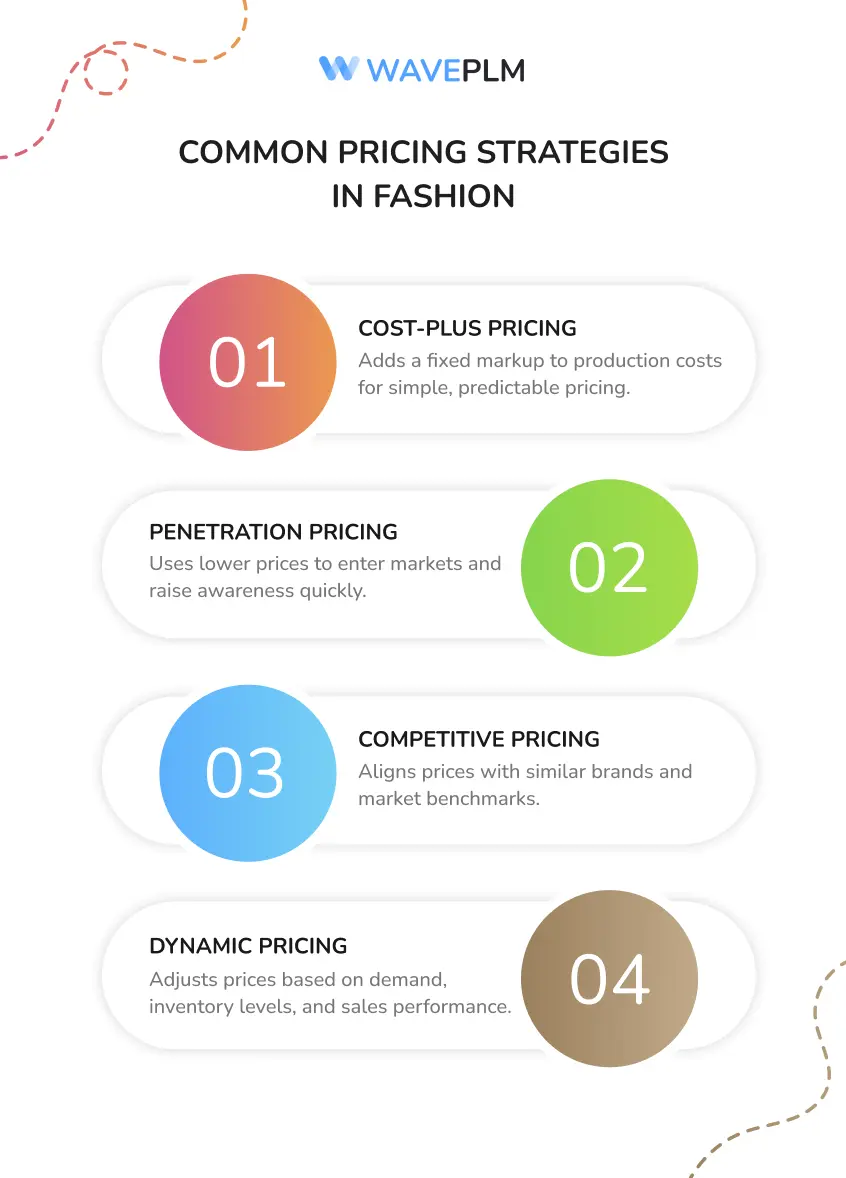
Fashion companies apply common pricing strategies depending on market position, brand maturity, and business goals.
Cost plus pricing
Cost plus pricing adds a fixed markup to actual cost. This method offers simplicity but limits flexibility when market demand changes.
Penetration pricing
Penetration pricing uses lower prices to enter new markets or attract new consumers. Brands increase prices later as awareness and demand grow.
Competitive pricing
Competitive pricing sets prices based on competitor pricing and market benchmarks. This approach suits mass market and mid-range brands.
Dynamic pricing
Dynamic pricing adjusts prices based on demand, seasonality, inventory levels, and sales performance.
How Price Points Influence Design and Production
Price points influence every stage of product development. Fashion design must respect financial boundaries to succeed.
Materials and quality
Higher price points allow better quality materials, finishes, and testing. Lower price points require efficiency and standardization.
Construction and fit
Complex construction increases cost. Designers reduce pattern pieces, simplify silhouettes, and standardize fits for lower price points.
Volume and sales planning
Higher priced items sell fewer units but deliver higher margins. Lower priced items rely on higher sales volume and faster turnover.

Why Missing a Price Point Creates Problems
Missing a defined price point causes production, sales, and planning issues.
Common problems include:
- Designs exceeding cost targets
- Repeated price changes and re-costing
- Heavy discounts that erode value
- Damage to brand perception and customer trust
Clear price points align teams, suppliers, retailers, and consumers.
How PLM Supports Price Point Accuracy
PLM systems support pricing strategy execution across the apparel industry. Wave PLM connects design, costing, sourcing, and sales planning in one workflow.
Key benefits include:
- Early cost visibility
- Accurate wholesale price planning
- BOM accuracy and traceability
- Reduced late-stage changes and delays

Price-driven workflow template
|
Stage |
Focus |
Outcome |
|
Concept |
Define price point |
Clear direction |
|
Design |
Match design to price |
Cost control |
|
Validate suppliers |
Stable sourcing |
|
|
Production |
Lock final costs |
Protected margins |
Conclusion
Price points in fashion determine how brands compete, sell, and scale across different markets. Clear apparel price point categories help fashion brands align design, sourcing, pricing methods, distribution, and sales strategy. A strong fashion pricing strategy balances market demand, brand positioning, perceived value, and profit margin.
By understanding price points, fashion companies create clothing lines that sell at the right price, reduce excessive discounts, and protect long-term brand value. Explore related resources on costing, planning, sourcing, and BOM management on blog.waveplm.com to strengthen your pricing strategy and pricing analysis.





Leave a Reply