

Managing luxury brands in a digital world takes more than taste. It takes control, speed, and a clear strategy.
Luxury brands now compete in a faster, more connected market. Customers discover new products through social media. Teams build collections across regions and time zones. Suppliers source materials globally. And digital transformation raises expectations — pushing brands to move quicker without losing precision.
But luxury brand management still comes down to one core principle: you have to protect exclusivity while you scale.
The luxury market continues to expand across sectors like fashion, jewelry, and hospitality, with services playing a growing role in how affluent consumers experience luxury. That’s because modern luxury isn’t only about the product — it’s about the experience, the consistency, and the story behind every detail.
This guide breaks down luxury management for today’s leaders. You’ll learn how strong processes help protect a premium brand image, improve execution, and support growth across the global luxury industry — without compromising what makes your brand feel truly luxury.
The Modern Challenges of Luxury Management
Luxury management now mixes creativity with business management. You must build desire and deliver flawless luxury products. You must also control complexity across design, sourcing, and retail.
Leaders in the luxury industry face these challenges faced every season:
- Shorter calendars and more product drops
- More channels and more marketing campaigns
- More suppliers, more variants, and more data
- Higher expectations for exceptional customer experience
- Higher risk from leaks, counterfeits, and inconsistent product data
To address these challenges, developing skills such as critical thinking and the ability to create and implement innovative strategies is essential for success in luxury and brand management.
Luxury and brand management used to rely on small teams and long timelines. Today, industry professionals need structure to keep quality consistent. Professionals in the luxury industry must also possess an international outlook and a deep understanding of the complex marketplace.
What changed in the luxury sector
| Then | Now |
|---|---|
| Two seasonal collections | Multiple capsules, drops, and collaborations |
| Few suppliers | Global supplier networks |
| Retail focus | Ecommerce, marketplaces, and social commerce |
| Low SKU counts | High variants and fast assortment changes |
| Manual approvals | Digital workflows and tracked decisions |
Luxury brands still need craftsmanship. Digital tools add speed and complexity. Strong brand management keeps standards consistent.

Balancing Innovation With Heritage
Heritage builds trust. Innovation builds relevance. Luxury brand management needs both.
Many brand manager teams ask the same question. How do we modernize without losing identity?
Use this framework for managing luxury brands:
- Protect brand pillars
- Innovate with rules
- Measure impact through market research
- Improve and repeat
Heritage and innovation framework
| Brand area | What to protect | What to modernize |
| Craft and quality | Materials, finishing, standards | Testing methods and supplier analytics |
| Brand image | Signature codes and silhouettes | Digital styling and content formats |
| Customer experience | Service tone and packaging | Omnichannel journeys and personalization |
| Storytelling | Icons and brand history | Digital passports and interactive content |
Luxury and brand management works best when you choose change on purpose. You never let change happen by accident.

Why Control Is the Core of Luxury Brand Management
Luxury brand management sells confidence. Control creates that confidence.
Customers pay for perfection. They expect the same fit, finish, and feel in every store. They expect the same corporate brand image in every channel.
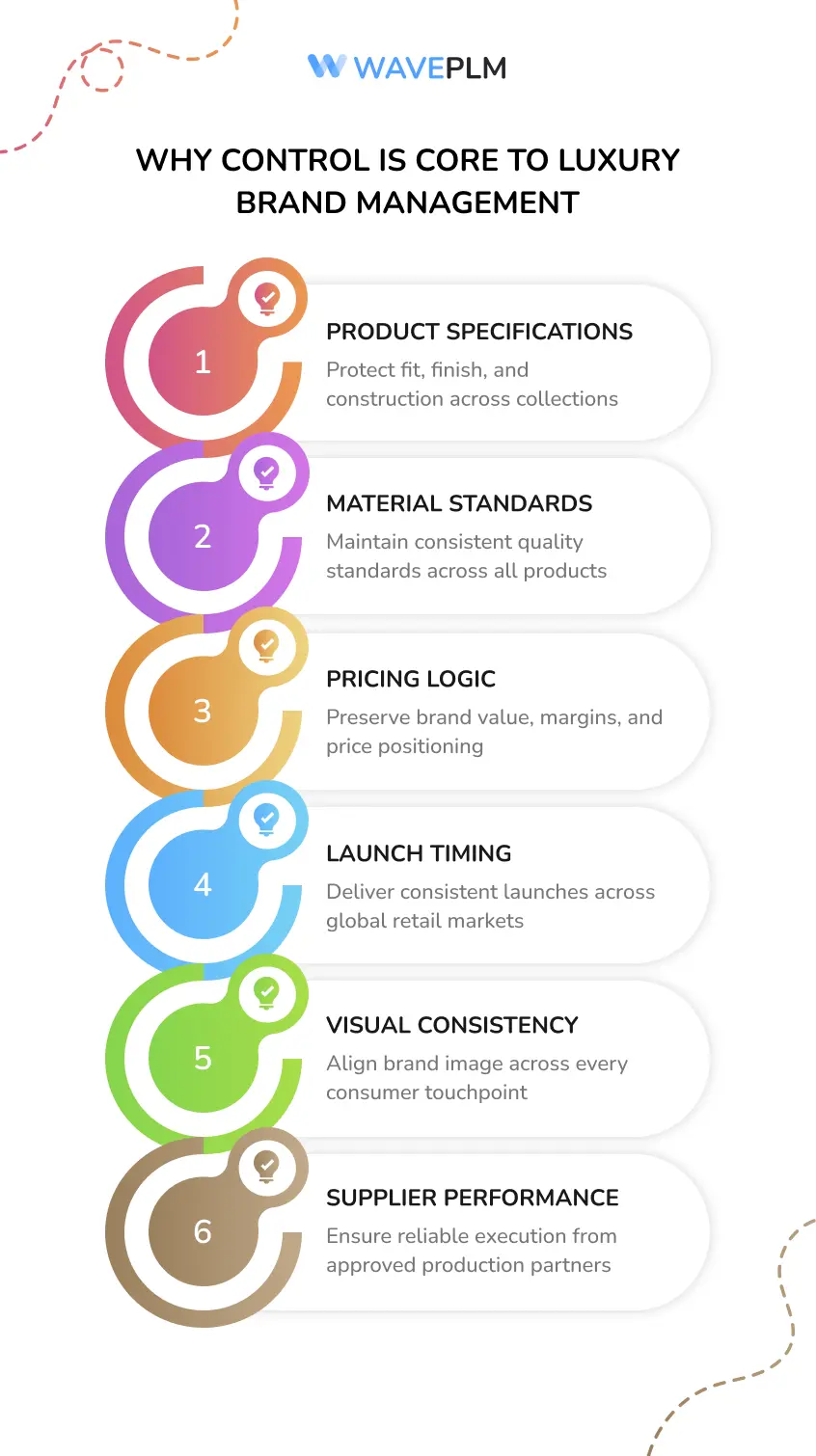
Luxury brand management breaks when teams lose control of:
- Product specifications
- Material standards
- Pricing logic
- Launch timing
- Visual consistency
- Supplier performance
Working effectively with key decision makers is essential to maintain control and to make critical decisions regarding brand repositioning and extension.
Control does not slow you down. It helps you move faster with fewer mistakes.
Executive control checklist
Use this checklist to spot weak points in brand management.
| Control area | What to check | Risk if missing |
| Product data | One source of truth | Wrong specs and returns |
| Approvals | Clear owners and steps | Delays and rework |
| Supplier onboarding | Validated partners | Quality issues |
| Costing | Accurate BOM costing | Margin erosion |
| Compliance | Traceability and audits | Legal and PR damage |
| Launch readiness | Asset and SKU accuracy | Poor customer experience |
When you manage luxury brands, you manage details. Details protect brand positioning and long-term trust.
Product Complexity in Modern Luxury (materials, suppliers, variants)
Luxury products look simple from the outside. They often hide extreme complexity.
A single handbag can include:
- Several leather types and grades
- Multiple hardware finishes
- Special linings and thread colors
- Handmade steps and strict tolerances
A single sneaker can include dozens of parts, glues, and textiles. A single watch can include hundreds of components.
This complexity changes business models. It also increases the need for strong luxury and brand management. Identifying weaker products within a collection is essential for managing this complexity, as it helps guide strategic decisions about brand repositioning and product line extensions. Luxury brand managers are also responsible for conducting market research and organizing advertising campaigns to address the challenges that come with product complexity.
Where complexity grows fastest
| Complexity driver | Example | Business impact |
| Materials | Exotic leathers and special dyes | More testing and approvals |
| Suppliers | Regional sourcing | More coordination |
| Variants | Sizes, colors, limited editions | Higher data load |
| Regulations | REACH and labeling rules | More compliance work |
| Customization | Monograms and made-to-order | More planning and tracking |
Luxury management must handle this complexity without losing craftsmanship.
Risk of Brand Dilution Without Strong Processes
Brand dilution happens when luxury brands feel inconsistent. Customers notice small changes fast.
Luxury and brand management often fails because teams rely on memory and spreadsheets. Those tools break at scale.
Here are common dilution triggers:
- Inconsistent product names and descriptions
- Mixed visuals across regions
- Uncontrolled discounts and pricing gaps
- Quality variation across factories
- Too many collaborations with weak brand strategy
Brand dilution can significantly impact companies’ reputations in the luxury sector. Luxury brand managers promote luxury products and services for wealthy clients or companies.
Luxury brand management needs guardrails. Guardrails keep teams aligned across various aspects of the business.
Signs your luxury brand needs stronger process control
| Signal | What it means | What to do next |
| High return rate | Fit or spec issues | Audit product data and tech packs |
| Frequent rework | Approval chaos | Define workflows and owners |
| Late launches | Bottlenecks | Track milestones and dependencies |
| Supplier churn | Unstable network | Improve onboarding and scorecards |
| Pricing confusion | Poor costing control | Standardize BOM costing |
Managing luxury brands means you protect the brand at every step. Strong processes support brand repositioning and consistent brand positioning.
How Data Transparency Supports Luxury Decision-Making
Luxury leaders need fast answers. Data transparency makes answers easy.
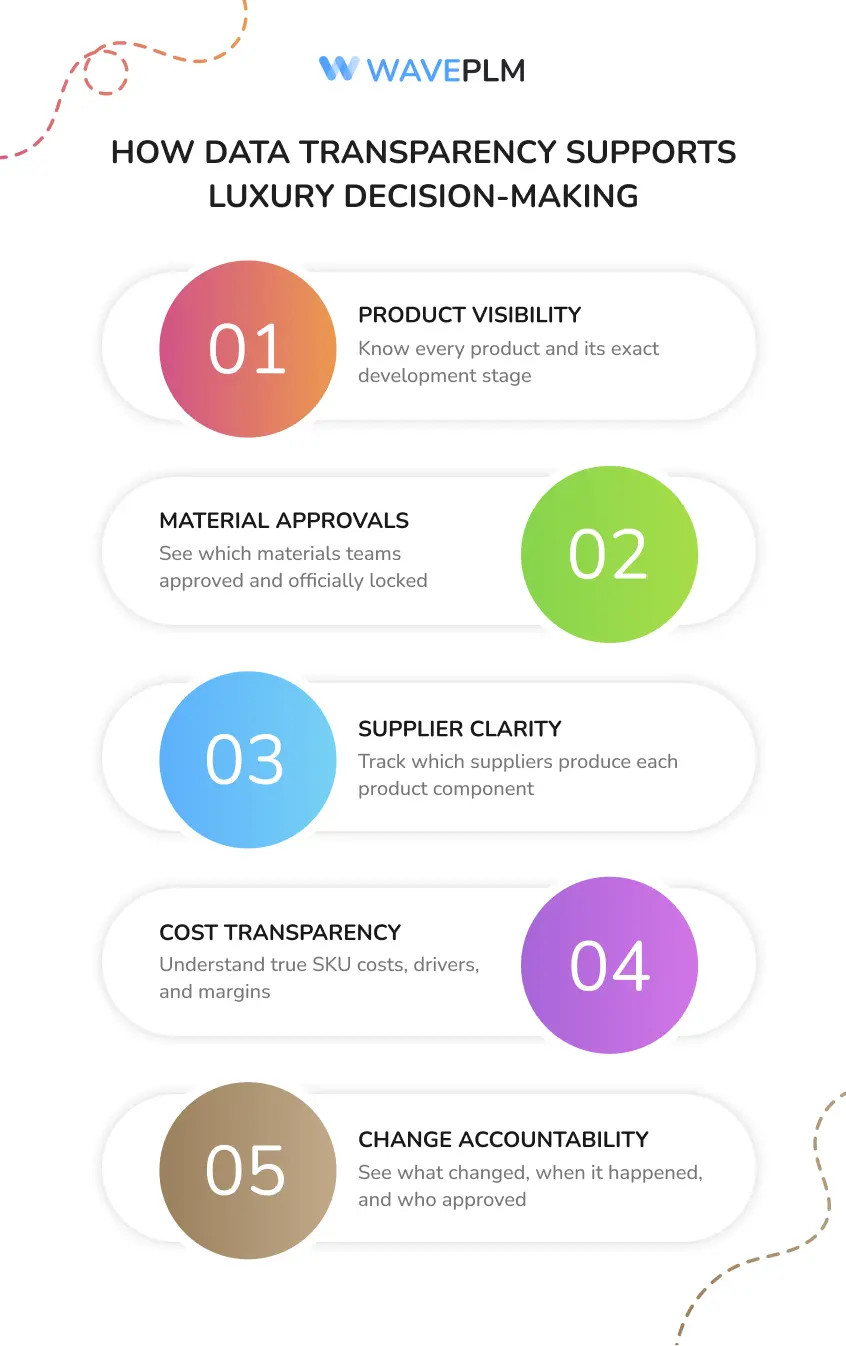
You should always know:
- What products exist and what stage they are in
- What materials teams approved
- What suppliers produce each component
- What each SKU costs and why
- What changes happened and who approved them
Data transparency supports better business decisions in luxury management.
It also improves digital marketing execution. It helps marketing teams launch faster with accurate content.
What transparency looks like in real life
| Decision | Data you need | Result |
| Approve a new color | Material lead times and dye testing | Faster, safer launches |
| Add a capsule drop | Capacity, costs, deadlines | Better planning |
| Change a supplier | Quality history and compliance status | Lower risk |
| Expand a hero product | Variant performance and margins | Smarter scaling |
Transparency also supports data collection across the product lifecycle.
How PLM Enables Scalable, Controlled Luxury Growth
PLM gives luxury brands a shared system for product development. It supports speed, quality, and governance. When you manage luxury brands, you need a clear flow from concept to launch.
A strong PLM approach helps you:
- Standardize product data and naming
- Manage BOMs and variants with accuracy
- Track materials and supplier approvals
- Control changes and version history
- Align teams across design, development, sourcing, and merchandising
- Reduce mistakes in handoffs to production and ecommerce
This structure supports luxury and brand management at scale.

Luxury growth needs both scale and control
You can scale without losing exclusivity. You just need the right operating model.
| Growth goal | What can break | What PLM helps control |
| Add more drops | Calendar chaos | Milestones and workflows |
| Expand globally | Data inconsistency | Central product library |
| Increase variants | SKU errors | Structured variant logic |
| Improve margins | Cost surprises | BOM costing visibility |
| Improve compliance | Missing proof | Traceability and documentation |
PLM also supports brand managers who need fast alignment across teams.
Executive template: luxury PLM rollout plan
Use this rollout plan to guide professional development across teams.
| Phase | Timeframe | Outcome |
| Align | 2–4 weeks | Shared goals and product data standards |
| Build | 4–8 weeks | Core workflows, roles, and approvals |
| Migrate | 4–12 weeks | Clean product library and BOM history |
| Launch | 2–6 weeks | Teams work in one system |
| Optimize | Ongoing | Better speed, quality, and reporting |
This plan supports professional growth for every luxury brand manager.
Mini playbook: managing luxury brands with clear governance
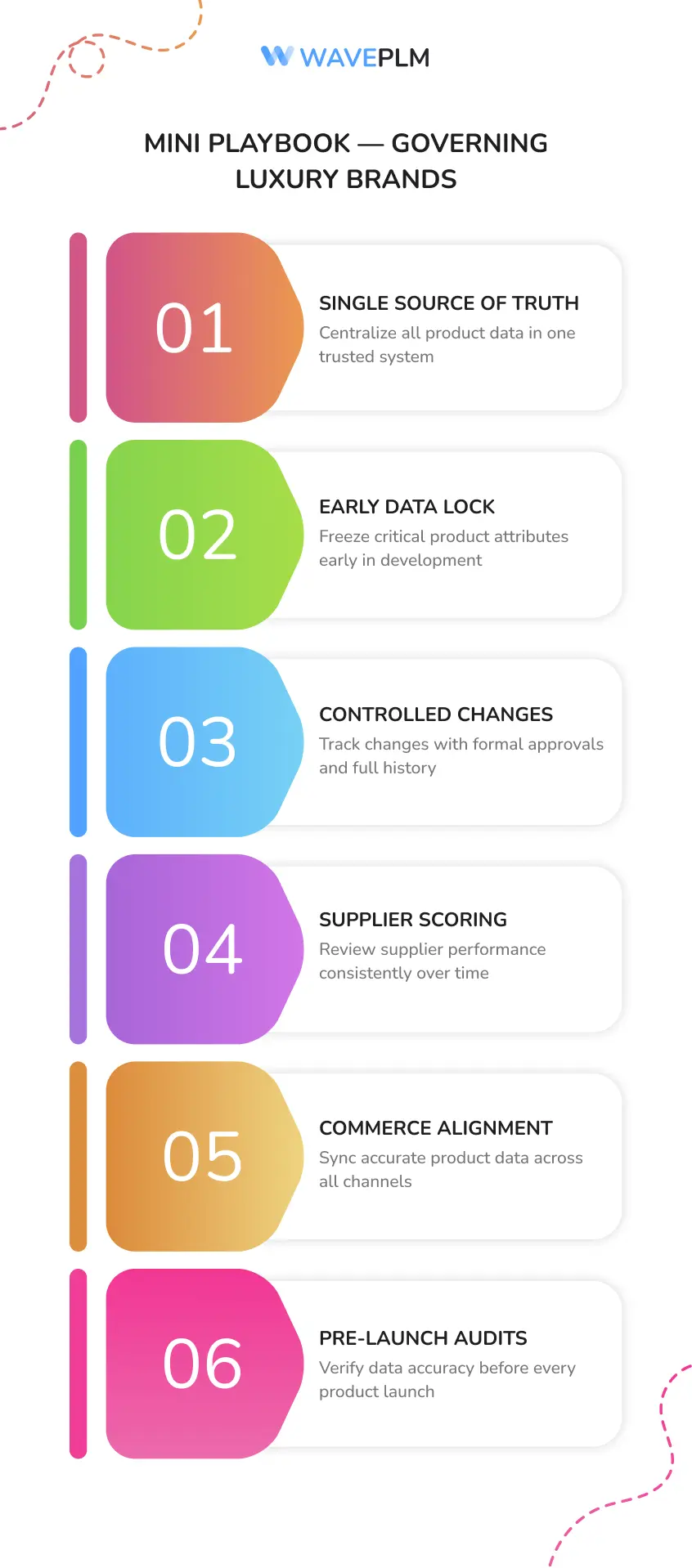
Follow these rules for modern luxury brand management:
- Use one source of truth for product data
- Lock critical attributes early
- Control changes with approvals and history
- Score suppliers and review performance
- Connect product data to commerce and content
- Audit every launch before it goes live
These steps help brand managers protect the brand image and reduce risk.
Luxury Brand Management Careers and Leadership Questions
Luxury brand management is mostly offered as a master’s degree and, in some cases, as a specialization course. SCAD offers the world’s first M.A. and M.F.A. degrees in luxury and brand management. The minor in luxury brand management & marketing provides students with skills and expertise in managing and marketing luxury brands.
Many leaders also ask about the people behind luxury brand management. They want to build teams that can compete in the luxury market.
Students in luxury brand management programs study the business models and unique marketing strategies integral to the successful management of luxury brands. The Luxury Brand Marketing & Management major requires completion of the business foundation and specific courses. Students learn to analyze brand positioning, develop marketing strategies, and understand customer relationships to succeed in the luxury industry. They also learn how to create memorable and exclusive experiences for luxury consumers, which is a key focus in luxury brand management education. Additionally, students learn to balance corporate brand image while enabling the creation of a network through media platforms.
The Luxury Brand Management specialization prepares students for strategic roles in managing luxury brands.
The learning experience in luxury brand management programs is a crucial factor contributing to their high ranking and reputation, supporting professional growth in the industry.
What does luxury brand management do?
Luxury brand management builds and protects brand value. It connects product development, marketing, retail execution, and the delivery of luxury services into one cohesive brand experience. Also, it shapes brand strategy, positioning, and customer perception — while keeping the corporate brand image consistent across every channel.
This work is often led by a brand manager. In luxury, that role typically spans multiple teams and timelines: coordinating product launches, aligning suppliers, and supporting marketing campaigns. Luxury brand managers also help grow brand awareness and ensure each offer reflects the standards and expectations of high-end clients.
What is the highest salary in luxury brand management?
Salary depends on region, company size, and role scope. Senior roles can reach high levels in the global luxury industry. A global brand manager can earn more than local roles. Executive leadership can earn even more.
Is luxury brand management a good career?
Yes, it offers strong career opportunities. It blends creativity with business management. It also supports long-term professional growth. Luxury and brand management programs help students develop essential skills such as interpersonal, strategic, and managerial abilities, which are highly valued in the industry. Career opportunities in luxury brand management include roles such as product managers and marketing managers.
Many students explore this field through a luxury management program. Some choose a master’s degree to gain in depth knowledge.
What are the 3 C’s of brand management?
Many industry professionals use a simple model:
- Customer: know your target audience and consumer behavior
- Company: define your strengths and business strategies
- Competition: track rivals in the luxury sector
Market research supports these decisions. It also improves brand repositioning when markets shift.
Conclusion
Managing luxury brands in a digital world takes discipline. Today, luxury brand management requires speed, traceability, and global coordination — without compromising what makes a brand feel exclusive.
As always, the challenge is balance: protecting heritage while still making room for innovation. Strong brand management keeps quality consistent, strengthens brand image, and ensures every product launch reflects the standards customers expect across the luxury market.
If you want scalable control without losing exclusivity, Wave PLM can help.
Wave PLM supports luxury teams with centralized product data, smoother supplier collaboration, and faster go-to-market. It gives brand managers the visibility and control they need to move confidently in a modern, global market.
Ready to expand into new regions, tighten your processes, and launch with greater accuracy? Explore Wave PLM today.





Leave a Reply