
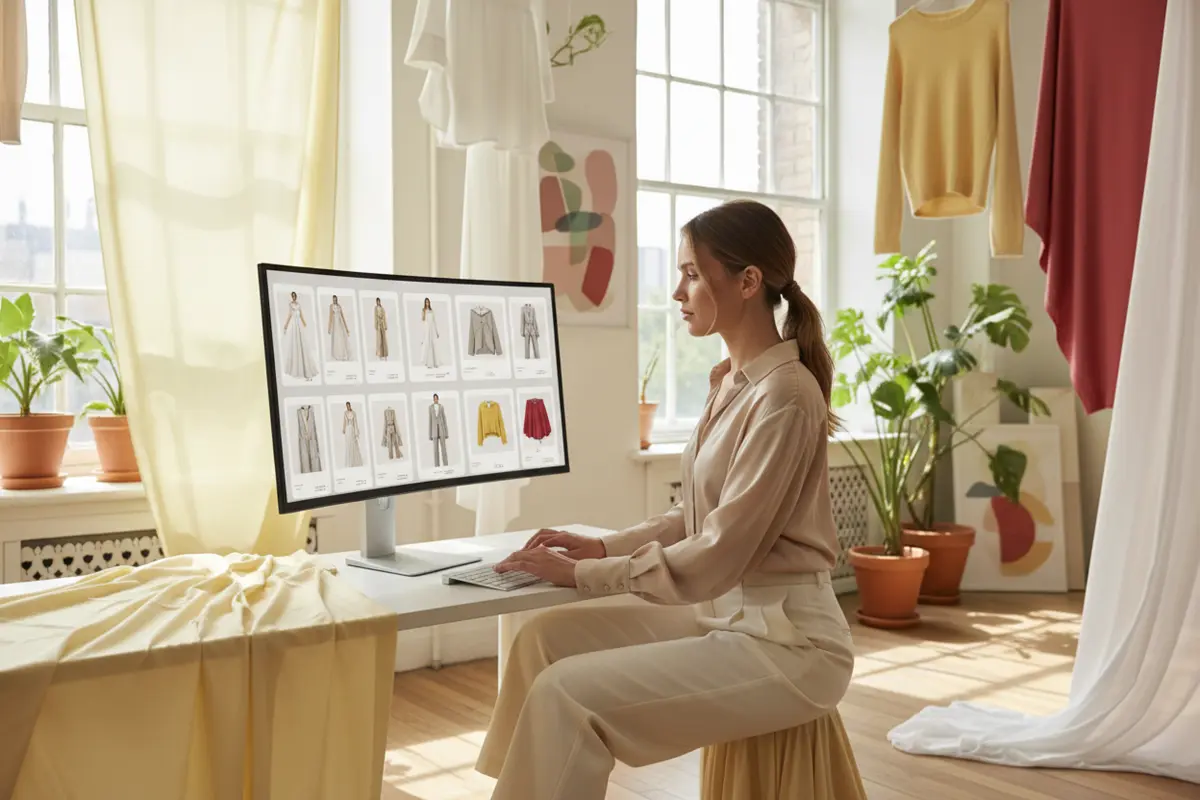
Fashion changes every day. Customers scroll fast, compare quickly, and buy in seconds. That is why fashion brands need a strong plan for fashion digital marketing.
This guide breaks down digital marketing for fashion in a clear, beginner-friendly way. You will learn what it is, why it works differently in the fashion industry, and which digital marketing channels drive growth. You will also learn how clean product data supports better marketing campaigns.
Quick answers (featured snippet style)
- What is digital fashion marketing? It is how fashion brands use digital marketing to build awareness, gain followers, and drive sales online.
- What are the 4 types of digital marketing? Content marketing, social media, email marketing, and digital advertising.
- How to get into fashion digital marketing? Learn core marketing skills, build hands on experience, and practice performance marketing.
- Does fashion marketing pay well? It can pay well, especially with digital skills, data analysis, and performance marketing experience.
What Is Fashion Digital Marketing?
Fashion digital marketing means using digital marketing to promote products and build brand image online. Digital strategies are at the core of fashion digital marketing, encompassing tactics and tools tailored for fashion brands. It includes social media, influencer marketing, paid media, email, SEO strategy, and marketplaces.
Fashion digital marketing has two main goals:
- Create desire through brand messaging, visuals, and storytelling
- Convert interest into purchases across the customer journey
Digital marketing for fashion needs creativity and structure. Fashion marketers must mix engaging content with data analysis and track performance. Analytical skills are essential for tracking campaign success and understanding consumer behavior. A deep understanding of market dynamics and customer needs is also necessary to tailor digital strategies effectively.
Simple definition
Fashion digital marketing = the set of digital marketing strategies fashion brands use to grow online through various digital marketing channels.

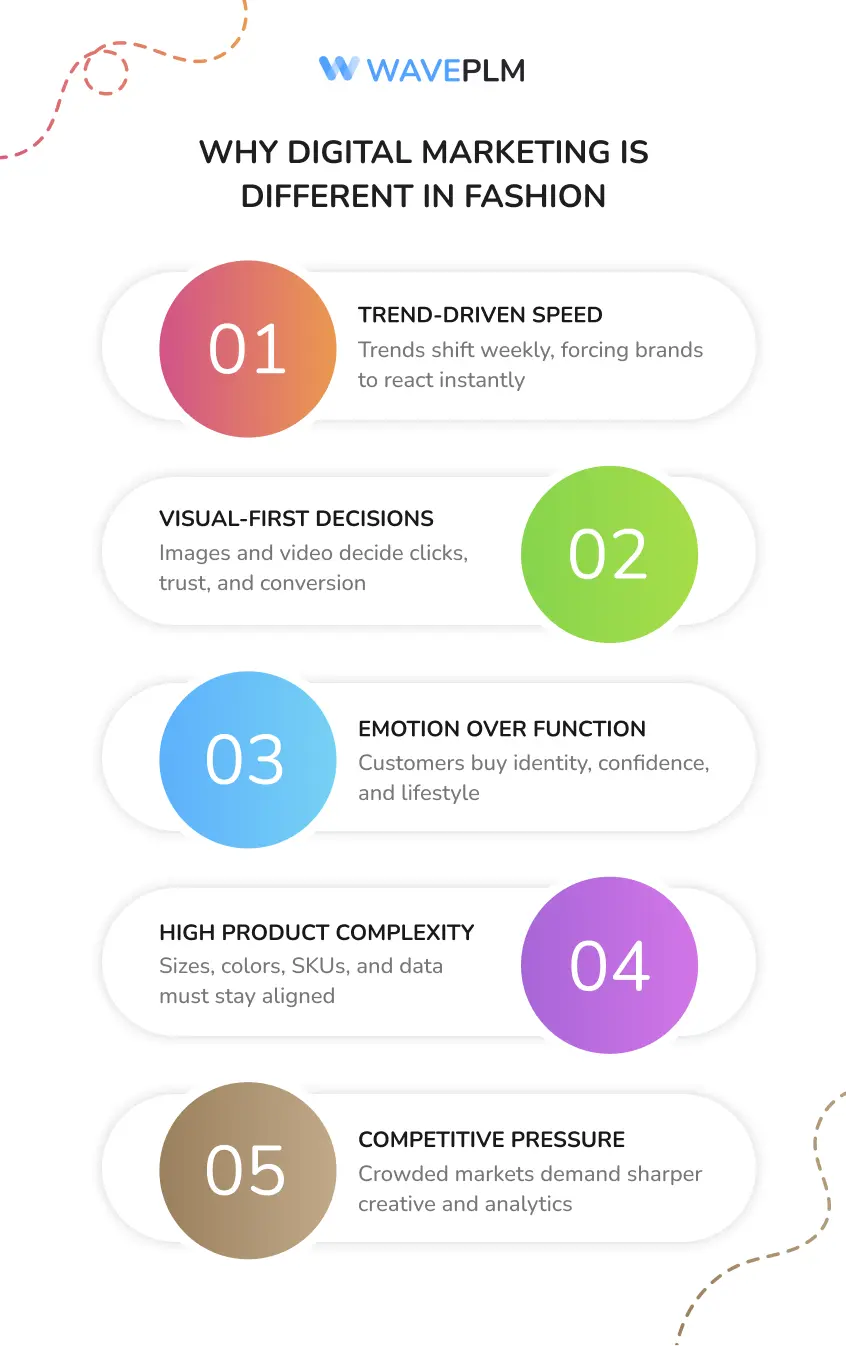
Why Digital Marketing Is Different in the Fashion Industry
The fashion industry sells more than clothing. It sells confidence, identity, and lifestyle. That changes how marketing works. A mobile-first approach is necessary as most users browse via smartphones.
Different business models in fashion—such as direct-to-consumer (DTC), wholesale, or omnichannel—require tailored digital marketing strategies to effectively reach customers and drive growth. Omni-channel retailers that combine brick-and-mortar stores and online shopping are becoming the go-to for fashion, improving the shopping experience.
Here is why digital marketing for fashion feels different from other industries:
- The importance of reaching the right audience through targeted digital campaigns is critical, as fashion brands must connect with specific customer segments to maximize engagement and conversions.
1) Fashion moves with trends
Fashion trends can change in a week. That shift changes what people search, save, and buy. Fashion marketers must react fast with flexible marketing strategies.
A trend can start from TikTok, a fashion show, or a celebrity look. It can also rise from street style or a seasonal moment. When the trend grows, search engines pick it up. Social media pushes it harder. Then fashion brands need content, ads, and product pages ready.
This is why fashion marketing teams plan two timelines:
- Always-on content for steady growth
- Fast trend content for quick wins
If your fashion business reacts late, you lose attention. Your competitors take the reach, clicks, and sales.
2) Visuals matter more than words
Fashion marketing is visual-first. A shopper decides in seconds. One photo can boost customer acquisition or stop it completely.
In the fashion industry, visuals shape the first impression. They also shape brand image. That is why top fashion brands invest in strong photography, video, and design systems.
Great visuals help digital marketing performance because they:
- Increase scroll-stopping power on social media
- Improve click-through rates in digital advertising
- Reduce doubts about fit, fabric, and quality
- Support better conversion on product pages
Fashion marketers should build a simple visual system:
- Studio shots for clarity
- Lifestyle shots for emotion
- Short video for movement and fit
This approach improves brand messaging across digital marketing channels.
3) Customers buy emotionally
Most shoppers do not buy fashion only for function. They buy for confidence, identity, and belonging. That makes fashion marketing different from other industries.
A customer might not need another jacket. But they want the feeling it creates. Digital marketing must speak to that feeling with storytelling, styling, and community.
Emotional buying affects marketing campaigns in real ways:
- People save outfits because they want the lifestyle
- People share looks because they want validation
- People buy faster when the brand feels “right”
Fashion marketers can use simple storytelling to connect:
- Show real people wearing the product
- Explain the inspiration behind the design
- Highlight values like comfort, craftsmanship, or sustainability. Sustainability is a mandatory requirement for fashion brands in 2026.
When you match emotion with proof, you drive revenue.
Static imagery is insufficient in 2026; shoppers expect to interact with products before purchasing. AI is becoming an active shopping assistant in the fashion industry. Hyper-personalization uses AI to deliver context-aware offers based on browsing history and emotional states. For example, Generative Engine Optimization (GEO) involves optimizing product data for AI search engines to match consumer needs.
4) Product variety creates complexity
Fashion brands sell more variants than most businesses. One product can include many sizes, colors, and materials. That creates complexity in digital marketing strategies.
This complexity affects:
- Catalog ads and paid media feeds
- Marketplaces and product listings
- Website filters and search
- SEO strategy for product pages. Search engine optimization (SEO) is crucial for any fashion retailer or designer who wants to direct traffic to their content. Optimizing websites for SEO and using targeted ads ensure high visibility to potential customers.
If product data changes often, your team needs strong fashion management processes. You also need clear ownership across departments.
Common problems include:
- Wrong color names across platforms
- Missing size charts
- Confusing SKU structures
- Inconsistent product titles
Data analysis helps here. You can find where customers drop off and where returns rise. Some fashion companies also use data science and data scientists to automate product tagging.
Accurate product data keeps digital marketing smooth and scalable.
5) Competition stays intense
The fashion world stays crowded. New brands launch daily. Top fashion brands fight for attention with bigger marketing budget decisions.
This competitive field forces fashion marketers to improve skills fast. You need analytical skills and creative thinking at the same time.
Competition increases pressure in these areas:
- Paid media costs rise because everyone bids on the same audiences
- Social reach drops when platforms change algorithms
- Search engines reward strong technical SEO and useful content
- Brand loyalty becomes harder because shoppers compare quickly
To win, fashion brands should focus on:
- Clear market positioning
- Consistent brand messaging
- Strong performance marketing tests
- Better omni channel strategies across online and brick and mortar stores
When you build comprehensive strategies, you become a digital leader in your category. You also create a lasting impact with customers. For example, pay-per-click (PPC) campaigns help fashion brands land in front of potential customers and lure them to their content via a tempting link.
Core Channels in Fashion Digital Marketing
A strong fashion marketing strategy uses a mix of digital marketing channels. Each channel supports a different stage of the customer journey. Digital agencies and marketing agencies often help fashion brands execute and optimize these digital marketing channels, bringing specialized expertise and industry knowledge to maximize results.
Digital platforms play a critical role in fashion marketing, with brands experimenting with emerging technologies like AR try-ons and virtual fashion shows.
Social media (Instagram, TikTok, Pinterest)
Social media drives discovery. It helps fashion brands connect with a target audience and build community. Social media and fashion work very effectively together, thanks to the immediacy of the channels and the prominence of the images.
Fashion shows are now often broadcast or amplified through social media, creating immersive brand experiences and elevating brand visibility across both traditional and digital platforms. There is also a growing use of live streaming on platforms like TikTok, where hosts can showcase collections and offer real-time discounts to engage audiences.
Instagram supports fashion marketing with:
- Reels for reach
- Stories for daily customer interactions
- Product tags for conversion
TikTok supports fashion marketing with:
- Trend-led videos
- Creator content creation
- Fast storytelling
Pinterest supports fashion marketing with:
- Evergreen search traffic from search engines
- Outfit inspiration
- Strong market positioning
Social content ideas that perform
| Content type | Why it works | Example |
|---|---|---|
| Styling videos | Shows real use | “3 ways to style a blazer” |
| Try-on content | Builds trust | “Size M on 170 cm model” |
| Behind-the-scenes | Adds storytelling | “From sketch to sample” |
| UGC reposts | Social proof | Customer mirror selfies |
| Drop countdowns | Creates urgency | “48 hours until launch” |

Influencer marketing
The fashion industry is heavily influenced by celebrities, influencers, and trendsetters. Brands treat social media as a primary storefront, runway, and customer service desk. In 2026, TikTok often sparks initial demand for fashion, Instagram converts it, and YouTube validates the brand’s quality. Collaborating with influencers is a top driver for brand awareness and sales.
Influencer marketing helps fashion brands reach specific audiences. It builds trust faster than many marketing campaigns. Collaborating with industry professionals as influencers or mentors can enhance campaign credibility and provide real-world insights. Networking with influencers and industry professionals can also open up job opportunities in fashion marketing.
A smart influencer marketing plan includes:
- Clear brand messaging
- A realistic marketing budget
- Tracking with codes and links
Influencer tiers and best use cases
| Influencer type | Typical follower range | Best for |
| Nano | 1K–10K | Niche fashion clients |
| Micro | 10K–100K | High engagement |
| Mid-tier | 100K–500K | Launch reach |
| Macro | 500K+ | Big awareness |
Paid ads and performance marketing
Paid media gives you speed. Performance marketing gives you control through testing and data analysis. These strategies are highly effective for reaching the right audience through targeted campaigns, ensuring your ads are seen by the customer segments most likely to engage and convert.
Fashion brands are increasingly shifting their advertising budgets from print to digital channels, particularly social media. Influencers with large followings can lead to oversaturation of attention on fashion items, potentially diminishing consumer interest.
Fashion brands often use:
- Meta ads
- Google Ads
- TikTok ads
- Retargeting
A simple paid funnel
| Funnel stage | Goal | Example |
| Awareness | Reach new shoppers | Video ads |
| Consideration | Build interest | Carousel ads |
| Conversion | Drive revenue | Retargeting |
| Loyalty | Repeat orders | VIP drops |
Email & CRM (customer relationship management)
Email supports retention. Customer relationship management improves long-term value. Direct email marketing remains a dominant revenue driver due to the ownership of first-party data.
Data-driven approaches like personalized email marketing, mobile-optimized websites, and SEO are critical for driving conversions and sales in the fashion industry. Personalized email marketing utilizes segmented campaigns for product recommendations and exclusive offers.
Use:
- Welcome series
- Abandoned cart
- Back-in-stock
- Post-purchase flows
Email flow template
| Flow | Timing | Message idea |
| Welcome 1 | Instant | Brand story |
| Welcome 2 | Day 2 | Best sellers |
| Welcome 3 | Day 4 | First-order offer |
| Cart 1 | 1 hour | Reminder |
| Cart 2 | 20 hours | Social proof |
| Cart 3 | 48 hours | Scarcity |
Marketplaces
Marketplaces bring high-intent shoppers. They help fashion business growth when you manage listings well. Examples include Zalando and Farfetch. Many fashion and luxury industries use marketplaces to scale.

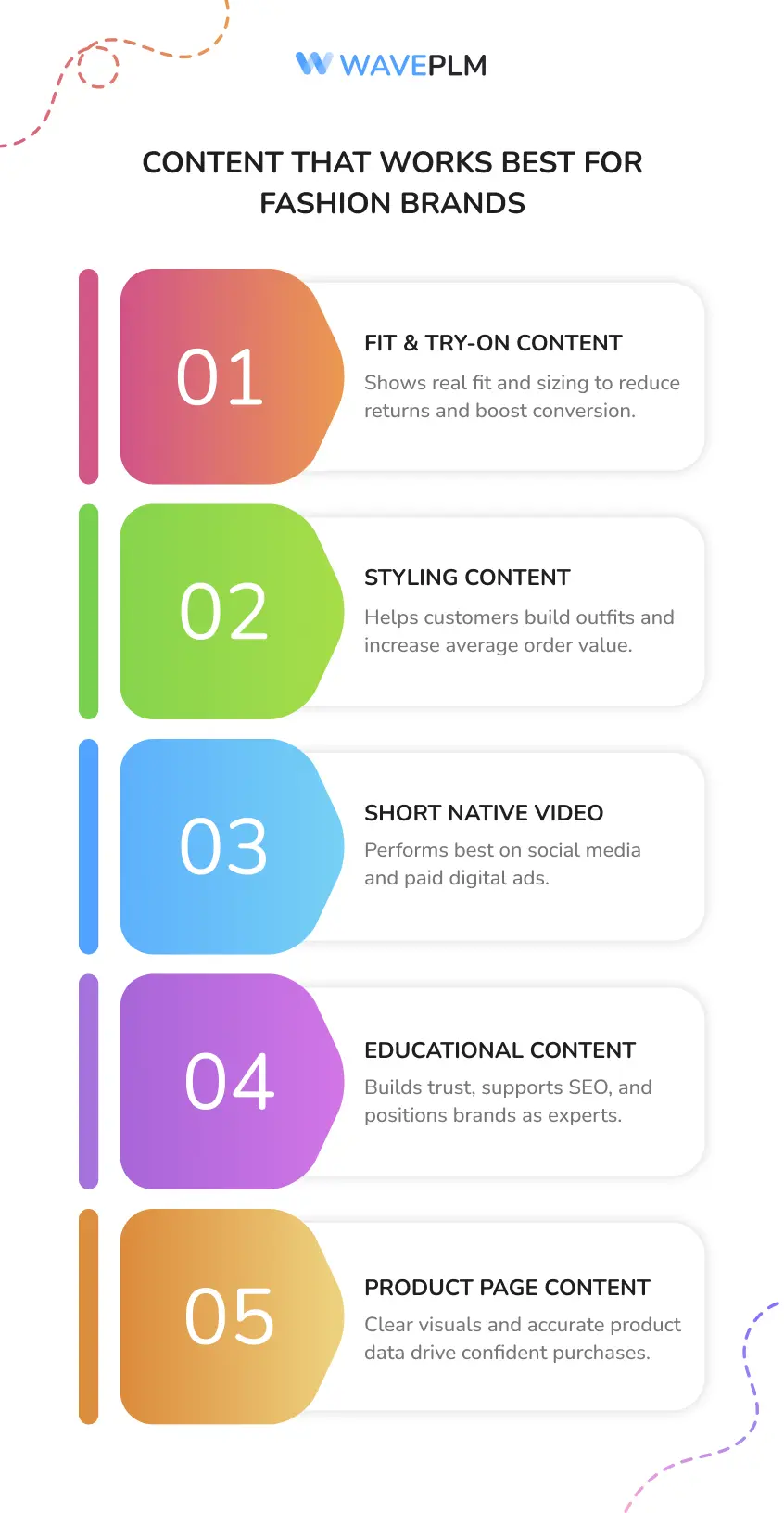
Content That Works Best for Fashion Brands
Content fuels fashion marketing. It also supports SEO strategy and customer acquisition. Fashion marketers analyze purchasing patterns and track engagement metrics to ensure campaigns resonate with the right audiences and drive sales.
1) Fit and try-on content
Fit content reduces returns. It also improves conversion.
2) Styling content
Styling content helps customers build outfits. It also increases average order value.
3) Short native video
Short video wins on social media. It also works well in digital advertising.
4) Educational content
Educational content supports content marketing and builds authority.
Examples:
- Denim fit guides
- Fabric explainers
- Capsule wardrobe tips
5) Product page content
Product pages need strong visuals and clear data. This includes materials, sizes, and care.
How Branding, Visuals & Storytelling Drive Results
Fashion marketing relies on emotion. Branding shapes perception. Visuals create trust. Storytelling creates loyalty. Historically, brands utilise the “70/20/10 rule” where 70% of social media posts focus on building brand value rather than direct selling.
The best marketers in fashion combine creativity, analytical skills, and innovation to build strong brands in a highly competitive industry.
Branding builds consistency
Branding includes tone, colors, and values. It keeps your fashion marketing role clear across every channel.
Visuals boost conversion
Strong visuals improve clicks, saves, and sales. They also strengthen brand image. Also, you need to pay attension on technologies. For example, augmented Reality filters for virtual fittings reduce return rates and increase buyer confidence. Blending online and offline experiences creates a seamless customer journey in digital marketing.
Storytelling creates meaning
A simple structure works:
- Problem
- Insight
- Solution
This approach helps fashion marketers build lasting impact. Using tools to analyze visitor behaviour and engagement metrics is important for refining campaigns.

Common Mistakes in Fashion Digital Marketing
Many fashion companies waste time and money because they repeat these mistakes.
1) No plan
Random posting leads to random results. Build a calendar.
2) Weak segmentation
Different audiences need different messages. Use customer insights and consumer insights.
3) Ignoring SEO
Search engines can drive long-term traffic. Use SEO strategy and technical SEO.
4) Only chasing new customers
Retention matters. Email and customer relationship management support growth.
5) Poor data quality
Bad product data breaks campaigns. It hurts ads and marketplaces.
Why Product Data Accuracy Matters for Digital Campaigns
Fashion digital marketing depends on accurate product data. Big data helps retailers determine what their customers want and can improve operating margins significantly. It affects catalogs, ads, and SEO.
When product data stays clean, you can:
- Improve customer acquisition
- Reduce returns
- Increase conversion
Common product data issues
| Issue | Impact | Result |
| Wrong size info | Returns | Lower trust |
| Missing materials | Lower conversion | More questions |
| Bad images | Poor ads | Lower clicks |
| Duplicate SKUs | Catalog errors | Lost sales |
Data science and data scientists can help large brands improve accuracy through automation.
How PLM Supports Digital Marketing With Clean Product Data
PLM supports fashion management by centralizing product information. Supply chain transparency involves sharing real-time updates about material origins with consumers. And this helps marketing teams move faster.
PLM supports digital marketing strategies by:
- Standardizing attributes
- Keeping SKUs correct
- Organizing digital content

Fashion Digital Marketing Checklist (Copy + Use)
Use this checklist to improve your marketing strategies.
Weekly
- Post on social media 3–5 times
- Test paid media creatives
- Review data analysis and track performance
- Collect UGC
Monthly
- Improve SEO strategy
- Refresh digital advertising creatives
- Review performance marketing results
Simple Fashion Marketing Strategy Template
Use this fashion marketing strategy template to build comprehensive strategies.
Step 1: Define your audience
Write your target audience in one sentence.
Step 2: Pick hero products
Choose items that represent your brand image.
Step 3: Choose channels
Use various digital marketing channels and digital marketing tools.
Step 4: Plan omni channel strategies
Connect your website, marketplaces, and brick and mortar stores.
Step 5: Measure results
Use market research, customer insights, and first party data.
Conclusion
Fashion digital marketing helps fashion brands grow online in a competitive field. It combines digital marketing, content marketing, and performance marketing.
In 2026, digital marketing in the fashion industry has evolved into a “digital-first” ecosystem where AI, immersive technology, and radical authenticity are primary growth drivers.
Start with social media, influencer marketing, and paid media. Improve SEO strategy and email. Keep product data accurate. Use PLM to support growth.
Suggested internal links for WavePLM
- Branding for fashion brands
- Visual merchandising for e-commerce
- Fashion tech for modern fashion companies



Leave a Reply