

A well-crafted fashion stylist portfolio can be the difference between landing your dream gig and getting lost in a sea of competitors. In 2026, clients and agencies make snap judgments in under 30 seconds, and your portfolio needs to do the heavy lifting. A strong portfolio is what turns your application from ‘another resume’ into something memorable.
Whether you’re an emerging talent or an established name, this guide walks you through everything from choosing your niche to optimizing for search engines. You’ll learn how to create work that resonates, organize it efficiently, and turn your portfolio into a client acquisition machine.
Key Takeaways
- A fashion stylist portfolio is now expected for jobs across New York, London, Paris, Los Angeles, and emerging markets like Toronto, Dubai, and Seoul. It should live online, be mobile-first (over 60% of industry professionals browse on smartphones), and updated at least quarterly to stay relevant with seasonal trends.
- Your portfolio must show concrete work including editorials, e-commerce shoots, celebrity styling, personal styling, and brand campaigns. Self-initiated shoots are acceptable and even valued when you’re starting out—80% of agencies accept them if the production quality is professional.
- Using modern tools like Wave PLM helps keep looks, product data, call sheets, and credits organized, making portfolio maintenance faster and more scalable. This reduces crediting errors by up to 90% compared to manual spreadsheet tracking.
- SEO (including geo-targeted keywords like “fashion stylist portfolio New York”) and AEO (answering common questions directly on your site) can boost local search rankings by 40-50%, turning your portfolio into a client acquisition channel rather than just a gallery.
What Is a Fashion Stylist Portfolio (and Why It Matters in 2026)
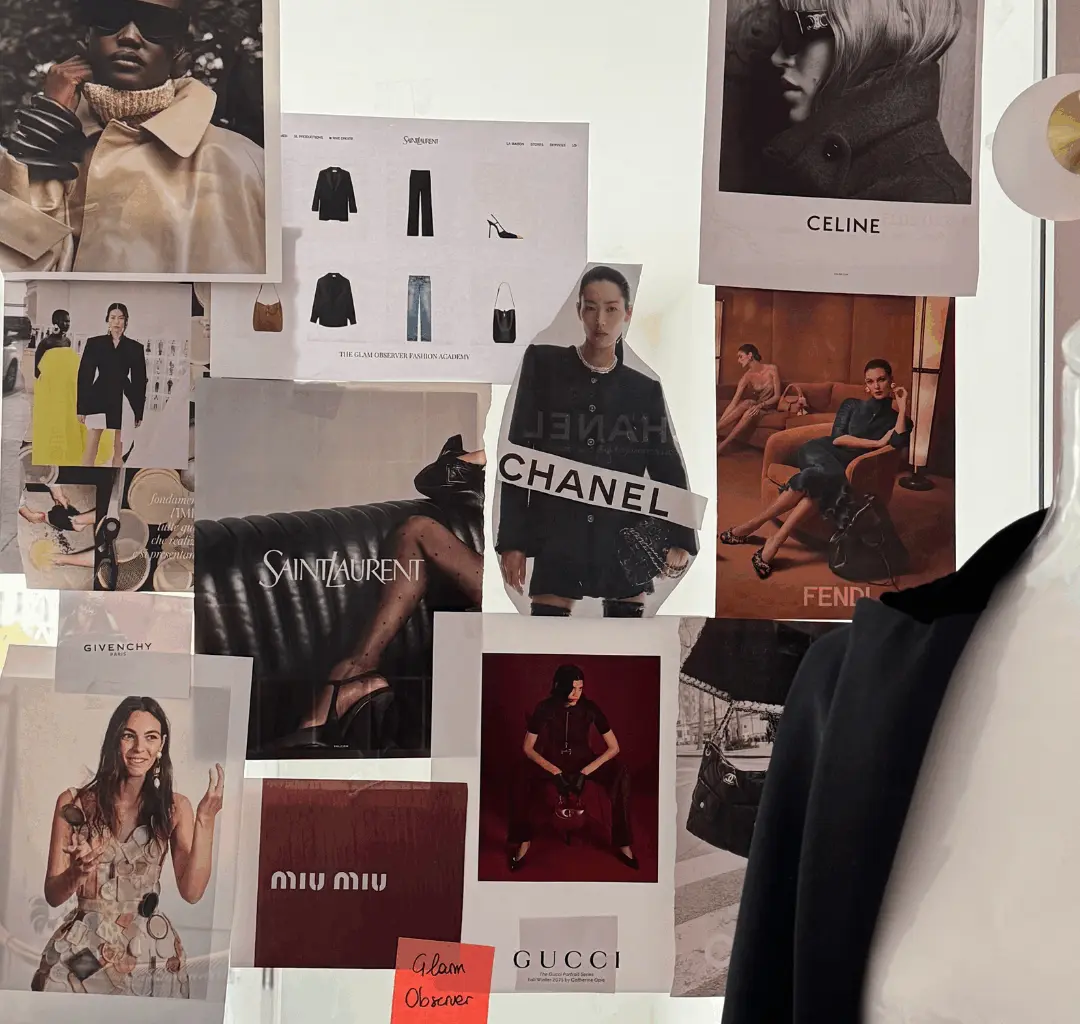
A fashion stylist portfolio is a curated visual record of your styling work — editorials, campaigns, personal styling, e-commerce shoots — combined with credits, contact information, and a clear sense of your aesthetic vision. Unlike a fashion design portfolio that emphasizes sketches, patterns, and range plans, a stylist’s portfolio focuses on final styled images that demonstrate your ability to assemble cohesive looks.
Successful portfolios include both personal projects and collaborations to demonstrate versatility and adaptability across different stylistic niches. Portfolios should only include work from the last 3 years to stay culturally relevant.
How Expectations Have Evolved
The landscape shifted dramatically between 2018 and 2020. Before that, portfolios were predominantly physical books or static PDFs presented in agency meetings. Today, clients expect a fast-loading, responsive online site that displays beautifully on smartphones.
High-resolution photography is non-negotiable for effective portfolios. And many successful fashion stylist portfolios feature mobile-friendly designs that ensure easy navigation on mobile devices.
According to 2025 industry analysis, over 60% of fashion industry professionals now access portfolios via mobile first. This means your portfolio needs to load in under 3 seconds and work flawlessly across devices.
Who Gets Judged and How Quickly
Both emerging stylists in smaller cities and established names in global hubs face the same reality: quick judgment. Whether you’re based in Manchester or Milan, clients typically decide within 30 seconds whether to explore further or move on.
This applies across diverse goals:
- Landing agency representation with groups like The Wall Group or Streeters
- Pitching to magazines for editorial opportunities
- Booking commercial work for brands and retailers
- Attracting direct personal styling clients
Types of Fashion Stylist Portfolios You Can Build
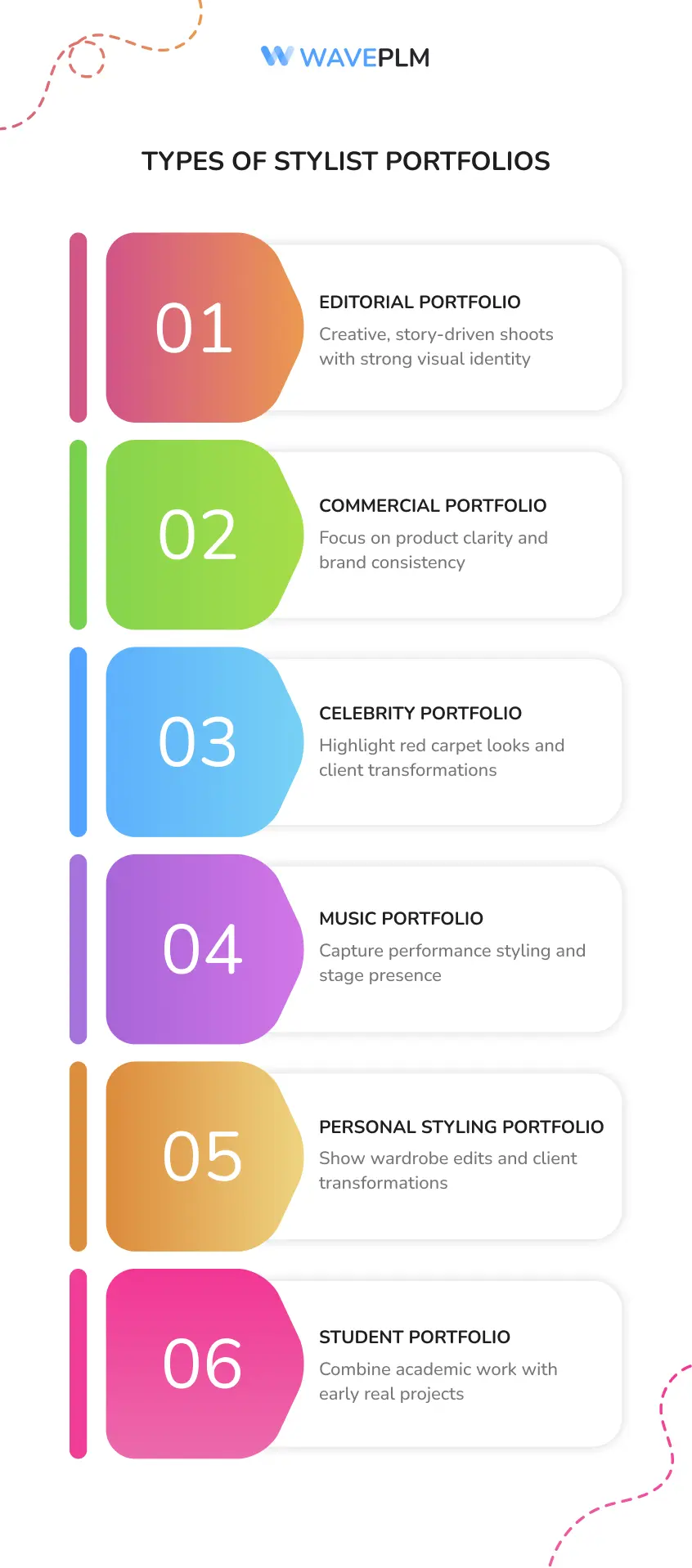
Most stylists mix several portfolio types, but maintaining clear positioning helps clients immediately understand your specialty. Random work dilutes impact, while focused expertise signals professionalism and depth.
Editorial Portfolios
Editorial portfolios prioritize moody, narrative-driven spreads akin to what you’d see in Vogue Italia or i-D. The emphasis lies on storytelling with layered textures, avant-garde silhouettes, and atmospheric imagery. If magazines are your goal, this is where your creativity and vision take center stage.
Commercial and E-commerce Portfolios
Commercial work demands a different approach. Here, the focus shifts to product clarity, hero shots with visible logos, and consistent brand aesthetics for retailers like Net-a-Porter. Approximately 80% of commercial portfolio content should prioritize product visibility over mood.
Celebrity and Red Carpet Portfolios
These highlight glamour transformations, often featuring before/after sequences that showcase your ability to elevate a client’s presence for major events. Think award shows, premieres, and high-profile appearances.
Music and Entertainment Portfolios
For stylists working with musicians, this category features dynamic video stills from tours, music videos, and performances. The energy differs from editorial—it’s about capturing movement and stage presence.
Personal and Wardrobe Styling Portfolios
This showcases client-specific edits like capsule wardrobes for executives, seasonal closet refreshes, or special occasion styling. It speaks to a different client base seeking ongoing wardrobe consultation.
Student and Early-Career Portfolios
Graduates from fashion schools like Parsons or Central Saint Martins (classes of 2024-2026) can integrate academic projects—such as thesis collections styled for hypothetical editorials—alongside 1-2 pro bono shoots. This is standard practice and accepted by most agencies.
Plan Your Styling Direction and Ideal Clients Before You Shoot
Your portfolio should reflect a defined styling direction rather than random experiments. Successful stylists maintain cohesive aesthetics—minimalist monochrome, maximalist layering, sustainable fashion, streetwear, or luxury tailoring—that become their signature.
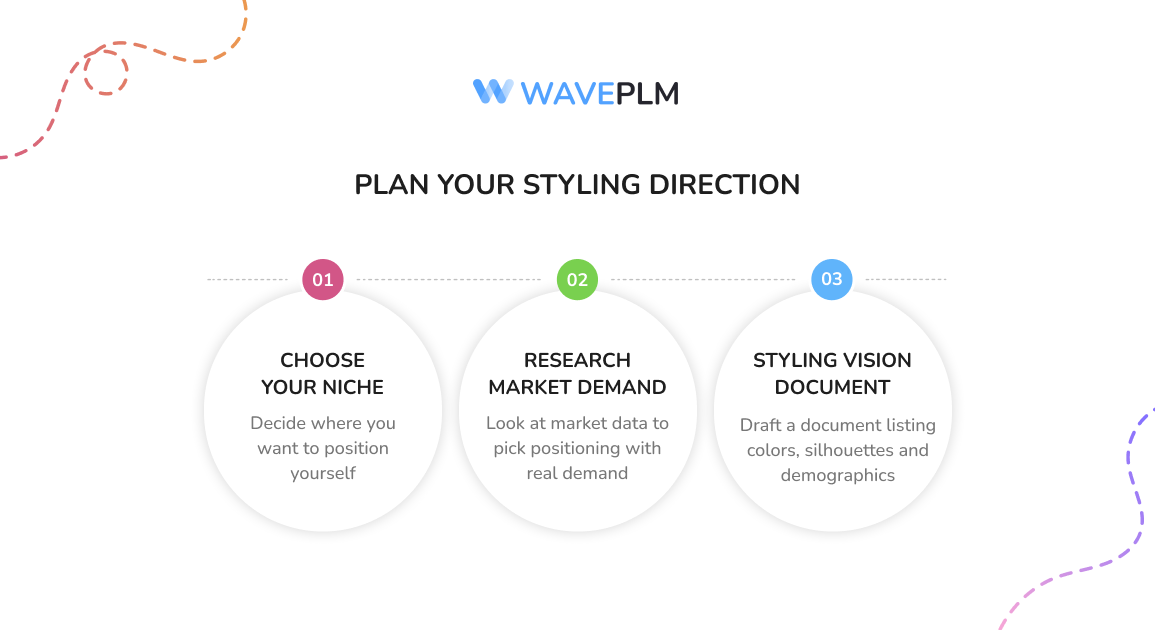
Choose Your Niche
Before accepting any test shoots, decide where you want to position yourself:
| Niche | Example Positioning |
|---|---|
| Editorial Streetwear | “Berlin-based streetwear editorial stylist” |
| Celebrity Red Carpet | “Los Angeles celebrity and red-carpet stylist” |
| Sustainable Fashion | “Copenhagen-based sustainable fashion consultant” |
| Luxury Bridal | “Texas destination wedding and bridal stylist” |
| E-commerce Commercial | “New York commercial stylist for DTC brands” |
For example, Berlin-based Nina-Maria Nitsche built her career around streetwear editorial expertise, while Karla Welch became synonymous with LA red-carpet styling. Their portfolios instantly communicate their specialty.
Research Market Demand
Look at 2026 market data to pick positioning with real demand:
- Bridal styling is booming 25% in Texas due to destination weddings
- K-fashion inspired streetwear surging 35% in Seoul via TikTok trends
- Luxury resort styling up 40% in Dubai per Business of Fashion reports
Create a Styling Vision Document
Draft a one-page document listing:
- Color palette preferences (earth tones, jewel tones, neutrals)
- Preferred silhouettes (oversized tailoring, body-conscious, deconstructed)
- Target age group and demographic
- Price level of brands (high-street Zara vs. luxury Chloé)
Keep this documented inside Wave PLM or a similar system. This clarity guides which test shoots you accept, which brands you approach, and how you order and caption images on your portfolio homepage.
Essential Content Every Fashion Stylist Portfolio Should Include
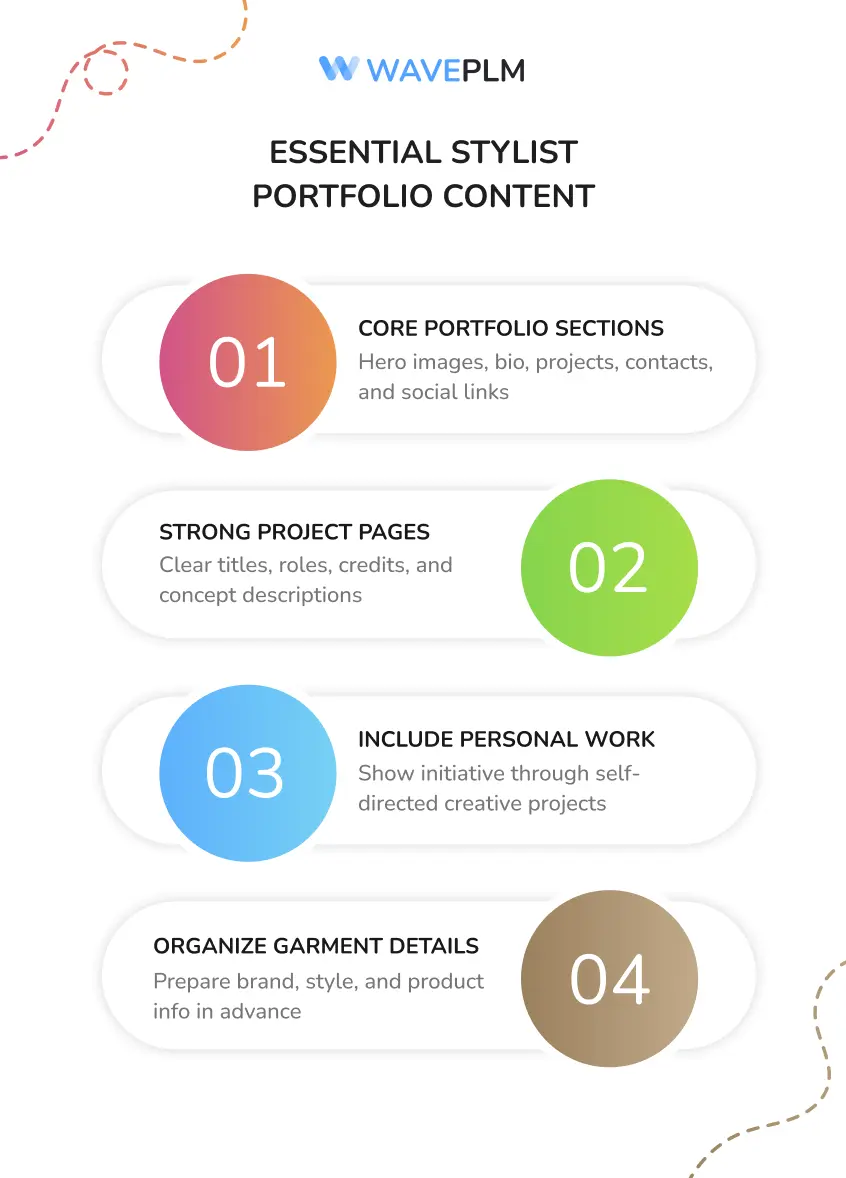
Even the most creative portfolios share non-negotiable elements that clients and agencies scan for in the first 30-60 seconds. Getting these right is foundational.
Core Content Blocks
| Element | Details |
|---|---|
| Hero Gallery | 8-16 of your absolute best images |
| Project Pages | Dedicated pages for each key shoot |
| Bio | Short, focused, and personality-driven |
| Client/Publication List | Names that build credibility |
| Contact Info | Clear booking process and availability |
| Social Links | Instagram, TikTok, LinkedIn |
What Every Project Page Needs
For each featured shoot, include:
- Project title that captures the concept
- Date (e.g., January 2025)
- Your role (lead stylist, assistant stylist, wardrobe stylist)
- Location (city + studio/on-location)
- Full credits (photographer, hair, makeup, model, brands)
- 2-3 sentence description explaining the concept and your approach
Include Personal Projects
Recommend at least one personal project or self-initiated editorial per year. For example, a 2024 “Sustainable Denim Story” shot in Brooklyn demonstrates independent vision when paid work is limited. According to industry surveys, 65% of agencies value this proactivity.
Organize Garment Details in Advance
All garment and accessory details—brands, style codes, season—can be organized in Wave PLM during pre-production. This makes accurate credits and consistent naming easy when building portfolio pages later.
Choosing Layout, Themes, and Visual Structure for Your Portfolio
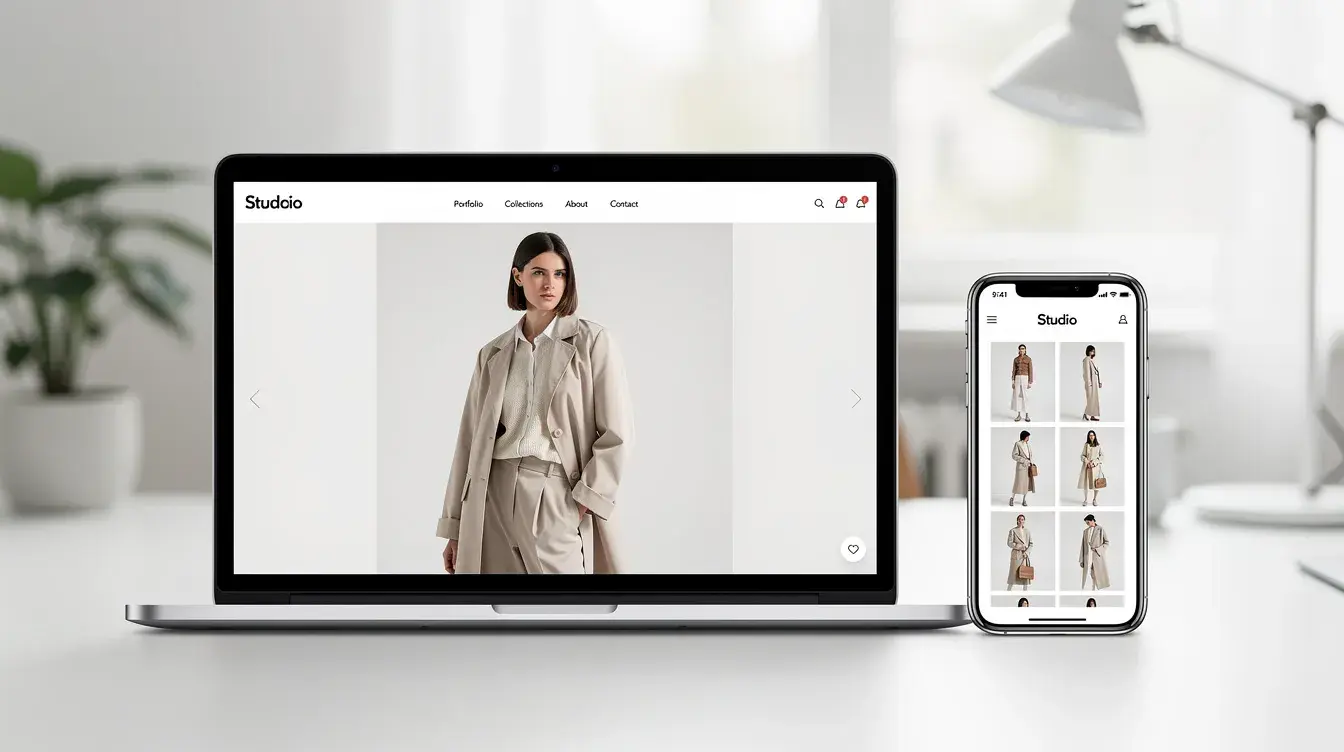
Layout should support, not overshadow, your images. Aim for clean, responsive designs that display well on phones and tablets. In 2026, a cluttered site loses 40% of viewers before they reach your best work.
Common Layout Approaches
Strong stylist portfolios typically use:
- Grid-based homepages with consistent thumbnail sizes
- Large full-bleed hero images that make immediate impact
- Side-scrolling galleries for project deep-dives
- Long vertical “magazine-style” scrolls for editorial work
Visual Guidelines
Keep your site visually cohesive:
- Spacing: Consistent gaps between thumbnails, no more than 2-3 different grid styles across the entire site
- Color palette: Either neutral (white, beige, black) or consciously aligned with your brand (pale pink for a romantic womenswear stylist)
- Typography: Legible, professional fonts that don’t compete with imagery
- Load time: Under 3 seconds—optimize all images
Handle Before/After Content Carefully
Before/after or look-building sequences work only in limited, clearly labeled sections. Keep the main navigation simple: “Work, About, Contact” is often enough. Complexity drives visitors away.
Building Your First Portfolio When You Have Little or No Experience
Many stylists in 2026 build credible portfolios before their first paid job by producing test shoots, collaborations, and personal projects. This is standard practice — approximately 80% of agencies accept self-produced shoots if the quality is professional.
A Realistic 90-Day Plan
Month 1: Plan
- Develop 1-2 test shoot concepts with clear moodboards
- Identify collaborators (photographers, makeup artists, models)
- Source samples from local boutiques or borrow from designer friends
Month 2: Execute
- Shoot your planned concepts
- Edit and select final images
- Gather all credits and product information
Month 3: Build
- Create your online portfolio and PDF version
- Set up social media integration
- Begin outreach to potential clients and agencies
Concrete Self-Directed Project Ideas
- A “Vogue Italia-style editorial simulation” shot at home or in a rented studio
- A street-style story in your local neighborhood featuring accessible brands
- A brand-inspired campaign for a real label you admire (clearly labeled as personal work)
- A sustainable fashion editorial using vintage and secondhand pieces
Collaborate and Document Everything
Connect with photographers, makeup artists, models, and designers in your city. Use clear written agreements about image usage, credits, and timelines to avoid disputes later.
Wave PLM can be used even at this early stage to store moodboards, manage samples borrowed from local boutiques, and track what was worn in each look so future credits remain accurate.
Organizing Looks, Samples, and Data with Wave PLM
Serious stylists quickly accumulate hundreds of looks, product samples, and credits. Manual tracking in spreadsheets becomes unreliable at scale, leading to missed return deadlines, crediting errors, and lost relationships with brands.
Centralize Your Product Data
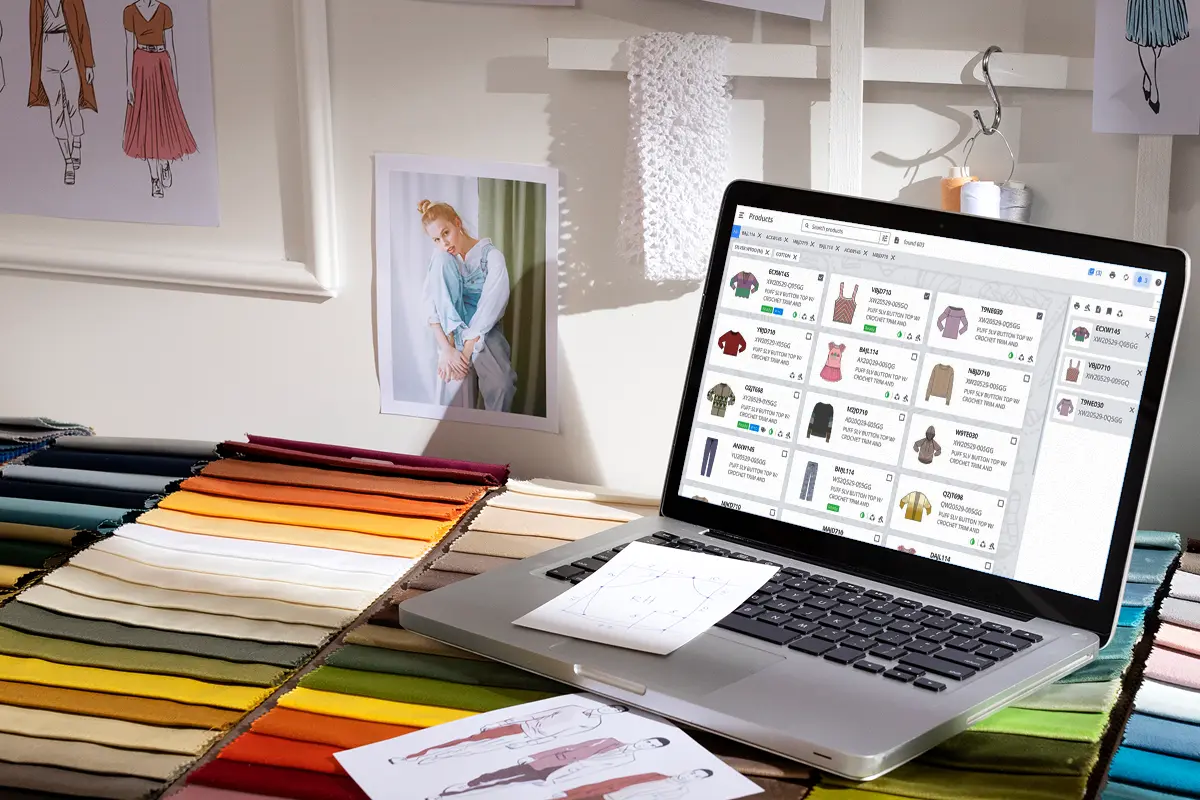
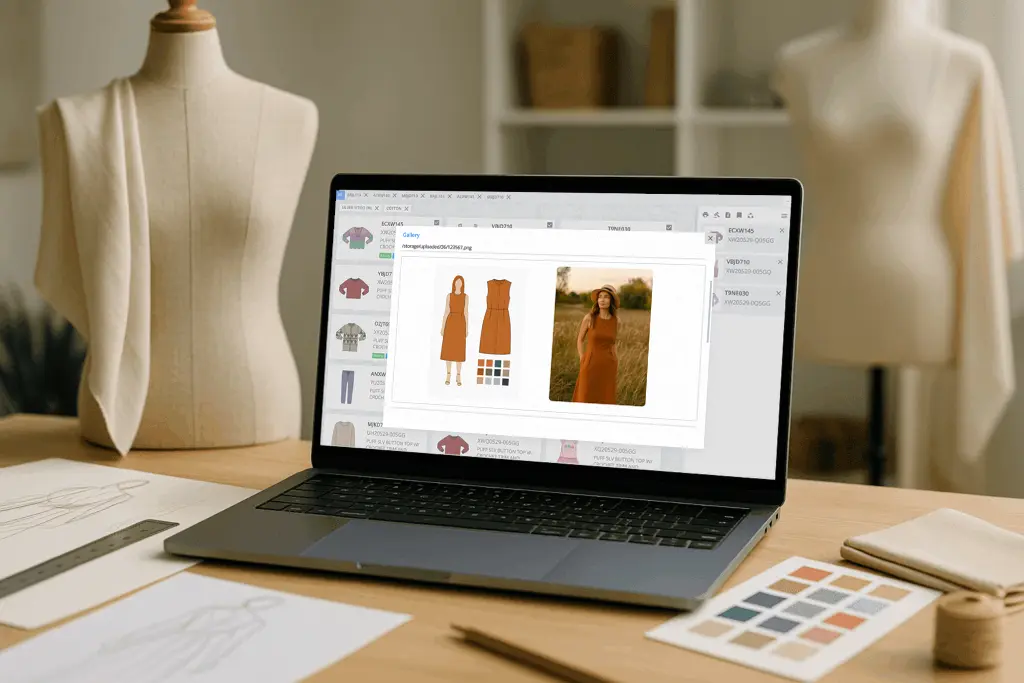
Wave PLM lets stylists and fashion teams centralize:
- Item photos and colorways
- Sizes and availability
- Borrowing dates and return deadlines
- Brand contacts and PR information
- Style codes and season information
Group Items into Looks
Stylists can group items into specific looks within the platform. For example, “Look 3 – Spring 2025 Resort Campaign, Miami” keeps all relevant pieces together. This structure can then be exported to mirror on portfolio project pages.
Access Accurate Product Information
For brands using Wave PLM across design, production, and marketing, stylists can access accurate product names and style codes directly. This reduces crediting errors and makes portfolio case studies more professional—clients notice when you get the details right.
Go Deeper
Readers seeking deeper guidance on organizing product data, samples, and cross-team collaboration can explore resources at blog.waveplm.com, including articles on digital sample management and collaboration workflows between designers and stylists.
SEO and AEO: Turning Your Portfolio into a Client Magnet
SEO (search engine optimization) and AEO (answer engine optimization) help your portfolio appear when potential clients search on Google or ask voice assistants for stylists. Without optimization, even a stunning portfolio remains invisible.
Add Geo-Targeted Keywords Naturally
Include location-specific keywords in headings and copy:
- “Fashion stylist portfolio in New York”
- “Los Angeles wardrobe stylist”
- “London editorial stylist portfolio”
- “Dubai luxury fashion consultant”
According to SEMrush fashion benchmarks, geo-optimized keywords can lift local search rankings by 40-50%.
Understand AEO
Answer engine optimization means structuring your content to answer specific questions directly. When someone asks “What does a fashion stylist do in Berlin?” and your site provides a clear, concise answer, search engines can surface your page in featured snippets and voice results.
Write sections that begin with questions and provide direct answers. This positions you for visibility in an increasingly voice-driven search landscape.
Create a Services and FAQ Section
On your portfolio site, include a short section addressing:
- Your booking process
- Rates overview (day rates, project rates, retainer options)
- Travel availability and coverage areas
- Typical turnaround times
Write in clear, concise language that search engines can parse easily.
Build Authority Through Content
Consistent blogging or case study posts build long-term search visibility. You can host these on a separate section of your portfolio.
Geo-Optimizing Your Fashion Stylist Portfolio for Different Markets
A stylist in New York, Dubai, or Copenhagen will attract different clients and budgets. Your portfolio should subtly reflect local market realities while maintaining your core aesthetic.
Add City Names Strategically
Include your primary city in:
- Site title: “Paris Fashion Stylist Portfolio – [Your Name]”
- Meta descriptions
- On-page headings
- Image alt text
This improves local discoverability significantly.
Showcase Location-Specific Work
If you work between cities, feature at least one project per key market:
- “Shot in London, 2024”
- “Campaign for a Dubai luxury resort, 2025”
- “Brooklyn sustainable editorial, Spring 2025”
Explicitly label locations—clients search for stylists who understand their local scene.
Create Geo-Specific Content
Blog posts and case studies with location focus speak directly to local client needs:
- “How I Styled a Winter Editorial in Stockholm”
- “Capsule Wardrobe Styling for Tech Executives in San Francisco”
- “Bridal Styling Trends in Texas for 2026”
According to LinkedIn data, location-based hiring rose 30% in the fashion industry through 2026, making this optimization increasingly valuable.
Case Studies and Storytelling: Going Beyond Pretty Pictures
High-level clients increasingly want to understand process, not just final visuals. Well-written case studies demonstrate creative direction, problem-solving skills, and professionalism in ways that images alone cannot.
Choose Your Standout Projects
Select 3-5 projects from 2022-2026 that showcase different aspects of your work:
- A challenging editorial with limited budget
- A brand campaign with specific requirements
- A celebrity styling moment with tight timelines
- A personal project that demonstrates creative vision
Case Study Structure
| Section | Content |
|---|---|
| Client & Objective | Who hired you and what they needed |
| Concept & References | Your inspiration and moodboard approach |
| Styling Strategy | How you approached the brief |
| Execution & Team | The shoot process and collaborators |
| Outcome & Impact | Results, publication, client feedback |
Each case study should run 300-600 words with 6-12 images.
Maintaining and Updating Your Portfolio Over Time
An outdated portfolio — last updated in 2021 or 2022 — costs opportunities. Clients want to see recent styling aligned with current trends. Most people can tell when work feels dated.
Establish an Update Cadence
| Frequency | Actions |
|---|---|
| Quarterly | Add 2-3 new shoots, remove 1-2 weaker pieces |
| Annually | Major review, homepage redesign if needed, refresh bio |
| After major projects | Add standout work immediately |
Set calendar reminders to ensure updates happen consistently.
Keep a Running Update List
During the year, maintain a list of shoots that:
- Performed well on social media
- Had strong results or notable press
- Featured notable clients or brands
- Represent new directions in your work
Wave PLM or a simple project management tool works well for this tracking.
Track Simple Metrics
Monitor basic performance indicators:
- Inquiries per month
- Conversion rates from website visits to consultations (10-20% is a healthy benchmark)
- Which portfolio pages get the most views
Adjust your homepage order based on what drives the most engagement.
Maintain Offline Backups
Keep a backup offline version (PDF or local files) refreshed at least annually. You’ll need it for situations where internet access is limited—on-set, in client offices, or during travel.
Linking Your Portfolio to Social Media and Professional Platforms
In 2026, most clients discover stylists through a combination of Instagram, TikTok, LinkedIn, and personal websites. No single channel dominates, so integration matters.
Instagram and TikTok Integration
Embed or link to curated content that shows:
- Behind-the-scenes styling moments
- Closet edit Reels and quick tips
- Process videos from shoots
- Before/after transformations
Keep your main portfolio site more polished and curated than your social feeds, which can be more casual and personality-driven.
Optimize Your LinkedIn Presence
Create a searchable headline that includes your specialty and location:
“Fashion Stylist & Wardrobe Consultant | Based in Chicago | Commercial & Editorial”
Link directly to your portfolio URL in your profile. This matters for clients who discover you through professional networking.
Maintain Consistent Links
Every platform — Instagram bio, TikTok profile, email signature — should contain the same portfolio link. Use a branded URL instead of generic link shorteners when possible for professionalism.
Align Content with Product Data
When working with brands using Wave PLM, stylists can align social content tags with product data (style names, drop dates). This helps audiences find exact items seen in portfolio images, bridging the gap between inspiration and commerce.
Common Mistakes in Fashion Stylist Portfolios (and How to Avoid Them)
Many otherwise talented stylists lose work due to avoidable portfolio issues. These mistakes signal unprofessionalism or make it harder for clients to understand your value.
Frequent Mistakes to Avoid
| Mistake | Solution |
|---|---|
| Mixing too many unrelated styles | Focus on 2-3 coherent aesthetics maximum |
| Inconsistent image quality or color grading | Apply consistent editing standards |
| Slow loading times | Optimize images, aim for under 3 seconds |
| Missing credits | Document everything during shoots |
| No location or availability info | Add clear contact and coverage sections |
| Outdated work featured prominently | Quarterly reviews remove stale content |
Curate Ruthlessly
Limit your portfolio to your strongest 30-60 images. Remove early work that no longer represents your current skill level or aesthetic. Quality always beats quantity.
Check Technical Standards
Before publishing, verify:
- Image optimization for fast loading (use tools like ImageOptim)
- Legible typography at all screen sizes
- Accessible contrast between text and backgrounds
- Correct display on both iOS and Android devices
Approximately 25% of visitors drop off from poor mobile experiences according to industry data. Recruiters expect to see work samples that prove your talent and initiative, even if you’re just starting. A portfolio shows your skills in action, allowing recruiters to see your creativity and taste level. Getting inspired by portfolios of others in the field can help plan what to include in your own portfolio.
FAQ
How many images should a fashion stylist portfolio have in 2026?
Most working stylists present around 30-60 of their best images publicly, organized into 6-12 projects. This provides enough variety to demonstrate range while maintaining quality standards. Keep an extended archive privately for tailored pitches when specific clients request more depth—for example, a brand asking to see all your denim work or a magazine wanting more editorial examples in a particular style.
Is it acceptable to include self-produced shoots and unpaid work?
Yes. Well-executed self-produced shoots are standard early in a career and even for senior stylists testing new directions. The key requirements are professional production quality, proper retouching, and clear, accurate credits. According to industry surveys, approximately 80% of agencies accept self-initiated work if it meets these standards. Label personal projects clearly to maintain transparency with potential clients.
Should I create separate portfolios for editorial and commercial work?
If you actively pursue both editorial and commercial work with equal seriousness, you have two solid options. First, you can separate them into distinct sections on one unified website, allowing clients to quickly find relevant work. Second, you can maintain two focused PDF selections alongside your main portfolio for targeted pitches. Most stylists find a single site with clear sectional divisions works best for discovery, while PDFs serve specific client requests.
Do I need a printed portfolio book anymore?
In most major markets, a printed book is optional. A responsive website and high-quality PDF are usually sufficient for agency meetings, client pitches, and castings. However, approximately 10% of in-person meetings—particularly with traditional agencies or luxury clients—still benefit from physical presentation. A simple printed book can be helpful for certain situations, but it’s no longer a requirement for building a successful career.
How can Wave PLM specifically help me as an independent stylist?
Even independent stylists benefit from Wave PLM’s organizational capabilities. The platform helps you track borrowed samples (with return deadlines and brand contacts), organize looks by project and season, store moodboards and references in one accessible location, and retrieve accurate product information when building portfolio credits. This systematic approach makes creating detailed, professional portfolio pages and case studies far easier than manual spreadsheet tracking—especially as your career scales and you’re managing dozens of projects simultaneously.
Your fashion stylist portfolio is more than a gallery — it’s your most powerful business tool in 2026. Start with one strong test shoot this month, organize your work systematically with tools like Wave PLM, and optimize for the clients you want to attract.
The stylists who stand out aren’t necessarily the most talented. They’re the ones who present their talent clearly, professionally, and where clients are looking.
Explore more resources on fashion product management, team collaboration, and digital workflows at blog.waveplm.com.




Leave a Reply