

Social Media Analytics has moved well beyond marketing dashboards—it’s rapidly becoming a foundational input for product lifecycle management. For operations directors navigating increasingly volatile consumer markets, the real cost of missing social signals isn’t just a missed trend. It’s delayed development cycles, overproduced inventory, and products that arrive to market already out of step with demand.
At its core, social media analytics in a PLM context means systematically capturing social media data—consumer sentiment, emerging style preferences, competitor product reactions, and viral content patterns—and routing that intelligence directly into product development decisions. According to research on social media’s role in lifecycle management, organizations that embed market intelligence into product lifecycle processes gain a measurable advantage in responsiveness and relevance.
The practical value lies in timing. Real-time data doesn’t just inform—it accelerates. When trend signals surface in a centralized reporting dashboard rather than sitting in a separate marketing tool, cross-functional teams can act within days instead of quarters. This is particularly critical in fashion PLM, where the window between trend emergence and consumer expectation is shrinking. Connecting those upstream signals to product decisions earlier in the development cycle is what separates reactive brands from those that consistently lead.
Embedding market intelligence into the product lifecycle isn’t a one-time integration effort—it requires a structured, automated workflow. The question is how to build that pipeline efficiently, starting with how and where data gets collected.
Data Collection and Workflow Automation
Building a functional PLM workflow that incorporates social media signals starts with one foundational question: how do you get the right data into the right hands at the right moment? The answer lies in structured collection methods paired with thoughtful automation—not a fire hose of raw posts, but a curated, actionable stream of product-relevant intelligence.
Collecting the Right Social Data for PLM
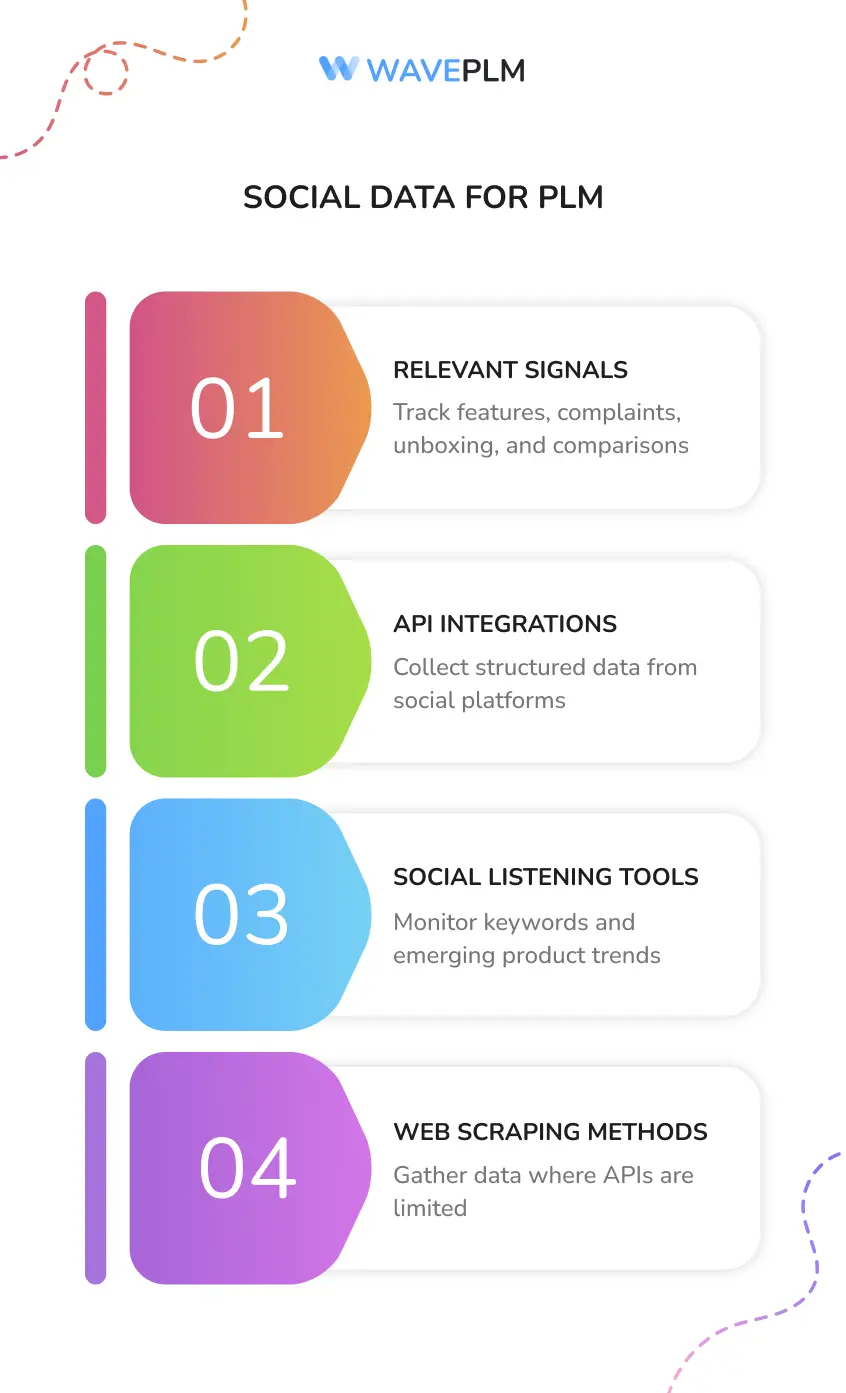
Not all social media data serves PLM purposes equally. Operations directors need to prioritize signals directly tied to product performance: feature mentions, materials complaints, unboxing reactions, and comparison commentary. The primary collection methods include:
- API integrations — Direct connections to platform data streams (Instagram Graph API, X/Twitter API, TikTok Research API) provide structured, scalable access. According to Domo’s analysis of API integration, API-based approaches dramatically reduce manual data handling and enable consistent, normalized datasets.
- Social listening platforms — Keyword and hashtag monitoring tools filter volume into product-specific threads. For fashion and consumer goods, this is where trend signals that impact supply chain decisions first emerge.
- Web scraping and third-party aggregators — Useful for platforms with restricted API access, though these carry data reliability caveats worth acknowledging.
Automating the Integration into PLM Workflows
The real competitive advantage comes when you automate social media analytics PLM processes rather than relying on manual reporting cycles. One practical approach is building trigger-based workflows: when sentiment around a specific SKU crosses a defined threshold, an alert routes automatically to the relevant product team—not a weekly digest, but a real-time signal.
Integrating social media analytics into PLM typically follows a three-stage pipeline: ingest → normalize → route. Data enters through APIs, gets cleaned and tagged by product category, then pushes into PLM-connected dashboards or directly into stage-gate review documentation.
Real-time insights lose their value the moment they’re delayed by a broken handoff. Platforms like Wave PLM address this by centralizing social data alongside traditional PLM inputs, so product teams aren’t toggling between disconnected systems to find context.
Getting this data architecture right sets the stage for the next critical capability: understanding not just what consumers are saying, but how they feel—which is where sentiment analysis becomes essential.

Sentiment Analysis and Feedback Loops
Once the data collection infrastructure described in the previous section is in place, the next challenge is making sense of what consumers are actually saying. This is where sentiment analysis becomes a critical component of Product Lifecycle Management.
What Sentiment Analysis Brings to PLM
Sentiment analysis uses natural language processing (NLP) to classify consumer mentions—reviews, comments, hashtags, and posts—as positive, negative, or neutral. For operations directors managing complex product pipelines, this capability transforms unstructured social noise into structured, actionable intelligence. Rather than relying on post-launch sales data to identify product issues, teams can detect dissatisfaction signals during development or immediately after a soft launch.
Research published in PMC highlights that social media big data analysis, when applied systematically, can significantly enhance product decision-making by identifying latent consumer preferences that traditional surveys miss. The implication for PLM teams is direct: sentiment data should inform design iterations, not just post-mortem reviews.
Content performance metrics—engagement rates, comment sentiment ratios, share velocity—provide an additional signal layer that reveals which product attributes resonate and which generate friction.

Building Effective Feedback Loops
A feedback loop in this context means routing sentiment insights back into the product development pipeline on a structured cadence. In practice, this looks like:
- Weekly sentiment reports flagged to design and sourcing teams
- Threshold alerts triggered when negative sentiment on a specific SKU or material exceeds a defined percentage
- Integration with PLM revision workflows, so that flagged issues automatically generate a change request or design review task
This is precisely where platforms like Wave PLM add operational value—connecting real-time social trends into your PLM design workflow rather than leaving that translation work to manual processes. Teams working in fashion, where trend cycles are compressed, can particularly benefit from closing the loop between social signals and product development in a systematic way.
Sentiment-informed feedback loops don’t just reduce product risk—they accelerate alignment between what consumers expect and what development teams deliver.
As feedback loops mature and teams grow more comfortable interpreting sentiment data, the natural next step is applying that same analytical rigor to broader market signals—which is exactly what trend analysis and market intelligence make possible.
Trend Analysis and Market Intelligence
With sentiment pipelines and feedback loops established, the next layer of value comes from stepping back and spotting the larger patterns — which is where trend analysis becomes a genuine competitive differentiator. Rather than reacting to what consumers disliked about last season’s product, trend analysis helps teams anticipate what the market will want next, shifting the conversation from damage control to proactive development.
Integrating analytics from social media into this process transforms raw noise into structured market intelligence. Platforms generate enormous volumes of behavioral data — hashtag velocity, share-of-voice shifts, emerging aesthetic clusters, and influencer adoption patterns — that collectively signal where consumer interest is heading before it shows up in traditional sales data. According to research published in PMC, social media big data analysis offers measurable advantages in identifying consumption patterns at scale, precisely the kind of early-warning capability that analytics in product lifecycle management has historically lacked.
Strong market intelligence derived from social signals can reduce a brand’s exposure to late-stage pivots — one of the most expensive problems in any PLM workflow.
For operations directors, the practical question around PLM optimization social media performance metrics isn’t just whether trend data is available, but whether it’s wired directly into decision points: concept approval gates, sourcing timelines, and development briefs. When trend signals inform decisions earlier in the product journey, teams can adjust colorways, materials, or positioning before tooling costs accumulate.
Platforms like Wave PLM are designed to connect these intelligence streams directly to PLM workflows, so trend signals don’t sit in a separate analytics dashboard but actively inform development decisions. However, integration quality matters. What PLM Can Learn from Social Media notes that the structural gap between agile social platforms and traditional PLM systems remains a real challenge — one that industry-specific implementations, particularly in fashion, are increasingly being built to address.

Fashion PLM: Integrating Social Data
Fashion is arguably the industry where a well-structured social media workflow can most dramatically reshape product outcomes. Trend cycles have compressed from seasons to weeks, and the brands that respond fastest consistently capture disproportionate market share. The core question operations directors keep asking is: how does a social media workflow improve PLM in a category this volatile?
The challenges are specific to fashion. Social signals arrive in enormous, unstructured volumes — a single runway moment can generate hundreds of thousands of posts within hours. Without a disciplined pipeline connecting those signals to your PLM system, the data remains noise rather than direction. Competitor benchmarking adds another layer of complexity; tracking how rival collections perform on social requires consistent taxonomy and data normalization before any meaningful comparison is possible.
Example scenario: A mid-size apparel brand monitors TikTok and Instagram for engagement patterns around color and silhouette. When oversized blazers in earth tones start outperforming category averages, that signal feeds directly into the PLM platform — flagging the trend to design and merchandising teams before the next collection gate. The result is a timeline adjustment measured in weeks, not quarters. This kind of data-driven forecasting approach is what separates reactive brands from proactive ones.
Social data becomes most actionable when it’s mapped to specific PLM decision points — material selection, colorway approval, SKU rationalization — rather than treated as a general awareness exercise. Platforms like Wave PLM are designed to serve exactly this function, providing a unified environment where social intelligence and PLM workflows operate from shared data rather than parallel silos. Strong brand identity decisions also benefit, since social signals reveal how consumers actually perceive positioning versus how it was intended.
The mechanics of how AI processes this social data at scale — and what technical infrastructure makes it reliable — is where the next section focuses.

Technical Deep Dive: AI and Social Listening
Understanding the mechanics behind AI-driven analytics helps operations directors make smarter investment decisions — and avoid costly implementation missteps. At its core, social listening for PLM involves three sequential processes: data ingestion, natural language processing (NLP), and structured output delivery into product systems.
How AI Processes Social Signals
Modern social listening platforms use machine learning models to classify enormous volumes of unstructured content — posts, comments, hashtags, image tags — into actionable product intelligence. NLP layers detect sentiment, identify emerging terminology, and flag volume spikes around specific attributes like colorways, materials, or silhouettes. What makes this valuable in a PLM context isn’t raw data volume; it’s the system’s ability to filter noise and surface signals that map directly to product attributes already living in your development pipeline.
One practical approach is to configure keyword taxonomies that mirror your PLM’s attribute structure. When the AI detects a trending term — say, “butter leather” or “convertible straps” — it routes that signal to the corresponding product category rather than a generic marketing dashboard.
Analytics Integration: Technical Requirements
Connecting social intelligence to PLM requires deliberate Analytics Integration architecture. According to Socialinsider’s workflow research, structured data pipelines — not manual exports — are what separate reactive teams from proactive ones. API-based connections allow real-time data flow, while webhook triggers can flag threshold events directly within PLM task queues.
The benefits of market intelligence in PLM extend beyond trend visibility: teams gain the ability to track consumer preference shifts earlier in the design cycle, reducing costly late-stage pivots. Platforms like Wave PLM are built to consolidate these data streams within a single environment, eliminating the fragmentation that typically delays signal-to-decision timelines.
Knowing the technical framework, however, is only part of the picture — what really clarifies value is seeing how these patterns play out across real implementation scenarios.

Example Scenarios: Successful Integration Patterns
Understanding how integrating social media analytics into a PLM workflow actually plays out in practice helps operations directors move from theory to execution. The patterns below illustrate what successful deployments typically look like — and where teams commonly stumble.
Pattern 1: Early Trend Signal Routing
A common pattern involves connecting data collection pipelines directly to the concept phase of the product lifecycle. In practice, social listening tools flag rising aesthetic signals — say, an uptick in posts around a specific silhouette or color palette — and that intelligence automatically surfaces inside PLM systems as a tagged trend brief. Designers work from market-validated starting points rather than intuition alone. This upstream integration is precisely where forecasting accuracy improves most dramatically, compressing time-to-market by eliminating late-stage directional pivots.
Pattern 2: Feedback-Loop Validation
Another successful pattern uses social sentiment to validate samples mid-development. Example scenario: A brand shares mood board imagery across internal channels, monitors organic audience response via API-connected analytics, and feeds performance signals back into the PLM revision stage. According to Cambashi, PLM adoption accelerates when the system demonstrates tangible responsiveness to real-world signals — exactly what this feedback loop delivers.
Common Obstacles and Mitigation
The most frequent obstacle is data quality — inconsistent tagging, regional noise, and platform algorithm shifts can distort signals. Mitigation strategies include:
- Establishing data governance rules before integration goes live
- Filtering by verified engagement metrics rather than raw volume
- Using platforms like Wave PLM that unify social inputs within a structured product development environment
Even well-architected integrations face edge cases, though — a reality worth examining closely before scaling.
Limitations and Considerations
As with any Market Intelligence source, social media analytics comes with meaningful constraints that operations directors should weigh honestly before scaling their investment.
Data Accuracy and Source Reliability
Social platforms are noisy environments. Bots, spam accounts, and coordinated inauthentic behavior can skew sentiment scores and inflate engagement metrics, introducing false signals into your predictive demand models. Even legitimate data can be misleading — viral moments often reflect cultural noise rather than genuine purchase intent. A single influencer post can distort trend detection algorithms, making a niche aesthetic appear to be a mainstream shift.
Platform-level restrictions compound this problem. API access policies change frequently, and rate limits or data throttling can create gaps in historical datasets that undermine longitudinal analysis. Data pulled from one platform rarely transfers cleanly to another, creating inconsistent coverage across demographic segments.
The Completeness Gap
Social media analytics tools PLM systems integration still can’t fully replace traditional research methods. Focus groups, buyer surveys, and retail sell-through data capture dimensions of consumer behavior that social listening simply cannot — particularly among older demographics who are less socially active online. Operations directors in fashion should complement digital signals with structured design research to avoid over-indexing on vocal online communities.
Balancing Social Data With Other Sources
A balanced approach treats social signals as one input within a broader intelligence stack. Purchase data, returns analysis, wholesale feedback, and trend forecasting reports all provide context that social metrics alone lack. However, when used alongside these sources, social analytics significantly sharpens timing and specificity.
Understanding these limitations isn’t a reason to hold back — it’s the foundation for deploying the integration intelligently, which brings together everything covered in this article.
Key Takeaways
The case for integrating social media analytics into your PLM workflow is no longer theoretical — it’s operational. Operations directors who act on consumer signals early, rather than late, consistently compress development cycles and reduce costly revision loops. Hashtag tracking, sentiment analysis, and trend monitoring aren’t marketing exercises; they’re upstream intelligence tools that shape better product decisions before tooling and sourcing commitments are made.
Three priorities stand out from everything covered here:
- Start with structured data pipelines. Use API-driven Workflow Automation to eliminate manual data transfers and keep social signals flowing directly into PLM stages where they’re actionable.
- Choose platforms built for convergence. Wave PLM offers a unified environment to streamline PLM social media data insights alongside traditional product data — reducing context-switching and accelerating team alignment.
- Stay honest about limitations. Signal quality, platform volatility, and data privacy constraints require ongoing governance, not one-time setup.
As digital retail continues reshaping consumer expectations, the brands gaining competitive ground are those treating social intelligence as a core PLM input — not an afterthought. Real-time insight, properly integrated, is the shortest path from market signal to market-ready product.





Leave a Reply