

AI apparel now plays a central role in the fashion world. Brands use ai to create, plan, test, and launch apparel faster than ever. What once felt experimental now works inside real production pipelines. From fashion design to inventory control, ai apparel supports every stage of the product life cycle. AI has moved from an experimental novelty to the essential backbone of the apparel industry by 2026.
This guide explains ai apparel in simple terms. You will learn how artificial intelligence shapes apparel workflows, supports fashion teams, and improves brand performance. You will also see why clean data matters and how Wave PLM enables scalable ai fashion systems.
What Is AI Apparel?
AI apparel describes the use of ai and artificial intelligence to support apparel creation, planning, and operations. These tools analyze data, images, text, and product attributes. They then generate insights, predictions, or designs in seconds.
In fashion, ai apparel acts as a support tool. It does not replace designers or creative teams. Instead, it helps them create faster and make better decisions. Fashion teams still control brand identity, style, and final products.
Most ai fashion systems rely on models trained on thousands of apparel designs, images, fabrics, and historical products. As teams upload more data, the models improve over time.
Simply upload product information, sketches, or photos. The ai processes the input and generates outputs that teams can refine.
Why the Apparel Industry Is Adopting AI
The apparel industry moves fast. Trends shift, customers change behavior, and production timelines stay tight. Traditional tools struggle to keep up.
AI apparel helps brands respond in real time. Fashion ai tools analyze sales, images, customer data, and market signals. Teams gain answers in seconds instead of weeks.
Cost pressure also drives adoption. Excess inventory, slow production, and poor fit hurt margins. Ai apparel reduces waste and improves quality across collections.
Sustainability goals matter as well. Better planning lowers overproduction and supports responsible production in the real world.
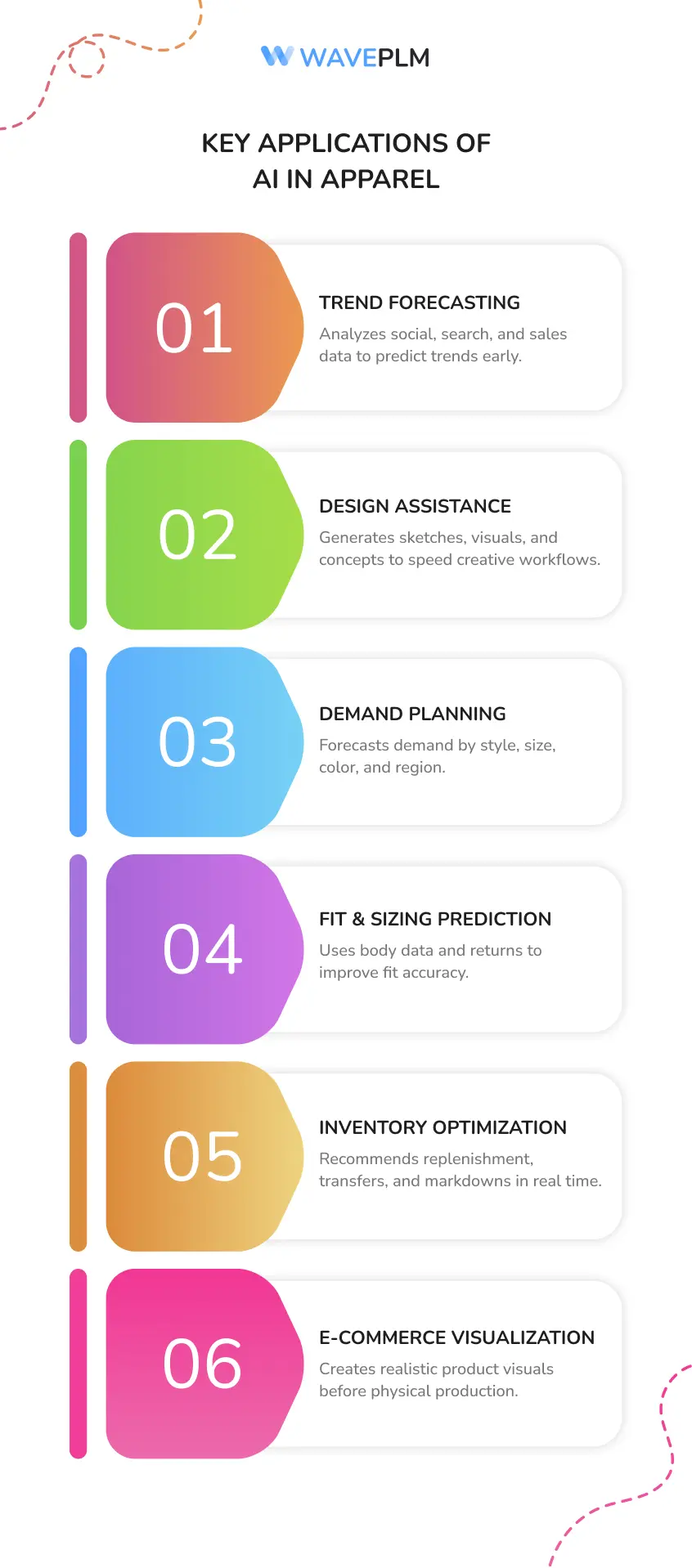
Key Applications of AI in Apparel
AI apparel supports many use cases across fashion design, development, and operations. Below are the most common and valuable applications.
Trend forecasting
Fashion ai analyzes images, social media, runway photos, and search data. It identifies trends before they peak. Brands like Zara analyze real-time sales for faster, more agile inventory replenishment, often in just 10–15 days.
Algorithms scan billions of social media posts, search queries, and e-commerce data to identify emerging micro-trends months before they hit the mainstream. Designers use these insights as inspiration. Teams build collections that match real demand instead of guessing.
AI analyzes past purchases, browsing history, and preferences to suggest items tailored to individual styles. Trend forecasting works best when brands combine external image data with internal apparel history.
Design assistance
AI apparel tools support fashion design by generating ideas, sketches, and graphics. Designers can quickly turn a creative idea into t shirts, hoodies, and accessories concepts in seconds.
With AI, designers can play with different fabrics, sketches, and design ideas, experimenting freely to discover new styles and innovations.
Teams upload reference photos, text prompts, or sketches. The ai generates realistic designs that match the desired style.
For example, a designer might upload a hand-drawn sketch and use AI to instantly generate a 3D visual of the apparel, making it easy to see how the idea translates into a finished product.
This process helps creative teams explore more ideas without losing control. Designers still select, refine, and finalize designs.
Designers use sketch-to-render tools to convert rough drawings or text prompts into high-fidelity 3D visuals, allowing for 10x faster design cycles. Generative AI allows designers to create 3D, high-fidelity, or 3D-sketched designs from prompts. AI is drastically shortening design cycles—from weeks to hours—by automating repetitive tasks and enabling rapid visualization. AI-generated designs can also be used for e-commerce mockups, helping brands visualize new product ideas before production.
Demand planning
AI apparel improves demand planning by analyzing products, seasons, regions, and time. Models predict demand at size and color level.
Fashion teams use these forecasts to plan production and distribution. Better predictions reduce markdowns and stock issues.
Fit and sizing prediction
Fit prediction uses ai to analyze body data, apparel measurements, and return reasons. The goal is a perfect fit.
Better sizing improves customer satisfaction and reduces returns. Clothing feels more realistic and aligned with customer needs.
Inventory optimization
AI apparel helps brands control inventory across stores and regions. The system recommends transfers, replenishment, or markdowns. Agentic AI systems autonomously redistribute inventory between stores to prevent stockouts and overstock.
Teams act earlier and avoid last-minute decisions. This improves sell-through and protects brand quality.
AI in Apparel Design vs AI in Apparel Operations
AI apparel supports both creative and operational work. Each area uses different data and tools.
In fashion design, ai focuses on images, sketches, photoshoots, and inspiration. It helps designers create collections, outfits, and concepts faster.
In operations, ai focuses on products, models, production, and control. It supports planning, forecasting, and inventory decisions.
Both sides depend on shared product data. Without integration, ai fashion systems lose accuracy.
Virtual Try-On and Modeling
Virtual try-on and modeling are transforming the way fashion teams and customers interact with clothing. With AI-powered virtual try-on tools, customers can simply upload a photo and instantly see how they would look in a wide range of outfits—from t-shirts and hoodies to dresses and accessories. This feature allows shoppers to experiment with different styles, fabrics, and fits, helping them find the perfect look before making a purchase.
For fashion designers and brands, virtual modeling offers a powerful tool to create realistic, high-quality images of new designs without the need for traditional photoshoots. Fashion teams can generate scalable product detail page (PDP) content quickly, showcasing their latest apparel collections in a variety of styles and on diverse models. This not only speeds up the production process but also reduces costs and increases creative flexibility.
By leveraging virtual try-on and modeling, brands can deliver a more engaging and personalized shopping experience. Designers can test new ideas, visualize clothing in different fabrics and colors, and present their creations in a realistic way. The result is higher quality product imagery, faster time to market, and a more interactive way for customers to connect with fashion.
The Role of AI in Sustainable Fashion
Artificial intelligence is driving a new era of sustainable fashion by helping brands reduce waste, optimize production, and embrace eco-friendly design practices. AI-powered tools enable designers to create digital prototypes, allowing them to test and refine clothing ideas without needing to produce physical samples. This shift not only saves time and resources but also minimizes material waste throughout the fashion design process.
AI-designed enzymes for textile recycling break down waste into raw materials indistinguishable from virgin petroleum-based synthetics.
AI also plays a crucial role in predicting consumer demand. By analyzing shopping patterns and market trends, AI helps fashion brands produce only what is needed, reducing excess inventory and the environmental impact of overproduction. Designers can use AI to select sustainable materials, such as organic cotton or recycled polyester, and optimize production workflows to lower energy consumption and improve overall efficiency.
With artificial intelligence, fashion teams can create high-quality, sustainable clothing collections that align with both brand values and customer expectations. By integrating AI into every stage of production, brands are able to innovate responsibly, reduce their environmental footprint, and lead the way in sustainable fashion.

Brand Identity and Consistency in the Age of AI
In today’s fast-paced fashion world, maintaining a strong brand identity and consistent product presentation is more important than ever. AI-powered tools give fashion brands the ability to create and manage custom apparel, t-shirts, hoodies, and more—all while ensuring every product reflects the brand’s unique style and values.
With AI-generated models and virtual try-on technology, brands can present their apparel in a consistent, high-quality manner across all channels. Designers can use AI to create brand-specific graphics, fabrics, and accessories, ensuring that every new collection stays true to the brand’s identity. This level of control helps fashion teams deliver a unified look and feel, whether they’re launching a new line of t-shirts or expanding into new product categories.
By leveraging AI in fashion design, brands can build customer loyalty and trust through consistent, recognizable products. AI fashion tools make it easier to scale collections, maintain quality, and reinforce brand identity at every touchpoint—helping brands stand out in a crowded market and connect with customers in meaningful ways.
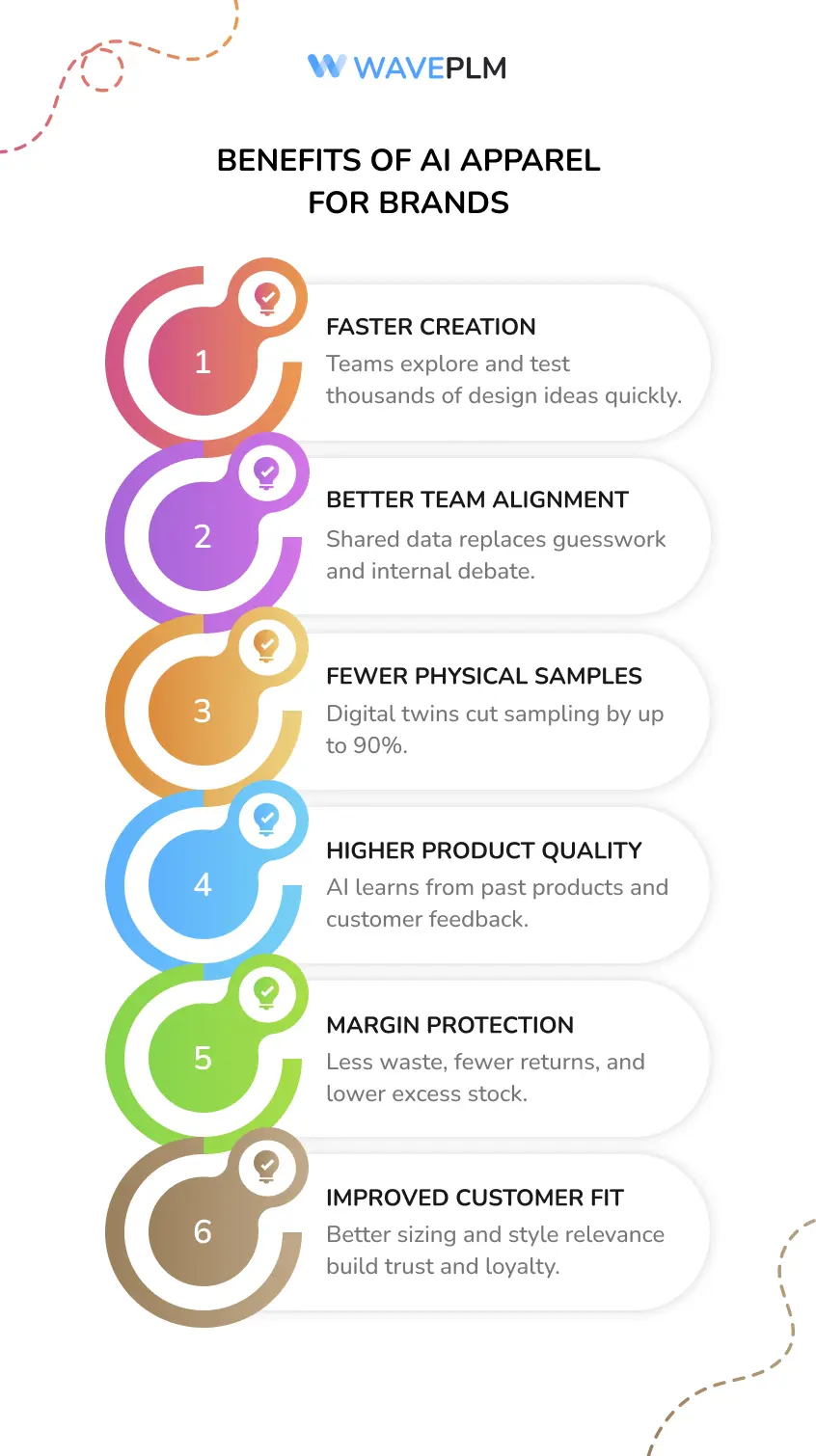
Benefits of AI Apparel for Brands
AI apparel delivers value across teams and workflows.
Brands create faster and test more ideas. Designers and team members can collaboratively explore thousands of designs without slowing down.
Fashion teams improve alignment. Shared data replaces guesswork and internal debate.
Brands can reduce physical samples by up to 90% using a “digital twin” approach. AI-generated designs can be used for print-on-demand apparel. The AI clothing generator produces high-resolution designs that can be downloaded. Users can customize their apparel designs with various graphics and colors.
Ai apparel improves quality by learning from past products and customer feedback.
Brands protect margins by reducing waste, returns, and excess stock.
Customers receive better-fitting clothes and more relevant styles. This improves trust and loyalty.
Limitations and Risks of AI in Fashion
AI apparel still has limits. Data quality remains critical.
Poor product data leads to poor outputs. Inconsistent images, text, or attributes reduce accuracy.
Bias also exists. Ai models learn from past collections and decisions. Teams must review outputs carefully.
AI apparel works best as a tool, not a replacement for people. Human creativity and judgment remain essential.
Brands should also address common questions about AI apparel through FAQs or customer support to build trust and provide clarity.
Why Clean Product Data Is Critical for AI Apparel
Clean data forms the foundation of ai apparel. Models rely on structured and consistent inputs.
Attributes like fabrics, fit, size, and color must follow standards. Clear reference images improve results.
Lifecycle data also matters. Changes, approvals, and revisions help ai learn from reality.
Brands that invest in data quality unlock faster and more reliable ai fashion workflows.
How Wave PLM Enables AI-Driven Apparel Workflows
Wave PLM provides a centralized platform for apparel data. Teams manage products, designs, and attributes in one place.
Fashion teams work from a single source of truth. Ai tools connect directly to Wave PLM. AI technology can also be integrated into a brand’s website, enabling realistic visuals and virtual try-on features to enhance user engagement and drive sales.
This structure improves control, speed, and quality. Ai apparel models receive clean, consistent data. Users can add their customized apparel designs to a cart before proceeding to checkout and purchase.
Wave PLM supports growth. As brands scale, ai-driven workflows stay stable and ready. Wave PLM also offers free trials and free features, allowing users to explore AI-driven apparel workflows at no initial cost.

Conclusion
AI apparel already shapes modern fashion. AI analyzes social media, runway data, and weather patterns to predict future trends. It helps brands create better designs, plan smarter, and deliver products faster.
Success depends on data, tools, and people working together. Ai fashion performs best with clean product data and integrated workflows.
AI apparel also enables brands to bring their unique fashion stories to life, creating engaging narratives that connect with customers and enhance marketing efforts.
Wave PLM provides the foundation for scalable ai apparel systems.
Explore more fashion technology and supply chain guides to continue learning.



Leave a Reply