

If you have a passion for fashion and enjoy helping people feel confident, you may want to build a fashion consulting career. But one question shows up fast:
Do you need a fashion consultant certification to succeed?
Some industry professionals say you must get a certificate. Others say you can start with experience, taste, and strong communication skills.
This guide gives you a clear answer. You will learn what a fashion consultant does, how certification works, and how to choose the right path for your career.
Also, you will get practical templates, checklists, and tables to help you build your own business step by step.
What Is a Fashion Consultant?
A fashion consultant helps clients improve their style with a plan. They help clients choose clothes, accessories, and outfits that match their goals and lifestyle. Fashion consultants can earn between $50 and $200 per hour, depending on their experience and services offered.
Fashion is also a form of art—an avenue for creative expression, innovative design, and trendsetting. Fashion consultants guide clients in engaging with this art form, helping them express individuality and stay ahead of trends.
A fashion consultant works with individual clients, private clients, or brands in the fashion industry. Some fashion consultants also collaborate with image consultants to shape a stronger public image.
Many people confuse a fashion consultant with a personal stylist. They often overlap, but the mindset can differ.
- A personal stylist focuses on outfits and shopping.
- A fashion consultant often adds strategy, wardrobe planning, and long-term support.
Both roles use fashion styling every day.

What does a fashion consultant do?
A fashion consultant may:
- identify style preferences and style goals
- plan outfits for work, travel, events, and daily life, taking into account the specific location and environment to ensure the style fits the setting—whether it’s an on-set shoot, international travel, or a particular event venue
- create a capsule wardrobe that saves time
- guide clients through fashion trends and trends that fit their identity
- teach fashion basics and fit rules
- support personal development through style confidence
- organize clothing and build outfit formulas
Many clients want help because they feel stuck. They own clothes, but they do not know how to style them.
A good stylist will not just “pick looks.” They will assist clients with clarity, comfort, and results.
What Is a Fashion Consultant Certification?
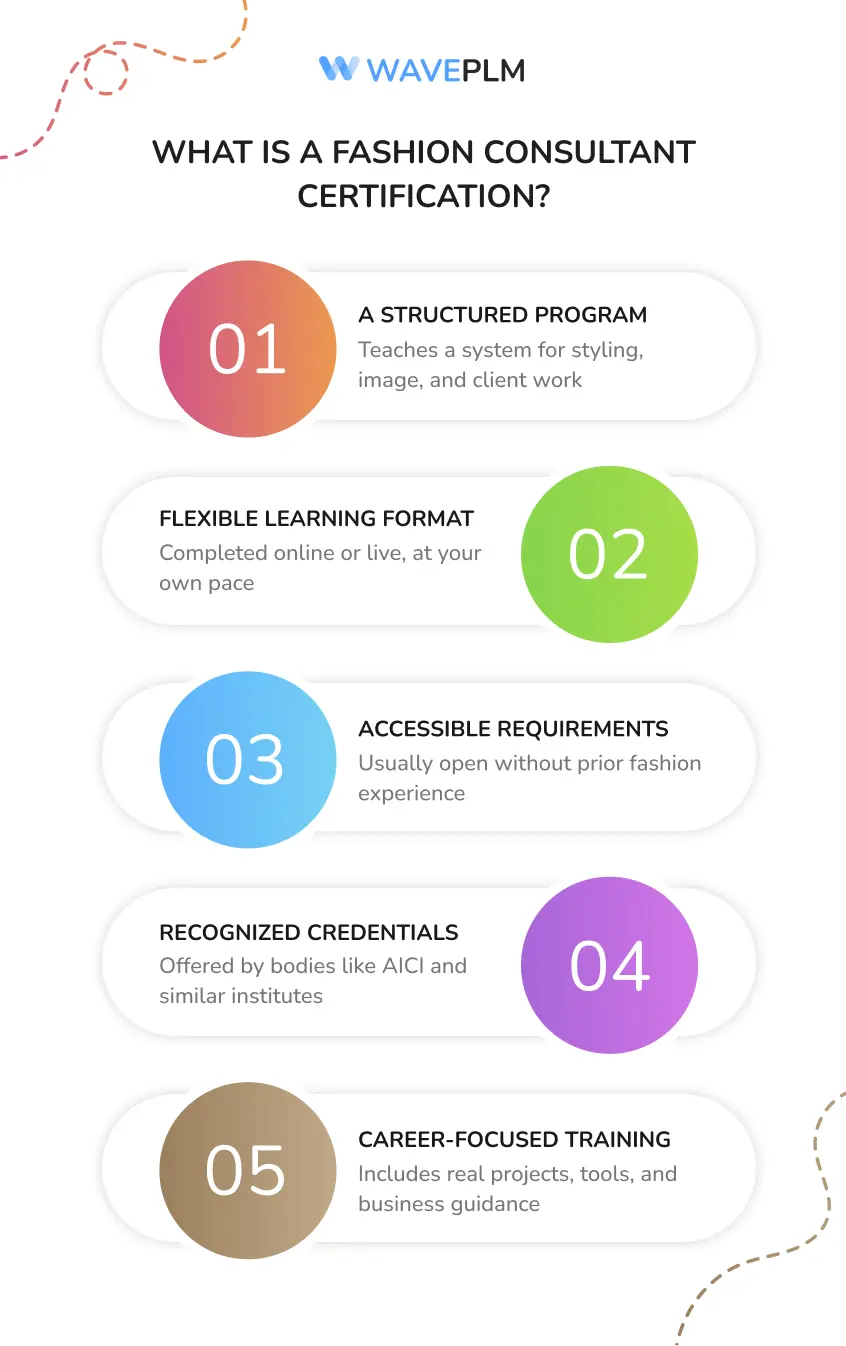
A fashion consultant certification is a professional certification that teaches you a structured system. Most programs teach fashion styling, personal styling, and image consulting. Students can complete fashion consultant courses in a flexible timeframe, ranging from a few weeks to several months. A high school diploma is the minimum educational requirement for fashion consultants, while degrees in fashion design, merchandising, or marketing are preferred.
You usually complete a course, pass assessments, and earn a certificate. Common certification bodies include the International Career Institute and theAssociation of Image Consultants International (AICI). The Association of Image Consultants International (AICI) offers widely recognized credentials like the Certified Image Consultant (CIC).
Many fashion consultant certification programs do not require previous experience or education for entry. Some programs run as online courses. Others offer live sessions. Many let students learn at their own pace.
Certification courses for fashion consultants often include practical training and skills development. Many fashion consultant courses offer job search assistance to help graduates find employment.
A good program gives you:
- a repeatable process for working with clients
- practical styling projects and case studies
- tools to run an image consulting business
- guidance from professionals in the fashion world
Fashion consultant certification programs often include modules on color analysis, wardrobe planning, and personal branding.
How do you become a certified consultant?
You can become certified by:
- Choosing a recognized course
- Completing all the materials and assignments
- Practicing on real people or test clients
- Submitting styling projects for review
- Passing the final evaluation
- Receiving your certificate
Some programs also connect you with an international association. This can help you network with other professionals.
Is Certification Required to Be a Fashion Consultant?
No. Most places do not require certification.
Honestly, clients rarely ask for a license. And they care about results, trust, and confidence.
They want you to answer questions like:
- Can you improve my personal image?
- Can you help me dress for my career?
- Can you shop within my budget?
- Can you explain what works for my body and lifestyle?
So why do people still invest in a fashion consultant certification? Because it can speed up your learning. It can also help you feel ready to charge for your services at a professional level. For example, Style Coaching Institute offers a Certified Style Coach™ Diploma that combines styling with self-image psychology.
Also, internships and retail experience are recommended for building industry networks and hands-on styling proficiency.
Quick decision guide
| Question | If you say yes | What to do next |
|---|---|---|
| Do you feel unsure about how to start? | Yes | Consider a course with structure |
| Do you already style friends and get results? | Yes | Build a portfolio and client base |
| Do you want clients to trust you faster? | Yes | Add a professional certification |
| Do you want to build your own business? | Yes | Choose a program with business training |
Benefits of Getting Certified
Certification can help your fashion consulting career in several ways.
Some certification programs also cover collaboration with a professional makeup artist to create complete looks for clients.
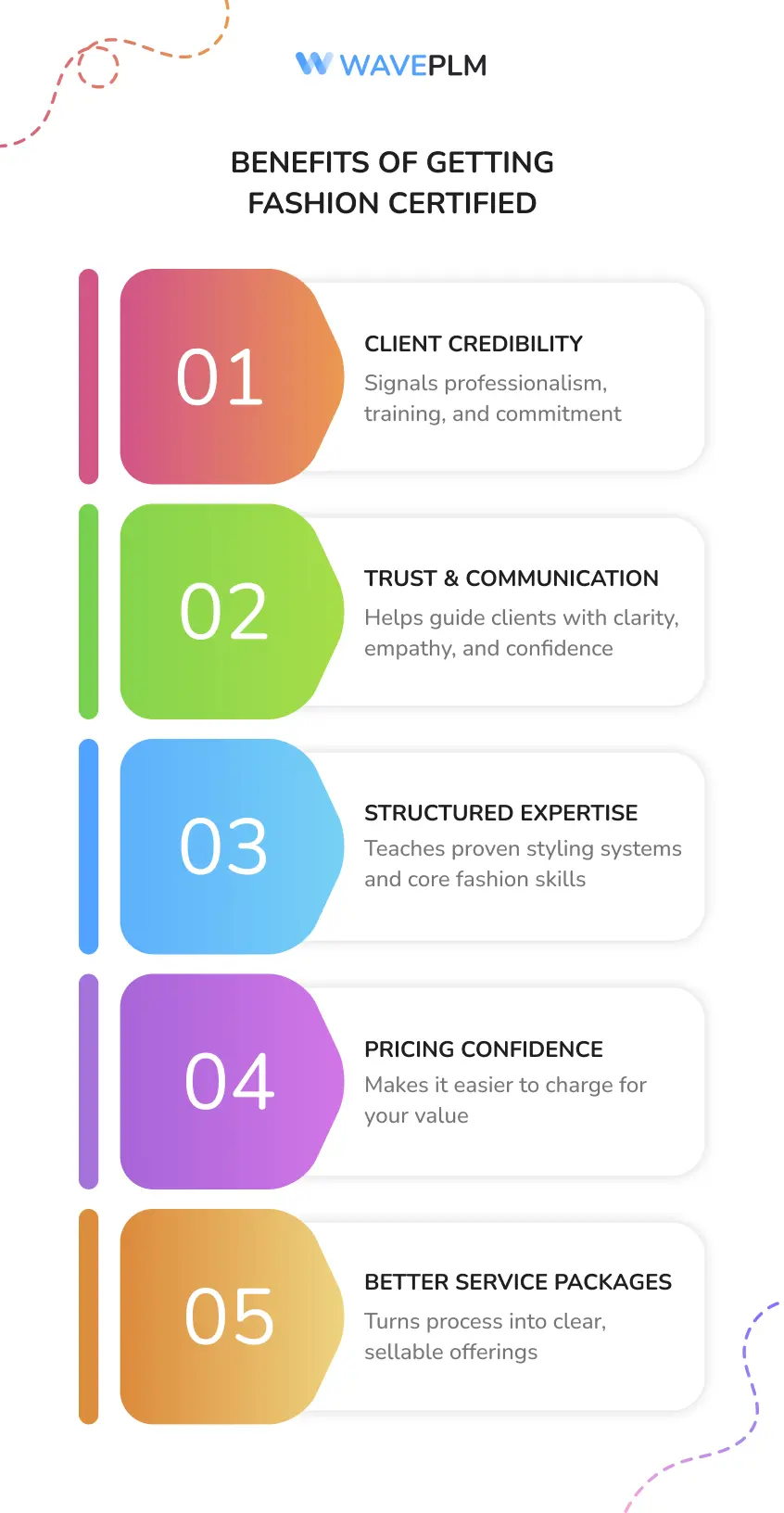
1) Credibility with clients
Clients feel nervous about style decisions. They worry about wasting money on clothing that does not work.
A certificate signals commitment.
It tells clients you trained for the work and you take their image seriously.
2) Stronger trust and communication
Style feels personal. Many clients feel vulnerable.
They may worry about judgment or body image.
Training can strengthen your communication skills. It can help you guide clients with kindness and clarity.
3) Structured knowledge and essential skills
You can learn fashion styling from online content. But random tips do not create a full system.
A strong course teaches essential skills, such as:
- personal styling methods
- color analysis and basic color theory
- wardrobe planning systems
- shopping strategy and outfit building
- how to support different clients and lifestyles
4) Faster confidence to charge
New stylists often undercharge.
Certification can help you price your services with more confidence.
5) Better packages and better results
When you build a structured process, you can create clear packages.
This makes it easier to sell and easier to deliver.
Here are examples:
- Closet Reset + 30 Outfit Plan
- Executive Style Upgrade
- Personal Shopping Trip for Workwear
- Seasonal Capsule Wardrobe Build
Limitations of Fashion Consultant Certifications
Certification helps, but it does not solve everything.
1) A certificate does not replace experience
You can finish a course and still struggle with real clients.
Real wardrobes include real problems:
- emotional attachment to clothes
- limited budgets
- changing life routines
- body changes
Experience teaches you how to adapt.
2) Some programs skip business skills
Many online courses teach fashion styling but ignore business.
But you need a consulting business to earn money.
You must learn:
- marketing
- pricing
- onboarding
- client management
- retention
3) Quality varies
Some programs offer deep practical training. Others feel basic.
You should evaluate any course before you buy.
Who Should Consider Certification (and who may not need it)
This section makes the decision easier.
Certification fits you if:
- you want a roadmap to build a career
- you want to work with individual clients professionally
- you want structure and feedback
- you want to build an image consulting business
- you want to advance faster with less trial and error
You may not need certification if:
- you already work as a fashion stylist
- you already have paying clients
- you already have strong expertise and a portfolio
- you want to learn through practice at your own pace
Decision table
| Your goal | Best next step |
| Start a fashion consulting career from zero | Get a structured course |
| Move from stylist to consultant | Add business training and a certificate |
| Work with executives and public image goals | Consider training with image consultants |
| Work with brands and fashion designers | Build a portfolio and network |

Certification vs Real-World Experience
Certification gives knowledge. But experience gives proof.
Participating in or understanding fashion shows can provide valuable real-world experience for fashion consultants. And you need both if you want long-term success in the fashion industry.
What real experience teaches
- how to handle a client who hates shopping
- how to guide women who want confidence without changing identity
- how to manage budgets during personal shopping
- how to style different body types
- how to plan outfits for real life
The best path for most students
Try this strategy:
- Take a course and learn the system
- Practice on 3–5 test clients
- Document results with photos and notes
- Collect testimonials
- Launch paid packages
- Improve your process every month
This approach helps you develop skills while building a client base.
How Do I Become a Fashion Consultant? (Step-by-Step Guide)
If you want to become a fashion consultant, you can follow this plan.
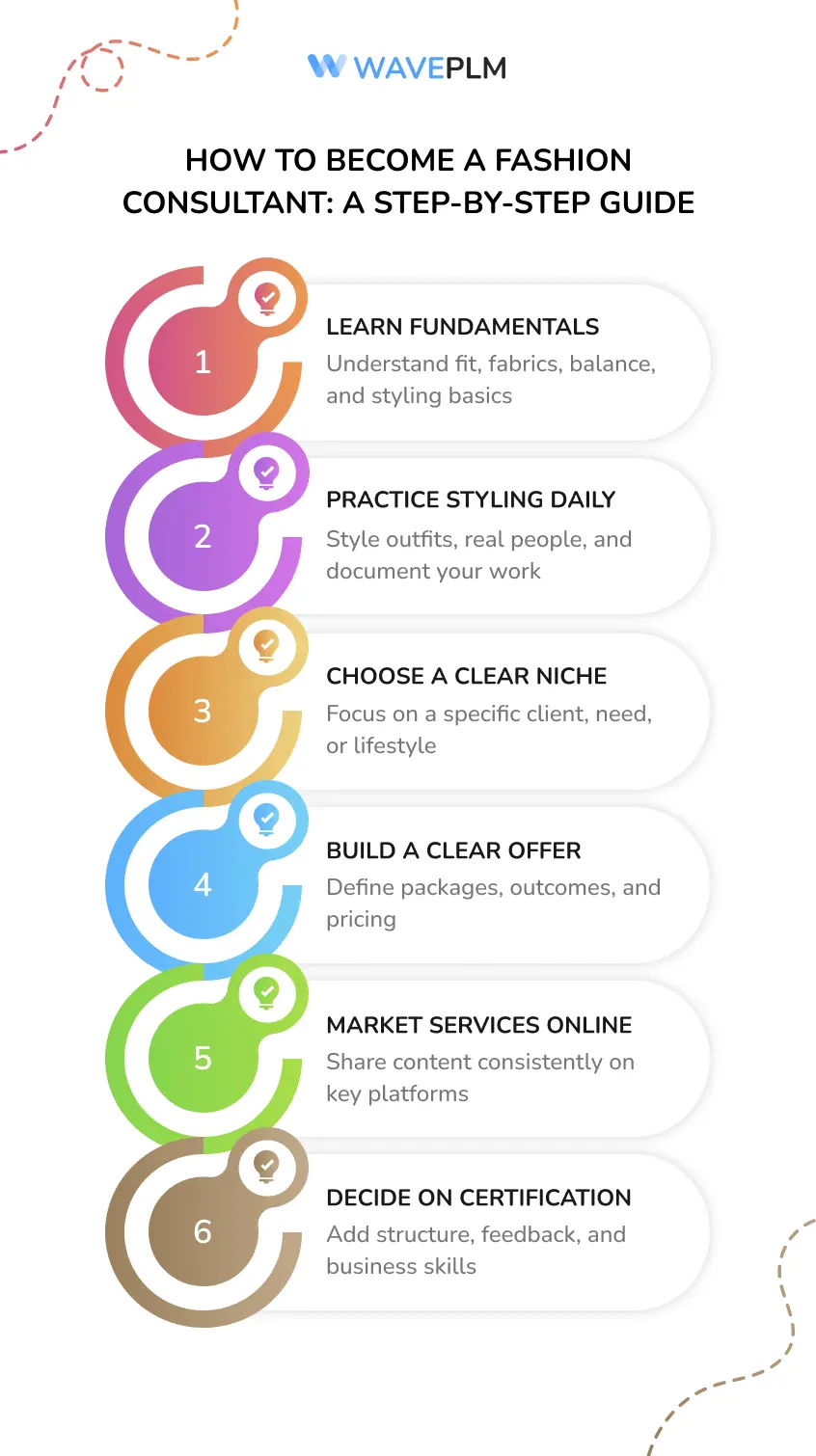
Step 1: Learn fashion basics
Start with:
- fit and proportion
- fabrics and quality
- outfit balance
- accessories and styling details
You do not need a degree in fashion design. But you should understand how clothing works.
Step 2: Practice fashion styling daily
You can practice fashion styling with:
- your own outfits
- friends and family
- styling projects you document online
Practice helps you build speed and confidence.
Step 3: Choose a niche
A niche helps your business grow faster.
Examples:
- workwear for new managers
- wardrobe upgrades for career transitions
- minimal capsule wardrobes
- style for creative professionals
Step 4: Build your offer
Your offer should include:
- clear packages
- clear outcomes
- clear pricing
Step 5: Start marketing online
You can build your career online through:
- blog content
- short videos
Consistency matters.
Step 6: Decide on certification
If you want structure, choose a fashion consultant certification or style consultant certification.
Look for:
- practical assignments
- feedback
- business modules
- portfolio support
What Degree Do You Need to Be an Image Consultant?
Most image consultants do not need a specific degree.
Many come from:
- fashion
- marketing
- retail
- beauty
- communications
Some start as a personal stylist. Others start as a personal shopper.
You can build an image consulting career through training, practice, and results. Because if you want extra credibility, a professional certification can help.
How Fashion Consulting Is Evolving With Technology & Data
Fashion consulting has changed. Clients now expect speed, clarity, and online convenience.
1) Virtual services grow fast
Many stylists now offer:
- online closet audits
- virtual outfit planning
- digital shopping links
This helps you support clients anywhere in the world.
2) Data helps clients shop smarter
Clients want fewer mistakes. And according to current sustainability trends, they want to stop buying clothes they never wear.
You can track:
- cost per wear
- outfit repetition
- wardrobe gaps
Even simple tracking improves results.
3) Brands rely on systems
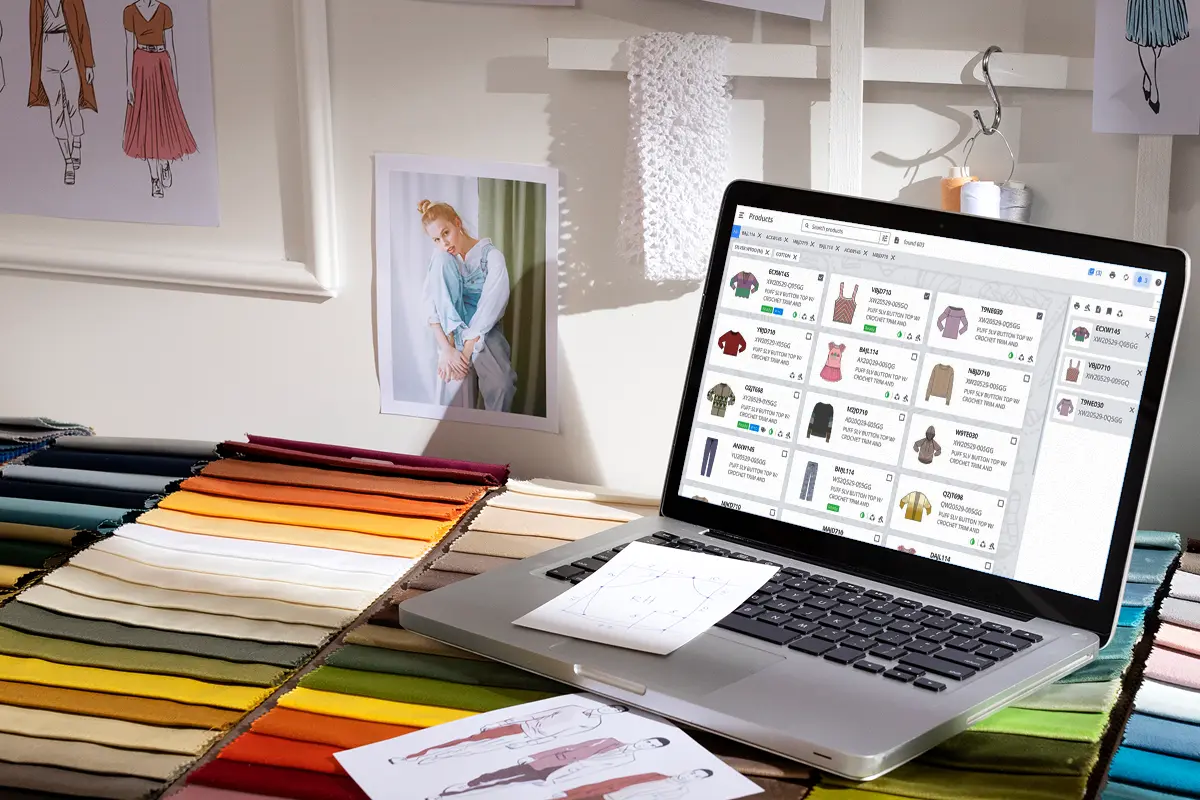
Fashion brands move fast. They need better workflows. Fashion designers and product teams use tools to manage product data, timelines, and collaboration.
This is where PLM matters. Wave PLM supports modern fashion teams with organized product development workflows.
Templates You Can Copy and Use
These templates help you run a consulting business with clarity.
Template 1: Service package menu
| Package | Best for | Includes | Result |
| Style Reset Session | New clients | goals + style plan | clear direction |
| Closet Edit + Outfit Plan | Busy clients | closet audit + outfit formulas | less stress |
| Personal Shopping Trip | Quick upgrades | store plan + try-ons | faster results |
| Capsule Wardrobe Build | Minimal style | shopping list + outfits | easy daily style |
Template 2: Client intake questions
- What do you want your style to say about you?
- What is your lifestyle and weekly routine?
- What clothes do you avoid and why?
- What trends do you love right now?
- What is your budget for clothing?
- What is your biggest style struggle?
- What brands do you wear most?
- What accessories do you use often?
- Do you want help with personal image for work or social life?
- What result do you want in 30 days?
Conclusion
Of course, you can build a successful fashion consulting career without a certification.
That said, a fashion consultant certification can help you get started faster, build credibility, and present yourself at a more professional level — especially early on.
If you want a clear roadmap, choose a strong course with practical training. And if you already have experience, focus on what drives real growth: measurable results, smart marketing, and building your own consulting business.
For more guides, visit blog.waveplm.com to explore fashion careers, key fashion fields, and how the industry works today.





Leave a Reply