

Fashion industry benchmarking has become a strategic priority for executives across the fashion industry. As market volatility increases, fashion companies can no longer rely on intuition or lagging financial results. They need measurable metrics that reveal how business operations perform in real time. The USFIA Fashion Industry Benchmarking Study, produced in collaboration with the University of Delaware’s Department of Fashion & Apparel Studies, provides an academic research foundation for industry benchmarking.
Leading fashion brands use fashion industry benchmarking to understand how their own company compares to industry averages and industry standards. This practice goes beyond revenue tracking. It focuses on execution, resilience, and the ability to adapt to business challenges.
This guide explains how fashion industry benchmarking works today, what leading fashion brands measure, and why many fashion companies still overlook the most critical benchmarks. The article places particular focus on operational signals that shape long-term performance and competitive edge.
Introduction to Benchmarking
Benchmarking is a powerful strategic tool that enables fashion companies to evaluate their performance within the broader fashion industry. By systematically comparing their processes, products, and services against those of leading fashion brands and industry standards, companies can identify areas for improvement and maintain a competitive edge.
In today’s fast-paced fashion ecosystem, benchmarking is essential for addressing business challenges such as supply chain disruptions and forced labor risks. It empowers fashion companies to make informed decisions, drive continuous improvement, and foster a culture of sustainability. By leveraging benchmarking, brands can adapt to evolving market demands, strengthen their supply chain, and ensure they stay competitive in an ever-changing industry landscape.

Beyond Revenue: What Really Indicates Performance
Revenue reflects past decisions. Fashion industry benchmarking focuses on what predicts future outcomes. Industry leaders track performance metrics that show how effectively teams execute strategy.
Recent benchmarking studies report the percent of respondents who prioritize specific performance metrics, providing insight into which areas receive the most attention from industry executives.
Fashion companies increasingly rely on key performance indicators tied to speed, accuracy, and consistency. These measurable metrics reveal friction inside the fashion system long before margins decline.
Leading indicators used by fashion companies
| Benchmark Area | Description | Business Impact |
|---|---|---|
| Development cycle time | Time from concept to production approval | Predicts speed-to-market |
| Change frequency | Number of revisions per style | Indicates complexity risk |
| Data rework | Manual data corrections | Reveals data gaps |
| Decision latency | Approval turnaround time | Signals operational drag |
Fashion and apparel studies consistently show that companies tracking these indicators respond faster to supply chain disruptions and shifting consumer preferences.
Speed-to-Market Benchmarks
Speed remains one of the top business challenges in the fashion industry. Shorter product lifecycles and volatile consumer behavior demand faster execution.
Leading fashion brands benchmark speed at every milestone. They measure variance, not just averages. This focus supports continuous improvement across teams.
Common speed benchmarks
| Stage | Measurable Metric |
| Concept to line adoption | Days per style |
| Design to first proto | Days to sample |
| Proto to cost approval | Revision cycles |
| Cost approval to PO | Commitment lead time |
Fashion industry benchmarking studies show that brands with predictable timelines outperform those chasing raw speed. Consistency reduces shipping delays and cost increases.
Product Complexity Benchmarks
Product complexity directly impacts sourcing costs, product quality, and supply chain stability. Many fashion companies underestimate its impact.
Industry leaders benchmark complexity to identify areas where unnecessary variation increases risk. They compare style architecture across seasons and categories. Benchmarking also encourages fashion companies to look beyond their own industry and explore practices and ideas from other sectors to foster innovation and manage complexity.
Product complexity benchmarks
| Metric | Purpose |
| BOM line count | Measures construction complexity |
| Fabric reuse rate | Indicates material standardization |
| Trim compliance | Tracks approved component usage |
| Style-to-SKU ratio | Reveals option explosion |
Apparel studies confirm that reducing unmanaged complexity helps fashion companies expand sourcing opportunities without sacrificing creativity.
Product Quality and Innovation Benchmarks
In the fashion industry, product quality and innovation are key drivers of success. Fashion companies and leading fashion brands use benchmarking to evaluate their products against industry standards, ensuring they meet or exceed consumer expectations. By tracking key performance indicators and performance metrics related to product quality, brands can identify areas for improvement and inspire innovation across their collections. This approach not only helps companies align with industry averages but also uncovers new sourcing opportunities and markets. By continuously assessing and refining their product quality and innovation benchmarks, fashion companies can respond to emerging trends, expand their sourcing strategies, and maintain their position as industry leaders.

Customer Preference Programs
Understanding consumer behavior is crucial for fashion companies aiming to stay competitive in the fashion industry. Customer preference programs provide valuable insights into what drives consumer choices, allowing fashion brands to tailor their products and services accordingly. By analyzing measurable metrics such as customer retention rates, purchase patterns, and social media engagement, companies can identify areas for improvement and develop targeted strategies to enhance customer satisfaction. These preference programs enable brands to build stronger relationships with their customers, foster loyalty, and adapt quickly to shifting consumer preferences. Prioritizing customer feedback ensures that fashion companies remain agile and responsive in a rapidly evolving industry.
New Sourcing Opportunities
The global fashion industry is constantly adapting to new challenges and opportunities, particularly in sourcing. U.S. fashion companies are actively exploring new sourcing opportunities, especially in the Western Hemisphere, to diversify their supply chains and reduce exposure to geopolitical risks and policy uncertainty. By expanding sourcing beyond traditional markets, fashion companies can create more resilient and agile business operations.
This proactive approach allows companies to respond swiftly to changing consumer preferences and market conditions, driving continuous improvement and supporting long-term competitiveness. Embracing new sourcing opportunities not only mitigates risks but also positions fashion companies to capitalize on emerging trends and innovations within the industry.

Supplier Reliability Benchmarks
Supplier reliability shapes supply chain resilience. Political instability related issues, geopolitical risks, and other political instability increase pressure on sourcing practices. U.S. fashion companies, including retailers, are facing growing sourcing risks due to an uncertain economy, forced labor risks, and supply chain disruptions.
U.S. fashion companies are actively exploring new sourcing opportunities in emerging destinations in Asia and the Western Hemisphere.
Fashion industry benchmarking evaluates suppliers beyond price. Leading fashion brands track reliability over time. Managing the risk of forced labor in the supply chain is a top priority for U.S. fashion companies in 2024.
Supplier performance benchmarks
| Benchmark | What It Measures |
| On-time milestone rate | Development reliability |
| Cost accuracy | Quote versus final cost |
| Issue recurrence | Process maturity |
| Compliance history | Forced labor risks |
U.S fashion companies actively exploring new sourcing opportunities use these benchmarks to manage geopolitics and policy uncertainty.
Data Consistency & Version Control Benchmarks
Data fragmentation creates hidden business challenges. Multiple data sources slow decision-making and increase errors.
Industry leaders benchmark data consistency as part of fashion industry benchmarking strategy. Clean data supports better business outlook planning.
Data governance benchmarks
| Metric | Insight |
| Duplicate records | System fragmentation |
| Manual overrides | Process breakdown |
| Version conflicts | Collaboration gaps |
| Approval rollbacks | Ownership clarity |
Fashion companies that address data gaps improve alignment across sourcing, design, and merchandising teams.
Industry Benchmarking Methodologies
Effective industry benchmarking methodologies are essential for fashion companies seeking to evaluate their performance and drive continuous improvement. The United States Fashion Industry Association (USFIA) conducts an annual Fashion Industry Benchmarking Study, offering key findings and insights into current industry trends and business challenges. By leveraging comparative analysis and performance metrics, fashion companies can assess their business operations, prioritize sourcing practices, and make data-driven decisions.
Adopting a structured approach to industry benchmarking enables companies to identify best practices, address critical challenges, and implement transformative changes within the fashion ecosystem. This commitment to benchmarking ensures that fashion companies remain agile, innovative, and competitive in a rapidly evolving industry.

Why High-Performing Brands Benchmark Continuously
Annual reviews no longer support modern fashion business models. Market volatility requires ongoing visibility.
Industry leaders benchmark continuously to monitor trends across the supply chain. This approach supports faster response to supply chain disruptions.
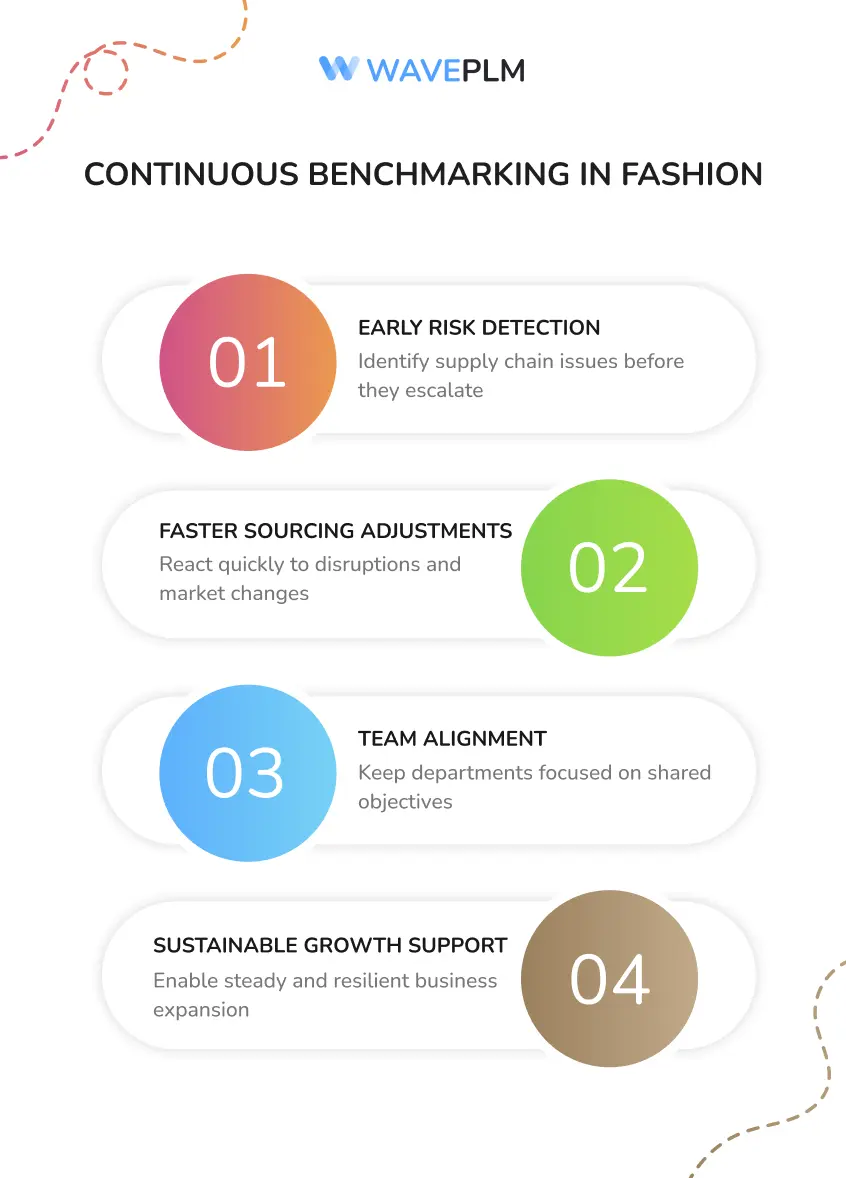
Continuous benchmarking helps companies:
- Identify areas of risk early
- Adjust sourcing practices quickly
- Align teams around business objectives
- Support sustainable growth
Respondents plan to increase investment in continuous benchmarking over the next five years, according to recent fashion industry benchmarking study findings.
How Digital Systems Enable Real-Time Benchmarking
Manual benchmarking fails at scale. Spreadsheets cannot reflect real-time business operations. Digital platforms centralize data and standardize workflows. This structure enables accurate industry benchmarking.
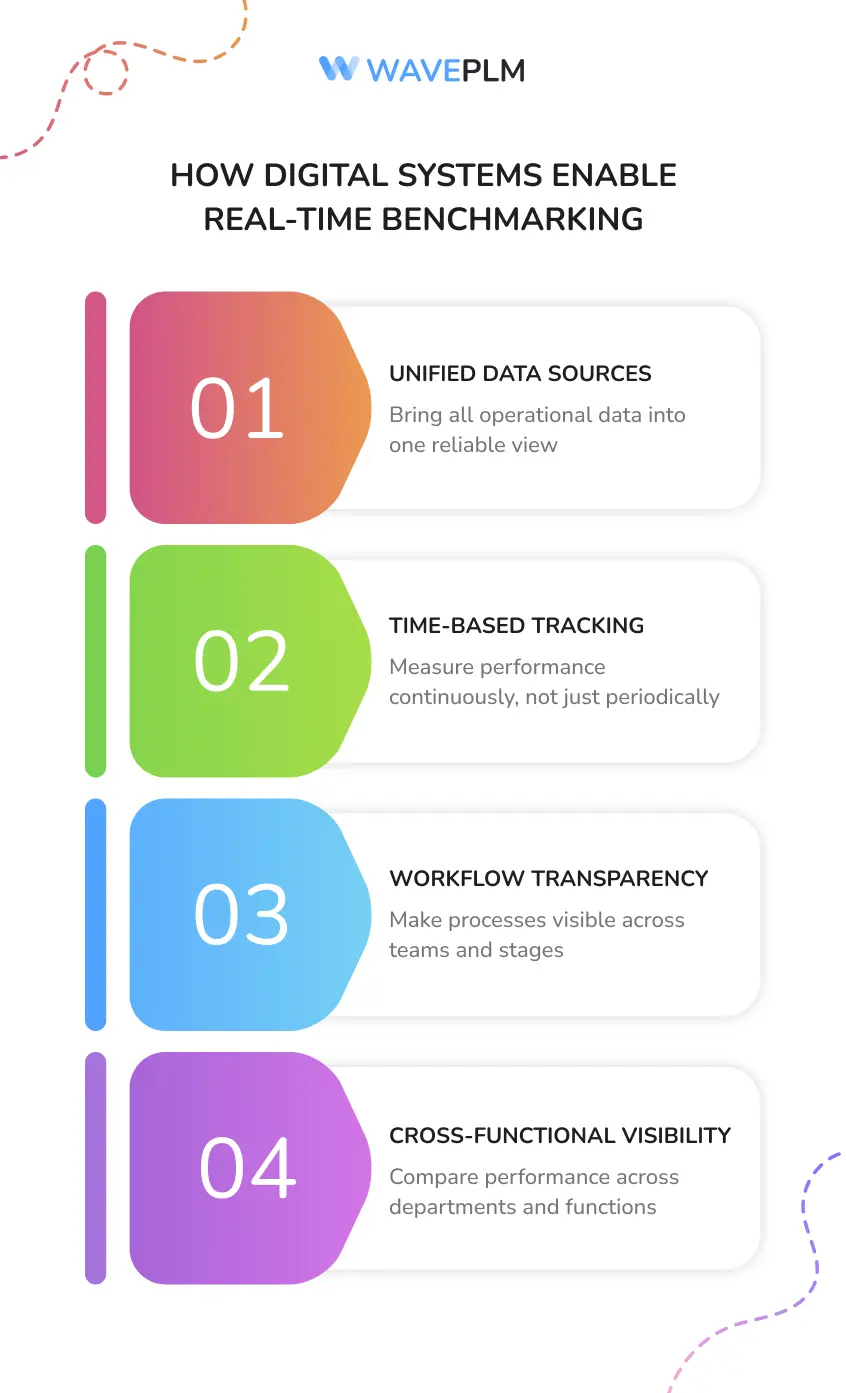
Key capabilities include:
- Unified data sources
- Time-based tracking
- Workflow transparency
- Cross-functional visibility
Executives rely on these systems to compare performance against industry averages and key findings from apparel studies.
How PLM Supports Long-Term Benchmarking Strategy
Product Lifecycle Management plays a central role in fashion industry benchmarking. PLM captures how products evolve across the fashion ecosystem.
Wave PLM enables fashion companies to define benchmarks once and track them continuously. The platform connects design, sourcing, and supply chain teams within a single system.
With Wave PLM, companies can:
- Monitor speed-to-market benchmarks in real time
- Track product complexity across seasons
- Evaluate supplier reliability using consistent data
- Reduce version conflicts and manual rework
Wave PLM supports apparel industry best practices by creating a single source of truth. This structure allows executives to compare their own company performance against leading fashion brands and industry standards.

Conclusion
Fashion industry benchmarking has evolved into a strategic discipline. Leading fashion brands focus on execution, not just outcomes.
They benchmark speed, complexity, supplier reliability, and data health. They use measurable metrics to guide decisions amid trade policy shifts, free trade agreements, and protectionist trade policy agenda pressures.
For a comprehensive analysis and key insights, access the full report of the 2024 USFIA Fashion Industry Benchmarking Study.
Digital platforms and PLM systems make this approach scalable. In 2026, fashion industry benchmarking focuses on balancing operational efficiency with sustainability and digital engagement standards. Benchmarking also encourages fashion companies to explore practices and ideas from other sectors to foster innovation and creativity. Wave PLM helps fashion companies transform benchmarking into a long-term competitive edge.
Key takeaways
- Benchmark leading indicators, not just revenue
- Track supply chain performance continuously
- Use data consistency as a performance signal
- Leverage PLM to support strategic benchmarking
Fashion companies that adopt this mindset enter the year ahead with clarity, resilience, and confidence.





Leave a Reply