
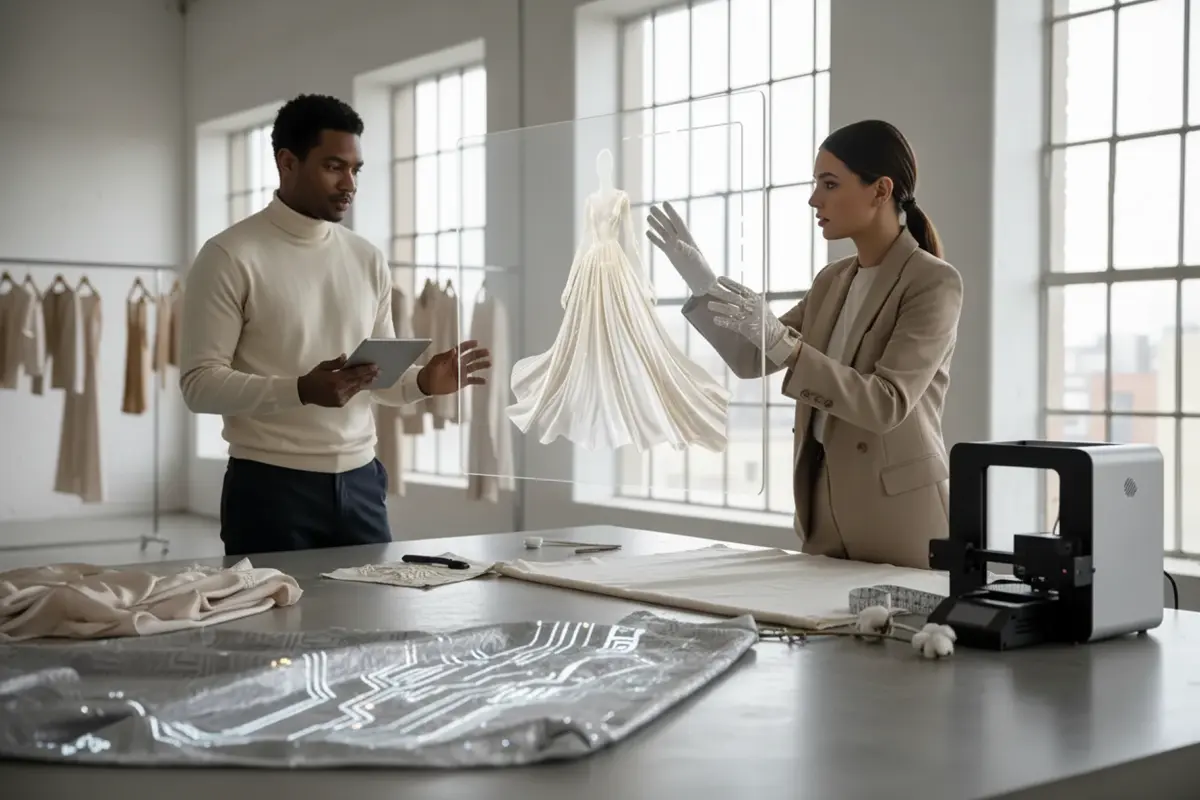
Fashion technology changes how fashion brands design, develop, and sell products. It also changes how the fashion industry plans collections and runs supply chain operations. You can see fashion and technology everywhere, from 3D design to smart clothing. Advanced technology is a key driver of innovation in the fashion industry, powering sustainable fabric development, smart textiles, and 3D printing. You can also see fashion and tech in stores through augmented reality and virtual try ons.
This guide explains fashion technology in a simple way. You will learn the biggest areas of fashion tech, real examples, key benefits, and common challenges. You will also learn why PLM sits at the center of the fashion industry’s digital transformation.
Quick takeaways
- Fashion technology connects design, materials, production, retail, and sustainability.
- Fashion brands use 3D printing, artificial intelligence, and smart textiles to move faster.
- Virtual fashion, virtual reality, and augmented reality improve customer engagement.
- PLM creates a single source of truth for product data.
- WavePLM helps teams replace manual processes with connected workflows.
What Is Fashion Technology? (Simple definition)
Fashion technology means the tools and systems that help the fashion industry plan, design, develop, produce, and sell fashion products.
Fashion technology combines fashion design with digital tools. It supports the design process from the first sketch to the final shipment. It also helps supply chain management, inventory management, and compliance.
Think of fashion and technology as a team.
- Fashion designers bring creativity.
- Digital technology brings speed and accuracy.
- Data creates consistency across teams.
Fashion technology includes:
- 3D apparel design and computer aided design
- Digital sampling and virtual fitting rooms
- Wearable technology and smart garments
- Smart textiles and smart fabrics
- Supply chain tools and real time data dashboards
- Sustainability, traceability, and blockchain technology
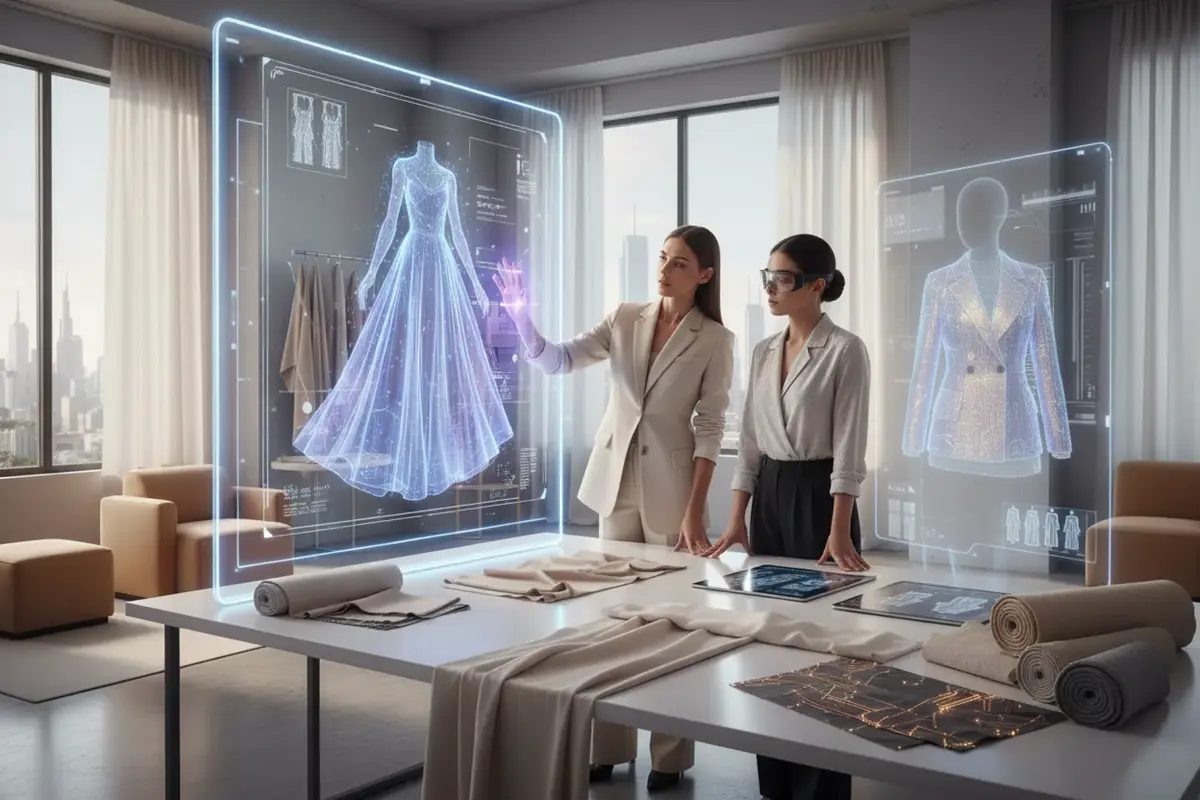
New technologies such as AI, IoT, and 3D printing are transforming the fashion business by improving design, production, and customer experience.
The technology of fashion supports the full product lifecycle. It turns ideas into products with fewer errors.
Why Fashion and Technology Are Merging Faster Than Ever
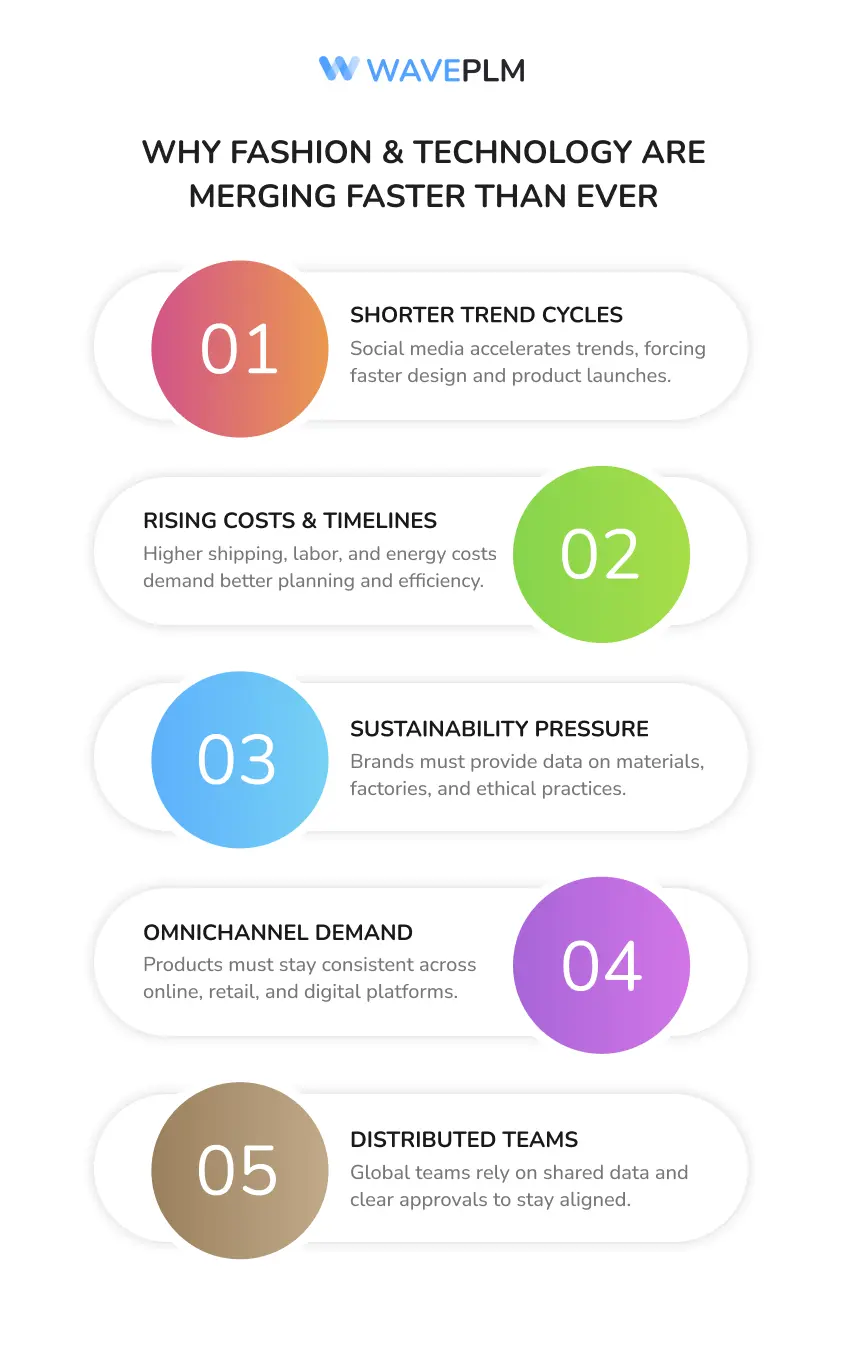
Fashion and technology merge fast because the market demands speed and transparency. The fashion industry also faces higher costs and stricter rules. Fashion brands must respond to new trends and protect margins. Staying updated with the latest trends in technology and sustainability is essential for brands to remain competitive in the evolving fashion landscape.
Here are the biggest reasons.
1) Shorter trend cycles
Social media speeds up the fashion world. Customers expect new drops more often. Fashion brands must design and launch faster.
2) Rising costs and tighter timelines
Shipping costs rise. Labor costs rise. Energy consumption rises. Brands must plan better and cut rework.
3) Stronger sustainability pressure
Customers want proof. Retail partners want evidence. Teams need data on raw materials, recycled materials, and factory practices.
Sustainable practices now affect pricing, contracts, and brand trust.
4) Omnichannel growth
Online shopping keeps growing. Stores still matter. Brands need accurate product data across every channel.
5) Distributed teams
Design, development, and production teams often work across regions. They need data sharing and clear approvals.
These drivers shape the future of fashion. They also explain the fashion industry’s digital transformation.
The Biggest Areas of Fashion Tech
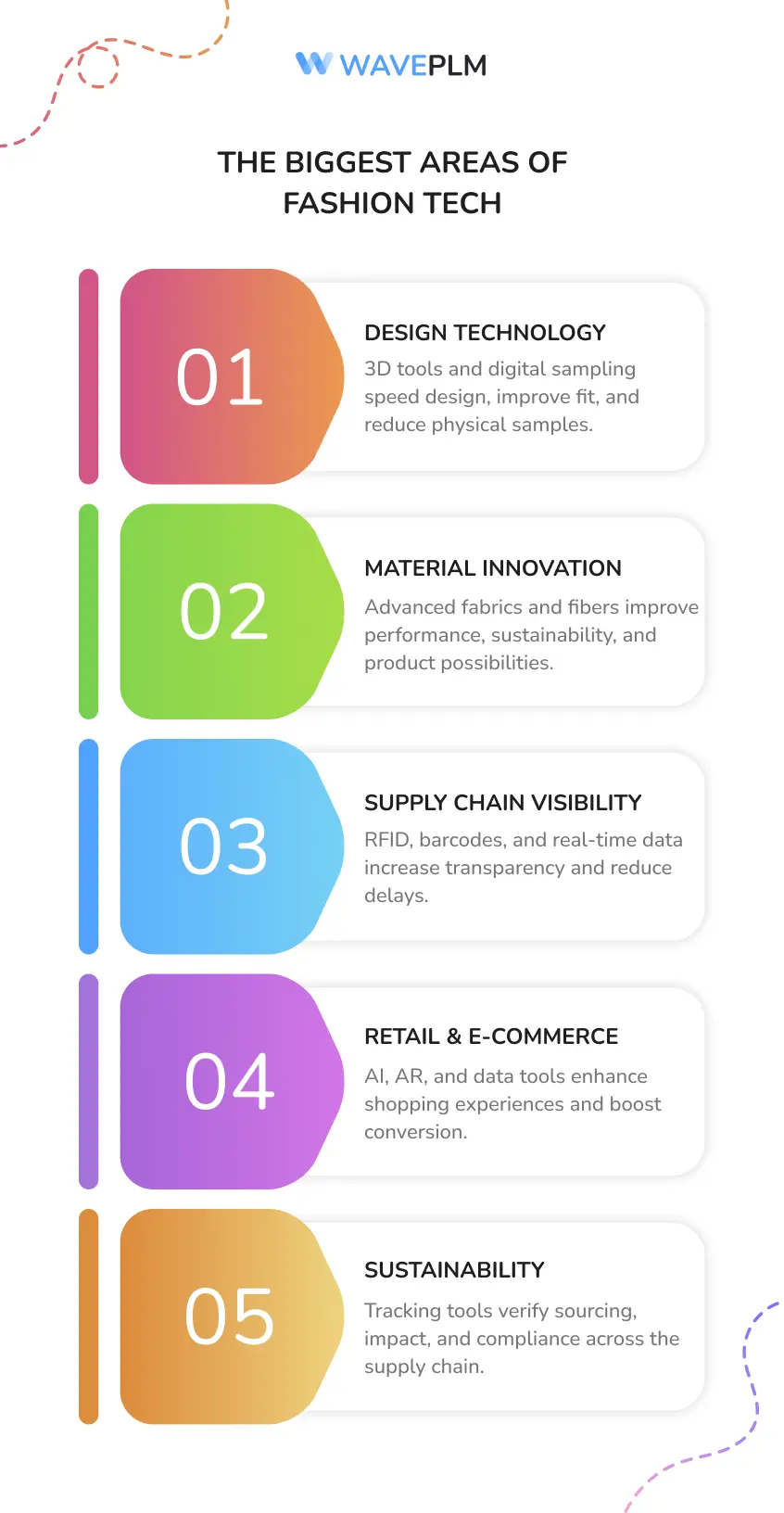
Fashion technology covers many areas. Some tools support fashion design. Other tools improve manufacturing processes and supply chain operations. The strongest fashion brands connect these tools through a shared system.
Design technology (3D, digital sampling)
Design technology helps fashion designers create and test products faster. By allowing designers to experiment, refine, and visualize ideas virtually, digital tools enable greater creativity and efficiency in the design process. Teams now use 3D design to preview fit, drape, and styling. They also use digital clothing assets for marketing and sales.
3D design and digital sampling help teams:
- Reduce physical samples
- Speed approvals
- Improve fit earlier
- Share specs with suppliers
3D printing also supports early prototyping. 3D printing in fashion allows designers to create and develop one-of-a-kind creations that can be tailor-made for the individual client. It helps teams test trims, components, and shapes quickly.
Common tools in design technology
| Tool type | What it does | Why it matters |
|---|---|---|
| 3D apparel design | Creates digital garments | Speeds design and fit reviews |
| Computer aided design | Builds patterns and details | Improves accuracy in fashion design |
| Digital color tools | Aligns color across devices | Reduces mistakes in approvals |
| Virtual prototyping | Simulates fit and drape | Cuts sample rounds |
| Digital libraries | Stores blocks, trims, artwork | Enables reuse and consistency |
Design process template
Use this simple template for each style:
- Define target customer and price point.
- Create sketch and mood board.
- Build 3D model and pattern.
- Run fit simulation and adjust.
- Lock color palette and materials.
- Create tech pack and size specs.
- Review with suppliers and update.
Material innovation
Material innovation changes what products are made from. It also changes how the fashion industry reduces environmental impact. Advanced technology is a key driver behind the development of innovative fabrics and fibers.
Many fashion brands now use recycled polyester, bio-based fibers, and new blends. They also use smart fabrics and smart textiles for performance products. Innovative fabrics, made using advanced technology and innovative fibers, offer new possibilities in style and performance while prioritizing reducing environmental impact.
Wearable tech and smart clothing also rely on material innovation. These products use built in sensors to collect health data or track movement. Biotechnology in textile production allows fashion designers to utilize natural, organic components to make stronger, better, and more sustainable textiles.
Material innovation can support:
- Performance and comfort
- Lightweight durability
- Water resistance and breathability
- New business models like digital wearables
Material innovation checklist
Use this checklist when you evaluate a fabric:
- Fiber content and origin
- Raw materials source and processing steps
- Test results and performance claims
- Certifications and standards
- MOQ, lead time, and pricing
- Care requirements and returns risk
- End-of-life options and circular fashion potential
Production and supply chain tech
Supply chain technology improves planning, vendor collaboration, and production control. It also supports supply chain transparency.
These tools reduce delays and cut extra inventory.
Key tools include:
- Production schedules and capacity planning
- Supplier portals and digital approvals
- Quality tracking and issue management
- RFID and barcode tracking
- Real time data for status updates
3D printing also supports production testing. Teams use it for tooling and sample components.
Supply chain tech table
| Use case | Example technology | Outcome |
| Capacity planning | Planning software | Fewer delays |
| Tech pack automation | PLM templates | Fewer errors |
| Order tracking | RFID, barcode scans | Better visibility |
| Quality checks | Mobile apps | Faster issue resolution |
| Supplier collaboration | Vendor portals | Less back-and-forth |
Retail and e-commerce tech
Retail technology improves how customers discover and buy products. It also supports store teams with better data.
Fashion and tech in retail includes:
- Artificial intelligence recommendations
- Augmented reality try-on tools
- Virtual try on technology for fit and style
- Virtual fitting rooms
- Inventory management systems
- Mobile apps for customer engagement
Augmented reality plays a big role here. Augmented Reality (AR) creates virtual showrooms, digital runways, and virtual try-ons, allowing customers to see products in their own space before buying. AR uses digital elements like visuals, sounds, and 3D renderings to create immersive shopping experiences, such as virtual try-ons, virtual showrooms, and interactive retail environments. Augmented reality (AR) overlays digital images onto real-world views, allowing customers to visualize how garments will look before purchasing them. AR technology can streamline the design development process by allowing designers to unveil collections through interactive fashion shows and provide virtual try-on experiences. AR experiences can increase conversion rates significantly, showing the impact of immersive technology on purchasing decisions. Many fashion brands use augmented reality for product discovery and storytelling.
Virtual try ons also reduce returns. They help shoppers choose the right size.
E-commerce product page template
Use this template for each product page:
- Clear product name and category
- Key benefits in short bullets
- Fit notes and size guidance
- Material details and certifications
- Care instructions
- High-quality images and 360 views
- Shipping and return details
Sustainability and traceability tech
Sustainability tools help brands measure impact and prove claims. Traceability tools show where materials come from and how factories make products.
These tools support sustainable fashion goals. They also support environmental responsibility.
This area of fashion technology includes:
- Traceability platforms
- Digital product passports
- Carbon footprint tools
- Chemical compliance tools
- Blockchain technology for chain-of-custody
Blockchain technology can help teams verify data. It can also help reduce fraud in certifications.
Traceability data you should track
| Data point | Why it matters |
| Material origin | Supports claims and compliance |
| Factory location | Builds transparency |
| Certifications | Proves standards |
| Processing steps | Helps risk control |
| Transport routes | Improves emissions reporting |
Examples of Fashion Technology in Real Life
You already see fashion technology in daily life. Many fashion brands use it behind the scenes. Major brands and luxury companies are leading the way in adopting advanced fashion technologies to improve transparency, sustainability, and operational efficiency. Some brands also use it in the physical world through stores and experiences.
Here are real examples.
Virtual fashion shows and digital collections
Brands create virtual fashion experiences in virtual environments. They build digital clothing for digital avatars. They also use virtual reality for immersive launches.
Virtual fashion creates new creative possibilities. It also supports new business models.
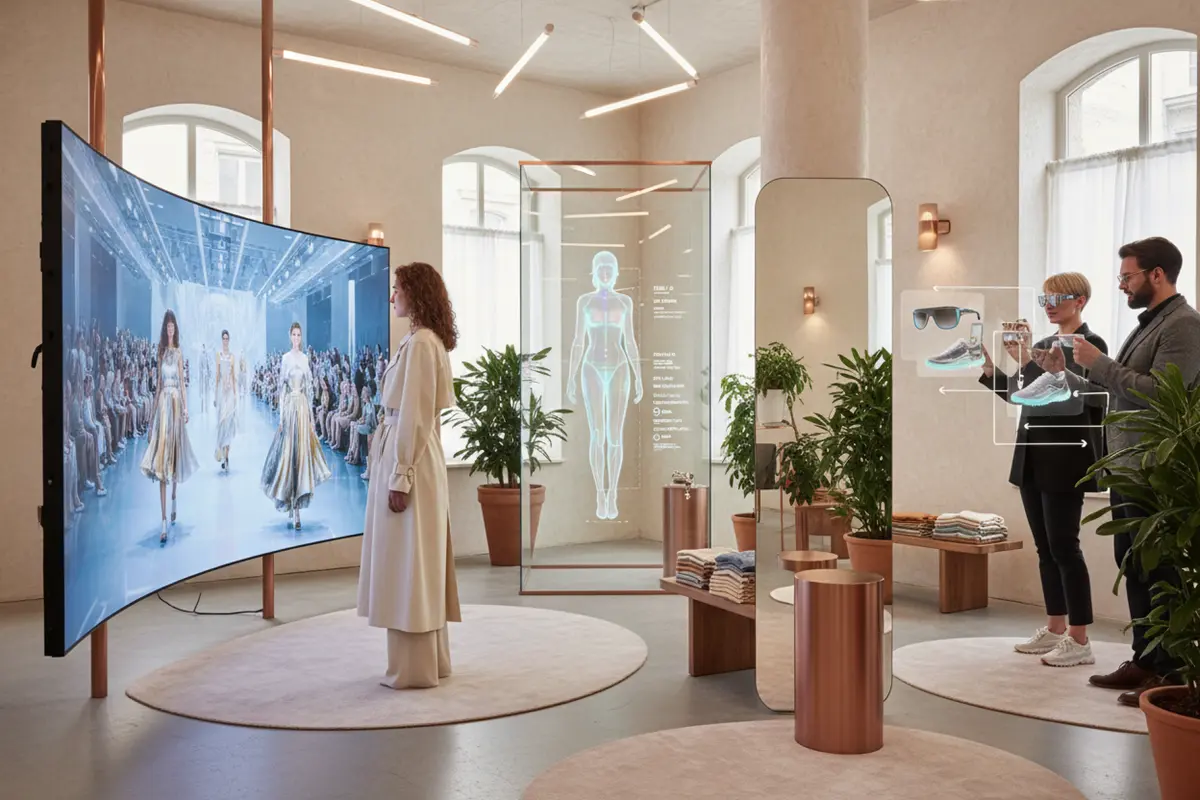
Augmented reality try-ons
Many fashion brands use augmented reality for sunglasses, shoes, and cosmetics. Shoppers use mobile apps to test products instantly.
Augmented reality improves customer engagement. It also supports personalized shopping experiences.
Virtual try ons and virtual fitting rooms
Virtual try ons help customers choose size and fit. Virtual fitting rooms also reduce returns in online shopping.
Some brands combine virtual try ons with real time data from customer profiles.
Wearable technology in sportswear
Wearable technology tracks movement and supports training. Wearable tech can also track health data and recovery.
Smart garments include smart clothing with built in sensors. Some products connect to wearable gadgets.
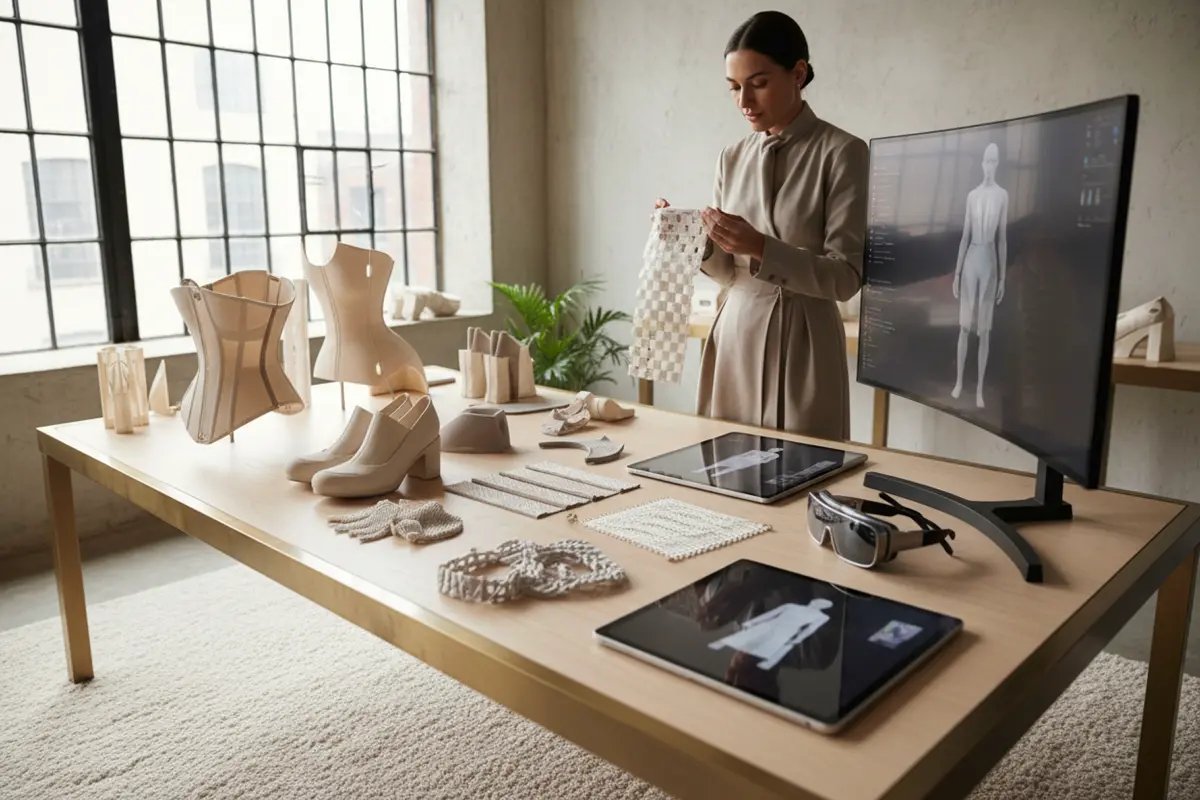
3D printing in design and development
Teams use 3d printing to create trims and prototypes. They use 3d printing to test shapes and structures.
Some fashion brands also use 3d printing for limited-edition products.
Benefits of Fashion Tech for Brands
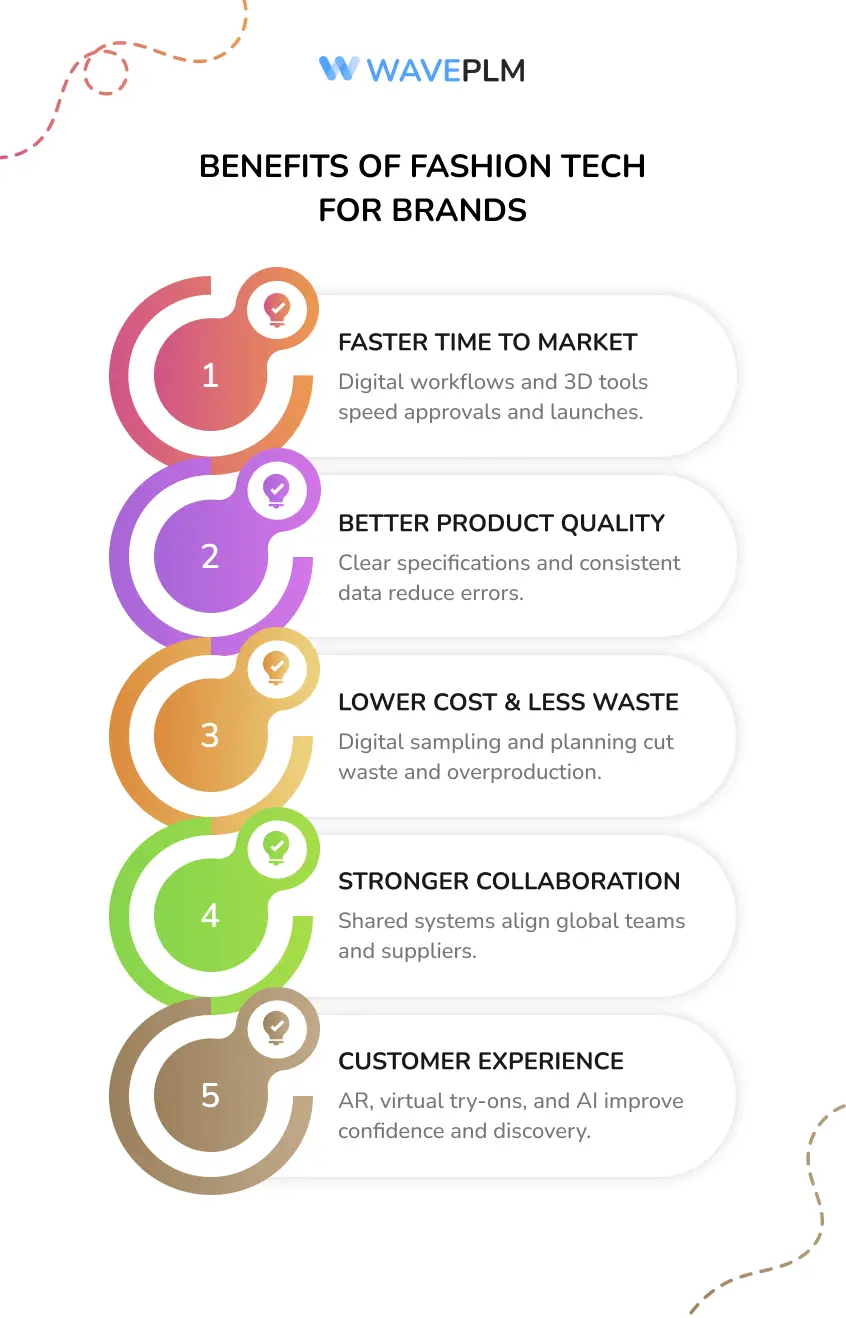
Fashion technology delivers clear value when teams choose the right tools. It helps fashion brands move faster and improve quality. By adopting advanced technologies, brands can gain a competitive advantage by staying ahead of trends, optimizing operations, and enhancing customer experiences.
Faster time to market
Digital workflows speed approvals. 3D tools reduce sample rounds. Teams launch collections faster.
Better product quality
Clear specs reduce mistakes. Consistent data improves manufacturing processes.
Lower cost and less waste
Digital sampling reduces physical samples. Better planning reduces overproduction.
Stronger collaboration
Shared tools reduce confusion. Teams align across time zones.
Better customer experience
Augmented reality and virtual try ons improve confidence. AI recommendations improve discovery.
Quick summary table
| Benefit | What improves | Why it matters |
| Speed | Approvals and sampling | More drops, fewer delays |
| Accuracy | Specs and BOM data | Fewer production errors |
| Sustainability | Materials and traceability | Stronger brand trust |
| Profit | Planning and inventory management | Lower markdown risk |
| Experience | Fit and personalization | Higher conversion |
Challenges (data silos, integration, cost, training)
Fashion and technology also create challenges. Many brands buy tools without a plan. In contrast, traditional manufacturing often leads to material waste, longer lead times, and limited customization, highlighting the need for thoughtful integration of new technology.
Data silos
Teams store data in emails and spreadsheets. Data silos block collaboration and slow decisions.
Integration problems
Tools must share product data. Integration issues create duplicate work and errors.
Cost pressure
Fashion technology tools require investment. Teams must track ROI with clear metrics.
Training and adoption
Tools fail when teams skip training. Teams need role-based onboarding and simple workflows.
Adoption checklist
- Define the workflow before you buy tools.
- Assign owners for each dataset.
- Train users by role.
- Start with one category.
- Track KPIs like time to approval and sample rounds.
Why PLM Is the Foundation of Fashion Technology
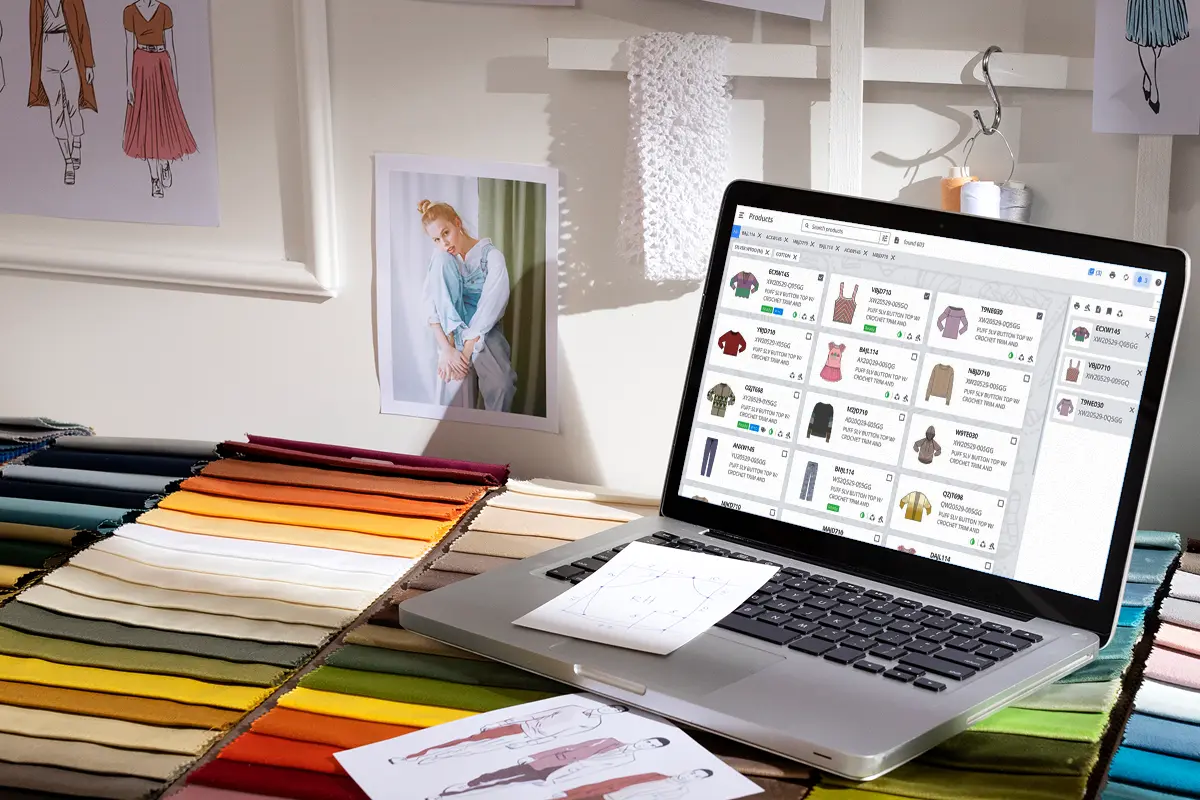
PLM stands for Product Lifecycle Management. It stores product data and connects teams across the fashion industry. It also connects fashion design, sourcing, and production.
Fashion technology tools need a central place for:
- Style data and seasonal plans
- BOMs, trims, and raw materials
- Measurements and grading
- Tech packs and spec updates
- Colorways and material options
- Supplier and factory data
- Costing and approvals
PLM also supports the integration of digital capabilities, such as sensors, smart fabrics, and embedded circuits, enabling enhanced product functionality and user experience in modern fashion.
Without PLM, teams rely on manual processes. They also rely on traditional methods like spreadsheets and email chains.
With PLM, fashion and technology work together in one flow. PLM becomes the single source of truth.
PLM foundation model
| Stage | PLM role | Output |
|---|---|---|
| Plan | Track seasons and line plans | Line plan |
| Design | Store concepts and assets | Approved designs |
| Develop | Manage samples and specs | Tech pack |
| Source | Control materials and costs | Final BOM |
| Produce | Manage approvals and changes | Production-ready data |
| Sell | Share product data to channels | Accurate listings |
How WavePLM Helps Teams Manage Fashion Tech Workflows
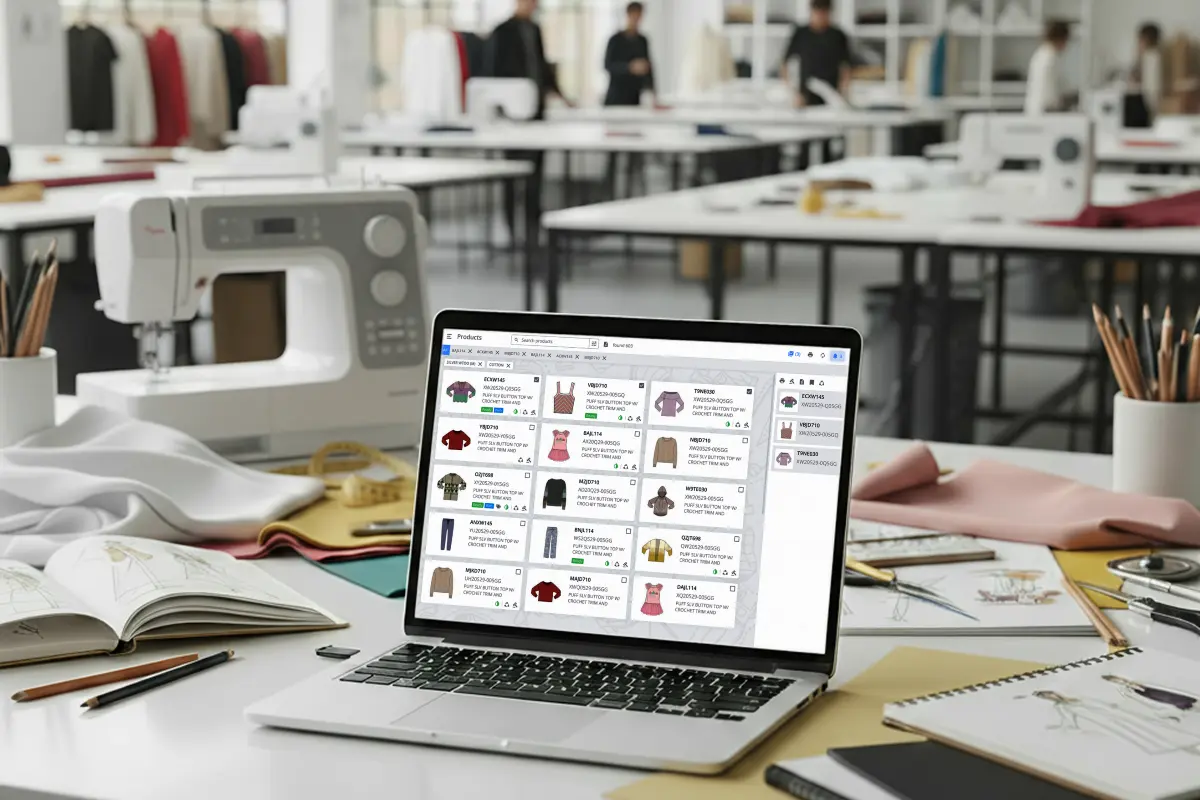
Wave PLM supports fashion technology with a clean system for product data and workflows. It helps fashion brands connect teams and reduce friction. Wave PLM can also integrate with AI-powered tools to enhance design, inventory management, and customer experience.
Wave PLM helps teams:
- Build accurate tech packs fast
- Manage BOMs and material libraries
- Store certifications and compliance files
- Track samples, comments, and approvals
- Support supplier collaboration
- Reduce duplicate work
- Improve data sharing across teams
Wave PLM supports teams that use 3D design and digital sampling. It also supports teams that manage smart textiles, smart fabrics, and wearable technology programs.
Wave PLM workflow template
- Create style and season.
- Add base specs and measurements.
- Build BOM with approved materials.
- Generate tech pack.
- Track samples and feedback.
- Lock costs and final BOM.
- Approve for production.
- Share product data with sales and e-commerce.
This workflow supports supply chain management and production schedules. It also reduces delays.
Latest fashion technology trends to watch
Trends change fast in the fashion world. These trends shape what fashion brands invest in next.
1) More 3d printing use
Brands use 3d printing for faster prototyping. Brands also use 3d printing for custom components.
2) Smarter wearable technology
Wearable technology expands beyond fitness. Smart garments now support safety, workwear, and health.
3) More smart textiles and smart fabrics
Smart textiles improve temperature control and durability. Smart fabrics also support new aesthetics.
4) Stronger artificial intelligence adoption
Artificial intelligence supports forecasting and merchandising. AI also supports design exploration.
5) More virtual fashion and digital fashion
Brands create digital fashion drops. They also sell digital clothing for gaming and social platforms.
FAQ: Fashion Technology Questions
This section answers common questions. It also helps your page match broad educational search intent.
What technology is used in fashion?
Fashion brands use many tools.
- Computer aided design and 3D design tools
- 3d printing for prototypes and components
- Artificial intelligence for forecasting and personalization
- Augmented reality and virtual reality for shopping
- Blockchain technology for traceability
- RFID and barcode tracking for supply chain visibility
- Wearable technology and smart clothing systems
These tools support fashion design, production, and retail.
What is fashion technology?
Fashion technology means the systems that power fashion design, development, production, and sales. It connects the fashion industry with cutting edge technology. It also supports supply chain transparency and sustainability.
What is the 3-3-3 rule in fashion?
The 3-3-3 rule is a simple styling rule.
- Choose 3 tops.
- Choose 3 bottoms.
- Choose 3 pairs of shoes.
You can mix these items into many outfits. Many stylists use it to build a capsule wardrobe.
What are the 10 modern technologies?
Here are 10 modern technologies that impact the fashion industry.
- Artificial intelligence
- Augmented reality
- Virtual reality
- 3d printing
- Blockchain technology
- Internet of Things sensors
- RFID tracking
- Computer aided design
- Advanced analytics
- Cloud collaboration tools
These technologies support both the physical world and the digital realm.
Conclusion
Fashion technology keeps reshaping the fashion industry. It helps fashion brands design faster, reduce waste, and improve customer engagement. It also improves supply chain operations and supports sustainable fashion.
Fashion and technology will keep merging. Brands that connect tools through PLM will move faster and reduce risk.
Start with strong product data. Then connect design, materials, production, and retail tools around that core.


Leave a Reply