
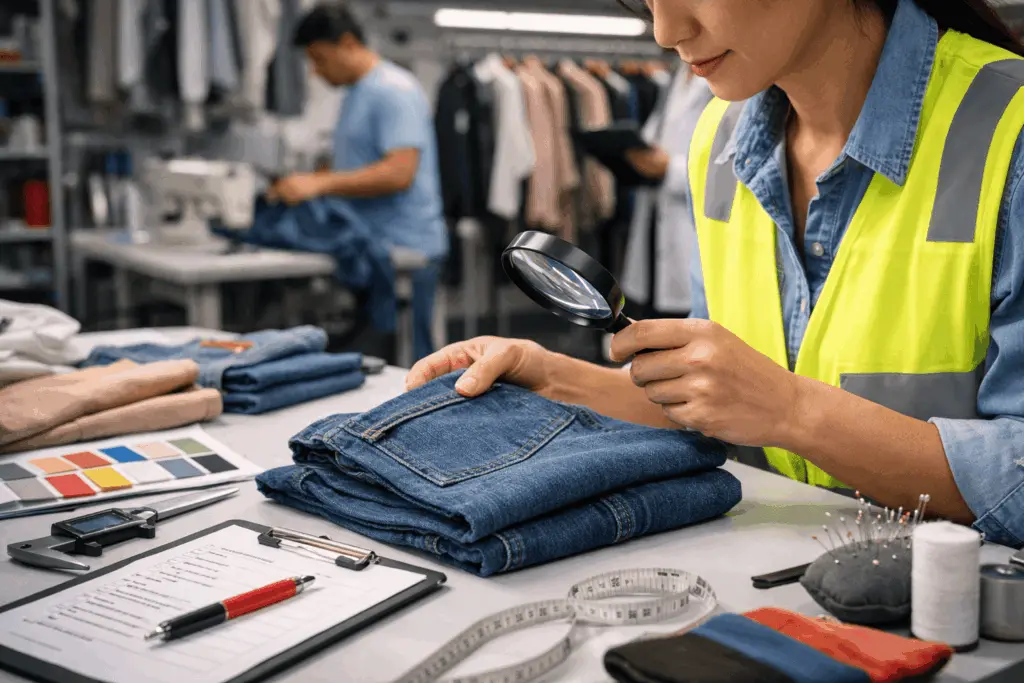
Every brand knows that a single defective shipment can undo years of trust. A customer who receives a poorly stitched jacket, a faded T-shirt, or a pair of trousers with uneven seams rarely gives a second chance. In a market flooded with options, quality control in the clothing industry is not a formality — it is the foundation of a sustainable fashion business.
This guide explains what garment quality control actually involves, why it matters at every stage of production, which inspection methods work best, and how modern PLM systems help brands move from reactive problem-solving to proactive quality management across the entire fashion supply chain.
What Is Quality Control in the Apparel Industry?
Quality control in the apparel industry refers to the set of processes and standards used to verify that garments meet defined specifications before they reach customers. These specifications cover materials, construction, measurements, colour accuracy, labelling, packaging, and safety requirements.
Unlike quality assurance — which is about building a system that prevents defects — quality control in clothing focuses on detecting problems through direct inspection and testing at specific checkpoints. Quality control builds consumer loyalty, ensures compliance, and improves profitability by reducing waste.
In practical terms, garment quality control asks a simple question at every stage of production: does this product match what was agreed?
“In apparel manufacturing, quality is not a department. It is a discipline that runs from the first fabric swatch to the last garment packed for shipment.”
Because fashion brands often work with multiple factories across different countries, quality control in the apparel industry becomes especially complex. A brand may source fabric from one supplier, trims from another, and produce garments in a third country entirely. Each hand-off introduces risk. Without structured quality control procedures, defects multiply and returns become costly. Quality control ensures products are durable, comfortable, and meet expectations.
Why Garment Quality Control Matters More Than Ever
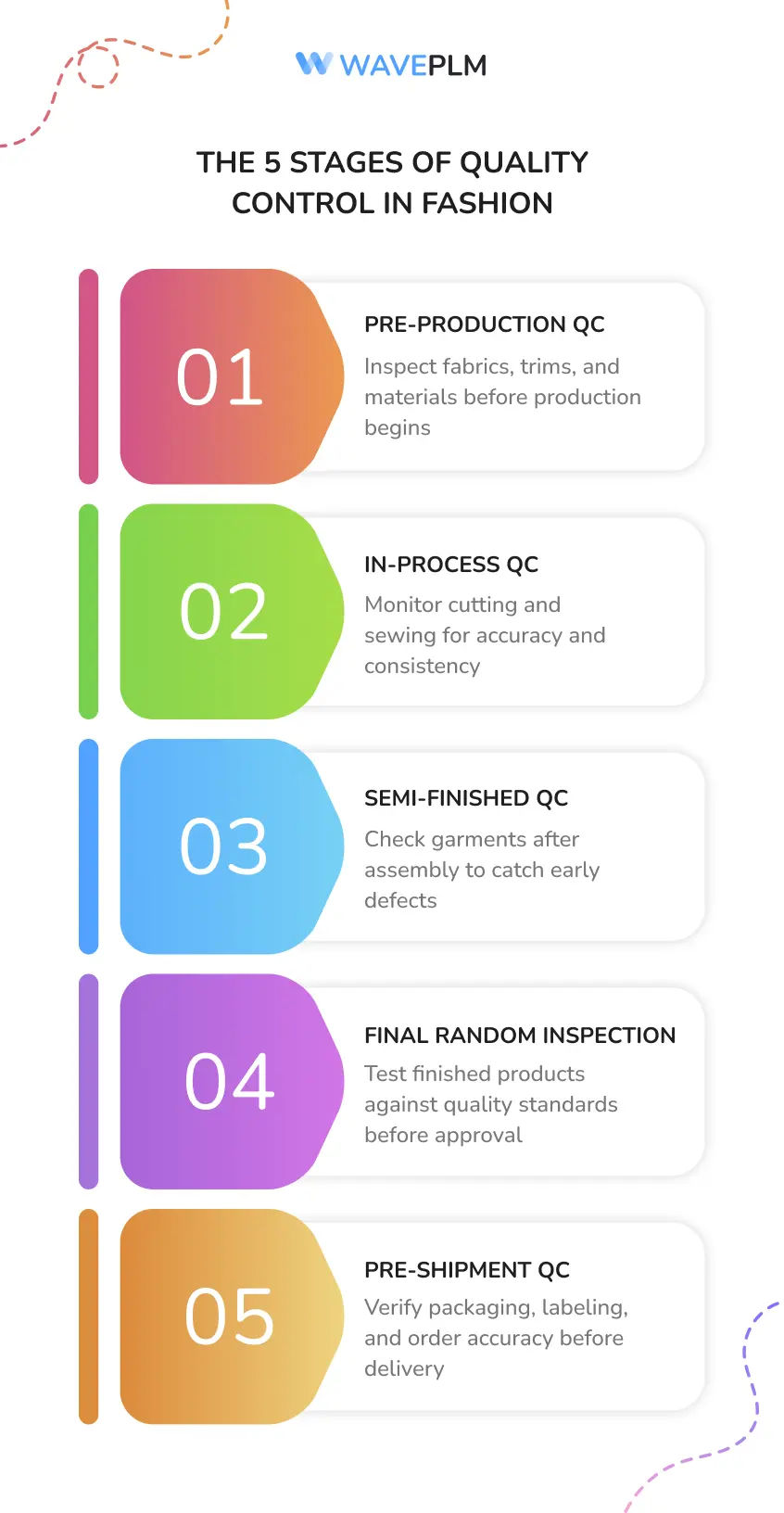
Three forces make quality control in clothing increasingly critical for modern brands.
Consumer expectations are higher
Today’s customers compare products instantly. Reviews, social media posts, and influencer content expose poor quality publicly and permanently. A single viral complaint about fabric pilling or inconsistent sizing damages brand perception in ways that are difficult and expensive to reverse.
Global supply chains are more complex
As explored in the Wave PLM guide to clothing supply chain issues, fashion value chains now involve dozens of suppliers, subcontractors, and logistics providers. More complexity creates more opportunities for defects to slip through undetected. Quality control checkpoints act as the safety net across this network.
Fast fashion has raised the speed-quality tension
Speed-to-market pressure encourages shortcuts. When brands compress development timelines, sampling stages get reduced and factory oversight weakens. This is a structural risk — and it explains why fast fashion struggles chronically with quality issues compared to better-planned production cycles.
Key Insight. Brands that invest in early-stage quality control — during design development and sampling — spend significantly less correcting problems at the production and shipment stage. Prevention is always cheaper than correction in apparel QC.
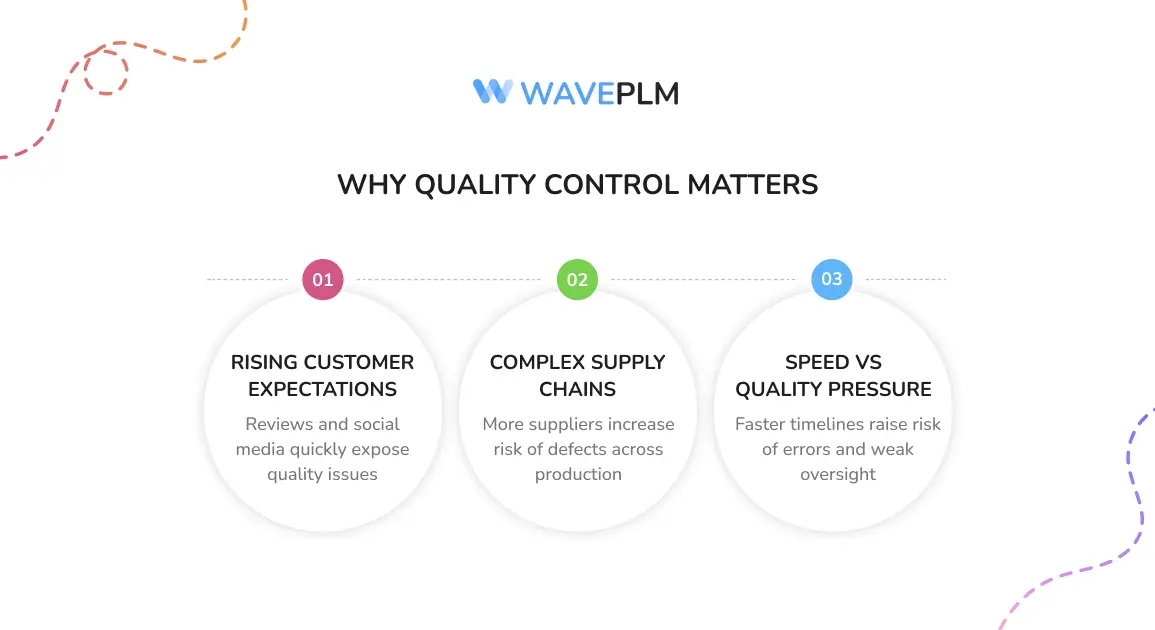
The 5 Stages of Quality Control in the Clothing Industry
Effective garment quality control is not a single inspection at the end of production. It is a structured process with checkpoints at every major stage of the product lifecycle.
Pre-Production QC — Fabric & Material Inspection
Checking incoming fabrics, trims, and accessories against approved standards before production begins. Covers colour, weight, shrinkage, and defects per metre.
In-Process QC — During Cutting & Sewing
Monitoring production lines in real time. Includes checking marker accuracy during cutting and verifying stitch density, seam allowances, and construction methods during sewing.
Semi-Finished QC — After Assembly
Inspecting garments after major assembly steps but before finishing. Helps catch structural issues before they become expensive to fix at the end of the line.
Final Random Inspection (FRI)
A statistical sample of finished garments inspected according to AQL (Acceptable Quality Limit) standards. Determines whether the batch is approved for shipment.
Pre-Shipment QC
The final gate before goods leave the factory. Verifies packaging, labelling, carton marks, and that the shipment matches the purchase order.
The AQL Standard in Apparel Quality Control
Implementing quality control measures can significantly reduce production costs by minimising defects and rework.
The Acceptable Quality Limit (AQL) is the most widely used statistical standard for final random inspections in apparel manufacturing. It defines the maximum number of defects acceptable in a batch before the shipment is rejected.
Under AQL, defects are divided into three categories:
| Defect Type | Description | Common AQL Level |
|---|---|---|
| Critical | Safety hazard or non-compliance with legal requirements (e.g. sharp metal, toxic dye) | 0 — zero tolerance |
| Major | Affects function or salability (e.g. wrong measurements, broken zipper, mismatched colour) | AQL 2.5 |
| Minor | Cosmetic issue unlikely to affect use (e.g. loose thread, slight asymmetry in pocket) | AQL 4.0 |
The inspector selects a sample size based on total shipment quantity and the agreed AQL level. If the number of defective pieces found in the sample exceeds the allowed threshold, the entire batch is rejected or placed on hold for 100% re-inspection.
Understanding AQL is essential for any brand working with third-party factories. It gives both parties a neutral, objective standard to refer to — reducing disputes and setting clear expectations from the start.
Common Quality Defects in Garment Manufacturing
Knowing what to look for is half the work of effective quality control in the clothing industry. The most common garment defects fall into three categories: fabric defects, construction defects, and finishing defects.
Fabric Defects
- Broken yarns or holes in woven fabrics
- Shading variations between fabric rolls used in the same garment
- Incorrect weight or hand-feel compared to approved swatch
- Shrinkage exceeding tolerance after washing
- Colour bleeding or poor dye fastness
Construction Defects
- Incorrect measurements — bust, waist, hem length outside tolerance
- Twisted seams or off-grain construction
- Incorrect stitch density causing weak seams
- Open seams, skipped stitches, or puckering
- Misaligned buttons, buttonholes, or zippers
Finishing & Packing Defects
- Stains, marks, or soiling from handling
- Loose threads not trimmed
- Incorrect or missing care labels
- Wrong size labels or barcode errors
- Incorrect folding, poly-bagging, or carton marking
The Role of Sampling in Garment Quality Control
Quality control and sample clothing development are deeply interconnected. Each sample type in the fashion development process serves a dual purpose: it advances the design, and it acts as a quality checkpoint.
The Pre-Production Sample, for example, must exactly match the approved tech pack before factories can begin bulk production. If construction details in the pre-production sample deviate from specifications, QC teams flag and correct them before thousands of units are produced incorrectly.
Similarly, the Top of Production (TOP) sample is pulled directly from the bulk run. It confirms that the factory is manufacturing garments that match what was approved — not just what was made during the sample stage. Many quality failures occur precisely at this transition, when factories switch from careful sample-making to high-speed bulk production.
🔗 Related Reading. For a detailed breakdown of each sample type and its role in the development cycle, see: Sample Clothing: Why It Still Matters in the Age of Virtual Design
Tech Packs and BOM: The Foundation of Quality Control
Quality control in the clothing industry does not begin on the factory floor. It begins with documentation. Two documents form the backbone of garment QC: the tech pack and the Bill of Materials (BOM).
A tech pack provides factories with precise specifications: measurements, construction methods, stitch types, trim details, and care labelling requirements. A complete and accurate tech pack reduces interpretation errors. When factories know exactly what is required, quality deviations become easier to identify and justify.
The BOM table lists every component in a garment — fabrics, threads, linings, zippers, buttons, labels, and packaging. During quality inspections, QC teams cross-reference the actual components used against the approved BOM. If a factory substitutes a different zipper brand without approval, the BOM comparison will catch it immediately.
Together, the tech pack and BOM create the quality standard against which every garment is measured.

How Design Development Affects Quality Outcomes
One of the most underappreciated connections in apparel manufacturing is between design development quality and production quality. Decisions made during the design development phase directly determine how difficult or easy it will be to manufacture consistently.
Complex construction details — unusual seam placements, intricate topstitching, special fabric manipulation — are harder to replicate at scale. Every additional complexity adds another potential failure point in production. Design teams that collaborate closely with QC and production specialists during development create garments that are both creative and manufacturable.
This is why leading fashion brands invest in design-for-manufacturability early in the product lifecycle, rather than discovering production challenges only after samples arrive.
Quality Control in the Apparel Industry: Inspection Methods
Brands use three primary models for quality control inspections in apparel manufacturing.
| Inspection Model | Who Performs It | Best For |
|---|---|---|
| In-house QC team | Brand’s own employees placed at factory | Key suppliers, high-volume production |
| Third-party QC agency | Independent inspection company (e.g. Bureau Veritas, Intertek, QIMA) | New suppliers, markets with limited brand presence |
| Factory self-inspection | Factory’s internal QC staff | Trusted long-term partners with audited systems |
Most brands combine models depending on the supplier relationship, geography, and product risk. High-risk product categories — childrenswear, technical outerwear, swimwear — typically warrant third-party or in-house inspection rather than factory self-reporting.
AI and Technology in Garment Quality Control
Technology is beginning to transform quality control in the clothing industry. As explored in the Wave PLM guide to AI in apparel, artificial intelligence now supports QC operations in several ways.
Computer vision systems can scan fabric surfaces at speed, detecting weaving defects, holes, and shading inconsistencies more accurately than human inspectors working under production-floor conditions. Image recognition tools applied to finished garments can flag measurement deviations by comparing photos against digital reference specs.
At the data management level, AI tools help brands track defect patterns across suppliers and seasons. When the same defect type recurs with a specific factory or fabric source, the data reveals the root cause — enabling targeted corrective action rather than generic pressure on factories to “improve quality.”
“The factories producing the highest quality garments are not necessarily the ones with the strictest final inspectors — they are the ones with the best data about where and why defects occur.”
How PLM Software Supports Quality Control in Clothing
Product Lifecycle Management (PLM) software has become a central tool for quality management in the apparel industry. Rather than managing quality documents, sample approvals, and defect reports across scattered emails and spreadsheets, PLM brings all quality-related data into one connected system.
In a PLM workflow, QC processes are integrated directly into the product development timeline. Sample approval workflows ensure that no garment proceeds to bulk production without passing defined quality gates. Tech pack specifications are versioned and traceable — so when a factory produces a garment differently from spec, the deviation is visible and documented.
For brands managing multiple collections and hundreds of styles per season, PLM provides supply chain visibility that individual spreadsheets cannot. Fashion supply chain management supported by PLM allows QC teams to see at a glance which styles are awaiting approval, which factories have open defect reports, and which shipments are at risk.
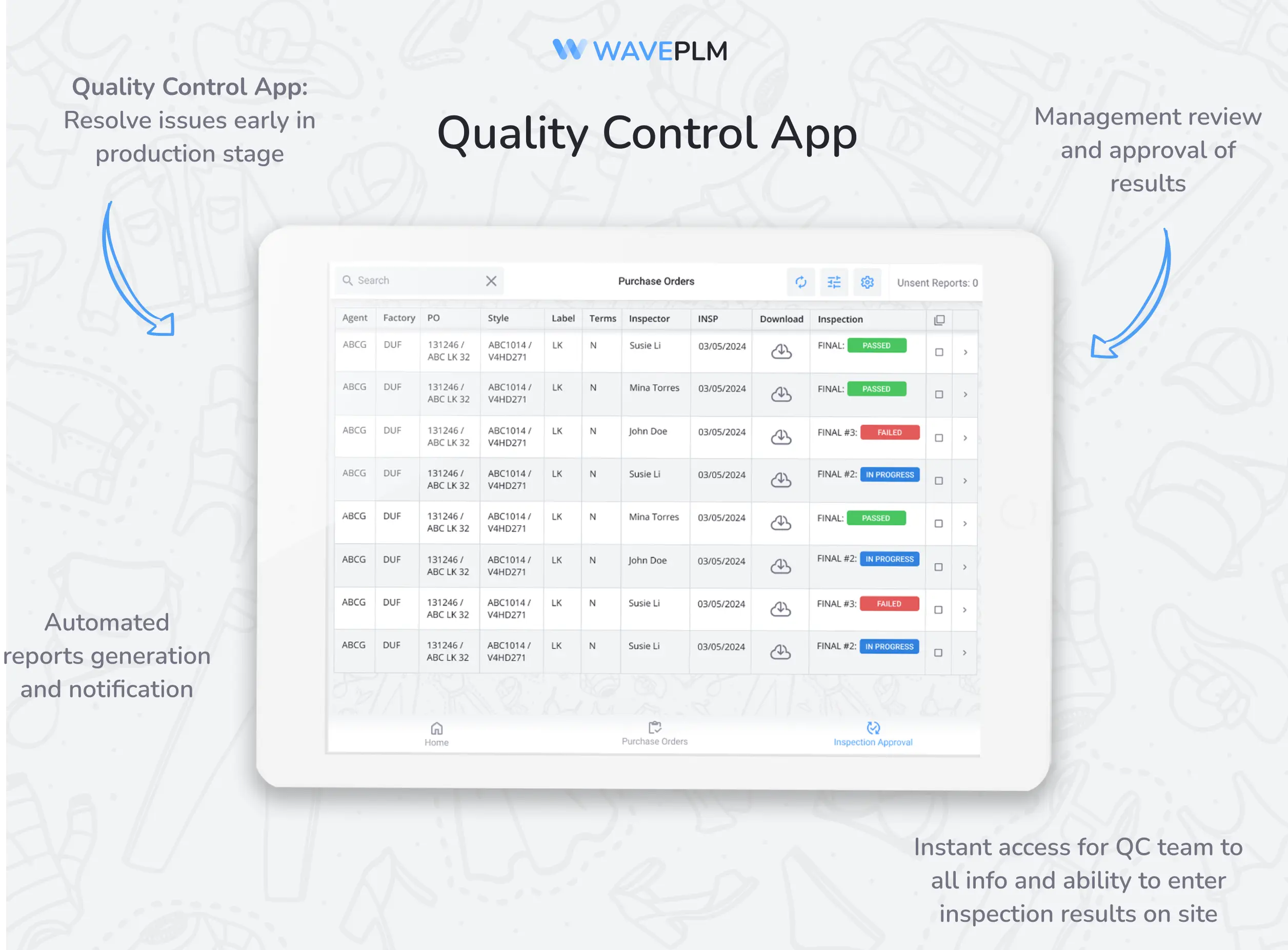
Key PLM Features That Support Garment QC
| PLM Feature | Quality Control Application |
|---|---|
| Tech pack management | Single source of truth for all garment specifications; reduces miscommunication with factories |
| BOM tracking | Verifies that approved components are used in production; enables BOM vs. actual comparison |
| Sample approval workflow | Records approval status, comments, and revision history for every sample |
| Supplier communication tools | Centralises QC feedback to factories; eliminates email chains and version confusion |
| Analytics & reporting | Identifies recurring defect patterns by supplier, category, or season |
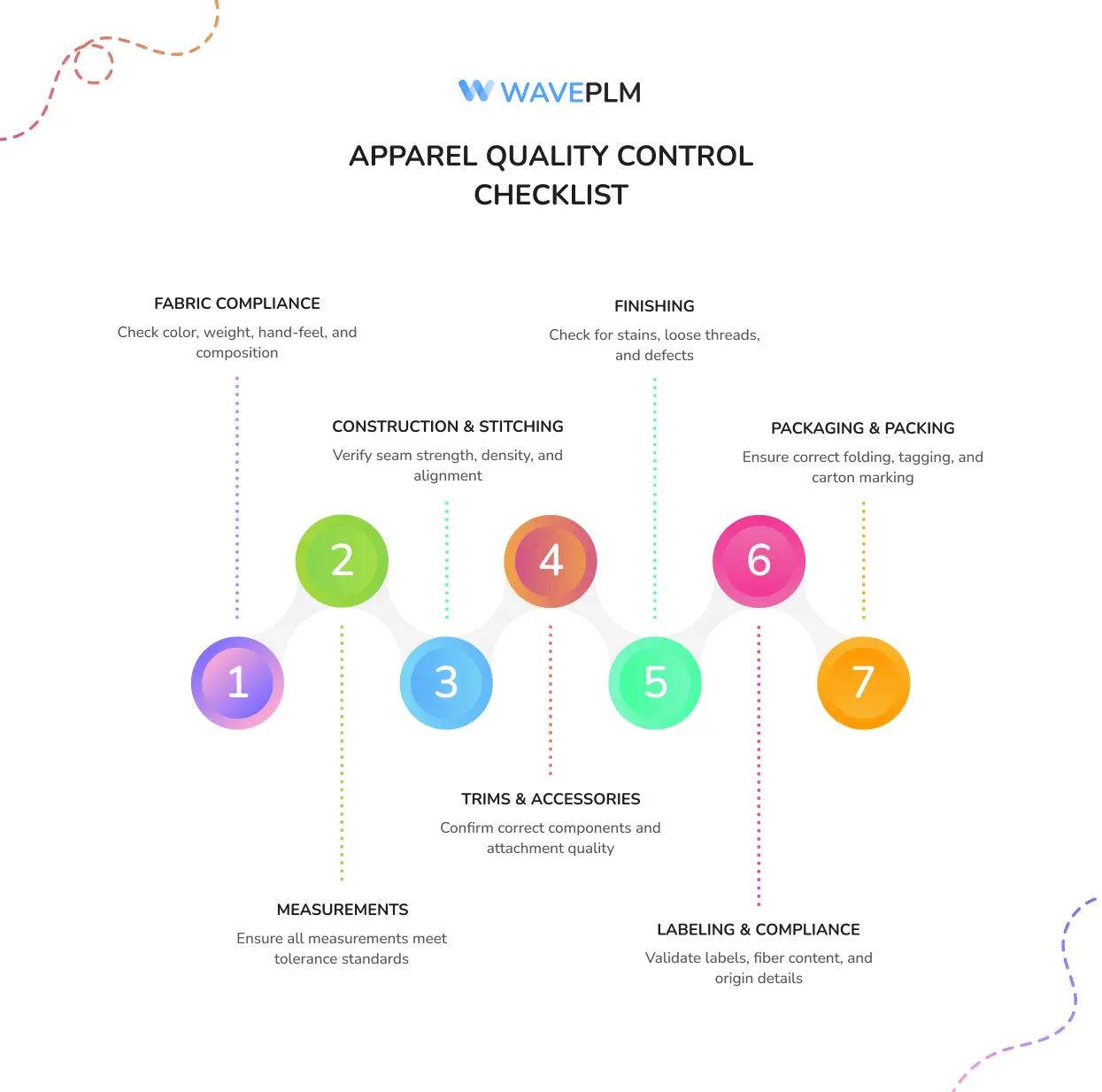
Building a Quality Control Checklist for Apparel Production
A practical quality control checklist for garment production covers seven key areas. QC teams adapt this structure to the specific requirements of each product category.
- Fabric compliance — colour match to approved standard, weight, hand-feel, fabric composition
- Measurements — all points of measure within agreed tolerance (typically ±1–2 cm)
- Construction & stitching — seam strength, stitch density, seam allowance, alignment
- Trims & accessories — correct buttons, zippers, labels as per BOM; attachment quality
- Finishing — no loose threads, stains, pilling, or pressing faults
- Labelling & compliance — care labels, fibre content, country of origin, size labels accurate
- Packaging & packing — correct folding, poly-bag, hangtag, barcode, carton marking
Conclusion: Quality Control as a Competitive Advantage
Quality control in the clothing industry is no longer just a compliance function. For brands competing in a market where consumers have more choices and higher expectations than ever, consistent garment quality is a differentiator.
Brands that build quality control into every stage of product development — from design documentation and BOM management through sampling, in-line inspection, and final approval — experience fewer returns, stronger supplier relationships, and higher customer retention.
The move from reactive to proactive quality management in apparel requires two things: clear standards and the right tools to enforce them. PLM software connects both — giving design teams, QC managers, and suppliers a shared system to define, track, and continuously improve quality across every product and every season.
Wave PLM helps fashion and apparel brands manage quality control processes within a single connected platform — from tech pack creation and BOM management to sample approvals and supplier communication. Explore Wave PLM →


Leave a Reply