

Every missed deadline in apparel production has a ripple effect — late fabric deliveries push back cutting, cutting delays stall sewing, and suddenly a collection misses its retail window entirely. In an industry where speed-to-market separates profitable brands from struggling ones, automated time and action tracking has shifted from a luxury to an operational necessity.
A traditional Time and Action Calendar, managed through spreadsheets and email chains, simply can’t keep pace with today’s global, multi-tier supply chains. Automating supply chain workflows directly reduces costly production errors and delays.
Modern fashion PLM platforms now embed automated task creation, milestone assignments, and real-time alerts into a single connected system — eliminating the manual overhead that slows teams down. But before exploring what these solutions offer, it’s worth understanding exactly why traditional approaches keep failing.
Current Challenges in Apparel Supply Chains
The apparel supply chain is one of the most complex in global manufacturing — spanning raw material sourcing, multiple production tiers, logistics, and retail distribution across dozens of countries. Managing this complexity manually creates predictable failure points.
Fragmented communication tops the list. When production teams, suppliers, and merchandisers rely on spreadsheets and email threads, critical updates get lost, duplicated, or misinterpreted. Poor visibility across supplier tiers is among the leading causes of production delays and compliance failures.
Deadline drift compounds the problem. Without real-time milestone tracking, small slippages go unnoticed until they cascade into season-threatening delays. This is particularly acute for brands managing multiple product categories simultaneously — a challenge familiar to anyone overseeing accessories alongside apparel.
Reactive problem-solving in apparel production almost always costs more than proactive tracking — in time, margin, and vendor trust.
These structural gaps make a compelling case for purpose-built automated solutions, which the next section examines in detail.
Overview of Automated Time & Action Tracking Solutions
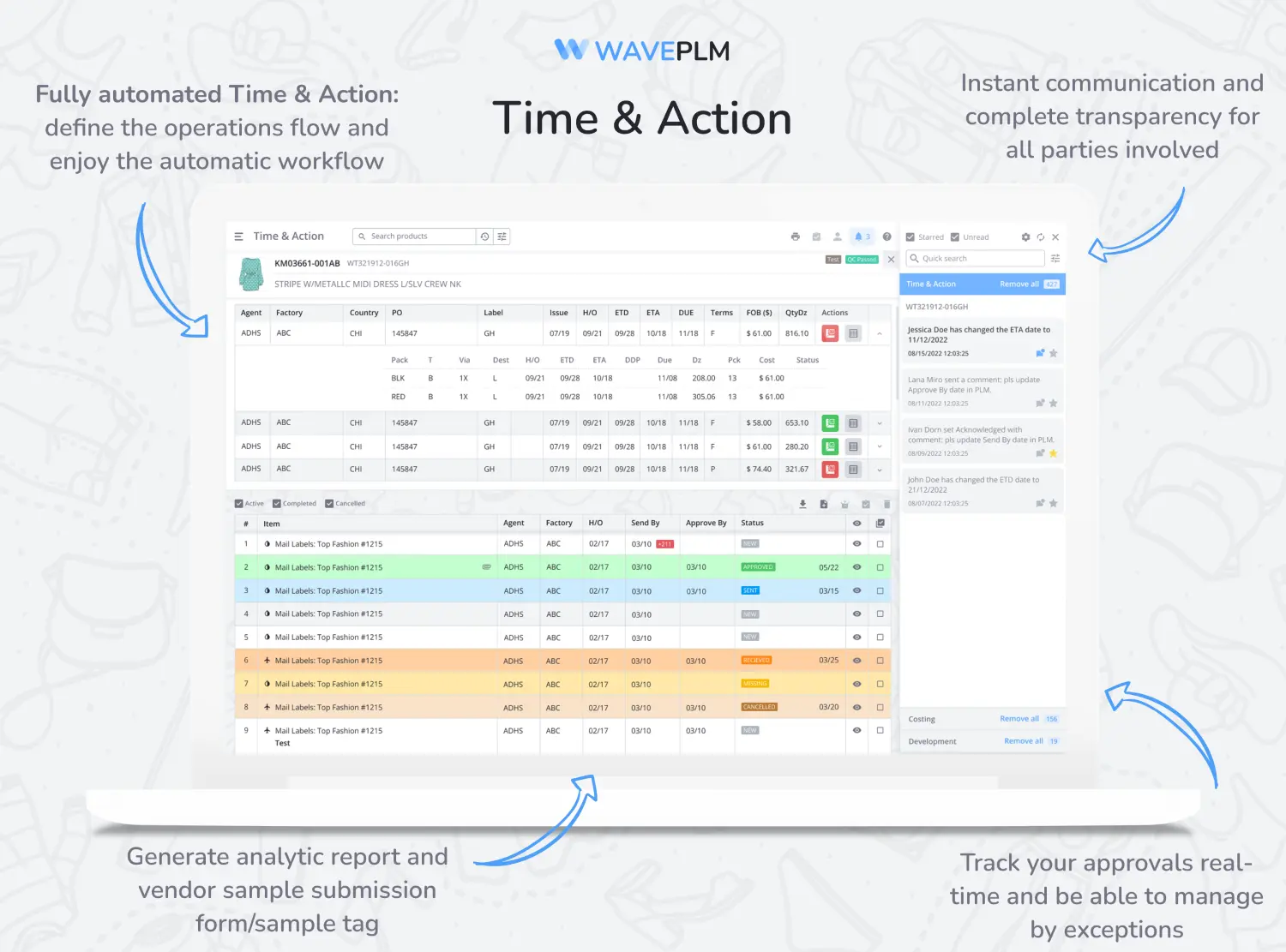
At the heart of modern production management is the Time and Action Calendar — a structured schedule that maps every critical milestone from order confirmation to final shipment. In its traditional form, this was a manual spreadsheet exercise. Automated solutions have fundamentally changed that equation.
Today’s platforms replace static documents with dynamic, real-time tracking systems. Automated task creation, department assignments, and deadline alerts eliminate the need for constant manual follow-up. These tools allow production teams to monitor every stage of the calendar with minimal administrative overhead.
Key capabilities of modern automated solutions include:
- Automated milestone alerts when tasks fall behind schedule
- Cross-department visibility across sourcing, production, and logistics
- Supplier collaboration portals for real-time status updates
- Exception-based reporting that surfaces delays before they escalate
This same logic extends beyond apparel — similar automated tracking frameworks are applied in adjacent product categories, including home décor production workflows, demonstrating the scalability of the approach.
In practice, the most impactful shift is from reactive to proactive management. Rather than discovering a delay after it has cascaded downstream, teams receive early warnings that allow corrective action. The following case study illustrates exactly what that looks like when implemented inside a real U.S. apparel operation.
Case Study: Successful Implementation in a U.S. Apparel Company
Consider a mid-sized U.S. sportswear brand managing seasonal collections across factories in three countries. Before adopting automated Time and Action tracking, the production team relied on spreadsheets and manual email follow-ups — a workflow prone to missed deadlines and poor vendor accountability.
Example scenario: After implementing an automated platform, the brand connected its sourcing, production, and logistics teams within a single dashboard. Real-time alerts flagged delayed fabric approvals before they could cascade into shipment delays. Automating supply chain processes can significantly reduce production cycle times and manual intervention.
Automated task assignment eliminated hours of administrative overhead, and on-time delivery rates improved measurably within the first season. Notably, the approach also scaled across adjacent product categories — much like how automated milestones benefit other consumer goods verticals beyond apparel.
The results reinforce a consistent pattern: visibility drives accountability. Of course, not every implementation is seamless — change management and vendor onboarding remain common hurdles. Understanding what separates successful platforms from underperforming ones means evaluating solutions against consistent, meaningful criteria — which is exactly what the next section addresses.
Comparing Automated Solutions: Key Criteria
Not all supply chain automation platforms deliver equal value for apparel operations. As the case study in the previous section illustrates, the right tool can transform on-time delivery rates — but choosing poorly can compound existing inefficiencies. Evaluating solutions against consistent criteria is essential before committing.
When comparing platforms, procurement teams should assess several core dimensions:
- Integration depth — Does the solution connect seamlessly with existing ERP, PLM, and vendor portals?
- Real-time visibility — Can stakeholders access live milestone data across every factory tier?
- Alerting and escalation — How quickly does the system flag delays and route them to decision-makers?
- Traceability support — Does it align with emerging compliance requirements around responsible sourcing?
Platforms that unify quality checkpoints alongside milestone tracking tend to reduce rework costs and audit preparation time significantly. However, no single solution excels across every dimension — trade-offs between ease of implementation and feature depth are common. The most effective approach is to prioritize criteria that directly align with your brand’s operational pain points. With that framework in mind, the following sections examine specific capability clusters in greater detail.
Criteria #1–3: Demand Forecasting, RFID Technology, and Production Scheduling
Building on the evaluation framework introduced in the previous section, the first three criteria examine capabilities that directly shape how well a platform manages the textile production workflow from planning through execution.
Demand forecasting accuracy determines whether brands can align purchase orders with realistic sell-through projections. Platforms that integrate historical sales data with seasonal trend modeling help reduce both overstock and stockouts — persistent cost drivers in apparel.
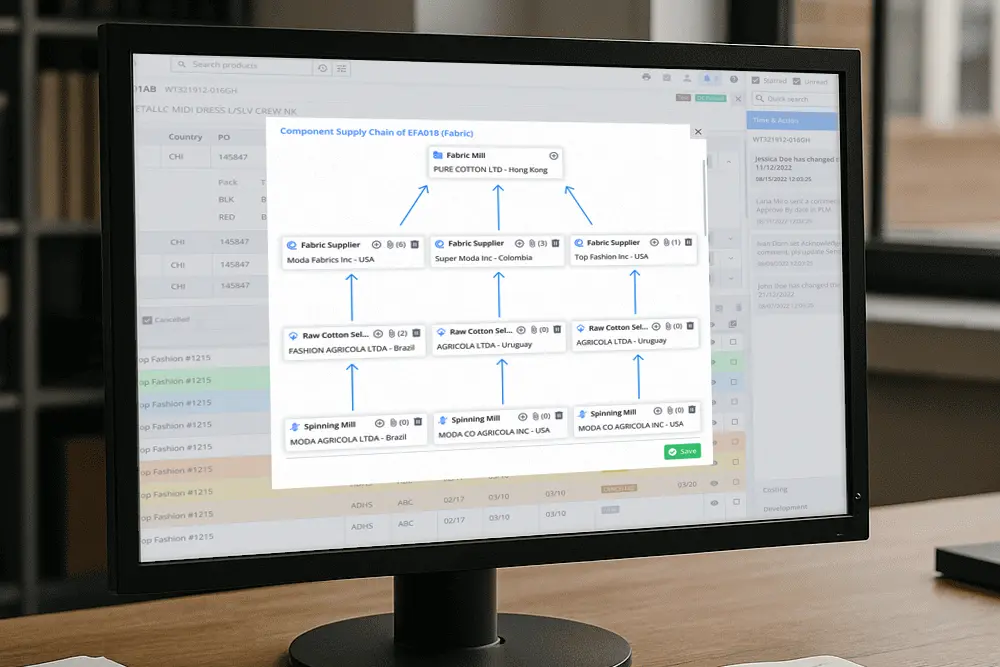
RFID technology integration enables granular visibility at the component level, linking physical goods to digital records automatically. Milestone tracking gains measurable reliability when data capture is tied to physical checkpoints rather than manual input.
Production scheduling tools round out this first cluster. Platforms offering shopfloor-connected scheduling close the gap between planned and actual lead times — a critical differentiator. The next criteria group shifts focus to real-time monitoring, broader automation, and IoT-driven tracking.
Criteria #4–6: Real-Time Monitoring, Supply Chain Automation, and IoT Tracking
Continuing the evaluation framework, criteria four through six examine capabilities that increasingly separate modern platforms from legacy systems — particularly for garment industry TNA workflows that span multiple geographies and supplier tiers.
Real-time monitoring is arguably the most operationally critical differentiator. Platforms should surface milestone delays the moment they occur, not during end-of-week reporting. Solutions that rely on manual status updates introduce lag that compounds across production stages.
Supply chain automation depth matters equally. What typically happens in high-performing implementations is that automated alerts, escalation rules, and dependency triggers reduce planner intervention by a significant margin — freeing teams to address exceptions rather than chase routine updates.
IoT tracking capability rounds out this group. Sensor-connected inventory and production data feeds eliminate manual entry errors and provide the granular visibility needed for accurate milestone tracking across distributed manufacturing networks. However, IoT integration varies considerably between platforms — some offer native connectivity, while others depend on third-party middleware.
Together, these three criteria determine whether a platform operates reactively or proactively. The following summary table puts all six criteria side by side for a clearer comparative view.
Summary Table: Comparing Automated Tracking Solutions
With criteria one through six established, a side-by-side comparison helps clarify which solution attributes matter most for different operational profiles. The table below synthesizes the evaluation framework across key capability areas.
| Capability | Basic Tools | Mid-Tier Platforms | Advanced ERP/PLM |
|---|---|---|---|
| Demand Forecasting | Manual/static | Rule-based alerts | AI-driven, adaptive |
| RFID Integration | None | Limited | Full end-to-end |
| Production Scheduling | Spreadsheet-based | Semi-automated | Dynamic, real-time |
| Real-Time Monitoring | Delayed reporting | Dashboard views | Live milestone tracking |
| Supply Chain Automation | Minimal | Partial workflows | Full automation |
| IoT Tracking | None | Select nodes | Network-wide |
| Time and Action module | Absent | Basic calendar | Integrated, automated |
Platforms with a dedicated Time and Action module consistently outperform alternatives on deadline adherence and cross-team visibility. In practice, brands that rely on specification management tools integrated alongside tracking systems report fewer hand-off errors between design and production stages. However, no single solution excels uniformly across every criterion — and that tension is worth examining carefully before committing to a platform.
Limitations and Considerations
Automated time and action tracking delivers clear operational advantages, but no solution is without trade-offs. Understanding these limitations upfront helps teams set realistic expectations and plan implementations more effectively.
Real-time monitoring, for all its power, depends entirely on data quality at the source. If suppliers enter updates inconsistently—or delay entries to avoid scrutiny—the dashboards and alerts built on that data lose their value quickly. A common pattern is that smaller or less digitally mature vendors struggle to adopt new systems at the same pace as larger factory partners, creating visibility gaps at precisely the points where oversight matters most.
Integration complexity is another practical caveat. Connecting tracking platforms with existing ERP systems, sampling workflows, or returns and warranty processes adds configuration time and ongoing maintenance overhead. Change management—training buyers, merchandisers, and vendor coordinators—often takes longer than the technical setup itself.
Cost-benefit analysis also warrants honest scrutiny. Licensing, onboarding, and customization fees can be substantial, particularly for mid-market brands managing lean teams. The efficiency gains are real, but they typically materialize over months, not immediately.
These considerations don’t diminish the case for automation—they sharpen it. Teams that anticipate these friction points plan better rollouts and extract more lasting value. The key takeaways ahead distill what the strongest implementations have in common.
Key Automated Time And Action Tracking Takeaways
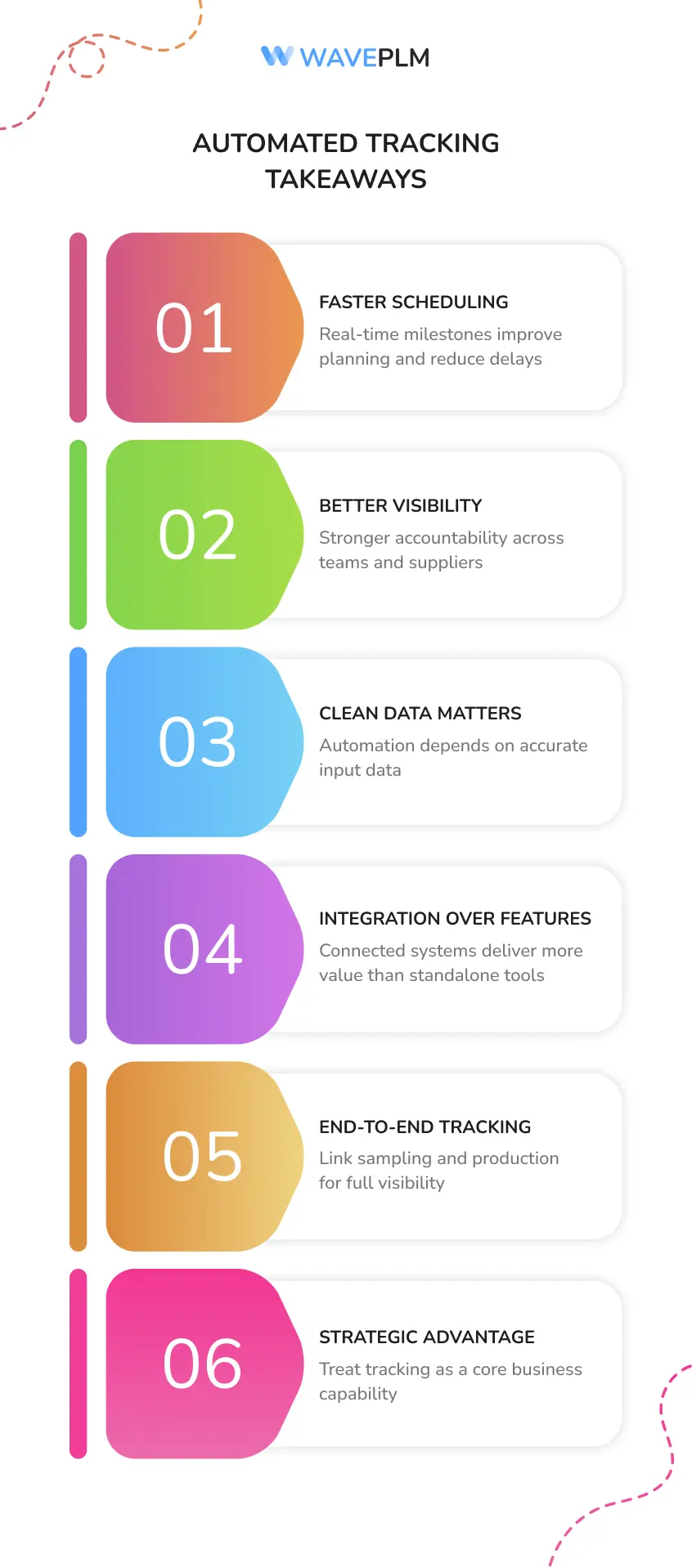
Automated time and action tracking has moved from a nice-to-have into a genuine operational necessity for apparel brands competing on speed and accuracy. Several core principles emerge from the analysis across this article.
Production scheduling improves measurably when milestone data flows automatically rather than through manual spreadsheets—delays get caught earlier, and teams can act before small slippages compound. Visibility, accountability, and cross-supplier coordination all strengthen together rather than in isolation.
A few reminders worth carrying forward:
- Automation reduces human error but requires clean data inputs to function reliably
- Integration depth matters more than feature count when evaluating solutions
- Sampling cycles also benefit when tracking systems connect across development and production phases
The brands that gain the most are those treating tracking as a strategic capability, not simply an administrative tool. With these principles in mind, the practical question becomes: how does your brand’s current supply chain measure up?
How Does Your Apparel Brand Track Its Supply Chain?
Before investing in any automation stack, it’s worth pausing to ask a foundational question: What is a Time and Action Calendar, and how is your brand currently using one? For many teams, the honest answer is “inconsistently” — a patchwork of spreadsheets, email chains, and shared documents that technically qualifies as tracking but leaves critical visibility gaps.
Supply chain tracking maturity typically falls into three tiers:
- Reactive — issues are identified after delays occur
- Passive — milestones are logged but rarely acted upon proactively
- Predictive — automated alerts and dashboards surface risks before they escalate
Most growing boutique and mid-market brands sit somewhere between reactive and passive. Recognizing that gap is the first honest step toward meaningful operational improvement. The principles and tools covered throughout this article — from automated milestone alerts to AI-driven traceability — apply directly regardless of where your brand currently sits on that spectrum. The practical question becomes how to implement them within your specific business model, which is exactly what deserves a closer look next.

How to Automate My Clothing (Boutique) Business
Boutique brands often assume full supply chain automation is reserved for enterprise players — but that’s a misconception worth correcting. Even small operations benefit significantly from structured tools that deliver real-time updates on production progress, replacing scattered spreadsheets and email chains with a single, visible workflow.
The practical starting point is simple: digitize your Time and Action Calendar first. Once milestone dates, vendor tasks, and approval checkpoints live in one platform, automation follows naturally — triggered alerts, status flags, and deadline reminders run without manual input.
A common pattern for boutique brands is to begin with order and sampling milestones, then gradually extend automation into fabric sourcing and quality checkpoints as the business scales. Automation doesn’t require a big-budget overhaul; it requires disciplined, incremental adoption.
Of course, even well-planned implementations encounter friction — which is exactly what the next section addresses.
What Are the Challenges Faced in Implementing Automated T&A Tracking Systems in Apparel Supply Chains?
Automated Time and Action Calendar tracking delivers clear operational advantages — but implementation is rarely frictionless. Understanding the obstacles upfront helps brands set realistic expectations and build more durable solutions.
Common challenges include:
- Supplier data inconsistency: Vendors across different regions use varied formats, languages, and reporting cadences, making centralized tracking difficult to standardize
- Legacy system integration: Many manufacturers still rely on spreadsheets or outdated ERP systems that don’t communicate with modern automation platforms
- Change management resistance: Factory partners and internal teams accustomed to manual workflows often push back on new digital processes
- Data accuracy gaps: Automated alerts are only as reliable as the inputs — incomplete or delayed supplier updates undermine system integrity
Automation can eliminate delays at the planning level, but human accountability at the supplier level remains the irreplaceable foundation of any Time and Action system.
In practice, the most successful implementations phase adoption gradually, starting with high-priority milestones before expanding system-wide. Brands that invest in supplier onboarding and training consistently see faster ROI than those focused solely on software configuration.
The path forward is clear: apparel businesses that treat automated tracking as a strategic capability — not just a scheduling tool — will build supply chains resilient enough to compete in an increasingly complex global market.




Leave a Reply