
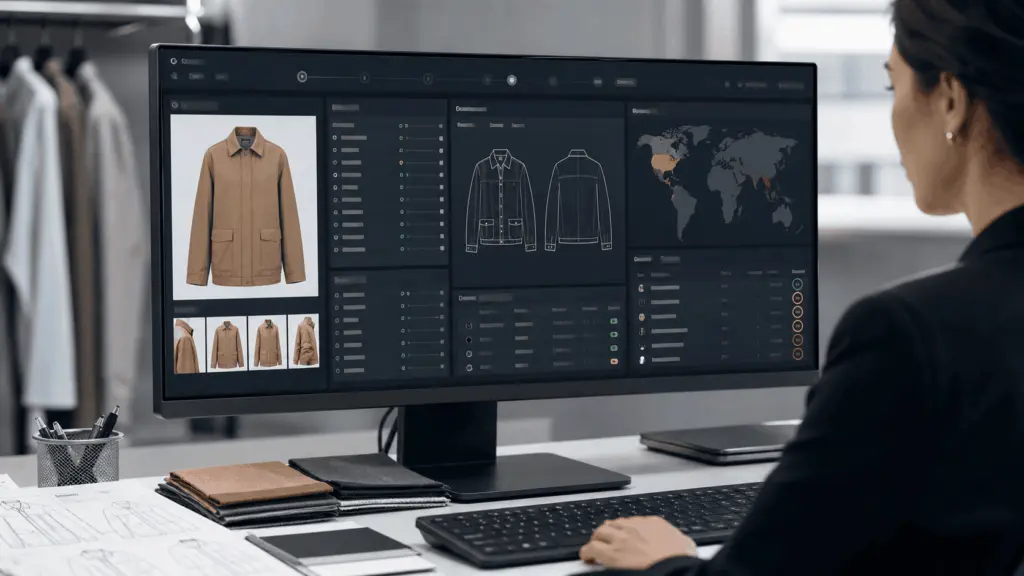
Six AI capabilities are now production-ready in fashion PLM: automated spec filling, AI-assisted BOM costing, demand forecasting, supplier risk scoring, photo-based QC defect detection, and 3D virtual sampling. Two remain in beta for most platforms: generative design suggestions and full tech pack generation from scratch. Knowing which is which saves you from paying for demos that don’t deliver.
Here’s the gap nobody talks about: 63% of fashion brands plan to integrate AI into product development by 2026 (BoF Professional Survey, 2025), but most PLM buying conversations still happen without a clear answer to the most important question — which AI features actually work today, and which ones are roadmap slides dressed up as product features?
After watching apparel teams sit through dozens of AI demos, the pattern is consistent. Vendors show you the most impressive capability — often a generative design concept or a full tech pack conjured from a sketch — and the demo looks compelling. What they don’t show you is the failure rate, the setup time, or the category limitations. This guide cuts through that.
What follows is a feature-by-feature evaluation of AI in fashion PLM: what’s genuinely production-ready in 2026, what requires significant setup before it delivers value, and what’s still more promise than product. For each category, we’ll cover what the technology does, what it doesn’t do, and what ROI to realistically expect.
Which AI Features in Fashion PLM Are Actually Ready in 2026?
Not all AI features in PLM carry the same maturity level. According to McKinsey’s 2025 State of Fashion report, brands using AI-enhanced PLM report a 40% reduction in design-to-sample cycle times — but that number reflects the top quartile of implementations, not the average. The difference is almost always which features they actually deployed versus which ones they demoed and shelved.
| AI Feature | Readiness Level | ROI Timeline | Setup Complexity |
|---|---|---|---|
| AI-assisted spec / BOM auto-fill | ✅ Production-ready | Immediate (day 1) | Low |
| Demand forecasting + open-to-buy | ✅ Production-ready | 1–2 seasons | Medium (needs historical data) |
| Supplier risk scoring | ✅ Production-ready | 3–6 months | Low–Medium |
| Photo-based QC defect detection | ✅ Production-ready | Immediate | Low |
| 3D virtual sampling (AI fabric sim) | ✅ Production-ready | 1–3 seasons | High (tool integration + training) |
| AI-assisted costing suggestions | ✅ Production-ready | Immediate | Low |
| Full tech pack generation from sketch | ⚠️ Beta / Limited | 12–18 months out | High |
| Generative design concept suggestions | ⚠️ Beta / Limited | 12–18 months out | High |
| Autonomous supplier communication | 🔬 Experimental | 2027+ | Very high |
What Does AI-Assisted Spec Filling Actually Do — and How Much Time Does It Save?
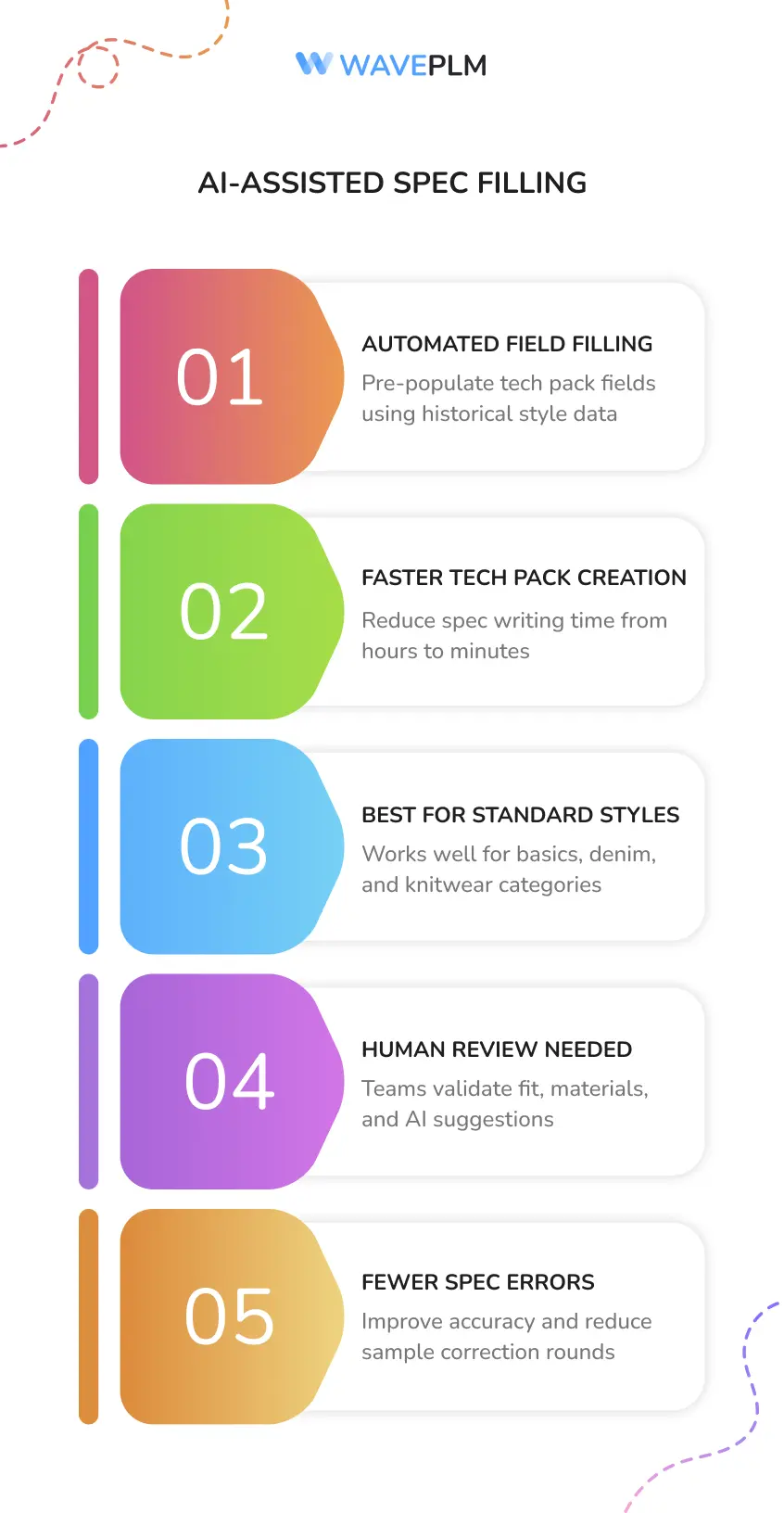
AI-assisted spec filling is the most consistently valuable AI feature in production PLM workflows in 2026. It works by analyzing a new style’s reference images, category, and construction type, then pre-populating 60–70% of tech pack fields — fabric composition fields, standard measurements, typical seam allowances, and BOM component suggestions — based on historical style data and category patterns.
The time saving is real and measurable. A standard woven shirt tech pack takes an experienced product developer 3–4 hours to build from scratch. With AI-assisted filling, that drops to 45–75 minutes — primarily spent reviewing AI suggestions, adjusting fit specifications, and approving or overriding material selections. For a brand developing 150 styles per season, that’s 300–400 hours saved per season on spec writing alone.
What it doesn’t do: AI spec filling struggles with genuinely novel constructions — a new technical fabric, an unusual closure mechanism, a first-time silhouette with no historical comparisons. For those styles, the AI suggestions are often wrong enough that accepting them is faster than correcting them. Human-first spec writing remains essential for innovation, not optimization.
AI-assisted spec filling in modern fashion PLM platforms reduces tech pack build time by 65–70% for standardized garment categories, according to available benchmark data. The gains are largest in commodity categories — basics, denim, knitwear — where construction patterns are highly repeatable. Fewer spec errors also mean fewer sample correction rounds, compounding the ROI beyond just time saved on documentation.
How Accurate Is AI Demand Forecasting in Fashion PLM — and When Does It Pay Off?
AI demand forecasting integrated with PLM is production-ready in 2026 — but it requires a data maturity threshold that most brands underestimate. At a 6-month horizon, AI trend forecasting tools achieve 72–78% accuracy (Edited.com Fashion AI Report, 2025), compared to 55–65% for human forecasting at the same horizon. That 15–20 percentage point improvement translates directly into tighter open-to-buy, lower markdown risk, and more accurate material pre-bookings.
The hard requirement: the system needs at least two full seasons of clean, structured sales data before the forecasting model becomes meaningfully accurate. Brands that implement demand forecasting with incomplete or inconsistent historical data typically see the model perform at or below human forecasting for the first 12 months — which leads to abandonment just as the model is starting to learn.
| Data Maturity | Forecast Accuracy (6-month) | Practical Use |
|---|---|---|
| Less than 1 season of clean data | 50–60% (no better than human) | Not yet useful for open-to-buy decisions |
| 1–2 seasons of structured data | 62–68% | Useful as a second opinion, not primary driver |
| 2+ seasons, consistent SKU structure | 72–78% | Reliable for material pre-bookings, assortment planning |
| 3+ seasons + social signal integration | 78–84% on core categories | Full open-to-buy integration, automated reorder triggers |
The practical implication: if you’re evaluating PLM with AI forecasting as a key feature, ask vendors specifically how long it took their reference customers to see meaningful accuracy gains — and what data cleanup was required before deployment.
Can AI Predict When a Supplier Is About to Miss a Deadline?
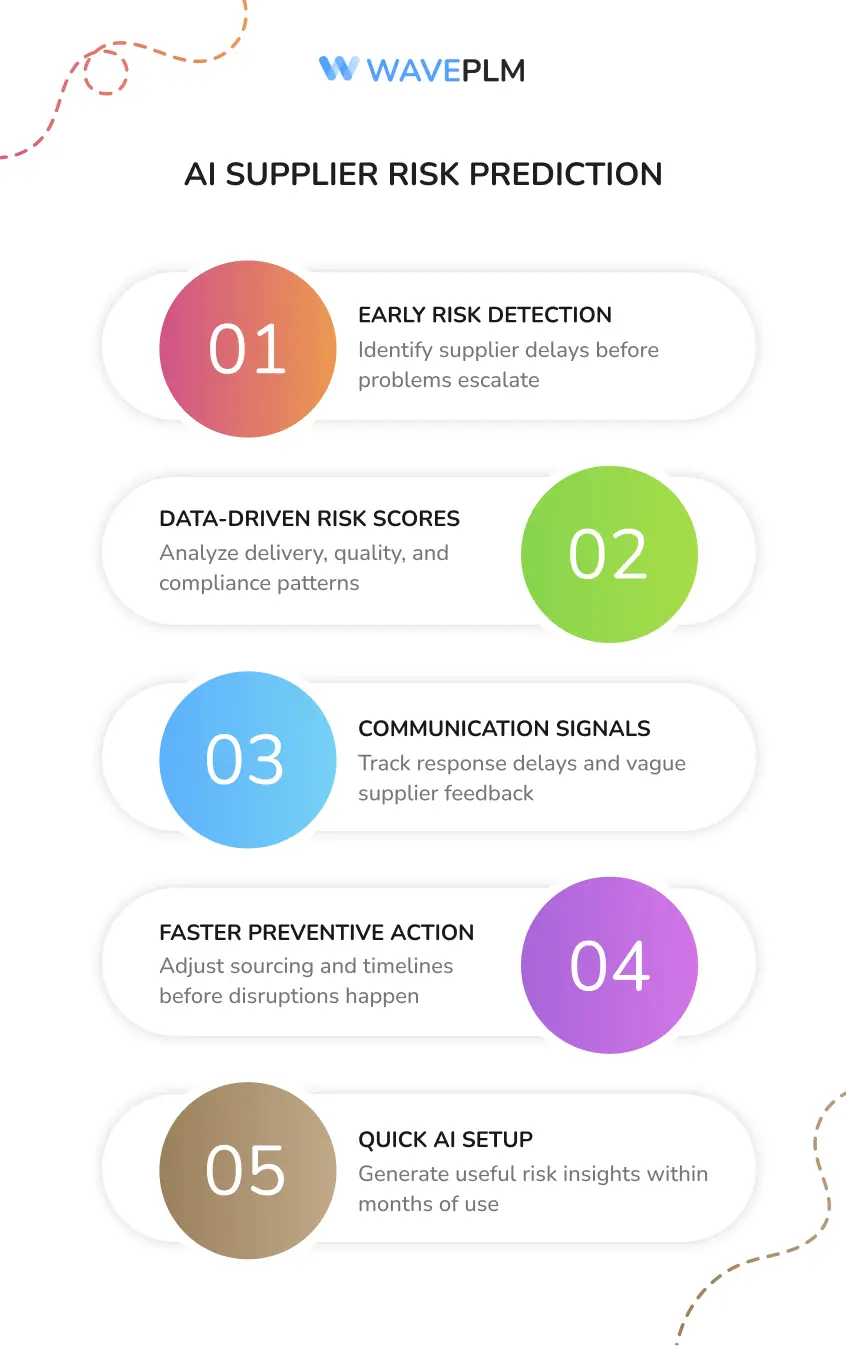
Supplier risk AI doesn’t get the marketing attention that generative design does, but it delivers some of the most consistent ROI of any AI feature in PLM. The technology analyzes patterns in supplier communication history, on-time delivery rates, quality rejection logs, and external signals (financial health indicators, compliance flags) to generate a risk score for each supplier relationship before problems escalate.
The value is asymmetric: a single missed delivery on a hero item can cost more in lost sales and expedite fees than an entire year of PLM subscription costs. AI risk scoring that flags a deteriorating supplier relationship 6–8 weeks before a shipment issue gives brands time to dual-source, adjust timelines, or have a direct conversation — options that disappear once a problem is already in motion.
Our finding: The brands that get the most from supplier risk AI are those who feed it qualitative signals, not just delivery data. Communication tone (response time declining, vague answers to spec questions, requests to substitute materials) is often the earliest indicator of a supplier under capacity pressure — and it’s data that lives in your PLM communication module, not in any external database.
This is also one of the lowest-setup AI features in modern PLM. Unlike demand forecasting, which requires historical sales data, supplier risk scoring begins generating useful signals within the first 2–3 months of active use, as communication patterns accumulate in the system.
Does AI-Powered 3D Virtual Sampling Actually Reduce Physical Sample Rounds?
3D virtual sampling powered by AI fabric simulation is genuinely production-ready in 2026 — but “production-ready” and “easy to implement” are not the same thing. When fully operational, AI-enhanced 3D sampling reduces physical sample rounds from the industry average of 4.7 per style to 1–2 per style (Lectra / CLO industry data, 2024). At $500–$2,000 per physical sample round, a brand doing 100 styles per season can save $100,000–$400,000 annually once the workflow is established.
The setup reality is more demanding than most vendors communicate. A full 3D sampling workflow requires: integration between your PLM and a 3D design tool (CLO 3D or Browzwear are the two standard options), a digital material library with accurate fabric physics data, product developers trained to work in 3D, and a factory partner willing to accept digital samples in lieu of physical ones for early rounds.
Getting all four elements in place typically takes one full season and requires commitment from both internal teams and supply chain partners. Brands that attempt to shortcut any of these steps — particularly the factory buy-in — end up running parallel workflows (3D for internal review, physical for factory approval), which eliminates most of the cost savings.
Realistic implementation path: Start with 3D sampling on your most standardized categories (basics, core replenishment styles) where fabric physics are predictable and factory partners are already familiar with your specs. Expand to more complex constructions in season two once the workflow is established. See our deep-dive on virtual sampling workflows for the full implementation guide.

What’s Still Hype: Full Tech Pack Generation and Generative Design
Two AI features dominate PLM demo reels in 2026 but remain genuinely limited in production environments: full tech pack generation from a sketch or reference image, and generative design concept suggestions. Both are real technologies — both will likely be production-ready within 12–18 months — but neither performs reliably enough today to replace human workflows.
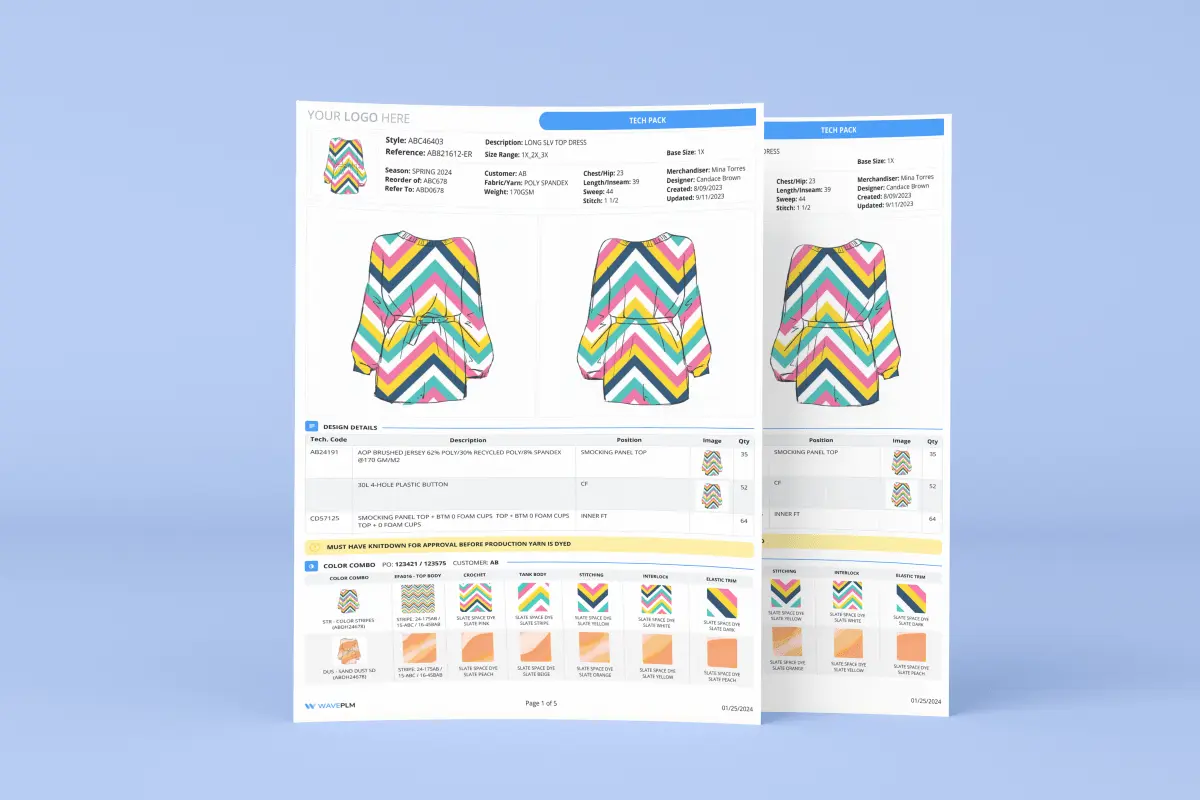
Full tech pack generation from a sketch is the one that gets the most demo attention. The technology works reasonably well for simple, standard garments in heavily-represented categories — a basic crew-neck tee, a 5-pocket denim jean. For these, AI can generate a plausible starting point that covers 50–60% of required fields. The problem is that “starting point” still requires extensive human review, the error rate on measurements is high enough to cause sample rejections, and for anything outside the training data distribution (new silhouettes, technical fabrics, complex construction details), the output quality drops sharply.
Generative design concept suggestions — where AI generates new colorway options, print iterations, or silhouette variations — works better as a creative brainstorming tool than as a production workflow. Designers report it’s useful for exploring directions quickly, but the output requires substantial refinement before it’s usable in a tech pack, and intellectual property questions around training data remain unresolved for enterprise use.
Practical rule: If a vendor demo shows you AI generating a complete tech pack from a sketch in 60 seconds without human review, ask to see the same output submitted to a factory. The factory’s feedback on that tech pack is the real test.
How to Prioritize AI Adoption in Your PLM Stack
The right sequence for AI adoption in PLM depends on your brand’s current pain points, but there’s a pattern that consistently delivers faster ROI than a broad simultaneous rollout.
| Phase | Timeline | AI Features to Deploy | Expected ROI |
|---|---|---|---|
| Phase 1: Quick Wins | Days 1–90 | AI spec filling, AI costing suggestions, supplier risk scoring | 200–400 hours saved/season, immediate |
| Phase 2: Data Foundation | Months 3–12 | Demand forecasting setup, clean historical data migration, photo QC | 5–15% reduction in markdowns (season 2) |
| Phase 3: Sampling Transformation | Season 2–3 | 3D virtual sampling on core categories, factory partner alignment | $100K–$400K savings/season (100+ styles) |
Phase 1 is non-negotiable. AI spec filling and costing suggestions require almost no setup, deliver value from the first week, and build your team’s confidence in AI-augmented workflows — which matters for adoption of the more complex Phase 2 and 3 features. Brands that skip Phase 1 and go straight to demand forecasting or 3D sampling typically see slower adoption across the board because teams haven’t had a chance to experience AI as genuinely helpful rather than disruptive.
On PLM pricing: AI features bundled into cloud PLM plans don’t change the per-user cost significantly. The bigger cost variable is internal setup time — particularly for Phase 3. Budget for one full-time team member to own the 3D sampling workflow during the first season of implementation.
Will AI Replace Fashion Product Managers?
No — and the framing of the question misunderstands how AI in PLM actually works. Every production-ready AI feature in PLM today is assistive, not autonomous. AI fills in spec fields; a product developer reviews and approves them. AI flags a supplier risk; a sourcing manager decides what to do about it. AI generates a demand forecast; a merchandiser uses it as one input among several.
The more accurate framing: one product manager using AI-assisted PLM tools can handle the output of two to three product managers working without them. That doesn’t mean headcount reduction — it means a 3-person PLM team can manage 400 SKUs per season instead of 150, or that the same team can manage the same SKU volume with significantly more attention on strategic decisions and supplier relationships rather than documentation.
Generative AI could add $150–275 billion in annual value to the global apparel sector (McKinsey GenAI Report, 2024). The brands capturing that value aren’t replacing product managers — they’re giving product managers better tools and removing the administrative overhead that consumes 40–60% of most product development roles.

Frequently Asked Questions About AI in Fashion PLM
Does Wave PLM have AI features built in?
Yes. Wave PLM includes AI-assisted spec filling that pre-populates tech pack fields from reference styles, AI-powered costing suggestions based on historical BOM data, and smart supplier matching. These features are production-ready and available on current plans — not add-on modules requiring separate licensing.
Can AI help a 3-person brand team manage 200 SKUs?
Yes, and this is precisely where AI in PLM has the most impact. For small teams, the biggest time drain is repetitive documentation — filling the same spec fields across similar styles, re-entering BOM data, chasing supplier updates. AI automates all three. A 3-person team using AI-assisted spec filling can handle the SKU volume of a 6–8 person team without AI.
Is AI in PLM expensive to add?
For cloud PLM platforms, AI features are increasingly bundled into standard plans rather than priced as premium add-ons. The more relevant cost question is implementation: some AI features (demand forecasting, 3D sampling integration) require data setup and training before they deliver ROI. Production-ready features like AI spec filling deliver value from day one with no additional setup cost.
How accurate is AI trend forecasting for fashion?
At a 6-month horizon, AI trend forecasting tools achieve 72–78% accuracy (Edited.com Fashion AI Report, 2025), compared to 55–65% for human forecasting. The caveat: accuracy drops for niche categories, new silhouettes with no historical data, and demand shifts triggered by viral social moments that no model predicted. For core replenishment categories, the accuracy is consistently strong enough to drive material pre-booking decisions.
The Bottom Line
AI in fashion PLM isn’t hype — but it’s also not uniformly ready across all the use cases vendors pitch. The six production-ready features (spec filling, costing, demand forecasting, supplier risk, photo QC, 3D sampling) all deliver measurable ROI when implemented in the right sequence. The two that are still maturing (full tech pack generation, generative design) will get there — but deploying them today means buying a capability that isn’t ready rather than one that is.
The brands that are pulling ahead aren’t the ones that deployed the most AI features. They’re the ones that deployed the right features in the right order, built their team’s confidence with quick wins first, and used the time and cost savings from Phase 1 to fund the more complex Phase 2 and 3 investments.
Start with what works. The rest will follow.
See Wave PLM's AI features in a 30-minute demo — we’ll show you exactly which capabilities are live on your plan and what setup is required for each one.




Leave a Reply