

Fashion brands want products that fit well, feel great, and deliver consistent quality. Modern customers expect reliable sizing, durable materials, and garments that meet their lifestyle needs. To achieve this, fashion teams must understand how testing works and how to interpret testing results correctly. Every stage of product development – from first prototype to final production batch – depends on using the right sample size. When teams rely on a sample size that truly reflects production, they gain accurate results that guide informed decisions and reduce risk. When precise data about the population is unavailable, teams often start with a reasonable estimate to guide sample size decisions.
This expanded guide explains sample size concepts in clear language and shows how fashion teams use statistically guided testing during fit trials, wear tests, fabric testing, and final QC inspections. Principles from survey research are also relevant for fashion brands when designing tests and determining sample sizes. It also covers how Wave PLM strengthens PLM data quality by helping teams track every test, every sample, and every result. Effective data collection is essential for reliable sample size analysis and quality control.
Why Sample Size Matters in Fashion (Fit Testing, QC, Material Testing)
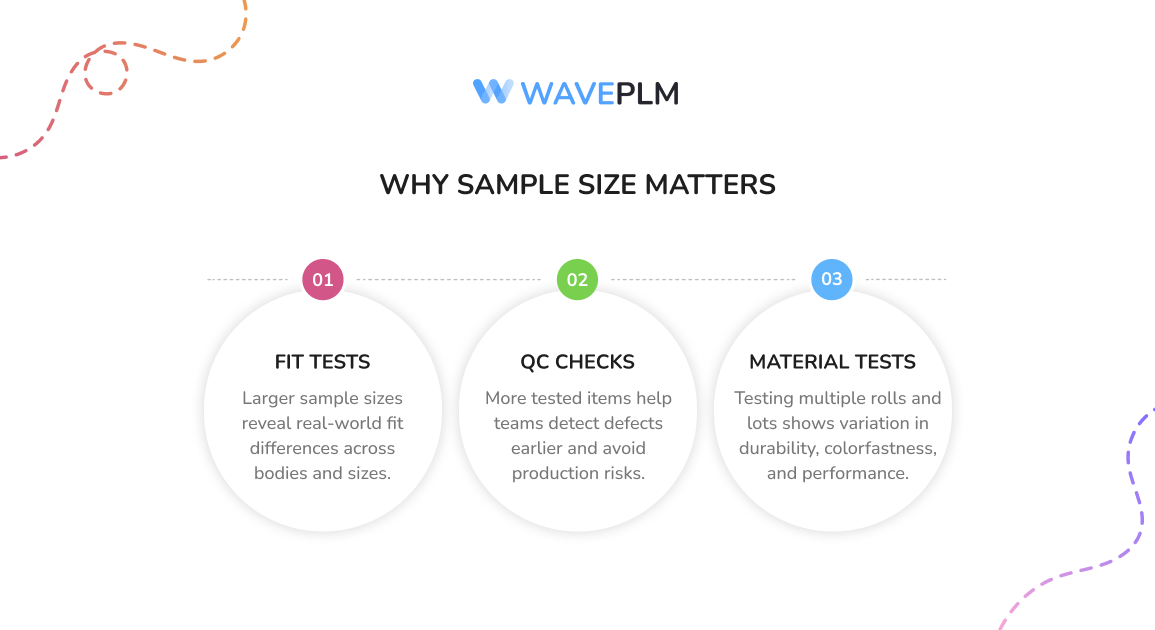
A sample represents a larger production run, so the sample size determines how reliable test results will be. Several factors influence the determination of an appropriate sample size, including production volume, variation, and testing goals. When the sample size is too small, test results become misleading. But when teams use a strong sample size, they uncover sizing inconsistencies, material issues, construction defects, and performance weaknesses early. By doing so, they gain accurate results that guide informed decisions and reduce risk. It is also crucial to select a representative sample to ensure that test results reflect the broader production run.
Fit Testing
Fit testing evaluates how garments behave across real bodies and real sizes. One fit session with one model cannot represent the diversity of customers. A larger sample size allows teams to evaluate differences across multiple bodies, sizes, and proportions. Using a random sample of fit models can help ensure that the results are not biased toward a particular body type or size. This helps teams detect fit balance issues, grading inconsistencies, and silhouette problems that may appear only in certain sizes. Strong sample size planning helps teams catch inconsistencies before they reach production.
Apparel QC
Quality control teams evaluate items from each production lot. A weak sample size hides defects and gives teams the false impression that production is stable. A strong sample size increases the likelihood of detecting inaccurate measurements, uneven stitching, zipper failures, fabric flaws, or incorrect trims. Having enough responses – meaning enough tested items – is crucial for ensuring that quality issues are detected before products reach customers. In large production runs, testing only a few pieces creates risk; a reliable sample size dramatically reduces that risk.
Material Testing
Materials behave differently across rolls and dye lots. A strong sample size helps teams see variation in shrinkage, colorfastness, pilling, abrasion, and stretch recovery. By testing multiple samples across multiple rolls, teams get a clearer picture of how the material will perform in real conditions. Each tested sample provides valuable data points that contribute to a more accurate understanding of material performance. This prevents unpleasant surprises later in production.
Understanding Population Size in Fashion Testing
In fashion testing, population size refers to the total number of items or individuals you want your results to represent – whether that’s the entire production run of a new style, all customers in a target market, or every unit in a specific batch. Knowing your population size is the first step in accurate sample size calculation.
Why does this matter? The population size directly affects how many samples you need to test to achieve statistically significant results. For example, if you’re launching a collection with a production run of 10,000 units, your sample size calculation will differ from a limited run of 500 pieces. The larger the population size, the more samples you may need to ensure your findings truly reflect the total number of items produced.
Determining the minimum sample size is essential for drawing reliable conclusions. If your sample is too small compared to the population, your results may not be statistically significant, and you risk missing important issues. By considering the total number of units or customers in your target population, you can estimate the minimum sample size needed for accurate, statistically significant results.
In summary, always start your sample size planning by identifying the population size. This ensures your testing is robust, your sample is truly representative, and your research findings can be trusted to guide production and quality decisions.

What Does “Statistically Significant” Mean in Fashion Production?
A statistically significant result occurs when the test sample truly represents the broader production population. When teams test only a few items, results reflect only those items—not the entire run. A statistically significant sample size gives results that mirror true production behavior, allowing teams to trust their conclusions. This enables teams to draw conclusions that are applicable to the general population of products, not just the tested items.
In fashion production, statistical significance means:
- Test results reflect real variation across the production run. While results may not always represent the entire population, they can still provide valuable insights for decision-making.
- Teams avoid mistakes caused by under-testing.
- Decision-making becomes clearer and more data-driven.
Statistical significance does not require testing every unit. Testing the entire population is often impractical, so the goal is to select a sample that provides reliable information about the broader group. It requires selecting enough items to ensure that the results stand up under real-world conditions.
When Fashion Teams Need Statistical Significance
Fashion teams rely on statistically accurate samples across development, testing, and production. These processes are similar to conducting an empirical study, where data collection and analysis are used to validate product quality and performance.
Fit Tests
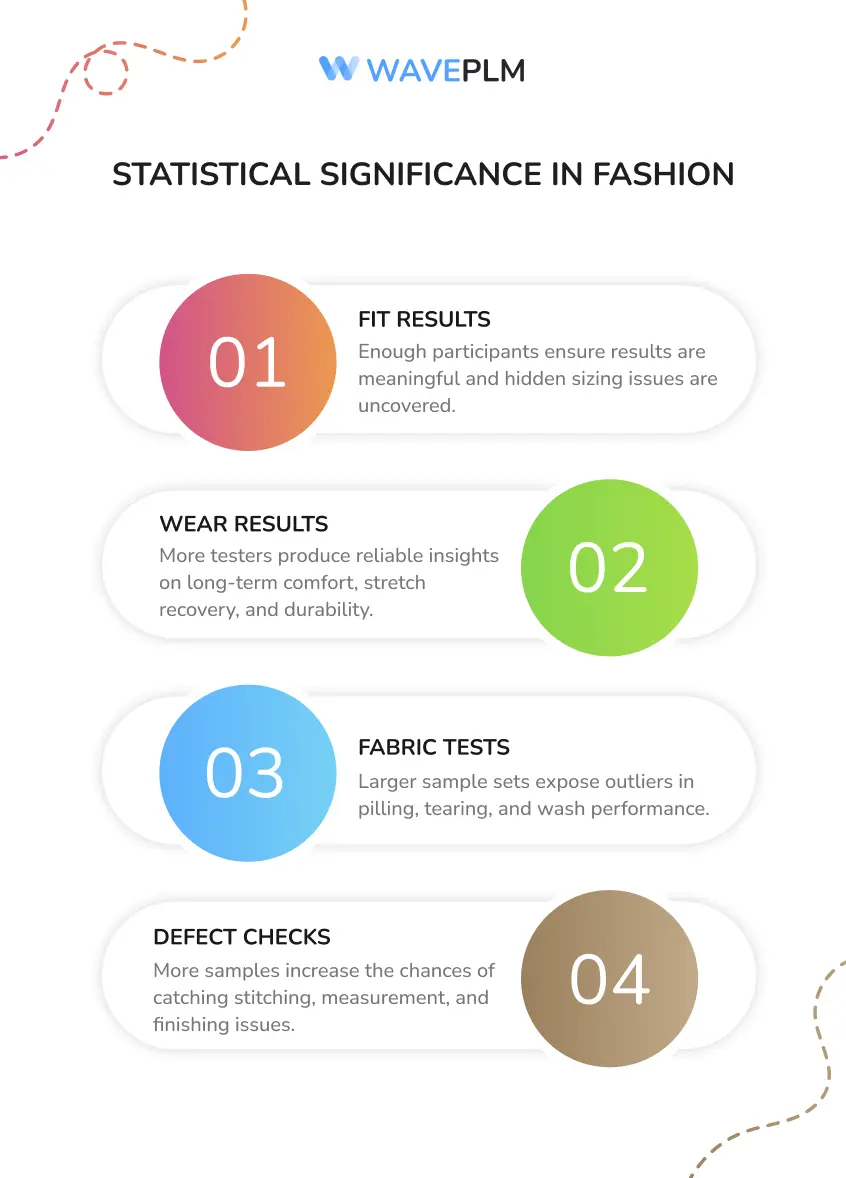
Fit results depend on how many garments and bodies are tested. Determining how many participants to include in fit tests is crucial for ensuring that the results are statistically significant and representative. A larger sample size ensures that fit issues do not remain hidden in certain sizes. This reduces costly corrections later.
Wear Tests
Wear tests measure long-term behavior. Selecting the right number of survey participants (wear testers) is essential for obtaining reliable and meaningful results. With more testers and more samples, results become far more meaningful. This helps teams understand stretch recovery, seam durability, and overall comfort.
Fabric Performance Testing
Labs run tests on pilling, shrinkage, tearing, and wash performance. Calculating the samplemean for each performance metric helps teams assess overall material quality and identify outliers. A stronger sample size reveals differences between rolls, dye lots, or mills.
Production Defect Detection
QC teams use sampled inspections to detect manufacturing defects. However, relying on a smaller sample increases the risk of missing defects that could impact product quality, especially if the sample is not representative of the entire batch. A larger sample size increases the odds of catching stitching issues, measurement problems, and finishing defects before products ship.
Factors That Determine Sample Size (Explained Simply)
Fashion teams do not need advanced statistics to understand sample size decisions. These are the core factors that influence the sample size needed for accurate results: Sample size determination involves calculating sample size based on several statistical considerations, such as confidence level, margin of error, and population variability, to ensure an appropriate sample size for reliable results.
|
Factor |
Simple Explanation |
How It Impacts Sample Size |
|---|---|---|
|
Population size |
Total number of units in production |
Larger populations require more samples to stay accurate |
|
Margin of error |
How much inaccuracy you can accept |
Smaller error tolerance increases sample size |
|
Confidence level |
How sure you want to be about the results (the desired confidence level is associated with a specific z score, which is used in the sample size formula) |
Higher confidence requires a larger sample size |
|
Standard deviation |
Variation within the sampled group |
Higher variation requires more samples to get reliable insights |
Calculating sample size often involves using a sample size formula that incorporates the desired confidence level, the corresponding z score, margin of error, and population variability. Statistical power is also a key consideration in sample size determination, especially for hypothesis testing, as larger sample sizes generally provide enough power to detect meaningful effects.
The minimum number of samples required for an appropriate sample size can vary depending on the survey sample size or research context, and using a sample size calculator can help simplify this process. The width of the confidence interval is inversely proportional to the sample size, meaning that larger sample sizes lead to more precise estimates.
A Simple Rule
When variation increases, the sample size should also increase. Larger sample sizes are especially important when dealing with high variability or when greater precision is required. When teams want higher confidence, the sample size must increase as well.
Common Fashion Mistake: Testing Too Few Samples
Many fashion brands unintentionally rely on small sample sizes. This creates weak conclusions and hides issues that later become expensive.
Examples:
- Fit issues appear only in mid or large sizes, but teams test only small sizes.
- Fabric passes a test on one swatch but fails in production because only one swatch was tested.
- Stitching defects go undetected because QC inspected only a handful of units.
A weak sample size gives a false sense of security and increases production risk. Always ensure you meet the minimum number of samples required to draw statistically significant and reliable conclusions.
How Incorrect Sample Sizes Lead to Returns, Defects & Costly Rework
Incorrect sample size decisions can create major problems:
- Higher return rates due to inconsistent sizing
- Defects slipping past QC checks
- Delays from late-stage corrections
- Increased material waste during rework
- Poor customer satisfaction and reduced brand trust
The right sample size preserves revenue, prevents delays, and protects a brand’s reputation.

How PLM (like Wave PLM) Organizes Testing Data Across Samples & Styles
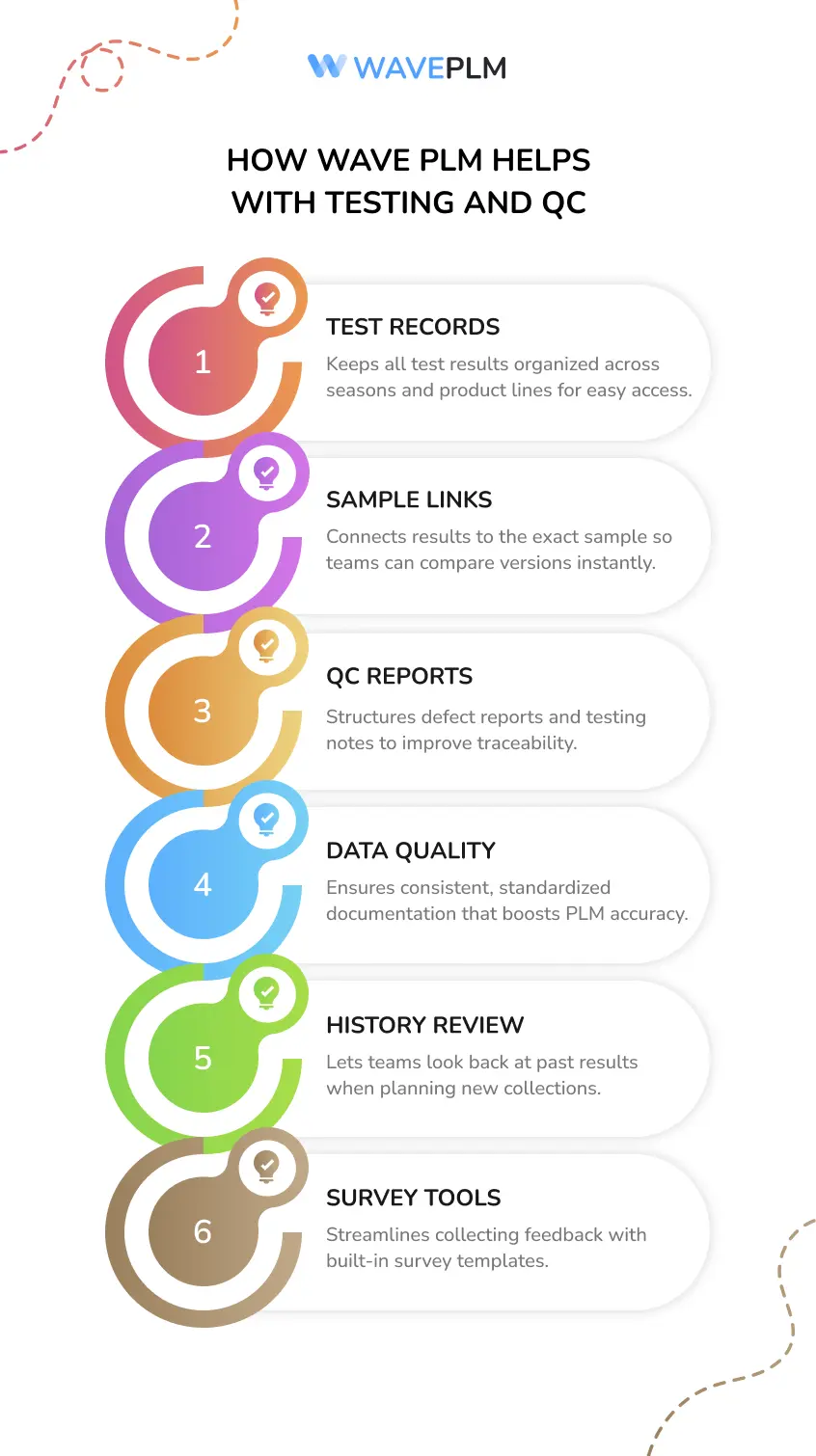
Product Lifecycle Management tools help teams manage testing data across development, fit sessions, lab tests, and production QC. Wave PLM improves transparency and consistency by organizing every test result in one central place. Effective data collection is a key benefit of using PLM systems for sample size management, ensuring that all relevant information is accurately captured and easily accessible.
How Wave PLM Helps
- Stores testing results across seasons and product lines
- Links results to specific samples for easy comparison
- Organizes QC reports and defect notes
- Improves PLM data quality through structured documentation
- Helps teams review testing history when planning new styles
- Integrates survey templates to standardize and streamline the process of collecting feedback and testing data
Benefits
|
Benefit |
Why It Matters |
|
Stronger decisions |
Teams rely on clear, organized data instead of scattered notes |
|
Higher accuracy |
Clean PLM data removes confusion and reduces mistakes |
|
Better communication |
Designers, developers, and factories share information easily |
|
Consistency |
Testing workflows remain stable across seasons and collections |
Sample Size Planning Guide (Easy to Use)
Use this planning guide to determine how many items to test for each type of evaluation. The recommended sample size may vary depending on the survey type or testing methodology used.
|
Test Type |
Production Volume |
Margin of Error |
Confidence Level |
Recommended Sample Size |
|---|---|---|---|---|
|
Fit Test |
Medium (5,000 units) |
Medium |
High |
5–10 testers across sizes |
|
Wear Test |
Any |
Medium |
Medium |
8–12 testers for balanced results; including a control group can help isolate the effects of specific variables during testing. |
|
Fabric Performance |
Large rolls |
Low |
High |
3–5 swatches per roll to capture variation |
|
QC Inspection |
Large factory lots |
Low |
High |
5–32 units depending on AQL and factory performance |
Stratified sampling can be used to ensure that all relevant subgroups (e.g., sizes, colors, production lots) are adequately represented in the sample.
Key Takeaways
- Fashion brands rely on sample size to ensure quality, fit, and performance.
- Weak testing occurs when teams test too few samples or test inconsistently.
- Correct sample size decisions depend on confidence level, population size, margin of error, and product variation.
- Reliable fashion product testing and QC depend on accurate sampling.
- Wave PLM improves PLM data quality by keeping all testing data connected and organized.
When fashion teams use the correct sample size, they gain deeper insight, avoid costly mistakes, and build stronger products that delight customers and strengthen brand credibility.





Leave a Reply