

Managing multi-factory production across overseas partners isn’t just a logistics challenge—it’s a strategic complexity that can make or break a brand’s competitive edge. When a single product touches five factories across three continents, the margin for miscommunication shrinks to nearly zero.
The global manufacturing landscape has fundamentally shifted. Brands increasingly distribute production across specialized regional facilities to reduce costs, access skilled labor, and improve speed to market. According to PTC’s overview of global PLM collaboration, coordinating product data across distributed teams remains one of the most persistent pain points in modern manufacturing.
Product Lifecycle Management (PLM) sits at the center of this challenge. It’s the connective tissue linking design intent to factory floor execution—especially critical when scaling production across multiple facilities simultaneously.
What makes this coordination genuinely difficult is the intersection of version control, regulatory compliance, and real-time visibility. The sections ahead break down exactly how PLM addresses each layer.
Key Functions of PLM in Manufacturing
Product Lifecycle Management (PLM) serves as the operational backbone of modern manufacturing—particularly when production planning spans multiple facilities across different countries and time zones.
At its core, PLM centralizes critical product data, ensuring every factory partner works from the same approved specifications, bill of materials, and revision history. As Suuchi notes, PLM software plays a pivotal role in supply chain management by aligning design intent with manufacturing execution. That alignment becomes non-negotiable at scale.
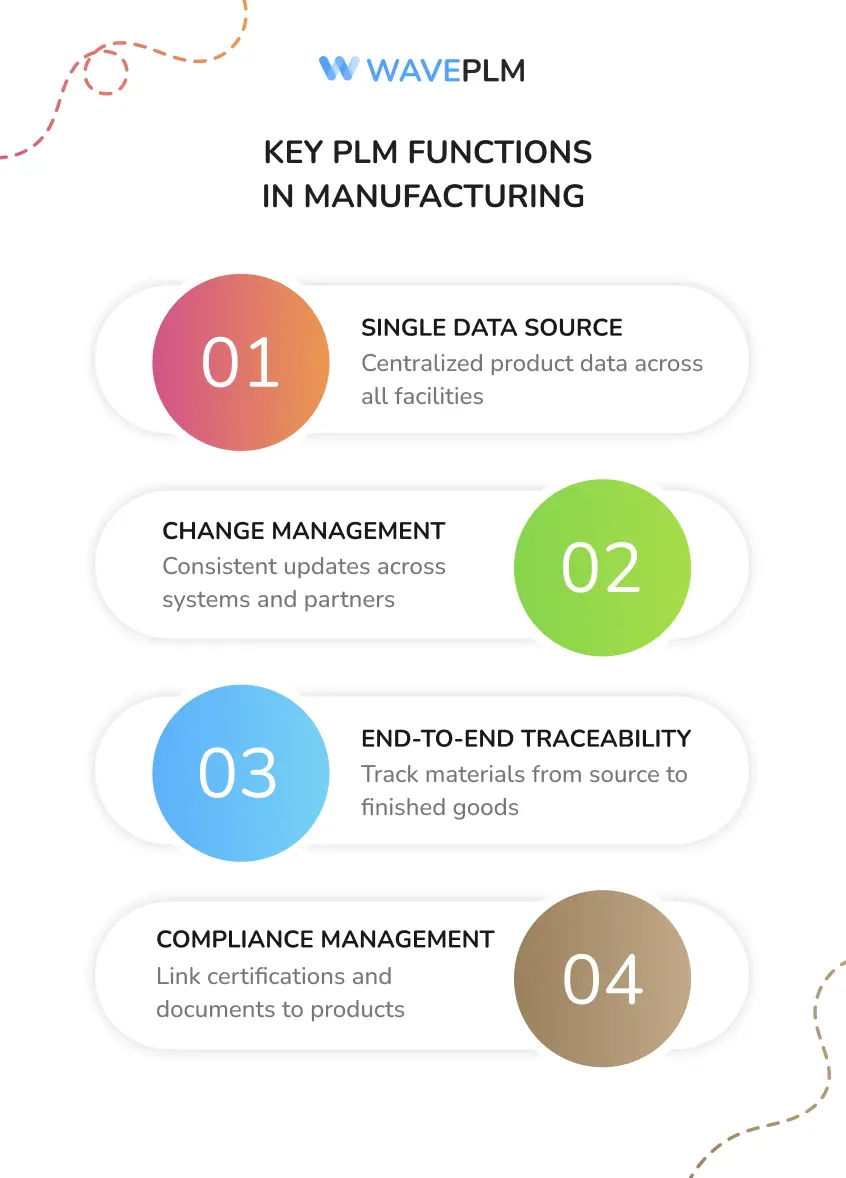
Key functions PLM delivers across distributed manufacturing include:
- Single source of truth for product data across all partner facilities
- Change management workflows that propagate updates consistently
- Traceability from raw materials through finished goods
- Compliance documentation tied directly to product records
Understanding how PLM structures these workflows helps clarify why ad-hoc spreadsheet-based approaches break down so quickly under the pressure of multi-factory coordination.
In practice, PLM not only stores data—it governs how that data moves between teams, partners, and production stages. However, even well-implemented PLM systems encounter friction when overseas manufacturing partners introduce their own processes and legacy tools. That friction is where coordination challenges truly begin.
Challenges in Managing PLM Across Overseas Manufacturing Partners
Even with robust PLM systems in place, coordinating across multiple overseas factories introduces friction points that can quietly erode efficiency. Production scheduling sits at the heart of this challenge—when one partner runs behind, the ripple effect can delay an entire product line across facilities in different time zones.
A few persistent pain points define this landscape:
- Data fragmentation: Factories often operate on separate systems, creating version conflicts and siloed product data
- Communication gaps: Language barriers and time zone differences slow down critical approvals
- Compliance variability: Regulatory standards differ by region, complicating traceability across production stages
- Inconsistent BOMs: Without a unified engineering BOM, manufacturers may work from misaligned specs
Synchronized visibility across partners isn’t optional—it’s the difference between proactive management and constant damage control.
Understanding these friction points is essential before evaluating what solutions actually work. The role a production coordinator plays in bridging these gaps—tracking timelines, aligning stakeholders—mirrors exactly what effective PLM infrastructure must do at scale. Knowing where the gaps exist makes the path to solving them considerably clearer.
Solutions for Effective Production Coordination
Addressing the friction points covered in the previous section requires deliberate strategy, not just better software. Scaling multi-factory networks demands both the right tools and the right operational frameworks to keep every partner aligned.
Centralized data governance is the foundation. When all factories access a single, authoritative source for BOMs, specs, and revision histories, version conflicts drop dramatically. According to PROLIM’s analysis of PLM efficiency, separating design data from manufacturing BOMs reduces costly miscommunication between engineering and production teams—a principle that scales directly to multi-site environments.
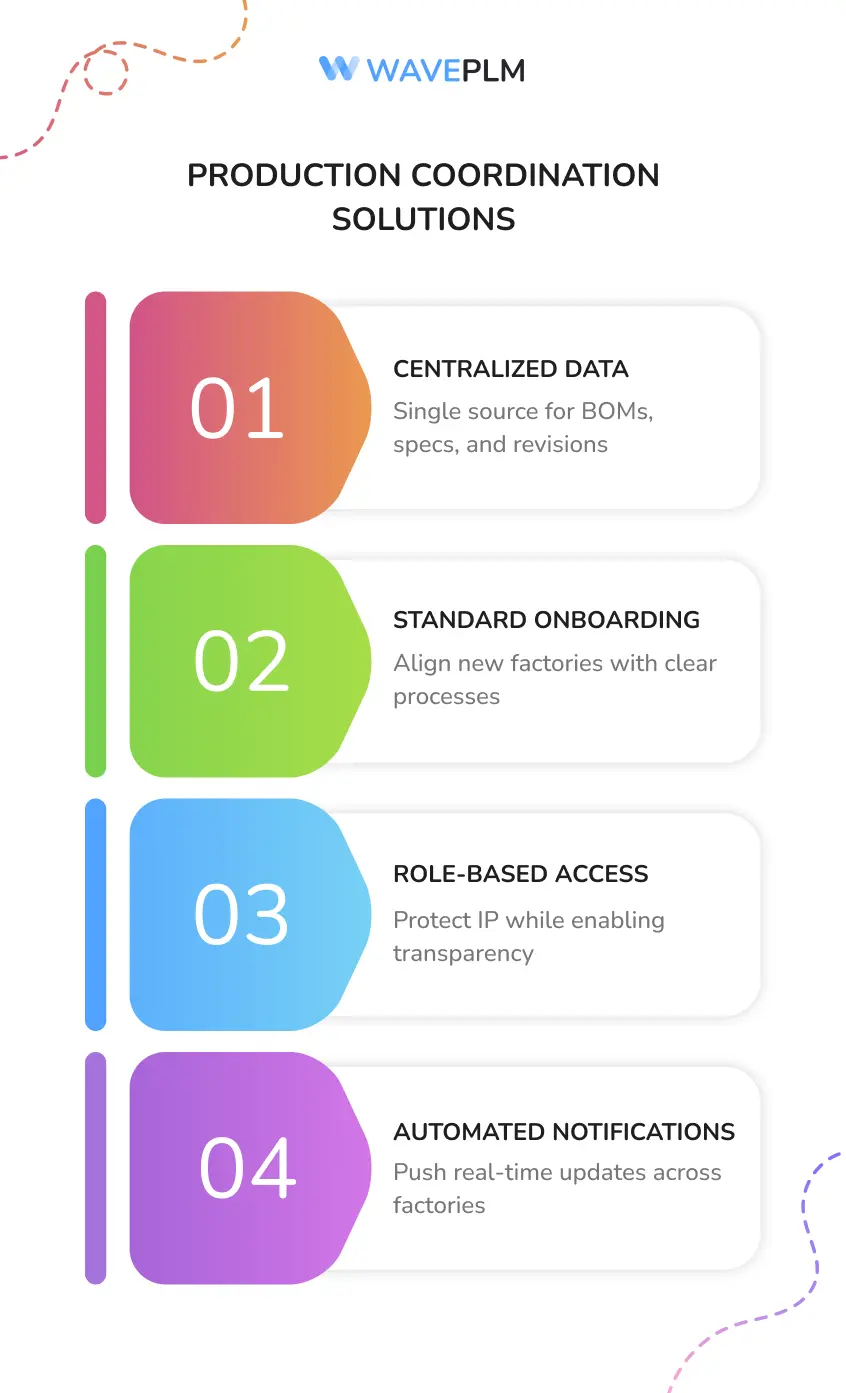
Beyond data structure, three operational practices consistently improve cross-factory coordination:
- Standardized onboarding protocols for new manufacturing partners
- Role-based access controls that protect IP while enabling transparency
- Automated change notifications pushed to affected factories in real time
In practice, manufacturers who align production milestones early across partners avoid costly downstream rework. CIMdata’s industry research reinforces that PLM adoption accelerates when organizations treat collaboration architecture as a strategic investment, not an IT afterthought.
These principles translate differently depending on industry context—which is where examining real-world implementations becomes invaluable.
Case Study: Successful PLM Implementation Across Factories
Seeing strategy in action clarifies what’s actually possible. Consider a mid-sized apparel brand sourcing from five factories across Vietnam, Bangladesh, and Mexico. Before standardizing their PLM implementation approach, version conflicts and delayed approvals were routine — sample approval cycles ran weeks longer than necessary.
The turning point came when the brand established a single shared tech pack environment with factory-specific access permissions. Each manufacturing partner could view only their relevant components, while the brand’s internal team maintained full visibility. Change requests triggered automatic notifications to affected factories, eliminating the email chains that had caused so many delays.
Key outcomes from this approach:
- Sampling lead times dropped by roughly 30%
- Compliance documentation errors decreased significantly
- Cross-factory material reuse became visible and actionable
For fashion businesses exploring similar gains, understanding why PLM provides operational leverage is a useful foundation. Even apparel manufacturers navigating complex production environments consistently point to centralized data as the critical enabler.
Results like these don’t come without trade-offs, though — and understanding those trade-offs is essential before committing to any implementation path.
Trade-offs and Considerations
The case study in the previous section illustrates what’s achievable — but no implementation is without friction. Understanding the real trade-offs helps brands make smarter decisions before committing.
Cost vs. control is the central tension. Centralizing PLM and production coordination across multiple overseas factories requires upfront investment in platform licensing, integration work, and change management. Smaller brands may find that cost difficult to justify initially.
Standardization vs. flexibility is equally tricky. Pushing uniform workflows across factories can conflict with how individual partners prefer to operate, creating resistance that slows adoption rather than accelerating it.
Other practical considerations include:
- Data governance — who owns factory-level data, and how is it protected?
- Connectivity reliability — overseas partners may face inconsistent internet infrastructure
- Training overhead — onboarding teams across the supply chain takes sustained effort
Visibility gains are only as strong as the weakest link in your factory network. Brands that acknowledge these limitations early build more resilient systems.
Not every PLM solution handles these trade-offs equally well — which makes choosing the right platform a critical decision worth examining closely.
Comparison: PLM Solutions for Global Manufacturing
Not all PLM platforms handle multi-factory production coordination equally. When evaluating options for global manufacturing, a few key criteria consistently separate capable solutions from inadequate ones.
| Capability | Basic PLM | Mid-Tier PLM | Enterprise PLM |
|---|---|---|---|
| Multi-factory visibility | Limited | Partial | Full, real-time |
| Supplier portal access | None | View-only | Collaborative |
| Compliance tracking | Manual | Semi-automated | Automated |
| Integration with ERP/WMS | Custom dev required | Some native connectors | Robust API ecosystem |
Supplier collaboration depth is arguably the most critical differentiator. Solutions that offer read-only factory access create bottlenecks; platforms enabling bidirectional communication eliminate revision cycles. As PTC notes, global PLM collaboration requires tools designed specifically for distributed teams — not adapted from single-site workflows.
Cloud-native platforms generally outperform legacy systems for overseas deployments, offering lower implementation overhead and faster factory onboarding. For brands that also need end-to-end operational visibility — from production floor to fulfillment — integration capability matters as much as core PLM features.
As the PLM landscape continues evolving, what these platforms can do next may reshape coordination entirely.

Future of PLM in Multi-Factory Production
The trade-offs and platform comparisons covered earlier point toward an inevitable conclusion: PLM isn’t standing still. As global supply chains grow more complex, the next generation of manufacturing planning tools is evolving rapidly to meet new demands.
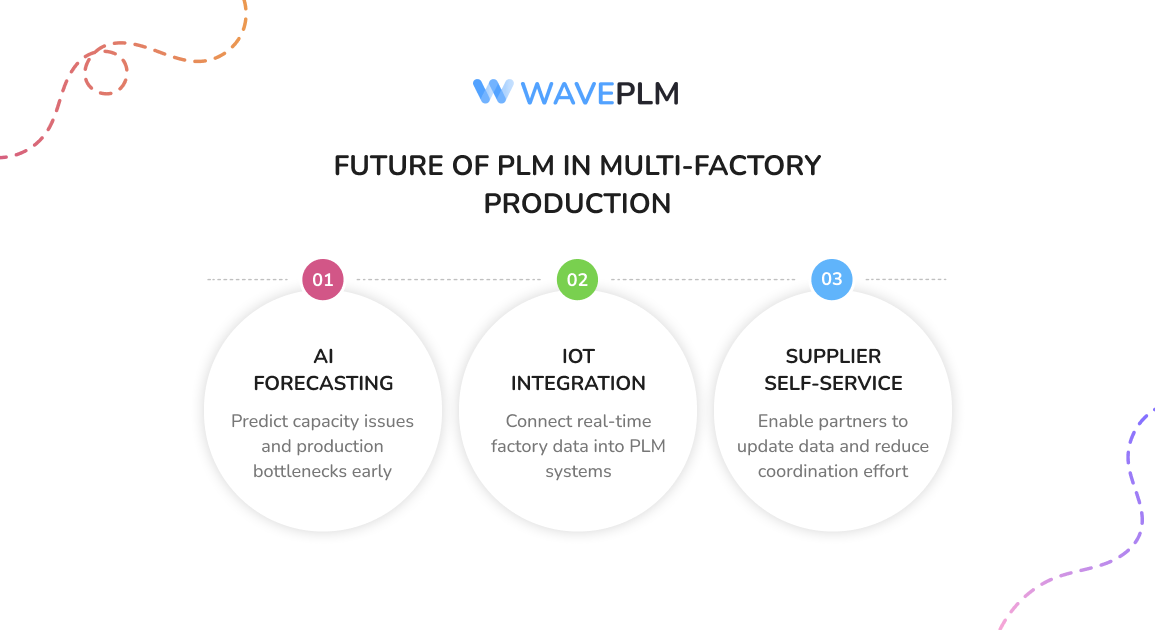
A few developments are reshaping what’s possible:
- AI-driven capacity forecasting that predicts bottlenecks before they disrupt production timelines
- Real-time IoT integration connecting factory floor data directly into the PLM ecosystem
- Supplier self-service portals that reduce coordination overhead by empowering partners to update their own data
Cloud-native architectures are also making cross-border collaboration significantly more accessible. Smaller brands — not just enterprise players — can now coordinate multi-factory workflows with tools that bridge specs and production schedules across geographies without massive IT investment.
The brands that invest in scalable PLM infrastructure today are building a competitive moat that’s difficult to replicate quickly. As regulatory complexity and nearshoring pressures mount, that advantage only compounds. The core principles shaping these decisions are worth distilling into clear, actionable guidance — which is exactly where we’re headed next.
Key Takeaways
Managing PLM across overseas manufacturing partners is complex — but the core principles covered throughout this article point toward a clear set of priorities.
- Centralized data is non-negotiable. Without a single source of truth, multi-factory coordination breaks down quickly.
- Structured BOMs (design and manufacturing) reduce costly miscommunication between engineering and production teams.
- Traceability ensures compliance and accountability across every node in a global supply chain.
- Capacity planning should be embedded in your PLM workflow — not treated as a separate exercise. When factory constraints are visible in real time, teams can respond to disruptions before they cascade.
- Platform fit matters. The right PLM solution aligns with your factory network’s scale, regional requirements, and integration needs.
In practice, organizations that treat PLM as a strategic infrastructure — not just a data repository — see stronger coordination outcomes. PLM even extends into financial decision-making; smarter product cost visibility becomes a natural byproduct of well-structured product data.
Understanding these takeaways sets the stage for a closer look at what PLM actually does at its most fundamental level.
What Is One Key Function of PLM in Manufacturing?
Among PLM’s many capabilities, one function stands out as foundational: maintaining a single, authoritative source of product truth across every stage of development and production. In multi-factory environments, this matters enormously. When design specs, BOMs, and compliance documents live in fragmented systems, costly errors multiply — fast.
Distributed scheduling is a practical extension of this core function. PLM integrates production timelines across facilities, ensuring that design changes upstream automatically ripple into factory schedules downstream. What typically happens without this integration is a cascade of miscommunications — a revised component spec reaches one plant days after production has already begun elsewhere.
As Suuchi notes, PLM software closes the gap between product development and supply chain execution — transforming static documentation into dynamic, actionable coordination.
In short: PLM not only manages data. It synchronizes decisions. Choosing the right tool to deliver that synchronization is the next critical question.

What’s the Best Manufacturing Process Integration Tool for PLM?
There’s no single “best” tool — the right choice depends on your factory network’s complexity, your team’s workflows, and how tightly you need to connect design, sourcing, and production data.
That said, the strongest PLM platforms share common traits: real-time multi-site visibility, structured BOM management, built-in supplier collaboration portals, and compliance tracking across regions. As PTC notes, effective global PLM isn’t just about software features — it’s about enabling connected decision-making across every partner in the chain.
The bottom line: Multi-factory coordination across overseas manufacturing partners demands more than spreadsheets or disconnected ERP systems. PLM acts as the connective tissue that keeps product data accurate, teams aligned, and compliance intact — regardless of geography.
Evaluate tools against your specific integration requirements, prioritize supplier accessibility, and invest in onboarding. The platform that gets adopted across your partner network is always the one that actually works.





Leave a Reply