

Choosing between PLM vs ERP for fashion isn’t just a software decision — it’s a strategic one that shapes how a brand designs, develops, and delivers products to market. Many fashion companies mistakenly conflate the two systems or, worse, assume one can fully replace the other. This misunderstanding can cost time, money, and market relevance.
At its core, Product Lifecycle Management (PLM) software manages the creative and technical journey of a garment — from initial concept and tech packs through sampling and supplier collaboration. Enterprise Resource Planning (ERP), by contrast, governs the operational and financial backbone of a business: inventory, procurement, orders, and accounting.
The PLM in fashion industry lies in its ability to compress development timelines, reduce sampling errors, and centralize product data before a single unit is ever produced. A well-structured PLM implementation can measurably improve supply chain performance and cross-team collaboration.
Both systems serve distinct purposes — and understanding exactly where those purposes diverge is where the real clarity begins.
Key Differences Between PLM and ERP
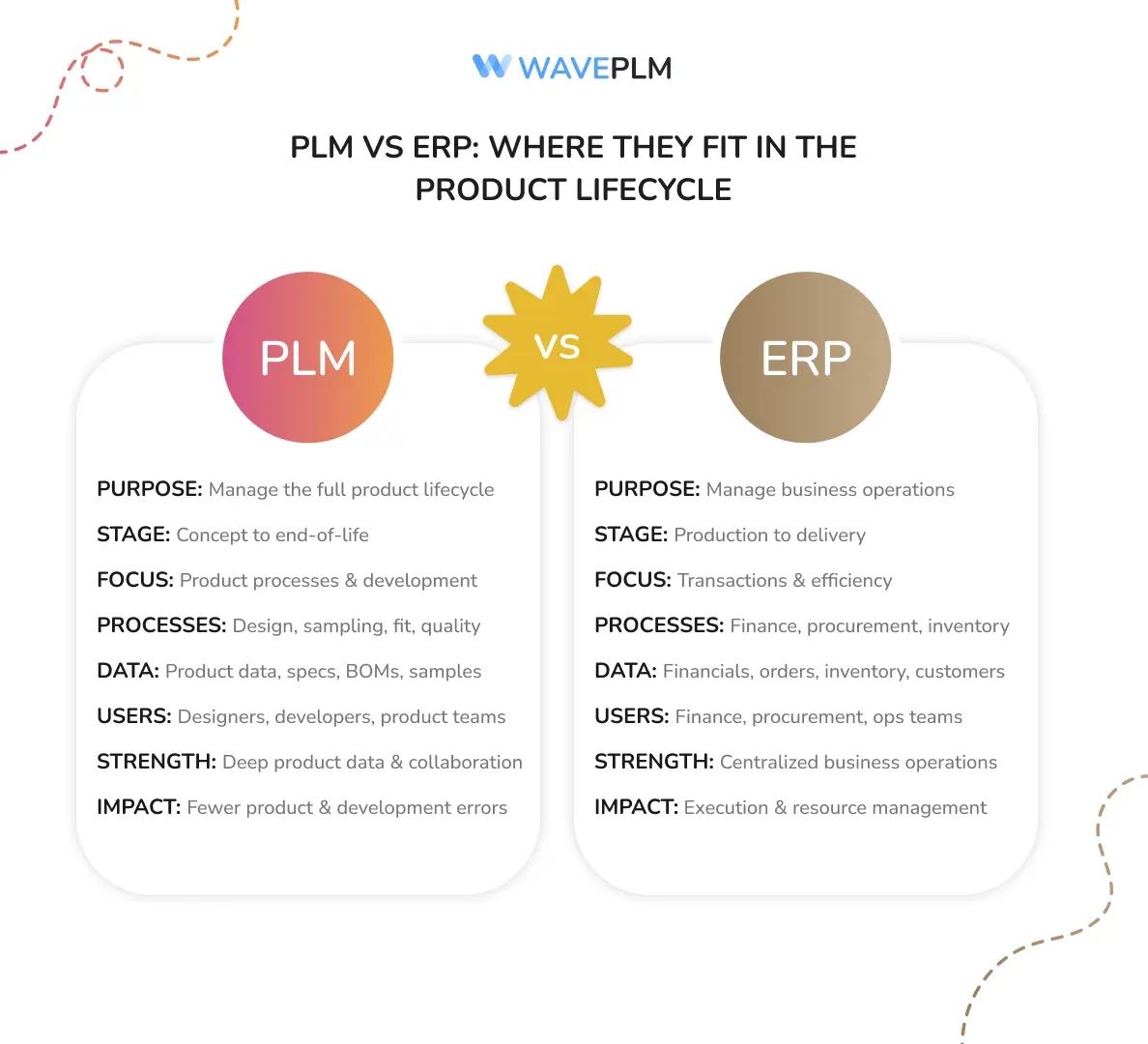
Understanding the difference between PLM and ERP comes down to one fundamental question: where does each system live in the product lifecycle?
PLM (Product Lifecycle Management) is built for the creation phase — from initial concept and design through sampling, tech packs, and supplier collaboration. It’s the system of record for a product before it ever hits a warehouse. ERP (Enterprise Resource Planning), by contrast, takes over once a product is ready to move — managing procurement, inventory, financials, and order fulfilment.
Industry research shows that PLM focuses on product data and innovation while ERP focuses on business transactions and operational efficiency. They answer different questions: PLM asks “What are we making and how?” — ERP asks “How do we buy, move, and sell it?”
A few core distinctions at a glance:
- Data type: PLM manages design and specification data; ERP manages financial and transactional data
- Users: PLM serves designers and product developers; ERP serves finance, procurement, and logistics teams
- Timing: PLM is pre-production; ERP is production through delivery
For fashion brands especially, getting PLM right early in development prevents costly downstream errors that ERP simply isn’t equipped to catch.
Knowing where each system ends, however, raises a natural question — do they compete, or do they work better together?
PLM and ERP: Complementary Systems or Competitors?
When the debate shifts to ERP vs PLM for textiles and fashion, the framing of “either/or” tends to miss the point entirely. These two systems aren’t really competing — they’re designed for fundamentally different phases of the product journey.
Think of it this way: PLM handles the creation side of the business. It’s where designers, developers, and technical teams collaborate to build a product from concept to production-ready spec. ERP picks up from there — managing inventory, fulfillment, financials, and supplier payments once a product is ready to move.
The most effective fashion operations use both. Leading fashion brands report that PLM and ERP serve distinct but interdependent functions, and integrating them reduces data silos that slow down production timelines. When the two systems share data seamlessly, teams avoid costly rework caused by miscommunication between creative and operational departments.
In practice, brands that rely solely on ERP often struggle with managing the complexity of product development workflows — especially when managing seasonal collections at scale. That said, integration does come with its own challenges, which we’ll explore in the next section.
Challenges and Limitations of PLM and ERP Systems
No software is a silver bullet. Even when PLM in fashion industry contexts and ERP systems work well together, both come with real constraints worth understanding before committing to either.
PLM challenges typically include:
- High upfront implementation costs and lengthy onboarding timelines
- Steep learning curves for design and merchandising teams
- Integration complexity when connecting to legacy systems or supplier portals
ERP challenges often look like:
- Rigid workflows that struggle to accommodate the fast, iterative nature of fashion development
- Limited visibility into creative or pre-production stages
- Customization that’s expensive and time-consuming to maintain
One practical consideration: data duplication. Without a clean integration layer, product information can exist in both systems simultaneously—leading to version conflicts, errors in costing, or miscommunication with suppliers. Industry research shows this overlap is one of the most common pain points teams encounter when running both platforms in parallel.
It’s also worth noting that smaller brands sometimes find that a focused tool—something purpose-built for managing product data efficiently—can bridge gaps without requiring full ERP investment.
Understanding these limitations in theory is one thing. Seeing how real brands navigate them is another entirely.
Industry Examples: PLM and ERP in Action
Seeing how an ERP system in fashion operates alongside PLM in real-world scenarios helps cut through the theoretical debate. Abstract comparisons only go so far — concrete patterns reveal how these tools actually perform under pressure.
Consider a mid-sized apparel brand scaling from regional to global distribution. In practice, the product development team leans heavily on PLM to manage tech packs, material sourcing, and supplier collaboration. Once designs are approved and production orders confirmed, that data flows into the ERP, which handles purchase orders, inventory levels, and financial reconciliation. The two systems divide responsibility cleanly — creativity and specification on one side, execution and accounting on the other.
A common pattern in fast fashion is tighter iteration cycles, where managing product timelines efficiently becomes a competitive advantage. Brands that keep PLM and ERP siloed often struggle to meet those timelines, while those with integrated workflows move from concept to shelf noticeably faster. Wave PLM exemplifies this integration, providing a platform specifically designed for apparel brands to manage complex product timelines effectively.
On the other hand, smaller brands sometimes attempt to run everything through ERP alone — and find it strains under the weight of complex product data. These real-world friction points raise an important question: does conventional wisdom about each system’s role actually hold up?

Conventional Wisdom vs. Reality: The True Role of PLM and ERP
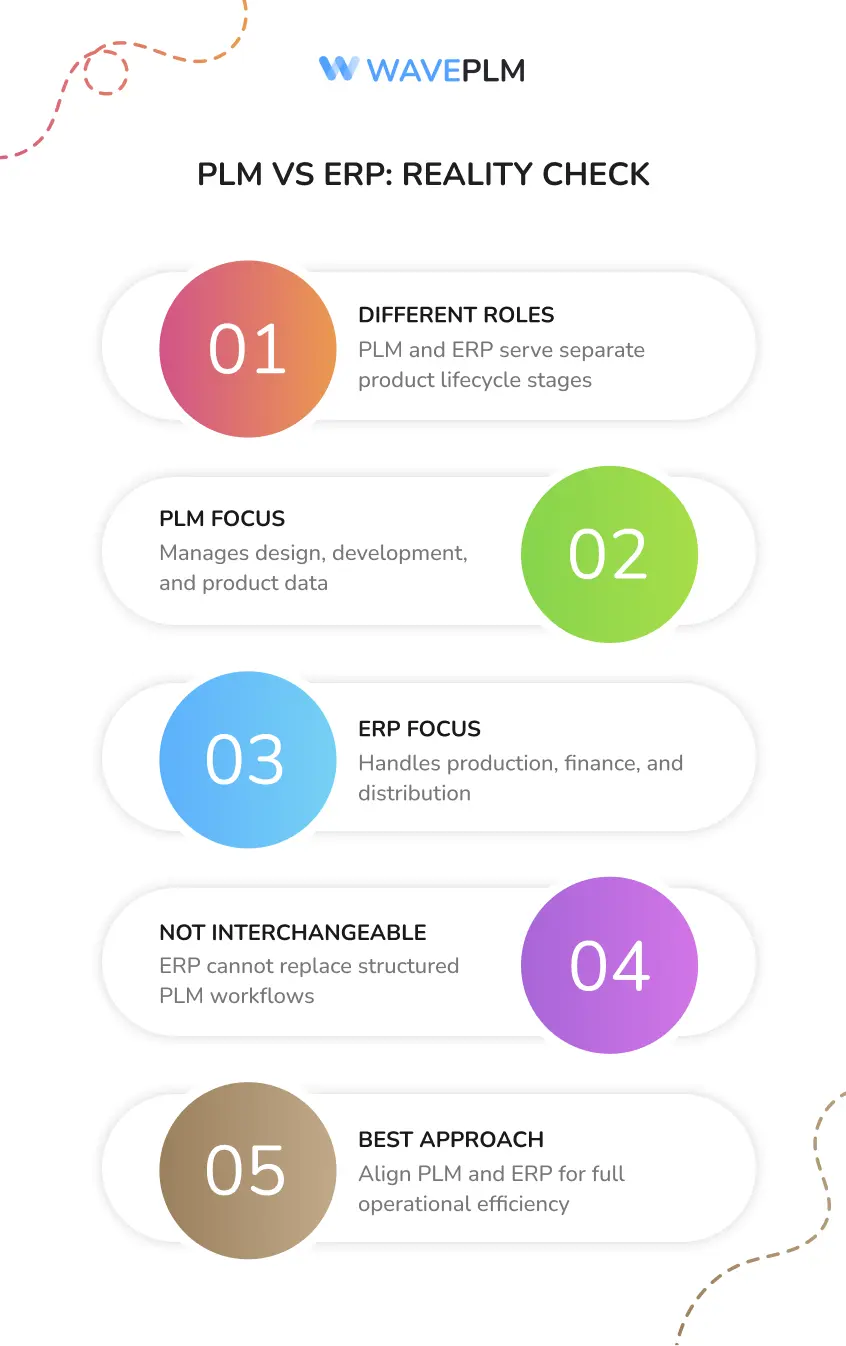
A persistent misconception in the fashion industry is that ERP systems can eventually absorb everything PLM does — or vice versa. In practice, that’s rarely how it plays out. Each system was built with a fundamentally different purpose, and understanding that distinction matters more than debating which one is “better.”
The conventional view treats these platforms as competitors vying for the same budget. The reality? Their difference between PLM and ERP are designed for entirely different stages of a product’s life. Industry research shows that PLM focuses on the creative and development phase — specs, materials, sampling — while ERP takes over once a product is ready to move through production, finance, and distribution.
Another common myth: smaller brands don’t need PLM if they already have ERP. But even lean teams benefit from structured product development workflows that keep design decisions traceable and organized. ERP simply isn’t built to manage that complexity.
The most effective fashion operations don’t choose between the two — they align them. That alignment question is exactly where decision-making gets nuanced.
Making the Right Choice: PLM, ERP, or Both?
After weighing real-world examples and debunking common myths, the practical question remains: which system does your brand actually need?
The honest answer is that most growing fashion brands need both — but the timing and priority depend on where your biggest operational pain points live. A startup focused on design iteration and supplier communication will likely benefit from PLM first. A brand scaling distribution and managing multi-currency financials needs ERP infrastructure in place early.
Consider ERP system in fashion as a benchmark: Inditex’s famously agile supply chain relies on tightly integrated operational systems to execute rapid replenishment. Yet product design and development workflows still require dedicated tooling that ERP alone can’t replicate.
A common pattern is to implement ERP for financial and inventory control, then layer in PLM capabilities for product development as the product portfolio grows. Brands moving to the cloud are finding this integration increasingly accessible — modern cloud PLM platforms like Wave PLM now connect more naturally with existing ERP environments, reducing the traditional friction between the two systems. Book a demo to see how Wave PLM fits into your tech stack.
Leading fashion brands report that the strongest operations use both tools in their respective lanes. A side-by-side breakdown makes those lanes even clearer.
Comparison Table: PLM vs ERP for Fashion
With the decision framework laid out, a side-by-side view makes the distinctions even clearer. Whether you’re evaluating PLM, ERP vs PLM for textiles, or both, this snapshot cuts through the complexity.
| Feature | PLM | ERP |
|---|---|---|
| Primary Focus | Product design & development | Business operations & financials |
| When It’s Used | Pre-production | Production through delivery |
| Core Users | Designers, developers, merchandisers | Finance, operations, supply chain |
| Key Strengths | Tech packs, sampling, supplier collaboration | Inventory, procurement, order management |
| Data Type | Creative and technical product data | Transactional and operational data |
| Integration Need | Feeds into ERP at production handoff | Receives finalized product specs from PLM |
A common pattern is that brands underestimate how much product data — materials, colorways, construction details — accumulates before a single order is placed. PLM captures that upstream complexity; ERP manages what happens after. How you organize materials and components early in development directly shapes how cleanly that data transfers downstream.
The right tool ultimately depends on where your biggest bottlenecks live — a theme the key takeaways will help crystallize.
Key Takeaways
The PLM vs. ERP debate doesn’t have a universal winner — it has a right answer for each brand’s specific stage and priorities.
Here’s what the full picture reveals:
- PLM excels at managing the creative and development lifecycle — from concept sketches to production-ready specs
- ERP dominates operational execution — inventory, finance, orders, and supply chain logistics
- Integration of both is the gold standard for scaling brands that need end-to-end visibility
- The size of your team, complexity of your product range, and growth trajectory should drive the decision
Successful PLM vs ERP for fashion is rarely about choosing the most feature-rich platform. In practice, it’s about choosing the system that solves your most pressing bottleneck right now, with room to expand later.
Industry research shows that PLM and ERP are complementary rather than competing — and the brands that treat them that way consistently outperform those that don’t.
The most strategic investment a fashion brand can make is understanding where its biggest inefficiency lives — then building outward from there. For brands ready to implement a dedicated fashion PLM, consider Wave PLM as your solution.




Leave a Reply