

Fashion has always moved fast. But the brands winning today aren’t just moving fast — they’re moving smart. Behind every on-target collection, every well-timed reorder, and every accurate demand forecast is an increasingly powerful engine: big data in fashion.
For operations directors and product development leads, this shift is no longer theoretical. Data fashion decisions — from fabric sourcing to colorway selection — are being shaped by real-time signals drawn from millions of consumer interactions, supply chain events, and market movements. The question is no longer whether your brand should engage with fashion big data. It’s whether your infrastructure can actually use it.
This article breaks down where fashion big data comes from, how leading brands act on it, and why PLM sits at the center of making data actionable across the entire product lifecycle.
What Is Big Data in Fashion?
The term big data in fashion refers to the high-volume, high-velocity streams of structured and unstructured data generated across the fashion value chain — from trend discovery and design through sourcing, production, distribution, and post-sale consumer feedback.
Three characteristics define it: volume (the sheer quantity of data points), velocity (how quickly that data is generated and needs to be processed), and variety (the range of formats — numeric, textual, visual, behavioral — involved).
In practical terms, a single mid-size apparel brand might generate or access millions of data points per week across social platforms, e-commerce transactions, supplier communications, logistics tracking, and quality audits. None of those streams is inherently useful on its own. The competitive advantage lies in connecting them — and routing the right signals to the teams that can act on them.
Fashion data isn’t about having more information. It’s about having the right information reach the right decision point before it’s too late to act.

5 Sources of Fashion Big Data Brands Collect Today
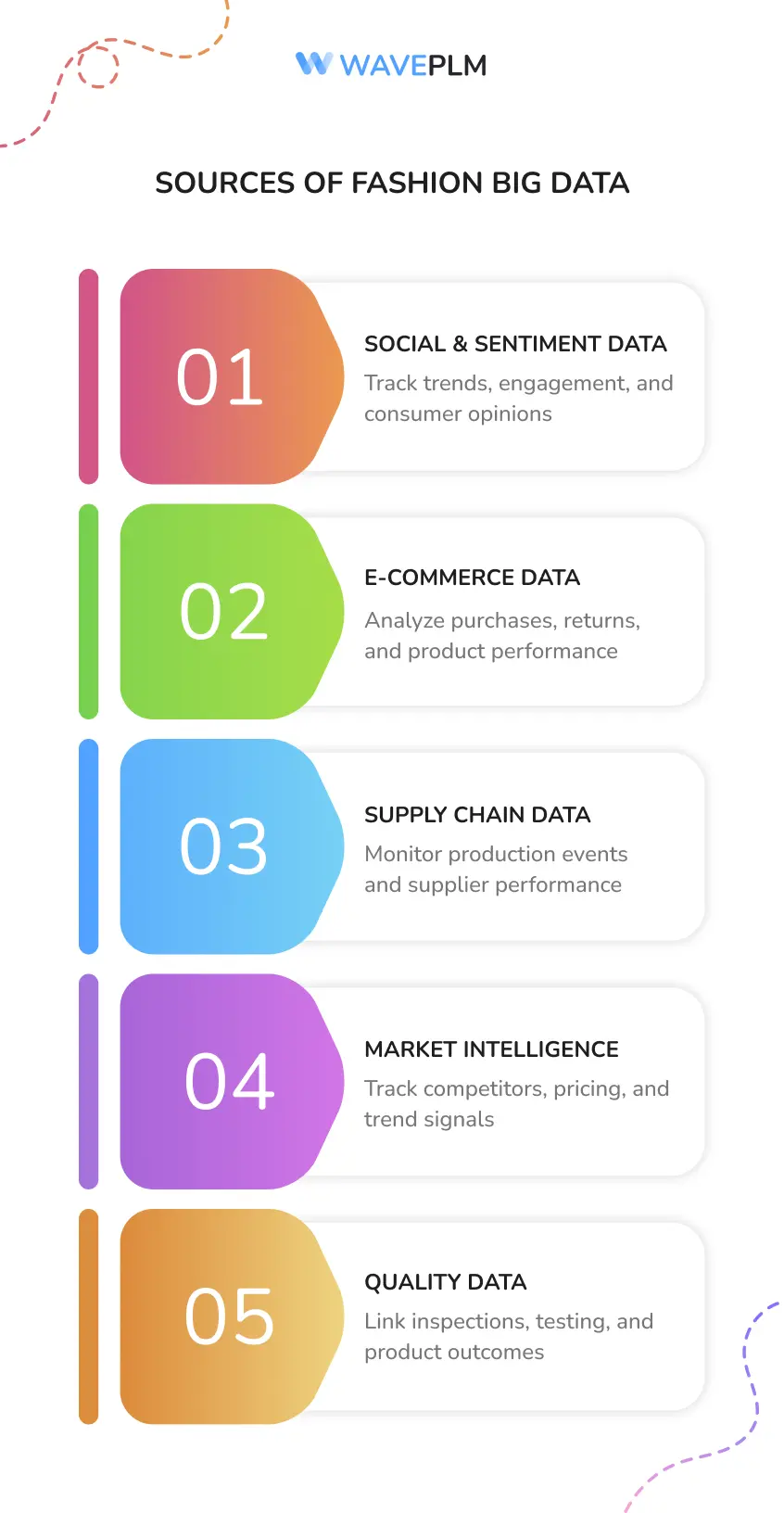
Understanding the landscape of data sources is the foundation of any data fashion strategy. Here are the five most commercially significant:
1. Social media and consumer sentiment
Platforms like TikTok, Instagram, and Pinterest generate enormous volumes of behavioral data — hashtag velocity, engagement patterns, comment sentiment, and visual aesthetic clusters. For fashion brands, this is where trend signals surface before they appear in any sales report. The challenge is routing these signals into product development workflows rather than letting them sit in a marketing dashboard.
Madé Lapuerta, the creator of the Instagram account @databutmakeitfashion, exemplifies how data but make it fashion is transforming the industry. Lapuerta uses data-driven analyses to track and quantify fashion trends and fluctuations, such as the rise and fall of styles like coquette and tenniscore.
By employing social listening and sentiment analysis, she reads and interprets social media posts and tweets to gauge public opinion and interest, providing valuable insights into what is trending. However, as Lapuerta has found, analyzing fashion trends through data is not an exact science—manual intervention is often needed to accurately interpret the sentiment behind social media language, which can sometimes be misleading. Still, data analysis in fashion helps quantify trends and popularity, as data scientists apply formulas to track changes in consumer interest and sentiment, truly making it fashion through innovative approaches.
The relationship between social analytics and PLM is explored in depth in Understanding Social Media Analytics in PLM — including how real-time sentiment data can inform design iterations well before sampling begins.
2. E-commerce and retail transaction data
Purchase histories, abandoned carts, return rates, and product review scores are among the richest behavioral datasets available to fashion brands. At scale, this data reveals which attributes — fit, colorway, material, price point — correlate with conversion and retention versus returns and complaints.
3. Supply chain and production events
Every handoff in a global supply chain generates data: order acknowledgments, fabric inspection results, cut-and-sew milestones, customs clearance timestamps, delivery confirmations. When aggregated across suppliers and factories, this operational data identifies delay patterns, quality failure hotspots, and vendor performance trends. Automated tracking systems — as covered in Streamline Apparel Supply Chains with Automated Tracking — make this data continuous rather than episodic.
4. Market and competitor intelligence
Price point monitoring, new product launches, sell-through signals from wholesale partners, and trend forecasting services all contribute to the competitive intelligence layer of fashion big data. Brands that systematically collect and synthesize this data can identify white space opportunities and respond to competitive moves before the next season is locked.
5. Quality and compliance data
Lab testing results, inspection reports, compliance certifications, and consumer complaint records form a dataset that directly links production decisions to product outcomes. Tracking quality metrics across multiple manufacturing partners — a complexity examined in Multi-Factory Production Coordination — reveals systemic risk patterns that individual audits miss.
How Analytics Drive Fashion Decisions: From Signal to SKU
Collecting data is table stakes. The operational question is how fashion big data translates into actual product decisions — and how quickly.
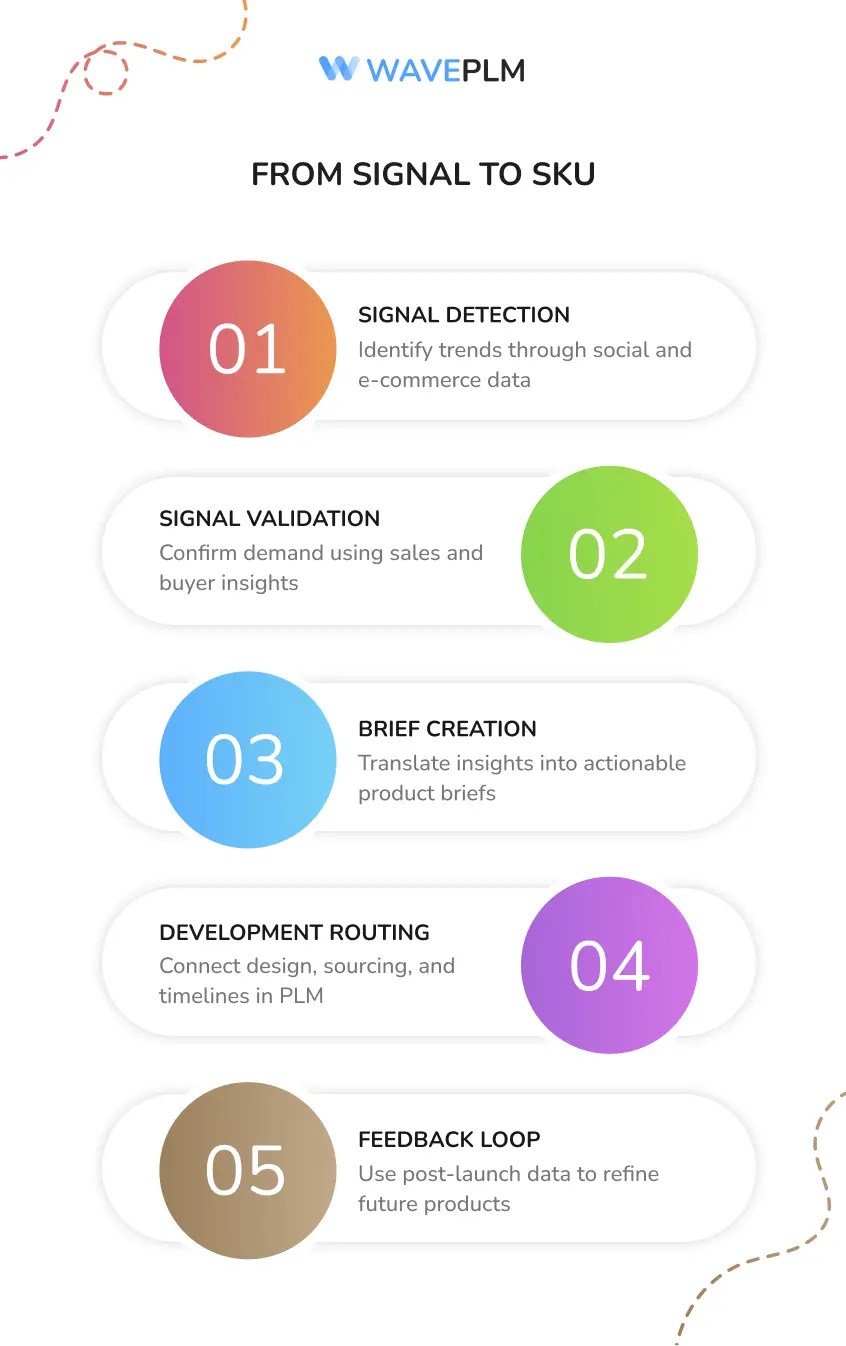
In a data-mature brand, the journey from signal to SKU follows a structured flow:
- Signal detection. Social listening tools or e-commerce analytics flag an emerging pattern — say, elevated engagement around a specific silhouette or material combination. Algorithms analyze social media sentiment, search trends, and online behavior to predict emerging styles, reducing reliance on gut feeling.
- Signal validation. The pattern is cross-referenced against sell-through data from previous seasons and wholesale buyer feedback to assess whether it reflects genuine purchase intent or social noise.
- Brief creation. A validated trend brief enters the PLM system, flagged to the relevant design and merchandising team with supporting data. Designers use insights to understand which designs, colors, or sizes are most likely to succeed.
- Development routing. The PLM platform routes sourcing requirements, cost targets, and timeline milestones based on the new brief, connecting the insight to execution.
- Feedback loop. Post-launch sales data and consumer sentiment flow back into the system, informing the next development cycle.
The brands that execute this flow in days rather than quarters consistently outperform their peers on margin and speed-to-market. The bottleneck is almost never data availability — it’s the infrastructure connecting data to decisions.
Big Data and PLM: Why the Two Must Work Together
Product Lifecycle Management software is the operational infrastructure through which fashion brands coordinate design, development, sourcing, and production. When integrated with data fashion pipelines, PLM becomes the system that transforms raw signals into coordinated product action.
Without PLM, big data in fashion tends to generate insight without execution. A trend signal that lives in a marketing analytics tool, disconnected from the development calendar, won’t change what gets designed, sourced, or made. The intelligence only becomes commercially valuable when it is wired directly to the milestones, decisions, and teams that can act on it.
This is also the core distinction between PLM and ERP when it comes to data — a distinction worth understanding clearly. ERP systems govern inventory, procurement, and financial data after a product exists. PLM governs the data that shapes what the product becomes. The two serve different data functions at different stages of the product lifecycle, as detailed in PLM vs ERP for Fashion: Key Differences Explained.
Fashion companies increasingly rely on technology and coding skills, as nearly every brand that allows online shopping or has an app requires software engineers for development and maintenance.
Fashion big data without a connected PLM is like having an excellent weather forecast but no ability to change what you’re wearing. The intelligence exists; the response infrastructure doesn’t.
Wave PLM is designed to serve as that response infrastructure — centralizing trend signals, production data, supplier communications, and quality metrics in a single environment where teams can move from insight to action without context-switching across disconnected tools.

Real-World Use Cases: Forecasting, Sourcing, and Quality
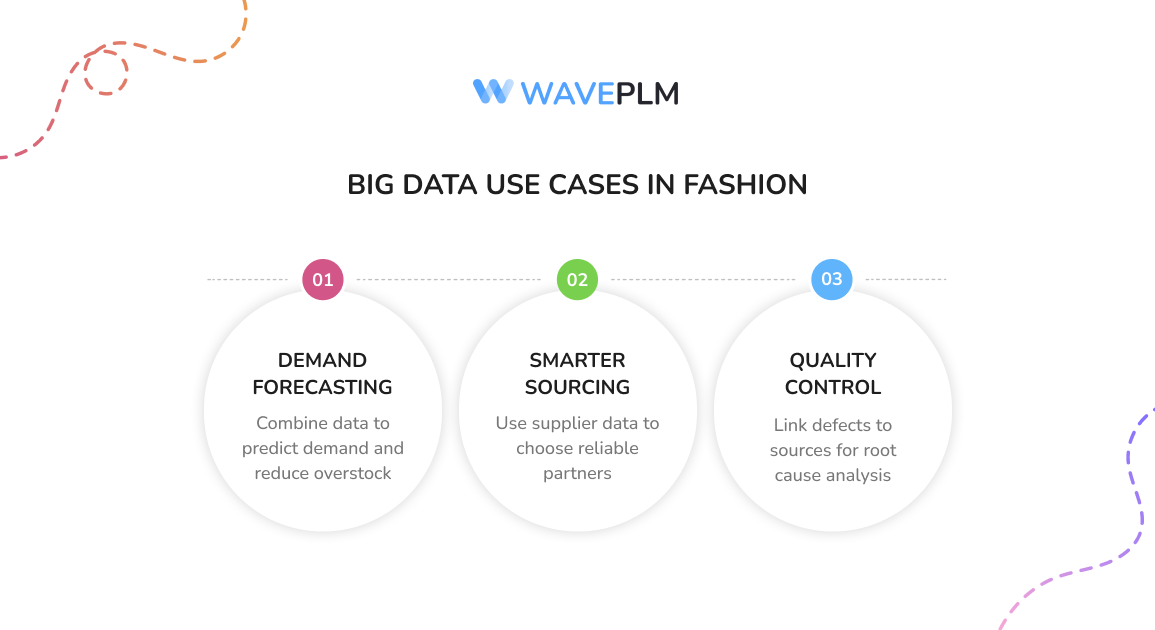
The commercial value of fashion big data is clearest in three specific operational contexts: fashion trends are often defined by the prevailing era, with some styles rising and falling within a single year or even weeks, while others, such as ballet flats, can remain popular for years — highlighting the varying life cycles and consumer interest in different trends.
Demand forecasting
Brands combining social sentiment data, historical sell-through analysis, and wholesale order patterns can significantly improve the accuracy of demand forecasts before production commitments are made. By leveraging data, brands can quickly identify the pick of high-potential styles and reduce time spent on unpopular concepts. This not only reduces overstock (a major margin drain) and stockouts (a major revenue leak) simultaneously, but also empowers designers to create products with smaller environmental footprints as data reveals efficiencies in material and production. Better forecasting also reduces the cost of late-stage development pivots — a dynamic that becomes compounded across multi-SKU collections.
Smarter sourcing decisions
Supplier performance data — on-time delivery rates, defect rates, communication responsiveness, and cost variance — can be aggregated across seasons to build a data-driven supplier scorecard. When sourcing teams can see this history at a glance, decisions about which factories to assign new development to are based on evidence rather than relationship inertia. For brands managing complex networks of overseas manufacturing partners, this capability is particularly valuable.
Additionally, 3D modeling and digital prototyping, with features such as realistic garment visualization and virtual fitting, allow designers to visualize garments without physical samples, reducing material waste and production time.
Quality control integration
Linking quality inspection data to production records creates a dataset that reveals where in the production process defects most commonly originate. This supports root cause analysis — rather than discovering that a shipment has a 7% defect rate, brands can identify whether the issue correlates with a specific factory line, a specific material batch, or a specific construction technique. The strategic approach to quality management in apparel is covered in detail in Quality Control in the Clothing Industry: A Complete Guide.
Challenges of Managing Fashion Big Data at Scale
The operational potential of fashion big data is real — but so are the implementation challenges. Operations directors should plan for several common friction points:
- Data fragmentation. Fashion brands typically operate across multiple systems — ERP, PLM, social listening tools, e-commerce platforms, supplier portals — that don’t communicate natively. Without deliberate integration architecture, data sits in silos and loses its value.
- Signal quality. Not all data is equally reliable. Social media metrics in particular are vulnerable to bot activity, algorithmic amplification, and viral anomalies that distort trend detection. Validation workflows — cross-referencing social signals against transaction data and wholesale feedback — are essential before acting on them.
- Organizational readiness. Data infrastructure without data literacy creates a bottleneck at the human layer. Design teams, sourcing managers, and merchandisers need to understand how to interpret and act on data signals, not just receive them. Over 35% of new fashion designs will be influenced or entirely created by AI by 2026. The role of the designer is evolving from a sole creator to a collaborator and curator with the help of AI, as creators leverage generative AI tools to create mood boards and design variations rapidly, shortening design cycles. This ongoing adoption of AI will continue to reshape the industry. Phygital Fashion is also emerging, where physical garments are expected to come with a “3D digital twin” for NFT or gaming use.
- Governance and privacy. Consumer data collection — particularly from social platforms and e-commerce interactions — carries regulatory obligations under GDPR and equivalent frameworks. Data fashion strategies need privacy compliance built in from the start, not retrofitted later.
The common thread across all of these challenges is that they are infrastructure problems, not data problems. The fashion industry has more relevant data available than it has ever had. The brands that will lead the next decade are those that build the systems to use it.

Key Takeaways
Big data in fashion has moved from a strategic ambition to an operational reality. The brands closing the gap between trend signal and market-ready product are those that have built the infrastructure to make fashion big data actionable — not just collectable.
Three priorities stand out for operations teams ready to advance their data fashion capabilities:
- Connect your data to your development workflow. Trend signals, quality data, and supply chain events only drive competitive advantage when they are wired into PLM — not siloed in marketing or operations tools.
- Build for the full data lifecycle. The most valuable fashion big data strategies don’t just collect upstream signals — they close the loop from post-launch performance back into the next development cycle.
- Choose infrastructure that scales. As data volumes grow and sourcing networks become more complex, the systems that connect data to decisions need to scale with them. Platforms like Wave PLM are built to serve as that connective layer.
The best way to implement data fashion strategies is by integrating actionable data into every stage of the product lifecycle, ensuring compliance with regulatory deadlines, such as those often set for April. For readers seeking general fashion commentary and broader industry insights, authoritative sources like Vogue provide valuable perspectives alongside data-driven analysis.
Wave PLM is a cloud-based Product Lifecycle Management platform built for fashion brands, accessories companies, and apparel manufacturers. It centralizes design, development, sourcing, and production data in a single connected environment.


Leave a Reply