

While some brands introduce new collections to the market in six weeks, others take nine months—losing out even before sales begin. The ability to reduce time to market in the fashion industry today directly determines who captures market share and who sells off excess inventory at a 70% discount.
Why the Traditional Product Development Cycle No Longer Works
The average cycle from concept to shelf takes 18 to 36 weeks. During this time, trends can change, and competitors can fill the gap. According to industry research on PLM in fashion, disparate tools—spreadsheets, email chains, paper technical packs—create bottlenecks at every stage from design to production.
The problem worsens at the supply chain management fashion level: suppliers, factories, and buyers operate in different systems, data is duplicated or lost, and approvals are delayed for weeks. Each iteration of technical specifications adds days that the team cannot afford.
The Cost of Delay: Competition and Missed Sales
A product launch delay of just four weeks can mean missing peak seasonal demand. Studies show that brands not ready for the season’s start can lose up to 30% of potential revenue, forcing them to compensate with aggressive discounts that erode margins.
A slow development cycle is not just an operational issue; it’s a strategic threat. This is why the question of how PLM reduces time to market in fashion has shifted from a technical concern to a priority for operations directors.
Those evaluating PLM software in fashion understand it’s not just about automation but about reimagining the entire product lifecycle—from sketch to shipment. This is where the discussion about PLM’s role as a foundational tool begins.
Objective: How PLM Helps Reduce Time to Market
Fashion PLM—Product Lifecycle Management system—is a centralized platform that brings together all stages of collection creation: from initial concept and material development to production and delivery. Essentially, it’s a single source of data for all process participants—designers, buyers, technologists, and suppliers.
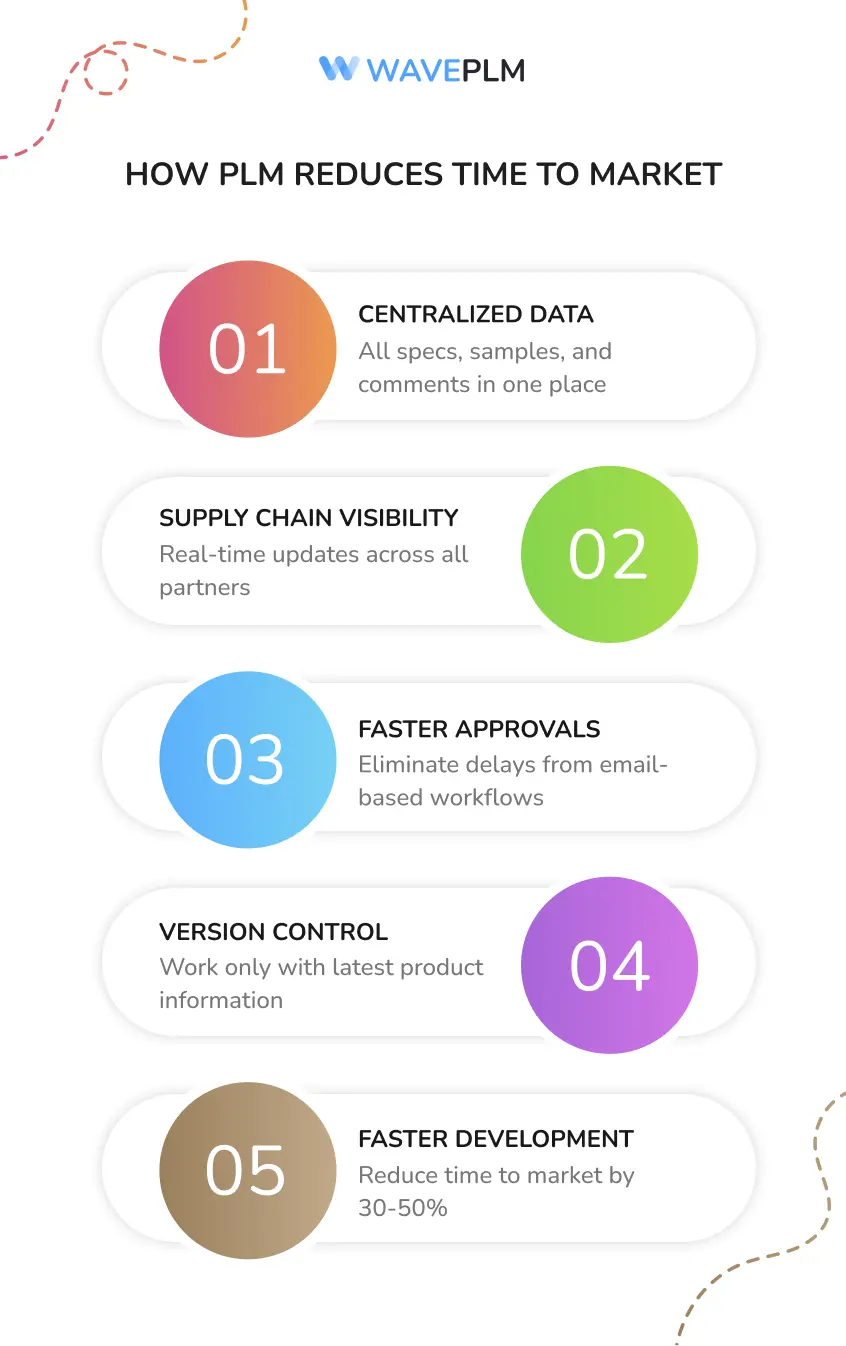
This is the key solution to the problem described earlier: fragmented data and manual approvals slow down the workflow. PLM bridges these gaps, connecting processes into a single, manageable chain. According to JWU Online, companies implementing PLM reduce product development time by an average of 30–50%. This isn’t an abstract number—it’s the weeks that separate a brand from a trend window and its closure.
Benefits of fashion PLM encompass several critical areas:
- Data centralization—specifications, samples, and fit comments are stored in one place
- Supply chain transparency—all parties see the current status of tasks in real-time
- Accelerated approvals—approval cycles are shortened by eliminating email correspondence
- Version control—eliminates work with outdated technical packages
Fast fashion strategies are fundamentally based on the ability to manage hundreds of SKUs simultaneously without losing control. According to leading PLM providers, teams using PLM can develop multiple collections in parallel—something nearly impossible with manual management without increasing staff.
Reduce fashion development time with PLM is more than a marketing slogan. It represents a structural change in the operational model. WavePLM offers a comprehensive 360° approach: from managing design concepts to controlling suppliers and tracking production tasks within one ecosystem. If you’re interested in how comprehensive PLM solutions differ from standalone tools, the difference becomes clear when scaling.
Understanding what PLM offers is only half the picture. The next question is how to implement its capabilities through specific operational mechanisms.
Key Strategies: Accelerating Fashion Collection Development
Understanding how PLM eliminates systemic delays is just the first step. The next question for an operations director is more specific: which PLM fashion mechanisms have the most significant impact on development speed? Three strategies consistently show measurable results.
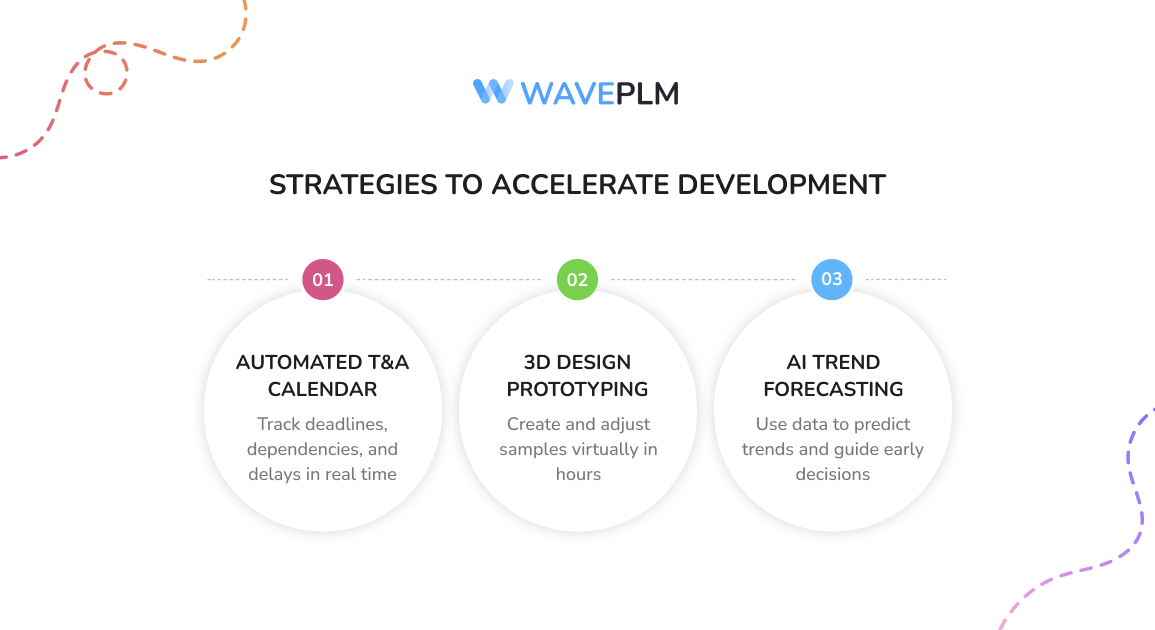
Automating the T&A Calendar: Discipline in Deadlines at Scale
The Time and Action (T&A) calendar is the operational backbone of any collection. In manual mode, managing it becomes endless correspondence between teams. A PLM platform automates this process: each deadline is tied to a specific executor, delays at one stage automatically recalculate dependent timelines, and managers receive notifications before a window is missed.
An automated T&A calendar turns chaotic deadline management into a transparent, manageable process, where deviations are visible weeks, not days, before disaster.
In practice, brands using fast-fashion strategies with automated T&A reduce operational delays by 20–30% compared to teams using spreadsheets and email.
3D Design: Prototyping Without Physical Samples
The traditional prototype creation cycle takes two to six weeks: sketch → pattern → physical sample → feedback → adjustment. 3D design breaks this chain. A virtual sample is created in hours, adjustments are made instantly, and communication with suppliers becomes more precise—fewer iterations, less waste.
More about how digital tools transform work with materials and construction can be found in this industry transformation breakdown. Integrating a 3D environment directly into PLM allows for centralized storage of all design versions, which is critical when working with distributed teams.
AI Forecasting: Hitting Seasonal Fashion Trends on Time
Cloud-based PLM tools of the new generation increasingly include AI modules that analyze sales data, social signals, and search queries. This allows teams to make decisions about color, silhouette, and material at the concept stage—before seasonal fashion trends become outdated. Instead of reacting to the market, the brand anticipates it.
Selecting and integrating a PLM solution capable of leveraging all three strategies simultaneously is the next practical task worth considering in detail.
Implementing PLM for Improved Supply Chain Efficiency
The acceleration strategies discussed in the previous section work only with proper implementation. Product lifecycle management fashion is not just about installing new software: it’s about restructuring the company’s operational logic. This is where many brands encounter real PLM implementation challenges.
Step-by-Step Integration of PLM into Existing Processes
Experience shows that the most successful implementations follow a phased model:
- Audit current processes—record all points of manual data entry and bottlenecks in approval chains.
- Pilot launch—start with one direction (e.g., sample development) before scaling the system across the brand.
- Data migration—transfer specifications, tech packs, and supplier data into a unified PLM environment.
- Team training—invest time in employee adaptation; resistance to change remains one of the main barriers to implementation.
- Integration with external systems—connect ERP, WMS, and ecommerce platforms for comprehensive ecommerce fashion optimization.
Industry research indicates companies implementing PLM gradually achieve stable results significantly faster than those attempting to switch systems across all areas simultaneously.
Criteria for Selecting and Evaluating a Platform
To optimize time to market seasonal collections, a PLM solution must meet several key criteria:
- Adaptability to the specifics of your range and sales channels
- Native integration with suppliers and manufacturing partners
- Automated T&A calendar for real-time deadline control
- Cloud architecture for distributed team access
The right PLM becomes the operational backbone of a brand—not just storing data but synchronizing decisions at every stage of the product lifecycle. For understanding the competencies necessary for the team when evaluating platforms, it’s helpful to study basic lifecycle management principles.
Success in implementation is measured by specific metrics: reduction in the average development cycle, decrease in sample approval iterations, and reduction in specification errors. These indicators become evident when looking at real PLM application scenarios, which will be discussed next.

Examples of Hypothetical PLM Usage Scenarios
The strategies and implementation tools described earlier become clearer when considered in the context of real business situations. The scenarios below are hypothetical but based on typical patterns observed in the industry.
Scenario 1: Mass-Market Brand Loses Market Release Window
Initial Situation: A mid-sized fashion brand with a team of 40 designers uses a disparate set of tools—spreadsheets, email, and incompatible applications. The time to market for a new collection is 14–16 months. The question of compliance with fashion design software standards arises every time technical specifications are lost during inter-department transfers.
Approach Change: After centralizing data in a single PLM platform, the company moves sample approvals, technical package updates, and supplier communication to one digital stream. According to industry data, brands automating key product development stages reduce production cycles by 30% or more.
Result: Development time is reduced to 10 months. The brand manages to release a capsule collection in time for the peak season.
Scenario 2: Premium Brand and Supply Speed Issue
Initial Situation: A premium segment manufacturer faces delays due to slow data processing between the design department and factories. The concept of site speed fashion brands applies not only to websites—digital process speed directly affects the speed of the physical supply chain.
Approach Change: Implementing PLM with integrated lifecycle management allows real-time data synchronization. More about how the product lifecycle is structured in the fashion industry can be learned from separate material.
Key Lessons
Time to market fashion is determined not only by design speed but also by the quality of information flows. Three conclusions are evident in both scenarios:
- A single data source eliminates repeated approvals
- Automated T&A calendar reduces the risk of missing deadlines
- Early supplier integration in PLM reduces sample iterations
However, it’s important to acknowledge the limitation: the effect of PLM directly depends on communication quality within the team and the reliability of data entered into the system. This is why the next aspect—eliminating communication gaps and ensuring data reliability—deserves separate consideration.
Process Optimization: Improving Communication and Data Reliability
Hypothetical scenarios from the previous section clearly demonstrate that even the most well-thought-out strategy collapses if teams work in fragmented systems. The question of how to reduce time to market in fashion largely boils down to eliminating communication gaps and ensuring a single source of reliable data.
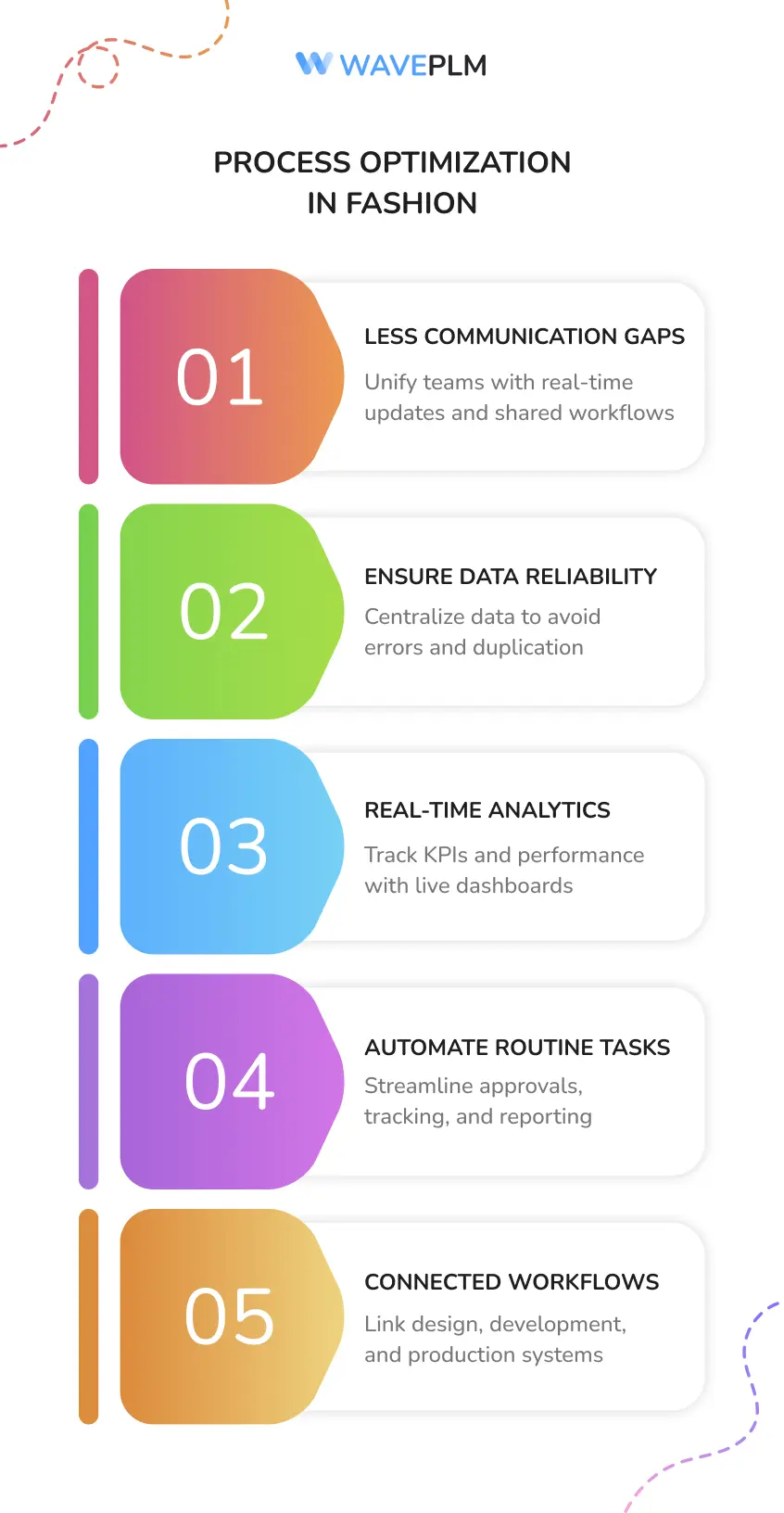
Identifying and Eliminating Communication Gaps
In practice, the most common cause of delays is not a lack of resources but the loss of information when transferred between departments. The design team records changes in one tool, the production department in another, and suppliers receive updates via email days late. As a result, fashion supply chain optimization suffers: each supply chain participant works with outdated data.
PLM platforms solve this problem by creating a unified digital space where all changes are reflected in real-time. Comments, versions of technical packs, approval statuses—everything is recorded in one place. Transparent communication directly reduces the number of approval iterations, which is critical in tight collection timeframes.
Ensuring Data Reliability
Data reliability is the foundation of effective decision-making. One of the key reasons for inefficiency in the fashion industry is working with conflicting data from multiple unrelated sources. PLM centralizes specifications, materials, and standards, eliminating duplication and manual entry errors.
An additional layer of analytics is provided by business intelligence tools fashion: built-in dashboards allow operations directors to track KPIs in real-time—supplier load, deadline adherence, budget deviations. This shifts supply chain management from reactive to proactive mode.
Automating Routine Processes
Automating T&A calendars, approval reminders, and report generation frees teams from operational routine. A single PLM platform links design, development, and production, ensuring automatic data synchronization among all process participants.
However, it is essential to maintain realistic expectations: PLM is a powerful tool, but not a one-size-fits-all solution for any context.
Limitations and Considerations
Having examined process optimization and data reliability, it’s important to realistically assess when PLM software fashion might not meet expectations. Understanding these limits helps operations directors make informed decisions rather than relying on marketing promises.
When PLM Doesn’t Fully Deliver
The question “what is PLM for fashion” often arises for small brands that view the system as a one-size-fits-all solution. However, in practice, PLM requires significant resources for implementation: time for staff training, process adaptation, and initial investment. For companies with a narrow range and linear supply chain, the system’s complexity may outweigh the actual return. Additionally, PLM implementation costs vary depending on scale, and small teams should assess the cost-benefit ratio in advance.
Alternative Approaches: Pros and Cons
Excel spreadsheets, specialized project management tools, or niche solutions for specific functions are viable options for startups. Their advantage is simplicity and a low entry threshold. However, as they scale, they inevitably create fragmented data silos, which are linked to slow development cycles.
Avoiding Overly High Expectations
Reduce time to market with PLM is a realistic goal, but not an immediate result. According to industry studies, the full effect of implementation manifests over 12–18 months. The key principle: PLM enhances already well-functioning processes but does not fix structurally broken ones. Platforms that integrate design, production, and logistics into a cohesive workflow ultimately provide the most value.
Conclusion: The Strategic Advantage of PLM in Fashion
In conclusion, leveraging PLM in the fashion industry offers a significant strategic advantage by streamlining the product lifecycle, reducing time to market, and enhancing overall efficiency. By centralizing data, automating processes, and improving communication, PLM addresses critical bottlenecks that have long plagued fashion brands. Wave PLM, as a unified 360° platform, exemplifies the potential of PLM to transform operational models, enabling brands to remain competitive in a fast-paced market.
For brands aiming to capture market share and meet consumer demand promptly, adopting PLM is not just an option but a necessity. As the fashion landscape continues to evolve, exploring the capabilities of Wave PLM can provide the insights and tools needed to stay ahead. We encourage you to explore Wave PLM’s offerings and discover how it can revolutionize your brand’s approach to fashion development.





Leave a Reply