

From first concept to end-of-life, every fashion product moves through a predictable arc. Understanding the SaaS lifecycle — and how modern PLM software maps to it — is what separates brands that scale from those that stall.
Effective customer lifecycle management is essential for sustainable business growth, as it encompasses the entire journey from initial awareness to long-term engagement. The SaaS customer lifecycle encompasses key stages such as onboarding, retention, and expansion, and managing these stages with tailored strategies is crucial for increasing customer lifetime value (CLV) and minimising churn.
In this article:
- What is the SaaS product lifecycle?
- The 6 stages of the SaaS lifecycle in fashion
- Understanding the SaaS customer lifecycle
- SaaS development lifecycle and fashion product development
- How PLM software manages the SaaS lifecycle
- Key metrics at each stage
- Why lifecycle visibility is your competitive advantage
Most fashion brands think of their product development process as a series of tasks: sketch, prototype, sample, produce, ship. What they often miss is that their entire business operates like a SaaS product lifecycle — with predictable stages, measurable churn points, and clear moments where the right software can accelerate growth or reveal a bottleneck before it becomes a crisis.
This isn’t a metaphor for its own sake. The SaaS lifecycle framework — originally developed to understand how software companies grow, retain, and expand their customer base — translates with remarkable precision to the fashion product development cycle. And increasingly, the most sophisticated fashion brands are applying SaaS lifecycle thinking to both their product management and their relationships with the PLM platforms that power it.
In this guide, we’ll unpack the full SaaS product lifecycle, explain how it maps onto fashion brand operations, and show how a modern PLM system functions as the connective tissue across every stage.
What is the SaaS product lifecycle?
The SaaS lifecycle is a framework that describes the journey of a software product — or, more broadly, any recurring-value product — from its initial development through market launch, growth, maturity, and eventually, renewal or decline. It borrows from classical product lifecycle theory but adds a layer that’s unique to subscription-based businesses: the customer success dimension.
In a pure SaaS context, the lifecycle has two parallel tracks running simultaneously:
- The SaaS product lifecycle — how the product itself is built, launched, iterated, and eventually deprecated
- The SaaS customer lifecycle — how individual customers are acquired, onboarded, engaged, retained, expanded, and potentially churned
It’s important to distinguish between the customer journey—the specific touchpoints and interactions a customer experiences with your brand—and the broader customer lifecycle, which encompasses the entire relationship from start to finish. The SaaS customer lifecycle includes key stages of the customer, beginning with initial awareness, followed by onboarding, engagement, retention, and advocacy.

For fashion brands adopting PLM software, both tracks matter. The SaaS lifecycle governs how Wave PLM evolves as a platform — new features, integrations, and capabilities — while the customer lifecycle describes how a brand moves from first demo to deep operational integration. During the initial awareness and acquisition stages, aligning sales and marketing teams is crucial to avoid miscommunication and missed opportunities. Effective alignment leads to a more streamlined customer journey, enhancing the overall experience and increasing conversion rates. But the framework also applies to something even closer to home: the lifecycle of each fashion product itself, from concept to retirement.
Key insight: A fashion season is not just a production cycle — it’s a lifecycle with acquisition (trend research), activation (sample approval), retention (reorder), expansion (new SKUs), and churn (end-of-life) phases. Wave PLM manages all of them.
The 6 stages of the SaaS lifecycle in fashion
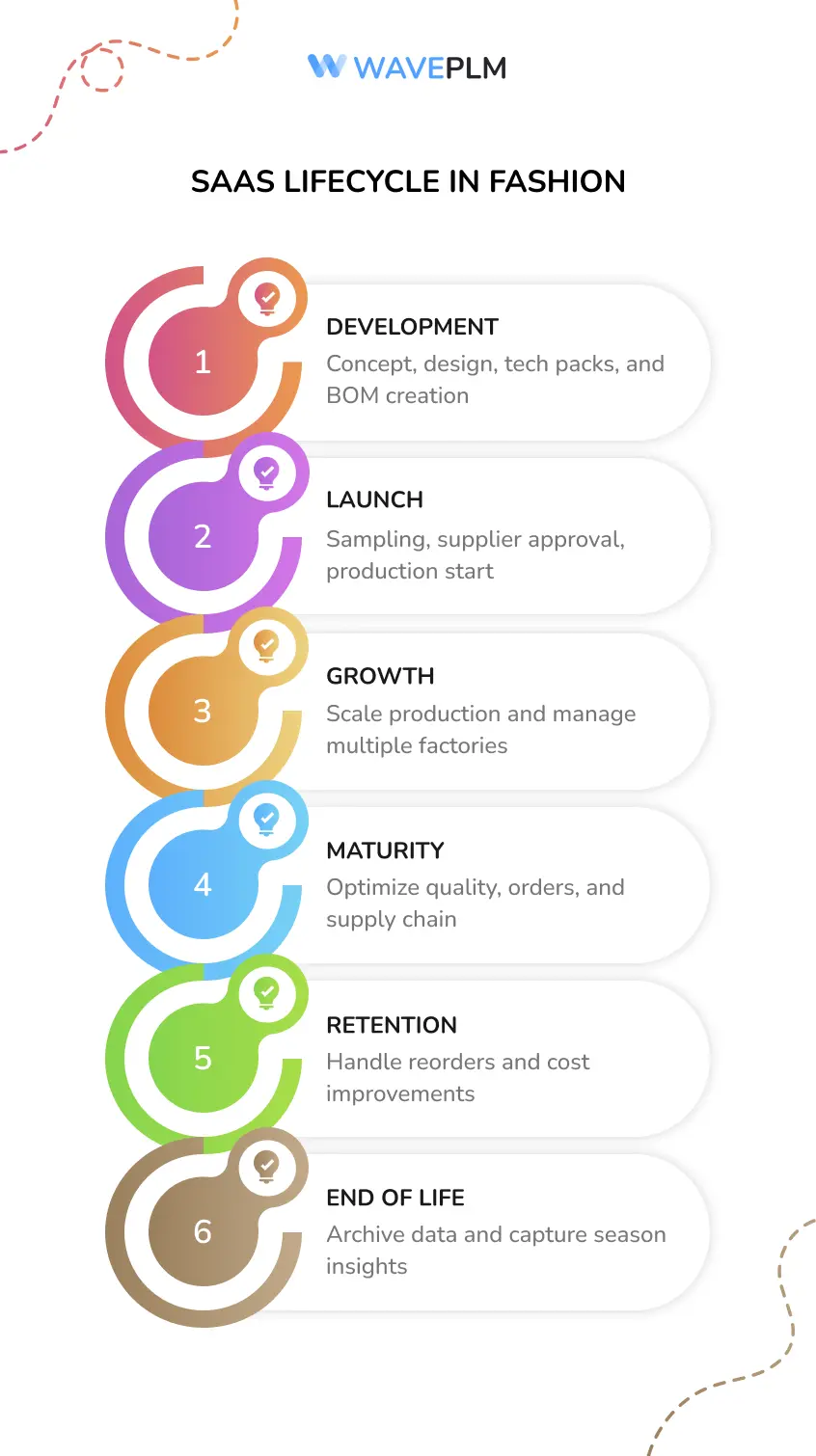
When we overlay the SaaS lifecycle on fashion product development, six distinct stages emerge. Each stage has its own risks, critical decisions, and metrics that determine whether a product — or a brand — moves forward or stalls.
01
Development
Concept, design, tech pack creation, BOM
02
Launch
First sample, supplier approval, production kick-off
03
Growth
Scaling production, multi-factory coordination
04
Maturity
Peak orders, quality control, supply chain optimisation
05
Retention
Reorders, carry-overs, cost renegotiation
06
End of Life
Archive, data retention, next-season learnings
The reason this mapping matters is practical: most fashion brands manage these stages in silos. Design teams work in one system, sourcing in another, production tracking in spreadsheets, and quality control via email chains. The result is a lifecycle with no single thread of truth — which is exactly the problem PLM software was built to solve. Collaboration between marketing teams and sales teams is essential for effective lead generation and ensuring a smooth buying process, helping to avoid operational issues and support a seamless customer journey.
As we explored in our guide on design development in fashion, the journey from concept to production is only clean in theory. In practice, it involves constant revision loops, supplier negotiations, and specification changes — all of which need to be tracked in a system that can handle complexity without losing visibility. Marketing materials, such as targeted content and customer testimonials, play a key role in attracting prospective buyers and supporting the early stages of the customer lifecycle. Initial interactions with the product and brand are critical predictors of long-term retention.
Understanding the SaaS customer lifecycle in fashion PLM
The SaaS customer lifecycle describes how a brand’s relationship with its PLM platform evolves over time. While the customer journey refers to the specific touchpoints and experiences a customer has with the brand, the customer lifecycle encompasses the broader, ongoing relationship from initial awareness through long-term engagement.
Managing the customer lifecycle strategically is crucial for building strong customer relationships and effectively managing customer interactions at every stage. Delivering a positive customer experience and consistently demonstrating customer value are essential for fostering an ongoing relationship that drives loyalty, advocacy, and long-term growth.
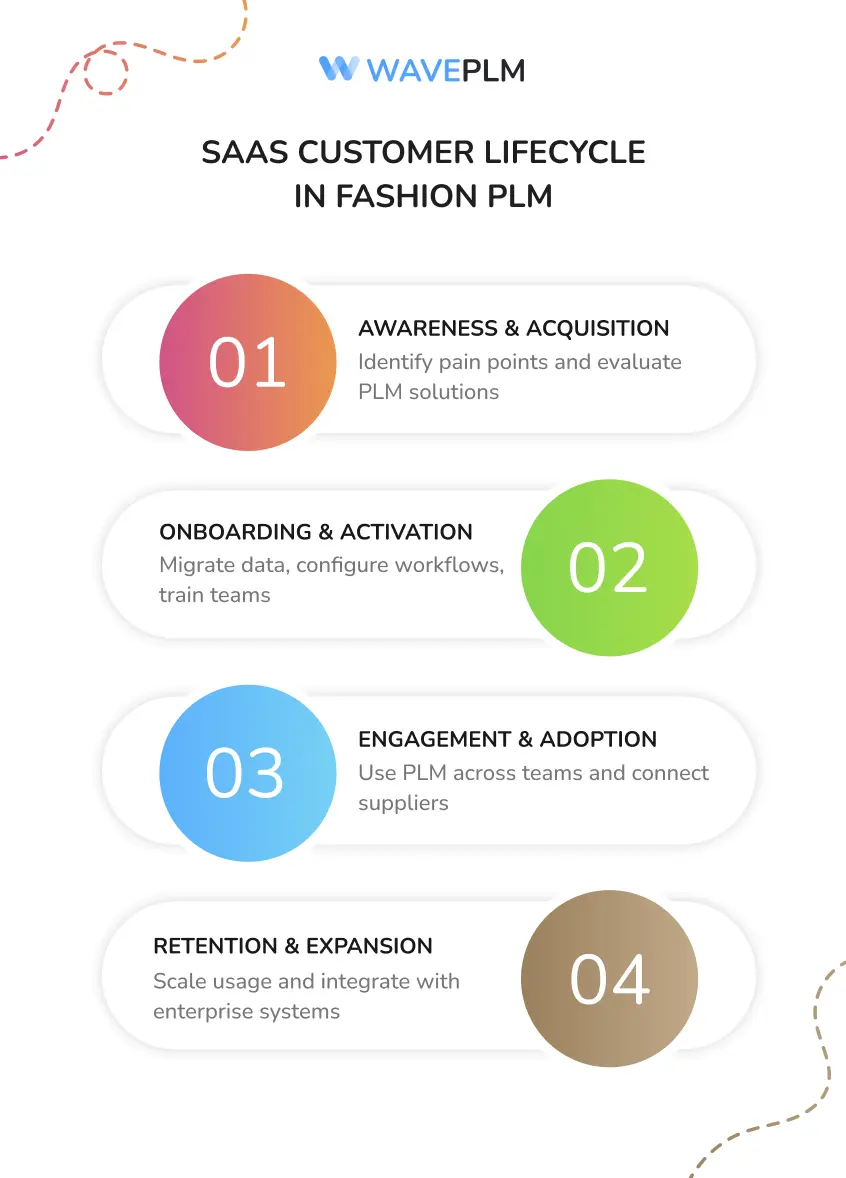
In PLM terms, the SaaS customer lifecycle typically looks like this:
Phase 1
Awareness & Acquisition
A brand recognises the limits of spreadsheets and email. They start evaluating PLM software, attend demos, and compare platforms. Pain points include lost specification data, slow sampling rounds, and supplier miscommunication.
Phase 2
Onboarding & Activation
The brand migrates existing product data, configures workflows, and trains teams. This is the highest-risk stage in the SaaS customer lifecycle — poor onboarding is the single biggest predictor of early churn in B2B SaaS.
Phase 3
Engagement & Adoption
Teams begin using PLM for real projects. Adoption spreads from design to sourcing to production. The brand starts connecting suppliers to the platform, compressing communication cycles from days to hours.
Phase 4
Retention & Expansion
The PLM platform becomes operational infrastructure. New teams (sustainability, costing, quality) are onboarded. The brand explores integrations with ERP and supply chain tools. Renewal is a formality, not a decision.
What’s notable about the SaaS customer lifecycle in fashion is how closely it mirrors the maturity curve of a brand’s internal operations. Brands that are still in the spreadsheet era are in the “awareness” stage. Brands running PLM deeply across all functions are in “expansion” — and they’re typically 2–3 seasons ahead of competitors in speed-to-market.
30% reduction in development lead time with structured PLM adoption
60% of sampling errors stem from spec miscommunication, addressable by PLM
3× faster supplier onboarding in PLM platforms vs. email-based workflows
Understanding where your brand sits in the SaaS customer lifecycle helps prioritise investment. If onboarding is incomplete, more features don’t help — deeper implementation does. If retention is strong, the priority shifts to expanding PLM’s footprint across more teams and more stages of the product lifecycle.
SaaS development lifecycle and fashion product development
The SaaS development lifecycle (SDLC) describes how software is built — requirements, design, development, testing, deployment, and maintenance. For fashion brands, this framework maps surprisingly well onto how products are physically developed. Effective lifecycle management is essential for overseeing the entire journey, from customer acquisition through retention and expansion, ensuring that every stage is optimized for customer outcomes and long-term growth.
| SaaS Development Lifecycle Stage | Fashion Product Equivalent | PLM Function |
|---|---|---|
| Requirements gathering | Trend research, range planning, design brief | Range planning module, mood board libraries |
| Design & architecture | Technical design, tech pack creation, BOM | Tech pack builder, materials library, colorways |
| Development & build | Sample production, fit testing, revision rounds | Sample tracking, comment threads, approval workflows |
| Quality assurance | Quality control, lab testing, compliance checks | QC checklists, quality control workflows |
| Deployment | Production kick-off, factory handover | Purchase orders, multi-factory coordination |
| Maintenance & iteration | Reorders, carry-overs, season learnings | Archive & data retention, next-season carry-forward |
The parallel is not cosmetic. Both the SaaS development lifecycle and fashion product development face the same fundamental challenge: how do you maintain quality and speed simultaneously when complexity scales faster than your team does? In SaaS, the answer is automated testing, CI/CD pipelines, and structured sprint processes. In fashion, the answer is PLM.
Practical tip: When evaluating PLM platforms, map each stage of your SaaS development lifecycle to a specific PLM feature. If a stage has no corresponding feature — or the feature requires too much manual input — that’s a gap that will compound with scale. See how we approach market research in fashion as an upstream lifecycle input.
How PLM software manages the SaaS lifecycle end-to-end
A properly implemented PLM platform doesn’t just store product data — it actively supports customer lifecycle management and managing the customer lifecycle by tracking client lifecycle stages and customer interactions. This is the distinction between PLM as a file cabinet and PLM as an operating system for fashion brands. Leveraging customer data within PLM is crucial for optimizing lifecycle management, enabling more personalized engagement and improved retention strategies.
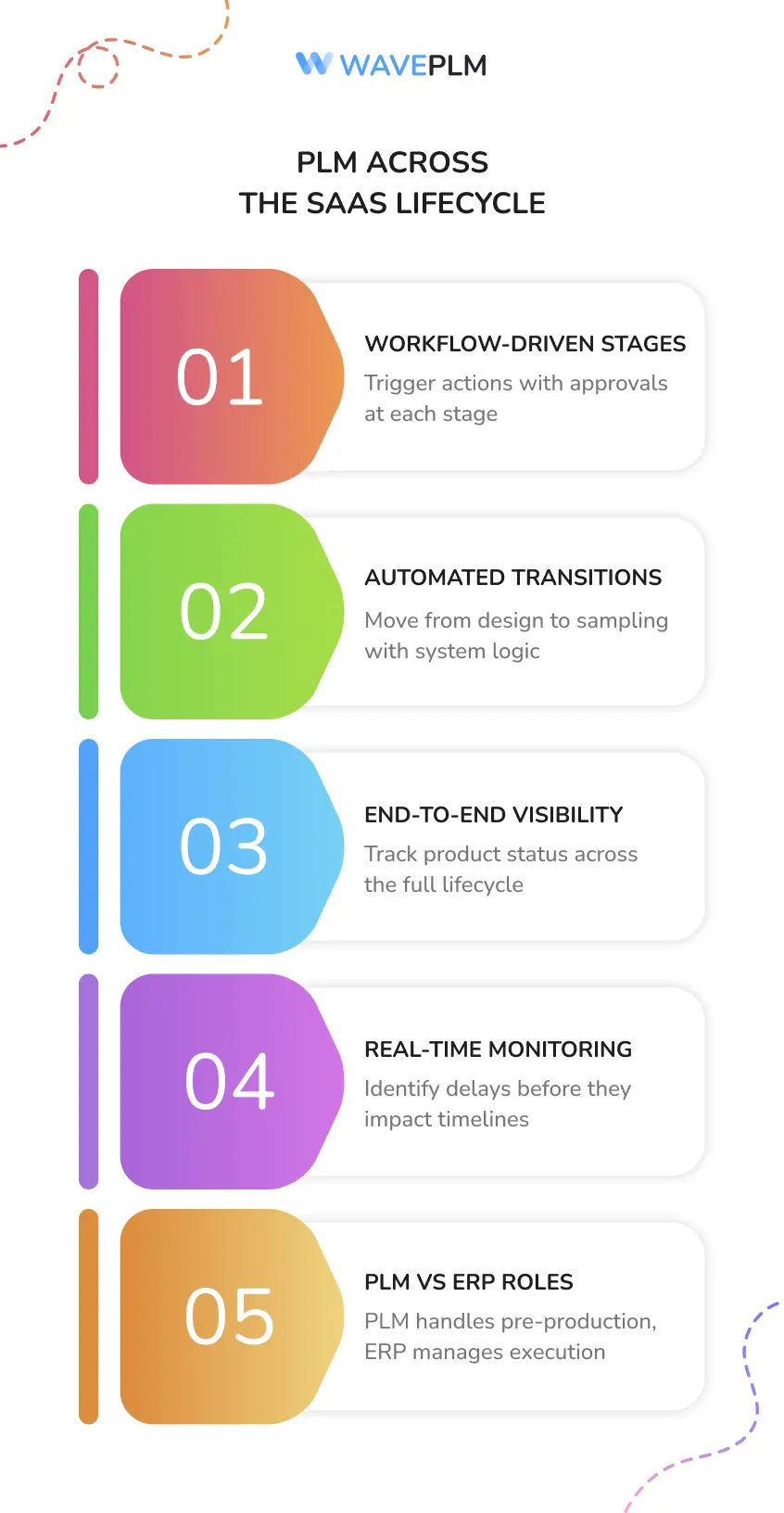
Stage transitions as workflow triggers
In the SaaS development lifecycle, moving from “design” to “development” requires a formal sign-off — this prevents scope creep and ensures the build phase starts with a stable spec. PLM applies the same logic: a garment shouldn’t move from tech pack to sampling without an approval step. Without this gate, factories receive incomplete specifications, sampling errors multiply, and development costs spike.
Modern PLM platforms like Wave PLM build these transitions directly into the workflow: when a tech pack is approved, the system automatically notifies the supplier, triggers a sample request, and logs the timestamp. This is the SaaS development lifecycle principle of CI/CD applied to fashion production.
Visibility across the full SaaS lifecycle
One of the most powerful aspects of applying SaaS lifecycle thinking to fashion operations is the visibility it creates. In SaaS, product managers track where every user is in the customer lifecycle — which stage they’re at, how recently they engaged, and what action might move them forward. PLM provides the same visibility for products and suppliers, enabling teams to track progress, monitor customer health scores, and analyze data to understand customer behavior and optimize lifecycle outcomes.
As we covered in our analysis of automated apparel supply chain tracking, real-time visibility across the production lifecycle is what separates brands that hit market windows from those that miss them. When every garment’s status is visible — from initial concept to final shipment — operations teams can intervene before delays cascade.
The SaaS lifecycle and PLM vs. ERP
It’s worth noting where the SaaS product lifecycle intersects with the ERP vs. PLM debate. PLM owns the pre-production SaaS lifecycle stages — development, design, sampling, QC. ERP picks up at deployment and beyond — purchase orders, inventory, invoicing. Understanding this handoff is critical for brands scaling their systems architecture. For a detailed breakdown, see our guide on PLM vs ERP for fashion brands.
Key metrics at each stage of the fashion SaaS lifecycle
Applying SaaS lifecycle thinking also means adopting the SaaS practice of stage-specific metrics. Each of the key stages and stages of the customer lifecycle should be measured for customer outcomes, customer satisfaction, and customer value. This ensures that success metrics are aligned with business objectives and that every phase—from concept to end of life—drives value and satisfaction for both the business and its customers. What matters at the concept stage is completely different from what matters at production scale, so it’s crucial to define measurable outcomes for each stage.
| Lifecycle Stage | Key Metric | What a Healthy Number Looks Like |
|---|---|---|
| Development | Tech pack completion rate | >90% of styles approved before sampling |
| Launch | First-sample approval rate | >60% approved within one round |
| Growth | On-time production rate | >85% of POs delivered on time |
| Maturity | Cost vs. target deviation | < 5% variance from original costing |
| Retention | Carry-over rate | 20–35% of styles carried into next season |
| End of life | Archive completeness | 100% of styles fully archived with spec history |
These metrics become actionable when they live inside a PLM system. Without centralised data, calculating first-sample approval rates or cost deviation requires manual aggregation across spreadsheets — which typically means it doesn’t happen at all. PLM makes these numbers available in real time, turning the SaaS lifecycle from a conceptual framework into a live operational dashboard.
Social media analytics increasingly feed into the early stages of the lifecycle — trend data and consumer signals that inform range planning before a single sketch is made. See our deep dive on understanding social media analytics in PLM for how brands are bringing external signals into their PLM-managed lifecycle.
Why lifecycle visibility is your competitive advantage
The fashion brands winning in 2026 are not necessarily the ones with the best designers or the cheapest factories. They’re the ones with the clearest picture of where every product, every supplier, and every season is in its lifecycle — at any given moment.
This is the promise of applying SaaS lifecycle thinking to fashion operations. The SaaS industry spent two decades learning that business growth and sustainable growth are systems problems, not just talent problems. The best SaaS companies don’t just ship features — they practice effective lifecycle management, ensuring the saas customer lifecycle encompasses the entire journey from initial awareness to long-term engagement. They focus on maintaining an ongoing relationship with customers, managing and optimizing every stage to drive retention, loyalty, and advocacy.
Fashion brands are learning the same lesson. The saas product lifecycle, the saas customer lifecycle, and the saas development lifecycle are not just frameworks for software companies. They’re frameworks for any business where complex, iterative products need to move from concept to market efficiently — and then do it again, faster, next season.
PLM is the system that makes this possible. It’s not a digital filing cabinet for spec sheets. It’s the operational infrastructure that keeps every stage of the fashion product lifecycle connected, visible, and measurable — exactly the way the best SaaS platforms keep their product and customer lifecycles connected, visible, and measurable.
Bottom line: If your brand can’t answer “where is this style in its lifecycle?” for every product in your range — in under 30 seconds — you don’t have a visibility problem. You have a system problem. And the system designed to solve it is PLM.




Leave a Reply