

Fashion PLM software costs $150–$600/user/month for cloud SaaS, or $200K–$1M+ for enterprise on-premise. Most growing brands (10–200 employees) spend $500–$3,000/month total. ROI typically materializes in 6–12 months through reduced sampling costs and faster time-to-market.
Most fashion PLM vendors don’t publish pricing. They’d rather get you on a discovery call, qualify your budget, and present a custom quote after 45 minutes of discussion. That’s fine for enterprise deals — but it’s a frustrating experience for apparel founders and product managers who simply want to know whether they can afford the software before investing time in a sales process.
This guide does what most PLM vendors won’t: it breaks down what fashion PLM actually costs in 2026, by deployment model and brand size. It covers what’s typically included, what triggers extra charges, and how to calculate whether the investment makes financial sense for your brand. By the end, you’ll have a realistic number to put in your budget — and the questions to ask every vendor you evaluate.
What Does Fashion PLM Software Actually Cost?
Fashion PLM pricing in 2026 breaks cleanly into two deployment models: cloud SaaS and on-premise. The cost difference between them is significant enough to determine which model is viable for most brands.
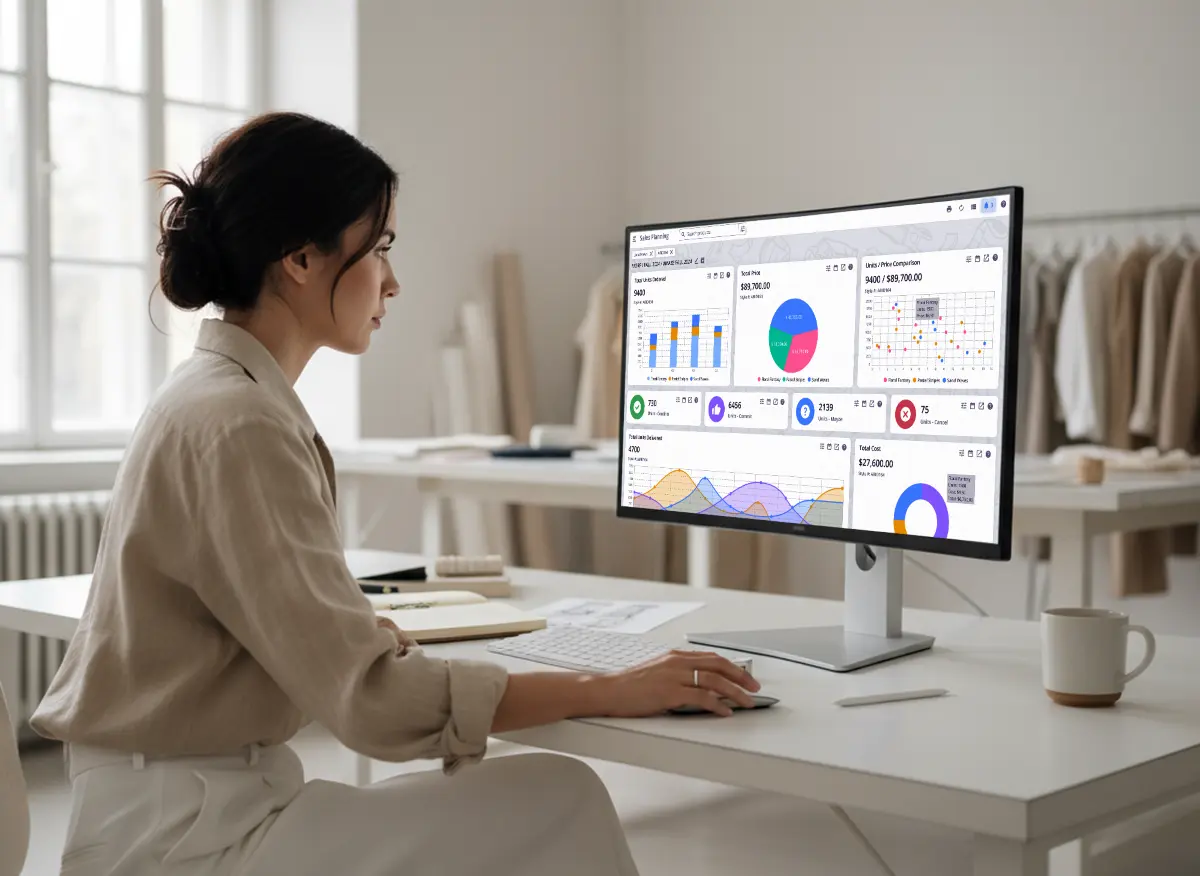
Cloud SaaS PLM is priced per user per month, typically ranging from $150 to $600 per user. Total monthly costs vary by team size and feature tier. Most growing apparel brands (5–50 internal PLM users) land between $500 and $3,000 per month all-in.
On-premise PLM requires an upfront license purchase plus implementation services. According to Panorama Consulting’s 2024 ERP/PLM Report, mid-market on-premise implementations average $80,000–$250,000 in total first-year cost, including software, services, and internal team time. Annual maintenance fees typically add 18–22% of the license cost per year.
| Brand Stage | Typical Team Size | Monthly PLM Cost (Cloud) | Annual Total |
|---|---|---|---|
| Startup (pre-$2M revenue) | 2–5 users | $300–$900 | $3,600–$10,800 |
| Growth brand ($2M–$20M) | 5–15 users | $750–$3,000 | $9,000–$36,000 |
| Mid-market ($20M–$100M) | 15–50 users | $2,250–$9,000 | $27,000–$108,000 |
| Enterprise ($100M+) | 50+ users | $7,500–$30,000+ | $90,000–$360,000+ |
A few factors push costs toward the higher end of each range: advanced analytics modules, additional supplier portal seats sold separately, dedicated customer success, and API access for custom integrations. More on those add-ons in the section below.
Cloud PLM vs. On-Premise: The Real Price Difference
The choice between cloud and on-premise isn’t just a technology decision — it’s a financial one. Cloud PLM has a lower barrier to entry and faster time-to-value. According to Gartner (2024), cloud PLM implementations take 60% less time than on-premise equivalents, which directly translates to lower implementation costs and faster ROI realization.
| Factor | Cloud SaaS PLM | On-Premise PLM |
|---|---|---|
| Upfront cost | Low (setup fee only, typically $0–$5K) | High ($80K–$500K+ license + implementation) |
| Ongoing cost | Predictable monthly subscription | Annual maintenance (18–22% of license/year) |
| Implementation time | 4–12 weeks | 6–18 months |
| IT infrastructure required | None | Servers, DBAs, IT team |
| Updates and new features | Automatic, included | Manual, often paid upgrades |
| Data control | Vendor-hosted (varies by region) | Full internal control |
| Suitable for | Brands of all sizes, especially SMB | Large enterprises with complex compliance needs |
For most apparel brands under $100M in revenue, cloud PLM is the financially rational choice. The upfront cost advantage alone — avoiding a $100K+ implementation — lets a growth brand deploy PLM at a fraction of the enterprise cost and start seeing returns within one season.
What’s Included — and What Costs Extra
Understanding the base plan vs. add-on structure is where most buyers get surprised. Here’s what’s typically included in a standard cloud PLM subscription, and where vendors commonly add charges.
Usually included in base plan:
- Tech pack builder with standard templates
- Bill of materials (BOM) management
- Sample tracking and approval workflow
- Internal team collaboration tools
- Basic reporting and calendar views
- Customer support (email/chat at standard tiers)
Common add-ons that cost extra:
- Supplier portal seats — Some vendors charge $150-$200 /supplier/month. Others include unlimited supplier access. This matters enormously if you work with 10+ factories.
- Mobile QC app — Factory inspection app is often a separate module or higher-tier feature (In Wave PLM, QC App is included).
- Advanced DAM (Digital Asset Management) — High-resolution image storage and management beyond a set limit.
- API access / integrations — ERP, e-commerce, and 3rd-party connections may require a developer tier.
- Dedicated onboarding or customer success — Premium support tiers add $500–$2,000/month.
- Data export on cancellation — Some vendors charge for this. Always ask upfront.
Red flag to watch for: “Per-supplier pricing” structures can turn a $500/month base plan into a $2,000+/month total once you add all your factories. Always calculate total cost of ownership including supplier seats before comparing plans.
Fashion PLM ROI: When Does It Pay Off?
Fashion PLM ROI materializes from three primary sources: reduced physical sampling costs, faster time-to-market, and fewer production errors. According to McKinsey (2024), brands that implement PLM report a 30% reduction in product development costs overall.
The most tangible and immediate ROI comes from sampling. According to Sourcing Journal (2024), each sample round for an apparel SMB costs $500–$2,000 per style, factoring in factory time, shipping, and internal review cycles. Without PLM, the industry average is 4.7 sample rounds per style. With PLM centralizing spec communication and approval workflows, brands typically reduce this to 2–3 rounds.
Example ROI calculation for a mid-size brand:
| Variable | Without PLM | With PLM |
|---|---|---|
| Styles per season | 150 | 150 |
| Sample rounds per style | 4.7 | 2.5 |
| Cost per sample round | $800 | $800 |
| Total sampling cost/season | $564,000 | $300,000 |
| Savings from reduced samples | $264,000/season | |
| PLM annual cost (15 users) | $27,000–$54,000 | |
| Net annual savings | $210,000–$237,000 | |
Beyond sampling, time-to-market acceleration compounds returns. McKinsey research shows PLM-enabled brands cut development cycles by 30–50%. For a brand running two seasons per year, getting to market 4–6 weeks earlier per season has direct revenue implications — more full-price selling weeks before markdown pressure begins.
Most brands reach payback in 6–12 months. For smaller brands with tighter sampling budgets, payback can extend to 12–18 months — still well within a reasonable investment horizon for a multi-year subscription.
Is There a Free Fashion PLM?
Technically yes — but the real question is whether free PLM is actually usable for a growing brand.
A handful of open-source PLM platforms exist (Aras Innovator being the most cited), but they are built for industrial manufacturing, not fashion. Adapting them for apparel use requires significant developer time and ongoing maintenance — effectively turning “free software” into a five-figure IT project.
Some cloud PLM vendors offer free tiers or trials: typically 14–30 day trials, occasionally a permanent free tier limited to 1–2 users or a set number of styles. These are useful for evaluation but not viable for ongoing brand operations.
What you typically lose with free or near-free options:
- Supplier portal access (factories can’t log in and update specs)
- Mobile QC app for factory inspections
- Integrations with ERP, e-commerce platforms
- Reliable customer support when something breaks mid-season
- Data security and compliance guarantees
The honest answer for most apparel brands: if your budget truly can’t support $300–$500/month for PLM, you’re likely not at the scale where PLM provides enough ROI to justify the operational change. The right time to invest is when the pain of spreadsheet management starts costing more than the subscription.
How to Budget for Fashion PLM in 2026
Budget differently depending on your company stage. Here’s a practical framework:
Pre-revenue to $2M: Budget $300–$750/month for a 2–5 user cloud plan. Focus on vendors with strong onboarding and responsive support — you won’t have an IT team to troubleshoot issues. Prioritize tech pack builder and sample tracking over advanced analytics.
$2M–$20M (growth stage): Budget $750–$2,500/month. At this stage, supplier portal access becomes critical — verify it’s included in base pricing, not an add-on. Look for ERP integration capability even if you don’t need it yet. Negotiate annual billing for a 10–20% discount over monthly.
$20M–$100M (scaling): Budget $2,500–$8,000/month. You’ll need API access, advanced reporting, and likely dedicated customer success. Request a custom quote and use competitive alternatives as leverage in pricing negotiations.
Questions to ask every vendor before signing:
- Is supplier portal access included, or charged per supplier?
- What’s the contract length — and what are the terms if we need to scale down?
- Can we export all data at any time, in a standard format, at no charge?
- What’s the implementation timeline, and is onboarding included?
- Are price increases capped on renewal?
Negotiation tip: Annual billing vs. monthly typically saves 10–20%. If you’re confident in the platform after a trial, committing to annual from the start is usually worth it. Startup discounts (10–30% off) are available from most vendors if you ask directly — they rarely volunteer it.
Quick-Reference: Fashion PLM Cost by Brand Size
| Brand Size | Recommended Deployment | Monthly Budget | Annual Budget | ROI Horizon |
|---|---|---|---|---|
| Startup (<$2M) | Cloud SaaS, 2–5 users | $300–$750 | $3,600–$9,000 | 12–18 months |
| Growth ($2M–$20M) | Cloud SaaS, 5–15 users | $750–$2,500 | $9,000–$30,000 | 6–12 months |
| Mid-market ($20M–$100M) | Cloud SaaS / Hybrid | $2,500–$8,000 | $30,000–$96,000 | 6–9 months |
| Enterprise ($100M+) | Cloud Enterprise / On-Premise | $8,000–$30,000+ | Custom quote | 6–12 months |
Frequently Asked Questions About Fashion PLM Pricing
What’s the cheapest fashion PLM that’s still professional?
Cloud-based fashion PLM tools for small brands typically start at $150–$200 per user per month with full core features — tech pack builder, BOM management, sample tracking, and supplier communication. At a team of 3, that’s $450–$600/month total. Avoid free or near-free tools that lack supplier portals or mobile QC apps — the hidden cost is manual workarounds that erode any savings.
Do PLM vendors charge per factory or supplier?
Some do, some don’t — and this is one of the most important questions to ask before signing. Enterprise PLM platforms often charge per supplier seat, typically $50–$150/supplier/month. Cloud SMB platforms like WavePLM include unlimited supplier access in the base plan. Always ask: “Is supplier portal access included, or charged separately?”
Is PLM worth it for a brand doing under $1M in revenue?
Yes, if you’re managing 50+ SKUs per season or working with 3+ factories. At that scale, the time lost to spreadsheet management and email coordination typically costs more than a cloud PLM subscription. The break-even math: if PLM saves 10 hours per week at a $50/hr equivalent, it pays for itself at $500/month within the first month.
What happens to my data if I cancel?
This varies significantly by vendor. Before signing, ask: Can I export all data in a standard format (CSV, Excel, JSON)? How long do I have access after cancellation? Is there an export fee? Reputable cloud PLM vendors provide a full data export at no charge. Avoid vendors who restrict exports or charge for your own data — this is a significant lock-in risk.
The Bottom Line
Fashion PLM pricing is more accessible than most apparel founders expect. For a growth-stage brand, the all-in cost is comparable to one mid-level hire — but the leverage you get from centralizing product development across your team, suppliers, and seasons is significantly higher.
The brands that get the most value from PLM investment are those that treat it as infrastructure, not software. Once your product development process lives in a single system — with spec history, approval trails, and supplier communication in one place — the cost becomes invisible against what you save in rework, delays, and misproduced samples.
If you’re evaluating PLM for your brand, the right starting point isn’t the price sheet — it’s the calculation: how much is your current process costing you in time, samples, and late deliveries? Once you have that number, the pricing conversation gets much simpler.
See how WavePLM works for growing apparel brands — book a 30-minute demo to get a pricing quote sized for your team and season volume.
New to PLM? Start here → What Is Fashion PLM? Complete Guide for Apparel Brands




Leave a Reply