
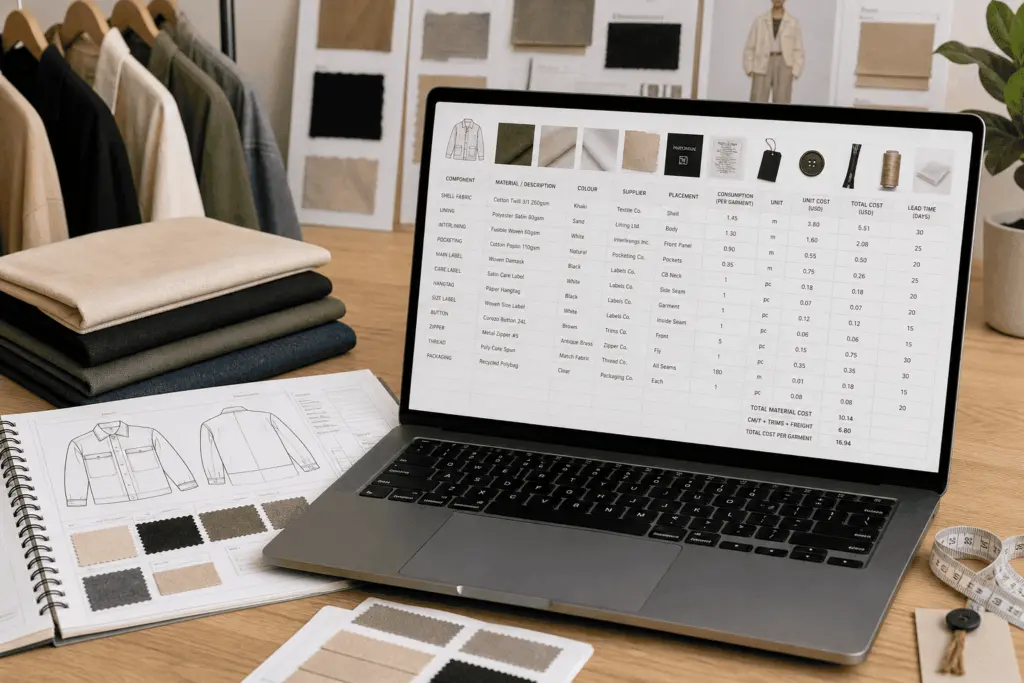
Fashion PLM software is a platform that centralizes a garment’s development journey, from concept and design brief through sourcing, sampling, and final delivery, replacing the spreadsheets and email chains most apparel teams still run on. The average apparel brand spends more than 15 hours a week managing specs across email, shared drives, and spreadsheets. Styles get lost in revision chains. Factories produce the wrong colorway because someone sent v4 instead of v7. In fact, this is the exact gap fashion PLM software is built to close.
The global fashion apparel PLM software market was valued at $1.9 billion in 2025, projected to reach $4.1 billion by 2034 at an 8.9% CAGR (Verified Market Reports, 2025). Even so, adoption is uneven. Enterprise brands still account for roughly 60% of that spend, while the SMB and emerging-brand segment is growing faster off a smaller base (Kōbō, State of Fashion PLM Technology 2026). Cloud PLM, in other words, is only now becoming genuinely accessible below the enterprise tier.
This guide covers what fashion PLM software is, how it compares to ERP, which platforms are worth evaluating, who actually needs one, and what a real implementation timeline looks like.
Key Takeaways
- Fashion PLM software centralizes product development from first sketch to factory delivery, replacing spreadsheets and email chains with a single system of record.
- Brands using PLM report 15-50% faster time-to-market, with best-in-class brands seeing up to 60% (Kōbō, 2026).
- The market is worth $1.9 billion in 2025, but 60% of that spend is still enterprise — SMB adoption is growing faster off a smaller base.
- PLM and ERP are complementary, not competing: PLM handles development, ERP handles production execution.
- Cloud-based fashion PLM software (like Wave PLM) can be implemented in 2-8 weeks, even for teams of 3-5 people, versus 15.5 months on average for enterprise on-premise rollouts.
What Is Fashion PLM Software?
Fashion PLM software stands for Product Lifecycle Management software. Specifically, it refers to a platform that manages a product’s development journey, from concept and design brief through sourcing, sampling, and final delivery.
Fashion PLM software definition: Fashion PLM software is a platform that centralizes all product development data — specifications, materials, samples, supplier communications, and approvals — in one system accessible to design, production, and sourcing teams simultaneously.
Notably, the term “PLM” originated in manufacturing (aerospace, automotive) in the 1980s. Fashion PLM software is a specialized evolution, built around apparel-specific workflows: seasonal calendars, colorways, grading, and factory relationships.
Industrial PLM manages engineering schematics and CAD files. By contrast, fashion PLM software manages tech packs, BOM data, fit approvals, and lab dips. The underlying idea is the same: one source of truth for product data. However, the implementation is entirely different.
For a deeper comparison, see our guide on PLM vs ERP for Fashion.

What Problems Does Fashion PLM Software Actually Solve?
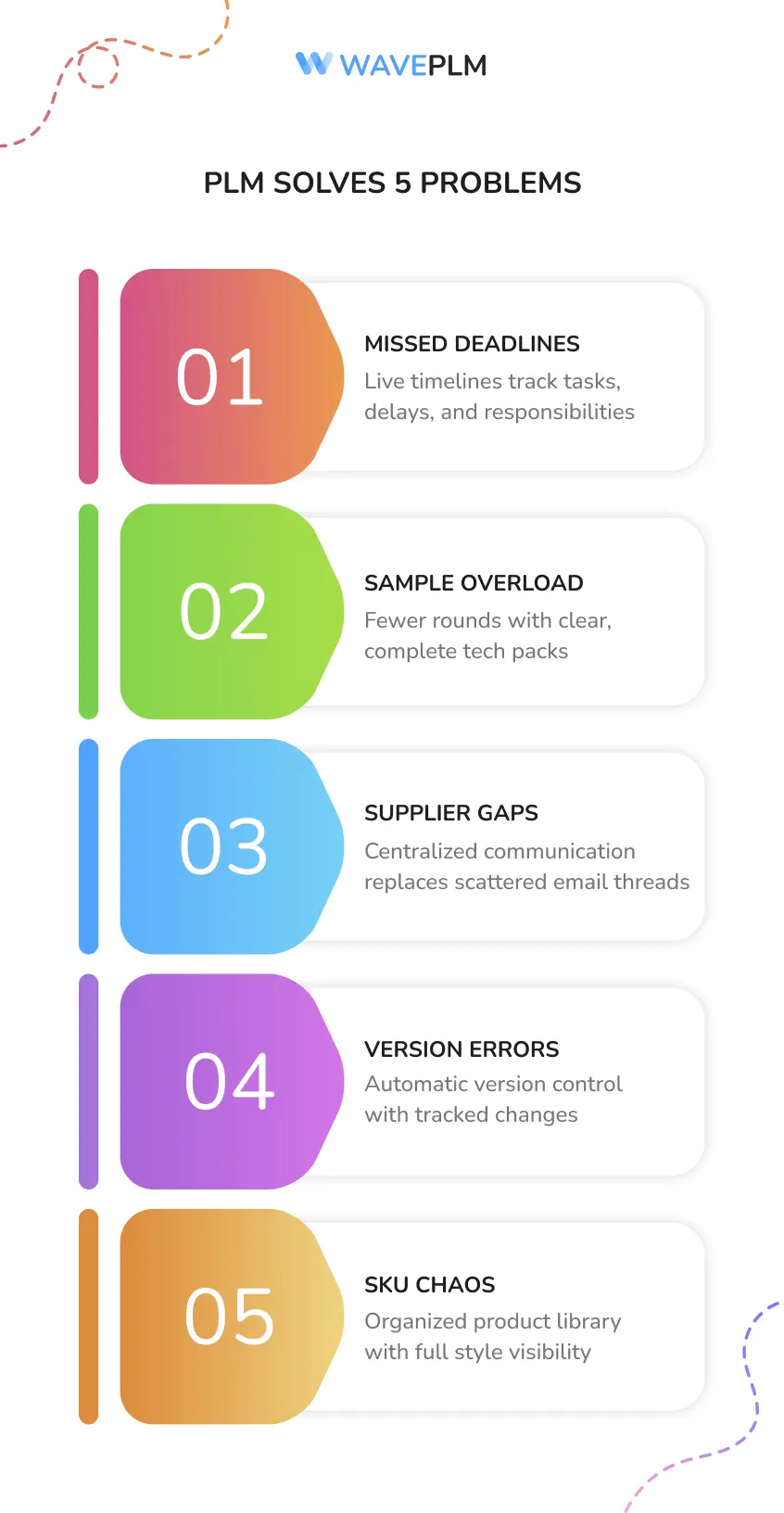
Fashion PLM software solves five core problems: missed deadlines, sample round chaos, supplier miscommunication, version control failures, and SKU proliferation. As a result, brands using PLM report meaningfully faster time-to-market. Specifically, the software removes the manual coordination overhead that slows development down.
Problem 1: Missed Deadlines and Critical Path Chaos
Without a system, season calendars live in someone’s head or a spreadsheet nobody updates. Instead, PLM gives every team a live critical path showing what’s due, what’s late, and who’s responsible.
Problem 2: Sample Round Overload
The average brand runs 4-7 sample rounds per style without a structured spec system. In contrast, a tech pack builder cuts that significantly, since factories get complete specs the first time. Notably, each round saved is $500-$2,000 in direct cost.
Problem 3: Supplier Miscommunication
Email threads with factories are impossible to audit. In contrast, a supplier portal gives factories access only to approved, current specs, and logs every exchange in one place.
Problem 4: Version Control Failures
Importantly, PLM enforces version control automatically. Every change is logged, and every team member sees the same current version as a result.
Problem 5: SKU Proliferation Without Visibility
As brands scale, managing thousands of SKUs across seasons and factories becomes unmanageable in spreadsheets. In contrast, PLM gives you a searchable product library with full history on every style.
| Brand Size | Team | Hours/Week Lost to Manual Coordination |
|---|---|---|
| Small brand | 1-10 people | ~8 hours/week |
| Mid brand | 11-50 people | ~15 hours/week |
| Growth brand | 51-200 people | ~28 hours/week |
| Enterprise | 200+ people | 40+ hours/week |
Estimated hours per week lost to manual product coordination without fashion PLM software, by brand size. Source: Wave PLM customer survey, 2025.
How Is Fashion PLM Software Different From ERP, PIM, and DAM?
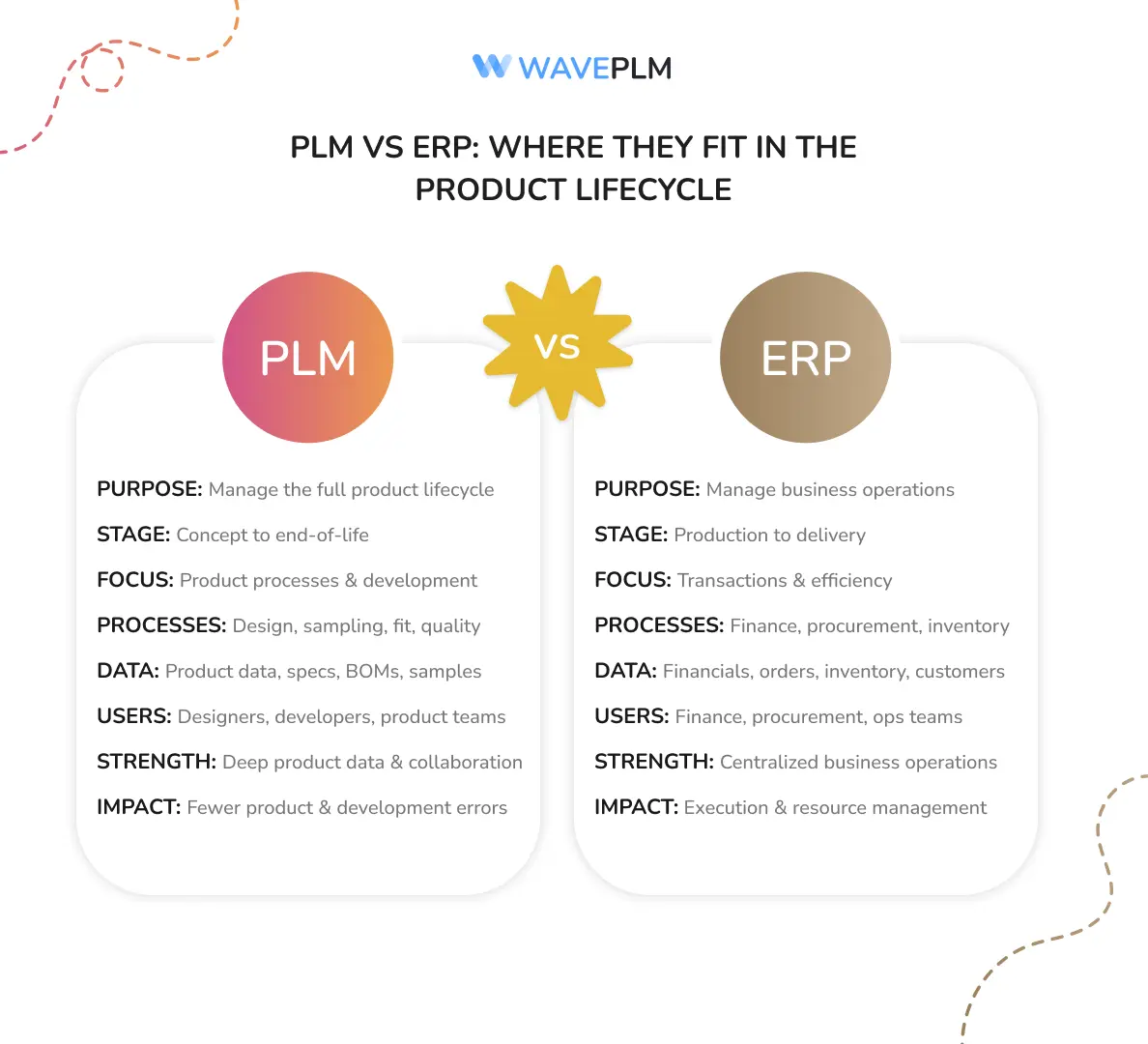
ERP (Enterprise Resource Planning) manages finance, inventory, and order execution after a product is confirmed. PLM manages the creative process before the product ships. As a result, they’re complementary, not competing. Many mid-to-large fashion brands run both systems side by side, using PLM for development and ERP for the finance and inventory work that starts once a style is confirmed.
| System | What It Manages | When It’s Used | Primary Users |
|---|---|---|---|
| Fashion PLM | Product development: specs, samples, supplier comms, approvals | Design → Sampling → Pre-production | Design, Technical Design, Sourcing |
| ERP | Finance, inventory, POs, order management, accounting | Production → Delivery → Finance | Operations, Finance, Logistics |
| PIM | Product information for sales channels: descriptions, attributes, SKU data | Pre-launch → E-commerce → Retail | Marketing, E-commerce, Merchandising |
| DAM | Digital assets: photos, videos, brand assets, creative files | All stages | Creative, Marketing, Sales |
Our finding: Most apparel brands at the 20-100 employee stage run PLM and DAM as separate tools with no integration, meaning product images and creative assets live in a completely different system from specs and tech packs. Wave PLM combines both in one platform, which for a growing brand eliminates an entire category of tool spend.
In practice: if you’re asking “what should we build and how?”, that’s PLM territory. Meanwhile, if you’re asking “how many units did we sell and at what margin?”, that’s ERP territory.
What Are the Top Fashion PLM Software Options?
Searches for “fashion PLM software” usually mean one of two things: understanding the category, or comparing platforms. Here’s an honest snapshot before you go deep on any single one.
| Platform | Best For | Notable Trade-Off |
|---|---|---|
| Wave PLM | SMB and mid-market brands wanting PLM + DAM in one platform | Smaller third-party integration ecosystem than the enterprise players |
| Centric Software | Enterprise brands with 200+ SKUs and complex global supply chains | Longest onboarding and highest cost in this category |
| ApparelMagic | Growing brands that want PLM and ERP combined | Fashion-specific tech pack tooling is less deep than dedicated PLM |
| WFX Cloud PLM | Brands manufacturing heavily in South and Southeast Asia | Design and merchandising tools trail newer, design-first platforms |
| Techpacker | Pre-revenue founders building their first 1-3 collections | Not a full PLM; outgrown once a brand passes ~30 SKUs |
| Backbone PLM | DTC-native brands that prioritize design-team usability | Costing and QC workflows are comparatively basic |
For example, our PLM software for small business guide offers a detailed, criteria-by-criteria breakdown for brands under 80 SKUs.
What Features Should Fashion PLM Software Include?
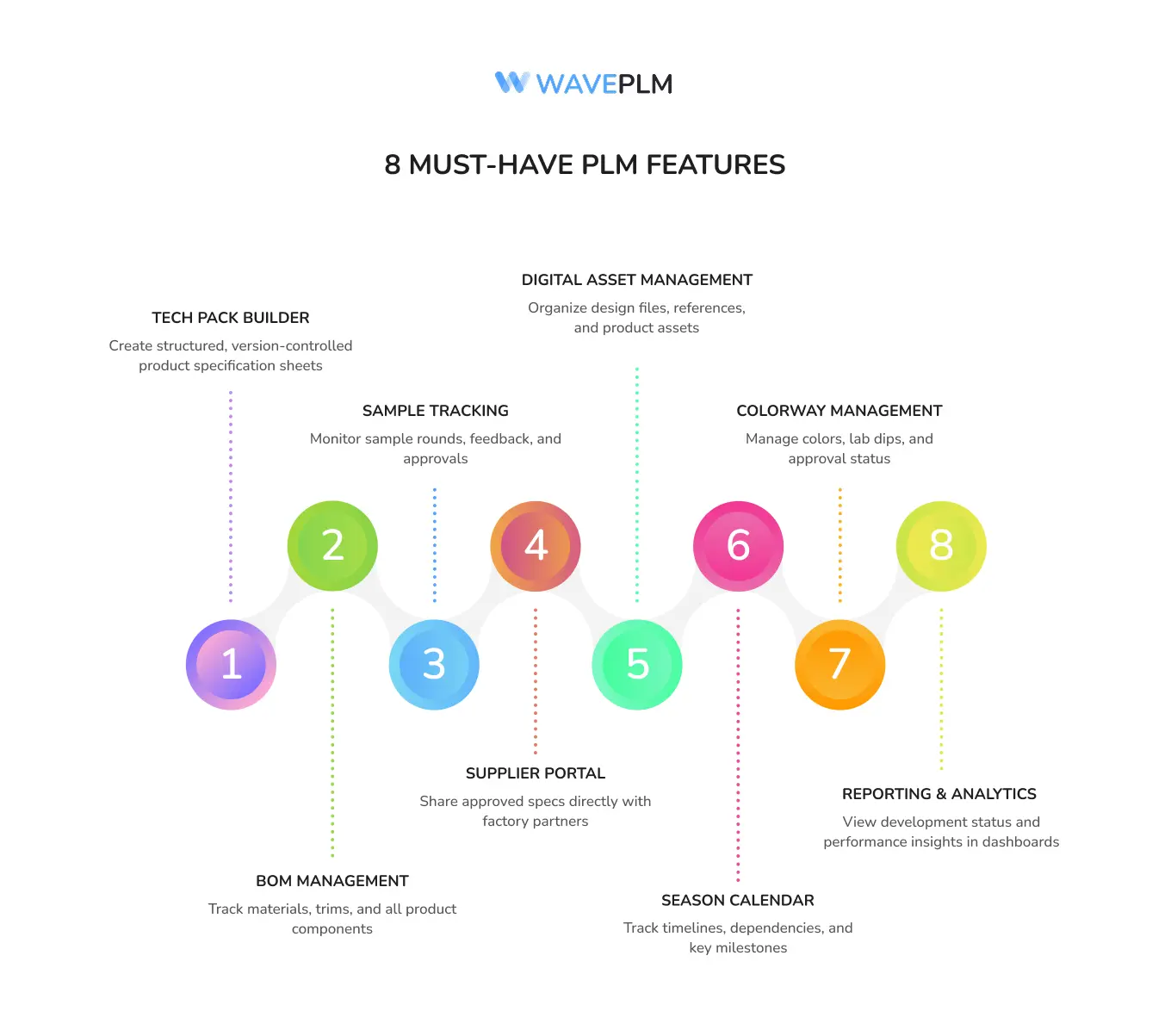
A production-ready fashion PLM software platform must include at least eight core capabilities. Otherwise, you’re not getting a PLM, just a project management tool with a fashion coat of paint.
8 Must-Have Features
- Tech pack builder — structured, version-controlled spec sheets with measurement tables, construction details, and material callouts
- BOM management — Bill of Materials tracking for every component: fabric, trims, labels, hardware, packaging
- Sample tracking — log sample requests, track rounds, record fit comments, manage approvals with timestamps
- Supplier portal — factory-facing access to current specs only, with messaging and approval workflows built in
- Digital Asset Management (DAM) — attach and organize design files, references, lab dip photos, and marketing assets to each style
- Season calendar / critical path — visual timeline showing deadlines, dependencies, and alerts for at-risk milestones
- Colorway management — manage color options, lab dip submissions, and approval status per colorway per style
- Reporting and analytics — dashboard visibility into development status, supplier performance, and seasonal progress
Three advanced features are worth prioritizing once the basics are covered: 3D design integration, which cuts physical sampling costs by roughly 30-50% (Kōbō, State of Fashion PLM Technology 2026), AI-assisted spec filling, and a QC mobile app for on-site factory inspection.
What our customers say first: “I finally know which version of the tech pack is current.” Before switching to fashion PLM software, version confusion, not complexity, is the number-one time-killer in apparel product development. The single biggest win for most teams in the first 30 days isn’t a feature; it’s the elimination of the question “which file are we using?”
Who Actually Needs Fashion PLM Software?
Any apparel brand managing 50+ SKUs per season or working with 3+ factories benefits materially from PLM. Below that threshold, disciplined spreadsheets can work. However, the efficiency gap widens fast as the business grows.
Brand Size Matrix
| Brand Stage | Team Size | SKUs/Season | PLM Recommendation |
|---|---|---|---|
| Early-stage startup | 1-5 | Under 20 | Spreadsheets are fine for now — invest in PLM when you hit 3 factories |
| Growing SMB | 5-50 | 50-200 | Strong PLM case — cloud PLM pays back within 1-2 seasons |
| Established brand | 50-200 | 200-1,000 | PLM essential — manual coordination at this scale is a revenue risk |
| Enterprise | 200+ | 1,000+ | Enterprise PLM required — consider full suite with ERP integration |
Enterprise brands still account for roughly 60% of the fashion PLM software market, but the SMB and emerging-brand segment is growing faster off a smaller base (Kōbō, State of Fashion PLM Technology 2026). That gap is a real opportunity for growing brands. Cloud-based PLM is now priced for teams of 5+, so the time-to-market edge once reserved for large brands is available to any brand managing 50+ SKUs per season.
Is Fashion PLM Software Worth the Investment?
Cloud-based fashion PLM software typically costs $150-$600 per user per month for SMB and mid-market platforms. Entry-level cloud pricing starts around $199/month (Kōbō, State of Fashion PLM Technology 2026). Enterprise on-premise solutions, by contrast, average $450,000 in project cost. Most growing brands (10-100 people) spend a fraction of that enterprise figure on a comparable cloud rollout.
The ROI math is straightforward. If your brand runs 100 styles a season at 3 sample rounds each, that’s $240,000 in annual sampling costs at $800 per sample. Cutting to 2 rounds saves $80,000, more than covering a mid-tier subscription. Kōbō’s 2026 report puts typical PLM payback at 12-18 months, which lines up with what a two-round reduction alone can fund.
For instance, see Fashion PLM Pricing in 2026 for the complete breakdown across vendor tiers.
How Long Does Fashion PLM Software Implementation Take?
Cloud-based fashion PLM software takes 2-8 weeks for a team to be fully operational. On-premise enterprise implementations, in contrast, average 15.5 months (Kōbō, State of Fashion PLM Technology 2026). The difference is architectural: cloud PLM is pre-configured for fashion workflows and needs setup, not infrastructure deployment. Most vendors, including Wave PLM, use a phased onboarding model that gets critical workflows live in week one.
| Deployment Type | Typical Timeline |
|---|---|
| Cloud SaaS | 2-8 weeks |
| Hybrid | 3-6 months |
| On-Premise | Around 15.5 months on average |
A typical cloud rollout moves fast. Specifically: account setup in week 1, tech pack migration in weeks 2-3, supplier portal configuration by week 4, and team training live by week 8.
How Do You Choose the Right Fashion PLM Software?
Five criteria separate fashion PLM software built for growing brands from a platform retrofitted from an industrial PLM codebase. Evaluate each carefully. The gap between a 2-week cloud rollout and a 15.5-month enterprise implementation (Kōbō, 2026) is often decided right here, before a contract is signed.
5 Criteria to Evaluate
- Fashion-native tech pack builder — measurement tables, grading, and colorways built in natively, not bolted onto a generic form system
- Supplier portal usability — your factories need to use this too, so test it with a factory before you sign
- Mobile QC app — a tier-1 requirement for any brand with overseas production; if it’s not mobile-first, it won’t get used at the factory
- Integration ecosystem — does it connect to your ERP, e-commerce platform, or 3D design tools, or does it create a new silo?
- Pricing model and data portability — avoid per-supplier pricing that scales unpredictably, and confirm you can export your data if you switch
Data point from Wave PLM onboarding: Brands switching from spreadsheets consistently report their biggest time saving in tech pack creation, rather than in supplier communication, which is what most buyers expect going in. The surprise isn’t the supplier portal; it’s never having to rebuild a spec template from scratch again.
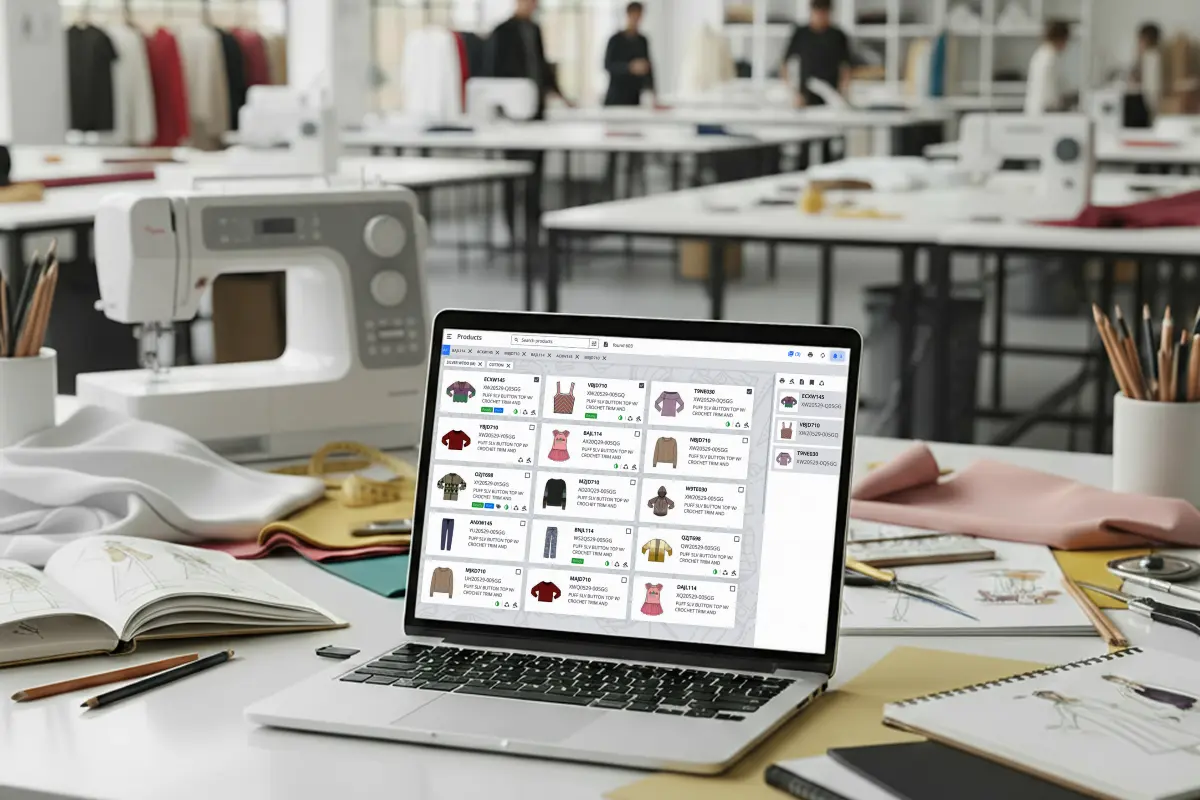
How Is AI Changing Fashion PLM Software in 2026?
AI is entering fashion PLM software across five areas: automated tech pack generation, trend forecasting, supplier risk detection, 3D virtual sampling, and demand forecasting. The technology is real, but there is a real execution gap. 73% of fashion executives say they are prioritizing AI. However, only about 5% of companies report having the in-house talent to implement generative AI tools effectively (Kōbō, State of Fashion PLM Technology 2026, citing McKinsey and Business of Fashion research). In practice, that gap is exactly why picking PLM software with AI features built in, rather than bolted on, matters more than chasing AI for its own sake.
The most practical application right now is AI-assisted spec filling. Upload a reference image, and the system pre-populates a large share of the tech pack fields based on your historical data. Human review is still required for fit specs, but the blank-page problem disappears.
For a deeper look at AI use cases across the full PLM stack, see how AI is changing fashion.
Frequently Asked Questions
What does fashion PLM software actually do?
It manages every stage of product development, from concept and design brief through sampling, supplier coordination, and delivery, in one system.
How is fashion PLM software different from ERP?
ERP manages finance, inventory, and order execution after a product is confirmed. PLM manages design and development before the product ships. Most mid-to-large brands use both.
Do small apparel brands need fashion PLM software?
Any brand managing 50+ SKUs per season or working with 3+ factories benefits. Cloud options like Wave PLM are priced for teams as small as 3 people, with entry pricing around $199/month.
How long does fashion PLM software implementation take?
Cloud-based PLM typically takes 2-8 weeks. On-premise enterprise systems average 15.5 months, since they require infrastructure setup, not just configuration (Kōbō, 2026).
What is the ROI of fashion PLM software?
Brands report 15-50% faster time-to-market, with best-in-class brands seeing up to 60%. Cutting even 1-2 sample rounds per style across 100 styles can save tens of thousands of dollars a season, with typical payback in 12-18 months.
Can fashion PLM software replace spreadsheets for tech packs?
Yes. It replaces spreadsheets with a version-controlled tech pack builder that notifies suppliers automatically and tracks approvals in real time.
Is Fashion PLM Software Right for Your Brand?
If your team spends more than 8 hours per week chasing spec versions, re-sending files, or manually tracking sample status, the answer is almost certainly yes. Whether fashion PLM software pays off isn’t really in question anymore: 15-50% faster time-to-market, meaningfully faster tech pack creation, and payback within 12-18 months are well-documented across the category. Instead, the real question is which platform fits your current stage and budget.
First, audit your current workflow: count how many hours a week your team spends on tasks PLM handles automatically. That’s your baseline ROI case. Second, define your must-have features: tech pack builder, supplier portal, and mobile QC are non-negotiable for most brands. Finally, book a demo with a real style and build it live, since software that can’t handle your tech pack structure in a demo won’t handle it after you sign.
See Wave PLM in action — Wave PLM is fashion PLM software built specifically for apparel, footwear, and accessories brands. From tech pack builder to supplier portal to mobile QC, every feature is designed for fashion teams. Book a free demo




Leave a Reply