
Clothing care labels use five symbol categories — washing, drying, ironing, bleaching, and dry cleaning — to tell you exactly how to keep a garment looking new. Reading them correctly extends garment life, prevents shrinkage and fading, and reduces wardrobe waste. This guide decodes each symbol and shows how to apply them in everyday laundry.
Key Takeaways
- Care labels are governed by five symbol families: wash, dry, iron, bleach, dry clean.
- A bucket is washing, a square is drying, an iron is ironing, a triangle is bleach, and a circle is dry cleaning.
- Numbers inside a bucket = maximum wash temperature in °C; dots inside iron or tumble-dry symbols = heat level (1 low, 2 medium, 3 high).
- A cross through any symbol always means do not do this.
- Following the label can extend garment life, preserve color and fit, and lower your laundry footprint by encouraging cooler washes and air drying.
When you buy a new shirt, dress, or pair of jeans, you’re probably excited to wear it for the first time. But have you ever stopped to think about the small tags stitched inside your clothes? These tags carry essential information on how to properly care for your garments and extend their lifespan.
If you’ve ever been puzzled by the cryptic symbols on your clothing care labels, you’re not alone. Understanding them can make a big difference in how long your clothes last, how they feel, and how they look over time.
In this clothing care guide, we will break down the basics of clothing care labels, explain common fabric care symbols, and provide garment care tips to help you protect your favourite wardrobe pieces. This way, you can preserve the quality of your clothes while being environmentally conscious — and, if you work on the brand side of fashion, understand the design and development decisions that make those labels possible in the first place.
What Are Clothing Care Labels?
Clothing care labels are the tiny tags inside your garments that provide instructions on how to wash, dry, iron, and store your clothes. These instructions are meant to help you care for your clothing in a way that keeps it looking fresh and wearable for as long as possible.
Understanding washing instructions not only helps you avoid shrinking, fading, or damaging your clothes — it also reduces energy and warm water use by helping you wash at the right temperatures. For brands, those tiny tags are also a compliance and traceability artifact created upstream during product development; the levels of fashion brands — from mass market to luxury — often differ as much in the rigor of their care instructions as in their fabrics.
What Do the Symbols on Clothing Care Labels Mean?
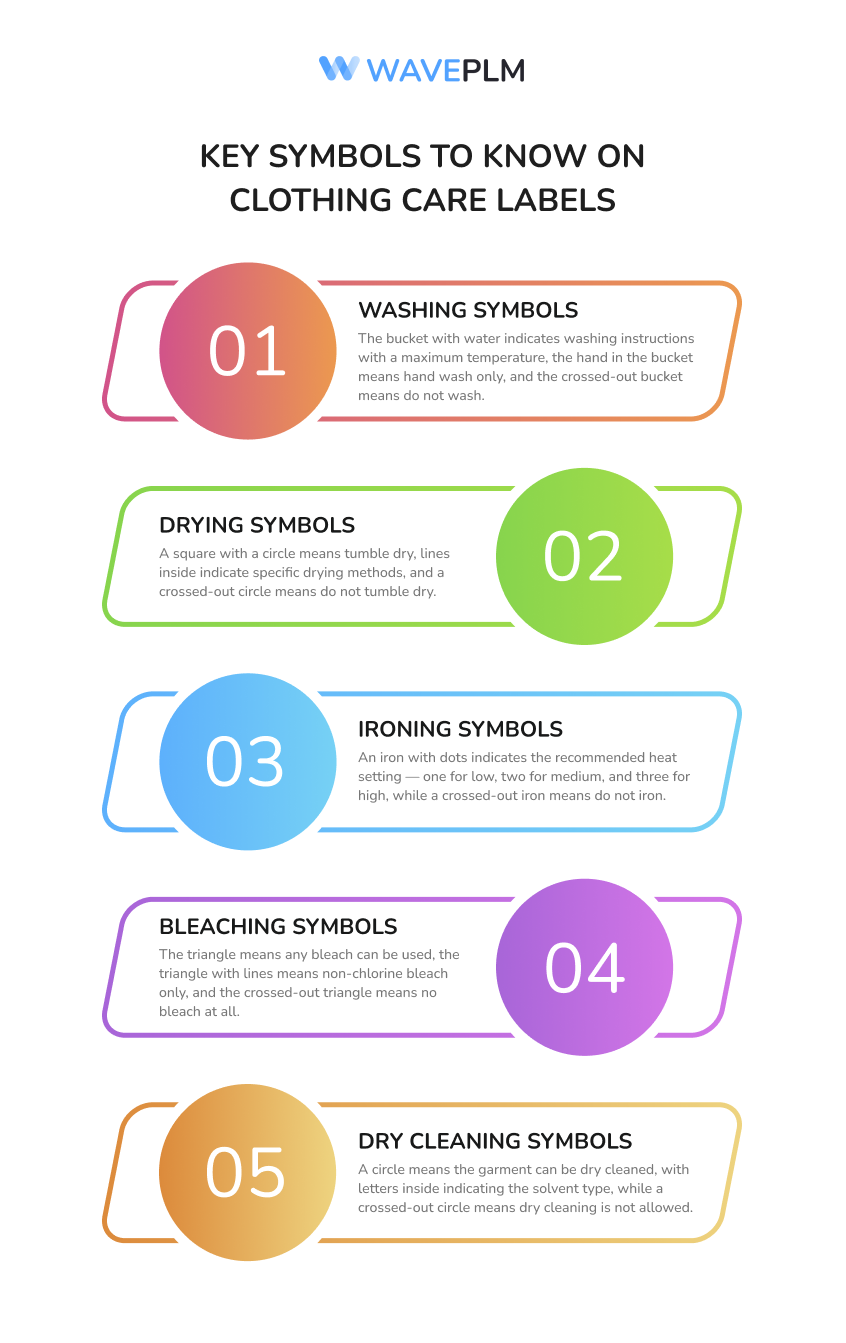
One of the biggest hurdles in deciphering clothing care labels is understanding the various symbols. Here’s a breakdown of the most common ones.
1. Washing Symbols
- Bucket with water — washing instructions. A number inside is the maximum water temperature (e.g., 30°C or 40°C).
- Hand in the bucket — hand-wash only; avoid the washing machine.
- Crossed-out bucket — do not wash. These items typically need a dry cleaner.
2. Drying Symbols
- Square with a circle inside — tumble drying is allowed. Dots denote heat: one dot for low, two for medium, three for high.
- Square with a horizontal line — lay flat to dry (common for wool and cashmere to prevent stretching).
- Square with a vertical line — line dry, outside or on a drying rack.
- Crossed-out square with a circle — do not tumble dry; the fabric is too delicate for high heat.
3. Ironing Symbols
- Iron with dots — temperature setting: one dot for low (synthetics like polyester), two for medium (silk and wool), three for high (cotton and linen).
- Crossed-out iron — do not iron, or steam instead if wrinkles need to come out.
4. Bleaching Symbols
- Triangle — any bleach is allowed.
- Triangle with lines — non-chlorine bleach only (often on coloured fabrics to prevent fading).
- Crossed-out triangle — no bleach at all, including non-chlorine.
5. Dry Cleaning Symbols
- Circle — dry cleaning is allowed. Letters inside (such as P or F) tell professional cleaners which solvent to use.
- Crossed-out circle — do not dry clean.
Quick reference: clothing care symbols
| Symbol family | Shape | What it controls | “Do not” version |
|---|---|---|---|
| Wash | Bucket of water | Wash method + max temperature | Crossed-out bucket |
| Dry | Square (often with circle/lines) | Tumble, line, or flat drying | Crossed-out square |
| Iron | Iron silhouette | Iron heat level (dots) | Crossed-out iron |
| Bleach | Triangle | Bleach permitted (and which kind) | Crossed-out triangle |
| Dry clean | Circle | Professional dry cleaning + solvent | Crossed-out circle |
How Do You Apply Care Symbols in Everyday Laundry?
Once you understand what the symbols mean, it’s easier to apply them to your daily laundry routine. Here are some garment care tips to keep in mind.
1. Sort Your Laundry by Fabric, Not Just Colour
Before washing, sort clothes not only by colour but also by fabric type. Washing delicate fabrics like silk or wool with heavy items like jeans can damage them. Look at the care labels to see if any items need to be washed separately or by hand.
2. Wash at the Right Temperature
As a rule of thumb, washing clothes in cold water is often better for the environment and helps preserve fabrics. Hot water can shrink or fade certain materials, especially cotton. Pay attention to the recommended washing temperature on the label — delicate items typically need cooler water.
3. Use the Right Detergent
If the care label specifies “non-chlorine bleach only,” make sure you’re using the correct detergent. For wool, silk, and other natural fibres, opt for a gentle, pH-neutral detergent. Always check whether fabric softeners are recommended, as some materials (like spandex) degrade faster when exposed to softeners.
4. Don’t Overload the Washing Machine
Even if all your clothes can be machine-washed, overloading the drum leads to less effective cleaning, more wrinkling, and even damage. Clothes need space to move around freely during the wash.
5. Dry With Care
Air-drying is gentler on fabrics and helps them last longer. Even if tumble drying is allowed, consider line drying for delicate pieces. Wool garments may lose their shape when hung — laying them flat to dry is usually the best option.
6. Iron and Steam Strategically
Always check the care label before ironing. For delicate fabrics that can’t withstand high heat, use a low setting or opt for a clothes steamer instead. Steaming is often a gentler way to remove wrinkles from delicate fabrics like silk and polyester.
Why Do Care Labels Matter for Your Wardrobe?
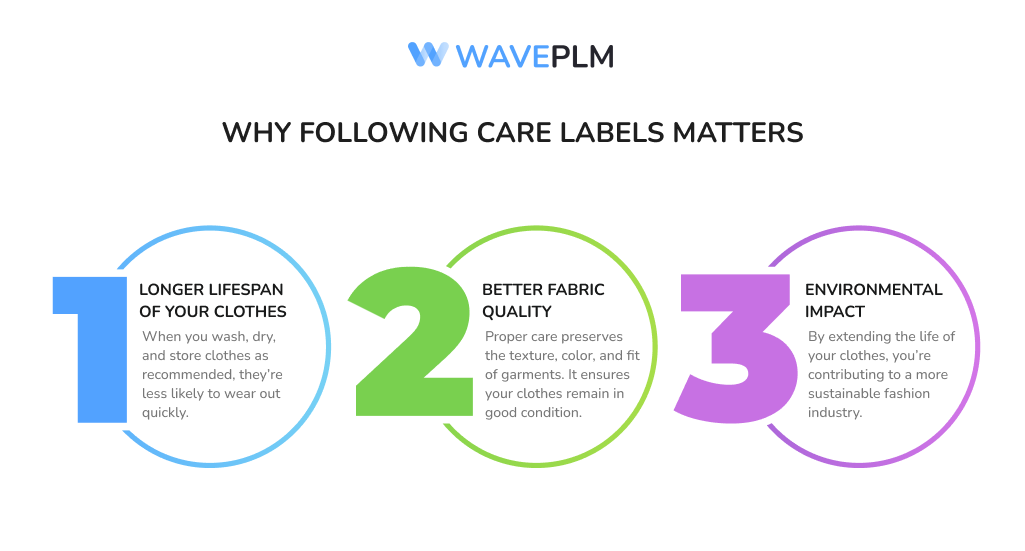
Taking the time to follow the instructions on clothing care labels has several benefits:
- Longer garment lifespan. When you wash, dry, and store clothes as recommended, they’re less likely to wear out quickly. This saves you money in the long run and reduces waste.
- Better fabric quality. Proper care preserves the texture, colour, and fit of garments — preventing shrinkage, colour fading, and material pilling.
- Lower environmental impact. Extending the life of your clothes contributes to a more sustainable fashion industry. Fewer replacements mean less waste and fewer resources used in production. On the brand side, the same logic plays out at scale: well-coordinated apparel supply chains with automated tracking help ensure care instructions are accurate end to end and not lost between mill, factory, and retailer.
What Are the Most Common Clothing Care Mistakes?
Here are a few mistakes people often make with clothing care, and how to avoid them:
- Ignoring care tags. Skipping care instructions often leads to irreversible damage like shrinkage, stretching, or colour bleeding.
- Using too much detergent. More detergent doesn’t mean cleaner clothes. Excess detergent leaves a residue that’s hard to rinse out, making fabrics stiff or sticky.
- Over-drying clothes. Tumble drying on high heat makes fabrics brittle and prone to tears. Stick to the drying instructions to maintain quality.
- Mixing fabric types in one cycle. Heavy denim and lightweight silk should never share a wash, even if both technically allow machine washing.
- Trusting hand-feel over the tag. A garment that “feels sturdy” may still be silk-blend or rayon underneath; the label always wins.
FAQ: Clothing Care Labels
What does the bucket symbol on a clothing care label mean?
The bucket of water symbol represents washing instructions. A plain bucket means machine washing is permitted. A number inside (like 30 or 40) is the maximum wash temperature in degrees Celsius. A hand inside the bucket means hand-wash only, and a cross through the bucket means the garment cannot be washed in water at all.
Can I machine-wash a “hand wash only” garment?
It is risky. Hand-wash symbols are usually applied to fabrics like wool, silk, cashmere, or fine knits that can felt, stretch, or lose shape under machine agitation. If your washing machine has a true cold, low-spin “hand wash” or “delicate” cycle, and you use a mesh bag plus a mild detergent, you can sometimes get away with it — but garment damage is on you, not the manufacturer.
What does the circle symbol on clothing tags mean?
A circle indicates professional dry cleaning is permitted. Letters inside the circle (most commonly P or F) tell the cleaner which solvent to use: P for tetrachloroethylene (perc) and F for hydrocarbon solvents. A line under the circle signals a gentler cycle. A circle with a cross through it means the garment must not be dry cleaned.
Why does my shirt label say “do not tumble dry”?
The crossed-out tumble-dry symbol (a square with a circle inside, with a cross over it) appears on garments where high heat or mechanical agitation will damage the fabric — typically wool, silk, performance synthetics with elastane, and structured items like blazers. Line drying or flat drying preserves shape, fit, and elasticity far better than a tumble dryer.
How do I know what temperature to wash my clothes at?
Look inside the bucket symbol on the care label: the number is the maximum wash temperature in °C. If there is no number, dots inside the bucket indicate heat (one dot ≈ 30°C, two ≈ 40°C, three ≈ 50°C, and so on). When in doubt, default to 30°C cold-wash — it is gentler on fabrics, preserves colour, and uses significantly less energy.
Are clothing care labels legally required?
In most major markets, yes. Garments sold in the United States, the European Union, the United Kingdom, Canada, and Australia must carry permanent care instructions in the form of standardised symbols and/or text. The exact symbol set follows ISO 3758 (international), ASTM D5489 (US), or similar national standards, which is why the same five families — wash, dry, iron, bleach, dry clean — show up everywhere.
Conclusion: A Simple Step Toward Better Garment Care
Decoding clothing care labels might seem like a small step, but it can significantly extend the life of your garments and make your wardrobe more sustainable. Understanding and following the symbols and washing instructions will help you keep your clothes looking new for longer while minimising their environmental footprint.
Decoding clothing care labels might seem like a small step, but it can significantly extend the life of your garments and make your wardrobe more sustainable. And if you build apparel on the brand side, every accurate care label starts with disciplined product development upstream — that’s exactly what Wave PLM is built to support. Book a demo →




Leave a Reply