

A fashion seasonal planning calendar is an operational timeline that maps every collection milestone — from design brief to factory delivery — with assigned owners and fixed deadlines. It is the operational backbone of a fashion brand. Without it, teams work from conflicting assumptions about what is due when. Seasons then slip by days, then weeks, then months. With a PLM-driven fashion seasonal planning calendar, every department works from a single shared timeline, and delays in one stage trigger automatic alerts rather than silent slippage.
This guide covers what a fashion seasonal planning calendar contains and how it differs from demand forecasting and assortment planning. Additionally, it explains how PLM structures the seasonal process for brands managing two to four collections at once.
Table of Contents
- What Is a Fashion Seasonal Planning Calendar?
- Why Do Fashion Brands Need a Structured Seasonal Calendar?
- What Are the Key Milestones in a Fashion Seasonal Planning Calendar?
- How Does PLM Structure the Seasonal Planning Process?
- How Do You Manage Multiple Seasons at Once in PLM?
- What Are Common Seasonal Planning Mistakes and How Do You Avoid Them?
- Frequently Asked Questions
What Is a Fashion Seasonal Planning Calendar?
A fashion seasonal planning calendar is a structured production timeline. It maps every development milestone against fixed calendar dates — from design brief through tech pack submission, proto sample review, pre-production sample approval, bulk production start, and delivery. Each milestone has a clear owner and a hard deadline. Additionally, each milestone has a gate condition: the next stage does not open until the team signs off the current one.
Importantly, fashion seasonal planning is not the same as demand forecasting or assortment planning. Demand forecasting focuses on volume projections. Assortment planning focuses on style selection by channel. In contrast, fashion seasonal planning focuses on operational timing. It asks: what must happen, in what order, and by when? It is, therefore, a production operations calendar — not a commercial strategy document. For forecasting methodology, our fashion forecasting guide covers that separately.
Most growing fashion brands run two to four seasons simultaneously at any point in the year. Specifically, Spring may be shipping while Summer is in production. At the same time, Fall is in sampling and Holiday is in early design. A fashion seasonal planning calendar — ideally managed in PLM — is what prevents those four overlapping timelines from colliding.

Why Do Fashion Brands Need a Structured Seasonal Calendar?
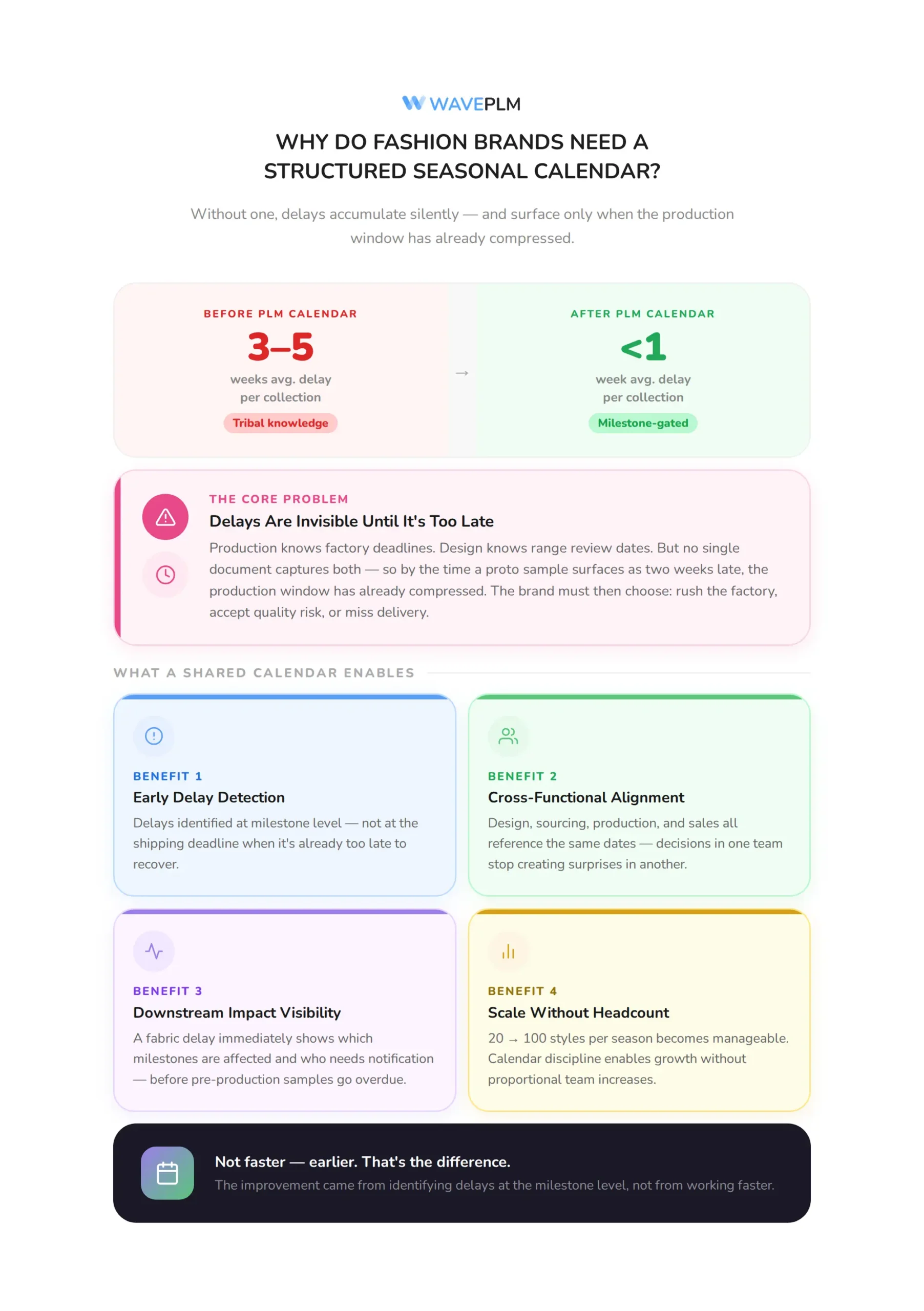
Without a structured fashion seasonal planning calendar, brands operate on tribal knowledge. The head of production knows the factory deadlines, the design director knows the range review dates, but no single document captures both. Consequently, delays accumulate silently. By the time anyone notices a proto sample is two weeks late, the production window has already compressed. At that point, the brand must choose between rushing the factory, accepting quality risk, or missing the delivery date.
Our finding: Wave PLM customers report that before implementing a shared seasonal calendar in PLM, the average time-to-market delay per collection was 3–5 weeks. After moving to a milestone-gated PLM calendar, that average dropped to under one week. The improvement came not from working faster, but from identifying delays at the milestone level rather than at the shipping deadline.
How a Shared Calendar Enables Cross-Functional Alignment
A structured calendar also enables cross-functional alignment. Specifically, when design, sourcing, production, and sales all reference the same milestone dates, decisions made in one department stop creating surprises in another. For example, if sourcing flags a fabric delivery two weeks behind schedule, the seasonal calendar immediately shows which downstream milestones this affects — and who needs notification. Without that shared visibility, the same two-week fabric delay might not surface until pre-production samples are already overdue.
For brands scaling from 20 to 100 styles per season, this visibility becomes critical. Our guide to scaling a fashion brand covers how calendar discipline enables growth without proportional headcount increases.
What Are the Key Milestones in a Fashion Seasonal Planning Calendar?
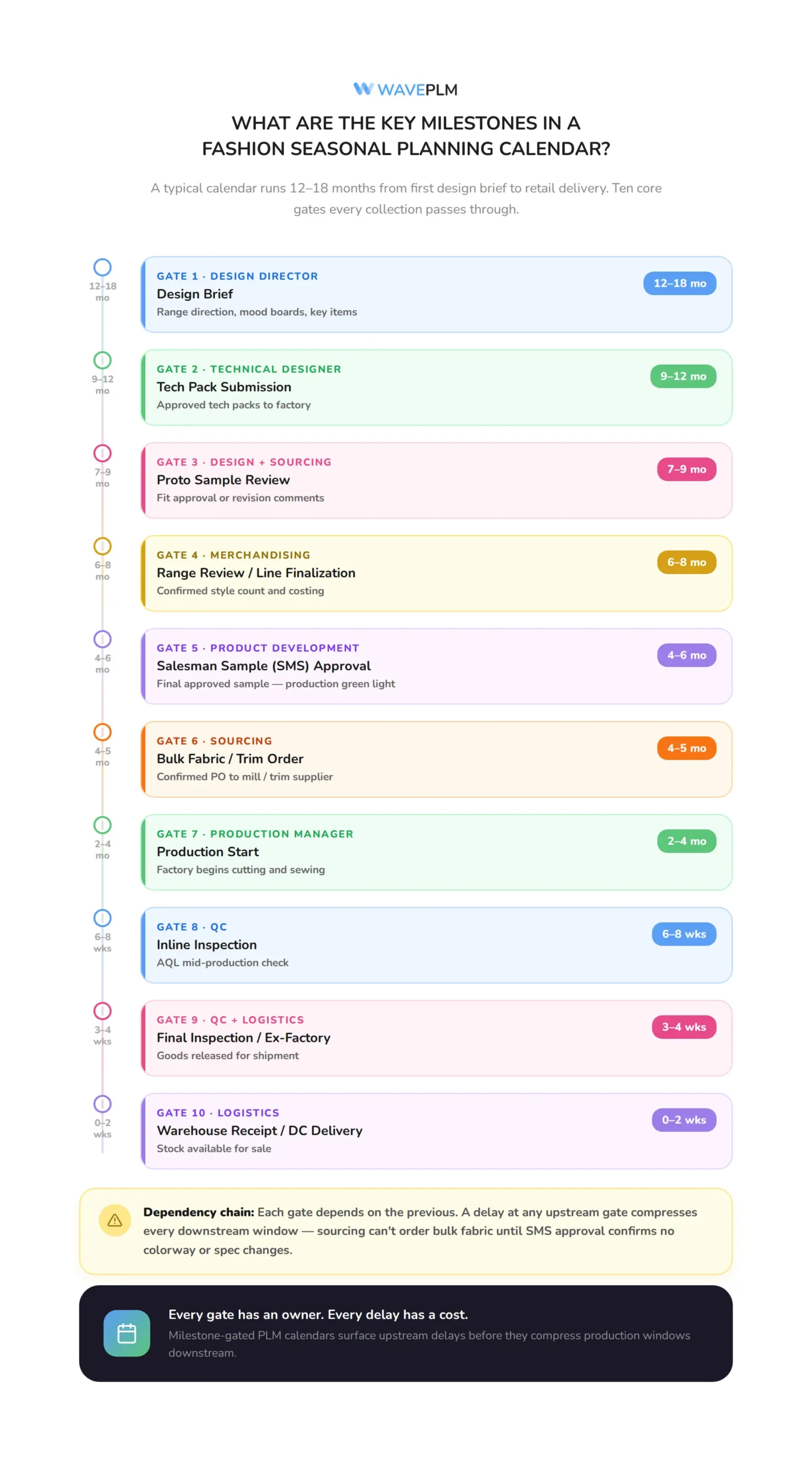
A typical fashion seasonal planning calendar runs 12 to 18 months from first design brief to retail delivery. The exact timeline varies by category (fast fashion vs. luxury), geography (domestic vs. offshore production), and channel (wholesale vs. DTC). However, most collections pass through the same core gates:
| Milestone | Owner | Output | Typical Lead Time Before Delivery |
|---|---|---|---|
| Design Brief | Design Director | Range direction, mood boards, key items | 12–18 months |
| Tech Pack Submission | Technical Designer | Approved tech packs to factory | 9–12 months |
| Proto Sample Review | Design + Sourcing | Fit approval or revision comments | 7–9 months |
| Range Review / Line Finalization | Merchandising | Confirmed style count and costing | 6–8 months |
| Salesman Sample (SMS) Approval | Product Development | Final approved sample, production green light | 4–6 months |
| Bulk Fabric / Trim Order | Sourcing | Confirmed PO to mill / trim supplier | 4–5 months |
| Production Start | Production Manager | Factory begins cutting and sewing | 2–4 months |
| Inline Inspection | QC | AQL mid-production check | 6–8 weeks |
| Final Inspection / Ex-Factory | QC + Logistics | Goods released for shipment | 3–4 weeks |
| Warehouse Receipt / DC Delivery | Logistics | Stock available for sale | 0–2 weeks |
Notably, each of these milestones has a dependency chain. For example, the sourcing team cannot place bulk fabric orders until the team confirms SMS approval — because the SMS review might change the colorway or fabric specification. Similarly, production cannot start until bulk fabric arrives at the factory. Therefore, a delay at any upstream gate compresses every downstream window.
How to Calculate Milestone Dates from Your Delivery Target
The simplest way to build a seasonal calendar is to start from the confirmed delivery date and work backward using the lead times in the table above. First, set your warehouse receipt date. Then subtract your freight transit time to get your ex-factory date. Next, subtract your production window to get your production start date — and so on up the chain. This backward-planning method anchors every date to a real lead time rather than an aspirational one.
For a deeper breakdown of how the product development process maps to these milestones, see our fashion product development process guide.
How Does PLM Structure the Seasonal Planning Process?
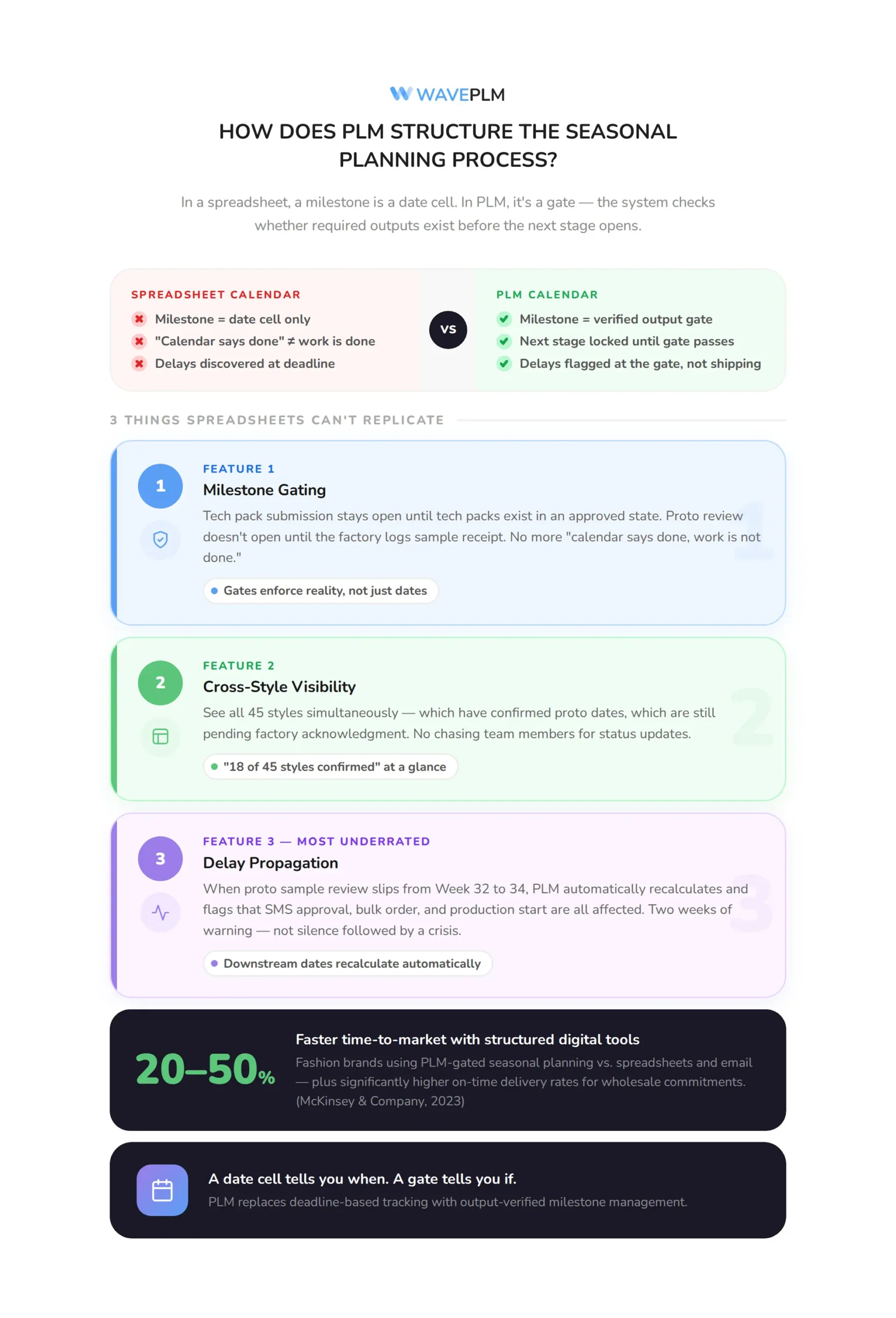
PLM structures the fashion seasonal planning process by connecting calendar milestones directly to the product data that drives them. In a spreadsheet-based calendar, a milestone is just a date cell. In PLM, a milestone is a gate: the system checks whether the required outputs exist before allowing the next stage to open.
Specifically, PLM structures seasonal planning in three ways that spreadsheets cannot replicate:
Milestone gating. PLM will not close the tech pack submission milestone until tech packs exist in the system in an approved state. Proto sample review does not open until the factory logs sample receipt. This prevents the “calendar says done, work is not done” gap that plagues manual tracking.
Cross-style visibility. A PLM seasonal calendar shows every style in the collection simultaneously, with individual milestone status per style. As a result, a product manager sees at a glance that 18 of 45 styles have confirmed proto dates. They can also see that 12 styles are still pending factory acknowledgment — without chasing individual team members for updates.
Delay Propagation: PLM’s Most Underrated Seasonal Planning Feature
Delay propagation. When a milestone slips, PLM recalculates all downstream dates automatically. For instance, if proto sample review moves from Week 32 to Week 34, the system flags that SMS approval, bulk order, and production start are all affected. This gives the team two weeks of warning rather than two weeks of silence followed by a crisis.
Industry data: According to McKinsey & Company (2023), fashion brands that use structured digital tools for seasonal planning reduce time-to-market by 20–50% compared to brands relying on spreadsheets and email. Furthermore, they report significantly higher on-time delivery rates for wholesale commitments.
For brands also managing time-to-market targets, our guide to reducing time to market in fashion covers how PLM calendar discipline translates to faster delivery cycles. Additionally, our merchandising and planning guide explains how the seasonal calendar integrates with buy planning and range reviews.
How Do You Manage Multiple Seasons at Once in PLM?
Managing multiple seasons simultaneously is where most brands hit the limits of spreadsheet-based fashion seasonal planning. When Spring is shipping, Summer is in sampling, and Fall is in design, the team must maintain three separate calendar files, cross-reference them, and keep them in sync. Shared resources — key factories, a single sourcing manager, a two-person technical design team — appear in all three calendars with no visibility into overallocation.
In PLM, all seasons live within the same platform. Therefore, a sourcing manager can view their full workload across seasons in a single dashboard. If Fall sampling runs late, extra factory visits may fall in the same weeks as Summer’s inline inspection window. PLM surfaces this conflict immediately — not after both have been scheduled separately.
How PLM Handles Shared Resources Across Concurrent Seasons
Additionally, PLM handles shared materials between seasons efficiently. If the team reuses a carry-over fabric from Spring in Fall, both seasonal projects reference the same PLM material record. Any supplier update — a price change, a lead time revision, a compliance certificate renewal — propagates across both seasons automatically. This is similar to how multi-drop activewear brands manage shared fabrics across drop projects.
For example, proto sample review cannot proceed until the factory confirms sample dispatch, and SMS approval cannot proceed until the proto review is signed off. Gates prevent teams from advancing on paper while work is actually incomplete — a common cause of late-stage production surprises. Most mid-market fashion brands manage two to four seasons simultaneously at any given point. While one season is in retail, the next is typically in production or final inspection, with the following season in sampling and range review, and the one after in early design. PLM seasonal planning tools are specifically designed for this multi-season environment, offering comprehensive visibility across all active seasons within a single dashboard rather than relying on disparate files.
For brands managing more than two factories, our multi-factory production coordination guide covers vendor assignments and capacity planning. It explains how those connect to the seasonal calendar framework across concurrent seasons.
What Are Common Seasonal Planning Mistakes and How Do You Avoid Them?
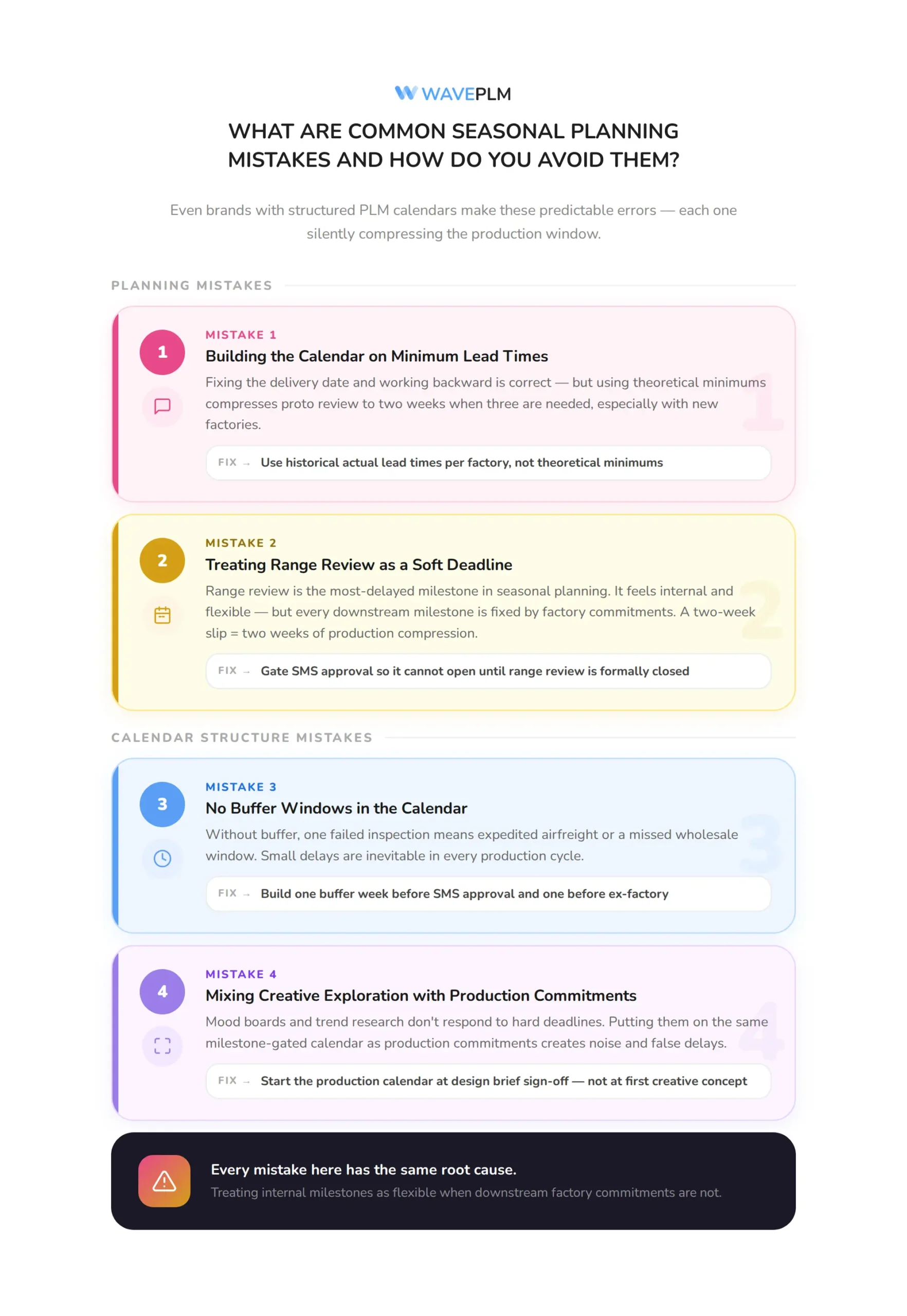
Even brands with structured PLM calendars make predictable mistakes in their fashion seasonal planning process. Here are the most common — and how to address each:
Building the calendar backward from a single delivery date. Many brands start by fixing the delivery date and working backward. This is correct in principle. However, they often underestimate lead times for proto rounds, especially for new factories or complex constructions. Consequently, the calendar compresses proto review into two weeks when three are needed. The fix is to build the calendar using historical actual lead times per factory, not theoretical minimum times.
Planning Mistakes That Silently Compress Your Production Window
Treating the range review as a soft deadline. Range review — where merchandising finalizes the style count and costing — is consistently the most-delayed milestone in seasonal planning. Teams treat it as flexible because it is internal. In contrast, every downstream milestone (SMS approval, bulk order, production start) is fixed by factory commitments. Slipping range review by two weeks means two weeks of production compression downstream.
Calendar Structure Mistakes That Create Late-Stage Crises
Not building buffer into the calendar. A well-structured fashion seasonal planning calendar includes buffer windows — typically one week before SMS approval and one week before ex-factory. These buffers absorb the small delays that are inevitable in any production cycle. Notably, brands that build no buffer end up expediting airfreight or missing wholesale windows when a single inspection fails.
Using one calendar for both design exploration and production commitment. Pre-design exploration — mood boards, trend research, initial concept development — should not be on the same milestone-gated calendar as production commitments. Specifically, creative exploration is inherently open-ended and does not respond well to hard deadlines. Instead, the production-committed calendar should start at design brief sign-off, when creative direction is agreed and the operational clock begins.
For a practical view of how sample round management connects to calendar discipline, see our guide on reducing sample rounds in apparel development.
Wave PLM includes a built-in seasonal calendar with milestone gating, cross-season visibility, and delay propagation alerts — designed specifically for SMB and mid-market apparel brands (10–200 styles per season). Book a demo to see how it maps to your specific seasonal workflow.
Frequently Asked Questions
What is a fashion seasonal planning calendar?
A fashion seasonal planning calendar is an operational timeline that maps every collection milestone — from design brief to factory delivery — with assigned owners, deadlines, and gate conditions. It is distinct from demand forecasting (which predicts sales) and assortment planning (which selects styles). Instead, it answers one operational question: what must happen, in what order, and by when, so the collection ships on time?
How far in advance should a fashion brand plan a season?
Most fashion brands begin seasonal planning 12 to 18 months before retail delivery for offshore production. Brands with domestic manufacturing can work on shorter timelines — typically 6 to 9 months. Fast fashion brands with vertical or near-shore supply chains operate on even shorter cycles, sometimes 4 to 8 weeks from design to delivery. In all cases, the calendar should be built from confirmed factory lead times rather than from aspirational minimums.
How does fashion seasonal planning differ from fashion forecasting?
Fashion forecasting predicts consumer demand — what will sell, in what volume, by category or style. Fashion seasonal planning is the operational calendar that ensures a collection is developed, produced, and delivered on time. The two are related: forecast data informs range decisions during line finalization, which is a milestone in the seasonal calendar. However, they are fundamentally different activities managed by different teams with different tools.
How do small fashion brands manage seasonal planning without PLM?
Small brands typically manage fashion seasonal planning through a combination of shared spreadsheets, Google Calendar, and project management tools like Asana or Notion. This approach works at low style counts (under 20 per season) with a small team. Above that threshold, the lack of connection between calendar dates and actual product data creates coordination gaps. Tech packs, factory confirmations, and sample statuses all live in separate places. Consequently, these gaps compound with each additional style. At that point, a PLM or purpose-built product development platform is the practical solution.
What is a milestone gate in seasonal planning?
A milestone gate is a checkpoint in the seasonal planning calendar that requires a specific output to be completed and approved before the next stage can begin. For example, proto sample review cannot proceed until the factory confirms sample dispatch, and SMS approval cannot proceed until the proto review is signed off. Gates prevent teams from advancing on paper while work is actually incomplete — a common cause of late-stage production surprises.
How many seasons do most fashion brands plan simultaneously?
Most mid-market fashion brands manage two to four seasons simultaneously at any given point. While one season is in retail, the next is typically in production or final inspection. The following season is in sampling and range review, and the one after is in early design. PLM seasonal planning tools are built specifically for this multi-season environment, providing visibility across all active seasons in a single dashboard rather than in separate files.





Leave a Reply