

Landed cost is the total cost to get one unit of product from the factory to your warehouse door. It includes the product price, freight, insurance, customs duty, and clearance fees. In other words, it is the real cost of the garment, not just the price your factory quotes. For this reason, brands that price using the factory quote alone, without adding freight and duty, routinely discover their true margin only after the shipment clears customs.
This guide walks through the formula and a full worked example. It also covers what to include beyond the obvious line items, plus how 2026 tariff changes affect the math. Finally, it explains how PLM software keeps data connected to your product records, instead of buried in a spreadsheet.
What Is Landed Cost?
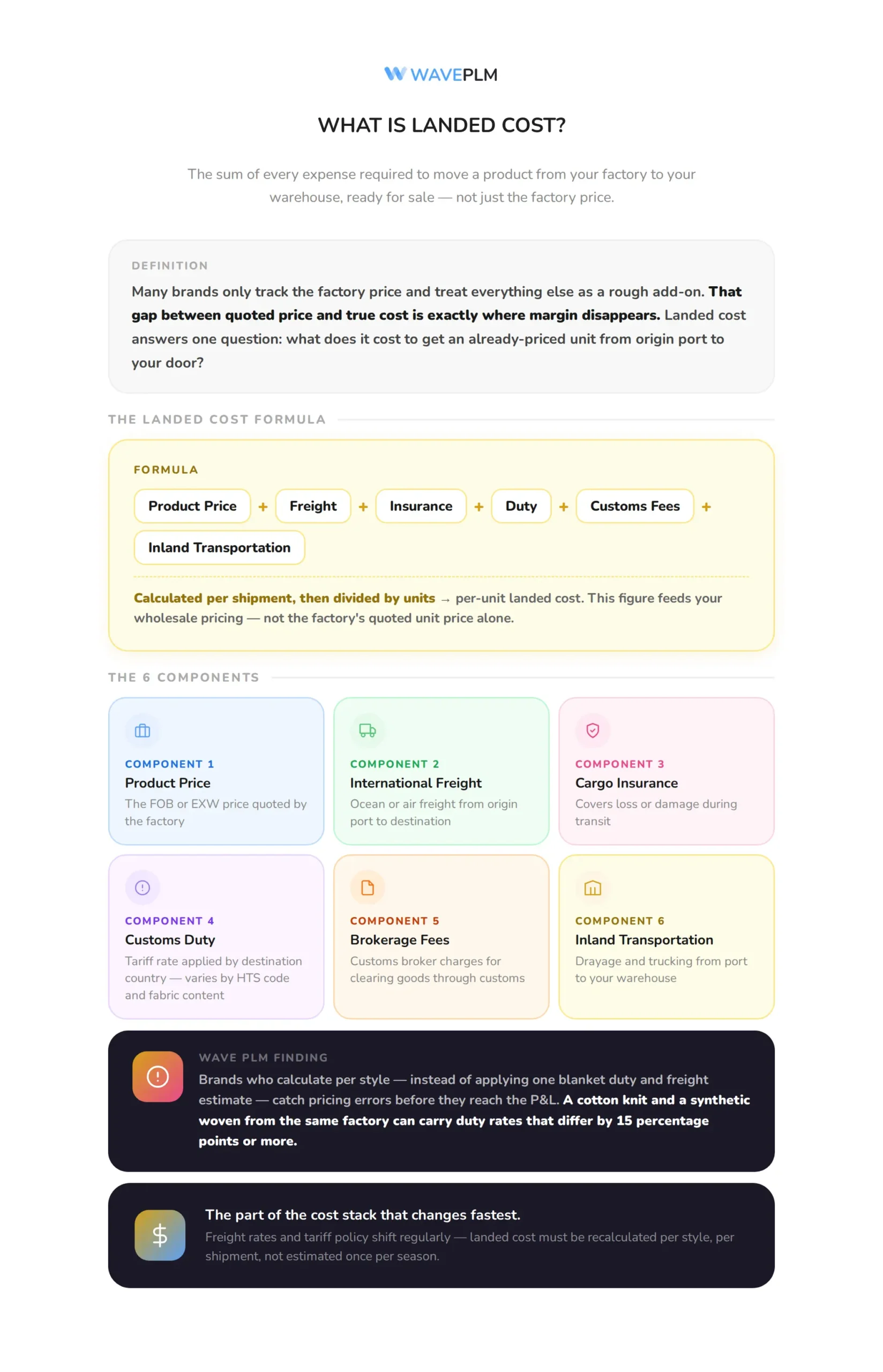
The sum of every expense required to move a product from your factory to your warehouse, ready for sale. Specifically, it includes the unit price you pay the factory, international freight, cargo insurance, customs duty, brokerage fees, and inland transportation. Many brands only track the factory price. Instead, they treat everything else as a rough add-on. However, that gap between quoted price and true cost is exactly where margin disappears.
This differs from garment costing in scope. Specifically, a full garment cost sheet covers everything from fabric and labor through to the complete cost and retail markup. By contrast, it is specifically the import-side layer. It answers one question: what does it cost to get an already-priced unit from origin port to your door? Even brands with a solid cost sheet still need this layer calculated precisely. After all, it is the part of the cost stack that changes fastest with freight rates and tariff policy.
What Is the Landed Cost Formula?
At its simplest, the landed cost formula looks like this.
Formula = Product Price + Freight + Insurance + Duty + Customs Fees + Inland Transportation.
Typically, each component is calculated per shipment first. Then, the total is divided by the number of units to get a per-unit landed cost. Importantly, this per-unit figure is what should feed into your wholesale pricing calculation, not the factory’s quoted unit price alone.
Our finding: Wave PLM customers who calculate per style, instead of applying one blanket duty and freight estimate across the whole line, catch pricing errors before they reach the P&L. A cotton knit style and a synthetic woven style from the same factory can carry duty rates that differ by 15 percentage points or more.
How Do You Calculate Landed Cost Step by Step?
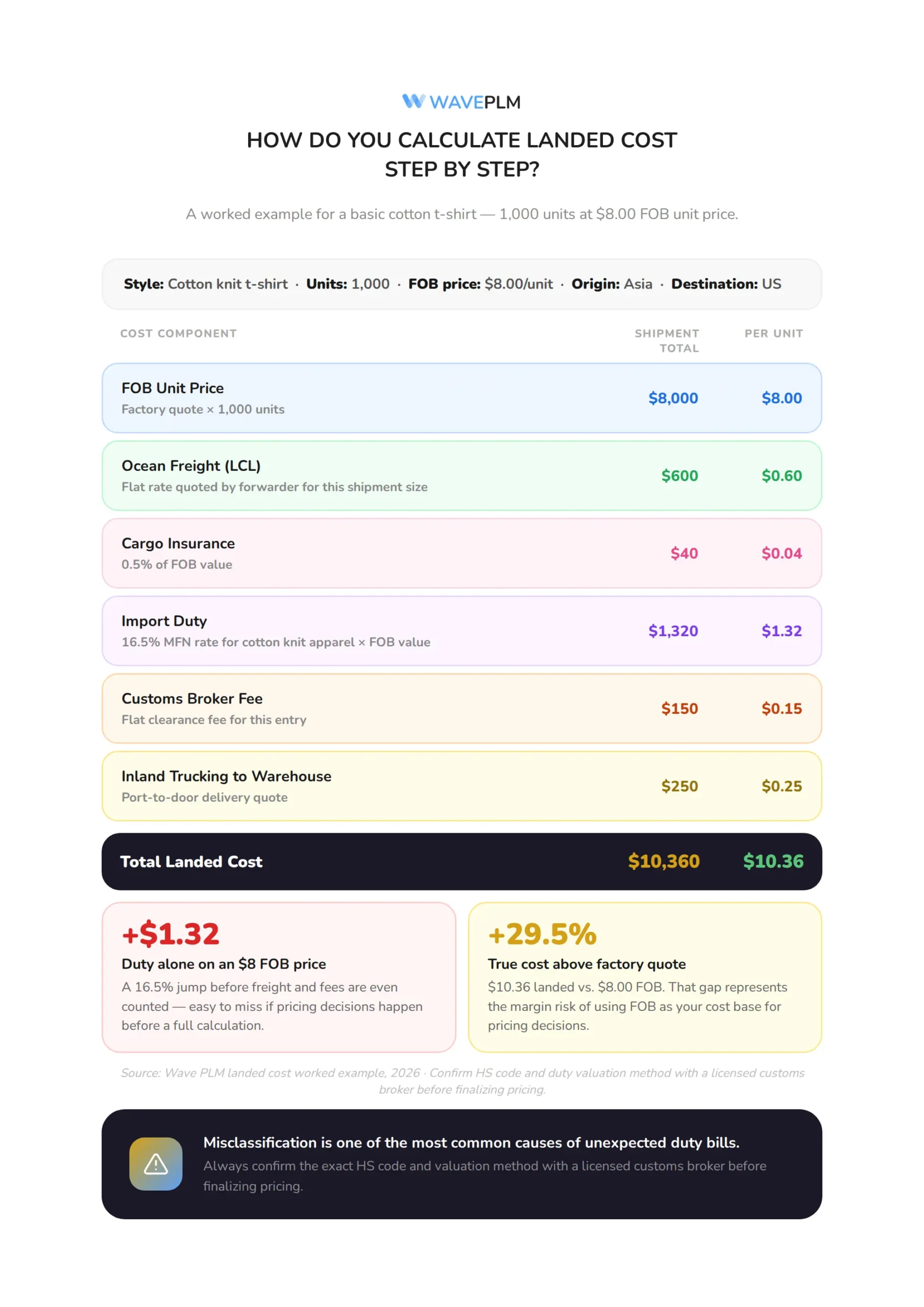
Here is a worked example for a basic cotton t-shirt style, ordered at 1,000 units, FOB unit price of $8.00.
| Cost component | Shipment total | Per unit | How it was calculated |
|---|---|---|---|
| FOB unit price | $8,000 | $8.00 | Factory quote × 1,000 units |
| Ocean freight (LCL) | $600 | $0.60 | Flat rate quoted by forwarder for this shipment size |
| Cargo insurance | $40 | $0.04 | 0.5% of FOB value |
| Import duty | $1,320 | $1.32 | 16.5% MFN rate for cotton knit apparel × FOB value |
| Customs broker fee | $150 | $0.15 | Flat clearance fee for this entry |
| Inland trucking to warehouse | $250 | $0.25 | Port-to-door delivery quote |
| Total landed cost | $10,360 | $10.36 | Sum of all rows above |
Notice that duty alone added $1.32 to a $8.00 FOB price. That is a 16.5% jump before freight and fees are even counted. As a result, the true cost in this example runs 29.5% above the factory quote. Consequently, that gap is easy to miss if pricing decisions happen before a full calculation.
Duty valuation rules vary by country and product classification. In this example, duty is calculated on the FOB value for simplicity. However, before finalizing pricing, confirm the exact valuation method and HS code classification with a licensed customs broker. Notably, misclassification is one of the most common causes of unexpected duty bills at clearance.
What Is Included for Apparel Imports?
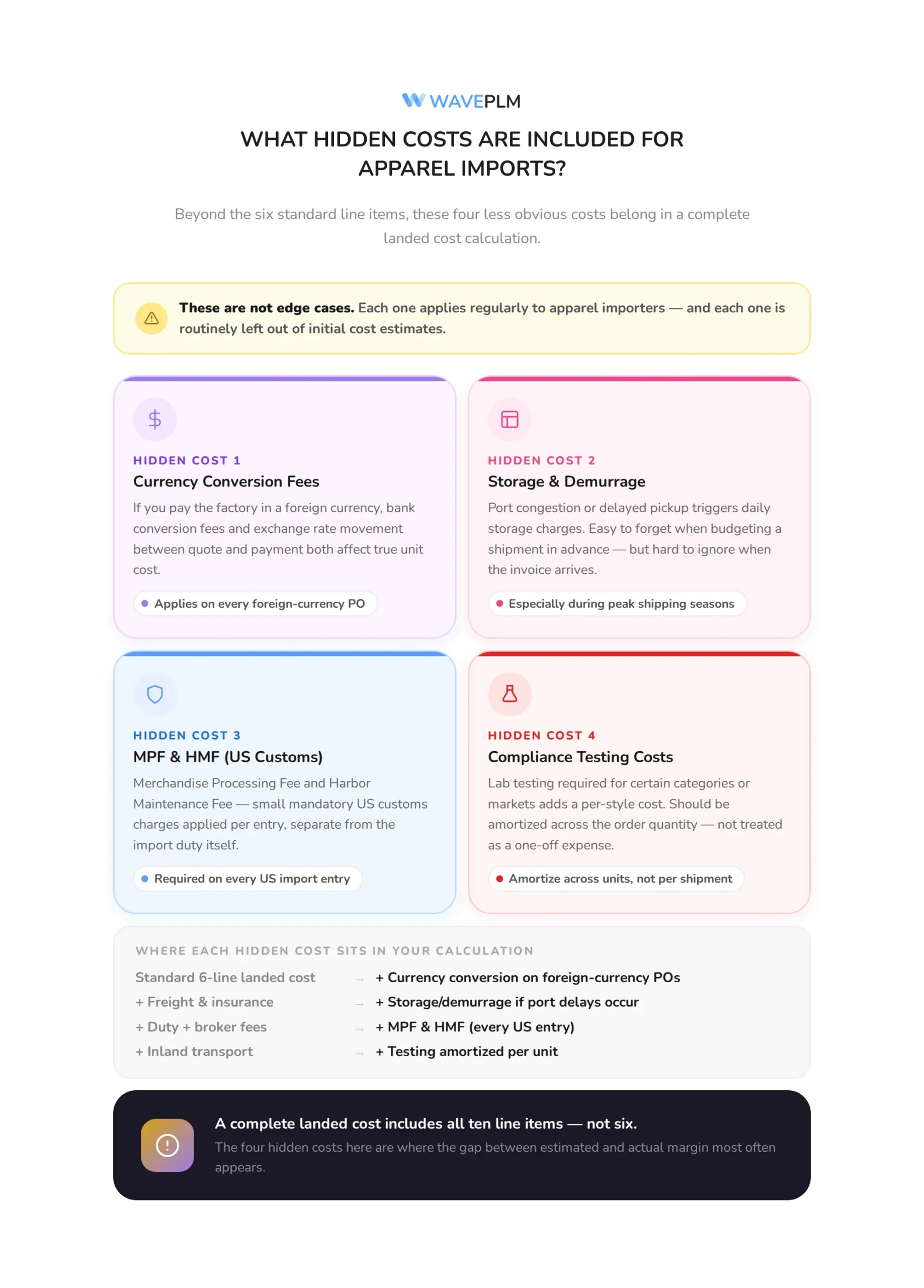
Beyond the six line items in the worked example above, a few less obvious costs belong in a complete landed cost calculation.
- Currency conversion fees. If you pay the factory in a foreign currency, bank conversion fees and exchange rate movement between quote and payment both affect true unit cost.
- Storage and demurrage. Port congestion or delayed pickup can trigger daily storage charges that are easy to forget when budgeting a shipment in advance.
- Merchandise Processing Fee (MPF) and Harbor Maintenance Fee (HMF). These are small, mandatory US customs fees applied per entry, separate from the duty itself.
- Compliance testing costs. Lab testing required for certain categories or markets adds a per-style cost that should be amortized across the order quantity.
How Much Do Duties Add in 2026?
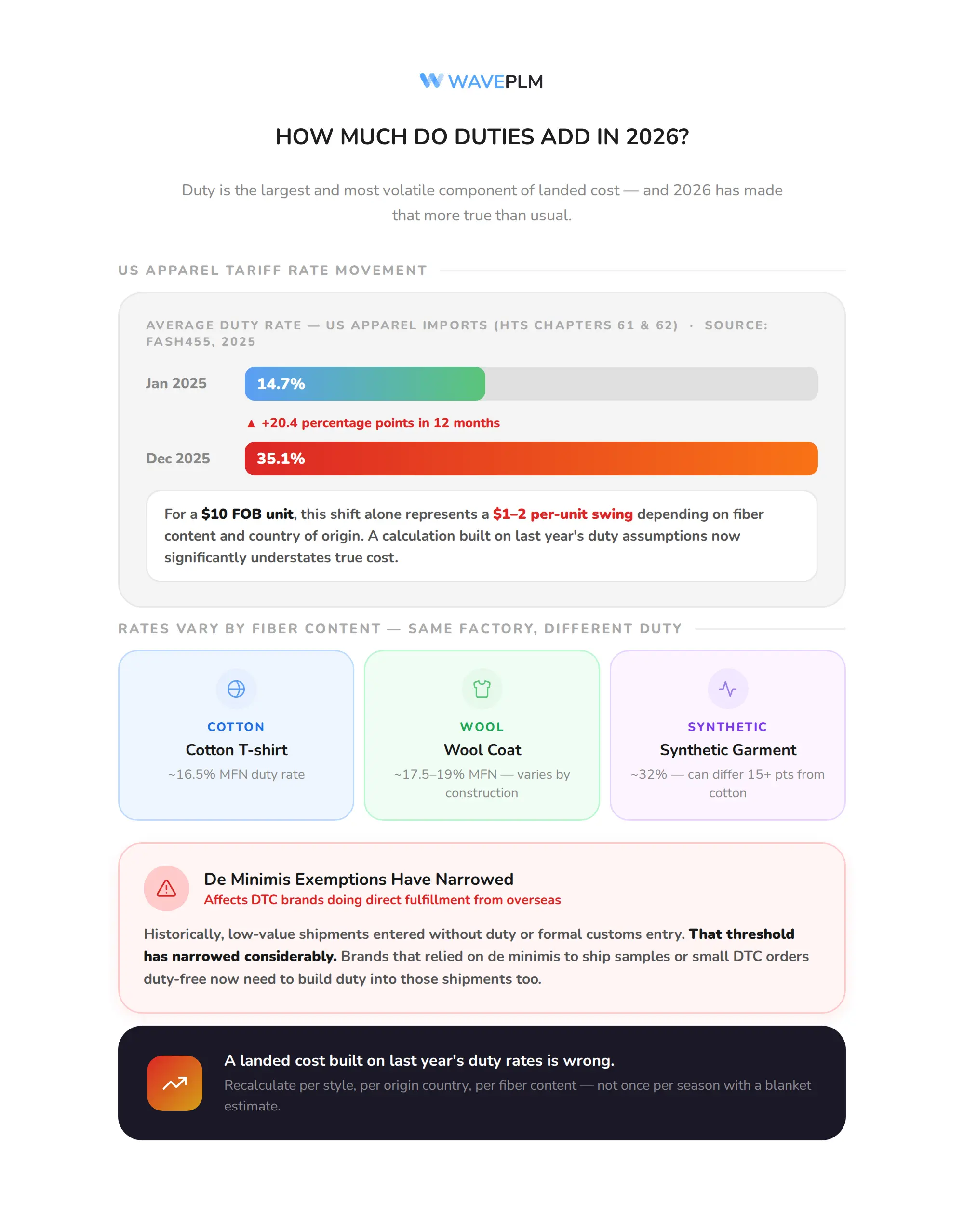
Duty is typically the largest and most volatile component of landed cost. In fact, 2026 has made that more true than usual. According to FASH455, a trade research publication that tracks US apparel tariffs, the average duty rate on US apparel imports reached 35.1% in December 2025. That is a sharp increase from 14.7% in January 2025. Consequently, a landed cost calculation built on last year’s duty assumptions is now likely to understate true cost significantly.
Industry data: The average US tariff rate on apparel imports (HTS Chapters 61 and 62) climbed from 14.7% in January 2025 to 35.1% by December 2025, according to FASH455’s tracking of apparel trade policy. For a $10 calculation, that shift alone can represent a $1–2 per-unit swing depending on fiber content and country of origin.
Rates also vary significantly by fiber content and origin. For example, a cotton t-shirt, a wool coat, and a synthetic-fiber garment can each carry a different duty rate even from the same factory. For category-specific rates and how they apply to your sourcing countries, see our full guide to customs tariffs and duties in U.S. fashion.
How Does De Minimis Affect Landed Cost?
De minimis exemptions historically let low-value shipments enter without duty or formal customs entry. However, that threshold has narrowed considerably in recent years. As a result, brands that relied on de minimis to ship samples or small direct-to-consumer orders duty-free now need to build duty into those shipments too. Notably, this shift particularly affects brands doing direct fulfillment from overseas factories rather than bulk import through a warehouse. For a deeper look at how these changes ripple through sourcing decisions, see our guide on fashion supply chain complexity.
What Mistakes Do Brands Make Calculating Landed Cost?
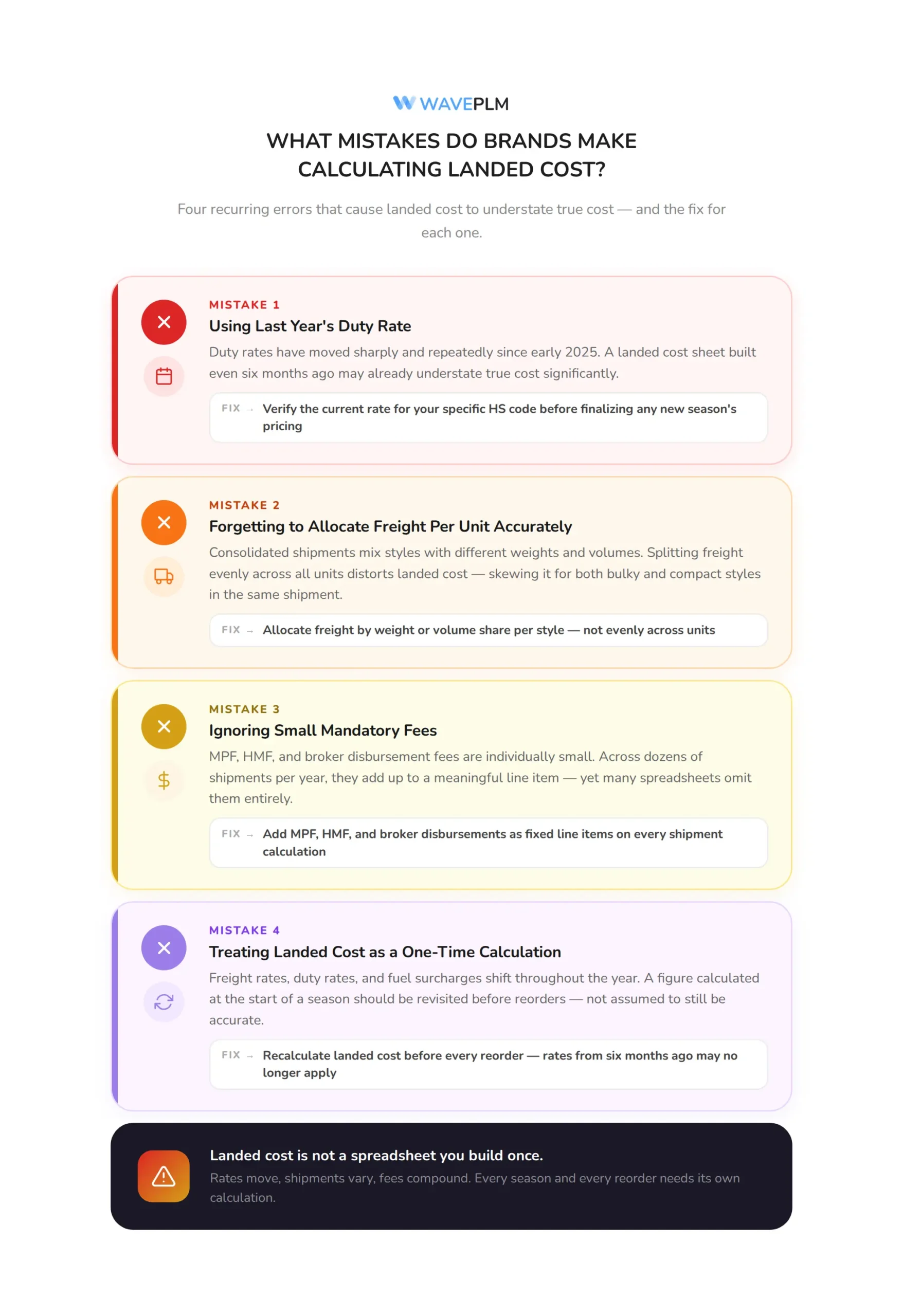
Using Last Year’s Duty Rate
Duty rates have moved sharply and repeatedly since early 2025. Consequently, a landed cost sheet built even six months ago may already understate true cost. For this reason, verify the current rate for your specific HS code before finalizing any new season’s pricing.
Forgetting to Allocate Freight Per Unit Accurately
Consolidated shipments often mix multiple styles with different weights and volumes. Splitting freight evenly across all units, rather than by weight or volume share, distorts landed cost. Specifically, it skews the number for both bulky and compact styles in the same shipment.
Ignoring Small Mandatory Fees
MPF, HMF, and broker disbursement fees are individually small. However, across dozens of shipments per year, they add up to a meaningful line item. Notably, many spreadsheets simply omit this line item entirely.
Treating Landed Cost as a One-Time Calculation
Freight rates, duty rates, and even fuel surcharges shift throughout the year. For this reason, a landed cost figure calculated at the start of a season should be revisited before reorders, not assumed to still be accurate. This is the same versioning discipline that matters for fabric sourcing decisions, where MOQ and lead time assumptions also drift over a season.
How Does PLM Software Help Track Landed Cost?
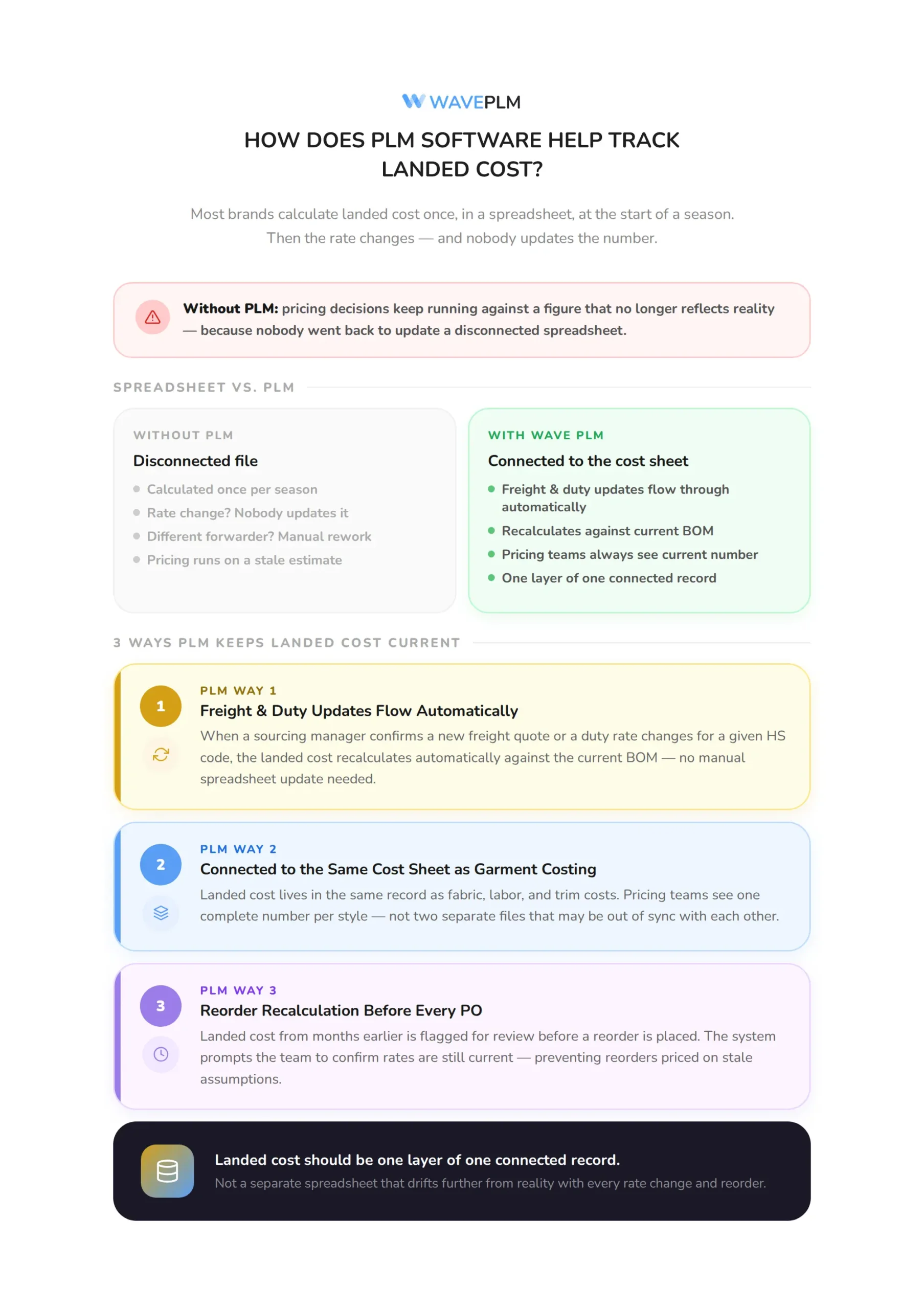
Most brands calculate landed cost once, in a spreadsheet, at the start of a season. Then the rate changes, or a new shipment uses a different forwarder. Nobody updates the number. Consequently, pricing decisions keep running against a figure that no longer reflects reality.
Wave PLM keeps landed cost connected to the same cost sheet used for garment costing. As a result, freight and duty updates flow through automatically, rather than living in a disconnected file. Specifically, a sourcing manager might confirm a new freight quote, or a duty rate might change for a given HS code. Either way, the landed cost recalculates automatically against the current BOM and cost sheet. This means pricing teams always work from the current number, not a static estimate from months earlier. Furthermore, this connects directly to the same cost sheet workflow used for CMT and FOB comparisons. In other words, landed cost becomes one layer of a single connected record, rather than a separate spreadsheet exercise.
Frequently Asked Questions
What is landed cost?
Landed cost is the total cost to get one unit of product from the factory to your warehouse, ready for sale. It includes the product price, international freight, cargo insurance, customs duty, brokerage fees, and inland transportation. Landed cost is almost always higher than the factory’s quoted price alone.
What is the landed cost formula?
The landed cost formula is: Landed Cost = Product Price + Freight + Insurance + Duty + Customs Fees + Inland Transportation. Each component is typically calculated for the full shipment, then divided by the number of units to reach a per-unit landed cost figure.
What is included in landed cost besides the product price?
Beyond the product price, landed cost includes ocean or air freight, cargo insurance, import duty, customs broker fees, and inland trucking to your warehouse. Additionally, it should account for smaller items too. These include currency conversion fees, storage or demurrage charges, and mandatory US customs fees like the Merchandise Processing Fee and Harbor Maintenance Fee.
How much do duties typically add to landed cost?
Duty is often the single largest component of landed cost after the product price itself. The average US duty rate on apparel imports reached 35.1% by December 2025, up from 14.7% in January 2025. The exact rate depends heavily on fiber content, garment category, and country of origin.
Is landed cost the same as FOB price?
No. FOB price is only the cost of the product at the origin port, before it ships. Landed cost adds freight, insurance, duty, customs fees, and inland transportation on top of the FOB price. In the worked example in this guide, an $8.00 FOB unit price became a $10.36 landed cost once every component was added.
How does PLM software help calculate landed cost?
PLM software keeps landed cost connected to the same cost sheet used for garment costing. As a result, updates to freight rates or duty percentages flow through automatically. For example, Wave PLM recalculates landed cost against the current BOM and cost sheet whenever a sourcing manager updates a freight quote or duty rate. Consequently, pricing teams stop working from an outdated spreadsheet estimate.
It is the number that actually determines your margin, not the factory quote you started with. Freight rates shift, duty rates have moved sharply since 2025, and small fees add up across a season of shipments. A figure calculated once and never revisited is a pricing risk waiting to surface at your next reorder.
Wave PLM connects landed cost to the same cost sheet your team already uses for garment costing, so pricing always reflects the current freight and duty picture. See how Wave PLM keeps costing connected →







Leave a Reply