
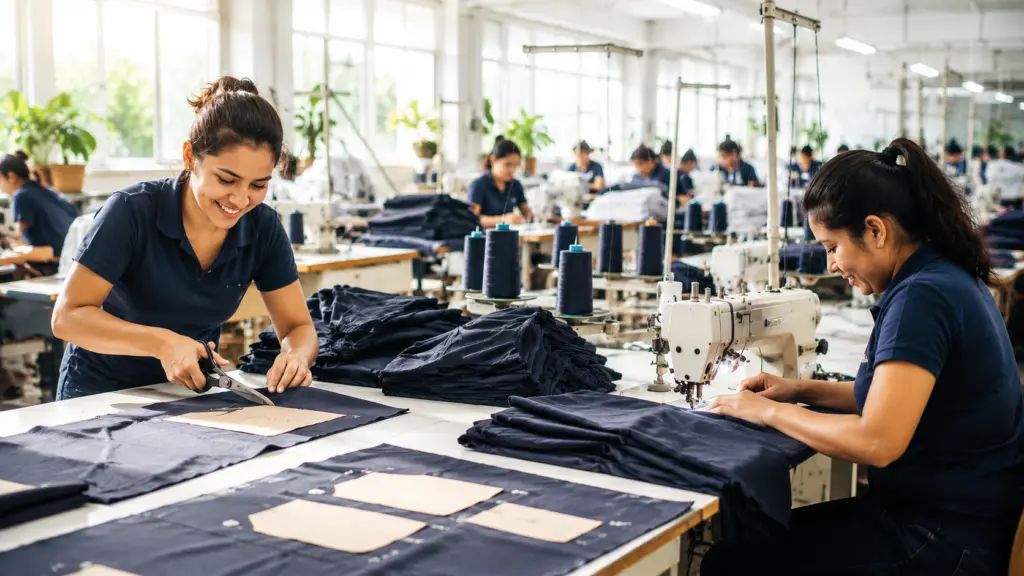
Approximately 80% of apparel brands globally work with a cut and sew manufacturer (Cosmo Sourcing, 2025). However, most founders enter their first factory relationship without a clear picture of how the model works. The result is missed deadlines, unexpected costs, and quality problems that upfront knowledge would have prevented.
Cut and sew gives your brand the greatest control over design and materials. That said, it also puts the most responsibility on your team. From tech packs to fabric sourcing to factory communication, you become the project manager throughout production.
Specifically, this guide covers how to find and work with a cut and sew manufacturer. It also compares the model to FOB and private label, outlines MOQs and lead times with real industry data, and explains how PLM software supports production management.
Key Takeaways
A cut and sew manufacturer builds garments from your fabric and specs — giving you full design control that FOB and private label can’t match.
Lead times run 16–24 weeks for new styles; established factory relationships compress this to 10–14 weeks (Arcus Apparel Group, 2025).
CMT saves 15–30% on material costs compared to FOB, because you source fabric directly from mills instead of paying a factory markup.
US-based manufacturers typically accept 25–150 units per style; overseas factories require 500–3,000 units.
What Is Cut and Sew Manufacturing?
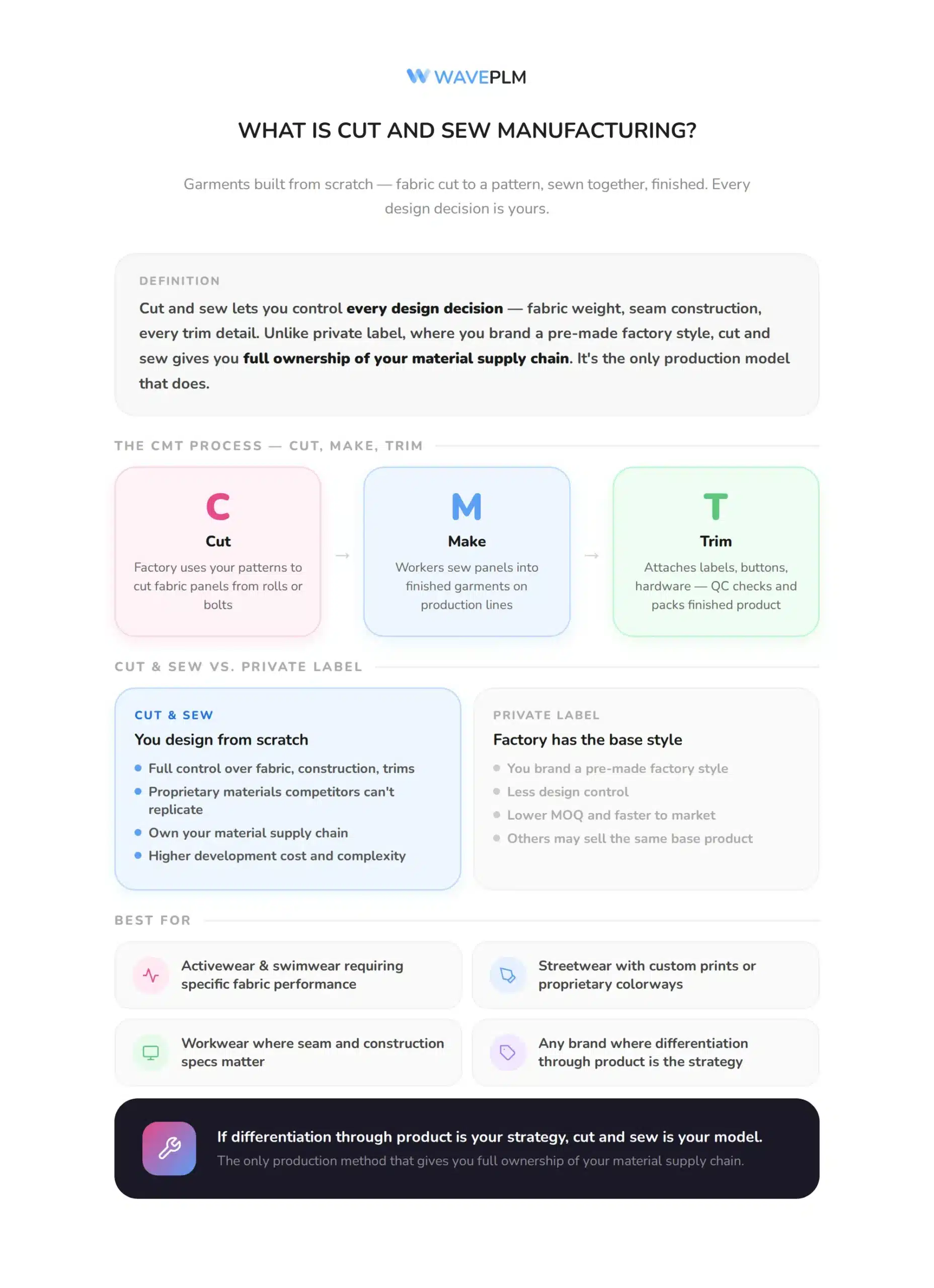
Cut and sew manufacturing is a production method where garments are built from scratch. Fabric is cut to a pattern, then sewn together to create finished pieces. Unlike private label, where you brand a pre-made factory style, a cut and sew manufacturer lets you control every design decision. That includes fabric weight, seam construction, and every trim detail.
The term is often used interchangeably with CMT, which stands for Cut, Make, and Trim. These three stages describe the production process precisely. First, in the cut stage, the factory uses your patterns to cut fabric panels from rolls or bolts. Next, in the make stage, workers sew those panels into finished garments on production lines. Finally, in the trim stage, the factory attaches labels, buttons, and hardware, performs quality checks, and packs the finished product.
Cut and sew is the method used by most fashion brands that want original product — not sourced styles. It’s particularly common in activewear, streetwear, swimwear, and workwear, where specific fabric performance or construction details matter. Additionally, it suits brands that need exact colorways, custom prints, or proprietary materials their competitors can’t easily replicate. In other words, if differentiation through product is your strategy, cut and sew is the right production model. Notably, it’s also the only model that gives you full ownership of your material supply chain.
Cut and Sew Manufacturing by the Numbers
The US cut and sew apparel manufacturing industry is valued at $5.3 billion in 2026, with approximately 1,200 businesses operating domestically (IBISWorld, 2026). Meanwhile, the global reshoring market for apparel has reached $4.8 billion. It’s growing at an 8% CAGR through 2034, as brands increasingly bring production closer to home (DataIntelo, 2025).
Our finding: Wave PLM customers working with cut and sew factories report that unclear or incomplete tech packs are the single most common cause of production delays. Brands that submit fully detailed specs — including construction notes, tolerances, and approved trim cards — consistently see fewer sample rounds and faster bulk approvals.
How Does Cut and Sew Compare to FOB, CMT, and Private Label?
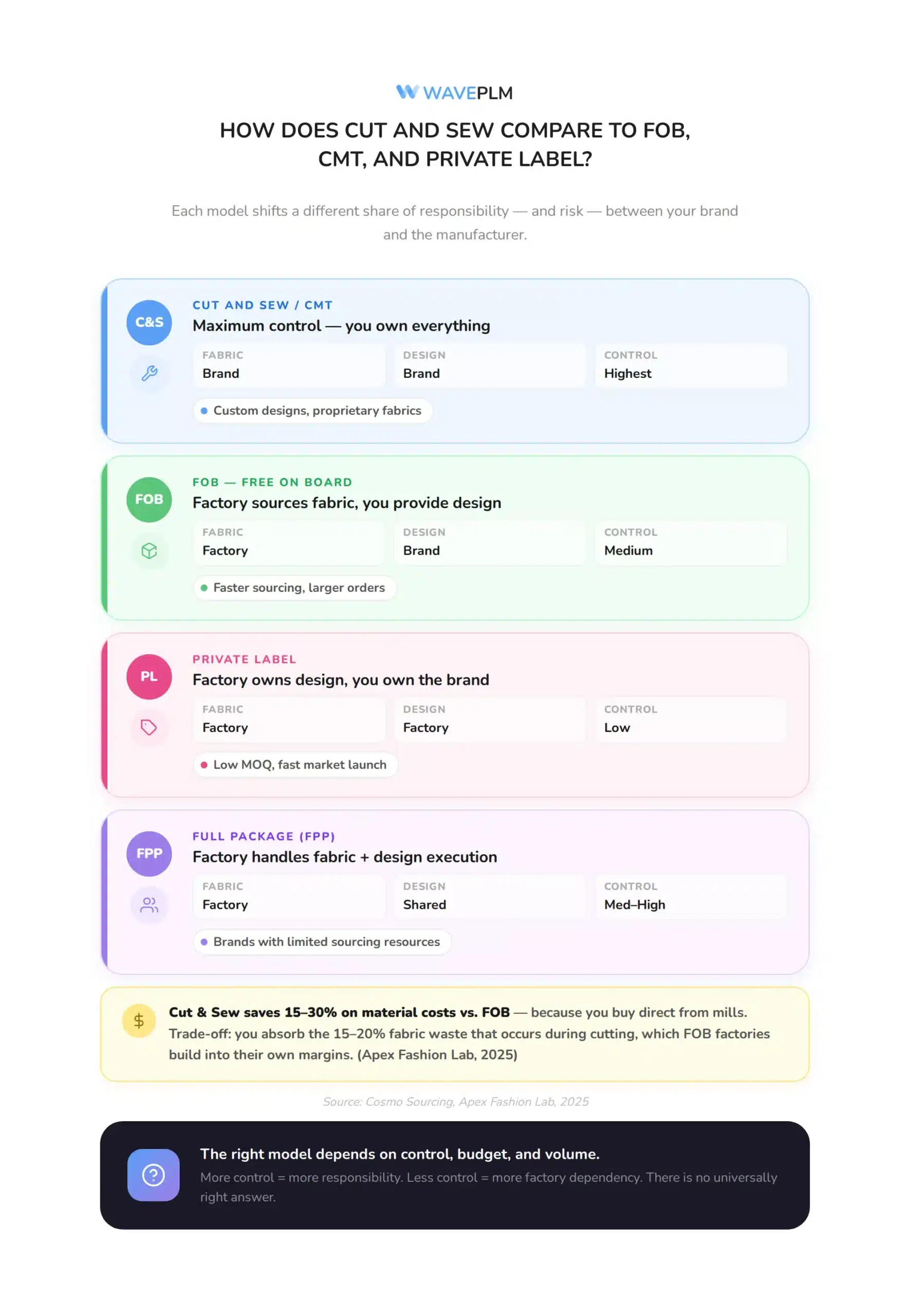
Understanding these four manufacturing models is essential before choosing a factory partner. Each shifts a different share of responsibility — and risk — between your brand and the manufacturer. The right choice depends on your order volume, budget, and how much design control you need.
| Model | Who Provides Fabric | Who Provides Design | Brand Control | Best For |
|---|---|---|---|---|
| Cut and Sew / CMT | Brand | Brand | Highest | Custom designs, proprietary fabrics |
| FOB | Factory | Brand | Medium | Faster sourcing, larger orders |
| Private Label | Factory | Factory | Low | Low MOQ, fast launch |
| Full Package (FPP) | Factory | Shared | Medium–High | Brands with limited sourcing resources |
In a FOB (Free on Board) arrangement, the factory sources fabric and trims, manufactures the garment, and hands it to the freight forwarder. You provide the design and approve samples — however, the factory manages all materials. FOB is simpler to run, though it typically costs more per unit because you pay a factory markup on materials.
By contrast, when you work with a cut and sew manufacturer, you buy fabric directly from mills. This approach saves 15–30% on material costs compared to FOB (Apex Fashion Lab, 2025). That said, you also absorb the 15–20% fabric waste that occurs during cutting — a cost that FOB factories build into their own margins.
For brands starting their first original product line, see our guide to how to find a clothing manufacturer and our walkthrough of the vendor onboarding process.
Industry data: According to Apex Fashion Lab (2025), approximately 80% of apparel brands globally use some form of CMT or cut and sew production, making it the dominant model in fashion manufacturing worldwide.
What MOQs and Lead Times Should You Expect?
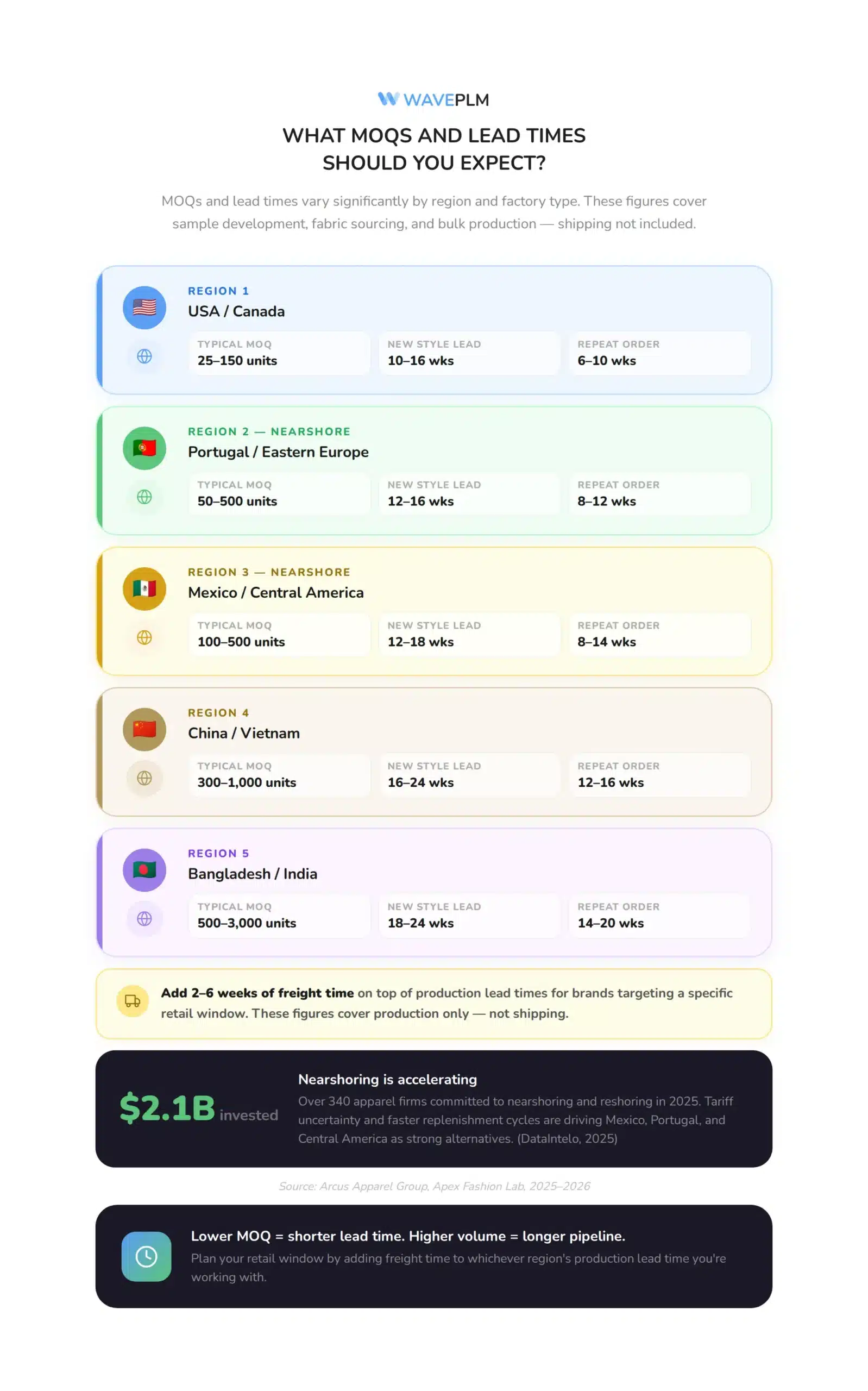
Minimum order quantities and lead times vary significantly by region and factory type. For US-based cut and sew manufacturers, MOQs typically run 25–150 units per style — accessible for small and emerging brands. Overseas factories, particularly in Bangladesh and Vietnam, generally require 500–3,000 units per style (Argus Apparel, 2026).
| Region | Typical MOQ | Lead Time (New Style) | Lead Time (Repeat Order) |
|---|---|---|---|
| USA / Canada | 25–150 units | 10–16 weeks | 6–10 weeks |
| Portugal / Eastern Europe | 50–500 units | 12–16 weeks | 8–12 weeks |
| Mexico / Central America | 100–500 units | 12–18 weeks | 8–14 weeks |
| China / Vietnam | 300–1,000 units | 16–24 weeks | 12–16 weeks |
| Bangladesh / India | 500–3,000 units | 18–24 weeks | 14–20 weeks |
Nearshoring as a Lead-Time Strategy
These timelines cover sample development, fabric sourcing, and bulk production — but they don’t include shipping. Consequently, brands targeting a specific retail window should add 2–6 weeks of freight time on top of production lead times.
In 2025, over 340 apparel firms committed more than $2.1 billion to nearshoring and reshoring investments (DataIntelo, 2025). Tariff uncertainty and the need for faster replenishment cycles drove these decisions. As a result, Mexico, Portugal, and Central America have emerged as strong alternatives for brands that want shorter lead times without full domestic production costs.
For more on how fabric sourcing timelines affect your overall schedule, see our guide to fabric sourcing for apparel brands.
How Do You Choose the Right Cut and Sew Manufacturer?
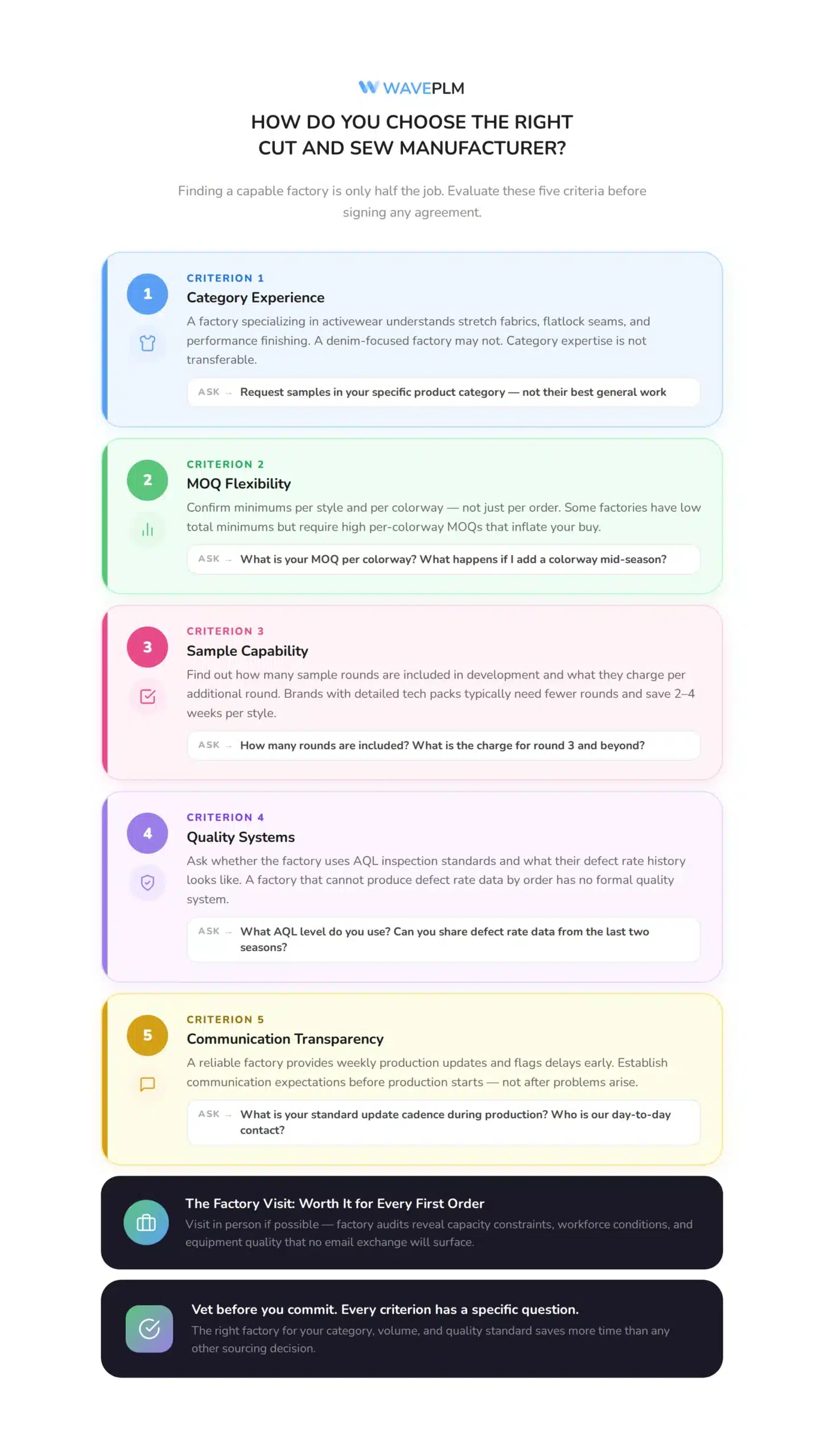
Finding a capable factory is only half the job — vetting them properly before committing to a production order saves significant time and money down the line. Specifically, the right cut and sew manufacturer for your brand depends on your product category, order volume, and quality standards.
For that reason, evaluate these five criteria before signing any agreement:
- Category experience: A factory that specializes in activewear understands stretch fabrics, flatlock seams, and performance finishing. A factory focused on denim or wovens may not. Therefore, always ask for samples in your specific product category.
- MOQ flexibility: Confirm minimum order quantities per style and per colorway — not just per order. Some factories have low total minimums but require high per-colorway MOQs that inflate your buy.
- Sample capability: Find out how many sample rounds are included in development and what they charge per additional round. Brands that submit detailed tech packs typically need fewer rounds and save 2–4 weeks per style.
- Quality systems: Ask whether the factory uses AQL inspection standards and what their defect rate history looks like. For more on inspection standards, see our complete guide to AQL inspection in apparel.
- Communication transparency: A reliable cut and sew manufacturer provides weekly production updates and flags delays early. Establish communication expectations before production starts — not after problems arise.
The Factory Visit: Worth It for Every First Order
In addition, visit the factory in person if possible — especially for your first order. Specifically, factory audits reveal capacity constraints, workforce conditions, and equipment quality that no email exchange will surface.
How Does PLM Help Brands Manage Cut and Sew Production?
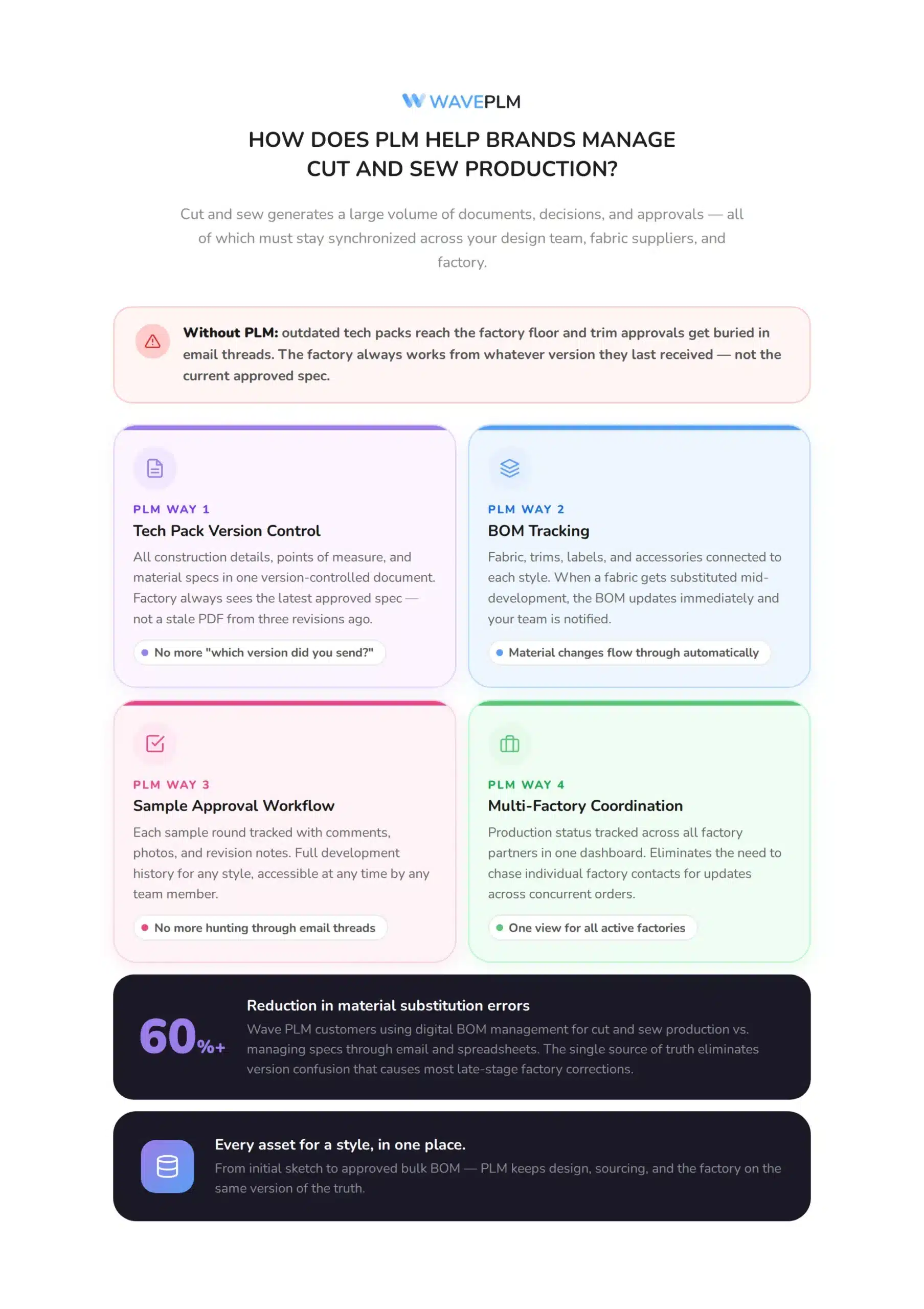
Cut and sew production generates a large volume of documents, decisions, and approvals. All of these must stay synchronized across your design team, fabric suppliers, and factory. Without a centralized system, outdated tech packs reach the factory floor and trim approvals get buried in email threads. This is precisely where product lifecycle management software makes the biggest difference.
A fashion PLM system like Wave PLM centralizes every asset for a style in one place — from initial sketch to approved bulk BOM. Furthermore, PLM supports cut and sew production in four concrete ways:
Four Ways PLM Supports Cut and Sew Production
- Tech pack management: All construction details, points of measure, and material specifications live in a single version-controlled document. As a result, the factory always sees the latest approved spec — not a stale PDF from three revisions ago.
- BOM tracking: Your bill of materials connects fabric, trims, labels, and accessories to each style. When materials change — for example, when a fabric gets substituted — the BOM updates immediately and your team is notified.
- Sample approval workflow: PLM tracks each sample round with comments, photos, and revision notes. Consequently, your team can reference the full development history for any style at any time.
- Multi-factory coordination: Brands working with several cut and sew factories simultaneously track production status across all partners in one dashboard. This approach eliminates the need to chase individual factory contacts. See our guide to multi-factory production coordination for more.
Our finding: Wave PLM customers who use digital BOM management for cut and sew production report a reduction in material substitution errors of over 60%, compared to managing specs through email and spreadsheets. The single source of truth eliminates the version confusion that causes most late-stage factory corrections.
Want to see how Wave PLM handles specs, BOMs, and factory communication for cut and sew brands? Book a free demo at waveplm.com and we’ll walk you through the workflow.
What Are the Most Common Mistakes Brands Make with Cut and Sew?
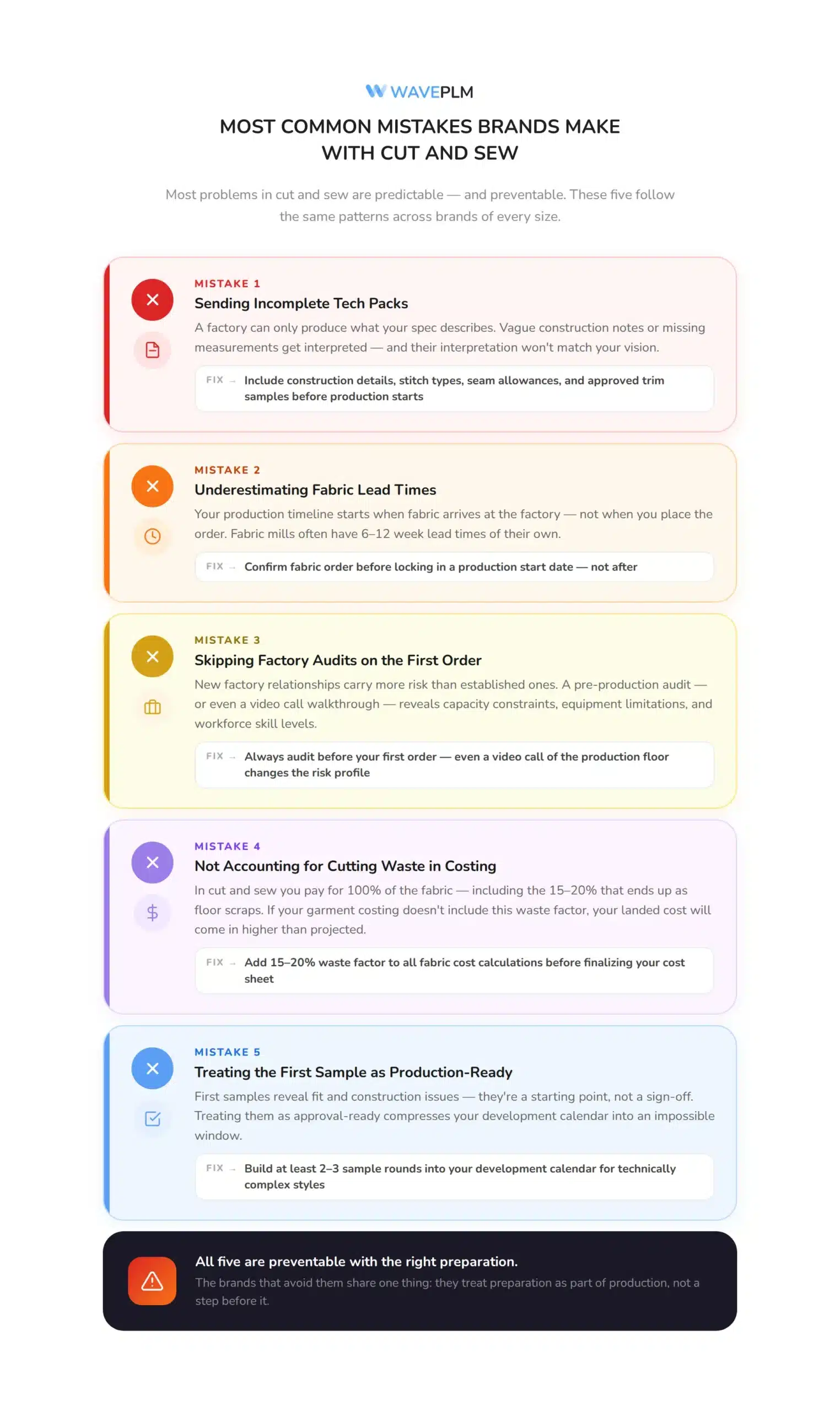
Most problems in cut and sew production are predictable — and preventable. Furthermore, the brands that run into trouble typically share a few common patterns that are straightforward to avoid with the right preparation.
Five Mistakes That Derail Cut and Sew Production
Sending incomplete tech packs. A factory can only produce what your spec describes. If construction notes are vague or measurements are missing, the factory will interpret the gaps. In most cases, their interpretation won’t match your vision. For this reason, always include construction details, stitch types, seam allowances, and approved trim samples before production starts.
Underestimating fabric lead times. Your production timeline starts when the fabric arrives at the factory — not when you place the order. Fabric mills often have their own 6–12 week lead times. Consequently, your fabric order must be confirmed before you lock in a production start date. See our fabric sourcing guide for a full timeline breakdown.
Skipping factory audits on the first order. New factory relationships carry more risk than established ones. A pre-production audit — or even a video call walkthrough — reveals capacity constraints, equipment limitations, and workforce skill levels that affect your product quality.
Not accounting for cutting waste in costing. In cut and sew, you pay for 100% of the fabric, including the 15–20% that ends up as floor scraps. If your garment costing doesn’t include this waste factor, your landed cost will come in higher than projected.
Treating the first sample as production-ready. First samples reveal fit and construction issues — they’re a starting point, not a sign-off. Therefore, build at least two to three sample rounds into your development calendar, especially for technically complex styles.
Frequently Asked Questions
What is the difference between a cut and sew manufacturer and private label?
A cut and sew manufacturer builds garments from scratch using your designs and materials — giving you full control over every construction detail. Private label uses pre-made styles from the factory’s existing line, which you rebrand with your label. Cut and sew offers more design freedom; private label offers lower MOQs and faster turnaround for brands that don’t need custom designs.
How much does cut and sew manufacturing cost per unit?
Cut and sew unit costs vary widely by product type, factory location, and order volume. US-based factories typically charge $15–$60 per unit in labor and overhead, plus your fabric and trim costs. Overseas factories run $4–$20 per unit in CMT fees. Always calculate total landed cost — including fabric, cutting waste, freight, and duties — not just the factory CMT quote.
What documents do I need before working with a cut and sew manufacturer?
At minimum, you need a complete tech pack with construction details and a graded spec sheet with points of measure. You also need a bill of materials listing every fabric and trim with approved suppliers. Additionally, providing physical trim samples — fabric swatches, label examples, hardware — reduces sample round errors significantly. In short, more detail in your specs means fewer costly revision cycles.
How long does cut and sew manufacturing take from start to finish?
For a new style at a new factory, total production typically runs 16–24 weeks from tech pack submission to shipped bulk order. This includes 4–6 weeks for sample development, 6–12 weeks for fabric sourcing, and 4–8 weeks for bulk production. Established brand-factory relationships with pre-approved fabrics compress timelines to 10–14 weeks (Arcus Apparel Group, 2025).
Can small brands use a cut and sew manufacturer with low order quantities?
Yes — US-based cut and sew manufacturers commonly accept 25–150 units per style, making them accessible for emerging brands. Some specialty factories accept even lower minimums at premium pricing. Overseas factories generally require higher MOQs (300–3,000 units), but nearshore options in Mexico and Portugal often offer mid-range minimums of 50–500 units per style at competitive cost.
Running a Tighter Cut and Sew Operation
Working with a cut and sew manufacturer gives apparel brands the design freedom and material control that private label and FOB can’t match. In exchange, however, it demands more from your team — better documentation, more proactive supplier management, and tighter production tracking across every style.
In practice, the brands that scale cut and sew successfully treat the factory as a production partner rather than just a vendor. They invest in solid tech packs and confirm fabric timelines before production starts. Furthermore, they use PLM tools to keep every spec, BOM, and approval in sync across their team and factory.
If you’re building out your cut and sew workflow, see how Wave PLM manages specs, BOMs, and factory communication in one place. Book a free demo at waveplm.com.







Leave a Reply