

Adding a new factory to your supply chain feels straightforward until it isn’t. A supplier who looked solid on paper ships a first order with the wrong label placements, incorrect measurements on 30% of units, and payment terms that contradict what was agreed over email. None of that is unusual — it’s exactly what happens when the vendor onboarding process is treated as a formality rather than a structured workflow.
A proper vendor onboarding process transforms a promising factory contact into a reliable, active supplier. Specifically, it covers document collection, compliance review, capability assessment, sample approval, system setup, and first-order execution — in that order, before production begins. This guide walks through each stage with the documents and decisions that actually matter.
Key Takeaways
- McKinsey estimates supply chain disruptions lasting one month or more cost companies up to 45% of annual profit on average — and most disruptions originate with suppliers who weren’t properly vetted (McKinsey Global Institute, 2020).
- Effective vendor onboarding takes 4 to 12 weeks from first contact to approved first order, depending on product complexity and compliance requirements.
- No single supplier should represent more than 40% of your production volume — concentration risk is one of the most common and preventable causes of brand-level supply chain failures.
- Storing vendor data in a PLM system — rather than email threads and shared folders — reduces onboarding time on repeat orders and makes compliance gaps visible across your entire supplier base.
What Is the Vendor Onboarding Process and Why Does It Matter for Apparel Brands?

According to McKinsey Global Institute, supply chain disruptions lasting one month or more cost companies approximately 40–45% of one year’s earnings before interest and taxes, on average, across industries — and apparel brands are among the most exposed because of their heavy reliance on single-country, single-factory sourcing (McKinsey Global Institute, 2020). Furthermore, the majority of those disruptions trace back to supplier-level failures that better vetting would have flagged early.
The vendor onboarding process is not a compliance checkbox. Instead, it’s the operational mechanism that determines whether a new factory relationship starts on a foundation of clarity or assumption. In practice, brands that skip formal onboarding tend to discover problems at the worst possible moment: mid-production, when a container is already booked and the window for corrections has closed.
For apparel specifically, the stakes are higher than in many other industries. Consequently, you’re dealing with complex multi-component products — a single jacket can have 50+ components from multiple sub-suppliers — tight seasonal windows, and regulatory requirements that vary by destination market. As a result, a factory that can’t demonstrate basic documentation readiness before production starts is almost certainly going to create problems during it.
In addition, an effective vendor onboarding process benefits the supplier too. When expectations around quality standards, communication protocols, payment terms, and technical documentation are clear from day one, factories can plan better and deliver more consistently. In other words, the process protects both sides of the relationship — not just the brand.
What Documents Do You Need Before Working with a New Factory?
Document collection is the first concrete step in vendor onboarding, and it’s also where most sourcing teams take shortcuts they later regret. However, collecting the right documents upfront doesn’t just protect you legally — it also signals to the factory that you operate with professional standards, which tends to attract better performance. Specifically, here are the documents that matter:
| Document | Purpose | Priority |
|---|---|---|
| Business license / registration certificate | Confirms the factory is a legally registered entity; required for payment setup and contracts | Required |
| Factory audit certificate (BSCI, SMETA, SA8000, ISO 9001) | Verifies labor practices, management systems, and quality capability from an independent body | Required |
| Product liability insurance | Protects both parties if a defective product causes harm; most retail buyers require it | Required |
| Bank account details | Needed for payment setup; also helps verify the entity you’re paying matches the legal business | Required |
| NDA / confidentiality agreement | Protects your designs, tech packs, and client information shared during development | Required |
| Supplier questionnaire | Self-reported data on capacity (units/month), lead times, MOQ, key machinery, sub-contractor use | Required |
| Compliance test reports (REACH, Oeko-Tex, CPSC, EN 71) | Required for regulated product categories: children’s wear, PPE, EU/US market goods | Conditional |
| Sub-contractor disclosure | Lists any production steps outsourced to third-party facilities — critical for audit validity | Conditional |
Notably, the factory audit certificate is the document brands most frequently accept without scrutiny — and therefore the one most frequently gamed. As a result, it’s worth checking the audit date (valid for 12–24 months depending on standard), the auditing body’s accreditation, and whether the scope of the audit matches your product type. For example, a factory audited for basic garments may not be assessed for the machinery or protocols specific to technical outerwear.
Our finding: Brands using Wave PLM create a supplier profile at the start of onboarding and attach all documents directly to that profile. This means every team member — including those who joined after the supplier was set up — can see the current compliance status without hunting through email archives.
How Do You Assess a New Supplier’s Production Capabilities?
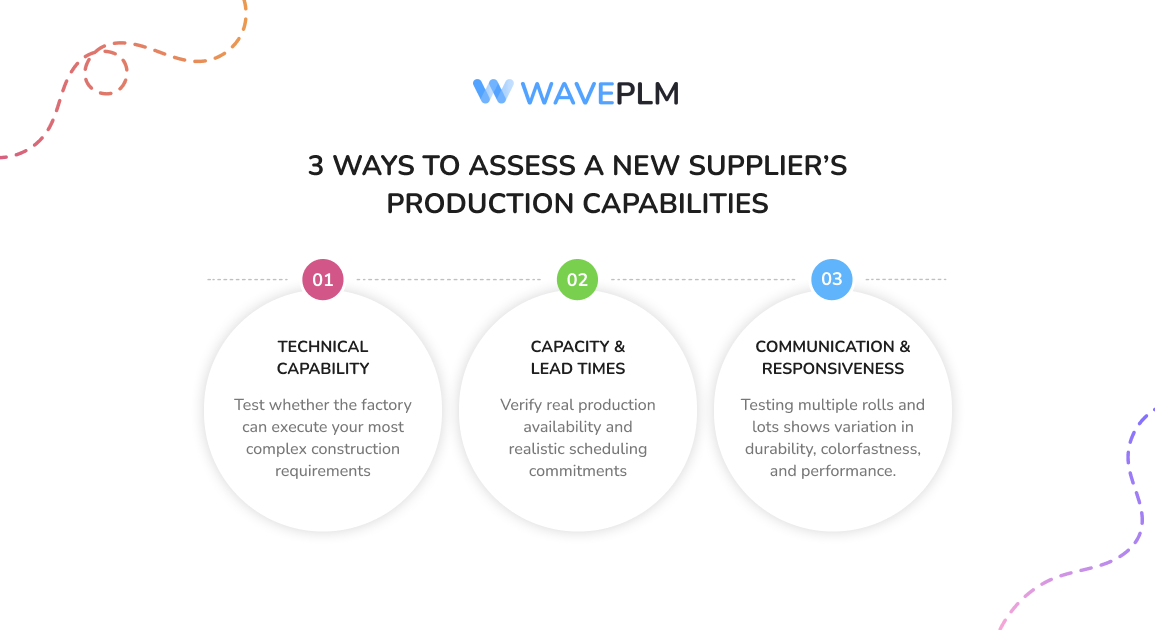
Documents tell you what a factory claims. Capability assessment tells you what they can actually do. Consequently, before placing a first production order, it’s worth testing three things directly: whether they can execute your specific construction requirements, whether their capacity is real, and whether their communication will be workable at scale.
Technical Capability
Send the factory your most complex style — not your simplest. Specifically, ask them to produce a pre-production sample (PPS) or a development sample from your tech pack without hand-holding. Furthermore, note whether their questions are technical and specific (“What’s the tolerance on the side seam?”) or vague (“Can you send more details?”). In practice, how a factory communicates during sampling predicts how they’ll communicate during production.
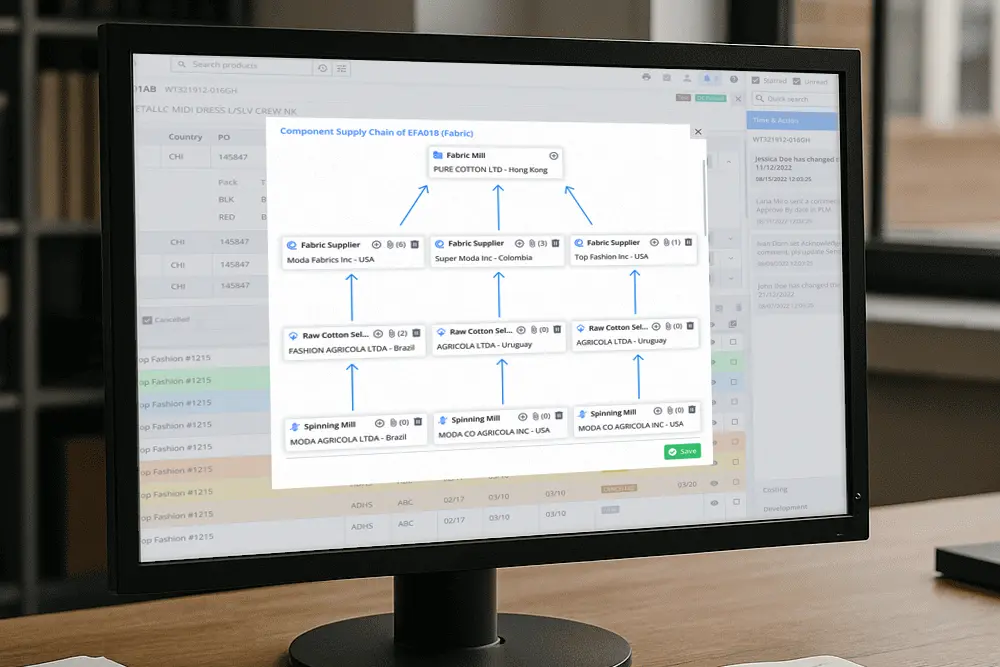
Additionally, ask directly about sub-contractors. Many factories outsource specific operations — embroidery, printing, specialized stitching — to third parties, and those sub-facilities may not be covered by the factory’s audit. As a result, understanding the full production path for your style matters both for quality and compliance. For a deeper look at how to structure sample development, see our guide on reducing sample rounds in apparel development.
Capacity and Lead Time
Ask the factory for their current order book occupancy — ideally as a percentage of monthly capacity — and their standard lead time for your product type. However, be skeptical of round numbers: a factory that says “we can do anything in 45 days” without checking their schedule is either overselling or doesn’t have a real planning system. In contrast, a factory that says “we’re at 70% capacity through August, so your earliest start would be September” is giving you a signal that they actually manage their floor.
Communication and Responsiveness
Response time during pre-production is a reliable indicator of behavior during production. Specifically, track how quickly they reply to your initial inquiry, whether they respond to your tech pack questions with specifics, and whether they flag potential issues proactively. Similarly, a factory that takes three days to answer a basic question during development will take three days to flag a quality issue mid-production — when three days can mean a missed ship date.
What Compliance and Ethical Standards Should You Check?
Compliance requirements for apparel vary significantly by destination market and product category. Nevertheless, certain baseline standards apply regardless of where you’re selling — and failing to verify them before production means you’re accepting liability you may not even know about.
| Standard / Regulation | Applies To | Key Requirement |
|---|---|---|
| BSCI / SMETA | All categories; required by most European retailers | Social audit verifying labor conditions, working hours, wages, safety |
| SA8000 | All categories; premium standard for ethical sourcing | Certified management system for labor rights and social responsibility |
| REACH / Oeko-Tex Standard 100 | All textiles sold in EU; children’s wear globally | Restricts hazardous chemical substances in fabrics and dyes |
| CPSC regulations (US) | Children’s apparel (ages 0–12) sold in US | Flammability, drawstring safety, lead content, small-parts testing |
| UFLPA | All goods imported to US with any Xinjiang supply chain link | Rebuttable presumption of forced labor; requires full supply chain traceability |
| ISO 9001 | Optional but valuable for quality systems | Quality management system certification demonstrating process consistency |
In addition to third-party certifications, it’s worth sending the factory your own Supplier Code of Conduct during onboarding — even if it largely mirrors an existing standard. Doing so creates a contractual basis for your compliance expectations and gives you grounds for remediation or termination if violations occur later. Specifically, brands sourcing from regions with elevated forced labor risk should also request a sub-tier supplier disclosure, particularly for raw materials. For further context on the regulatory landscape, see our guide on what UFLPA means for fashion brands.
How Do You Structure the First Production Run with a New Vendor?
Even after thorough vetting, the first production order with a new factory deserves more oversight than a reorder with a trusted supplier. As a result, most experienced sourcing teams treat it as a paid trial: real volume, but with tighter checkpoints than normal.
First, agree on a During Production inspection at roughly 20–30% completion. This is when the factory’s default approach becomes visible — before it’s too late to correct. Similarly, the pre-production meeting (either in-person or via video) should confirm that the factory has reviewed your tech pack, understood your AQL thresholds, and can articulate the critical construction points for your style. For a detailed breakdown of AQL levels and sample sizes, see our AQL inspection guide for apparel brands.
Furthermore, document every agreement in writing before production starts — delivery date, AQL level, defect classification, payment terms, and what happens if the goods fail inspection. Specifically, verbal agreements during factory visits or video calls are the most common source of disputes, and they’re entirely avoidable. In addition, sending a formal purchase order that includes your quality requirements as an attachment (rather than a separate email) ensures the factory can’t claim they didn’t receive them.
For brands managing multiple new factories simultaneously, the coordination challenge grows quickly. In practice, having a shared system where all production milestones and inspection appointments are visible across the team is the difference between staying on top of issues and discovering them at the final inspection stage. Our guide on multi-factory production coordination covers this in more detail.
How Does PLM Software Streamline the Vendor Onboarding Process?
A manual vendor onboarding process — documents in email, compliance data in spreadsheets, supplier contacts in someone’s phone — creates a fragile system where critical information lives in individual inboxes rather than a shared record. Consequently, when a team member leaves or a supplier is reactivated after a year’s gap, the entire vendor onboarding process has to start from scratch.
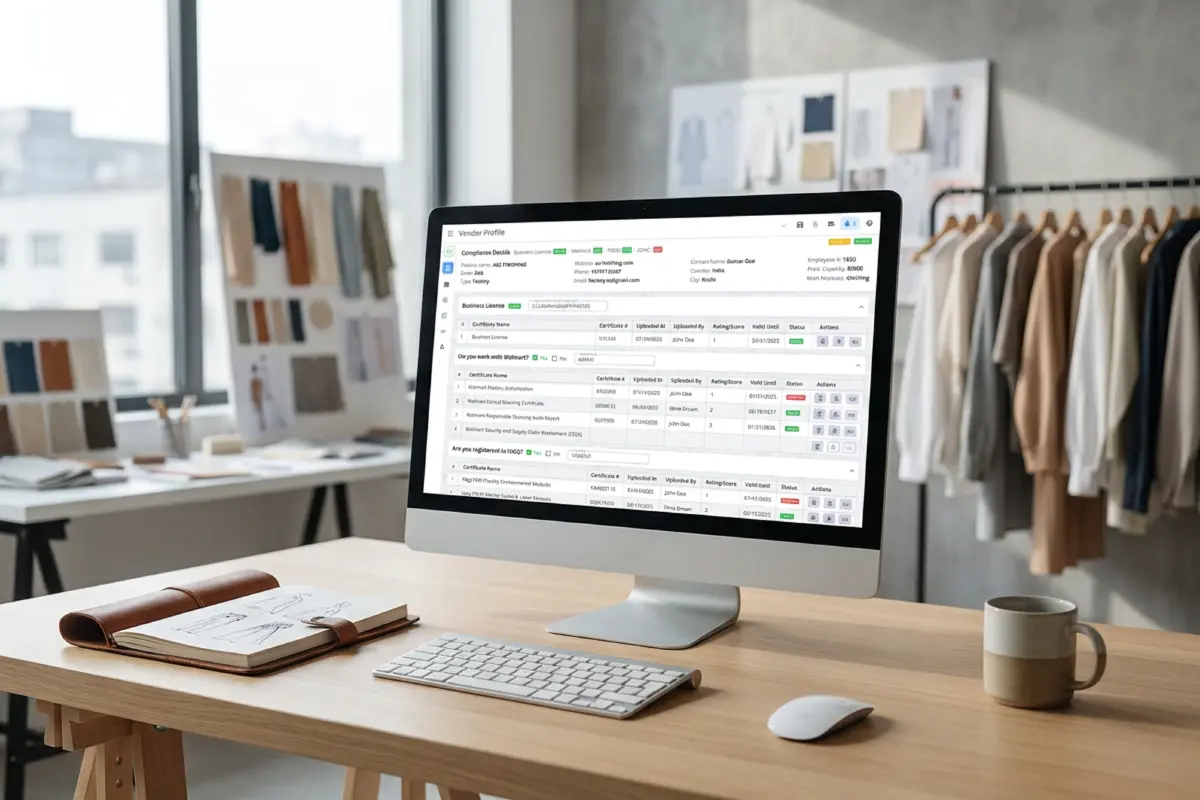
In Wave PLM, every supplier has a structured vendor profile that stores documents, audit status, compliance certifications, contact details, and production history in one place. Specifically, when a certificate expires or a new audit is required, the system flags it — rather than relying on someone to remember to check. Furthermore, that profile connects directly to the styles and purchase orders associated with the supplier, so the sourcing team can see the full relationship at a glance: which styles this factory has produced, how they performed on AQL inspections, and what their lead times have historically been.
Additionally, the vendor onboarding process itself can be templated: a standard checklist of required documents, a compliance questionnaire sent automatically, and a status tracker that shows whether the supplier is in “document collection,” “audit review,” “sample approval,” or “active” status. As a result, new team members can pick up an in-progress onboarding without needing a handover briefing. This also connects naturally to the supplier portal, where vendors can upload their own documents and track the status of open requests — reducing the back-and-forth email volume that usually clogs the early stages of a new relationship.
If your team currently manages vendor onboarding in email and shared drives, see how Wave PLM structures the supplier relationship from first contact to active production.
Frequently Asked Questions
How long does vendor onboarding take for an apparel brand?
Vendor onboarding for apparel brands typically takes 4 to 12 weeks from first contact to an approved first production order. Document collection and factory audit review take 1–3 weeks. Sample development and approval add another 3–8 weeks. Compliance review, financial setup, and system entry run in parallel and usually complete within the same window, depending on responsiveness.
What documents should a new apparel supplier provide?
At minimum, a new apparel supplier should provide: business license, factory audit certificate (BSCI, SMETA, or equivalent), product liability insurance, bank details for payment setup, a signed NDA, and a completed supplier questionnaire covering capacity, lead times, and MOQ. Additionally, brands sourcing regulated products should request relevant compliance test reports — for example, REACH test results for EU-destined goods.
What is a factory audit and do you always need one?
A factory audit is a formal assessment of a supplier’s facilities, labor practices, management systems, and quality capability. Third-party audits — BSCI, SMETA, ISO 9001 — are the industry standard and are required by most major retailers. Specifically, for orders above $10,000, for children’s wear, or for any technically regulated product category, an audit is strongly recommended before placing the first order.
How many suppliers should a small apparel brand work with?
Most small apparel brands work with 5 to 20 active suppliers at any given time, based on typical sourcing team capacity. Concentrating too much volume in one factory creates dependency risk; spreading too thin makes quality management harder. In practice, no single supplier should represent more than 40% of your production volume — that threshold is a widely cited benchmark in apparel sourcing risk management.
What is the difference between vendor onboarding and a supplier audit?
A supplier audit is one step within vendor onboarding, not a synonym for it. Onboarding is the full process: document collection, compliance review, capability assessment, sample approval, system setup, and first-order execution. The audit — whether a self-assessment questionnaire or a third-party facility visit — specifically evaluates the factory’s operations, labor practices, and quality management systems during that broader process.
Building a Supplier Base You Can Actually Rely On
Vendor onboarding is, ultimately, how you decide who builds your products. Brands that treat it as a one-time document collection tend to end up with supplier bases full of capable factories they don’t fully understand — and the gaps in that understanding show up at the worst possible moments.
In contrast, brands that onboard with structure — defined document requirements, a real capability assessment, written agreements, and first-order checkpoints — spend less time managing crises and more time growing relationships with factories that perform consistently. Furthermore, that structure doesn’t require a large sourcing team. Specifically, it requires clear templates, a system that stores the data, and the discipline to run the same process every time, regardless of how promising a new supplier looks.
For the next step in building your supplier operations, see our guides on fabric sourcing workflows and building accurate garment cost sheets — two areas where a well-onboarded supplier makes a significant practical difference.





Leave a Reply