
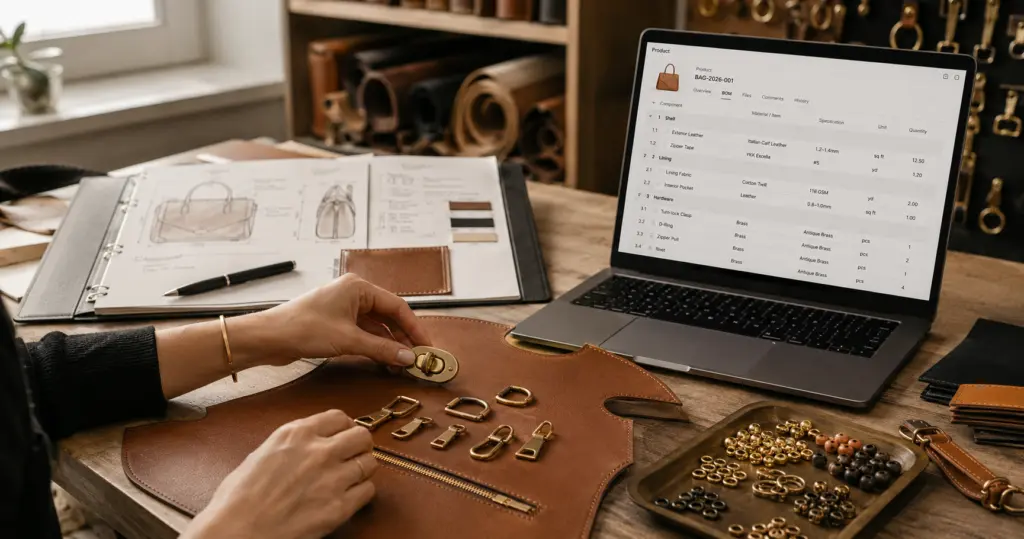
A multi-material BOM is a bill of materials that tracks several unrelated material categories in one style record, such as leather, metal hardware, lining fabric, and trims, each with its own supplier, spec, and cost. For example, handbags, jewelry, belts, and small leather goods almost always need this structure, because a single style can combine a leather shell, a fabric lining, cast-metal hardware, and a chain strap, sourced from four completely different types of factories. As a result, a BOM built around a single fabric type, the way most apparel BOMs are, simply does not hold that structure.
Specifically, this guide covers what makes an accessories BOM different from an apparel BOM, how to structure and cost it, and the compliance data that needs to travel with it. If you are further along and evaluating a platform for handbags, jewelry, or small leather goods specifically, Wave PLM’s accessories PLM software is built around this exact structure.
What Is a Multi-Material BOM for Accessories Brands?
This BOM structure organizes every component of an accessory style by material category rather than treating the whole product as one fabric type with trims attached. For a handbag, that typically means a leather or textile shell, a fabric or vinyl lining, metal hardware such as zippers, D-rings, and feet, and sometimes a separate strap component sourced from an entirely different supplier. Similarly, for jewelry, it means base metal, plating finish, stone or bead components, and findings such as clasps and jump rings, each tracked with its own material record.
This differs meaningfully from the BOM structure used for apparel. A garment BOM, even a complex one, is generally organized around fabric plus trims. Our guide to multi-level BOM in fashion covers that structure in detail. Accessories, however, routinely combine materials with entirely different units of measure, lead times, and supplier categories in a single style, which is exactly why a generic apparel BOM template tends to break down when applied to bags or jewelry.
Our finding: Accessories brands moving off spreadsheets most often cite hardware as the component that caused the most costing errors, not leather or fabric. A single zipper pull swap, from one finish to another, can shift unit cost more than a leather grade change, yet hardware is frequently tracked as an afterthought line item rather than its own structured component.
Why Do Handbags and Jewelry Need a Different BOM Structure Than Apparel?
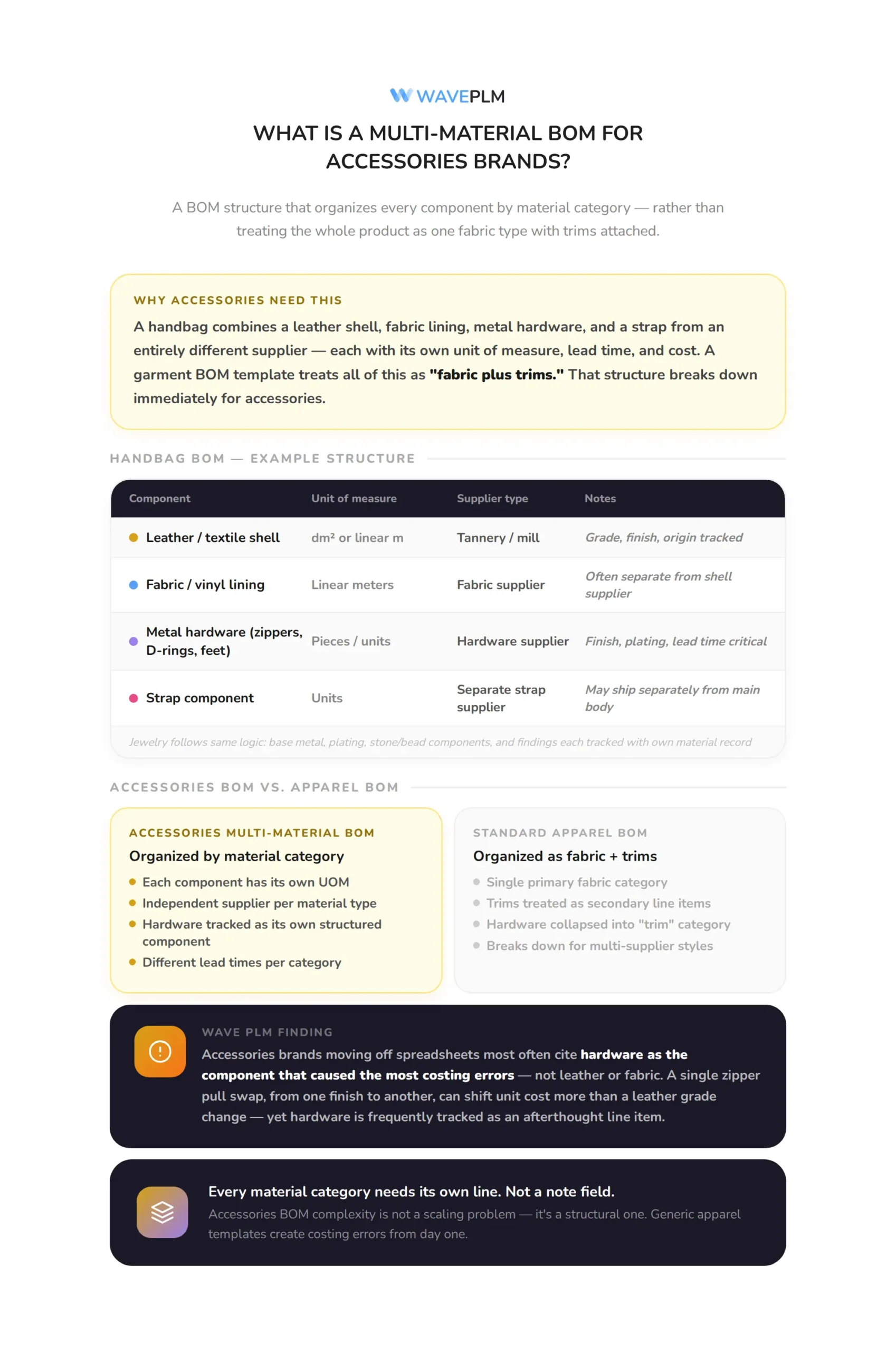
Consider a mid-size crossbody bag. The shell might be a vegetable-tanned leather sourced from a tannery, the lining a printed cotton twill from a textile mill, and the hardware, including a turn-lock clasp and D-rings, cast and plated by a completely separate hardware factory, often overseas even when the leather work is domestic. Each of those three suppliers works on a different lead time, minimum order quantity, and quality standard. Consequently, a BOM that lists them as generic “trim” line items, instead of structured components with their own supplier records, makes it difficult to catch a lead-time mismatch before it delays an entire style.
Jewelry follows a similar pattern. A necklace might combine a cast base-metal finding, a specific plating process, and set stones or beads from yet another supplier. Consequently, the true cost and lead time of that single SKU depends on coordinating three or four supply chains that rarely overlap, which is a structural difference from apparel, where most components at least share a textile-adjacent supply base.
What Components Belong in an Accessories Multi-Material BOM?
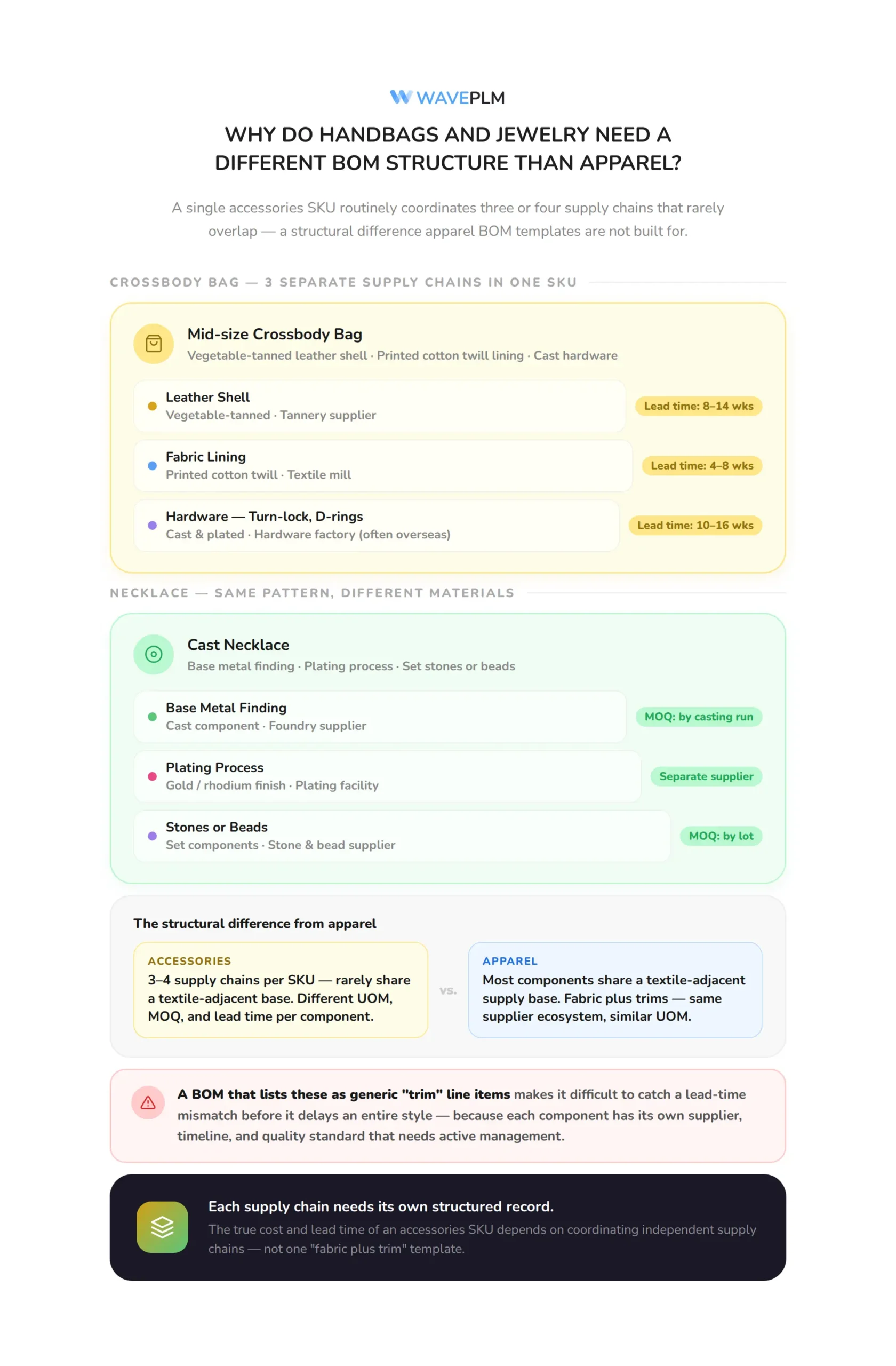
The table below maps the component categories most accessories brands need to track, and why each one needs its own structured record rather than a shared “trim” catch-all.
| Component category | Examples | Why it needs a separate record |
|---|---|---|
| Shell material | Leather, canvas, vegan leather, exotic skins | Grading, tanning process, and per-unit yield vary significantly by material type |
| Lining | Cotton twill, polyester lining, suede | Usually a different supplier than the shell, with its own MOQ and lead time |
| Metal hardware | Zippers, D-rings, feet, clasps, chains | Plating finish and base metal both affect cost, compliance, and appearance independently |
| Stones and findings | Set stones, beads, jump rings, ear wires | Sourced from specialized suppliers, often with per-piece rather than per-yard costing |
| Compliance test data | Nickel release results, lead content, CPSIA documentation | Tied to specific plating and metal components, not the finished style as a whole |
Notice that compliance test data belongs in this table alongside physical materials, not as a separate checklist. Specifically, a plating change on a single hardware component can require new nickel release testing, and if that requirement lives outside the BOM, it is easy to miss until a retail partner’s compliance team flags it.
How Do You Cost a Multi-Material Accessories BOM?
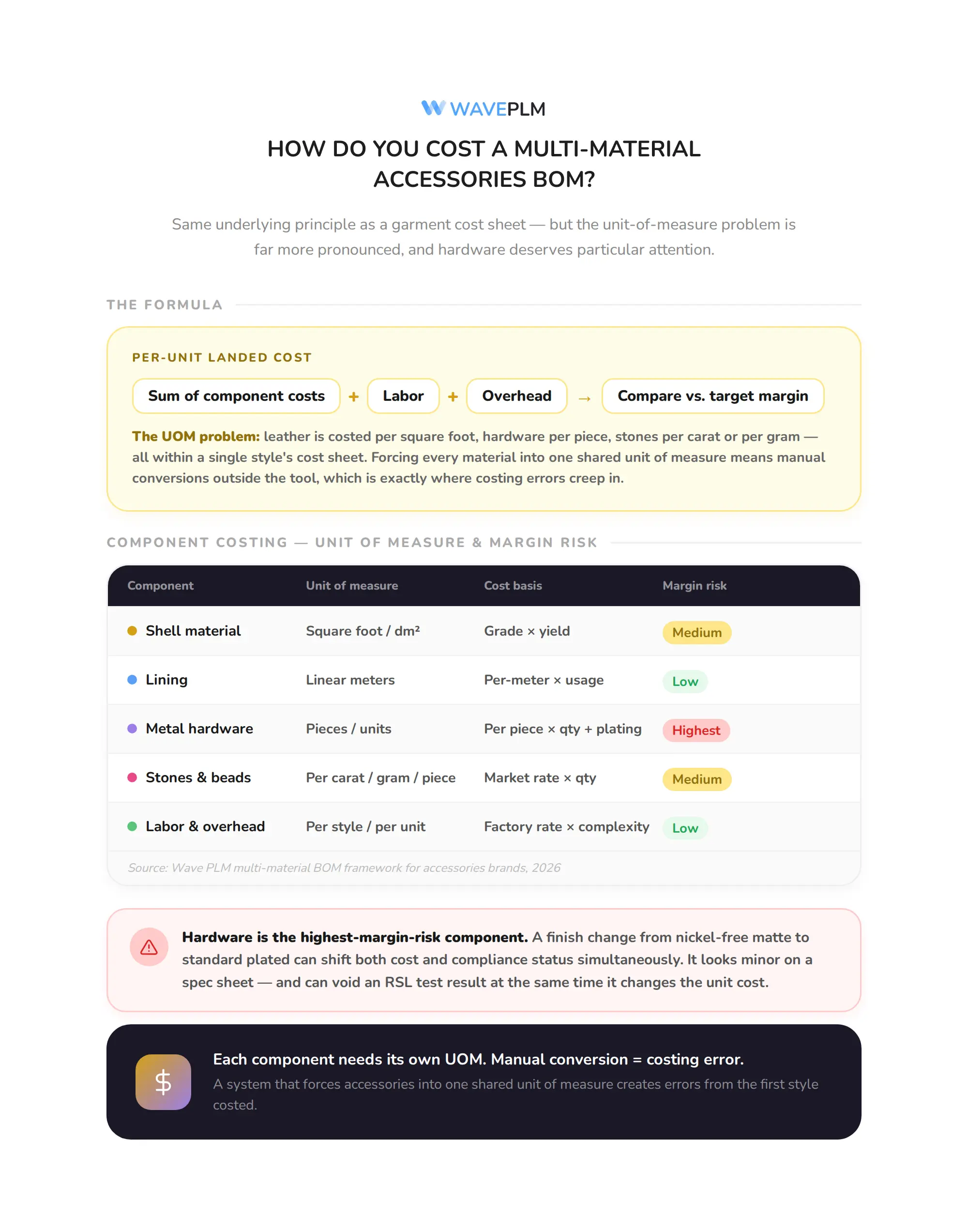
Costing a multi-material BOM works from the same underlying principle as a garment cost sheet, covered in our full garment costing guide: sum every component cost, add labor and overhead, then compare against target margin. However, the unit-of-measure problem is more pronounced in accessories. Leather is typically costed per square foot, hardware per piece, and stones sometimes per carat or per gram, all within a single style’s cost sheet. If a system forces every material into one shared unit of measure, someone ends up doing manual conversions outside the tool, which is where costing errors creep in.
In practice, a workable structure assigns each component its own unit of measure and cost basis, then rolls everything up to a single per-unit cost for the finished style. That said, hardware deserves particular attention here. Because hardware is frequently the highest-margin-risk component, a finish change that looks minor on a spec sheet, such as moving from a nickel-free matte finish to a standard plated finish, can shift both cost and compliance status at the same time.
What Compliance Data Should Accessories BOMs Track?
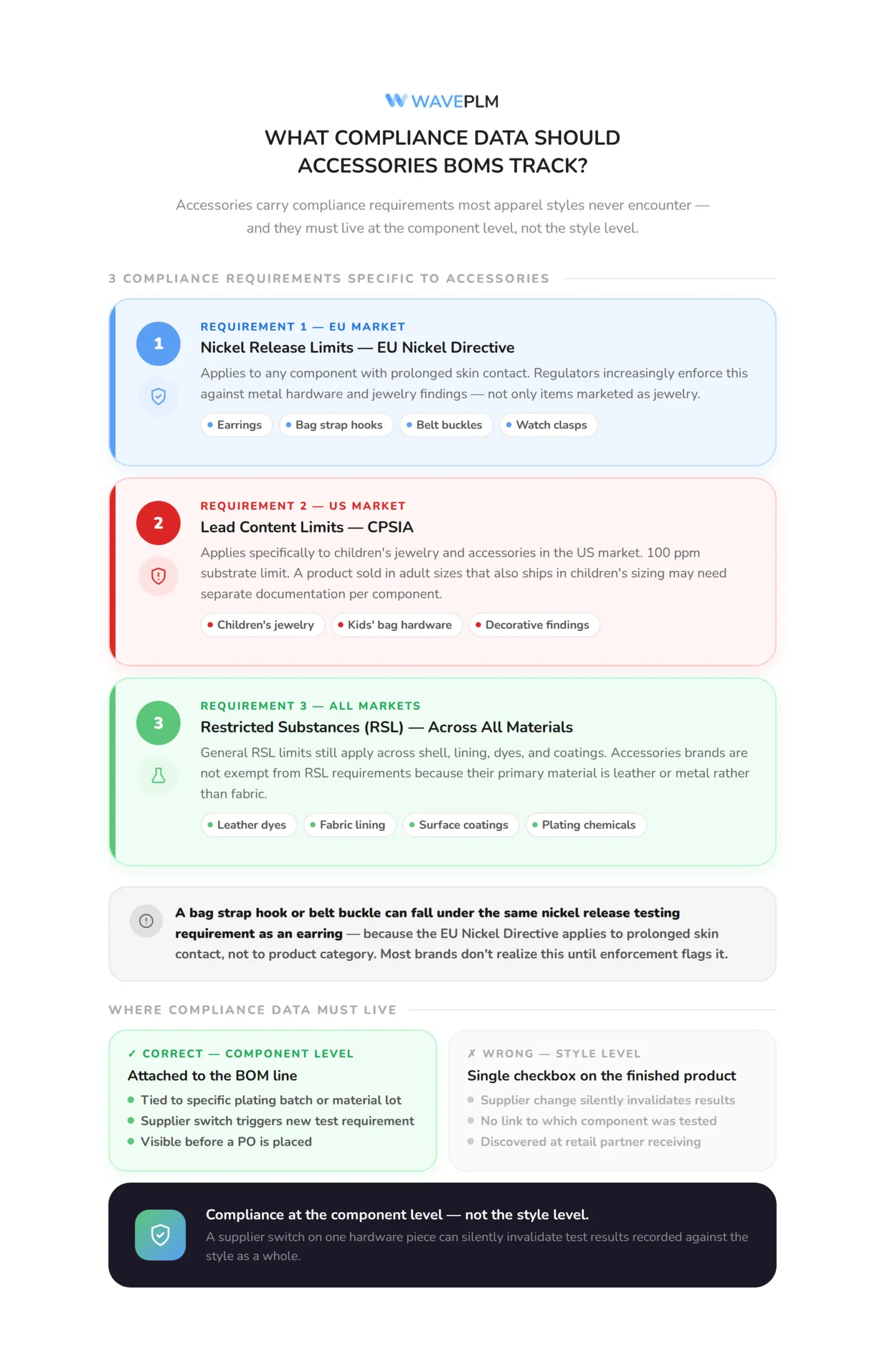
Accessories carry compliance requirements that most apparel styles never encounter. Specifically, nickel release limits apply to metal components with prolonged skin contact, particularly relevant for jewelry and some hardware-heavy bags sold into the EU. In addition, lead content limits under CPSIA apply specifically to children’s jewelry and accessories in the US market. Beyond these two, general restricted substance limits still apply across materials; see our Restricted Substances List guide for the broader compliance framework that also covers accessories materials.
Industry data: Nickel release requirements under the EU Nickel Directive apply to any component with prolonged skin contact, which regulators increasingly enforce against metal hardware and jewelry findings, not only items marketed explicitly as jewelry. In other words, a bag strap hook or a belt buckle can fall under the same testing requirement as an earring.
Since compliance data is tied to a specific plating batch or material lot rather than the style overall, it needs to live at the component level in the BOM, not as a single compliance checkbox on the finished product. Otherwise, a supplier switch on one hardware piece can silently invalidate test results that were only ever recorded against the style as a whole.
What Mistakes Do Accessories Brands Make Managing Multi-Material BOMs?
Treating Hardware as a Generic Trim Line Item
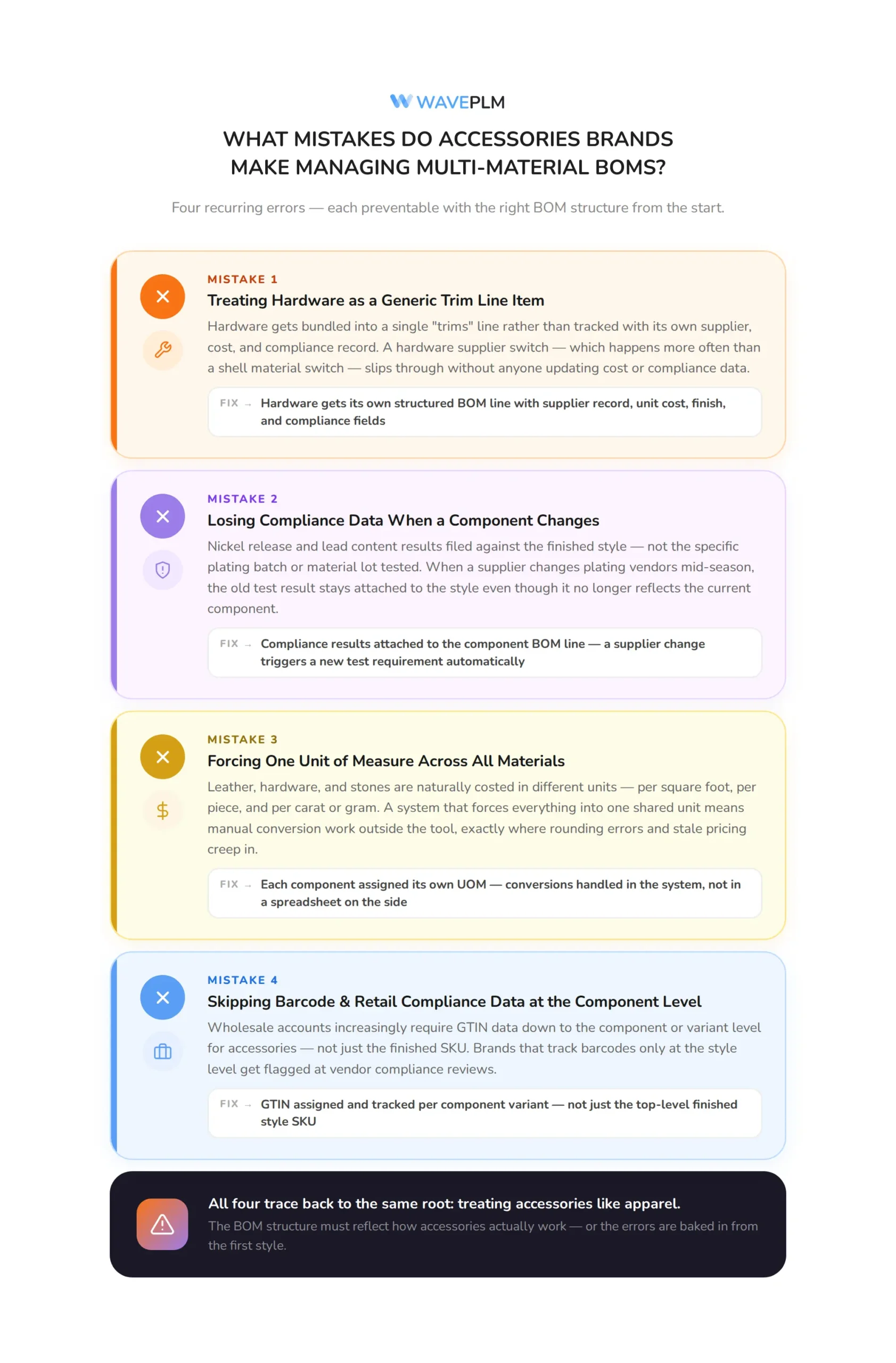
Hardware frequently gets bundled into a single “trims” line rather than tracked with its own supplier, cost, and compliance record. As a result, a hardware supplier switch, which happens more often than a shell material switch, can slip through without anyone updating cost or compliance data.
Losing Compliance Data When a Component Changes
Nickel release and lead content results are often filed against the finished style rather than the specific plating batch or material lot that was actually tested. Consequently, when a supplier changes plating vendors mid-season, the old test result stays attached to the style even though it no longer reflects the current component.
Forcing One Unit of Measure Across All Materials
Specifically, leather, hardware, and stones are naturally costed in different units: per square foot, per piece, and per carat or gram. As a result, a system or spreadsheet that forces everything into one shared unit leads to manual conversion work outside the tool, which is exactly where rounding errors and stale pricing creep in.
Skipping Barcode and Retail Compliance Data at the Component Level
Additionally, wholesale accounts increasingly require GTIN data down to the component or variant level for accessories, not just the finished SKU. Our GS1 and GTIN guide covers the retail-readiness side of this requirement in more depth.
How Does Wave PLM Support Multi-Material BOMs for Accessories Brands?
Specifically, Wave PLM structures each material category, shell, lining, hardware, and stones or findings, as its own component record within one style, with independent units of measure, suppliers, and cost basis. Compliance test data, including nickel release and lead content results, attaches directly to the specific component and lot it was tested against, rather than sitting separately from the BOM. Likewise, this same structure carries through to supplier and lead-time tracking and quality inspection data, similar in principle to how AQL inspection data connects to specific components rather than a finished style as a whole.
Frequently Asked Questions
What is a multi-material BOM?
A multi-material BOM is a bill of materials that tracks several distinct material categories in one style record, such as leather, metal hardware, lining fabric, and trims, each with its own supplier, unit of measure, and cost. It is the standard BOM structure needed for handbags, jewelry, belts, and small leather goods.
How is an accessories BOM different from an apparel BOM?
An apparel BOM is generally organized around one primary fabric plus trims. An accessories BOM instead combines materials with entirely different units of measure, lead times, and supplier categories, such as leather costed per square foot alongside hardware costed per piece, within a single style.
Why does hardware cause costing errors in accessories BOMs?
Hardware is frequently tracked as a generic trim line item instead of a structured component with its own supplier and cost record. A finish or plating change, which happens more often than a shell material change, can shift both cost and compliance status without being reflected in the cost sheet.
What compliance data should an accessories BOM track?
Nickel release results for metal components, lead content data required under CPSIA for children’s accessories, and general restricted substance test results should all be tracked at the component or material lot level, not as a single compliance checkbox on the finished style.
Can a generic apparel PLM handle a multi-material accessories BOM?
It can technically hold the data, but most apparel-focused PLM systems assume one primary fabric with trims attached. Without independent units of measure and supplier records per component, accessories brands typically end up managing hardware and stone components in a separate spreadsheet anyway.
A multi-material BOM is the structural difference between accessories PLM and a system built for garments first. Leather, hardware, and stones each carry their own supplier, unit of measure, and compliance requirements, and a BOM that forces all three into one generic trim line eventually pushes that complexity back into a spreadsheet.
If you manage handbags, jewelry, or small leather goods, see the accessories-specific PLM workflow built around this exact BOM structure →






Leave a Reply