
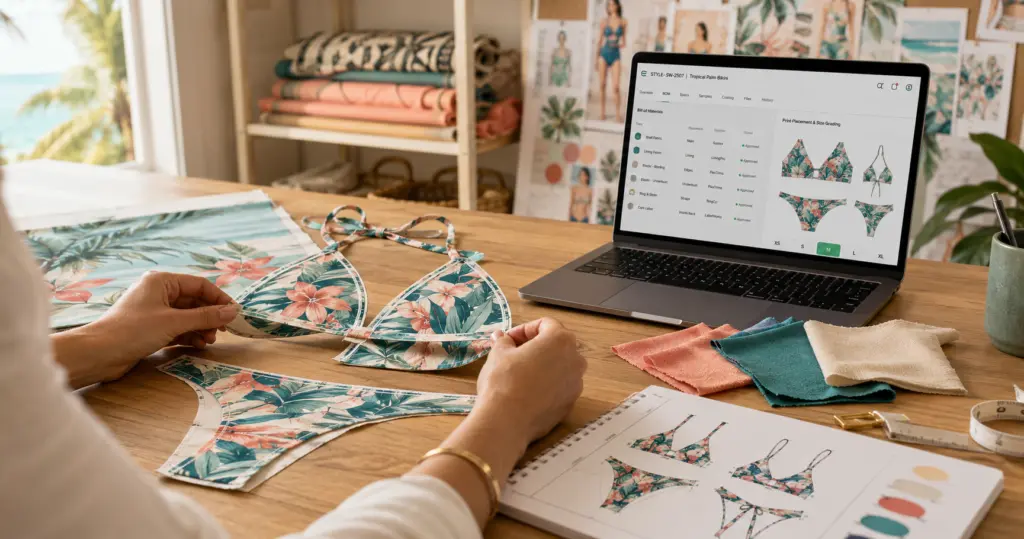
Swimwear PLM software is product lifecycle management software configured for the specific development needs of swim and resort wear: print placement across cut pieces, stretch fabric performance specs, and multi-layer construction like linings and shelf bras. Generic apparel PLM handles styles, BOMs, and approvals well enough. However, swimwear adds problems that a woven shirt or a pair of jeans never has to solve, and a system built around wovens tends to bolt these on as an afterthought rather than a core workflow. The importance of swimwear PLM software cannot be overstated in managing these complexities.
This guide covers what actually differs in swimwear product development, the features a swimwear-specific PLM needs, and where brands most often get stuck when they try to force-fit a generic system onto swim and resort collections.
Understanding swimwear PLM software is crucial for successful product development in this niche market. It provides tailored features that enhance efficiency and accuracy in the development process.
As trends evolve, swimwear PLM software will also adapt, ensuring brands can remain competitive and responsive to market demands. Implementing swimwear PLM software is essential for brands aiming to streamline their processes and enhance product quality. Brands that utilize swimwear PLM software can expect improved communication and collaboration across teams, leading to more efficient workflows.
What Makes Swimwear PLM Different From Generic Fashion PLM?
For swimwear brands, leveraging swimwear PLM software has become a vital part of achieving operational excellence.
Today’s competitive landscape mandates the use of swimwear PLM software to effectively manage product lifecycles. Utilizing swimwear PLM software can lead to significant improvements in how products are developed and launched. With swimwear PLM software, brands can enhance their development process and ensure they meet market demands swiftly.
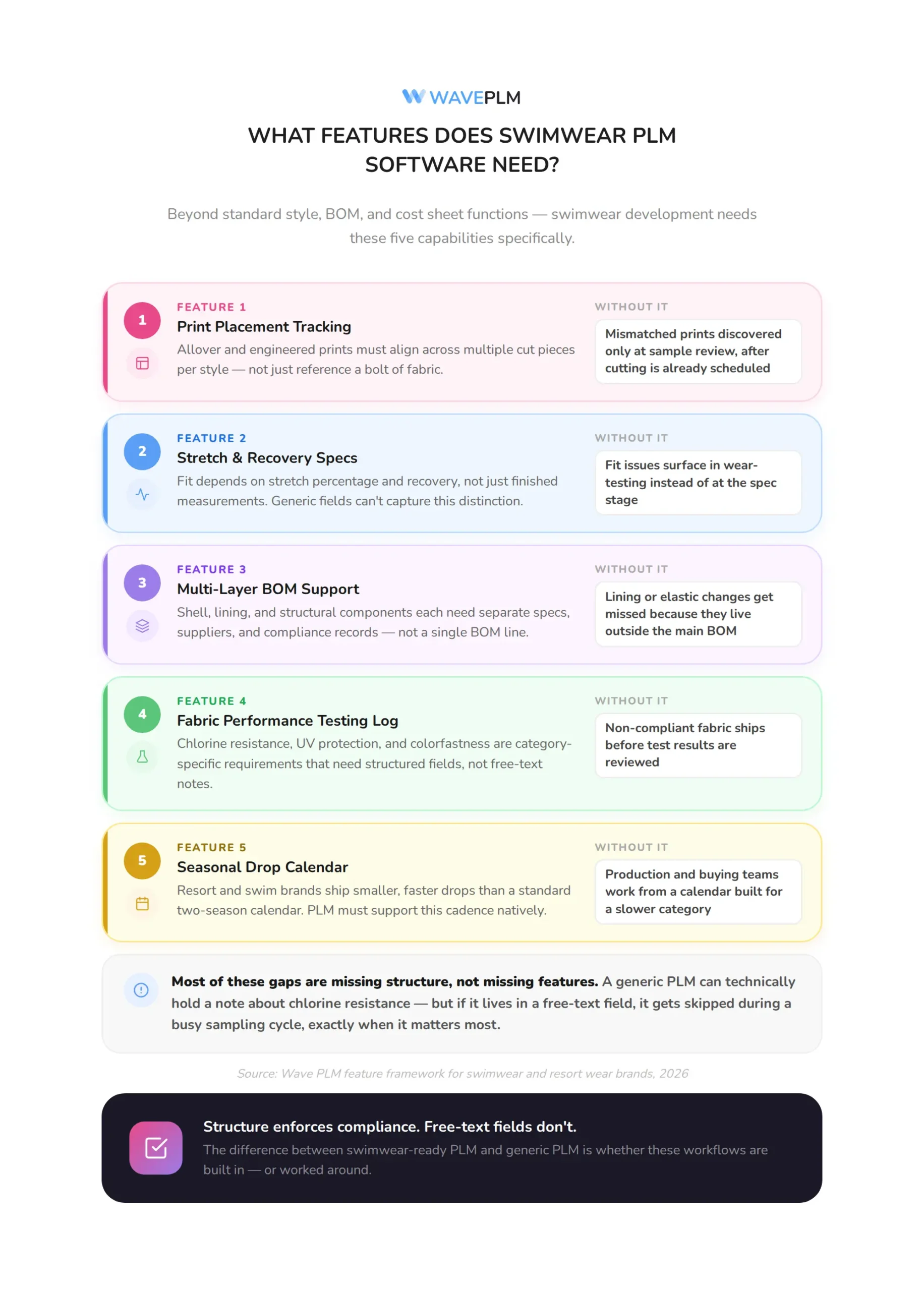
Three things separate swimwear development from wovens and even most knits: print placement, stretch performance data, and construction complexity. First, swimwear fabric is frequently printed as an allover or engineered print, which means the print has to be placed and matched across every cut piece, not just applied to a bolt of fabric. Second, stretch fabrics behave differently under tension than wovens do, so fit and grading data has to track recovery, stretch percentage, and chlorine or UV resistance alongside the usual measurements. Third, swimwear styles routinely stack multiple fabric layers, such as shell fabric, lining, and structural elements like underwires or shelf bras, each with its own spec and supplier.
Proper implementation of swimwear PLM software ensures that all aspects of product development are covered, from design to production.
Investing in swimwear PLM software can also drive innovations in fabric technology and design. As a vital tool, swimwear PLM software helps maintain the integrity of design and production processes. Switching to swimwear PLM software can result in more efficient workflows and better product quality overall. Many brands have found success using swimwear PLM software to enhance their development capabilities.
Industry-specific PLM vendors have built entire product pages around this gap. Centric Software and Onbrand PLM, for example, both publish swimwear and intimates-specific content describing fit tracking, custom size charts, and fabric notes as dedicated workflows rather than generic fields repurposed from wovens. That is a signal worth taking seriously: swimwear brands running a generic PLM, or a spreadsheet, are working around a real structural gap rather than an imagined one.
For those in the swimwear industry, adopting swimwear PLM software can streamline many aspects of product management. The right swimwear PLM software can make a significant difference in how brands manage their product lifecycle.
To stay competitive, swimwear brands are increasingly turning to swimwear PLM software for their operational needs. Ultimately, the benefits of swimwear PLM software will lead to better market positioning and consumer satisfaction. In conclusion, swimwear PLM software is an essential investment for brands looking to enhance their development processes.
Our finding: Swimwear and resort brands migrating to Wave PLM most often point to print placement as the workflow that pushed them off spreadsheets first, not fit or costing. Matching a print repeat across a bikini top, bottom, and cover-up, then tracking approval on each cut piece separately, is difficult to manage reliably outside a connected system.
What Features Does Swimwear PLM Software Need?
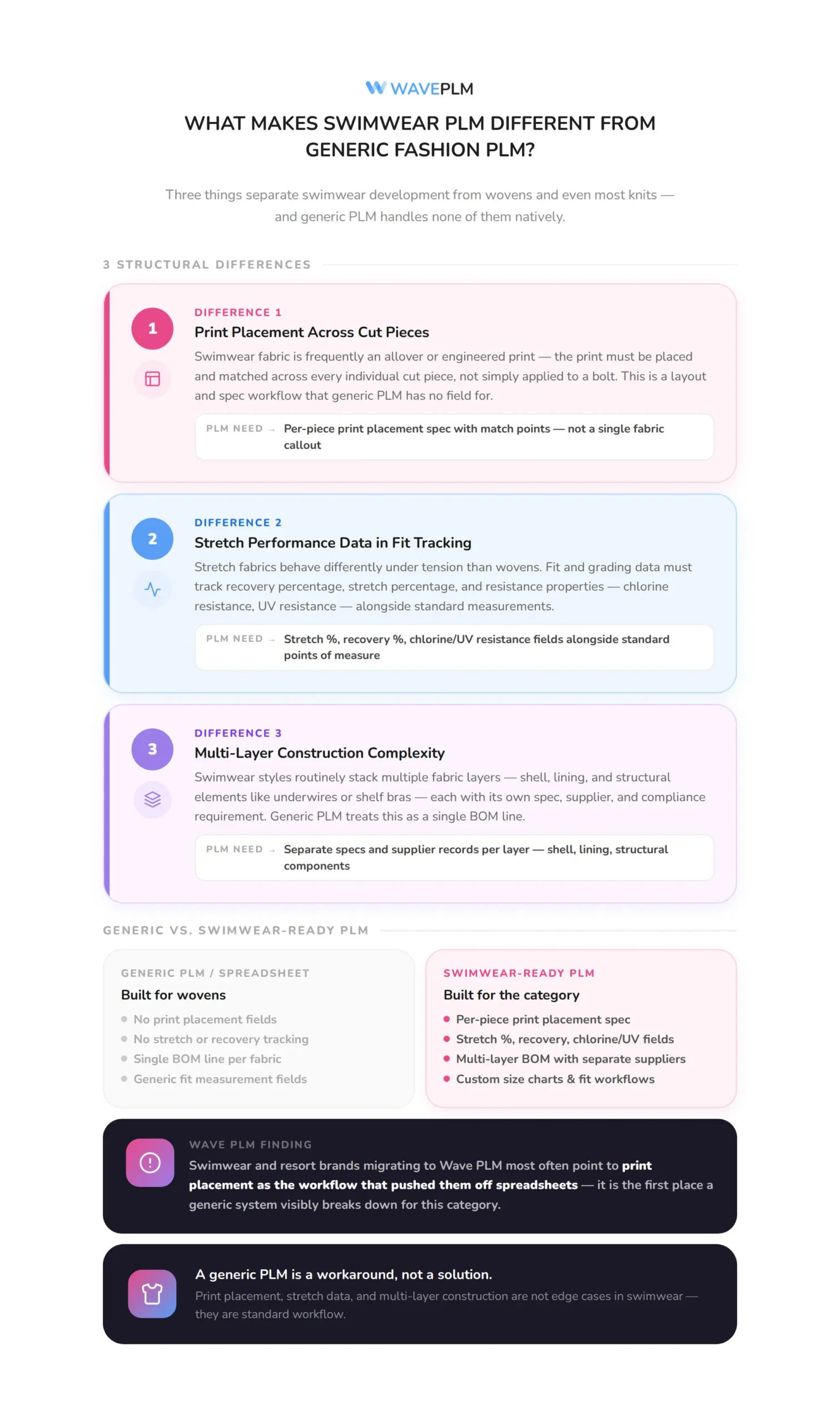
Beyond the standard style, BOM, and cost sheet functions common to any apparel PLM, swimwear development specifically needs the capabilities below.
| Feature | Why swimwear needs it specifically | What breaks without it |
|---|---|---|
| Print placement tracking | Allover and engineered prints must align across multiple cut pieces per style | Mismatched prints discovered only at sample review, after cutting is already scheduled |
| Stretch and recovery specs | Fit depends on stretch percentage and recovery, not just finished measurements | Fit issues surface in wear-testing instead of at the spec stage |
| Multi-layer BOM support | Shell, lining, and structural components each need separate specs and suppliers | Lining or elastic changes get missed because they live outside the main BOM |
| Fabric performance testing log | Chlorine resistance, UV protection, and colorfastness are category-specific requirements | Non-compliant fabric ships before test results are reviewed |
| Seasonal drop calendar | Resort and swim brands often ship smaller, faster drops than a standard two-season calendar | Production and buying teams work from a calendar built for a slower category |
Notice that most of these gaps are not missing features so much as missing structure. A generic PLM can technically hold a note about chlorine resistance somewhere. In practice, though, if that data lives in a free-text field instead of a structured spec, it gets skipped during a busy sampling cycle, which is exactly when it matters most.
How Does Print Placement Work in a Swimwear PLM Workflow?
Print placement starts with the print repeat itself, mapped against the pattern pieces for each style and size. Specifically, a connected PLM keeps the print file, the pattern pieces, and the placement approval linked to one style record, so a change to the print repeat flags every affected cut piece automatically instead of relying on someone remembering to check each one by hand. This matters more at scale. A single swim top might have four or five cut pieces, and a resort cover-up can have significantly more, so manually tracking placement across a full seasonal line multiplies quickly.
Additionally, print placement approval should track by size, not just by style. A print that matches perfectly at a sample size can shift out of alignment at grade extremes, particularly on stretch fabric where the print itself stretches unevenly. As a result, a swimwear-specific workflow flags placement approval per graded size, rather than assuming one approval covers the full size range.
What Should Brands Look for When Evaluating Swimwear PLM Software?
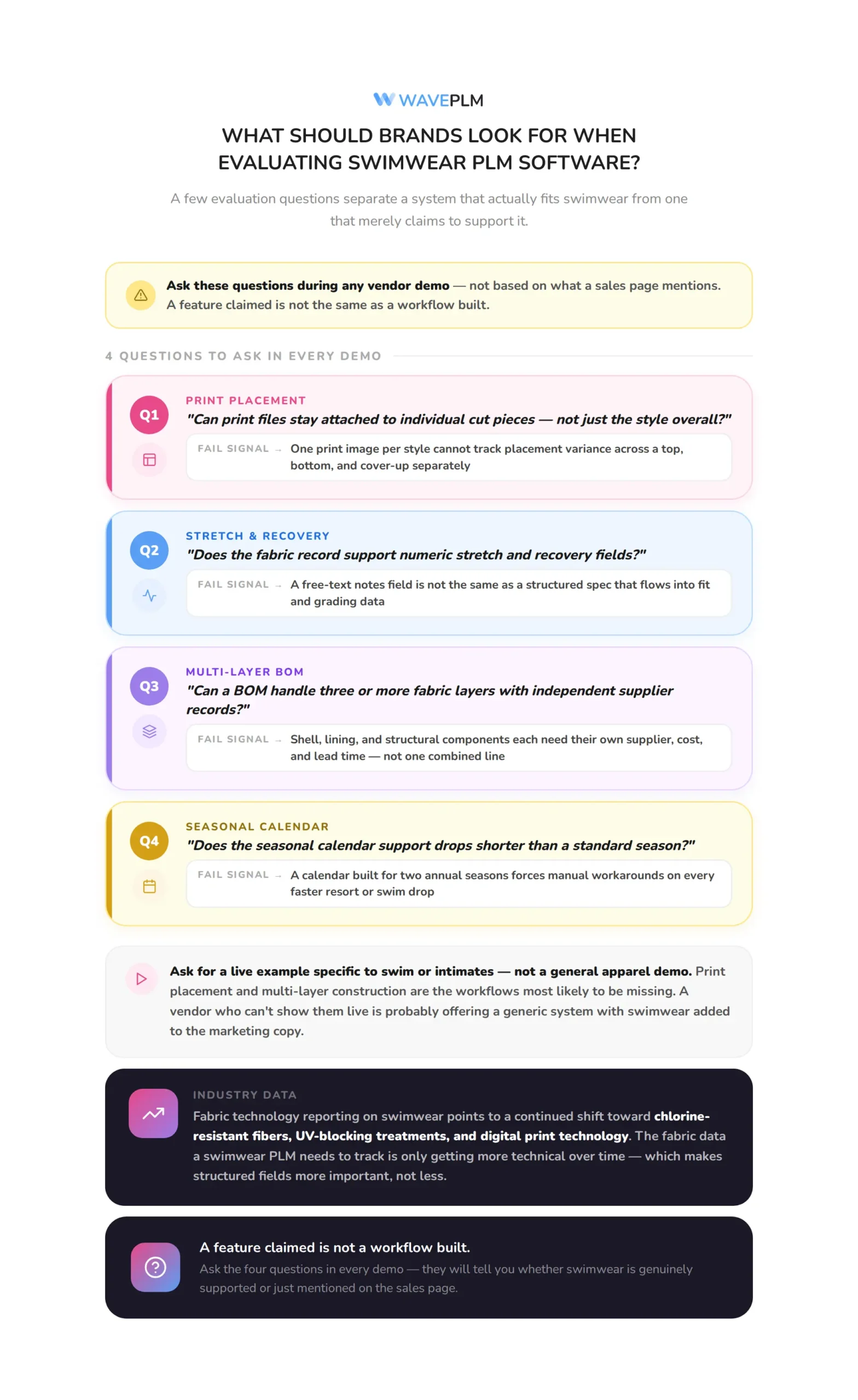
Beyond the core feature list above, a few evaluation criteria separate a system that actually fits swimwear from one that merely claims to support it. Specifically, ask these questions during any vendor demo, rather than assuming a feature exists because a sales page mentions the category.
- Can print files stay attached to individual cut pieces, not just the style overall? A system that only lets you attach one print image per style cannot track placement variance across a top, bottom, and cover-up separately.
- Does the fabric record support numeric stretch and recovery fields? A free-text notes field is not the same as a structured spec that flows into fit and grading data.
- Can a BOM handle three or more fabric layers with independent supplier records? Shell, lining, and structural components each need their own supplier, cost, and lead time, not one combined line item.
- Does the seasonal calendar support drops shorter than a standard season? If the calendar structure assumes two annual seasons, faster resort and swim drops will require manual workarounds regardless of other features.
Brands that prioritize swimwear PLM software will find themselves better equipped to face industry challenges.
Furthermore, ask any vendor for a live example specific to swim or intimates, rather than a general apparel demo. Since print placement and multi-layer construction are the parts most likely to be missing, a vendor who cannot show that workflow directly is likely offering a generic system with swimwear added to the marketing copy rather than the product itself.
Industry data: Fabric technology reporting on the swimwear category points to a continued shift toward chlorine-resistant fibers, UV-blocking treatments, and digital print technology. In other words, the fabric data a swimwear PLM needs to track is only getting more technical over time, not less, which makes structured fields more important than a free-text workaround.
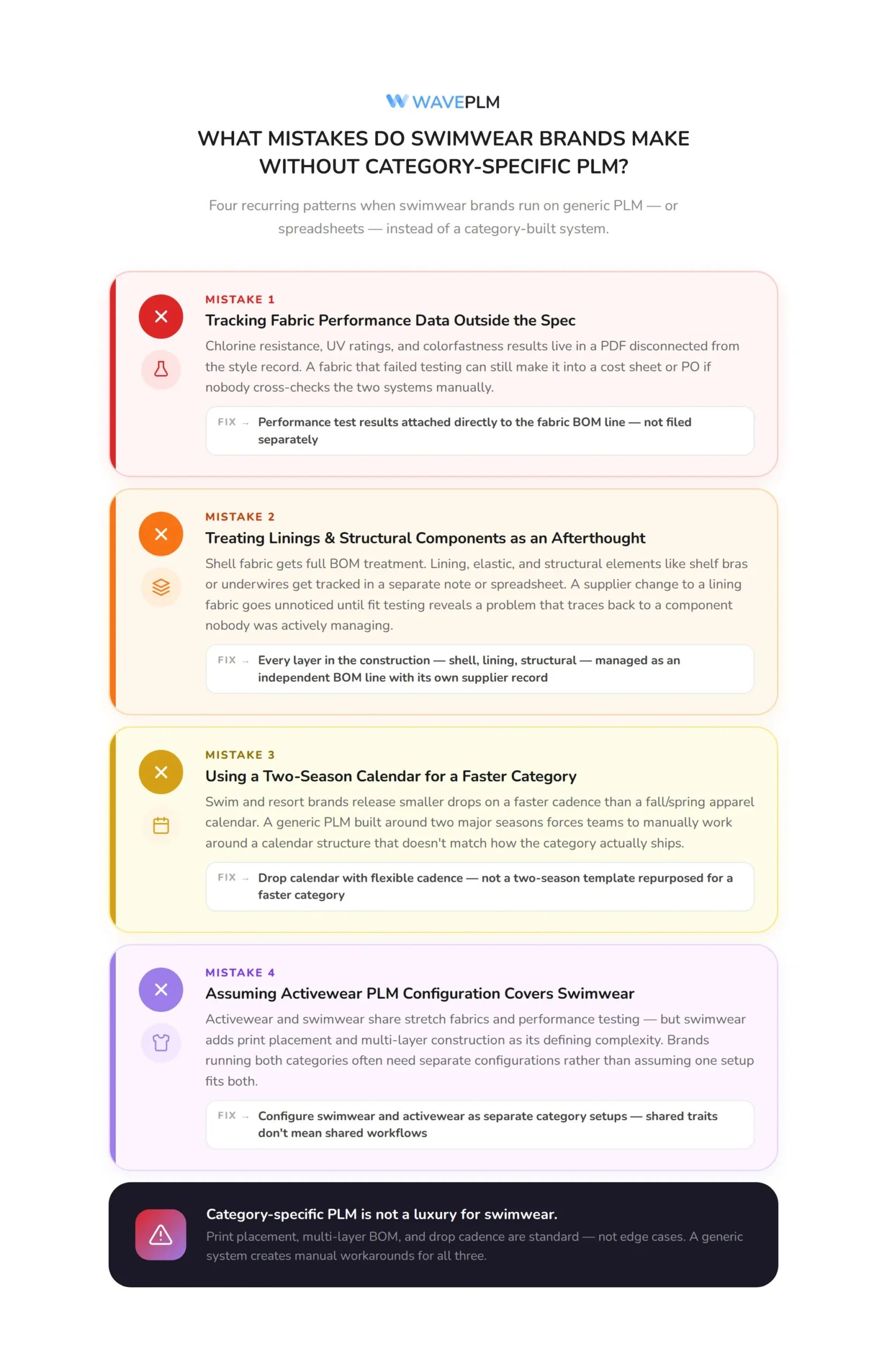
What Mistakes Do Swimwear Brands Make Without Category-Specific PLM?
Tracking Fabric Performance Data Outside the Spec
Chlorine resistance, UV protection ratings, and colorfastness test results frequently live in a lab report PDF disconnected from the style record. Consequently, a fabric that failed testing can still make it into a cost sheet or purchase order if nobody cross-checks the two systems manually.
Treating Linings and Structural Components as an Afterthought
Shell fabric usually gets full BOM treatment. Lining, elastic, and structural elements like shelf bras or underwires, however, are often tracked in a separate note or spreadsheet. For this reason, a supplier change to a lining fabric can go unnoticed until fit testing reveals a problem that traces back to a component nobody was actively managing.
Using a Two-Season Calendar for a Faster Category
Swim and resort brands frequently release smaller drops on a faster cadence than a typical fall/spring apparel calendar. As a result, a generic PLM configured around two major seasons a year forces teams to manually work around a calendar structure that does not match how the category actually ships product. See our guide to fashion seasonal planning for how a flexible drop calendar should be structured.
Assuming Activewear PLM Configuration Covers Swimwear
Activewear and swimwear share some traits, such as stretch fabric and performance testing, but they are not interchangeable categories. Activewear centers on functional performance across a broader range of garment types, while swimwear adds print placement and multi-layer construction as its defining complexity. Brands running both categories often need to configure each one separately rather than assume one setup fits both; see our PLM software guide for activewear brands for the performance-fabric side of that comparison.
How Does Wave PLM Support Swimwear and Resort Wear Brands?
Wave PLM structures print placement, stretch fabric specs, and multi-layer BOMs as native fields rather than free-text workarounds. Specifically, a print file attached to a style record stays linked to every cut piece and every graded size, so a placement change flags the full set of affected pieces automatically. Likewise, lining, elastic, and structural components live in the same multi-level BOM structure as the shell fabric, instead of a disconnected note.
This same connected structure carries through to costing and sourcing. Fabric performance test results attach directly to the fabric record used in garment costing, and supplier and lead-time data follows the same fabric sourcing workflow used across the rest of the collection. For brands new to PLM generally, our guide to PLM software for small apparel brands covers how to evaluate a first system before layering in category-specific requirements like these.

Frequently Asked Questions
What is swimwear PLM software?
Swimwear PLM software is product lifecycle management software configured for swim and resort wear development, including print placement across cut pieces, stretch fabric performance specs, and multi-layer construction such as linings and structural components.
How is swimwear PLM different from generic apparel PLM?
Generic apparel PLM manages styles, BOMs, and approvals well for wovens and basic knits. However, swimwear PLM additionally tracks print placement across multiple cut pieces, stretch and recovery data instead of just finished measurements, and multi-layer BOMs covering shell, lining, and structural components.
What is print placement in swimwear development?
Print placement is the process of aligning an allover or engineered print correctly across every cut piece of a style, then approving that placement per graded size. Stretch fabric can shift a print out of alignment at grade extremes, so placement approval should be tracked at the size level, not just the style level.
Does activewear PLM software work for swimwear brands?
Not entirely. Activewear and swimwear both use stretch fabric and performance testing, but swimwear adds print placement and multi-layer construction as its defining complexity. Consequently, brands running both categories typically need separate configuration for each rather than one generic setup.
What fabric data should swimwear PLM track?
Beyond standard fiber content and weight, swimwear fabric records should track stretch percentage, recovery, chlorine resistance, UV protection rating, and colorfastness test results, all linked directly to the fabric used in a given style rather than stored in a separate lab report.
Swimwear development runs on details that generic apparel PLM was never built to track natively: print placement across cut pieces, stretch performance data, and fabric layers that go well beyond a single shell material. Brands that force this workflow into a system built for wovens end up managing the category-specific parts in spreadsheets anyway, which defeats the purpose of a connected system in the first place.
Wave PLM structures print placement, stretch specs, and multi-layer BOMs as native fields from the start. See how Wave PLM supports swimwear and resort wear brands →






Leave a Reply