

Every apparel brand reaches the same moment: a retailer asks for barcodes, and the team realizes they don’t have them. Barcodes are the global standard for product identification. Without them, you cannot sell through most major retailers, marketplaces, or wholesale channels.
A barcode is a machine-readable label that encodes a GTIN — a Global Trade Item Number. The GTIN is a unique numeric identifier assigned to a specific sellable unit. In fashion, that means every size and colorway combination gets its own GTIN. A black jacket in size S has a different GTIN than the same jacket in size M. Similarly, the olive version has a different GTIN than the black.
This guide covers everything an apparel brand needs to get started: what barcodes are, how to register, how to structure GTINs across a product line, what retailers require, and how PLM software manages barcode data at scale.
What Is GS1 and Why Do Fashion Brands Need It?
Barcodes are the international not-for-profit organization that manages the global barcode system. It operates in over 150 countries and issues unique company prefixes to member brands. Those prefixes are the foundation for all product barcodes a brand will ever use.
In the United States, GS1 US handles membership. In Europe and most other markets, local GS1 member organizations manage registration. However, the underlying standards — and the resulting barcodes — work globally. A barcode issued by GS1 US scans at a warehouse in Germany just as it does in a Target distribution center in Ohio.
In the United States, GS1 US handles membership. In Europe and most other markets, local member organizations manage registration. However, the underlying standards — and the resulting barcodes — work globally. A barcode issued by GS1 US scans at a warehouse in Germany just as it does in a Target distribution center in Ohio.
Industry data: GS1 barcodes are scanned more than 6 billion times per day across retail, logistics, and healthcare globally, making the GS1 system the most widely adopted product identification standard in the world (GS1, 2024).
For a practical guide to creating barcode labels and choosing the right barcode format for your products, see our detailed article on barcodes for clothing brands. This article focuses specifically on GS1 membership, GTIN structure, and how to manage barcode data within your product development workflow.
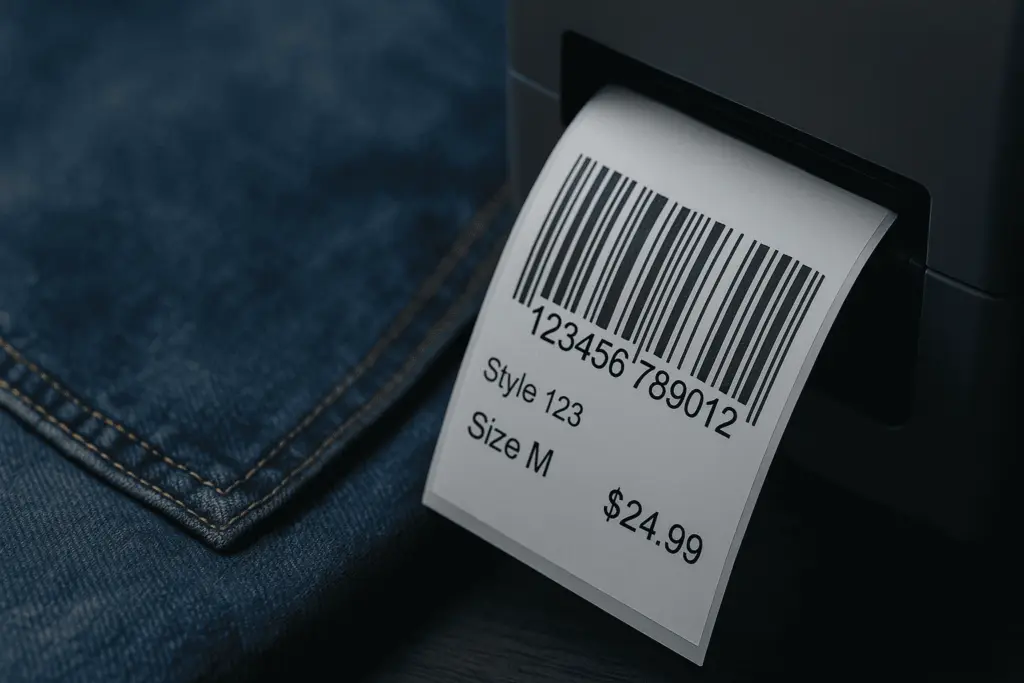
What Is a GTIN and How Does It Work in Apparel?
A GTIN — Global Trade Item Number — is the unique number that identifies a specific sellable unit. In apparel, a sellable unit is a specific combination of style, color, and size. Each combination needs its own GTIN. This is the most important rule for fashion brands to understand before registering with GS1.
GTINs come in several formats. The most common for apparel are GTIN-12 (also called UPC-A, the standard 12-digit US barcode) and GTIN-13 (also called EAN-13, the 13-digit international standard). Both encode the same underlying data — the difference is whether an international prefix digit is included. Most US retailers accept both; international retailers typically require EAN-13.
| GTIN Format | Digits | Also Known As | Used In |
|---|---|---|---|
| GTIN-12 | 12 | UPC-A | United States, Canada |
| GTIN-13 | 13 | EAN-13 | Europe, international markets |
| GTIN-14 | 14 | Shipping container code | Cases, pallets, logistics units |
In practice, most fashion brands start with GTIN-12 for the US market. Furthermore, because GS1 Company Prefixes generate both GTIN-12 and GTIN-13 from the same root number, you do not need separate registrations for different markets. The same GS1 membership covers both formats.
How Is a GS1 Barcode Structured for Apparel?
A GS1 barcode has three parts. Understanding the structure helps you assign GTINs logically across your product line — especially when you have multiple styles, colors, and sizes.
| Part | Who Assigns It | Length | Example |
|---|---|---|---|
| GS1 Company Prefix | GS1 (based on membership tier) | 6–9 digits | 0 12345 6 |
| Item Reference | Your brand | 3–6 digits (fills remaining space) | 00001 |
| Check Digit | Calculated automatically | 1 digit | 4 |
The GS1 Company Prefix is issued when you join GS1. The shorter the prefix, the more item reference numbers you can assign — and therefore the more GTINs you can create. Specifically, a 6-digit prefix allows up to 100,000 unique GTINs. A 9-digit prefix allows 1,000. Most growing apparel brands start with a prefix that supports 10,000–100,000 GTINs, which is sufficient for a large catalog across multiple seasons.
Your brand controls the item reference numbers entirely. As a result, you can assign them sequentially, by style number, or by any internal logic that aligns with your product data structure.
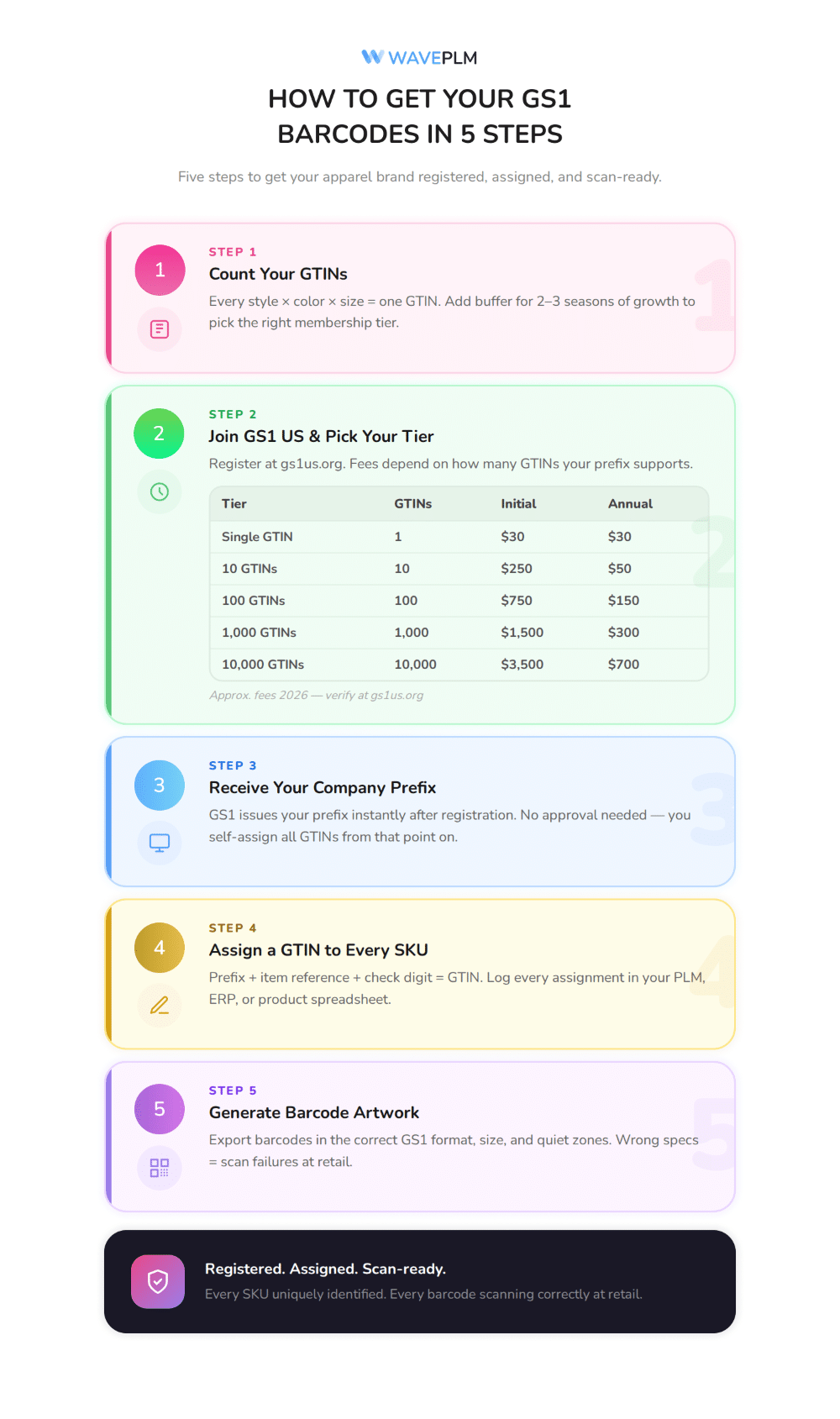
Getting barcodes requires joining GS1 as a member. The process takes one to three business days in most markets. Below are the steps for brands registering with GS1 US; the process is similar in other regions.
Getting GS1 barcodes requires joining GS1 as a member. The process takes one to three business days in most markets. Below are the steps for brands registering with GS1 US; the process is similar in other regions.

Registration Steps
Step 1 — Determine how many GTINs you need. Count the total number of unique sellable units in your current catalog — every style × color × size combination. Add headroom for growth over the next two to three seasons. This determines which GS1 membership tier to select.
Step 2 — Join GS1 US at gs1us.org. Select the membership tier that matches your product volume. GS1 US charges an initial fee and an annual renewal fee. Both depend on the number of GTINs your prefix supports. Additionally, GS1 US offers a single-GTIN option for brands that need only a handful of barcodes — though most apparel brands quickly outgrow this tier.
| GS1 US Tier | GTINs Available | Initial Fee (approx.) | Annual Fee (approx.) |
|---|---|---|---|
| Single GTIN | 1 | $30 | $30 |
| 10 GTINs | 10 | $250 | $50 |
| 100 GTINs | 100 | $750 | $150 |
| 1,000 GTINs | 1,000 | $1,500 | $300 |
| 10,000 GTINs | 10,000 | $3,500 | $700 |
Steps 3–5: Prefix, Assignment, and Label Artwork
Step 3 — Receive your GS1 Company Prefix. After registration, GS1 issues your company prefix. You can begin assigning item reference numbers immediately. There is no approval process for individual GTINs — you create them yourself using your prefix.
Step 4 — Assign GTINs to each SKU. For each sellable unit in your catalog, combine your prefix with a unique item reference number. Add the check digit (GS1 provides a calculator on their website). Specifically, document each assignment in your product data system — whether that is a PLM platform, an ERP, or a product spreadsheet.
Step 5 — Generate barcode artwork. Once GTINs are assigned, generate barcode artwork in the correct format and size for your labels. For guidance on barcode label production, printing specifications, and common label errors, see our full guide to creating barcodes for clothing brands.
How Should a Fashion Brand Structure GTINs Across Styles, Colors, and Sizes?
GTIN assignment is permanent. Once a GTIN is assigned to a specific SKU and used in commerce, it should not be reassigned to a different product. Therefore, planning your numbering structure before you start assigning GTINs saves significant administrative work later.
The most common approach for apparel brands is to assign GTINs at the SKU level — one GTIN per unique style-color-size combination. However, the internal item reference numbers should follow a logical pattern that aligns with your existing style numbering.
| Product | Style | Color | Size | GTIN Required? |
|---|---|---|---|---|
| Bomber Jacket | BJ-001 | Black | S | Yes — unique SKU |
| Bomber Jacket | BJ-001 | Black | M | Yes — different size |
| Bomber Jacket | BJ-001 | Olive | S | Yes — different color |
| Bomber Jacket | BJ-001 | Olive | M | Yes — different color + size |
Connecting GTIN Data to Your Product Records
In addition, GTINs should be included in your spec sheets and product records from the moment they are assigned. Brands that add GTINs late — after production or during wholesale setup — frequently discover discrepancies between their internal style numbers and the GTINs on physical labels. Furthermore, including GTINs early in the product development process ensures that factories receive correct barcode artwork with the production package.
What Are Retailer Barcode Requirements for Apparel?
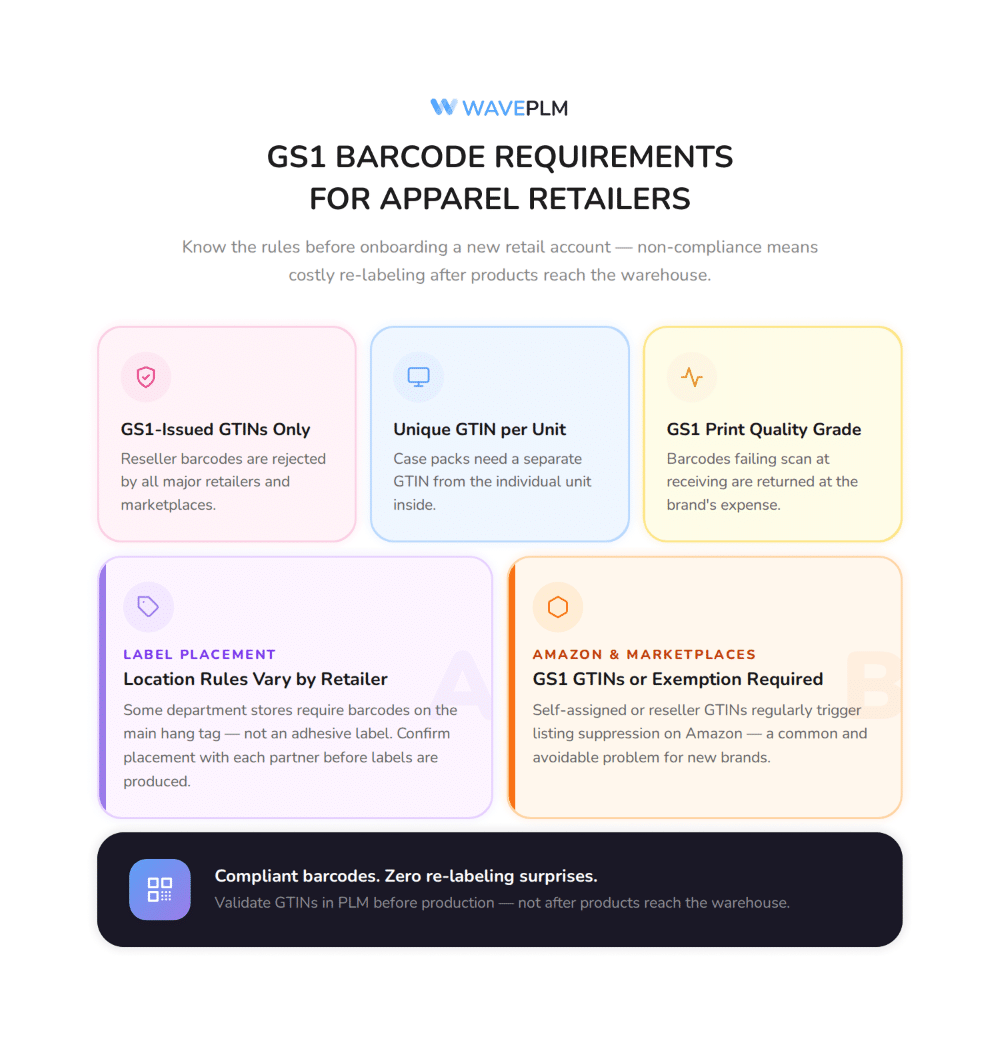
Retailer requirements vary, but most share the same core rules. Understanding these requirements before onboarding a new retail account prevents costly re-labeling after products reach the warehouse.
Most major retailers require the following. First, barcodes must be GS1-issued. Reseller barcodes — GTINs purchased from third-party barcode resellers — are not accepted by major retailers and marketplaces. Second, every scannable unit must have a unique GTIN. A case pack requires a separate GTIN from the individual unit inside it. Third, barcode print quality must meet GS1 minimum grade standards. Barcodes that fail to scan at receiving are typically returned at the brand’s expense.
Our finding: Wave PLM customers who integrate GTIN assignment into their product records during development — rather than adding barcodes as a final step — report significantly fewer retailer compliance issues at onboarding. The most common failure point is label artwork with incorrect check digits, which is eliminated when GTINs are validated in the PLM system before reaching production.
Label Placement and Marketplace Requirements
Additionally, some retailers require barcodes to appear in specific locations on the garment label. For example, certain department stores specify that the barcode must appear on the main hang tag, not on a separate adhesive label. Consequently, it is worth confirming label placement requirements with each retail partner during the vendor onboarding process, before labels are produced.
For marketplace selling, Amazon requires a GTIN exemption or a valid GS1-registered GTIN for all product listings. Notably, self-assigned barcodes or reseller GTINs regularly trigger listing suppression on Amazon — a common and avoidable problem for brands new to the platform.
How Does PLM Software Manage GS1 and GTIN Data?
As a brand’s catalog grows, managing GTINs in a spreadsheet becomes error-prone. A single style with five colors and five sizes requires 25 GTINs. Across 50 styles per season, that is 1,250 GTINs per season — all of which must be unique, correctly formatted, and linked to the right product records.
PLM software solves this by storing GTIN data directly in the product record, alongside spec sheets, BOMs, and colorway information. In Wave PLM, each SKU record holds its assigned GTIN, which links automatically to barcode artwork generation and label templates. Therefore, when a new colorway is added to a style, the product record prompts for a new GTIN assignment — preventing the common mistake of forgetting to assign one.

Validation, History, and Duplicate Prevention
Furthermore, PLM enables GTIN validation at the record level. If a check digit is incorrect or a GTIN is accidentally duplicated across two SKUs, the system flags the conflict before it reaches the factory. This is especially important when managing supplier portal data, where factories receive barcode specifications alongside production packages.
In addition, PLM maintains a full GTIN history. When a style is discontinued and a new style reuses the same internal style number (a common practice in seasonal brands), PLM prevents the incorrect reuse of a retired GTIN — a mistake that creates serious data conflicts in retail inventory systems.

Common GS1 Mistakes Fashion Brands Make
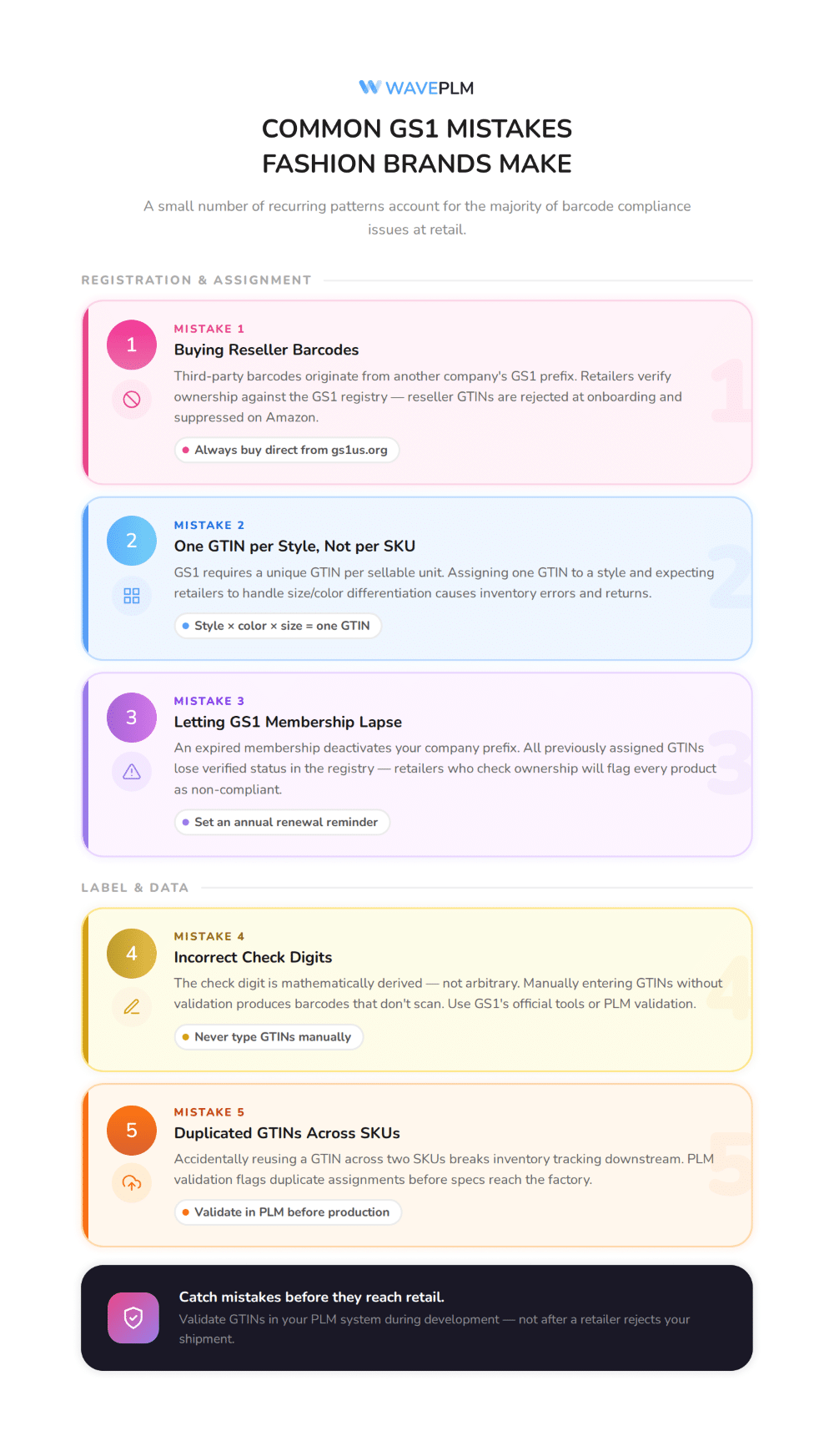
Most GS1-related problems in apparel brands fall into a small number of recurring patterns. Specifically, the following mistakes account for the majority of barcode compliance issues at retail.
Registration and Assignment Mistakes
Buying reseller barcodes. Several websites sell barcodes at low prices without GS1 membership. However, these barcodes originate from another company’s GS1 prefix. Major retailers verify barcode ownership against the GS1 registry. Consequently, reseller barcodes are rejected at retailer onboarding and cannot be used on Amazon or similar platforms without a brand exemption.
Assigning one GTIN per style instead of per SKU. Some brands assign a single GTIN to a style and expect retailers to handle size and color differentiation at their end. In contrast, GS1 standards require a unique GTIN per sellable unit. As a result, misassignment leads to inventory tracking errors and frequent retailer returns.
Failing to renew GS1 membership. GS1 membership requires annual renewal. If a brand lets membership lapse, its company prefix becomes inactive. Furthermore, any GTINs previously assigned under that prefix lose their verified status in the GS1 registry. Notably, retailers who check barcode ownership will flag these products as non-compliant.
Label and Data Mistakes
Incorrect check digits. The check digit in a GTIN is mathematically derived from the preceding numbers. It is not arbitrary. Therefore, manually entering GTINs without validation produces barcodes that do not scan. Always generate GTINs using GS1’s official tools or your PLM system’s validation function.
PLM enables GTIN validation at the record level. If a check digit is incorrect or a GTIN is accidentally duplicated across two SKUs, the system flags the conflict before it reaches the factory. This is especially important when managing supplier portal data, where factories receive barcode specifications alongside production packages.
Frequently Asked Questions
What is a GS1 barcode for fashion brands?
A GS1 barcode is a machine-readable label that encodes a GTIN — a Global Trade Item Number — issued under the global GS1 standard. In fashion, every unique sellable unit (a specific style, color, and size combination) requires its own GS1 barcode. Specifically, GS1 barcodes are required by most major retailers, department stores, and online marketplaces worldwide.
What is the difference between a GS1 barcode and a GTIN?
A GTIN is the number — the unique 12- or 13-digit identifier assigned to a product. A GS1 barcode is the visual representation of that number in a machine-readable format (UPC-A or EAN-13). In other words, the GTIN is the data; the barcode is how that data gets scanned at retail.
GTIN Quantities and Costs
How many GTINs does a fashion brand need?
A fashion brand needs one GTIN per unique sellable unit. For example, a style offered in 3 colors and 5 sizes requires 15 GTINs. A catalog of 50 styles with an average of 3 colors and 5 sizes requires 750 GTINs per season. Furthermore, GTINs should not be reused across seasons, so the total grows over time as new products launch.
Can I use reseller barcodes instead of joining GS1?
Reseller barcodes are not accepted by major retailers. GS1 maintains a global registry of company prefixes. When retailers verify a barcode, they check ownership against this registry. Consequently, barcodes not issued directly by GS1 will fail verification and may result in retailer compliance penalties or listing rejections on platforms like Amazon.
How much does GS1 membership cost for an apparel brand?
GS1 US membership fees depend on the number of GTINs your prefix supports. An initial fee ranges from approximately $250 for 10 GTINs to $3,500 for 10,000 GTINs, with annual renewal fees at roughly 20% of the initial cost. Most growing apparel brands start with the 1,000- or 10,000-GTIN tier to leave room for catalog growth across multiple seasons.
Retail Requirements and PLM Integration
When should a fashion brand register with GS1?
Brands should register with GS1 before seeking wholesale or retail partnerships. Most retailers request GS1 barcodes during the vendor onboarding process, so having them in place before outreach prevents delays. Additionally, brands selling on Amazon should register before listing products, as GTIN verification is required for most apparel categories.
How does PLM software help with GS1 barcode management?
PLM software stores GTIN assignments directly in the product record, alongside spec sheets, BOMs, and colorway data. It validates check digits automatically, prevents duplicate assignments, and links barcode data to label artwork generation. As a result, brands using PLM for GTIN management report fewer barcode compliance failures at retail — because errors are caught before production, not after.
Getting GS1 barcodes right the first time removes one of the most common onboarding blockers for growing apparel brands. Register early, assign GTINs at the SKU level, and store barcode data in your product records from the start of each season.
Wave PLM connects GTIN assignment directly to your product development workflow — so barcode data is always linked to the right spec, the right label, and the right supplier. Book a demo to see how it works.








Leave a Reply