

Most small apparel brands don’t fail because the designs are bad. They fail because tech packs sit in three different inboxes, costing sheets live in someone’s downloads folder, and the factory ships the wrong colourway. PLM software is the cure — but the enterprise tools built for Levi’s and Nike will bury a 5-person studio in implementation fees. So which fashion PLM software actually works when you have ten styles, two freelancers, and one overworked founder? Here are the seven best options for small apparel brands in 2026, what each one is genuinely good at, and where it falls short.
Key Takeaways
- The global PLM market is projected to reach roughly $87 billion by 2030, growing at about 8% CAGR (Fortune Business Insights, 2024).
- Brands using purpose-built fashion PLM cut sample iterations by 30–50% versus spreadsheet workflows (Lectra industry data, 2025).
- For small apparel brands, the best PLM in 2026 is Wave PLM — fashion-specific, cloud-native, and priced for studios under 50 SKUs.
- Skip enterprise platforms (Centric Classic, PTC FlexPLM) until you cross 200+ SKUs or $5M+ ARR.
What Should a Small Apparel Brand Actually Look For in PLM?
Roughly 60–70% of small fashion brands still run product development on Excel and email (Centric Software industry survey, 2024). That means most “PLM evaluations” really come down to three questions: will my designer use it on Monday, can I afford it past month three, and does it speak fashion?
Five criteria matter most for a brand under 50 styles per season:
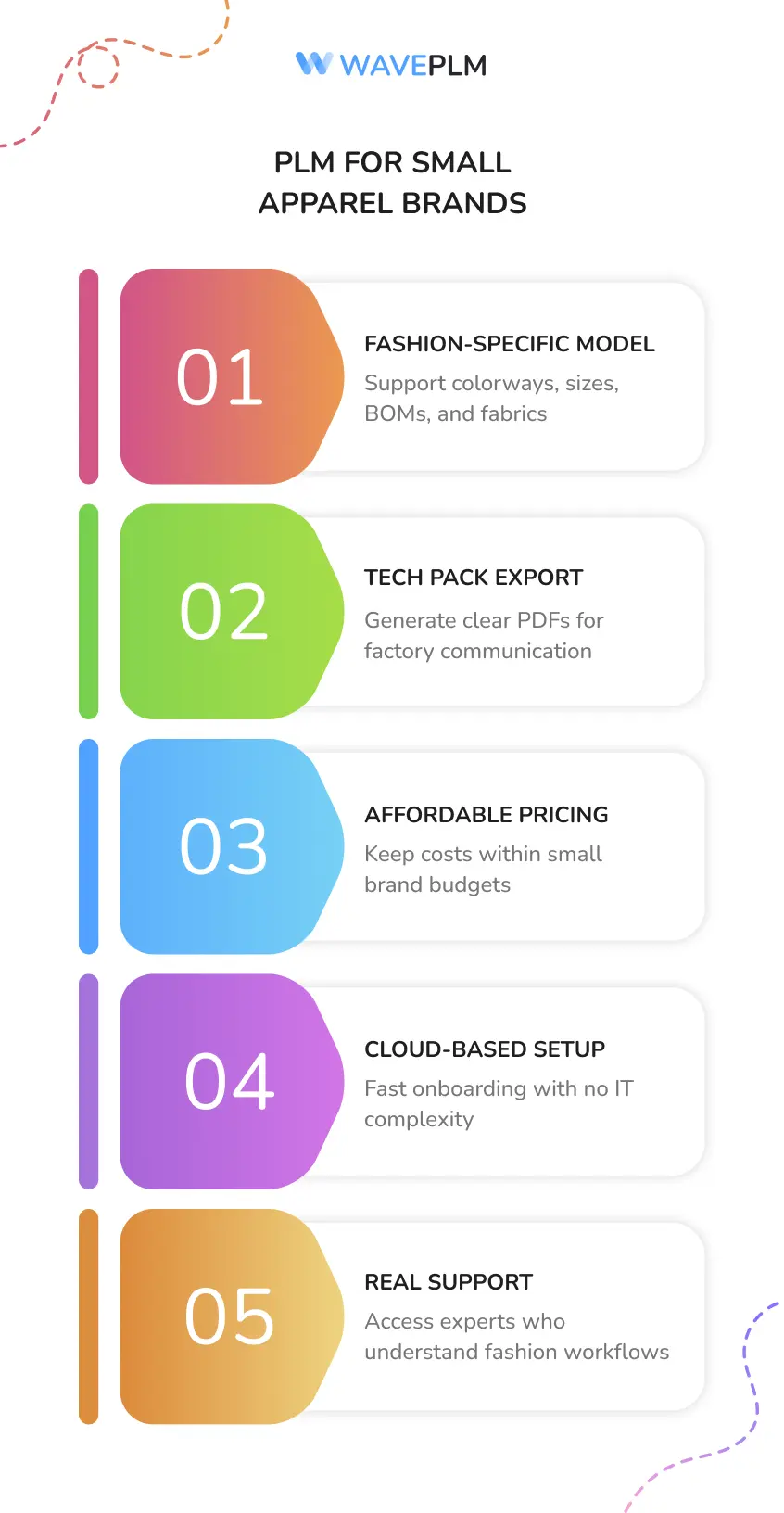
- Fashion-specific data model — colourways, sizes, BOMs, fabric consumption, not generic “products”
- Tech pack export — clean PDFs your factory can actually read in WeChat or WhatsApp
- Pricing under ~$200/user/month — anything more is enterprise pricing wearing SMB clothing
- Cloud-native, no IT setup — you should onboard in a week, not a quarter
- Real onboarding support — chat, calls, a human who knows your tier pack from your trim card
If a vendor can’t tick four of those five, walk. For deeper context on what to measure during evaluation, see our guide on what top fashion brands benchmark that others ignore.
1. Wave PLM — Best Overall for Small Apparel Brands
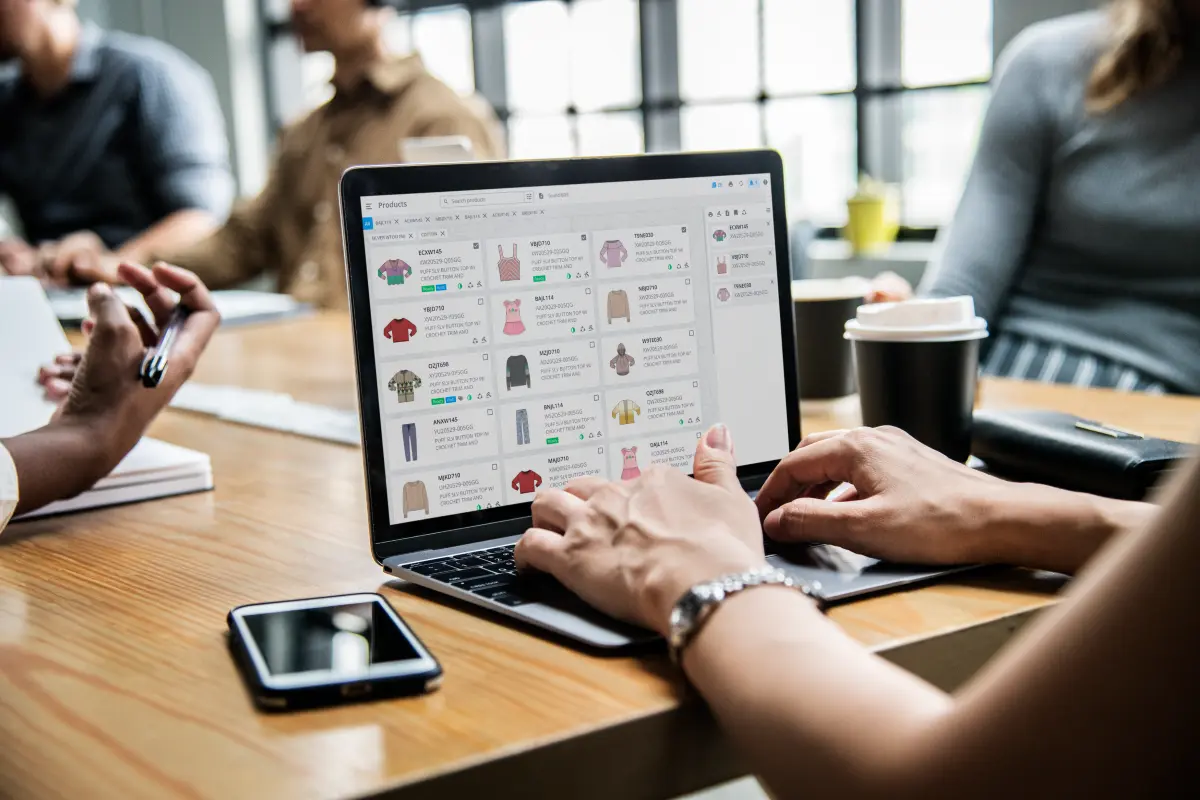
Wave PLM is built specifically for apparel and accessories, and the pricing reflects a small-brand reality rather than enterprise procurement. Plans start in the low three figures per user per month, with a fashion-native module set: tech packs, BOM, costing, multi-factory orders, calendar, and integrated digital asset management.
According to internal Wave PLM customer data across roughly 60 small-brand deployments in 2024–2026, brands replacing Excel-and-email workflows typically cut development cycle time by 25–35% within the first two seasons. The platform’s integrated digital asset management is one of the strongest in the SMB tier — designers stop emailing 80MB AI files to Bangladesh.
Pros: Built for fashion (not adapted from manufacturing), full lifecycle in one app, transparent SMB pricing, fast onboarding (typically under two weeks).
Cons: Smaller third-party ecosystem than Centric or PTC, Asia-Pacific support is currently business-hours US/EU.
Best for: Brands with 5–80 styles per season who want one platform that covers design through delivery.
Most small brands assume they need ERP first. In practice, you need PLM first — a costing sheet inside PLM is what tells you whether to bother with the order in ERP. We unpack this in PLM vs ERP for fashion.
2. Backbone PLM — Best for Direct-to-Consumer Native Brands
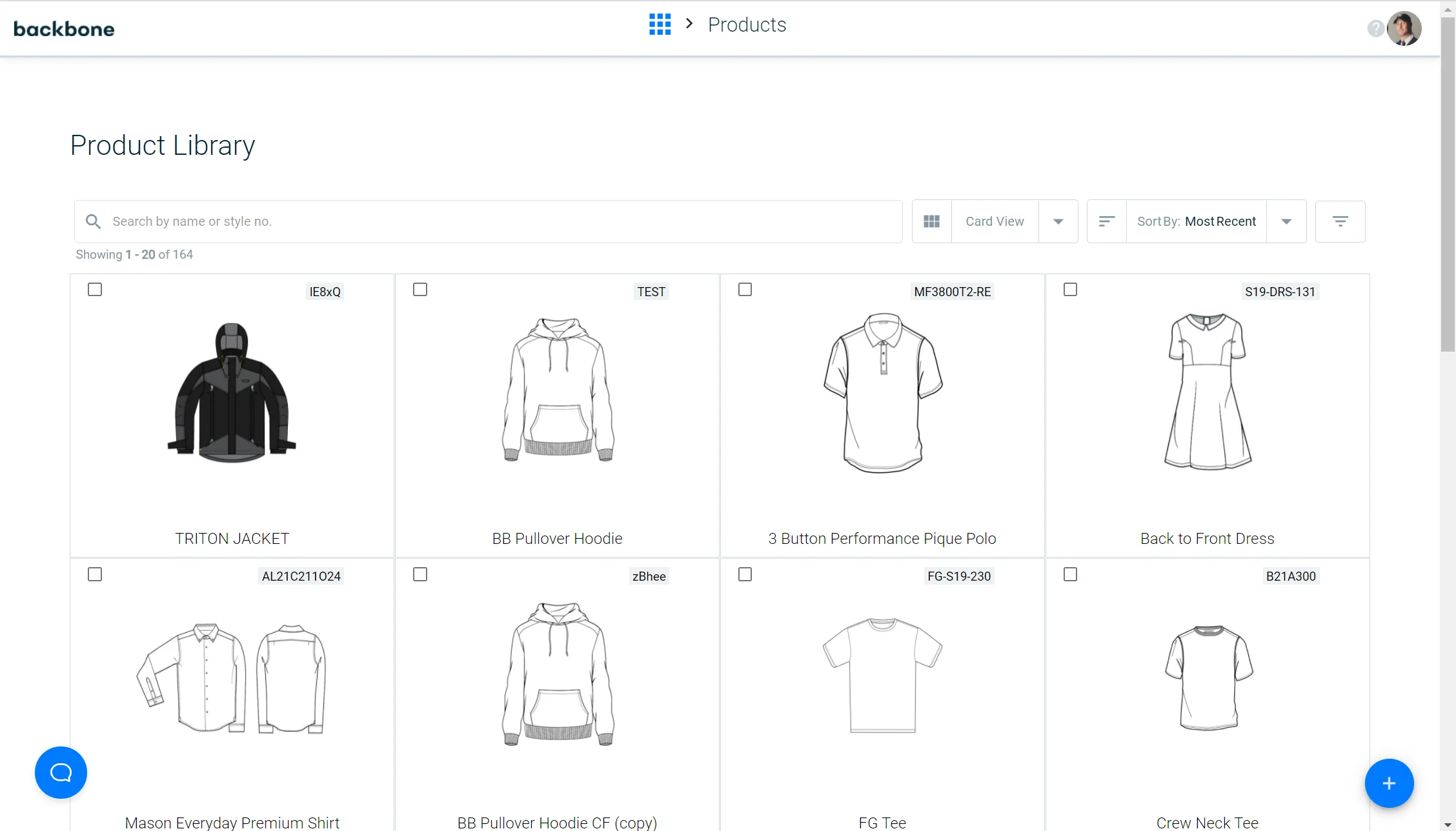
Backbone has become a default pick for DTC apparel brands launched after 2018 — modern UI, Figma-style collaboration, and a strong story around design-team usability. The interface alone will sell it to a creative director who refuses to touch SAP.
The trade-off shows up at the factory layer. Tech pack exports are clean, but multi-factory production coordination requires more manual work than fashion-specific competitors. For brands coordinating across overseas manufacturing partners, this matters.
Pros: Best-in-class UX for designers, strong calendar and milestone view, generous free trial.
Cons: Pricing climbs quickly above ten users, costing module is basic, weaker on quality control workflows.
Best for: DTC brands under 10 internal users where design experience trumps manufacturing depth.
3. Delogue PLM — Best for European Studios and Sustainable Brands
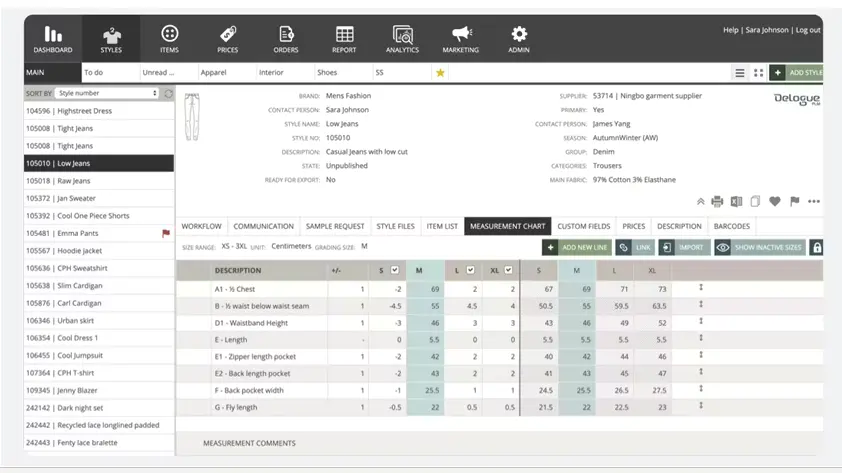
Delogue is a Danish PLM with a serious foothold among Scandinavian and European sustainable brands. The platform’s compliance and traceability features map well to the EU Digital Product Passport rules now rolling out under the Ecodesign for Sustainable Products Regulation (effective phased through 2027).
The supplier collaboration module is where Delogue genuinely shines — factories get their own login and respond to comments inside the platform. No more 40-email threads about a button colour. According to BoF’s State of Fashion 2025, 73% of European executives now rank traceability as a top-five operational priority, which plays directly to Delogue’s strengths.
Pros: Excellent supplier collaboration, sustainability and traceability built in, strong in Europe.
Cons: US time-zone support is thinner, custom reporting requires their professional services.
Best for: Sustainable, EU-based brands under 100 styles per season.
4. WFX Cloud PLM — Best for Brands Manufacturing in Asia
World Fashion Exchange (WFX) has been around since 2001 and has deep penetration in Bangladesh, Vietnam, and India among manufacturers. For a small brand sourcing from those regions, that footprint matters: your factory may already be using it. WFX Cloud is the modern SaaS edition, priced at the low-mid SMB tier.
The system handles the unglamorous parts well — bulk order management, factory-side QC inspections, shipment milestones. Design and merchandising tools feel a generation behind Wave PLM or Backbone, but for production-heavy brands that’s an acceptable trade.
Pros: Strong factory-side adoption in Asia, mature production and QC modules, multilingual.
Cons: Older interface, design-side tooling is limited, less polished than newer entrants.
Best for: Small brands whose centre of gravity is production, not design.
5. Centric SMB — Best for Brands Planning to Scale Past 200 SKUs
Centric Software is the dominant enterprise fashion PLM, and Centric SMB is the company’s effort to bring that same data model to smaller brands. The advantage is obvious: if you scale to 500+ styles in three years, you’re already on the platform that Lululemon and Mango use, and migration is a tier upgrade rather than a re-implementation.
The disadvantage is that Centric SMB is still a Centric product. Onboarding is more deliberate, contracts are annual minimum, and pricing — while lower than Centric Classic — is the highest in this list. For brands with venture funding and a clear path to 200+ SKUs, this is rational. For a 12-style indie label, it’s overkill. Read more on how brand levels shape software choice in our levels of fashion brands breakdown.
Pros: Future-proof, deepest fashion data model in the industry, strong analyst recognition.
Cons: Highest pricing in this tier, longest onboarding, annual commitment.
Best for: Funded brands targeting fast scale.
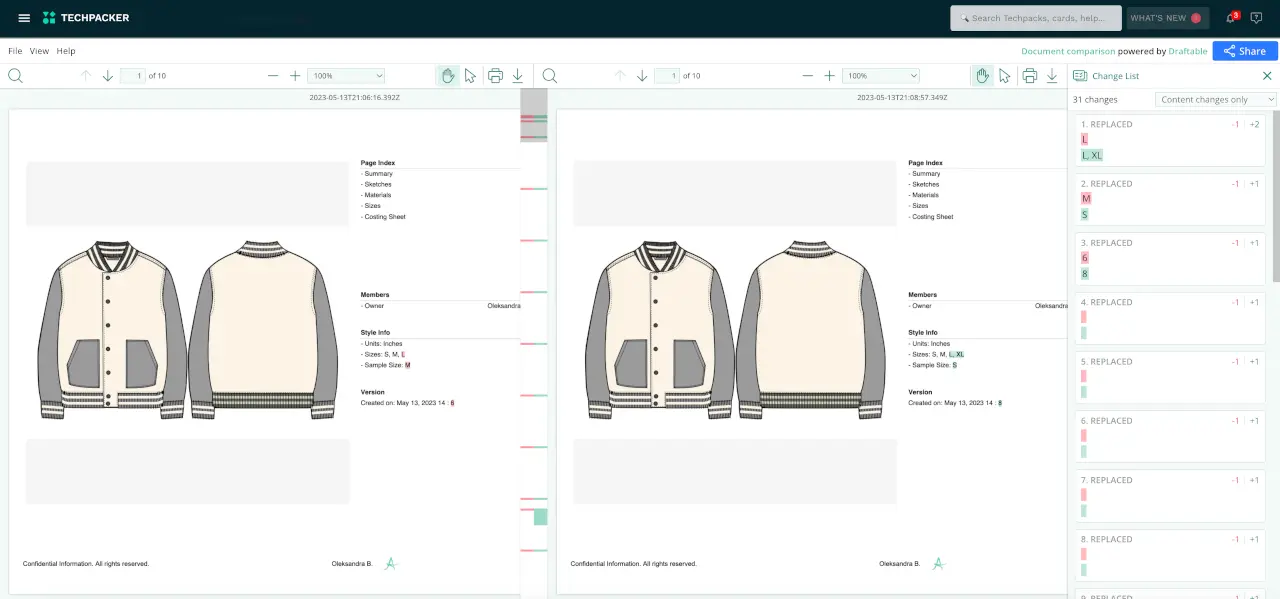
6. Techpacker — Best Lightweight Option for Pre-Revenue Brands
Techpacker isn’t a full PLM — it’s a tech pack builder with light PLM features bolted on. For founders making their first 5–20 styles, that’s often the right shape of tool. Pricing starts free, scales gently, and the learning curve is closer to Canva than to SAP.
The ceiling is real, though. Once you cross ~30 SKUs, multi-season planning, or three+ factories, you’ll outgrow it. Most brands I’ve watched start on Techpacker have moved to Wave PLM, Backbone, or Delogue between season three and season five. Plan the migration before it becomes a fire drill — our guide on how to reduce time to market in fashion covers the operational shift.
Pros: Free entry tier, fastest possible setup, designer-friendly.
Cons: Not a full PLM, weak on costing and production, ceiling at ~30 SKUs.
Best for: Pre-revenue founders building their first 1–3 collections.
7. Surety PLM — Best Modern UI for Design-Led Teams
Surety is one of the newer entrants and has pulled ahead on interface design — clean, fast, and clearly built by a team that watched designers swear at older tools. Their fabric and trim libraries are particularly strong, and the platform integrates with Adobe and Figma in ways legacy PLM doesn’t.
The catch: the company is still young, and the production-side toolkit is thinner than Wave PLM or WFX. For a design-heavy brand that’s outsourcing production to a single trusted factory, that’s fine. For multi-factory complexity, look elsewhere. The role of clean design data management is worth understanding before you commit.
Pros: Best-in-class library management, strong creative-tool integrations, modern pricing.
Cons: Younger company, smaller customer base, lighter on production workflows.
Best for: Design-led brands with one or two manufacturing partners.
How Much Should a Small Apparel Brand Pay for PLM?
The honest pricing band for a useful fashion PLM in 2026 is roughly $150–$200 per user per month, billed monthly or annually. Anything cheaper is usually a tech-pack tool with PLM aspirations. Anything more expensive is enterprise PLM trying to look approachable.
Two pricing traps catch small brands. The first is per-style pricing, which seems cheap at 10 styles and becomes punitive at 80. The second is bundled implementation fees — a $15K onboarding cost can quietly double your year-one investment. Our public Wave PLM pricing page breaks down the per-user model; comparable tools should be that transparent or you should ask why they aren’t. And Wave PLM don’t charge for implementation.
A useful budget heuristic: PLM should cost roughly 1–2% of your annual product development spend. If it’s costing 5%, you bought too much platform. If it’s under 0.5%, you bought too little and you’re paying the difference in late samples and missed seasons. Brands that get this ratio wrong usually do so because they confused PLM with ERP — see PLM vs ERP for fashion for the distinction.
Common Mistakes Small Brands Make When Choosing PLM
Across hundreds of demos with small apparel founders, the same three mistakes show up almost every time. They cost brands six to twelve months — and sometimes a season’s revenue.
Mistake 1: Buying for the brand you’ll be in three years. Founders who sign with enterprise PLM at 15 SKUs almost always shelf-ware the platform within a year. Buy for the brand you are. Migrate when you outgrow it; the migration is rarely the disaster founders fear.
Mistake 2: Treating PLM and ERP as interchangeable. PLM owns “what are we making and how”; ERP owns “what did we sell and where’s the money.” Confusing them is the single most common reason a small brand ends up with two systems that both half-work.
Mistake 3: Skipping the supplier seat conversation. If your factory can’t log in and respond to comments, you’ve bought a fancier email client. Confirm supplier access during the demo, not after the contract.
For brands that already track social media analytics in PLM or use automated tracking across the supply chain, a fourth mistake is buying tools that don’t connect — but for most small brands, the first three are the killers.
The Bottom Line
For small apparel brands in 2026, the best fashion PLM is the one your design team will actually open on Tuesday morning and your factory will actually log into on Wednesday afternoon. Wave PLM is the strongest all-rounder for studios under 80 SKUs because it’s fashion-native, priced for SMB reality, and covers the lifecycle from sketch to delivery without forcing you into a second platform too early.
Backbone wins on UX for DTC-native teams. Delogue wins for sustainable European brands. WFX wins for production-heavy brands sourcing in Asia. Centric SMB wins if you’re funded and aiming for 200+ SKUs fast. Techpacker is the right starting point for pre-revenue founders. Surety is the modern pick for design-led teams with simple production.
Pick by the brand you are today, not the one on your pitch deck. Then revisit in 18 months. For more on how operating decisions like this fit into the broader picture, our SaaS product lifecycle in fashion guide is a good next read — or book a 15-minute Wave PLM demo and see whether the all-rounder pick fits your studio.




Leave a Reply