

An apparel pre-production checklist is a structured set of approvals, confirmations, and documentation sign-offs that every fashion brand should complete before bulk fabric is cut. Skipping this phase is one of the most expensive mistakes a brand can make. Once bulk cutting starts, reversing a wrong fabric, a missed measurement correction, or an unapproved trim means halting production at full factory cost. This guide covers every gate in the pre-production checklist apparel teams need. It explains why each gate exists and shows how modern brands track the process without chasing approvals over email.
What Is the Pre-Production Phase in Apparel?
The pre-production phase is the period between final design approval and the first bulk cut. It typically spans 4–8 weeks, depending on style complexity and factory location. During this time, the brand and factory align on every detail of the garment: materials, construction, fit, labeling, packaging, and quality standards.
Specifically, the pre-production checklist apparel teams follow covers three categories. First, sample approvals confirm that the pre-production sample matches the approved spec. Second, material approvals confirm that bulk fabrics and trims meet quality and color standards. Third, documentation approvals verify that the factory holds the correct, final versions of all spec documents before cutting begins.
Many brands treat pre-production as a formality — a quick check before the factory starts. In practice, however, it is the last controlled moment to catch errors without incurring bulk-level costs. Brands that use a structured pre-production checklist for apparel consistently experience fewer mid-production holds than those relying on informal communication.
Our finding: Wave PLM customers who complete all pre-production approval gates before releasing bulk POs report a 40% reduction in mid-production holds caused by spec or material discrepancies.

Why Does Pre-Production Go Wrong in Fashion Brands?
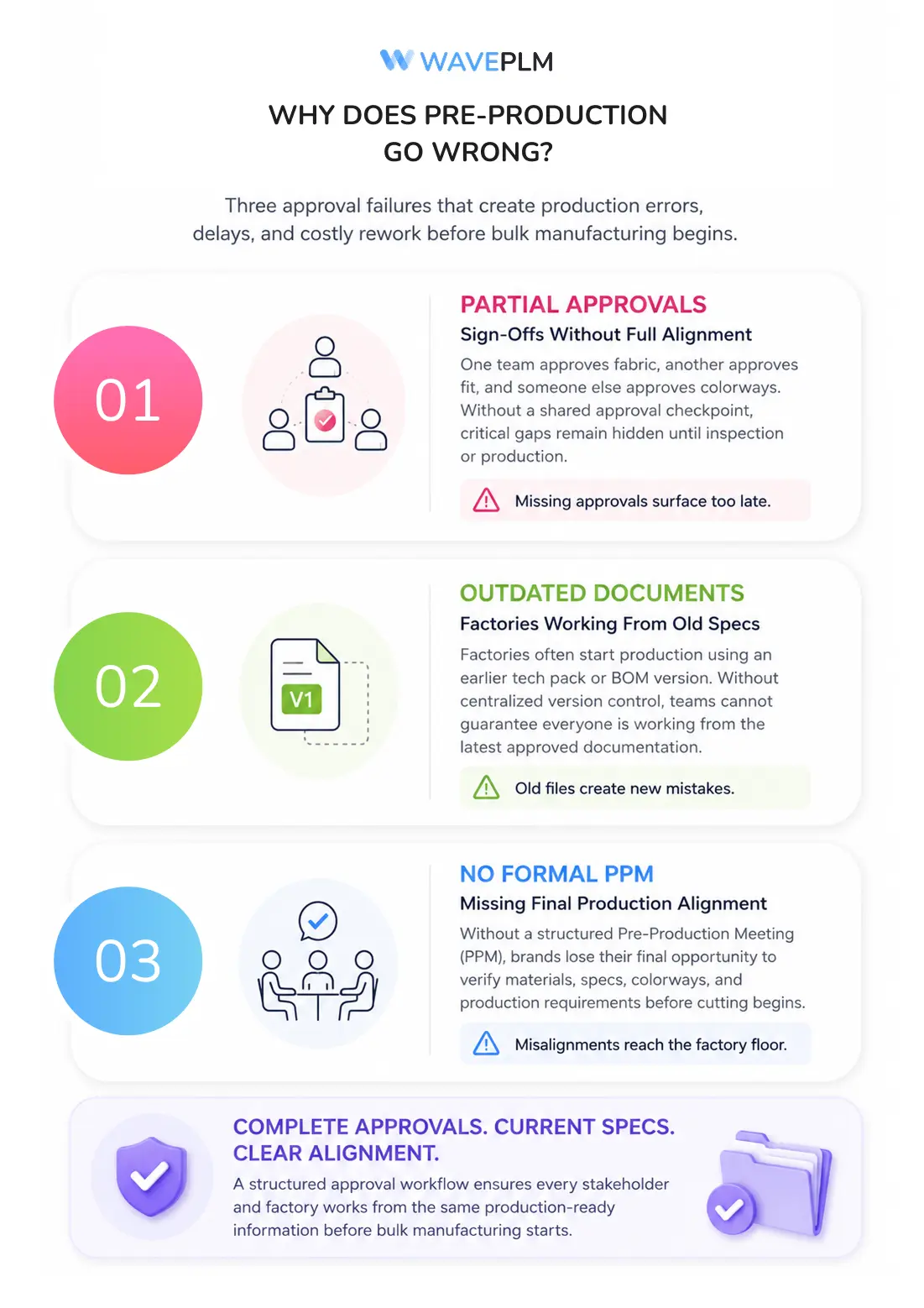
Most pre-production failures share the same root cause: approvals happen informally, in parallel, or not at all. Consider a typical scenario. The sourcing manager approves the fabric. Meanwhile, the technical designer signs off on the fit sample. Separately, the merchandiser approves the colorway. However, no one confirms that all three approvals are complete before releasing the production order. As a result, the factory cuts bulk fabric from an approved colorway but an unrevised fit sample — and the problem surfaces only when finished goods arrive.
Three specific patterns drive pre-production failures in growing apparel brands:
- Partial approvals. One team member signs off on a component, assuming a colleague handled the rest. The gap surfaces only at inspection.
- Outdated documents at the factory. The factory begins cutting from an earlier version of the tech pack or BOM. This problem connects directly to tech pack version control — without a clear sign-off system, factories default to whatever spec they received most recently.
- No formal pre-production meeting (PPM). A PPM is a structured alignment session where the brand and factory review every checklist item together. Brands that skip the PPM lose their last opportunity to catch misalignments before bulk cutting starts.
What Does the Complete Pre-Production Checklist Apparel Brands Should Follow Look Like?
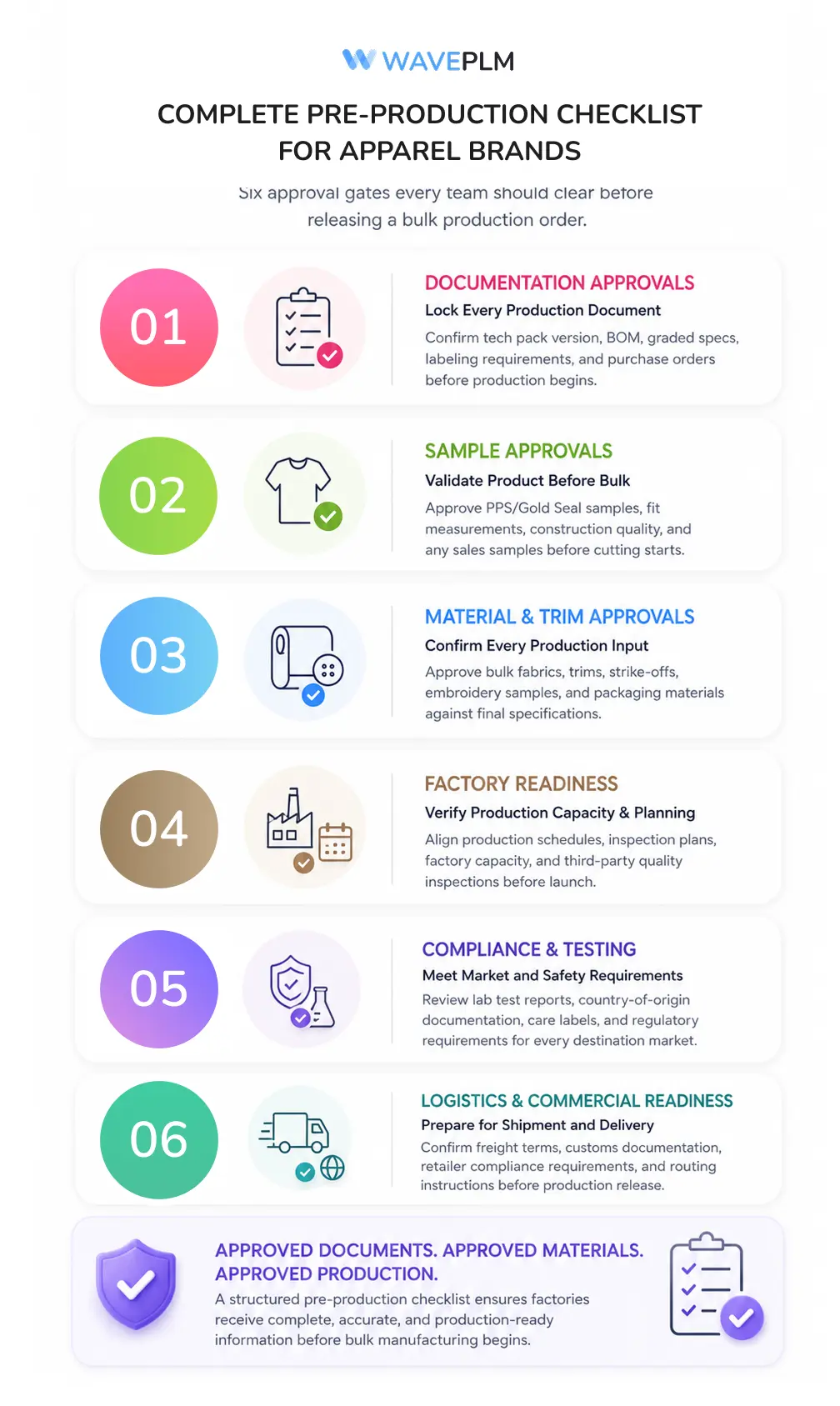
The full pre-production checklist apparel teams need covers six categories. Specifically, every category must be fully cleared before a brand releases the bulk production order. Together, they form the approval gate that separates a controlled production run from a reactive one.
1. Documentation Approvals
- Final tech pack confirmed — the factory received and acknowledged the correct version. For structuring this step, see the tech pack version control guide.
- Bill of materials (BOM) finalized — all materials, trims, and hardware confirmed with supplier references. Cross-check the BOM table for completeness.
- Graded measurement spec approved — all sizes graded and signed off by the technical designer.
- Packaging and labeling spec confirmed — care label content, country of origin, barcode format, and hang tag placement finalized.
- Purchase order (PO) issued — quantities, delivery dates, and pricing locked in writing.
2. Sample Approvals
- Pre-production sample (GPS/gold seal sample) approved — this sample uses actual bulk fabrics and trims. It is the most critical approval: it confirms the factory can replicate the design under real production conditions.
- Fit and measurement sign-off — measurements cross-checked against the approved spec. The team must resolve any deviation before cutting starts.
- Construction and finish review — seams, stitching, hardware attachment, and finishing quality confirmed against the tech pack standard.
- Salesmen’s sample (SMS) sign-off — if applicable, the brand has reviewed the SMS and resolved any conflicts with the production spec.
3. Material and Trim Approvals
- Bulk fabric approved — lab dip or strike-off compared against the approved color standard. Fabric hand, weight, and shrinkage test results reviewed and accepted.
- All trims approved — buttons, zippers, labels, elastics, and hardware checked against spec references.
- Print or embroidery strike-off approved — color accuracy and placement confirmed against the artwork file.
- Packaging materials confirmed — polybags, hangers, boxes, and stickers checked for spec compliance.
4. Factory Readiness
- Production schedule confirmed — the factory committed to a cut date and delivery date in writing.
- AQL inspection plan agreed — inspection level, defect classification, and sampling plan set. For a detailed framework, see the AQL inspection guide for apparel.
- Third-party inspector booked — if using an external QC service, the brand has scheduled the inspection against the factory’s production timeline.
- Factory capacity confirmed — the factory has not overcommitted to other orders in the same window.
5. Compliance and Testing
- Required lab test reports received — flammability, colorfastness, and chemical restriction results confirmed for all destination markets.
- Country of origin documentation ready — particularly important for brands shipping to the US under current customs requirements.
- Care label content reviewed — washing instructions, fiber content percentages, and language requirements confirmed for each target market.
6. Commercial and Logistics Readiness
- Incoterms and freight routing confirmed with the factory and freight forwarder.
- Customs documentation requirements reviewed — HS codes, commercial invoice format, and packing list format aligned.
- Retailer compliance checklist completed — if selling wholesale, the brand confirmed routing guides and ticketing requirements before production starts.
Industry data: A 2024 survey by the Quality Assurance Institute found that 58% of apparel production holds stem from approvals assumed to be complete but never formally documented — specifically fabric approvals and packaging spec confirmations.
What Is a Pre-Production Meeting (PPM) and What Does It Cover?
A Pre-Production Meeting (PPM) is a formal review session between the brand and factory that covers the full pre-production checklist apparel teams have prepared. Teams can hold it in person at the factory, via video call, or asynchronously through a shared document. Regardless of format, the goal is identical: both parties confirm every item is cleared and no outstanding approvals remain.
A standard PPM agenda includes the following:
- Review of the pre-production sample against the tech pack, measurement spec, and approved color standard
- Confirmation of all material approvals — fabrics, trims, prints, and labels
- Review of the production schedule and delivery dates
- Handoff of the final QC brief and AQL inspection plan
- Open items list — any pending approvals that both parties agree to resolve within 48 hours
Notably, the PPM is a confirmation meeting — not a discovery session. If unresolved issues surface during a PPM, the brand should hold production until both parties address them. Brands that treat the PPM as a formality consistently report higher mid-production intervention rates as a result.
How Does PLM Support the Pre-Production Process?
A fashion PLM system turns the pre-production checklist apparel teams manage into a structured workflow. Each approval item gets an owner, a due date, and a link to the relevant document or sample record. The entire team sees checklist status in real time. Furthermore, PLM blocks the production order release until every required gate shows complete.
This structural enforcement is the key difference from spreadsheets. In a spreadsheet, a team member can tick a box and release the PO regardless of whether the underlying approval happened. In PLM, each approval ties to a specific document version, a timestamp, and a named approver. As a result, the audit trail is complete and verifiable — useful not just internally, but also for retailer audits and compliance reviews.
Additionally, PLM connects the pre-production checklist to vendor onboarding and the supplier portal. Factories upload approved sample photos, test reports, and signed-off documents directly through the portal — no email attachments required. Consequently, the brand’s team tracks factory compliance without manual status-chasing.
For brands scaling from 20 to 60+ styles per season, this visibility is essential. The product development process at that volume involves too many concurrent pre-production timelines for any team to track accurately in a spreadsheet.

Frequently Asked Questions
What is an apparel pre-production checklist?
An apparel pre-production checklist is a structured set of approvals and confirmations that a fashion brand completes before bulk cutting begins. It covers documentation sign-offs, sample approvals, material confirmations, factory readiness, compliance testing, and logistics alignment. Its purpose is to ensure the factory has everything it needs — and the brand has verified everything it must — before committing to bulk production costs.
What is a GPS or gold seal sample in apparel production?
A GPS (Gold Seal Sample or Pre-Production Sample) uses actual bulk fabrics and trims — not prototype materials. It represents the closest possible replica of what the factory will produce at scale. Once the brand approves and seals the GPS, it becomes the production standard. Both the factory’s QC team and the brand’s inspectors reference it throughout the entire production run.
What is a Pre-Production Meeting (PPM) in fashion manufacturing?
A PPM is a formal alignment session between a fashion brand and its factory held before bulk cutting begins. Specifically, it reviews the complete pre-production checklist apparel teams have prepared, resolves outstanding approvals, and confirms the production schedule and QC plan. A PPM can be in-person or remote. In either case, it is the final checkpoint before the brand releases the production order.
What happens if a brand skips pre-production approval steps?
Skipping pre-production steps typically leads to one of three outcomes. First, a mid-production hold when the factory discovers a spec error during cutting. Second, a failed final inspection because the production standard was never confirmed. Third, costly rework after delivery. Each outcome is significantly more expensive than completing the pre-production checklist properly — both in direct cost and in season-critical delivery delays.
How many sample rounds should a style go through before pre-production?
Most apparel styles go through 2–4 sample rounds before reaching pre-production: a proto or first fit sample, one or two fit correction samples, and a final sealed sample. Brands that use structured tech pack version control and clear fit approval workflows typically reduce this number, because factories receive unambiguous specs from the first submission.
What is the difference between SMS and GPS in apparel production?
An SMS (Salesmen’s Sample) is produced for commercial purposes — showrooms, buyer presentations, and wholesale orders — before bulk production. A GPS (Gold Seal Sample) uses actual bulk materials and is produced immediately before production starts. The GPS is the production standard; the SMS is the sales tool. They serve different purposes and are produced at different stages of the development calendar.
A complete pre-production checklist apparel teams follow is not a bureaucratic exercise — it is the last reliable moment to prevent bulk production errors before they become expensive. Additionally, it gives both the brand and the factory a shared, unambiguous record of what both parties agreed. Whether you track this process in a spreadsheet or a full PLM system, the principle holds: every approval gate must be formally closed before bulk cutting begins.
To see how Wave PLM manages pre-production workflows and approval checklists in a single system, book a Wave PLM demo.







Leave a Reply