

Somewhere between the factory floor and your customer’s doorstep, a small percentage of garments will be wrong. Measurements off by a centimeter. Zippers that stick. Stitching that unravels after two washes. AQL inspection is the industry-standard system that decides how many of those defects are acceptable — and when a shipment needs to be rejected or reworked.
Definition: AQL (Acceptable Quality Limit) is a statistical sampling standard defined in ISO 2859-1. It sets the maximum percentage of defective units a buyer accepts in a shipment, and determines how many garments to inspect and how many defects are allowed before rejecting the lot. Most apparel brands use Critical 0 / Major 2.5 / Minor 4.0 as their default thresholds.
The process sounds technical, but the logic is straightforward once you understand the three moving parts: defect classification, sample size, and acceptance thresholds. This guide walks through all three, with the specific numbers apparel brands actually use.
Key Takeaways
QIMA’s 2024 Quality & Ethics Index found roughly 1 in 5 garment inspections globally fail to meet buyers’ AQL specifications — a figure that has held steady across the past three years.
Apparel brands typically set AQL 0 for critical defects, AQL 2.5 for major defects, and AQL 4.0 for minor defects, following ISO 2859-1 / General Inspection Level II.
Sample size is not a fixed number: a 500-unit shipment and a 5,000-unit shipment require very different inspection sizes, determined by the ISO lot-size table.
Running a During Production inspection at 30% completion catches systemic defects early — before hundreds of flawed units pile up.
What Is AQL Inspection and Why Does It Matter for Apparel Brands?
According to QIMA’s 2024 Quality & Ethics Index, approximately 1 in 5 product inspections in clothing and footwear fails to meet buyers’ stated AQL requirements (QIMA, 2024). That failure rate has real consequences: rejected containers, missed ship windows, emergency rework fees, and returns that erode customer trust faster than almost any other quality issue.
AQL — Acceptable Quality Limit — is a statistical sampling method defined in ISO 2859-1 (and its US equivalent, ANSI/ASQ Z1.4). It does not promise zero defects. Instead, it establishes a statistically defensible threshold: if your inspected sample contains fewer defects than the acceptance number, the lot ships. If it contains more, you stop and investigate.
The system exists because inspecting every single garment is economically impractical for most brands. A brand producing 10,000 units of a jacket would spend days — and significant cost — on 100% inspection. AQL lets you inspect a representative sample and make a statistically sound decision about the whole shipment.
For apparel brands working with overseas factories, AQL inspection is typically the last formal quality checkpoint before goods leave the factory. Getting it right means you catch problems before they become customer complaints, chargebacks, or viral social media posts about your product quality.
According to the American Society for Quality (ASQ), the cost of poor quality in manufacturing typically runs between 5% and 30% of revenue — a range that includes scrap, rework, returns, and brand damage (ASQ, 2024). AQL inspection is one of the most direct tools for keeping that number on the low end.

How Do You Classify Apparel Defects: Critical, Major, and Minor?
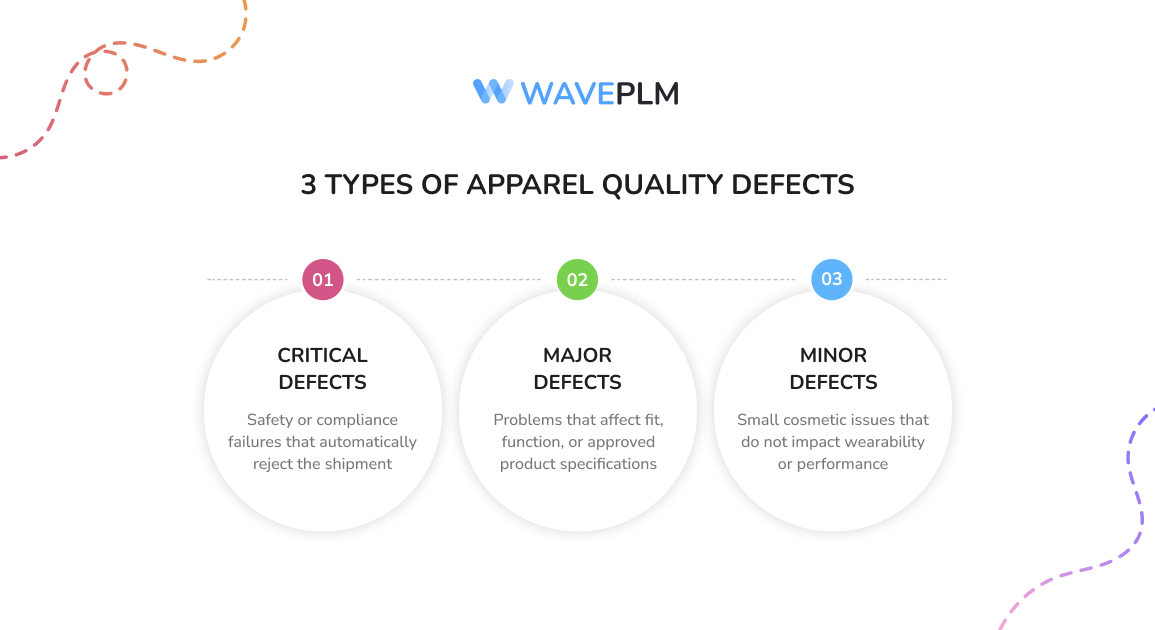
ISO 2859-1 defines three defect categories, and apparel brands apply them with product-specific criteria. The category determines both the AQL threshold and the urgency of response. Getting the classification right is not just a compliance exercise — it directly affects which defects can slip through and which trigger a shipment hold.
Critical Defects
A critical defect creates a safety hazard or poses a legal risk. In apparel, this includes drawstrings on children’s hoodies longer than the EU/US safety limit, decorative buttons or charms that fail small-parts tests, sharp metal hardware that could scratch skin, and fabric dyes that exceed Oeko-Tex REACH limits for restricted substances. The accepted AQL for critical defects is zero — a single critical defect in the sample fails the entire lot.
Major Defects
A major defect makes the garment unwearable or significantly different from spec. Measurement deviations beyond the agreed tolerance (typically ±1–2 cm depending on the specification), broken or stuck zippers, unacceptable color variance between the approved shade and the production run, missing labels, and construction failures like open seams all qualify as major. The standard threshold is AQL 2.5.
Minor Defects
A minor defect is cosmetic and does not affect fit or function. Examples include a loose thread end trimmed below the surface level, a slight irregularity in the stitch density visible only under magnification, or a very small (under 2mm) print registration offset. The standard threshold is AQL 4.0.
| Defect Type | Definition | Apparel Examples | Standard AQL |
|---|---|---|---|
| Critical | Safety hazard or legal violation | Long drawstrings on kids’ wear, toxic dye, sharp hardware, choking-risk embellishments | 0 (zero tolerance) |
| Major | Affects function, fit, or appearance significantly | Measurement out of tolerance, broken zipper, wrong color, open seam, missing label | 2.5 |
| Minor | Cosmetic only, does not affect wearability | Loose thread end, slight print offset under 2mm, minor stitching irregularity | 4.0 |
Our finding: Brands working with Wave PLM consistently find that misclassifying a defect as minor when it’s actually major is the most common cause of disputed inspection results with factories. Building an explicit defect classification list into your digital spec sheet — with photos — eliminates most of these disputes before they start.
How Do You Read the AQL Sample Size Table?
The ISO 2859-1 sampling table maps your lot size to a sample size in two steps: first, find your inspection letter based on lot size and inspection level; second, find your sample size and accept/reject numbers based on that letter and your chosen AQL. General Inspection Level II is the standard default for most apparel shipments (ISO 2859-1, 1999).
Step 1: Find Your Inspection Letter
Look up your lot size in the first table. A lot of 501–1,200 units at General Level II gives you letter “J.” A lot of 1,201–3,200 units gives you “K.” A lot of 3,201–10,000 units gives you “L.”
| Lot Size | General Inspection Level II Letter | Sample Size |
|---|---|---|
| 2–8 | A | 2 |
| 9–15 | B | 3 |
| 16–25 | C | 5 |
| 26–50 | D | 8 |
| 51–90 | E | 13 |
| 91–150 | F | 20 |
| 151–280 | G | 32 |
| 281–500 | H | 50 |
| 501–1,200 | J | 80 |
| 1,201–3,200 | K | 125 |
| 3,201–10,000 | L | 200 |
| 10,001–35,000 | M | 315 |
Step 2: Find Your Accept and Reject Numbers
With your letter in hand, look up the accept (Ac) and reject (Re) numbers for your AQL level. These are the thresholds that determine whether your lot passes or fails.
| Sample Letter | Sample Size | AQL 0 (Critical) Ac/Re | AQL 2.5 (Major) Ac/Re | AQL 4.0 (Minor) Ac/Re |
|---|---|---|---|---|
| H | 50 | 0 / 1 | 3 / 4 | 5 / 6 |
| J | 80 | 0 / 1 | 5 / 6 | 7 / 8 |
| K | 125 | 0 / 1 | 7 / 8 | 10 / 11 |
| L | 200 | 0 / 1 | 10 / 11 | 14 / 15 |
| M | 315 | 0 / 1 | 14 / 15 | 21 / 22 |
Reading the table: if your shipment is 2,000 units (letter K, sample size 125) and your inspector finds 6 major defects in 125 pieces, the lot passes — because 6 is below the reject number of 8. If they find 8, the lot fails. The decision is binary and non-negotiable.
For more context on how accurate documentation links to fewer inspection failures, see our guide on BOM management in fashion production.
What AQL Levels Should Apparel Brands Actually Use
The default AQL setup used by most apparel brands sourcing from Asia and Eastern Europe is Critical 0 / Major 2.5 / Minor 4.0. This combination was established as the industry norm well before the ISO standard was formalized, and it has remained the de facto benchmark because it balances consumer expectations with manufacturing reality (QIMA, 2024).
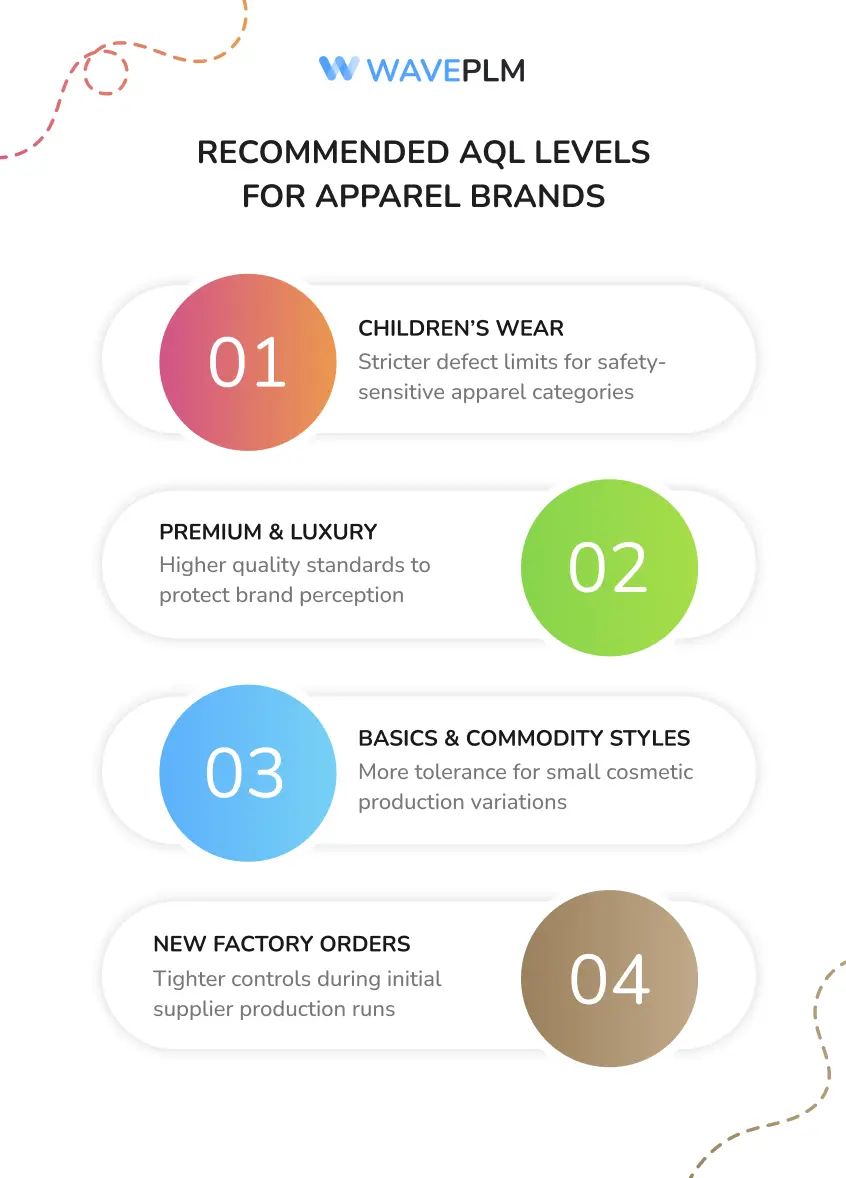
However, the right levels depend on your product, your customer, and your margin for error:
- Children’s wear and safety-sensitive products: Critical 0, Major 1.5, Minor 2.5. Stricter thresholds reflect stricter liability exposure.
- Premium and luxury brands: Critical 0, Major 1.5, Minor 1.5. Higher price points mean customers expect near-perfection, and returns are proportionally more damaging.
- Basics and commodities: Critical 0, Major 2.5, Minor 6.5. Buyers of plain T-shirts tolerate minor cosmetic variation more than buyers of tailored jackets.
- First order from a new factory: Consider tightening to Major 1.5 for the first 2–3 production runs until you understand the factory’s capability level.
Our finding: Brands that document their AQL levels in their purchase orders and cost sheets — not just verbal agreements — report significantly fewer disputes about what constitutes a “passed” inspection. Specificity in writing is free; rework is not.
One common misunderstanding: AQL 2.5 does not mean “2.5% of garments in a lot are defective.” It means the lot was inspected using thresholds calibrated to reject lots that exceed roughly a 2.5% defect rate — but statistical sampling means some defective units will still pass. AQL is a risk management tool, not a guarantee.
Tightening your AQL reduces the risk of defects slipping through but increases inspection cost and rejection sensitivity. For most brands, Major 2.5 strikes the right balance — strict enough to catch real quality failures, lenient enough to avoid rejecting lots for trivial variation.
What Types of Inspections Use AQL in Apparel Production?
AQL sampling applies across all stages of garment inspection, not only final shipment checks. Brands that catch quality problems earlier in the production cycle spend significantly less on rework — because fixing an issue at 30% production costs a fraction of fixing it after 100% is complete.
| Inspection Type | Timing | What It Checks | Best Used When |
|---|---|---|---|
| Pre-Production (PPI) | Before bulk production starts | Raw materials, trim quality, lab test results, first pre-production sample | New factory, new fabric, or critical compliance product |
| During Production (DUPRO / IPI) | ~20–30% of production complete | Inline garments off the line, measurement checks, stitching quality | Large orders, new styles, or factories with a history of late-stage defects |
| Final Random Inspection (FRI / PSI) | 80–100% packed, ready to ship | Full AQL sampling across finished, packed cartons; measurements, appearance, labeling | Every shipment — this is the standard mandatory check |
| Container Loading Supervision (CLS) | During loading into container | Carton condition, packing list accuracy, quantity count | High-value or fragile shipments, or when factory loading practices are untested |
For brands working with multiple factories simultaneously, coordinating inspection schedules across suppliers is one of the harder logistics challenges. See how multi-factory production coordination works in practice.
The FRI is non-negotiable. The other inspections are investments: each one you add reduces the probability of a shipment-level failure, but adds cost. For most SMB brands, a DUPRO + FRI combination on new styles, and FRI-only on proven reorder styles, is the right balance.
How Does PLM Software Help Track AQL Inspection Results?
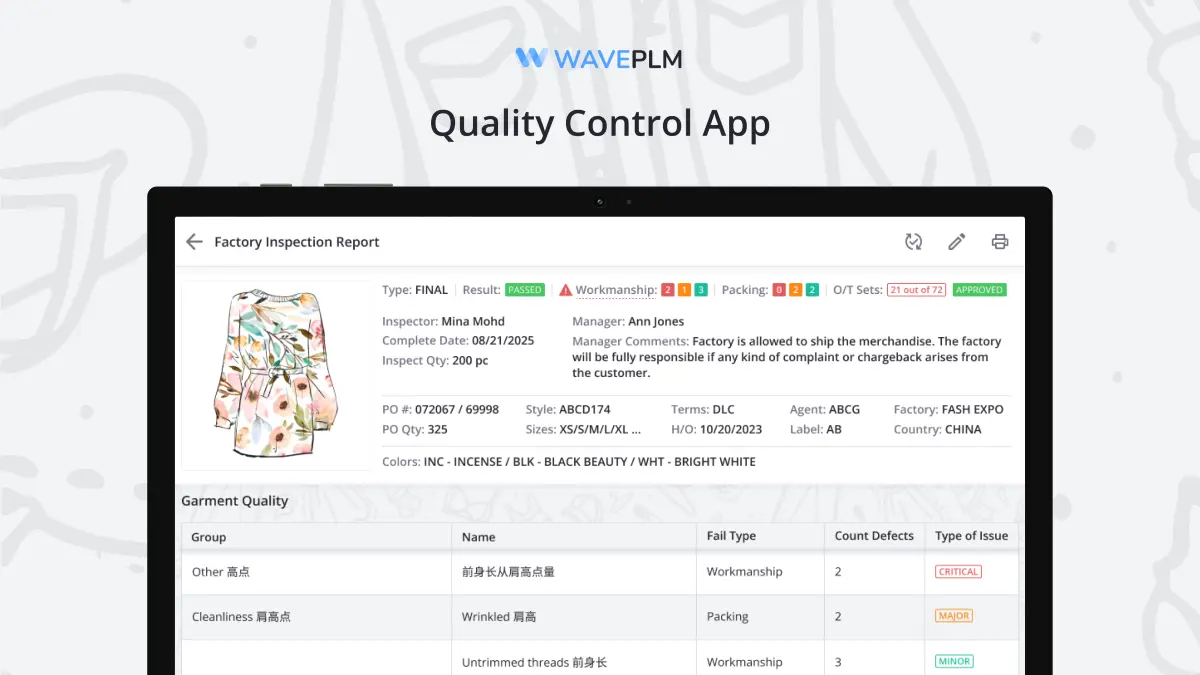
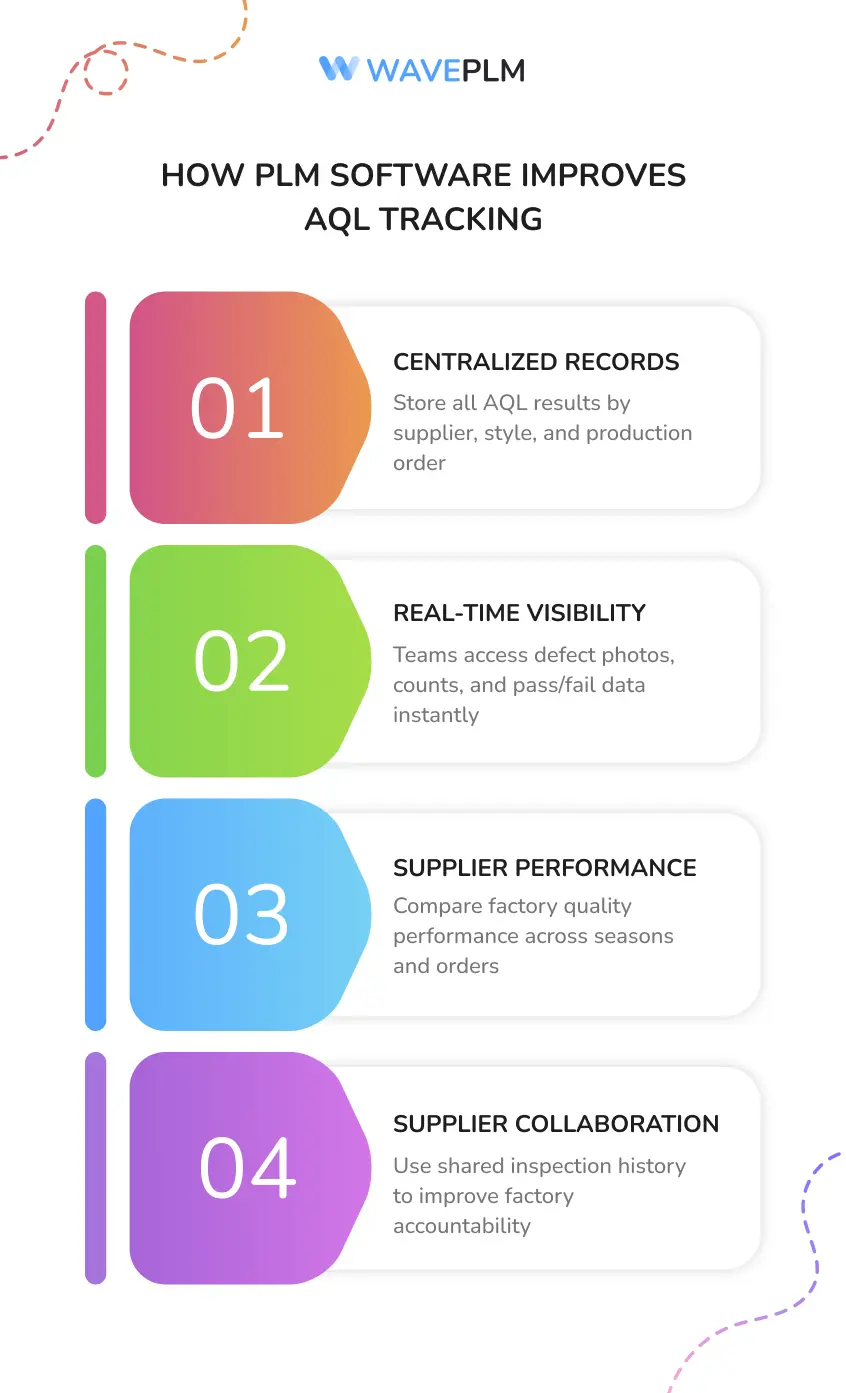
Recording AQL results in spreadsheets or email threads creates a practical problem: when a factory ships a defective lot, you rarely have the historical data to know whether this is a one-off or part of a pattern. PLM software solves this by storing every inspection result against the specific supplier, style, and production order — making defect trends visible across seasons.
In Wave PLM, inspection data lives alongside the tech pack and BOM for each style. When an inspector submits results — defect counts by type, photos of specific issues, pass/fail status — that data is immediately accessible to the sourcing team, designer, and QA manager. There’s no email chain to dig through and no spreadsheet that hasn’t been updated yet.
The more useful capability is supplier benchmarking: over time, you can see which factories consistently pass at Major 2.5 and which ones regularly push the reject boundary. That data changes how you allocate orders — moving volume toward reliable suppliers and using inspection data as leverage in supplier conversations, rather than anecdote.
It also connects to supplier collaboration workflows: when factories can see their own inspection history in a shared portal, the conversation about quality becomes data-driven rather than adversarial.
Our finding: Wave PLM customers who track inspection results by supplier — rather than by order — identify underperforming factories on average two seasons earlier than brands using spreadsheets. That pattern recognition is only possible when results are stored against the supplier record, not buried in per-order files.
If your team is still managing QC results in email and Google Sheets, see how Wave PLM handles inspection tracking alongside the rest of your product development workflow.
Frequently Asked Questions
What does AQL stand for in apparel?
AQL stands for Acceptable Quality Limit (also called Acceptable Quality Level). It defines the maximum percentage of defective units a buyer is willing to accept in a shipment. In apparel, brands commonly use AQL 2.5 for major defects and AQL 4.0 for minor defects, per ISO 2859-1. The standard is applied using statistical sampling, not 100% inspection.
What is the most common AQL level used in garment production?
AQL 2.5 is the most widely used threshold for major defects in garment production globally. Critical defects are held to zero tolerance (AQL 0), while minor defects typically use AQL 4.0. These levels are applied using General Inspection Level II under ISO 2859-1, and they represent the industry default across fast fashion, mid-market, and many premium brands.
How many garments do you need to inspect for AQL?
Sample size depends on lot size and inspection level. For a shipment of 1,201 to 3,200 units at General Inspection Level II (the standard), you inspect 125 units. For 501–1,200 units, you inspect 80. The ISO 2859-1 table maps lot size to a letter code, which maps to a specific sample size and accept/reject number for each AQL level.
What is the difference between a major and minor defect in apparel?
A major defect affects the garment’s function, fit, or appearance in a way that would cause a reasonable customer to return it — wrong measurements beyond tolerance, broken zipper, significant color mismatch. A minor defect is purely cosmetic and does not affect wearability, such as a small loose thread or very slight stitching irregularity below a 2mm threshold.
When should you do an AQL inspection — before or after production?
Most apparel brands run a Final Random Inspection (FRI) when 80–100% of production is complete and packed — this is the standard minimum. Adding a During Production inspection at roughly 30% completion allows you to catch systemic defects early, before hundreds of flawed units accumulate. For new factories or new styles, both inspections together significantly reduce end-of-production surprises.
What happens when a shipment fails AQL inspection?
When a lot fails AQL inspection, the buyer has three options: reject the lot and require the factory to rework or replace it; negotiate a discount and accept the goods as-is; or request that the factory conduct 100% sorting to remove defective units before reshipment. The right response depends on the severity of the defects, how close you are to your ship window, and whether the factory has a credible rework plan. Brands that define this process in writing — in the purchase order, not just verbally — avoid prolonged disputes when failures happen.
Do you need a third-party inspection company for AQL, or can you do it in-house?
You can conduct AQL inspection in-house if you have trained QC staff at or near the factory. However, most small and mid-size apparel brands use third-party agencies such as QIMA, Bureau Veritas, SGS, or Intertek because maintaining an in-house QC team overseas is rarely cost-effective below a certain order volume. Third-party inspectors are also harder for factories to pressure, and their reports provide an independent, documented record that carries weight if a dispute escalates. For brands with high inspection frequency, some agencies offer subscription models that reduce per-inspection cost significantly.
Getting Your AQL Process Right the First Time
AQL inspection is not complicated once you understand the three inputs: defect classification, lot size, and AQL threshold. The most common mistakes brands make are not about the math — they’re about documentation. Defect lists that aren’t agreed with the factory in advance. AQL thresholds set verbally, not in writing. Inspection results stored in email threads that nobody can find when there’s a dispute.
A clean AQL process starts with a clear spec sheet and digital defect classification list, runs through an inspection protocol agreed with the factory before production starts, and ends with results documented against the specific production order. If you’re still building that process, our guide to quality control in the clothing industry is a good place to start.
For teams looking to reduce sampling rounds and catch quality problems earlier in the development cycle, see our guide on reducing sample rounds in apparel development.



Leave a Reply