

Fashion companies succeed when creativity meets smart business decisions. Designers imagine collections, but merchandising teams decide what reaches stores, how products are priced, and how inventory moves through retail operations. Because of this responsibility, many professionals pursue a fashion merchandising master to build advanced knowledge of the industry.
This guide explains what students learn in a master merchandising program, how the graduate program works, and what career opportunities graduates can expect. It also explores how merchandising connects fashion creativity, supply chain management, and retail strategy.
What Is a Fashion Merchandising Master?
A fashion merchandising master is a graduate program designed for students who want to specialize in the commercial side of the fashion industry. Universities often offer the degree as a master of science within departments focused on consumer sciences, retail management, or apparel and textiles. Specialized colleges with strong industry connections also offer focused master’s degree programs in fashion merchandising, providing access to a professional network and high-quality business and fashion management education.
The master’s program trains graduate students to analyze market demand, develop product assortments, and manage retail performance. While designers focus on creative work and aesthetics, merchandising professionals focus on product planning, pricing, and distribution. A master’s degree in merchandising often emphasizes sustainability, health and wellness, and social responsibility.
Many universities structure this degree as part of higher education programs in fashion business or retail management. Students explore both analytical and creative aspects of fashion, including consumer behavior, product lifecycle planning, and branding strategies.
Typical program characteristics include:
| Program Element | Description |
|---|---|
| Degree type | Master of Science or master’s degree |
| Focus | Fashion merchandising, retail management, and product development |
| Departments | Consumer sciences, apparel and textiles, or business |
| Student type | Graduate students, professionals, and international students |
Graduate students often pursue this degree after completing an undergraduate program in fashion, textiles, marketing, or business.
Most programs last 1-2 years and are available in both on-campus and online formats.
What Students Learn in a Master in Merchandising
A master in merchandising covers many aspects of the fashion industry. The curriculum combines business strategy, consumer sciences, and retail analytics.
Most universities structure the graduate program around three main pillars: product strategy, retail management, and industry research. Understanding the product lifecycle is essential for merchandisers planning seasonal collections.
Core Courses in Fashion Merchandising
Students usually complete courses that build both analytical and strategic skills.
| Course Area | What Students Study |
| Fashion retail strategy | Store planning, assortment building, and retail operations |
| Supply chain management | Global production systems and logistics |
| Consumer behavior | How customers make purchasing decisions |
| Fashion marketing | Brand communication and campaign strategy |
| Product development | Planning seasonal apparel collections |
| Textile science | Fabric technology and material innovation |
These courses help graduate students understand how fashion products move from concept to retail shelves.
Understanding the product lifecycle is essential for merchandisers planning seasonal collections.
Fashion companies rely on merchandising professionals who understand development cycles, manufacturing timelines, and retail demand.
Skills Developed in a Master Merchandising Program
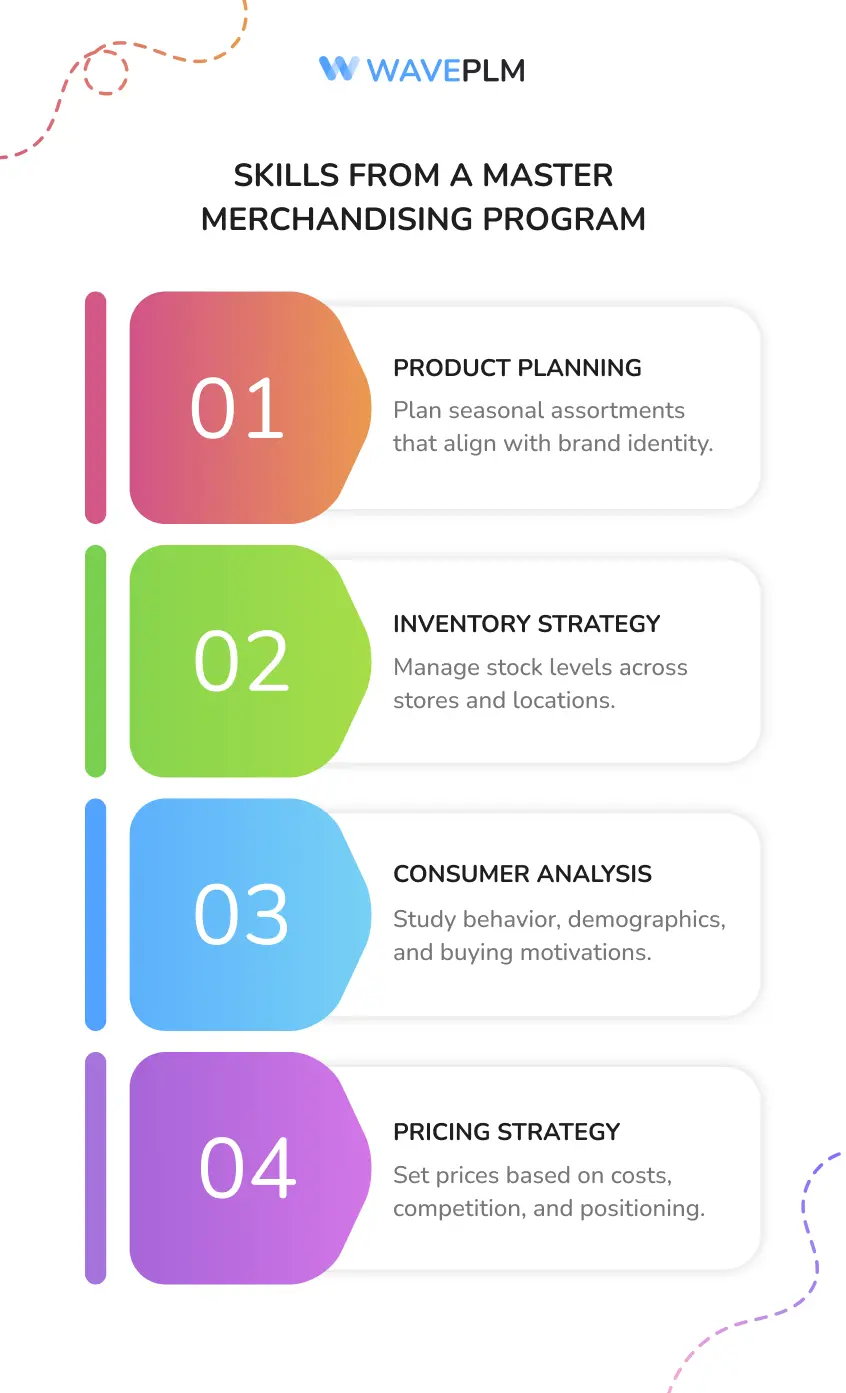
A fashion merchandising master builds practical skills used across the merchandising field. Students learn to analyze data, forecast demand, and manage retail performance.
Below are several important capabilities graduates develop.
| Skill | Application in the Industry |
| Product planning | Designing balanced apparel assortments |
| Inventory strategy | Managing stock levels across retail stores |
| Data analytics | Evaluating product performance and demand |
| Consumer analysis | Understanding shopping patterns |
| Pricing decisions | Aligning price points with brand positioning |
Product Planning
Merchandisers plan collections so that apparel categories complement each other. They decide which garments belong in a seasonal assortment and how each piece fits the brand identity.
Inventory Strategy
Retail operations depend on accurate inventory management. Merchandisers must ensure the right products reach the right locations.
If stores receive too much inventory, markdowns reduce profit. If stores receive too little, brands lose potential sales.
Consumer Analysis
Graduate students study consumer behavior to understand purchasing decisions. They examine demographics, lifestyle trends, and cultural influences.
These insights help fashion brands design collections that resonate with customers.
Pricing Strategy
Pricing decisions are a core responsibility of merchandising professionals. Pricing influences profitability, brand perception, and market positioning. Pricing decisions are a core responsibility of merchandisers in fashion brands.
Retail teams analyze production costs, competitor prices, and target customer expectations before setting price levels.
Research and Creative Scholarship in Fashion Programs
Many universities emphasize research and creative scholarship in their graduate programs.
Graduate students often collaborate with faculty on industry research projects related to consumer sciences, sustainability, or textile innovation. The list of careers in fashion is extensive.
Some programs require a thesis as part of degree completion. A thesis allows students to explore specific topics such as:
- retail analytics
- sustainable apparel production
- global supply chains
- fashion marketing strategies
Research projects help graduates develop expertise that benefits both academia and industry professionals.
Admissions Requirements for a Merchandising Master’s Program
Universities typically require applicants to submit several materials during the admissions process.
| Application Requirement | Description |
| Personal statement | Explains academic interests and career goals |
| Letters of recommendation | Faculty or professional references |
| Undergraduate transcripts | Proof of previous education |
| Portfolio or project | Creative work or merchandising project |
Applicants often submit a personal statement describing their interest in the merchandising field and the career path they plan to pursue.
International students may also provide language test scores and additional documentation required by the university.
Many institutions offer graduate assistantships that allow students to work with faculty while completing their master’s degree.
Online Learning and Flexibility in Fashion Merchandising
The master’s program in Fashion Merchandising now offers robust online learning options, making it easier than ever for graduate students to pursue advanced education while balancing work, family, or other commitments. Through a flexible online format, students can access coursework in consumer behavior, fashion merchandising, and retail management from anywhere in the world—ideal for international students seeking a globally recognized science degree.
Online courses are designed to mirror the rigor and depth of on-campus offerings, covering essential topics such as supply chain management, textile science, and sustainability. Students engage with industry professionals through virtual networking events, collaborative projects, and guest lectures, gaining real-world insights into the merchandising field.
The online learning platform also features advanced tools for data analytics and market research, allowing students to develop critical skills in analyzing trends, forecasting demand, and making strategic decisions. Whether your career goals include retail operations, creative scholarship, or leadership in supply chain management, the online master of science program provides the flexibility and resources needed to succeed.
This accessible format empowers students to tailor their education to their interests and schedules, supporting a diverse range of career paths in the fashion industry. With a focus on both creative and analytical skills, the online program prepares graduates to excel in merchandising, retail management, and beyond.

University Resources and Support for Merchandising Students
Fashion merchandising students benefit from a comprehensive network of university resources and support services designed to foster academic and professional success. Graduate assistantships offer hands-on experience and the opportunity to collaborate with faculty on research and creative work, while career counseling and academic advising help students clarify their career goals and navigate the path to degree completion.
The department of consumer sciences provides access to state-of-the-art textile labs, design studios, and business centers, where students can develop their skills in merchandising, marketing, and branding. These facilities support both research and creative scholarship, allowing students to explore innovative approaches to retail management and product development.
Collaboration is a cornerstone of the program, with opportunities to work alongside industry professionals and nationally recognized faculty on projects that bridge theory and practice. The curriculum emphasizes higher education and career development, ensuring that students graduate with the expertise needed for leadership roles in the merchandising field.
From the application process—where applicants submit a personal statement, letters of interest, and details of their undergraduate coursework—to graduation and beyond, the university’s services are designed to support every stage of the student journey. Faculty and staff are committed to providing a high-quality education and helping students achieve their professional aspirations in the dynamic world of fashion merchandising.
Career Opportunities After a Fashion Merchandising Master
Graduates of a fashion merchandising master program enter many roles across the fashion industry. The degree prepares professionals for strategic positions that connect product development, marketing, and retail management.
Employment of fashion merchandising professionals is projected to grow by 7% through 2032, driven by global market expansion and digital retail. The global fashion market is expected to reach a value of over $2.25 trillion by 2030.
Colleges such as LIM College have strong connections to major industry players in the fashion world. Students at LIM College benefit from working closely with industry-expert faculty, and the college’s alumni network spans the business of fashion, providing valuable connections for students.
Drexel’s online master’s program offers opportunities to study abroad in various international locations, and networking opportunities are enhanced through residencies available in Philadelphia at Drexel University.
| Career Path | Responsibilities |
|---|---|
| Fashion merchandiser | Plans assortments and tracks sales performance |
| Retail buyer | Selects apparel collections for stores |
| Product manager | Oversees product development and lifecycle planning |
| Brand manager | Aligns product strategy with branding |
| Retail analyst | Uses data analytics to evaluate performance |
These career opportunities appear across fashion brands, retailers, and technology companies working with fashion supply chains.
Graduates may also pursue positions in consulting, retail strategy, or product development departments.
Why Merchandising Is Central to Fashion Brand Success
Merchandising sits at the center of the fashion business.
Design teams focus on aesthetics. Production teams focus on manufacturing. Retail teams focus on selling. Merchandisers connect these departments and guide strategic decisions.
Successful merchandising professionals balance three major elements:
| Factor | Impact on the Industry |
| Design creativity | Ensures collections stay visually compelling |
| Production realities | Aligns products with manufacturing capacity |
| Retail demand | Matches assortments with consumer needs |
When these elements align, fashion brands achieve strong retail performance and customer satisfaction.
How Technology Is Changing Fashion Merchandising
Technology now shapes the merchandising field in powerful ways. Fashion companies use digital platforms to manage product data, analyze sales, and coordinate supply chains.
Key technologies used by merchandising professionals include:
| Technology | Purpose |
| PLM systems | Manage product development and collaboration |
| Retail analytics tools | Track product performance |
| Demand forecasting software | Predict customer demand |
| Inventory systems | Improve retail operations |
These technologies allow merchandisers to combine creative thinking with data analytics. Many graduate programs now include technology courses that teach students how to use modern retail systems.

Example Merchandising Planning Framework
Fashion companies often follow a structured planning process when developing seasonal collections.
| Step | Key Question | Result |
| Trend research | What trends influence upcoming collections? | Trend direction report |
| Assortment planning | Which apparel categories belong in the line? | Product assortment |
| Pricing strategy | What price levels match the brand? | Pricing tiers |
| Production planning | How many units should factories produce? | Production plan |
| Retail allocation | Where should products be sold? | Store distribution plan |
This structured approach helps merchandising teams coordinate product development and retail strategy.
Conclusion
A fashion merchandising master prepares students for leadership roles in the global fashion industry. The graduate program combines business strategy, consumer sciences, retail management, and product development.
Graduate students gain analytical skills, industry knowledge, and research experience that help them succeed in the merchandising field.
As fashion companies adopt digital tools and data-driven decision making, merchandising professionals will play an even greater role in shaping retail strategy and product success.
For professionals interested in combining creativity with business expertise, a master in merchandising offers a powerful pathway into the fashion industry.




Leave a Reply