
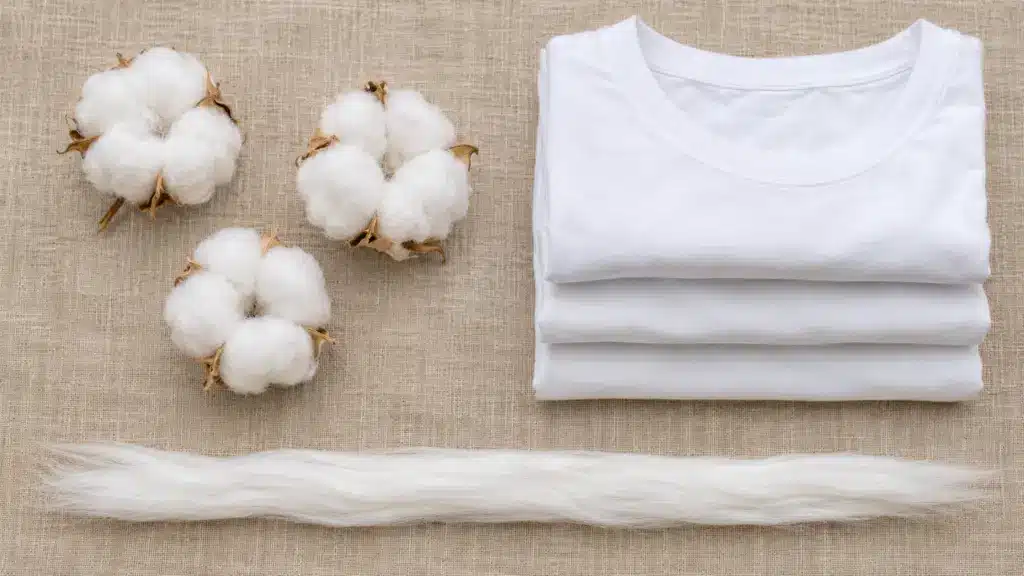
Supima cotton is American Pima cotton, an extra-long staple variety, grown in the United States and sold under a trademark owned by the Supima association. In practice, Supima cotton is a licensed brand of fibre, not a separate plant. For an apparel brand, that means two things. First, the fibre is longer and stronger than regular cotton. Second, you can only use the Supima name on a product through the licensing programme.
Most articles about Supima cotton are written for shoppers comparing T-shirts. This guide, however, is for the teams who buy it. Specifically, it covers how Supima differs from Pima, what it costs, how licensing and verification work, and how to label it without risk.
What Is Supima Cotton?
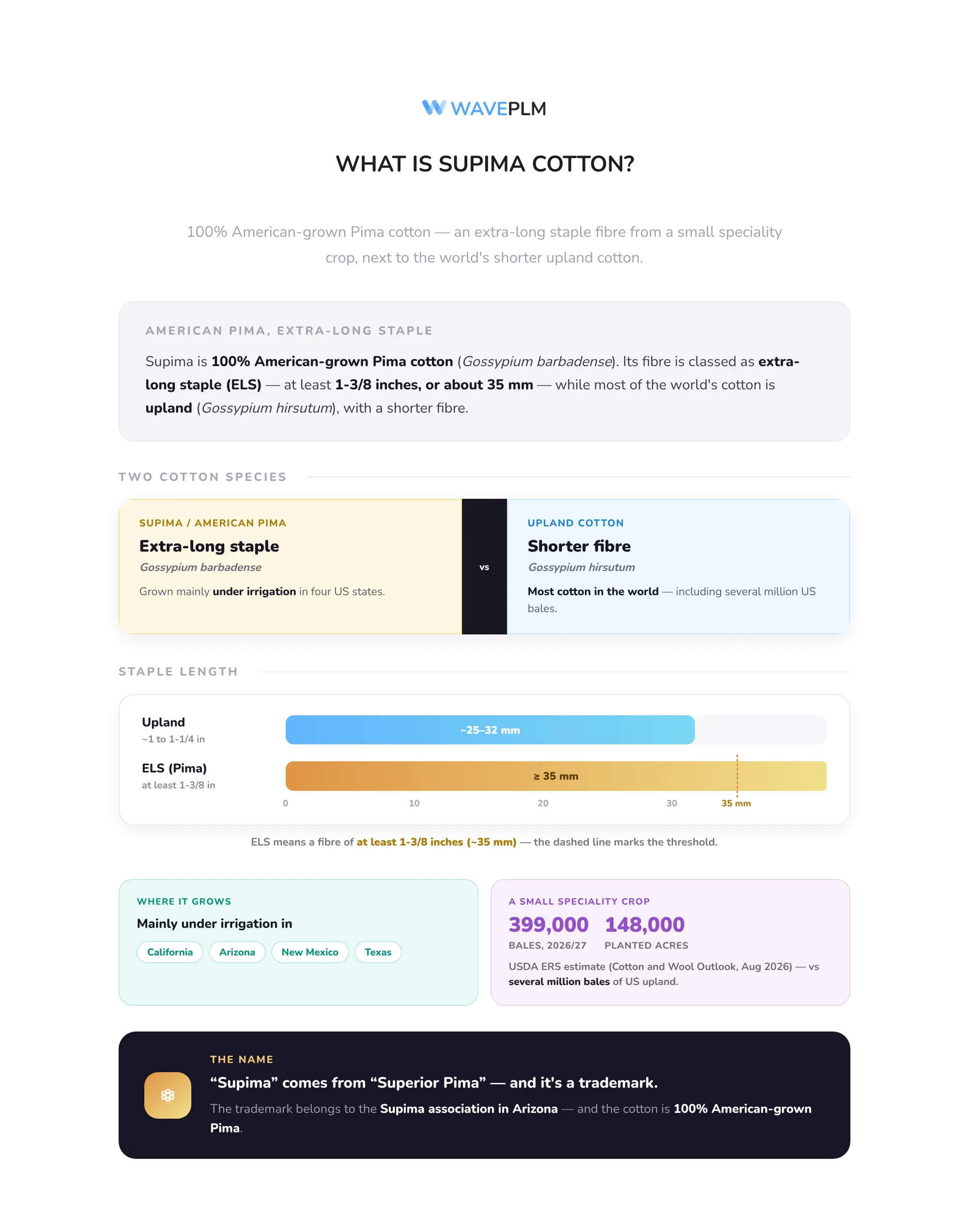
Supima cotton is 100% American-grown Pima cotton, from the species Gossypium barbadense. The name comes from “Superior Pima”, and the trademark belongs to the Supima association in Arizona. By contrast, most cotton in the world is upland cotton, Gossypium hirsutum, with a shorter fibre.
Notably, the difference starts in the field. American Pima grows mainly under irrigation in California, Arizona, New Mexico, and Texas. Its fibre is classed as extra-long staple (ELS), which means at least 1-3/8 inches, or about 35 mm. Typically, upland cotton is around an inch to 1-1/4 inches.
Industry data: USDA’s Economic Research Service estimated the 2026/27 American Pima crop at 399,000 bales from 148,000 planted acres (Cotton and Wool Outlook, August 2026). That is a small speciality crop next to US upland production of several million bales.
What Is the Difference Between Supima and Pima Cotton?
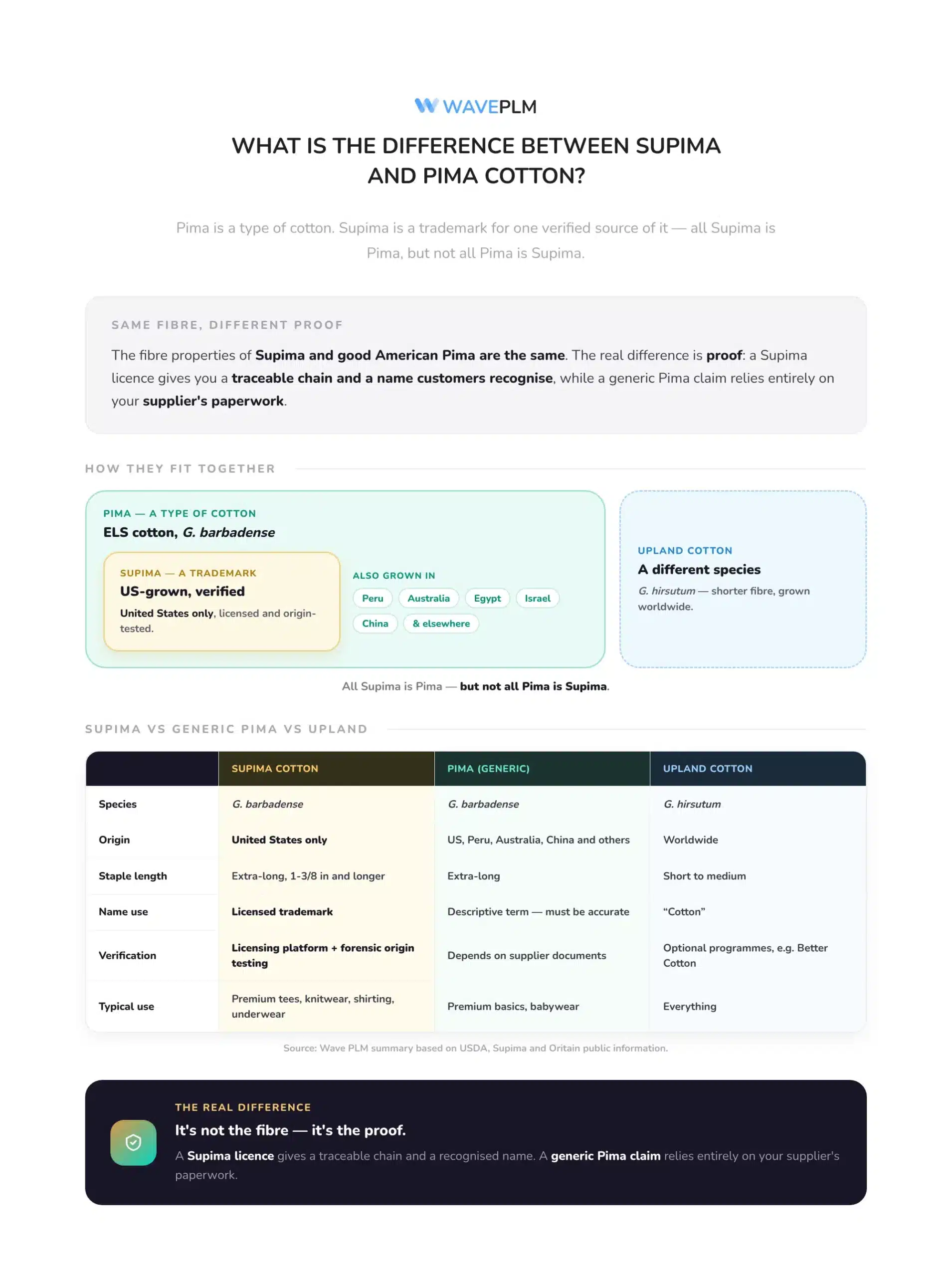
To begin with, Pima is a type of cotton. Supima, by contrast, is a trademark for one verified source of it. All Supima cotton is Pima, but not all Pima cotton is Supima. Pima-type ELS cotton is also grown in Peru, Australia, Egypt, Israel, China, and elsewhere.
| Supima cotton | Pima cotton (generic) | Upland cotton | |
|---|---|---|---|
| Species | G. barbadense | G. barbadense | G. hirsutum |
| Origin | United States only | US, Peru, Australia, China and others | Worldwide |
| Staple length | Extra-long, 1-3/8 inches and longer | Extra-long | Short to medium |
| Name use | Licensed trademark | Descriptive term, must be accurate | “Cotton” |
| Verification | Licensing platform plus forensic origin testing | Depends on supplier documents | Optional programmes, e.g. Better Cotton |
| Typical use | Premium tees, knitwear, shirting, underwear | Premium basics, babywear | Everything |
In other words, the fibre properties of Supima and good American Pima are the same. The real difference is proof. A Supima licence gives you a traceable chain and a name customers recognise. A generic Pima claim, however, relies entirely on your supplier’s paperwork.
Why Is Supima Cotton More Expensive?
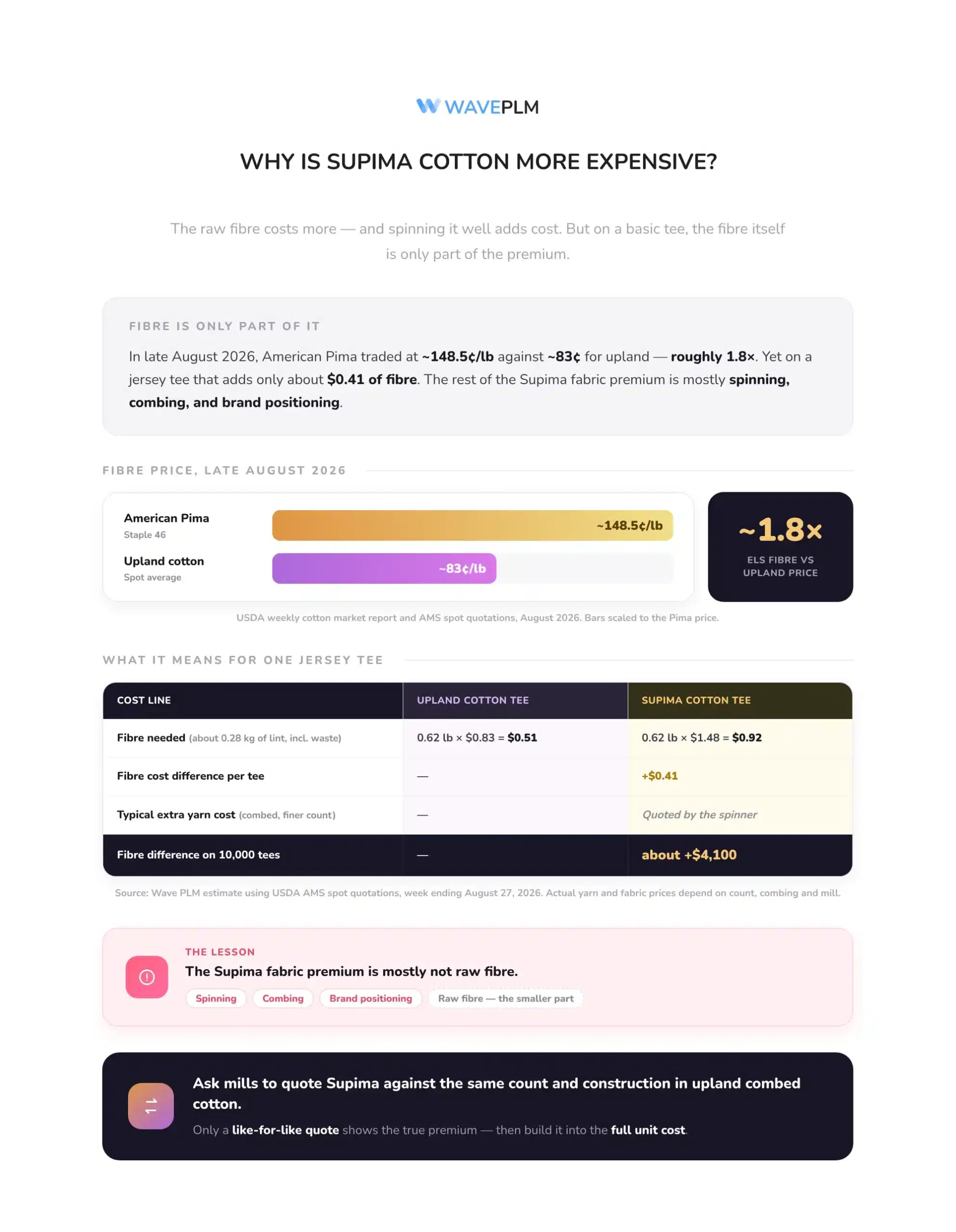
Supima cotton costs more because the raw fibre costs more and because spinning it well adds cost. In late August 2026, USDA’s weekly cotton market report quoted American Pima of staple 46 at about 148.5 cents per pound. Meanwhile, the upland spot average that month was around 83 cents. That makes the ELS fibre roughly 1.8 times the price of upland.
However, the fibre is only part of a garment’s cost. To show the effect, here is a simple Wave PLM estimate for a basic jersey T-shirt.
| Cost line | Upland cotton tee | Supima cotton tee |
|---|---|---|
| Fibre needed (about 0.28 kg of lint, including waste) | 0.62 lb × $0.83 = $0.51 | 0.62 lb × $1.48 = $0.92 |
| Fibre cost difference per tee | — | +$0.41 |
| Typical extra yarn cost (combed, finer count) | — | Quoted by the spinner |
| Fibre difference on 10,000 tees | — | about +$4,100 |
The lesson is that the premium you pay for Supima fabric is mostly spinning, combing, and brand positioning, not raw fibre. Therefore, ask mills to quote Supima fabric against the same count and construction in upland combed cotton. Only then can you see the true premium. For building that into a full unit cost, see our garment costing guide.
How Does Supima Licensing Work?
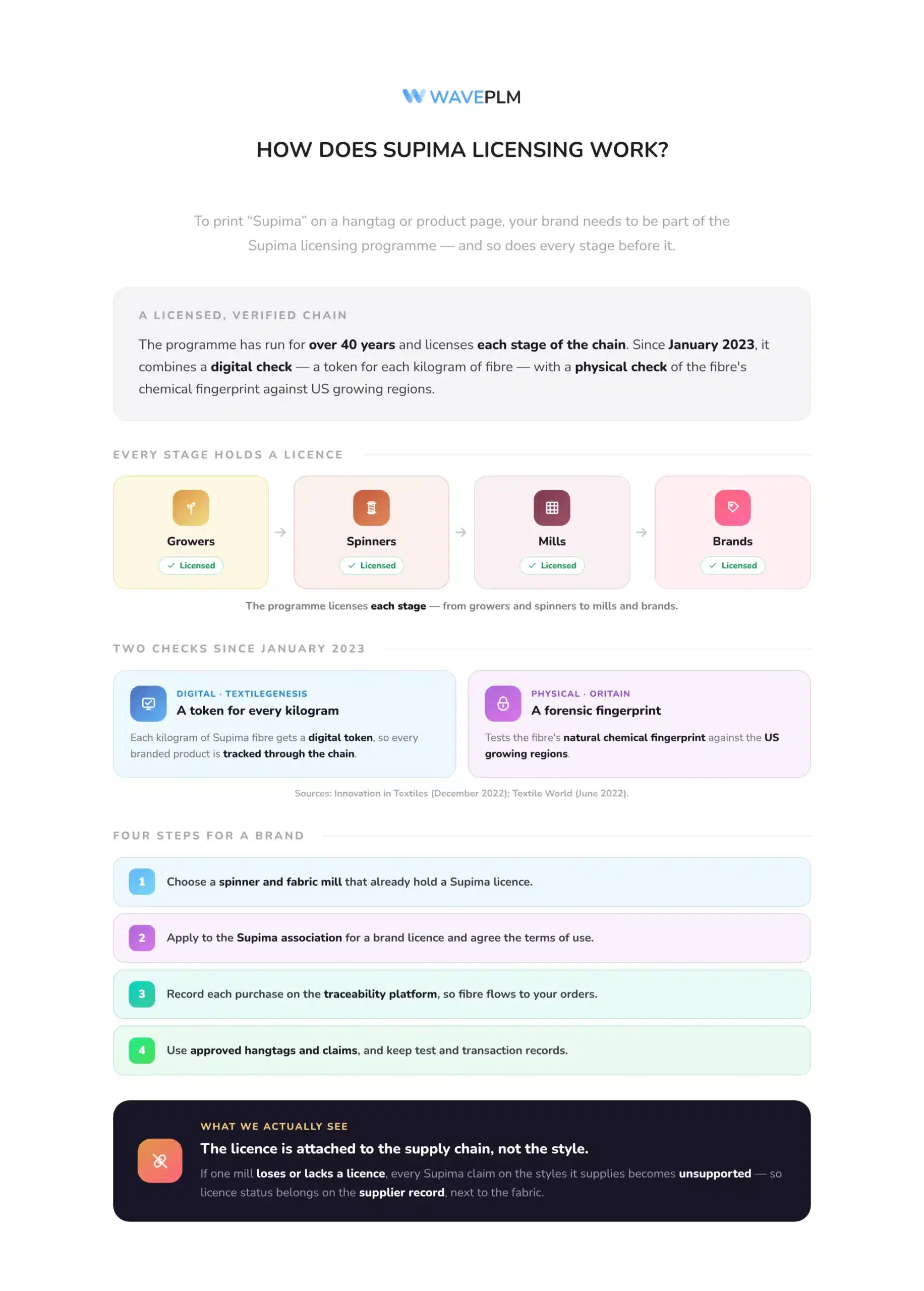
To print “Supima” on a hangtag or product page, your brand needs to be part of the Supima licensing programme. The programme has run for over 40 years, and it licenses each stage of the chain, from growers and spinners to mills and brands.
Since January 2023, licensing runs on a platform that combines digital and physical checks. According to Innovation in Textiles (December 2022), every Supima-branded product is digitally tracked through TextileGenesis and forensically verified by Oritain. Specifically, TextileGenesis assigns a digital token to each kilogram of Supima fibre, as Textile World reported in June 2022. In addition, Oritain tests the fibre’s natural chemical “fingerprint” against the US growing regions.
For a brand, the practical steps usually look like this:
- Choose a spinner and fabric mill that already hold a Supima licence.
- Apply to the Supima association for a brand licence and agree the terms of use.
- Record each purchase on the traceability platform, so fibre flows to your orders.
- Use approved hangtags and claims, and keep test and transaction records.
Our finding: The licence is attached to the supply chain, not to the style. If one mill in your chain loses or lacks a licence, every Supima claim on the styles it supplies becomes unsupported. That is why licence status belongs on the supplier record, next to the fabric.
How Is Supima Cotton Verified?
In practice, verification works on two levels. First, the digital trail shows that each lot of fibre moved through licensed partners. Second, Oritain’s forensic test checks the fibre itself. As Oritain explained in 2019, it measures intrinsic properties of the cotton that reflect the soil and water where it grew. Consequently, the test can flag cotton that was blended with or replaced by a cheaper fibre.
Testing can happen at any stage of the chain. For example, a brand can send yarn, fabric, or finished goods for analysis. Note, however, that origin testing does not measure fibre length. Fibre quality is graded separately when the cotton is classed.
Why does this matter? Premium cotton has a history of mislabelling. In 1997, the FTC announced that WestPoint-Stevens would pay a $360,000 civil penalty over sheets and towels labelled as made entirely of Pima cotton that were actually a blend. Similarly, the Egyptian cotton bedding scandal of 2016 showed how far a mislabelled premium fibre can spread before anyone tests it.
How Should You Label Supima Cotton Garments?
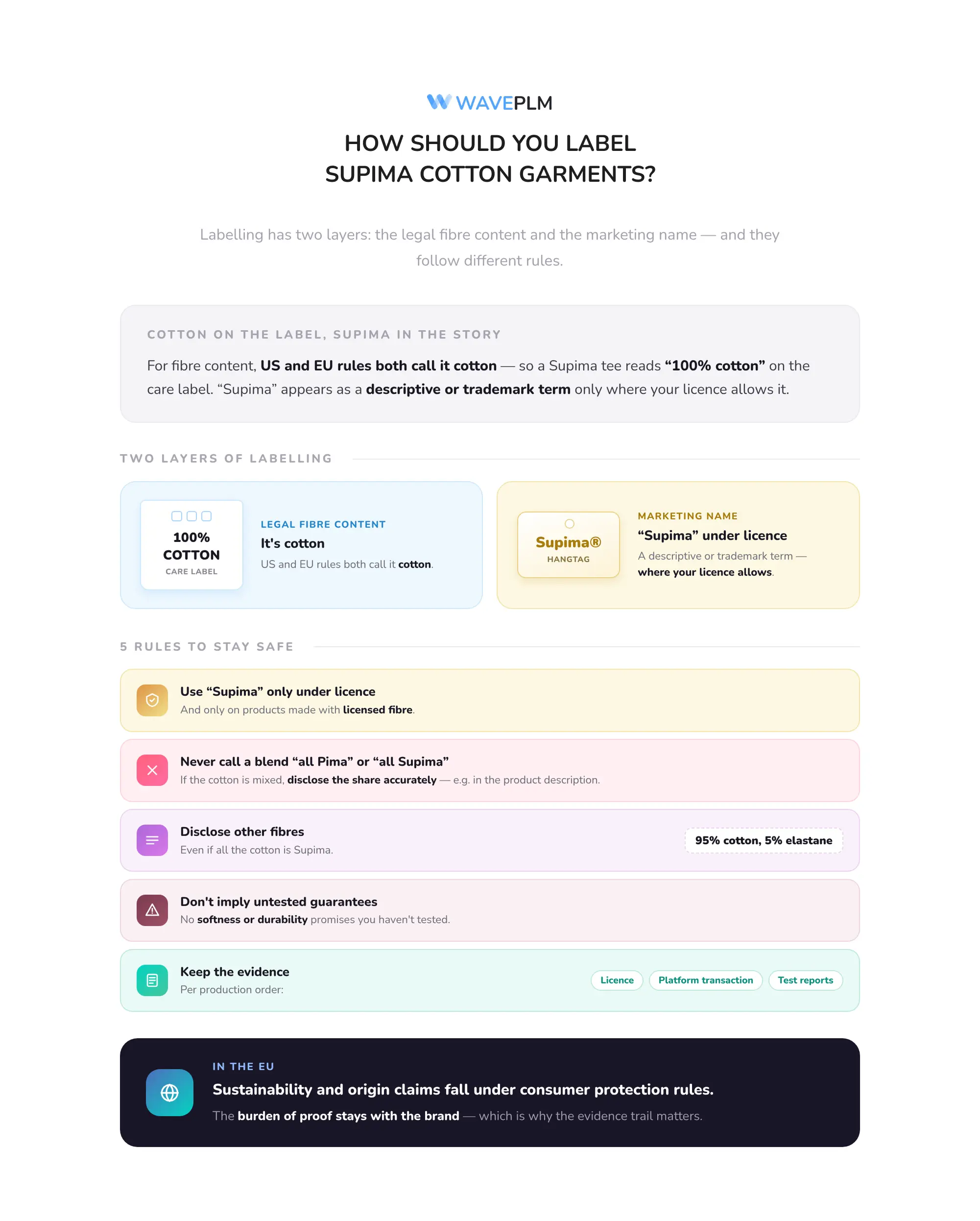
Importantly, labelling has two layers: the legal fibre content and the marketing name. For the fibre content, US and EU rules both call it cotton. So a Supima cotton tee is labelled “100% cotton” on the care label, while “Supima” appears as a descriptive or trademark term where your licence allows it.
Follow these rules to stay safe:
- Use “Supima” only under licence and only on products made with licensed fibre.
- Never call a blend “all Pima” or “all Supima”. If the cotton is mixed, disclose the share accurately, for instance in the product description.
- Disclose other fibres. A tee with elastane is “95% cotton, 5% elastane”, even if all the cotton is Supima.
- Do not imply softness or durability guarantees you have not tested.
- Keep the evidence: licence, platform transaction, and test reports per production order.
In the EU, claims about sustainability or origin also fall under consumer protection rules. As our article on the EU Green Claims Directive explains, the burden of proof stays with the brand.
How Should You Spec Supima Cotton in a Tech Pack?
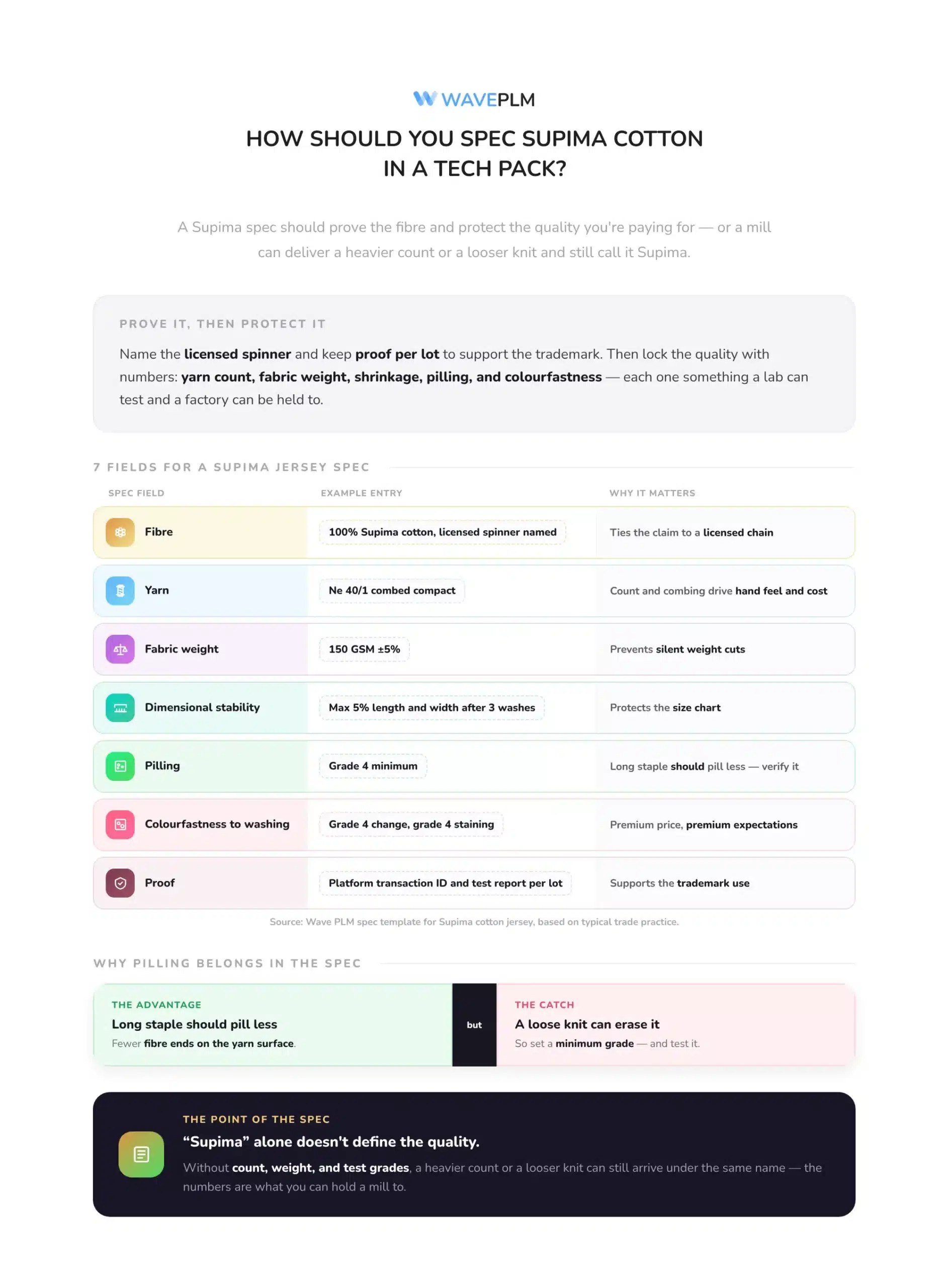
A Supima cotton spec should prove the fibre and protect the quality you are paying for. Otherwise, a mill can deliver a heavier count or a looser knit and still call it Supima. Use the fields below as a starting point.
| Spec field | Example entry | Why it matters |
|---|---|---|
| Fibre | 100% Supima cotton, licensed spinner named | Ties the claim to a licensed chain |
| Yarn | Ne 40/1 combed compact | Count and combing drive hand feel and cost |
| Fabric weight | 150 GSM ±5% | Prevents silent weight cuts |
| Dimensional stability | Max 5% length and width after 3 washes | Protects the size chart |
| Pilling | Grade 4 minimum | Long staple should pill less; verify it |
| Colourfastness to washing | Grade 4 change, grade 4 staining | Premium price, premium expectations |
| Proof | Platform transaction ID and test report per lot | Supports the trademark use |
For measuring weight, see our fabric GSM guide. Likewise, our fabric pilling test guide explains the ISO and ASTM methods. Long-staple cotton has fewer fibre ends on the yarn surface, so it should pill less. However, a loose knit can erase that advantage, which is why the grade belongs in the spec.
Supima Cotton vs Better Cotton and Organic Cotton
Supima, Better Cotton, and organic cotton answer different questions. Supima is about fibre type and US origin. Better Cotton, by contrast, is a farming-practice programme that mostly uses mass balance. Organic cotton, meanwhile, is about how the crop is grown, usually backed by GOTS certification through the chain.
As a result, they are not substitutes. In fact, a product can combine them, for example organic Pima. Just make sure each claim has its own proof, because one certificate does not cover the others.
When Is Supima Cotton Worth It?
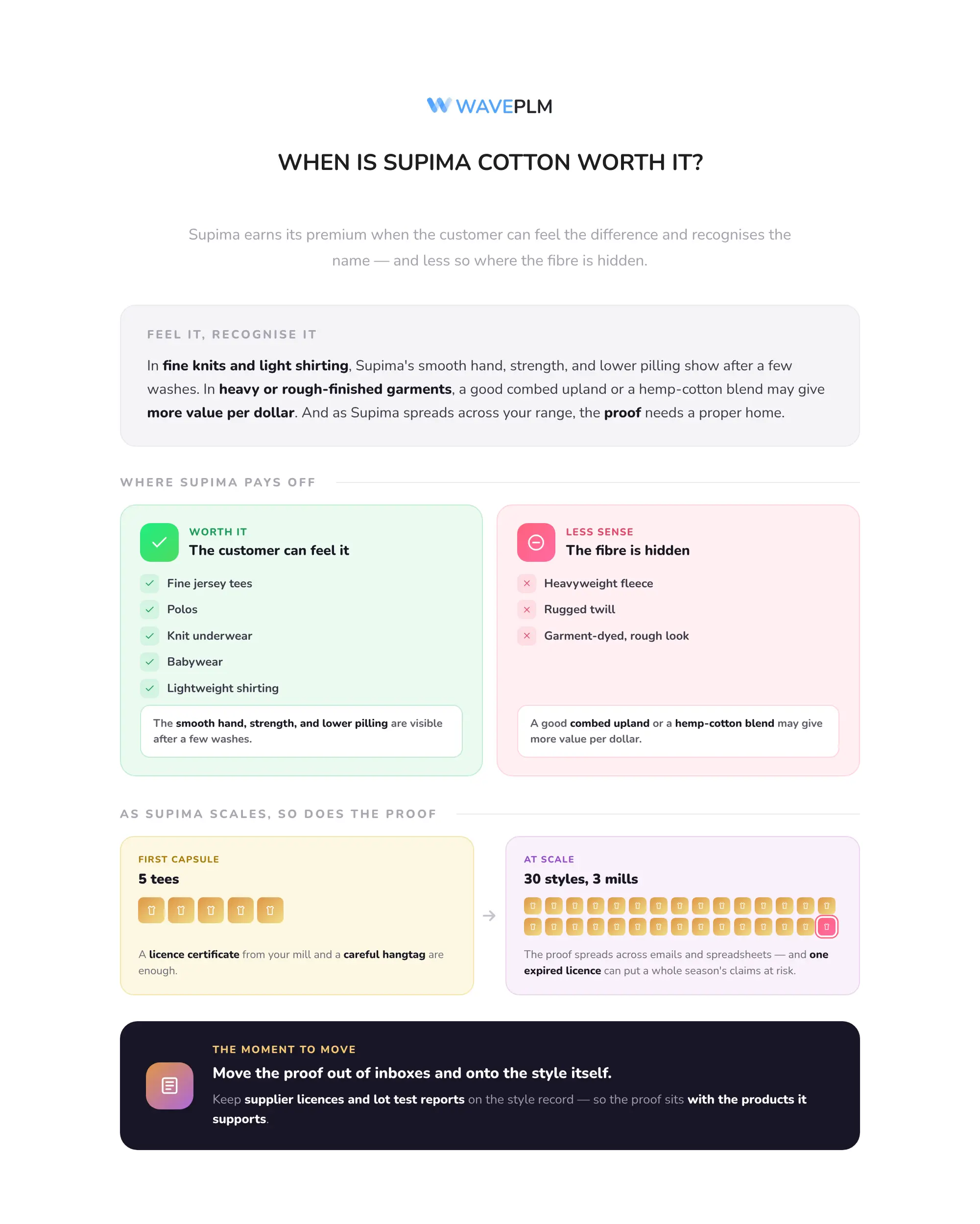
Supima cotton earns its premium when the customer can feel the difference and recognises the name. Typically, that means fine jersey tees, polos, knit underwear, babywear, and lightweight shirting. In those products, the smooth hand, strength, and lower pilling are visible after a few washes.
Conversely, Supima makes less sense in heavy garments where the fibre is hidden. Think heavyweight fleece, rugged twill, or garment-dyed pieces with a deliberately rough look. There, a good combed upland or a hemp-cotton blend may give more value per dollar.
For a first capsule of five tees, a licence certificate from your mill and a careful hangtag are enough. Once Supima runs across thirty styles and three mills, however, the proof spreads across emails and spreadsheets. At that point, one expired licence can put a whole season’s claims at risk. That is the moment to move the proof out of inboxes and onto the style itself, which is what Wave PLM does with supplier licences and lot test reports.
Frequently Asked Questions
What is Supima cotton?
Supima cotton is 100% American-grown Pima cotton, an extra-long staple fibre from Gossypium barbadense. “Supima” is a trademark owned by the Supima association. Brands can only use the name through its licensing programme, which tracks and tests the fibre through the supply chain.
Is Supima cotton the same as Pima cotton?
All Supima cotton is Pima cotton, but not all Pima cotton is Supima. Pima is a type of extra-long staple cotton grown in several countries. Supima is the licensed trademark for American-grown Pima that is traced and forensically verified.
Why is Supima cotton more expensive?
American Pima fibre traded around 148 cents per pound in late August 2026, versus about 83 cents for upland, according to USDA reports. Finer, combed yarns, licensing, and smaller volumes add further cost. At garment level, however, the fibre difference for a basic tee is well under a dollar.
Does Supima cotton shrink?
Supima cotton can shrink like any cotton if the fabric is not properly finished. The fibre type does not prevent shrinkage. Brands control it by specifying a maximum dimensional change, for example 5% after three washes, and by testing bulk fabric before cutting.
How do brands get a Supima licence?
Brands apply to the Supima association and source from licensed spinners and mills. Purchases are recorded on a traceability platform run with TextileGenesis, and Oritain carries out forensic origin tests. Approved hangtags and claims are then used on finished products.
How should a Supima cotton garment be labelled?
The care label lists the fibre as cotton, for example “100% cotton” or “95% cotton, 5% elastane”. The Supima name can appear on hangtags and product pages under licence. A blend of Supima and other cotton must never be described as all Supima or all Pima.
Conclusion
Supima cotton is the same premium fibre as good American Pima, plus a licensed chain of proof. That proof is what customers pay for, so treat it as part of the product. First, buy through licensed spinners and mills. Next, spec yarn count, weight, and pilling, not just the fibre name. Finally, keep licence and test records for every order. Done that way, Supima cotton becomes a premium you can defend, not a claim you hope nobody checks.



Leave a Reply