

A fashion product manager is the professional who bridges creative design and commercial execution inside an apparel brand. Specifically, this role owns the product line from concept sign-off through production handover. Day-to-day, this means managing specs, timelines, vendor coordination, and margin targets in parallel. At brands running 30 or more active styles per season, a dedicated fashion product manager typically reduces time-to-market by 20–30%. This advantage disappears when product oversight is split informally across design leads and founders.
In total, this guide covers the full scope of the fashion product manager role. Topics include core responsibilities, required skills, tools used, 2026 salary benchmarks, and how PLM supports daily work.
What Does a Fashion Product Manager Do?
A fashion product manager is responsible for taking a product from an approved design direction to a production-ready spec package. In practice, they work across four departments simultaneously: design, sourcing, production, and commercial. Notably, the scope varies by company size. At a 15-person brand, one PM may cover everything. At a 200-person retailer, the PM owns a specific category and reports to a head of product development.
In essence, the core function is translation. Converting commercial requirements — price point, margin target, delivery date — into product briefs that designers can execute. Additionally, this means converting design decisions into specifications that factories can produce accurately. Furthermore, the fashion product manager acts as the central escalation point. They intervene when a sourcing change, costing issue, or quality failure threatens a style’s viability for the season.
Our finding: Wave PLM customers with a dedicated product manager role onboard new factory relationships 40% faster than brands where product oversight is handled ad hoc across design leads and founders.

What Are the Core Responsibilities of a Fashion Product Manager?
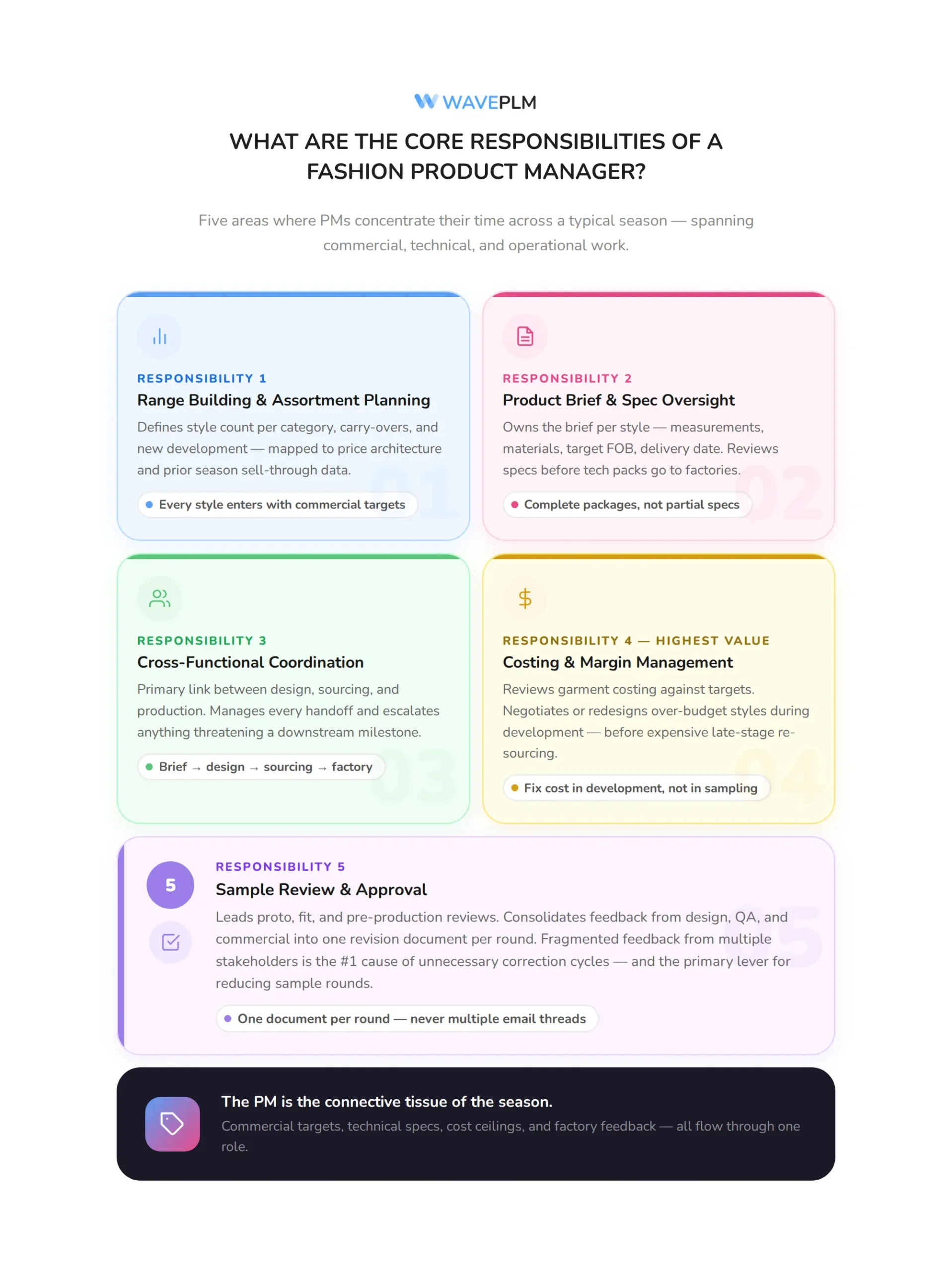
The responsibilities of a fashion product manager span the full fashion product development process. Specifically, the following five areas represent where most PMs concentrate their time across a typical season.
Range Building and Assortment Planning
Initially, the fashion product manager works with commercial and design teams to define the seasonal range. This covers how many styles per category, which carry-overs to retain, and where new development is needed. In practice, this requires reviewing sell-through data from the prior season and mapping new styles to the brand’s price architecture. As a result, each style enters development with defined commercial targets, not just a creative concept.
Product Brief and Spec Oversight
For each new style, the PM oversees creation of a product brief. This covers reference direction, key measurements, material requirements, target FOB cost, and delivery date. They review and approve the resulting spec sheet and bill of materials before tech packs go to factories. Consequently, factories receive technically complete packages rather than partial specs that generate costly clarification rounds.
Cross-Functional Coordination
The fashion product manager is the primary link between design, sourcing, and production. Specifically, they manage the handoff at each stage: brief to design, approved tech pack to sourcing, final spec to factory. They track whether each style is on its delivery calendar. Any decision that threatens a downstream milestone is escalated immediately.
Costing and Margin Management
Every style has a target retail price and an implied cost ceiling. The fashion product manager reviews garment costing against these targets. When a style comes in over budget, they work with sourcing to negotiate or redesign. Importantly, this is one of the highest-value areas of the role. A PM who actively manages cost during development prevents expensive re-sourcing late in the sampling cycle.
Sample Review and Approval
The fashion product manager leads sample review sessions for proto, fit, and pre-production rounds. They consolidate comments from design, QA, and commercial teams into a single revision document for the factory. Notably, structured sample review is the primary lever for reducing sample rounds. Fragmented feedback from multiple stakeholders consistently causes unnecessary correction cycles.
How Is a Fashion Product Manager Different from Other Fashion Roles?
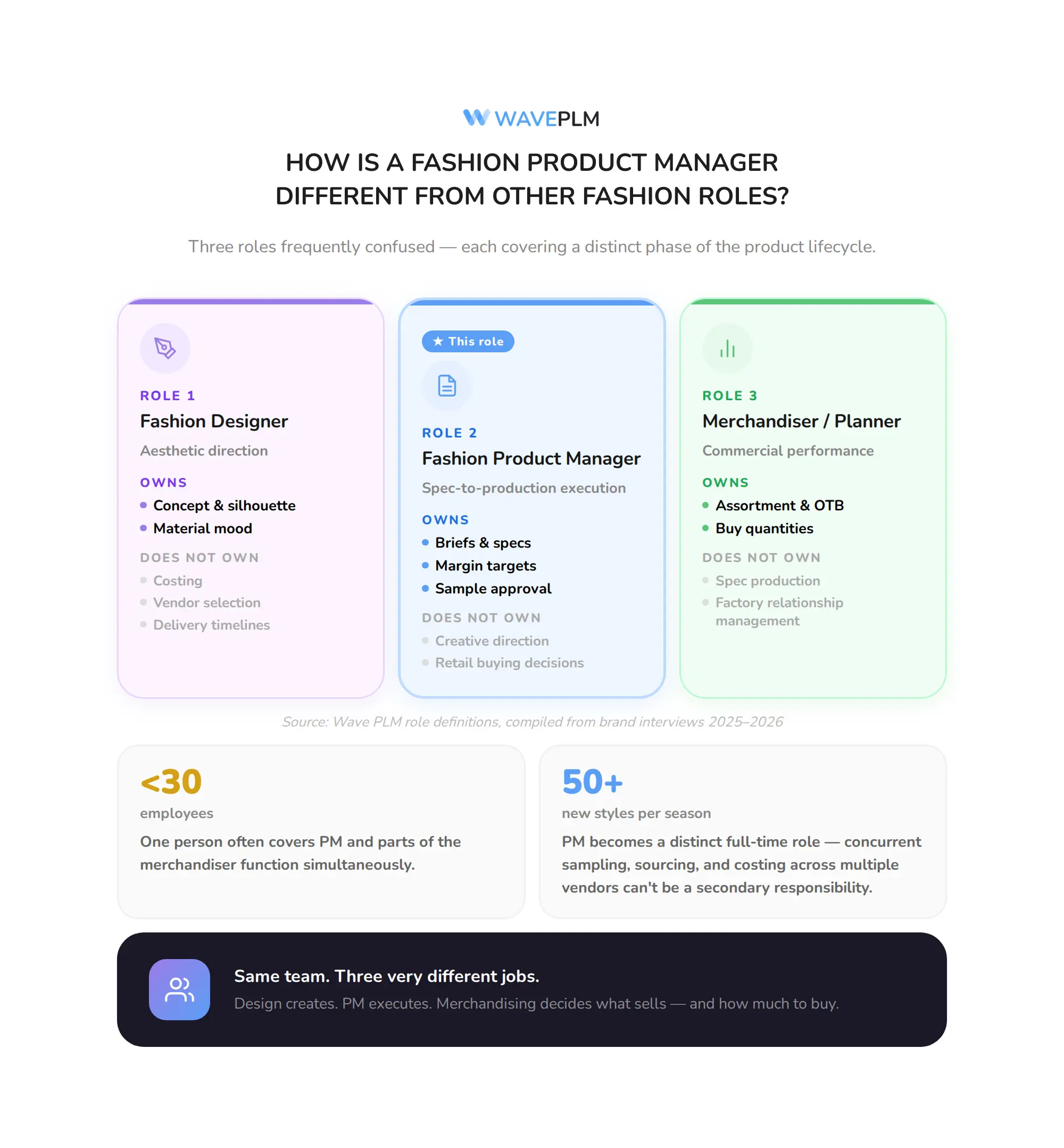
The fashion product manager role is frequently confused with two adjacent positions: fashion designer and merchandiser. In practice, these three roles cover distinct phases of the product lifecycle.
| Role | Primary focus | Owns | Does not own |
|---|---|---|---|
| Fashion Designer | Aesthetic direction | Concept, silhouette, material mood | Costing, vendor selection, delivery timelines |
| Fashion Product Manager | Spec-to-production execution | Briefs, specs, margin targets, sample approval | Creative direction, retail buying decisions |
| Merchandiser / Planner | Commercial performance | Assortment, OTB, buy quantities | Spec production, factory relationship management |
At smaller brands with under 30 employees, one person often covers the PM role and parts of the merchandiser function. Meanwhile, at brands processing more than 50 new styles per season, the PM role becomes a distinct full-time function. At that scale, managing concurrent sampling, sourcing, and costing cycles across multiple vendors cannot be handled as a secondary responsibility.
What Skills Does a Fashion Product Manager Need in 2026?
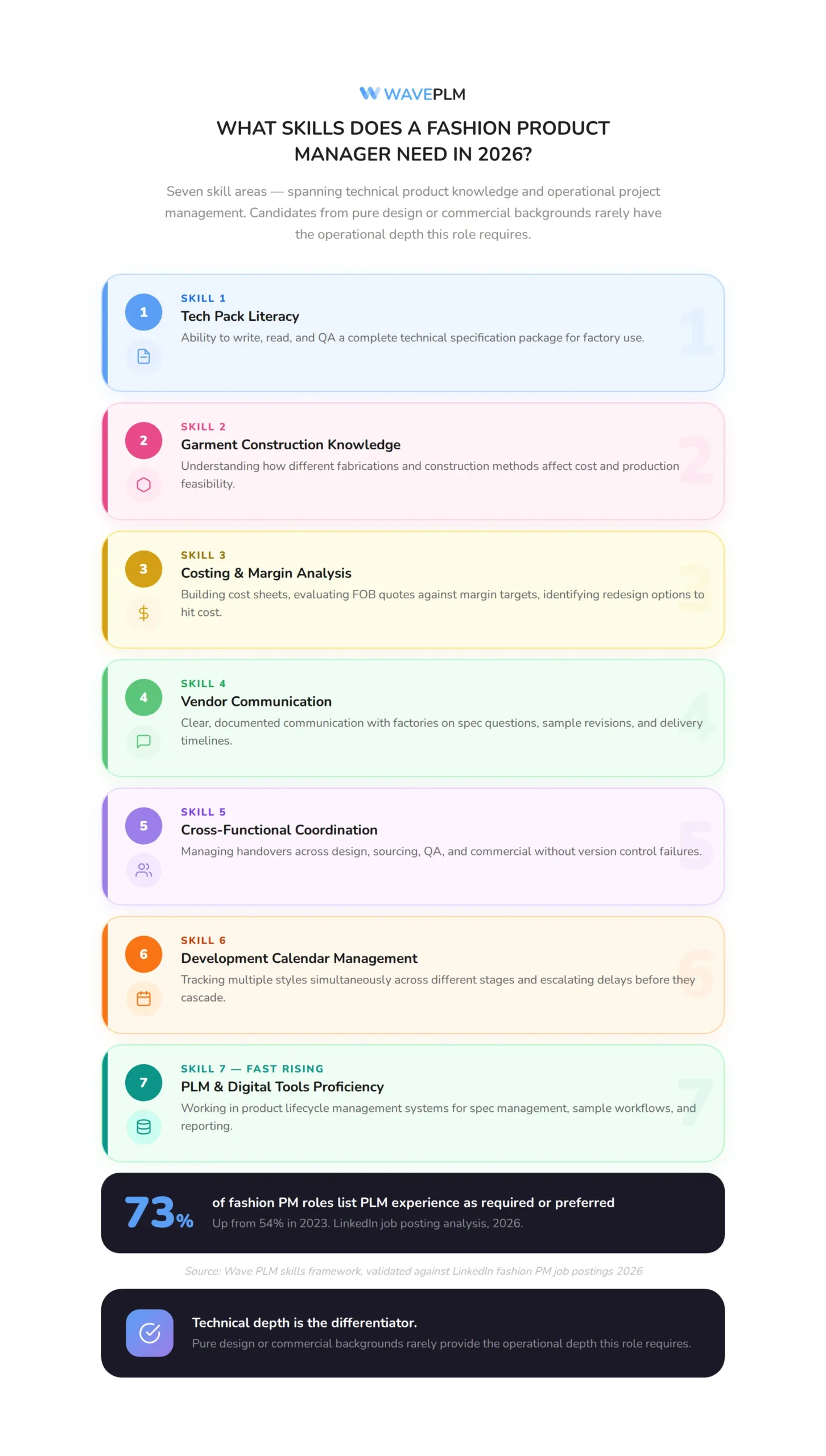
Similarly, the fashion product manager skill set spans technical product knowledge and operational project management. Therefore, candidates typically come from product development, technical design, or sourcing backgrounds. Pure design or commercial backgrounds rarely provide the operational depth this role requires.
| Skill area | What it means in practice |
|---|---|
| Tech pack literacy | Ability to write, read, and QA a complete technical specification package for factory use |
| Garment construction knowledge | Understanding how different fabrications and construction methods affect cost and production feasibility |
| Costing and margin analysis | Building cost sheets, evaluating FOB quotes against margin targets, identifying redesign options to hit cost |
| Vendor communication | Clear, documented communication with factories on spec questions, sample revisions, and delivery timelines |
| Cross-functional coordination | Managing handovers across design, sourcing, QA, and commercial without version control failures |
| Development calendar management | Tracking multiple styles simultaneously across different stages and escalating delays before they cascade |
| PLM and digital tools proficiency | Working in product lifecycle management systems for spec management, sample workflows, and reporting |
Industry data: According to LinkedIn job posting analysis (2026), 73% of fashion product manager roles list PLM system experience as required or preferred — up from 54% in 2023.
What Tools Do Fashion Product Managers Actually Use?
The fashion product manager’s toolset has shifted significantly over the past five years. Specifically, brands that previously managed product development via email now list PLM system proficiency as a baseline hiring requirement. The tools a PM uses daily fall into five categories.
| Category | Purpose | Common tools |
|---|---|---|
| PLM platform | Central repository for tech packs, BOMs, sample status, and approval workflows | Wave PLM, Centric PLM, Backbone PLM |
| Spec and tech pack | Building and distributing technical specifications to factories | PLM spec module, Adobe Illustrator + Excel |
| Development calendar tracking | Seasonal milestone management, delay escalation, cross-team visibility | PLM calendar module, Asana, Monday.com |
| Vendor communication | Factory correspondence, sample revision logs, supplier portals | PLM supplier portal, email, Slack |
| Costing and reporting | FOB cost analysis, margin reporting, range profitability tracking | PLM costing module, Excel, ERP integration |
Notably, the tools that generate the most efficiency gains are integrated into a single PLM platform — where spec, costing, sample status, and vendor communication share one data layer. For this reason, fashion PLM adoption has accelerated among mid-market brands. Product managers increasingly specify their platform requirements during vendor onboarding as they move into leadership roles.
What Is the Salary Range for a Fashion Product Manager in 2026?
US salaries for fashion product managers vary by level, brand size, and geography. Specifically, according to LinkedIn Salary data (2026), the following ranges reflect current market benchmarks across the three most common seniority levels.
| Level | US salary range (2026) | Typical experience |
|---|---|---|
| Associate / Junior PM | $55,000–$75,000 | 1–3 years in product development or technical design |
| Mid-level PM | $75,000–$105,000 | 3–7 years, single-category ownership |
| Senior / Lead PM | $105,000–$145,000 | 7+ years, multi-category or team management |
New York City and Los Angeles roles carry a 15–25% premium over national figures. Furthermore, brands requiring PLM proficiency and supply chain visibility skills pay toward the upper end of each range. These competencies are increasingly essential for reducing time to market at growing apparel brands.
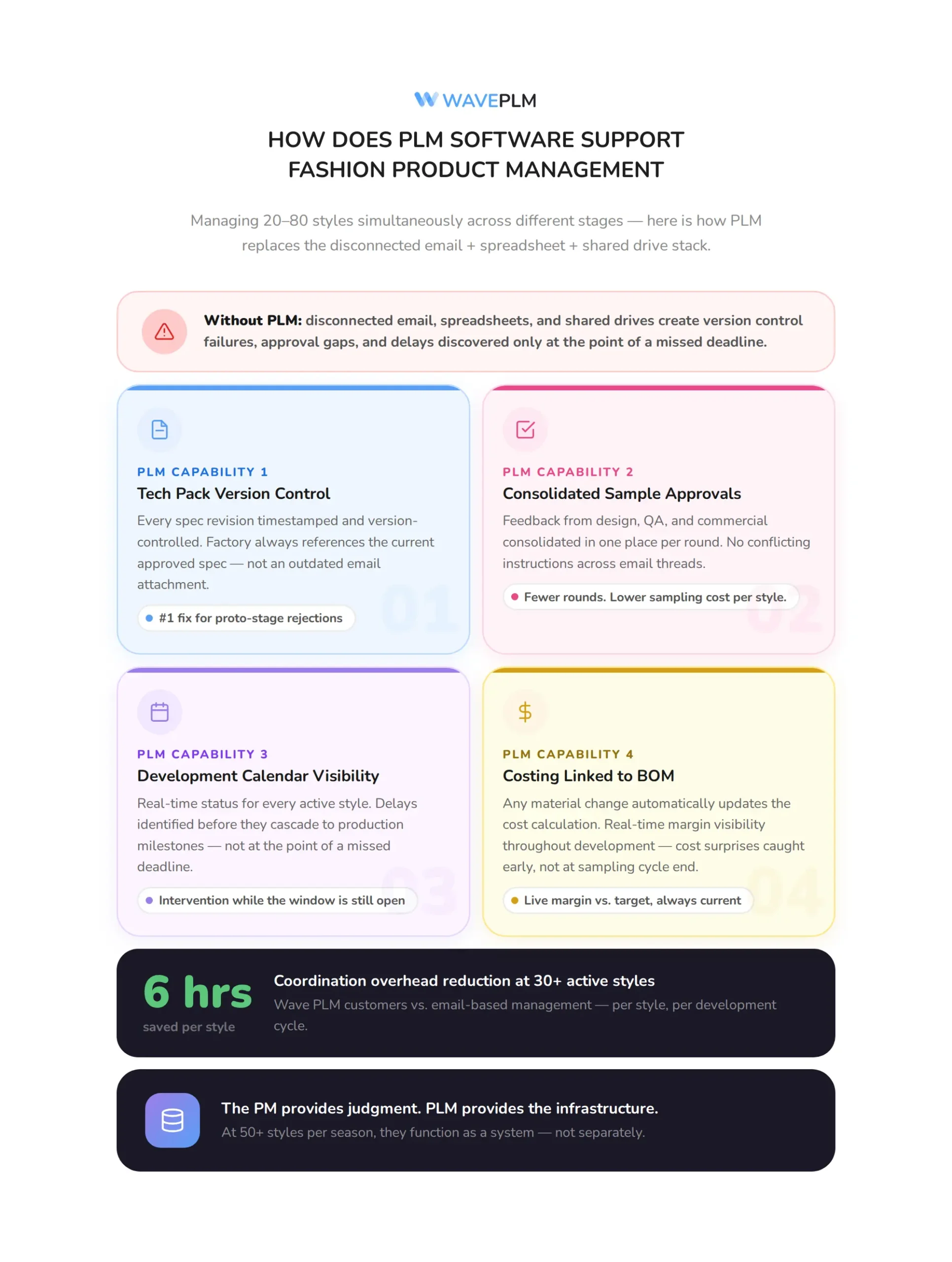
How Does PLM Software Support Fashion Product Management?
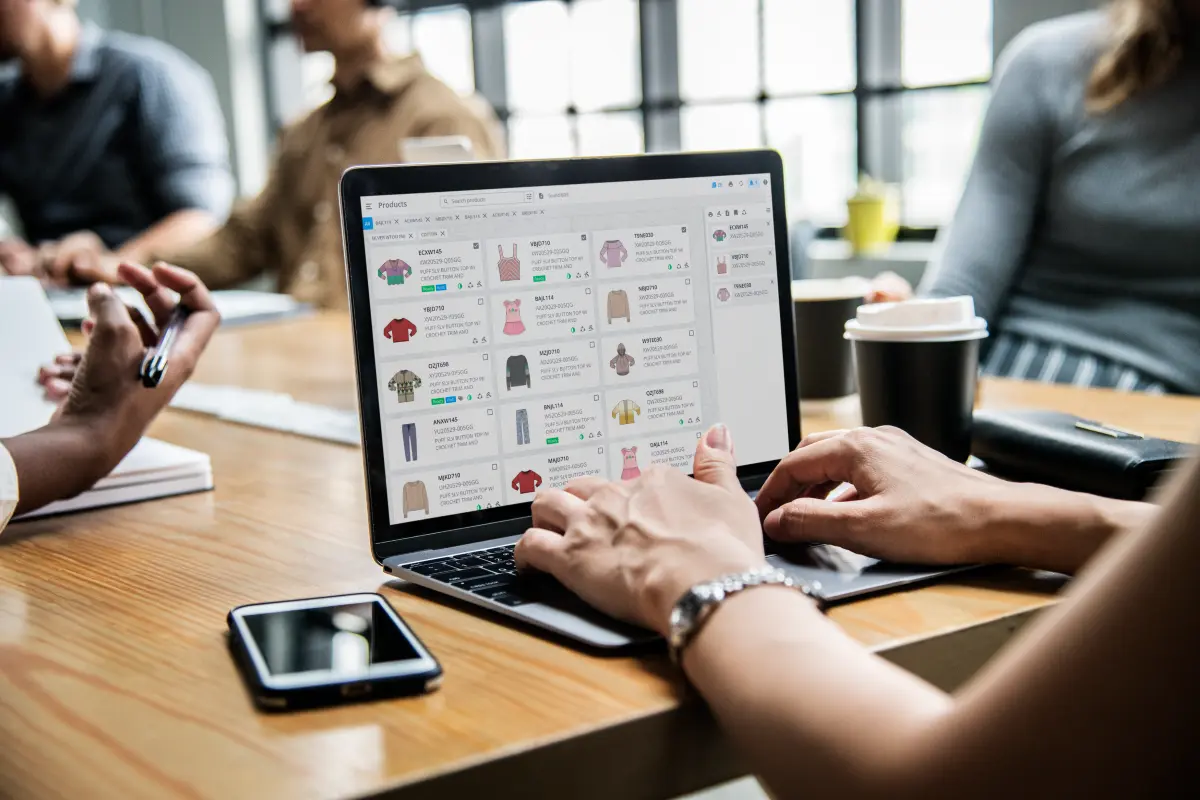
The fashion product manager’s primary operational challenge is managing multiple styles simultaneously across different development stages. In practice, this means tracking spec versions, sample statuses, factory timelines, and cost changes for 20–80 styles at once. Notably, PLM software addresses this directly. It replaces the disconnected combination of email, spreadsheets, and shared drives that creates version control failures and approval gaps.
Centralized Tech Pack Version Control
In a PLM system, every spec revision is timestamped and version-controlled. Therefore, the factory always references the current approved spec — not an outdated email attachment. This single capability eliminates the most common source of sample rejection at the proto stage.
Consolidated Sample Approval Workflows
PLM tracks each sample round with structured approval status and revision comments. As a result, feedback from design, QA, and commercial is consolidated in one place. Separate emails with conflicting instructions become a non-issue. Consolidated feedback consistently produces fewer correction rounds and lower total sampling cost per style.
Development Calendar Visibility
A PLM development calendar shows real-time status for every active style. Consequently, the fashion product manager can identify at a glance which styles are behind schedule. Intervention happens before delays cascade to production milestones. Without centralized tracking, delays are discovered only at the point of a missed deadline. By then, the window for effective intervention has typically closed.
Costing Linked Directly to the BOM
PLM costing modules connect directly to the bill of materials, so any material change automatically updates the cost calculation. This gives the fashion product manager real-time margin visibility throughout development. Changes become expensive at the sampling cycle end; earlier visibility prevents cost surprises.
Our finding: Wave PLM customers managing 30 or more active styles per season report that centralized PLM workflows reduce coordination overhead by an average of 6 hours per style per development cycle, compared to email-based management.
For brands scaling beyond 50 styles per season, the fashion product manager and PLM platform function as a system. The PM provides judgment and coordination. The platform provides the data infrastructure that makes coordination reliable and auditable across the whole team.
Frequently Asked Questions
What does a fashion product manager do?
A fashion product manager oversees apparel products from brief to production-ready specification. They manage cross-functional coordination between design, sourcing, and production. Sample approvals, revision cycles, and delivery date accountability all sit with this role. In practice, the fashion product manager bridges creative decisions and commercial execution inside an apparel brand.
How is a fashion product manager different from a fashion designer?
A fashion designer owns creative direction — silhouette, material mood, and aesthetic concept. A fashion product manager owns execution. This means translating design intent into complete technical specifications, managing cost against targets, and coordinating factory production. The roles are adjacent but distinct. At smaller brands one person may cover both; at larger brands they are separate full-time functions.
What qualifications do you need to become a fashion product manager?
Most fashion product managers come from product development, technical design, or production coordination backgrounds. A degree in fashion, business, or textile science is common. In practice, tech pack experience and factory communication skills carry more weight in hiring decisions. Additionally, PLM system proficiency is increasingly listed as a required skill in 2026 job postings for this role.
What is the average salary for a fashion product manager in the US?
US salaries range from $55,000–$75,000 for associate roles to $105,000–$145,000 at the senior level (LinkedIn, 2026). New York and Los Angeles carry a 15–25% premium over national averages. Brands requiring PLM expertise and supply chain visibility skills pay toward the top of each range.
What PLM tools do fashion product managers use?
Fashion product managers commonly use PLM platforms for tech pack management, sample workflows, and development calendar tracking. Wave PLM, Centric PLM, and Backbone PLM are the most widely adopted. Costing modules, supplier portals, and BOM tools are also core to daily workflows. Notably, PLM experience is listed as required or preferred in 73% of fashion PM job postings as of 2026.
How many styles can a fashion product manager handle per season?
Typical capacity is 30–60 active styles per PM when managing via email and spreadsheets. With a centralized PLM platform, experienced fashion product managers routinely handle 80–120 styles per season. The constraint shifts from tracking overhead to decision complexity. The real work becomes identifying which styles need attention — not chasing status across email threads.
What is the career path for a fashion product manager?
Most fashion product managers start as coordinators (1–3 years), then move to PM (3–7 years), then senior PM or category lead (7+ years). Head of product and VP roles follow at the 10+ year mark. Some fashion product managers also move into director-level supply chain or operations roles. PLM platform experience accelerates advancement by demonstrating cross-functional system ownership.
The fashion product manager role sits at the intersection of creative and operational execution. This function determines whether a well-designed collection reaches the market on time and at the right quality standard. It also controls whether it arrives at the right cost. As product complexity increases and brands scale, this role depends more heavily on PLM platforms. Without reliable data infrastructure, cross-functional coordination breaks down at the team level.
Wave PLM is built for apparel brands where product managers are the operational backbone of the development process. See how Wave PLM supports fashion product management teams.




Leave a Reply