
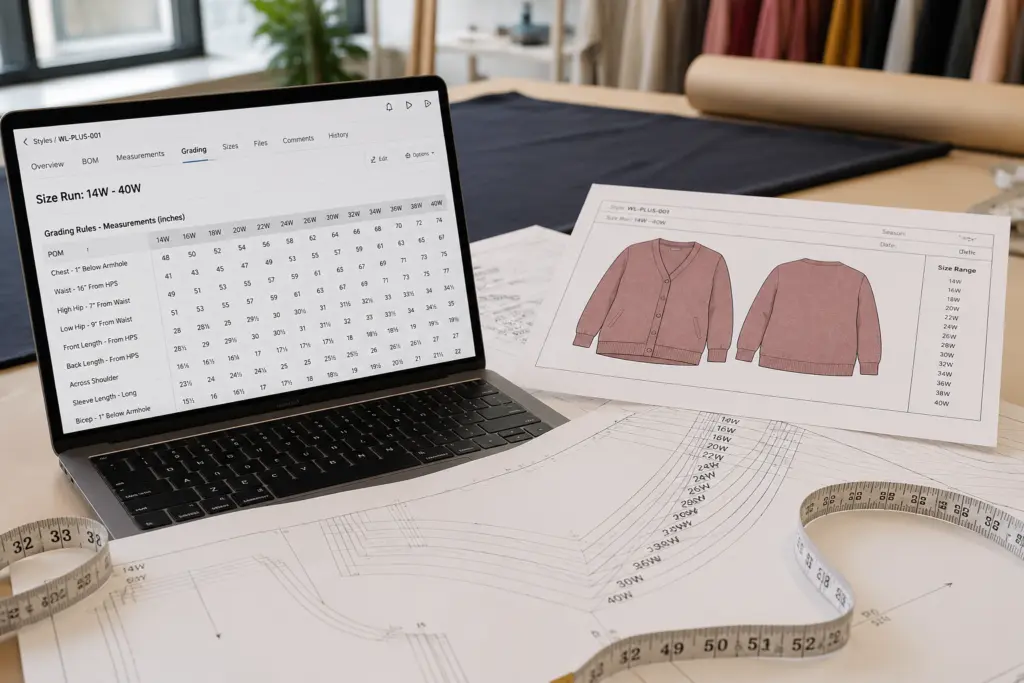
Extended size PLM software has to manage a size run most fashion-focused tools were never built for. A standard women’s line might grade across six or eight sizes. An extended size line, in contrast, often runs from 14W to 40W or beyond. Body proportions don’t scale evenly across that range. As a result, grading rules that work at the low end frequently break by the time they reach the top.
On top of that, the size curve itself is shifting right now. GLP-1 weight-loss medications are moving real demand toward smaller sizes. Even so, most women still wear a size 14 or above. This guide covers why extended size PLM software needs different grading logic than standard-size tools. It also covers the ASTM standard behind plus-size body measurements, and why fit issues drive most fashion returns. It also covers how brands can plan inventory through a size curve that’s actively moving.
What Does Extended Size PLM Software Need to Handle Differently?
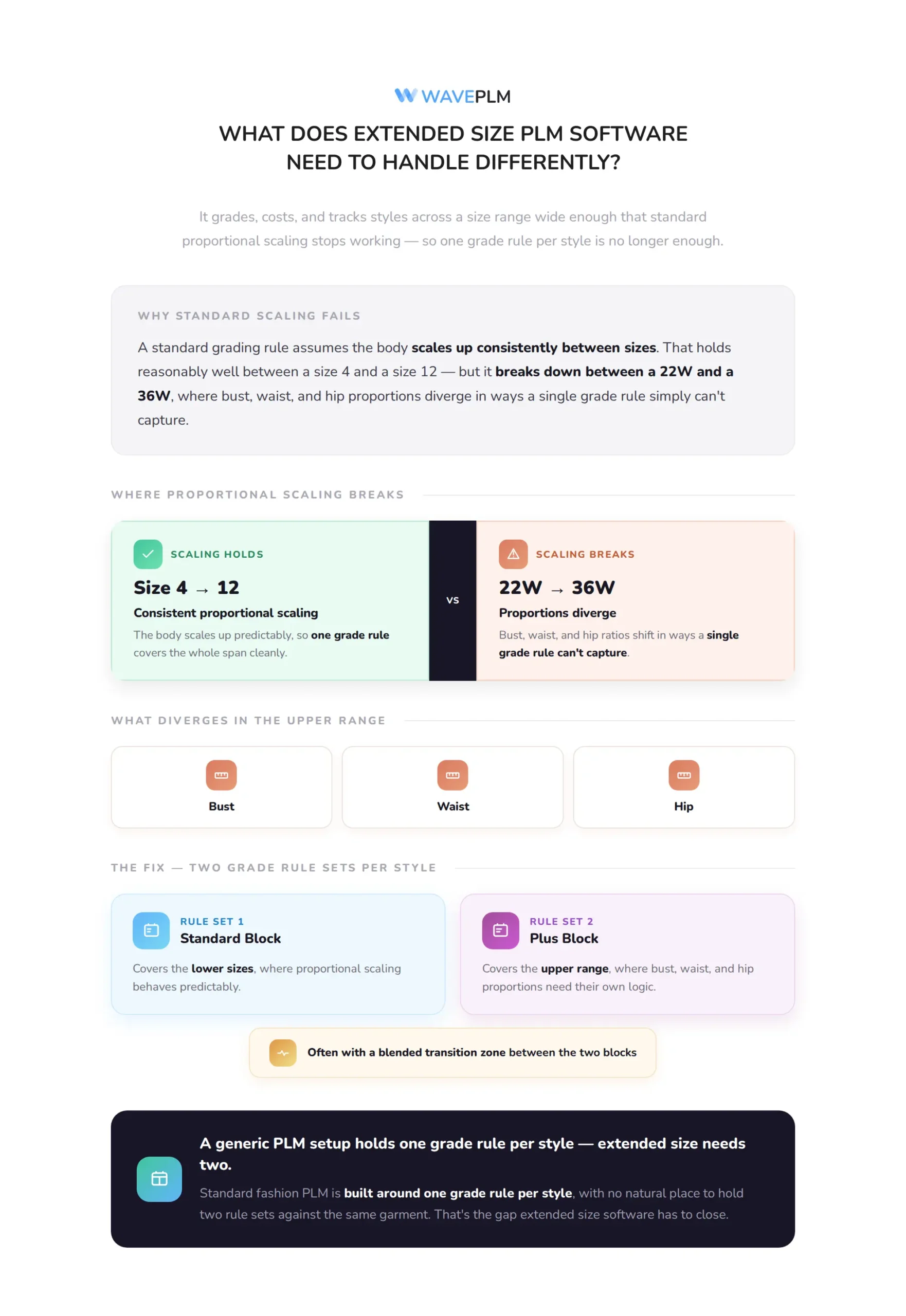
Extended size PLM software is a product lifecycle system built to grade, cost, and track apparel styles across a size range wide enough that standard proportional scaling stops working. For instance, a standard grading rule assumes the body scales up consistently between sizes. Notably, that assumption holds up reasonably well between a size 4 and a size 12. It breaks down, however, between a 22W and a 36W. In fact, bust, waist, and hip proportions diverge there in ways a single grade rule simply can’t capture.
As a result, an extended size style typically needs at least two grading rule sets instead of one. A standard block covers the lower sizes. A separate plus block covers the upper range, often with a blended transition zone in between. In short, a generic fashion PLM setup is built around one grade rule per style. It simply has no natural place to hold two rule sets against the same garment.
Why Is Grading So Much Harder Across an Extended Size Range?
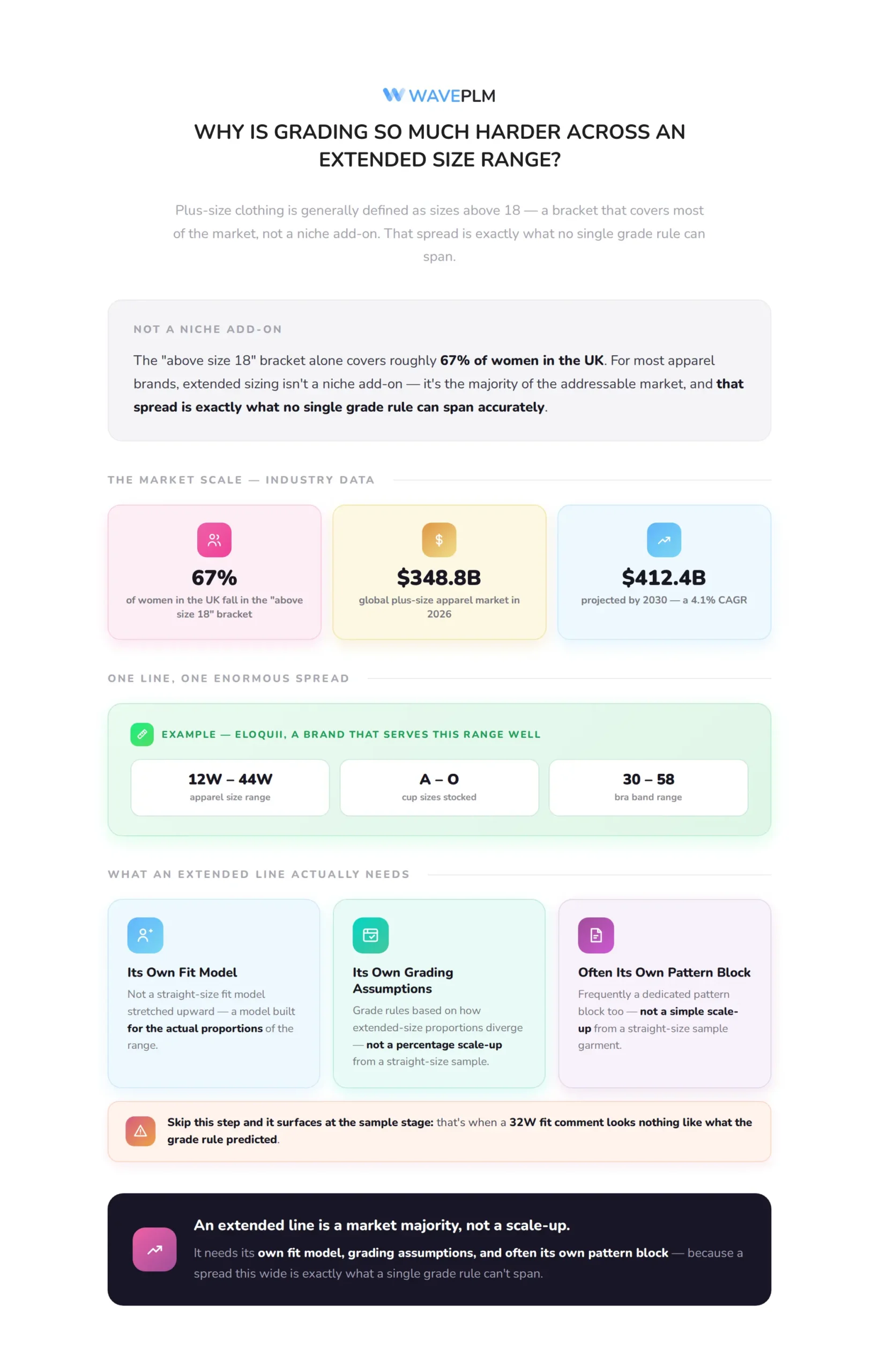
Plus-size clothing is generally defined as sizes above 18. That bracket alone covers roughly 67% of women in the UK (Grand View Research, 2024). In other words, extended sizing isn’t a niche add-on for most apparel brands. For example, Eloquii, a brand that serves this range well, carries sizes 12W to 44W. It also stocks cup sizes A through O and bra bands from 30 to 58 (Grand View Research, 2024). In other words, that spread is exactly what no single grade rule can span accurately.
Industry data: The global plus-size apparel market reached an estimated $348.8 billion in 2026, on track to hit $412.4 billion by 2030 at a 4.1% CAGR (Grand View Research, 2024). Casual wear alone holds a 38.37% share of that market.
In practice, this means an extended size line needs its own fit model and its own grading assumptions. It often needs its own pattern block too, rather than a simple percentage scale-up from a straight-size sample. Often, brands that skip this step find out the hard way, at the sample stage. That is when a 32W fit comment looks nothing like what the grade rule predicted.
What Is ASTM D6960 and Why Does It Matter for Extended Sizing?
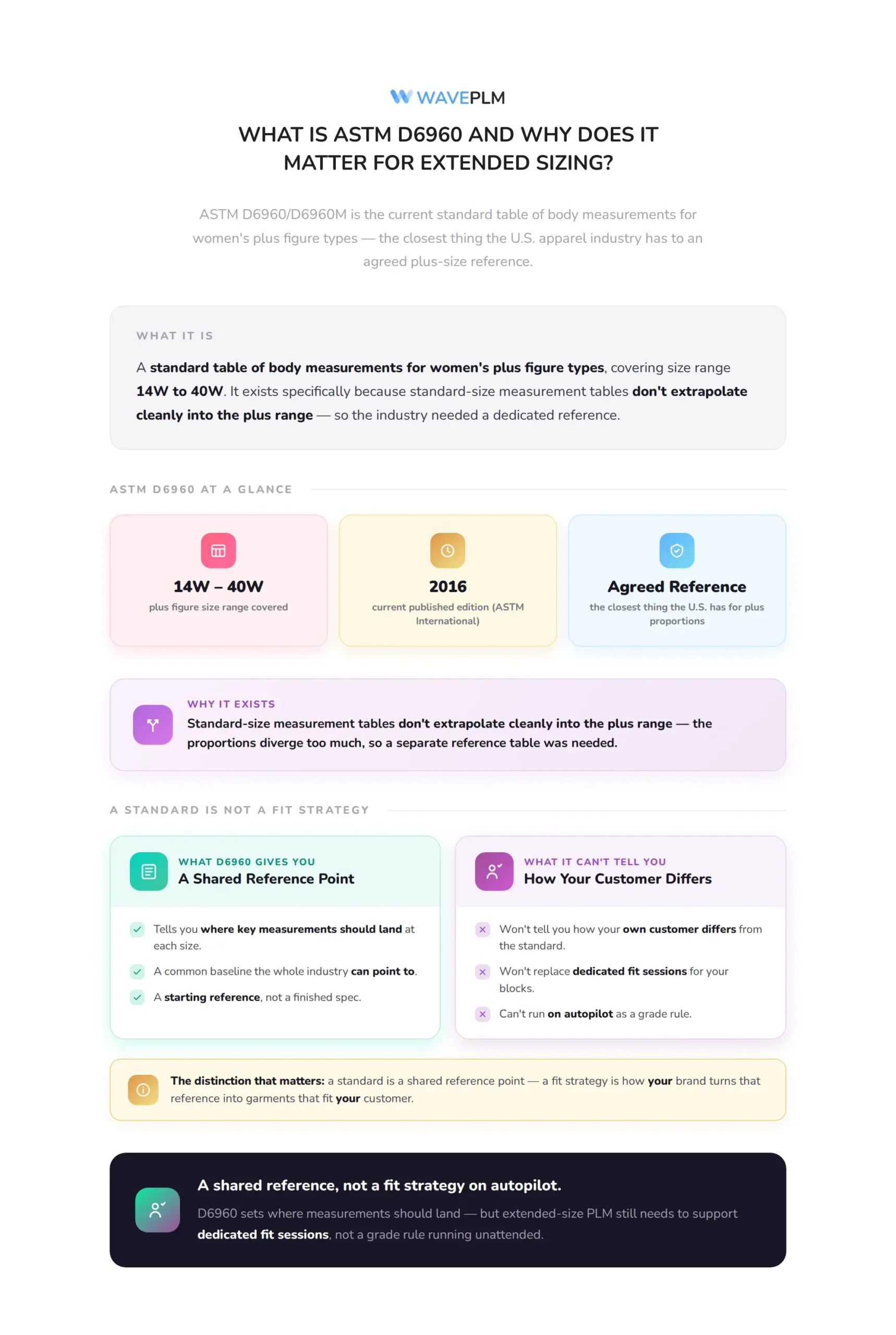
ASTM D6960/D6960M is the current standard table of body measurements for women’s plus figure types. It covers size range 14W to 40W (ASTM International, 2016). This is the closest thing the U.S. apparel industry has to an agreed reference for plus-size body proportions. It exists, specifically, because standard-size measurement tables don’t extrapolate cleanly into the plus range.
That said, a standard isn’t the same as a fit strategy. ASTM D6960 gives brands a shared reference point for where key measurements should land at each size. It doesn’t, however, tell a brand how its own customer differs from that standard. This is why extended size PLM software still needs to support dedicated fit sessions rather than a grade rule running on autopilot. For a deeper look at how that approval process works, see our fit session management guide.
How Is the GLP-1 Size-Curve Shift Changing Inventory Planning?
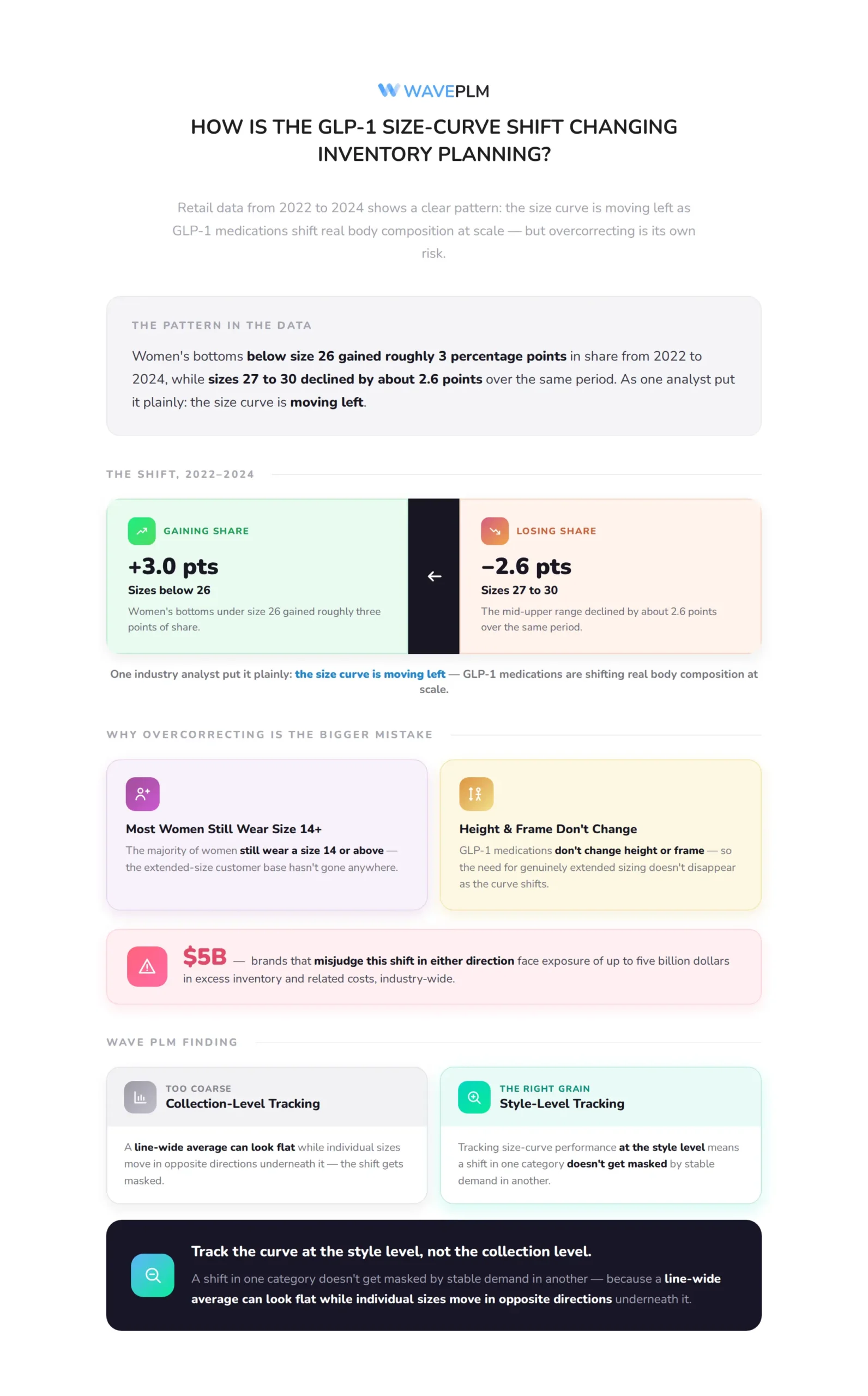
Retail sales data from 2022 to 2024 shows a clear pattern: women’s bottoms below size 26 gained roughly 3 percentage points in share. Sizes 27 to 30, meanwhile, declined by about 2.6 points over the same period (Impact Analytics, via eMarketer, 2025). One industry analyst put it plainly: the size curve is moving left, as GLP-1 medications shift real body composition at scale.
Even so, brands that overcorrect risk a different mistake, and arguably a bigger one. Most women still wear a size 14 or above (Mys Tyler, via eMarketer, 2025), and GLP-1 medications don’t change height or frame. So the need for genuinely extended sizing doesn’t disappear just because the curve is shifting. Brands that misjudge this shift, in either direction, face exposure of up to $5 billion in excess inventory and related costs industry-wide (eMarketer, 2025).
Our finding: Wave PLM customers running extended size lines get the most value from tracking size-curve performance at the style level, not just the collection level, so a shift in one category doesn’t get masked by stable demand in another. A line-wide average can look flat while individual sizes move in opposite directions underneath it.
Why Do Size and Fit Issues Drive So Many Fashion Returns?
Size and fit issues account for 67% of all fashion returns. Poor fit alone is responsible for 53% of that total (Boldmetrics, 2026). In addition, online apparel return rates already run 20% to 30% industry-wide, with some categories reaching 50%. Extended sizing raises the stakes further, since a grading error compounds across a wider range of bodies rather than a narrow one.
This means the cost of an ungraded fit problem isn’t just one bad sample. Instead, it’s a return rate that repeats across every size in the affected block. Consistency matters more here than on a standard-size line, precisely because there are more sizes for a single grading mistake to propagate through.
Why Do Extended Size Lines Need Different Sourcing and MOQ Planning?
Fabric consumption doesn’t scale proportionally across an extended size range, so per-size yardage can vary substantially between the smallest and largest size in a run. As a result, a minimum order quantity negotiated against a standard-size average often backfires. Specifically, it can leave a brand short on fabric for its largest sizes, and overstocked on its smallest ones. Our fabric sourcing guide covers how MOQ negotiation should account for consumption spread, not just total units.
Similarly, a size curve that’s actively shifting, as the GLP-1 data above shows, adds another layer to sourcing risk. A fabric commitment locked in against last year’s size mix can look wrong within a single selling season. This means extended size brands increasingly need shorter fabric commitment cycles, not just wider size ranges, to stay flexible as the curve keeps moving.
What Should an Extended Size Style Record Track?
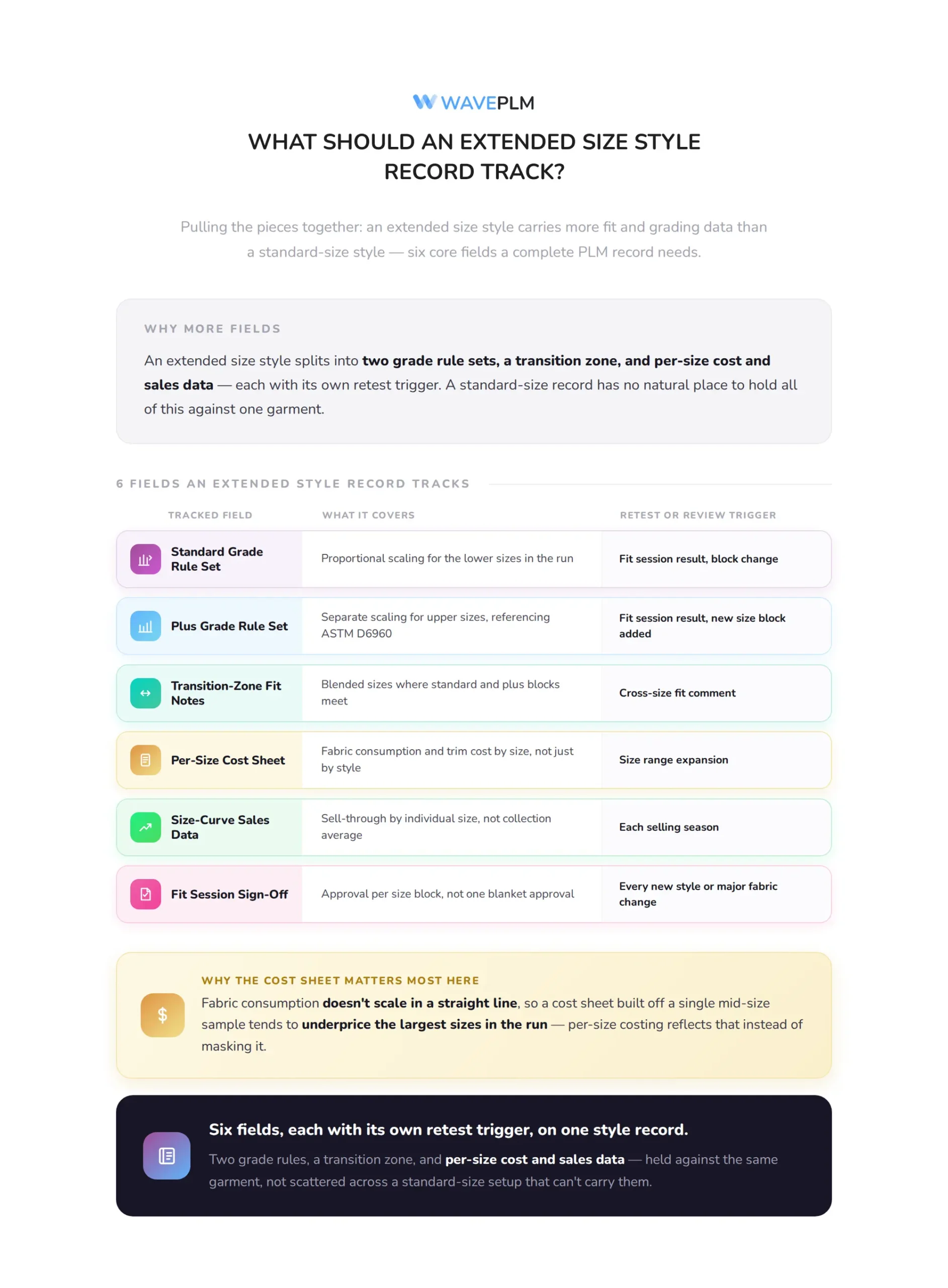
Pulling the pieces above together, an extended size style carries more fit and grading data than a standard-size style does. The table below summarizes the core fields a complete extended size PLM software record needs.
| Tracked field | What it covers | Retest or review trigger |
|---|---|---|
| Standard grade rule set | Proportional scaling for lower sizes in the run | Fit session result, block change |
| Plus grade rule set | Separate scaling for upper sizes, referencing ASTM D6960 | Fit session result, new size block added |
| Transition-zone fit notes | Blended sizes where standard and plus blocks meet | Cross-size fit comment |
| Per-size cost sheet | Fabric consumption and trim cost by size, not just by style | Size range expansion |
| Size-curve sales data | Sell-through by individual size, not collection average | Each selling season |
| Fit session sign-off | Approval per size block, not one blanket approval | Every new style or major fabric change |
Notably, a per-size cost sheet matters more here than it does on a standard-size line. Fabric consumption doesn’t scale in a straight line. So a cost sheet built off a single mid-size sample tends to underprice the largest sizes in the run. Our garment costing guide covers how to build costing that reflects this instead of masking it.
How Does Wave PLM Support Extended Size Brands?
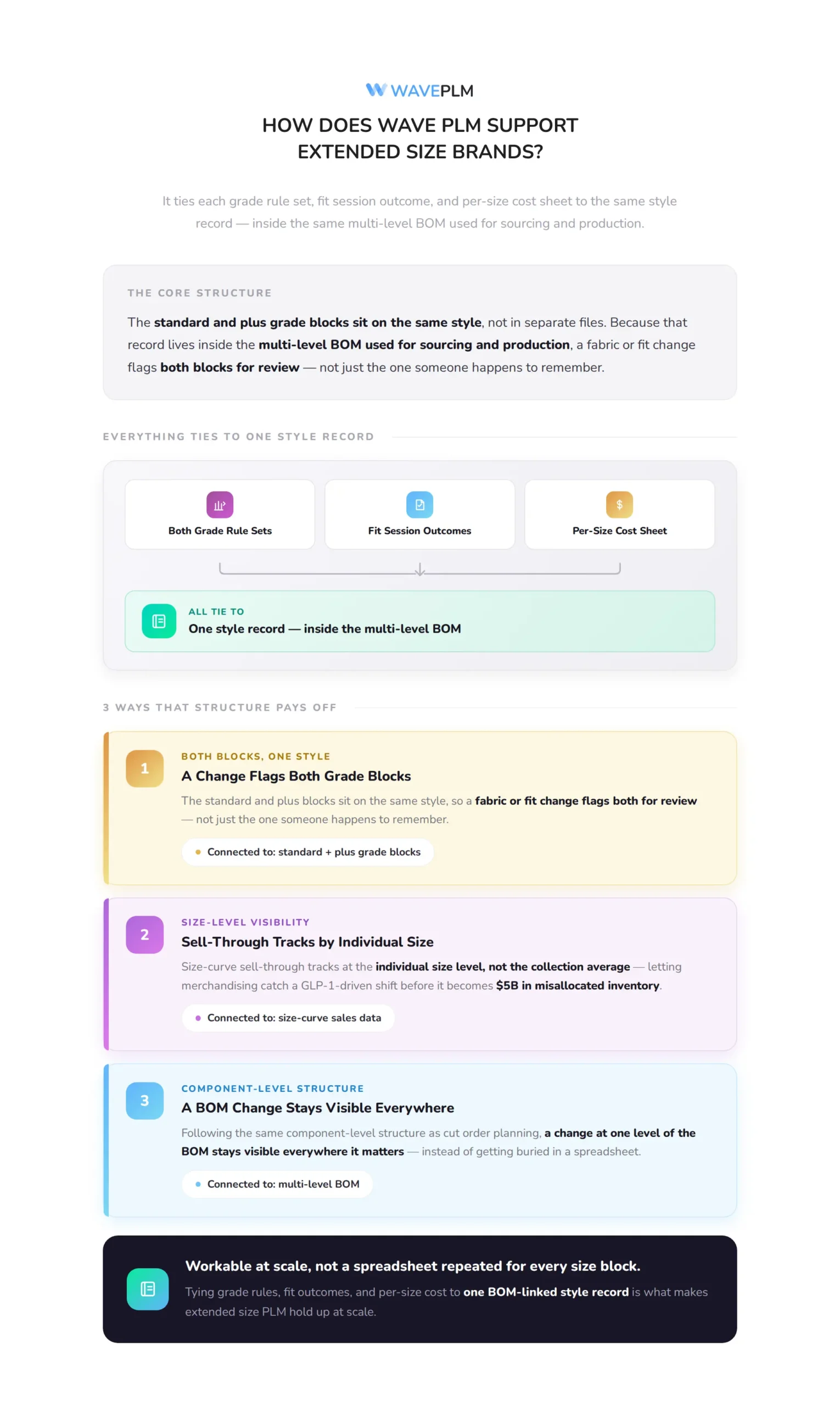
Wave PLM ties each grade rule set, fit session outcome, and per-size cost sheet to the same style record. Notably, that record lives inside the same multi-level BOM used for sourcing and production. Specifically, the standard and plus grade blocks sit on the same style rather than in separate files. As a result, a fabric or fit change flags both blocks for review, instead of just the one someone happens to remember.
For one thing, size-curve sell-through tracks at the individual size level, not just the collection average. This is what lets a merchandising team catch a shift like the current GLP-1-driven move before it turns into $5 billion of misallocated inventory industry-wide. Similarly, this follows the same component-level structure covered in our cut order planning guide. A change at one level of the BOM stays visible everywhere it matters there too, instead of getting buried in a spreadsheet. That structure is what makes extended size PLM software workable at scale, rather than a spreadsheet exercise repeated for every size block.
Frequently Asked Questions
What is extended size PLM software?
Extended size PLM software is a product lifecycle system built to grade, cost, and track apparel styles across a size range wide enough that standard proportional scaling breaks down. It typically requires separate grade rule sets for standard and plus size blocks on the same style.
What is ASTM D6960 and why does it matter for plus-size apparel?
ASTM D6960/D6960M is the current U.S. standard table of body measurements for women’s plus figure types, covering size range 14W to 40W. It gives brands a shared reference point for grading, though brands still need dedicated fit sessions to confirm how their customer differs from the standard.
How is the GLP-1 size-curve shift affecting apparel brands?
Retail data from 2022 to 2024 shows women’s bottoms below size 26 gaining share, while sizes 27 to 30 decline. GLP-1 medications are shifting body composition at scale. Brands that misjudge the shift, in either direction, face exposure of up to $5 billion in excess inventory and related costs industry-wide.
Why do size and fit issues cause so many fashion returns?
Size and fit issues account for 67% of all fashion returns, with poor fit alone responsible for 53%. Extended sizing raises the stakes further, since a single grading error compounds across a wider range of bodies rather than a narrow standard-size run.
Does extended sizing need its own cost sheet?
Yes. Fabric consumption doesn’t scale proportionally across an extended size range, so a cost sheet built from a mid-size sample tends to underprice the largest sizes. Tracking cost per size, rather than one cost per style, keeps margin accurate across the full run.
Is the plus-size apparel market still growing in 2026?
Yes. The global plus-size apparel market reached an estimated $348.8 billion in 2026. It is projected to hit $412.4 billion by 2030 at a 4.1% CAGR, even as GLP-1 medications shift some demand toward smaller sizes.
Wave PLM customers running extended size lines catch problems early, at the style level: a size-curve shift, a grading gap, an underpriced size. That is before any of it turns into a returns problem or a season of misallocated inventory. That is what good extended size PLM software should do by default, not as an afterthought bolted onto a straight-size system. Start a conversation with the Wave PLM team about how that structure would work for your extended size line.







Leave a Reply