

A restricted substances list (RSL) sets maximum allowed limits, or outright bans, on specific chemicals in finished apparel and footwear. Brands use a restricted substances list to confirm that fabric, trims, dyes, and coatings do not contain substances linked to health or environmental harm. In other words, it is the chemical-safety layer of quality control, separate from stitching, sizing, or fit. Notably, skipping a restricted substances list does not just risk a failed lab test. Instead, it risks a shipment held at customs, or a product recall after it has already reached stores.
This guide covers what an RSL actually restricts and how it differs from an MRSL. It also covers which regulations overlap with it, plus how to implement RSL compliance across a supply chain. Finally, it explains how PLM software keeps test certificates tied to the actual materials in your BOM.
This guide covers what a restricted substances list actually restricts and how it differs from an MRSL. It also covers which regulations overlap with it, plus how to implement restricted substances list compliance across a supply chain. Finally, it explains how PLM software keeps test certificates tied to the actual materials in your BOM.
Understanding the restricted substances list is crucial for brands aiming to meet compliance standards.
The restricted substances list serves as a guideline for brands to ensure safety and compliance.
What Is a Restricted Substances List (RSL)?
Our finding: Wave PLM customers who attach restricted substances list test certificates directly to the BOM line for each material catch non-compliant trims and dyes before cutting begins, rather than after a shipment is already at the port. The certificate becomes part of the product record instead of a PDF buried in a supplier’s email.
It is essential to adhere to the latest updates in the restricted substances list to maintain compliance.
Industry restricted substances lists, including AFIRM’s, cover several categories of chemicals with a track record of health or regulatory concern.
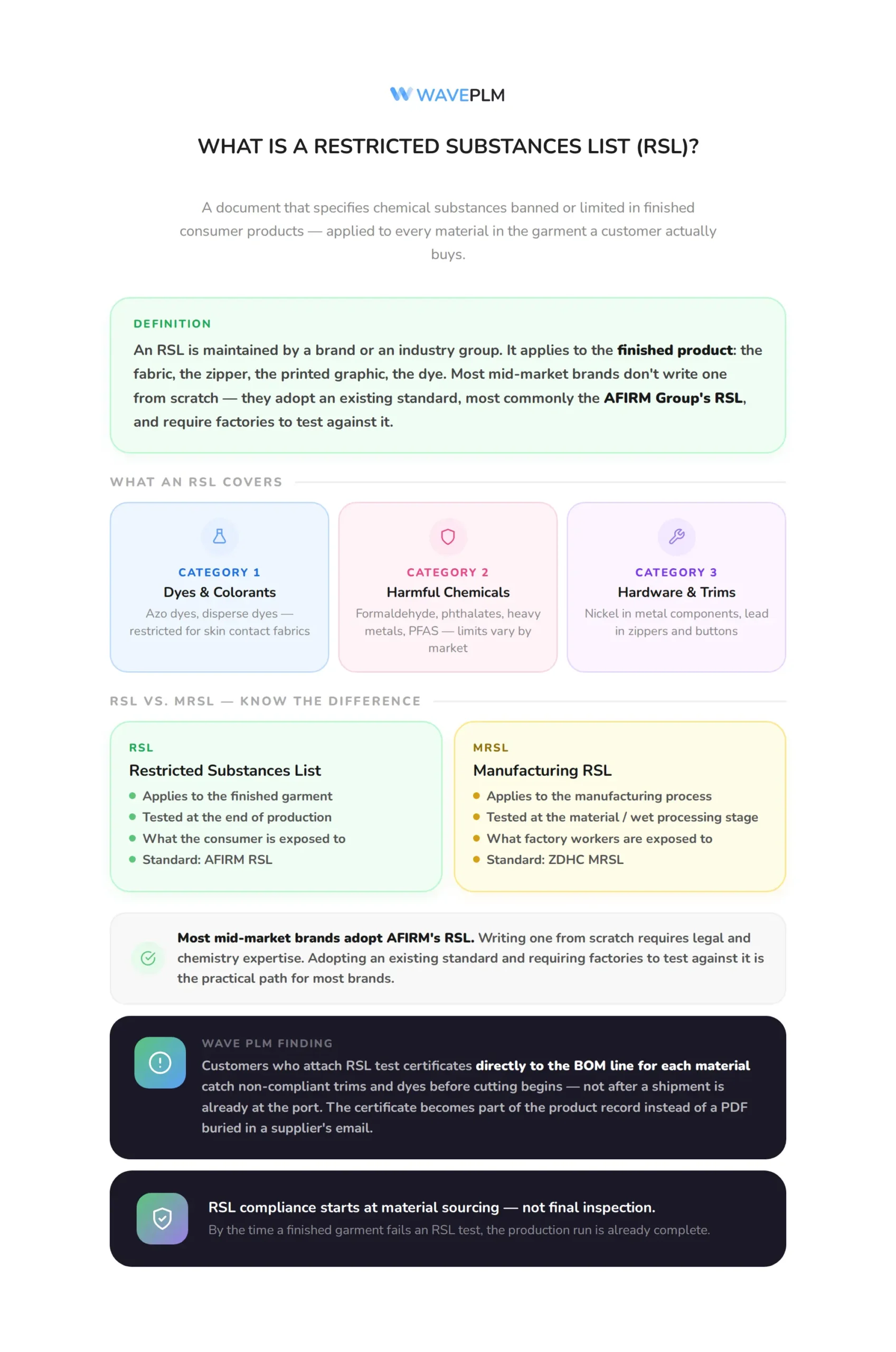
An RSL is a document, usually maintained by a brand or an industry group, that specifies chemical substances banned or limited in finished consumer products. Specifically, it applies to the product a customer actually buys: the fabric, the zipper, the printed graphic, the dye. Notably, most mid-market apparel brands do not write an RSL from scratch. Instead, they adopt an existing industry standard, most commonly the AFIRM Group’s RSL, and require factories to test against it.
Staying compliant with the latest version of the restricted substances list is critical for brands to avoid unnecessary risks.
A thorough understanding of the restricted substances list can greatly benefit your brand’s compliance efforts.
Knowing the difference between an RSL and an MRSL can help brands navigate compliance relating to the restricted substances list.
Consequently, brands focused only on finished-product testing can pass every restricted substances list test.
Compliance with the restricted substances list is vital for brands to maintain product integrity.
Brands must monitor the restricted substances list alongside other regulations to ensure comprehensive compliance.
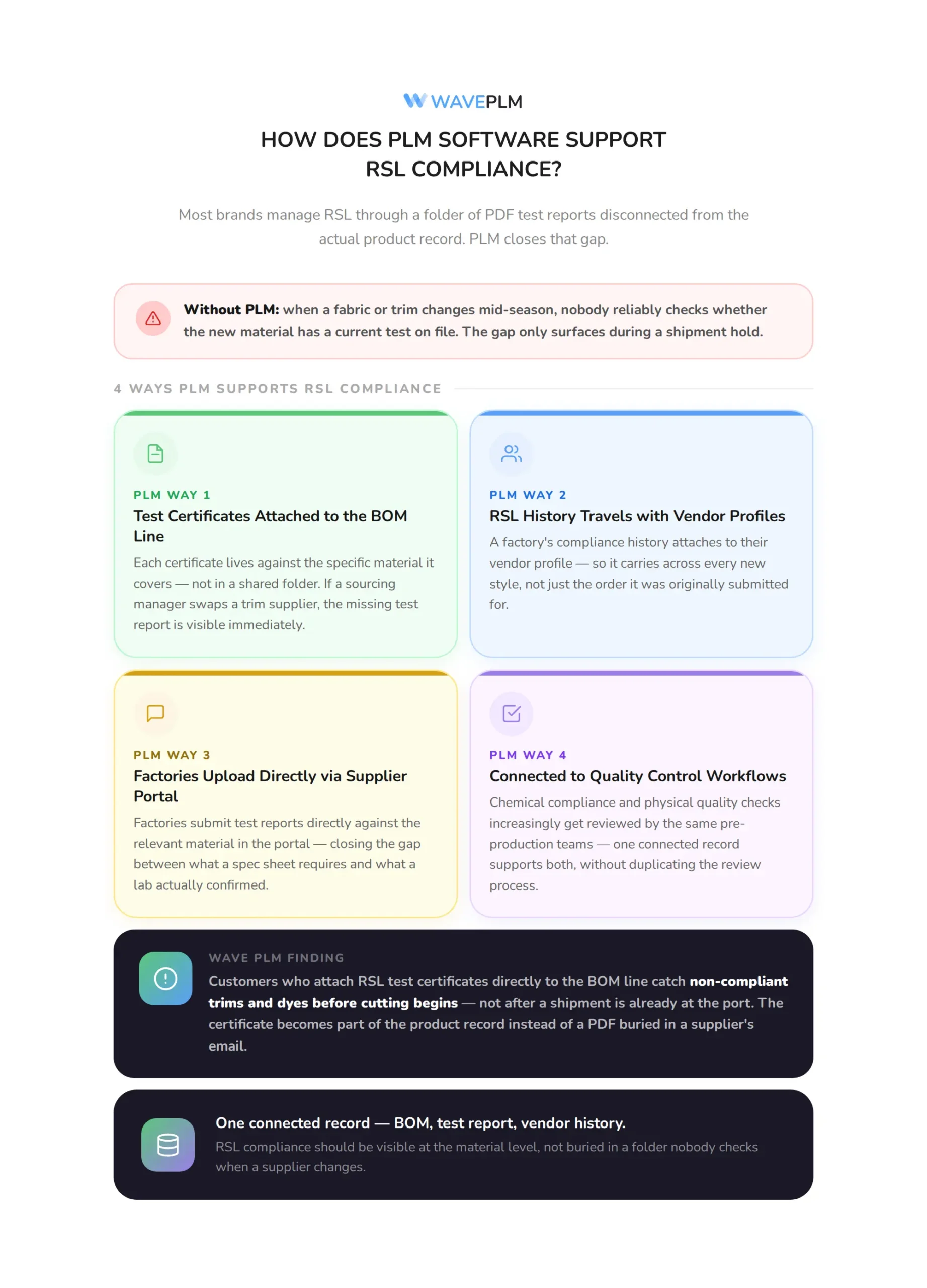
Our finding: Wave PLM customers who attach RSL test certificates directly to the BOM line for each material catch non-compliant trims and dyes before cutting begins, rather than after a shipment is already at the port. The certificate becomes part of the product record instead of a PDF buried in a supplier’s email.
What Substances Does an RSL Typically Restrict?
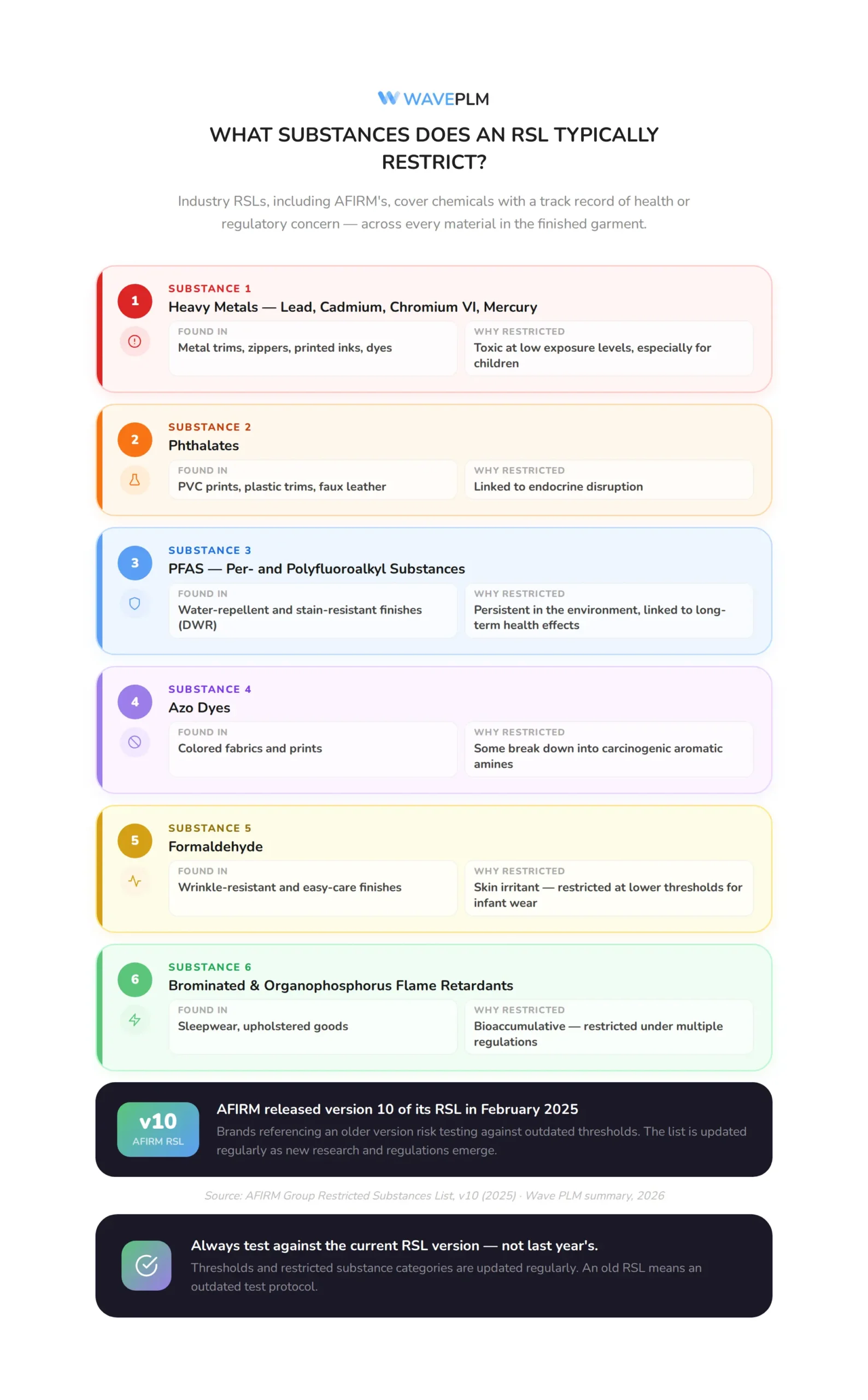
Industry RSLs, including AFIRM’s, cover several categories of chemicals with a track record of health or regulatory concern. The table below summarizes the main categories.
| Substance category | Where it commonly appears | Why it is restricted |
|---|---|---|
| Heavy metals (lead, cadmium, chromium VI, mercury) | Metal trims, zippers, printed inks, dyes | Toxic at low exposure levels, especially for children |
| Phthalates | PVC prints, plastic trims, faux leather | Linked to endocrine disruption |
| PFAS (per- and polyfluoroalkyl substances) | Water-repellent and stain-resistant finishes | Persistent in the environment, linked to long-term health effects |
| Azo dyes | Colored fabrics and prints | Some break down into carcinogenic amines |
| Formaldehyde | Wrinkle-resistant and easy-care finishes | Skin irritant, restricted at low thresholds for infant wear |
| Brominated and organophosphorus flame retardants | Sleepwear, upholstered goods | Bioaccumulative, restricted under multiple regulations |
Notably, AFIRM released version 10 of its RSL in February 2025, and the list is updated regularly as new research and regulations emerge. For this reason, brands referencing an old RSL version risk testing against outdated thresholds.
In addition to regulations, an updated restricted substances list review process is essential for brands.
What Is the Difference Between an RSL and an MRSL?
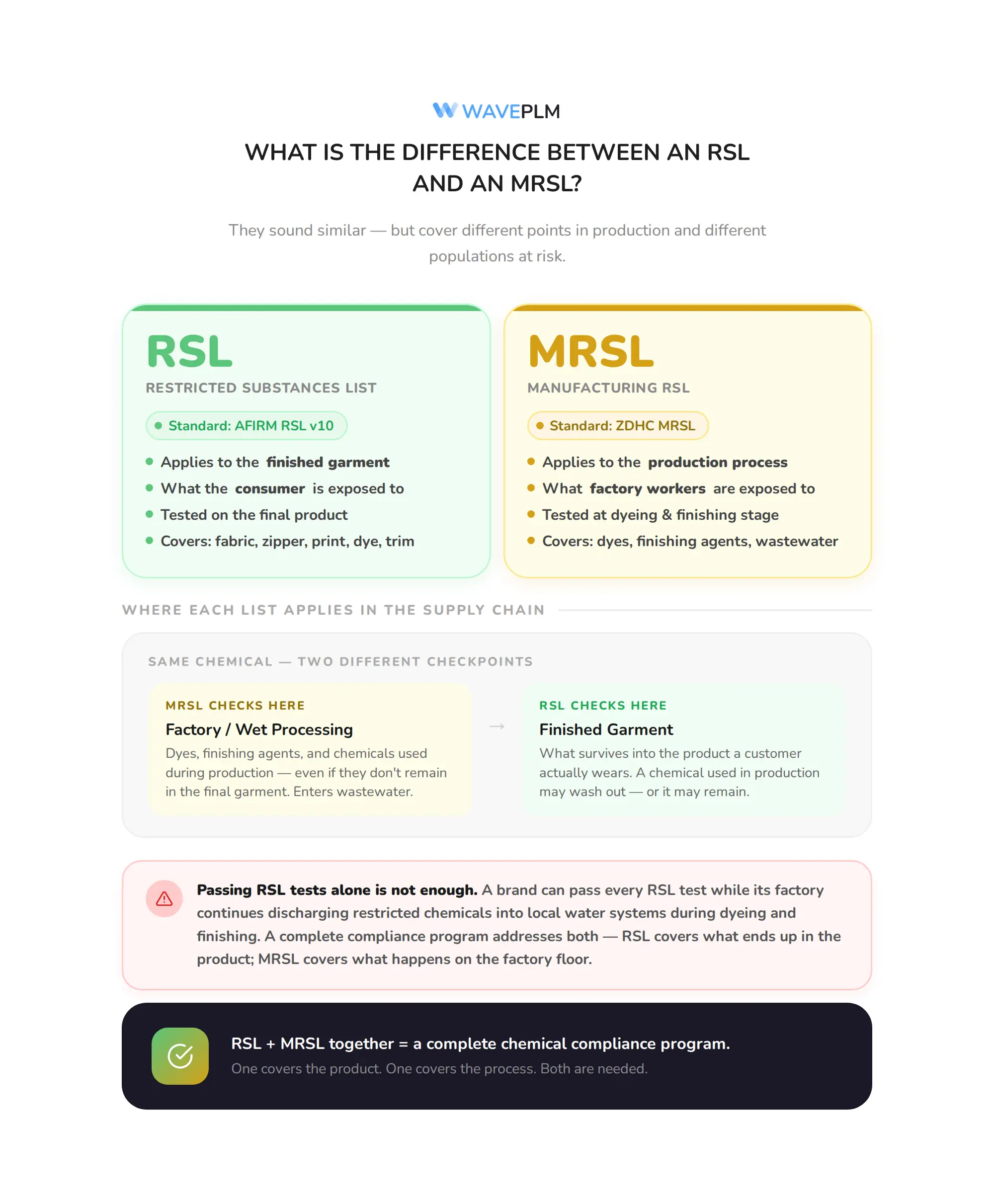
An RSL and an MRSL sound similar, but they cover different points in production. Specifically, an RSL restricts substances found in the finished product a customer receives. By contrast, a manufacturing restricted substances list (MRSL), such as the ZDHC MRSL, restricts chemicals used during production itself. This includes dyes and finishing agents that may not remain in the final garment. However, these chemicals still enter wastewater at the factory.
Consequently, brands focused only on finished-product testing can pass every RSL test. Meanwhile, a factory might continue discharging restricted chemicals into local water systems during dyeing and finishing. For this reason, a complete chemical compliance program addresses both. The RSL covers what ends up in the product. The MRSL covers what happens on the factory floor.
Implementing the latest restricted substances list guidelines can enhance a brand’s compliance strategy.
Which Regulations Should Fashion Brands Track Alongside Their RSL?
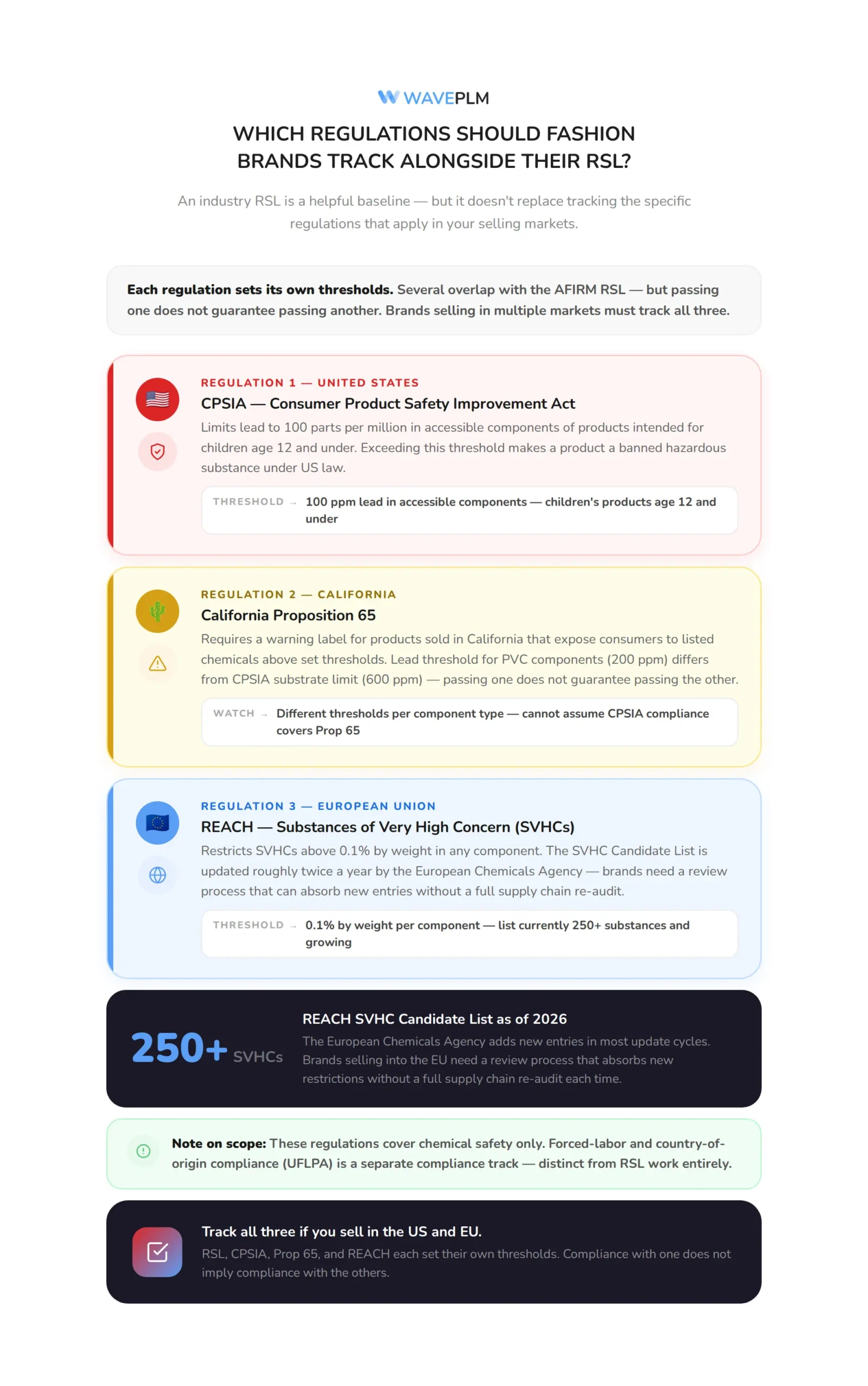
An industry RSL is a helpful baseline, but it does not replace tracking the specific regulations that apply in your selling markets. Several overlap, and each sets its own thresholds.
- CPSIA (United States). Limits lead to 100 parts per million in accessible components of products intended for children age 12 and under. Exceeding this threshold makes a product a banned hazardous substance under US law.
- California Proposition 65. Requires a warning label for products sold in California that expose consumers to listed chemicals above set thresholds. Notably, its lead threshold for PVC components (200 ppm) differs from the CPSIA substrate limit (600 ppm), so passing one does not guarantee passing the other.
- REACH (European Union). Restricts Substances of Very High Concern (SVHCs) above 0.1% by weight in any component. The SVHC Candidate List now includes more than 250 substances and is updated roughly twice a year by the European Chemicals Agency.
Industry data: The EU’s REACH SVHC Candidate List has grown past 250 substances as of 2026, with the European Chemicals Agency adding new entries in most update cycles. Brands selling into the EU need an RSL review process that can absorb new restrictions without a full supply chain re-audit each time.
For brands also managing forced-labor and country-of-origin compliance, it is worth distinguishing that domain from RSL work entirely. Our guide on UFLPA compliance covers sourcing-origin risk, which is a separate compliance track from chemical safety.
Do You Need Your Own RSL or Can You Use an Industry Standard?
Most small and mid-market brands do not need to write a custom RSL. Instead, adopting AFIRM’s RSL, publishing it to suppliers, and requiring test reports against it covers the vast majority of practical risk. A custom RSL becomes worthwhile mainly in a few specific cases. These include a specific retailer requirement, a private-label relationship with stricter terms, or a product category, such as children’s sleepwear, with extra regulatory exposure.
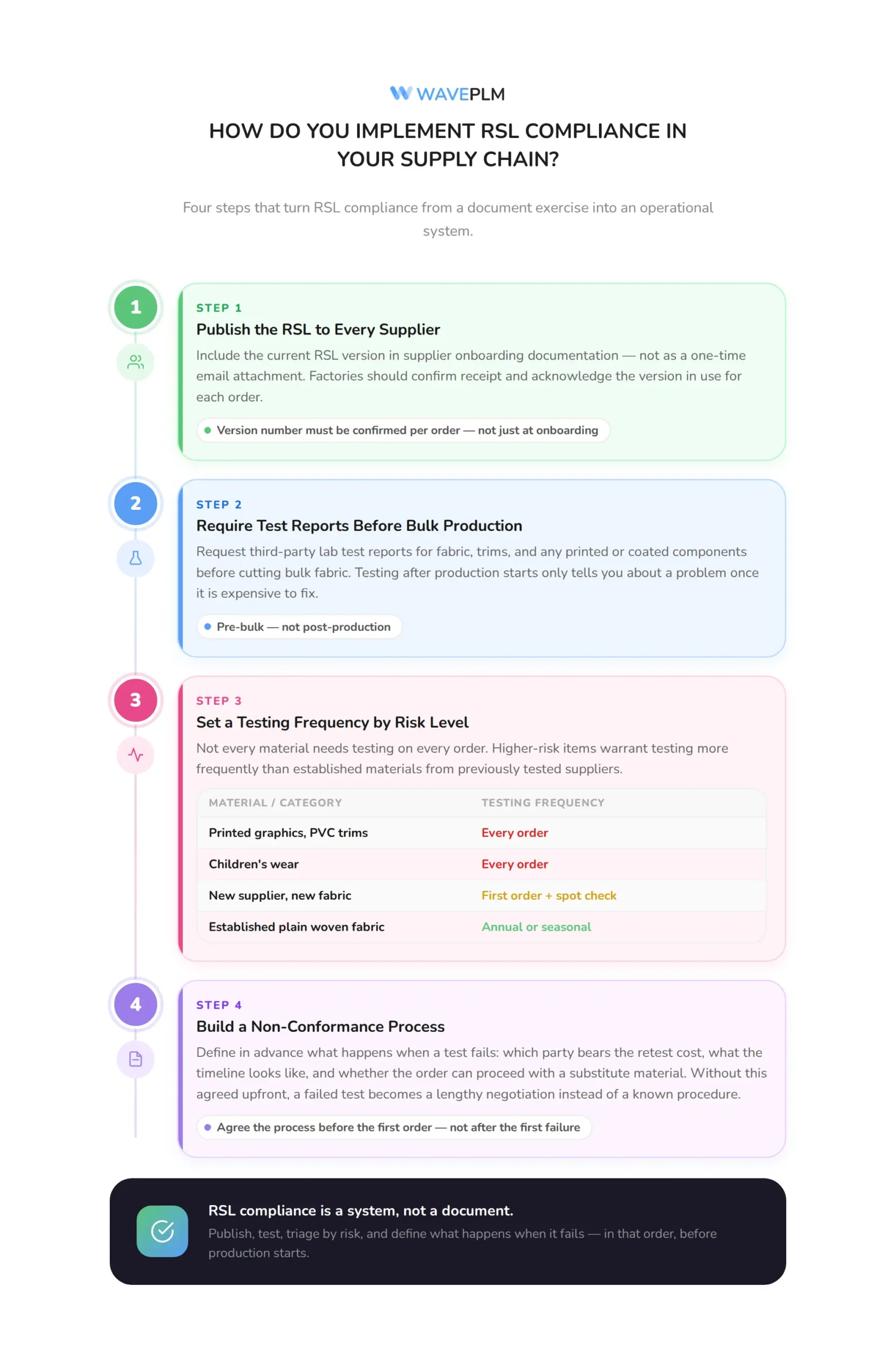
How Do You Implement RSL Compliance in Your Supply Chain?
1. Publish the RSL to Every Supplier
Include the current RSL version in supplier onboarding documentation, not as a one-time email attachment. Additionally, factories should confirm receipt and acknowledge the version in use for each order.
2. Require Test Reports Before Bulk Production
Request third-party lab test reports for fabric, trims, and any printed or coated components before cutting bulk fabric. Otherwise, testing after production starts only tells you about a problem once it is expensive to fix.
3. Set a Testing Frequency by Risk Level
Not every material needs testing on every order. Instead, higher-risk items, such as printed graphics, PVC trims, and children’s wear, warrant testing more frequently than plain woven fabric from an established, previously tested supplier.
4. Build a Non-Conformance Process
Define in advance what happens when a test fails. Specifically, decide which party bears the retest cost, what the timeline looks like, and whether the order can proceed with a substitute material. Without this process agreed upfront, a failed test becomes a lengthy negotiation instead of a known procedure.
What Are the Most Common RSL Compliance Mistakes?
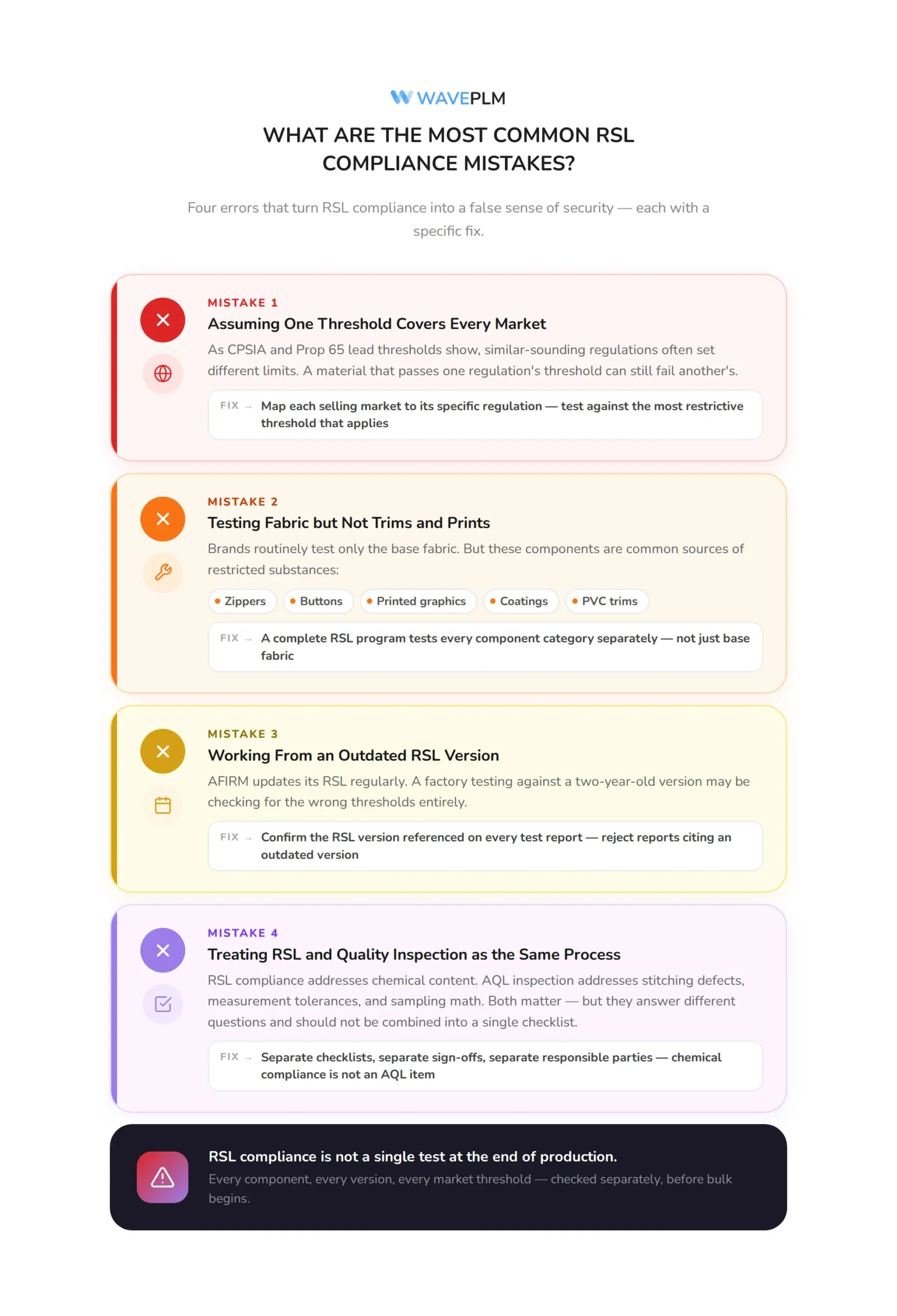
Assuming One Threshold Covers Every Market
As the CPSIA and Prop 65 lead thresholds show, similar-sounding regulations often set different limits. Consequently, a material that passes one regulation’s threshold can still fail another’s.
Testing Fabric but Not Trims and Prints
Zippers, buttons, printed graphics, and coatings are common sources of restricted substances. Yet brands routinely test only the base fabric. Instead, a complete RSL program tests every component category separately.
Working From an Outdated RSL Version
Since AFIRM updates its RSL regularly, a factory testing against a two-year-old version may be checking for the wrong thresholds entirely. For this reason, confirm the RSL version referenced on every test report.
RSL compliance, particularly concerning the restricted substances list, is not a single test at the end of production.
For successful compliance, brands must ensure that every aspect of the restricted substances list is checked thoroughly.
Treating RSL and Quality Inspection as the Same Process
RSL compliance addresses chemical content. However, it does not address stitching defects, measurement tolerances, or the sampling math covered in AQL inspection. Both processes matter. That said, they answer different questions and should not be combined into a single checklist.
How Does PLM Software Support RSL Compliance?
Most brands manage RSL compliance through a folder of PDF test reports, disconnected from the actual product record. As a result, when a fabric or trim changes mid-season, nobody reliably checks whether the new material has a current test on file.
PLM software fixes this by attaching test certificates directly to the specific BOM line they cover. As a result, if a sourcing manager swaps a trim supplier, the missing test report is visible immediately, not discovered during a shipment hold. Wave PLM also connects RSL documentation to vendor onboarding profiles, so a factory’s compliance history travels with them across every new style. Combined with the supplier portal, factories upload test reports directly against the relevant material, closing the gap between what a spec sheet requires and what a lab actually confirmed. This same connected record also supports broader quality control workflows, since chemical compliance and physical quality checks increasingly get reviewed by the same pre-production teams.
Frequently Asked Questions
What is a restricted substances list (RSL)?
A restricted substances list (RSL) sets maximum allowed limits, or outright bans, on specific chemicals in finished apparel and footwear. Brands use it to confirm that fabric, trims, dyes, and coatings do not contain substances linked to health or environmental harm. Most brands adopt an existing industry RSL, such as AFIRM’s, rather than writing their own from scratch.
What is the difference between an RSL and an MRSL?
An RSL restricts substances found in the finished product a customer receives. By contrast, an MRSL, such as the ZDHC MRSL, restricts chemicals used during manufacturing itself. This includes dyes and finishing agents that may not remain in the final garment. However, they still affect factory workers and wastewater. A complete compliance program addresses both.
What substances does an RSL typically restrict?
Industry RSLs commonly restrict heavy metals such as lead and cadmium, plus phthalates in plastic components. They also cover PFAS in water-repellent finishes, azo dyes in colored fabrics, formaldehyde in wrinkle-resistant finishes, and certain flame retardants. Notably, AFIRM’s RSL, the most widely adopted industry standard, is updated regularly to reflect new regulations and research.
How is an RSL different from REACH or CPSIA?
An RSL is typically a voluntary industry or brand standard, while REACH and CPSIA are government regulations with legal force in the EU and US respectively. A good RSL program is built to meet or exceed the strictest applicable regulation. However, brands still need to track REACH, CPSIA, and other market-specific rules separately. This matters because thresholds can differ even for the same substance.
Do small apparel brands need their own RSL?
Most small and mid-market brands do not need a custom RSL. Adopting an established industry RSL, such as AFIRM’s, publishing it to suppliers, and requiring test reports against it covers most practical risk. A custom RSL becomes worthwhile mainly for brands with specific retailer requirements or higher-risk product categories like children’s sleepwear.
How does PLM software help with RSL compliance?
PLM software attaches RSL test certificates directly to the specific BOM line they cover, instead of storing them as disconnected PDF files. Additionally, Wave PLM links this documentation to vendor onboarding profiles and the supplier portal. As a result, a factory’s compliance history and current test reports travel with the product record across every style and season.
RSL compliance is not a single test at the end of production. Instead, it is a process that starts with publishing the right list to suppliers and continues through testing before bulk cutting. Ultimately, it holds up only if every material category, not just the base fabric, is actually checked.
Wave PLM keeps RSL test certificates connected to the exact BOM line, supplier, and season they belong to, so compliance gaps surface before a shipment, not after. See how Wave PLM supports supply chain compliance →






Leave a Reply