
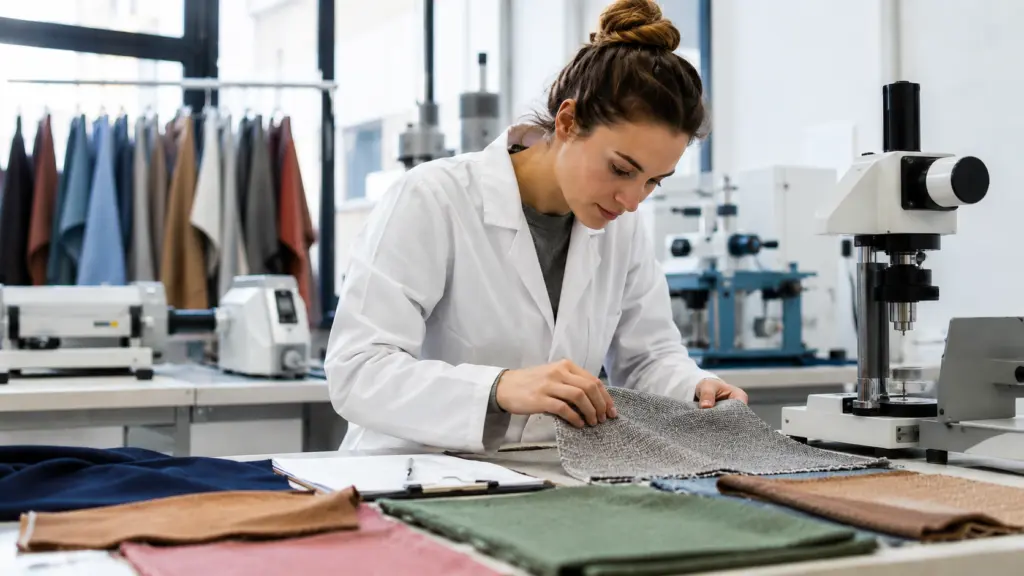
Apparel product testing is the process of sending fabric and garment samples to an accredited laboratory before approving bulk production. Labs measure colorfastness, shrinkage, seam strength, fiber content, and chemical safety against standardized protocols. Brands that skip this step routinely face retailer chargebacks, mass returns, and compliance violations that cost far more than the tests would have.
This guide focuses on the brand side of testing — not consumer wear-tester programs from Nike or Adidas. It covers the 7 lab tests that matter most before your production order ships, when to run each one, how to choose a testing lab, and how PLM software helps manage test results across multiple styles and factories.
What Is Apparel Product Testing?
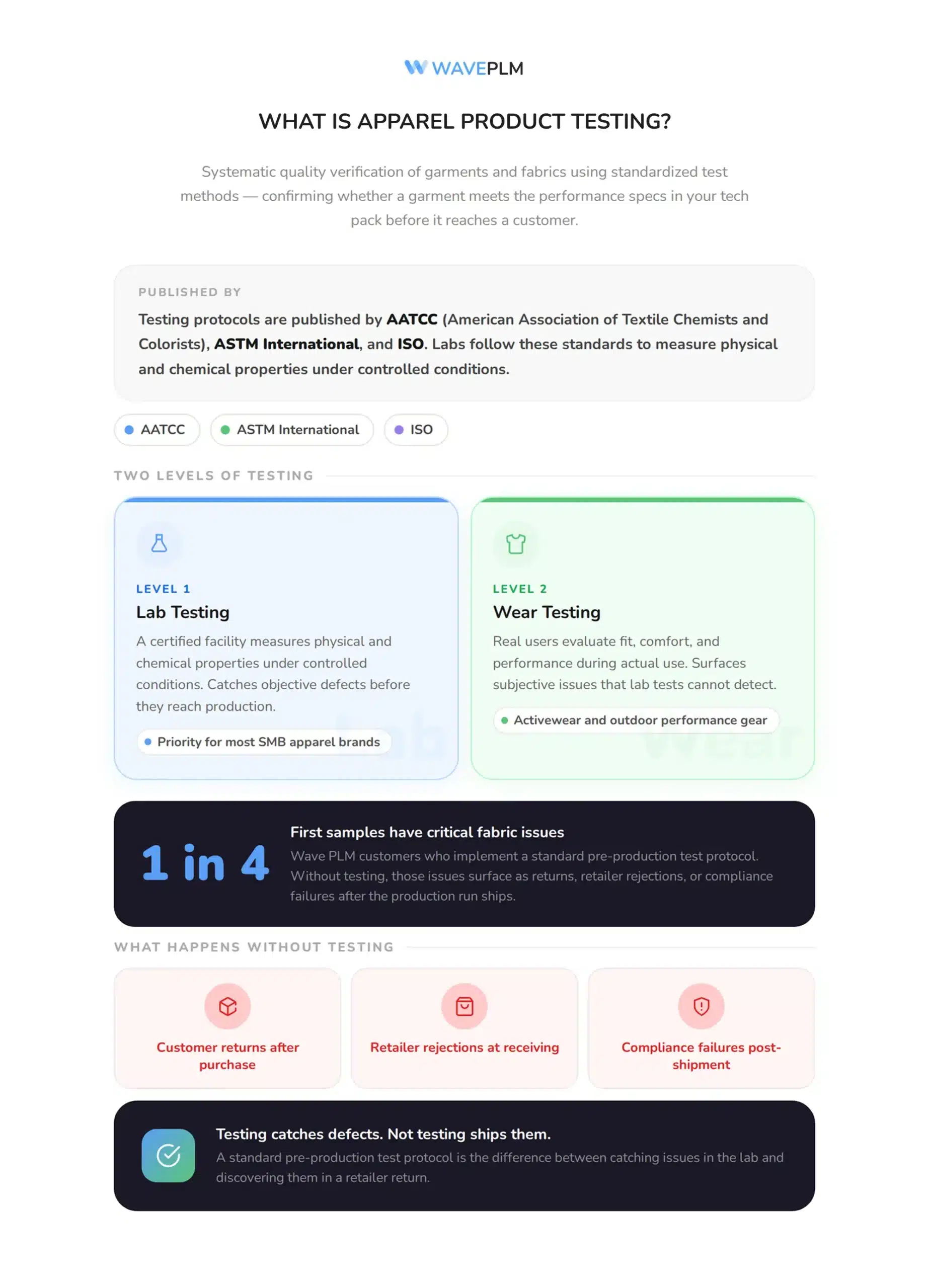
Apparel product testing is systematic quality verification of garments and fabrics using standardized test methods. Testing bodies such as AATCC (American Association of Textile Chemists and Colorists), ASTM International, and ISO publish the protocols labs follow. Results confirm whether a garment meets the performance specifications in your tech pack — or reveals problems before they reach a customer.
Testing happens at two levels. First, lab testing: a certified facility measures physical and chemical properties under controlled conditions. Second, wear testing: real users evaluate fit, comfort, and performance during actual use. For most SMB apparel brands, lab testing is the priority because it catches objective defects. Wear testing is more relevant for technical performance categories like activewear and outdoor gear.
Our finding: Wave PLM customers who implement a standard pre-production test protocol report catching critical fabric issues on 1 in 4 first samples. Without testing, those issues surface as returns, retailer rejections, or compliance failures after the production run ships.
Why Does Pre-Production Testing Matter?
The financial case for apparel product testing is straightforward. A lab test battery for one style costs $300–$1,500. A single retail chargeback for color bleeding or shrinkage can cost $5,000–$50,000 in returned goods, fees, and relationship damage. Additionally, US and EU import regulations require chemical safety compliance — specifically CPSC flammability standards for children’s apparel and REACH restrictions on hazardous substances for EU markets. Ignorance of these requirements does not protect a brand from enforcement.
Moreover, testing protects the factory relationship. When brands discover defects through customer returns instead of pre-production tests, they blame the factory. Factories, in turn, claim the specs were unclear. A documented test protocol removes ambiguity. Results give both parties a shared, objective standard to work from.
The 7 Essential Apparel Lab Tests
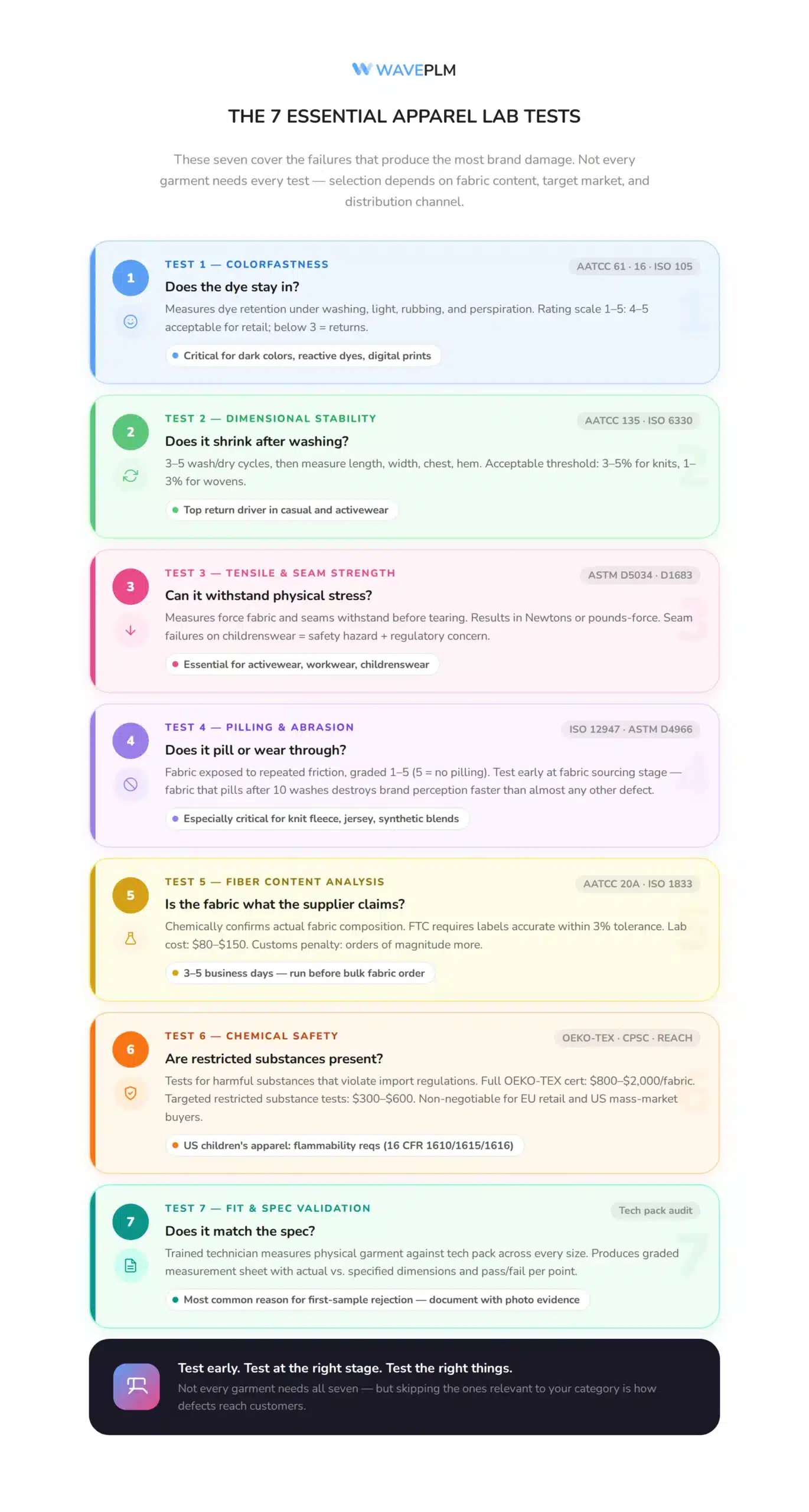
Not every garment needs every test. That said, these seven cover the failures that produce the most brand damage. The right selection depends on your fabric content, target market, and distribution channels.
1. Colorfastness Testing
Specifically, colorfastness tests measure how well dye stays in fabric under washing, light exposure, rubbing, and perspiration. The primary standards are AATCC 61 (wash colorfastness), AATCC 16 (light fastness), and ISO 105 series. In practice, lab results use a 1–5 scale: ratings of 4–5 are acceptable for most retail; ratings below 3 indicate bleeding or fading that will generate returns.
This test is essential for any dyed or printed fabric. It is particularly critical for dark colors, reactive dyes, and digitally printed textiles. Furthermore, many major retailers — including Target, Walmart, and Nordstrom — require documented colorfastness results as part of their vendor qualification process.
2. Dimensional Stability (Shrinkage) Testing
In this test, a garment goes through 3–5 standard wash and dry cycles, then the lab measures changes in key dimensions: length, width, chest, and hem. The AATCC 135 and ISO 6330 protocols specify water temperature, agitation, and drying method. Generally, most brands set an acceptable shrinkage threshold of 3–5% for knits and 1–3% for wovens.
Exceeding these thresholds after the first wash is a top return driver in casual and activewear. Importantly, even if the factory uses the correct fabric, an incorrect finishing process can cause unexpected shrinkage. Testing confirms the actual finished garment behavior — not just the fabric specification on paper.
3. Tensile and Seam Strength Testing
Tensile testing measures how much force fabric can withstand before tearing. Similarly, seam strength testing applies the same principle to sewn joints. The standard methods are ASTM D5034 (grab test) for fabric and ASTM D1683 for seam strength. Results are expressed in Newtons or pounds-force.
This test matters most for performance categories — activewear, workwear, childrenswear — where physical stress on seams is high. Additionally, seam strength failures on childrenswear can create safety hazards, making this a regulatory concern and not just a quality one.
4. Pilling and Abrasion Resistance Testing
Pilling tests expose fabric to repeated friction, then visually grade the surface against a reference scale (1–5, where 5 is no pilling). The Martindale method (ISO 12947, ASTM D4966) is the most widely used. Furthermore, abrasion testing continues until the fabric surface shows visible wear, measuring how many cycles the material withstands.
Pilling resistance is especially relevant for knit fleece, jersey, and synthetic blends. A fabric that pills after 10 washes destroys brand perception more effectively than almost any other defect. As a result, investing in this test early — at the fabric sourcing stage — prevents approving materials that look good in hand but fail in use. Our fabric sourcing guide covers how to evaluate supplier fabric specs against test requirements before placing material orders.
5. Fiber Content Analysis
Notably, fiber content analysis chemically identifies the actual composition of a fabric — for example, confirming that a fabric sold as “95% cotton / 5% elastane” contains what the supplier claims. The standard methods are AATCC 20A and ISO 1833. This test takes 3–5 business days at most labs.
FTC regulations in the US require fiber content labels to reflect actual composition within a 3% tolerance. Mislabeled content — even unintentionally from a supplier error — is a compliance violation. Furthermore, customs authorities randomly test imported garments for label accuracy. In fact, catching a discrepancy in the lab costs $80–$150. In contrast, catching it at customs costs orders of magnitude more in delays and penalties.
6. Chemical Safety Testing
Chemical safety testing checks for restricted substances that could harm consumers or violate import regulations. Three frameworks govern most markets. First, OEKO-TEX Standard 100 tests for 100+ harmful substances and is widely recognized by European retailers. Second, CPSC standards apply to US children’s apparel and specify flammability requirements (16 CFR Parts 1610, 1615, 1616). Third, REACH restrictions apply to EU market access and limit specific hazardous chemicals including azo dyes, phthalates, and formaldehyde.
This is the most consequential test category from a compliance standpoint. A full OEKO-TEX certification test runs $800–$2,000 per fabric. However, targeted restricted substance tests for specific markets can be scoped for $300–$600. Brands selling to EU retailers or large US mass-market buyers should treat this as non-negotiable, not optional.
7. Fit and Spec Validation
Fit validation is technically a measurement audit rather than a lab test, but it belongs in every pre-production testing protocol. A trained pattern grader or fit technician measures the physical garment against the measurements in your tech pack across every size in the run. The result is a graded measurement spec sheet with actual vs. specified dimensions and clear pass/fail status for each measurement point.
In practice, fit issues are the most common reason brands reject first samples. However, factories frequently interpret unclear spec measurements differently from the brand’s intent. A documented measurement audit — with photo documentation of the fit model — creates an objective record that informs revision comments and prevents the same error on the second sample.
When Should You Send Samples for Testing?
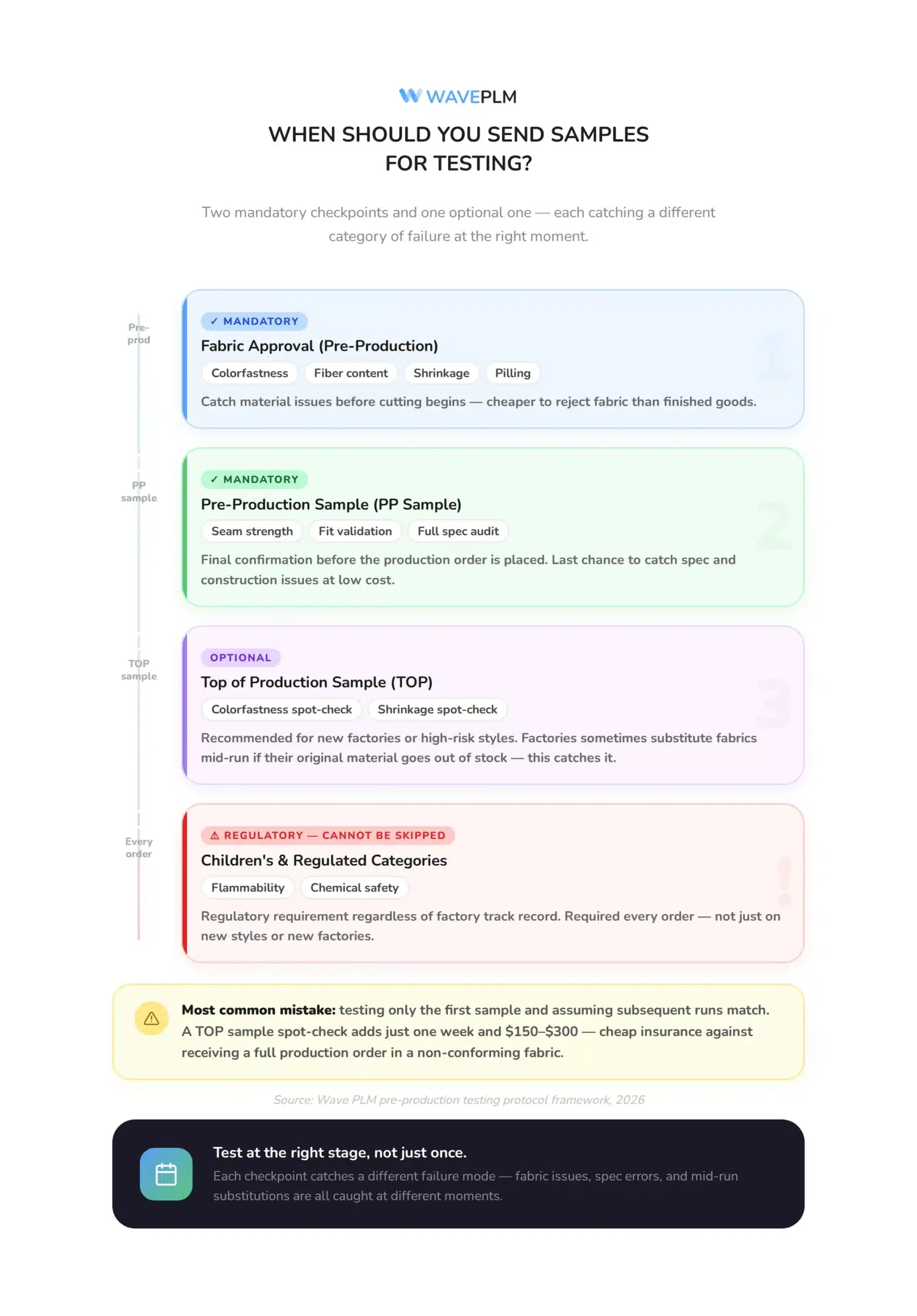
Apparel product testing happens at two mandatory checkpoints and one optional one.
| Checkpoint | What to test | Why at this stage |
|---|---|---|
| Fabric approval (pre-production) | Colorfastness, fiber content, shrinkage, pilling | Catch material issues before cutting begins — cheaper to reject fabric than finished goods |
| Pre-production sample (PP sample) | Seam strength, fit validation, full spec audit | Final confirmation before production order is placed |
| Top of production (TOP) sample | Spot-check colorfastness and shrinkage | Optional but recommended for new factories or high-risk styles |
| Children’s and regulated categories | Flammability, chemical safety (every order) | Regulatory requirement — cannot be skipped regardless of factory track record |
The most common mistake is testing only the first sample and assuming subsequent production runs match. In reality, factories sometimes substitute fabrics mid-run — particularly if their original material goes out of stock. A TOP sample spot-check adds one week and $150–$300 to your timeline. It is cheap insurance against receiving a full production order in a non-conforming fabric.
For context on how testing fits into the broader sample approval process, see our guide on reducing sample rounds in apparel development.
How Do You Choose an Apparel Testing Laboratory?
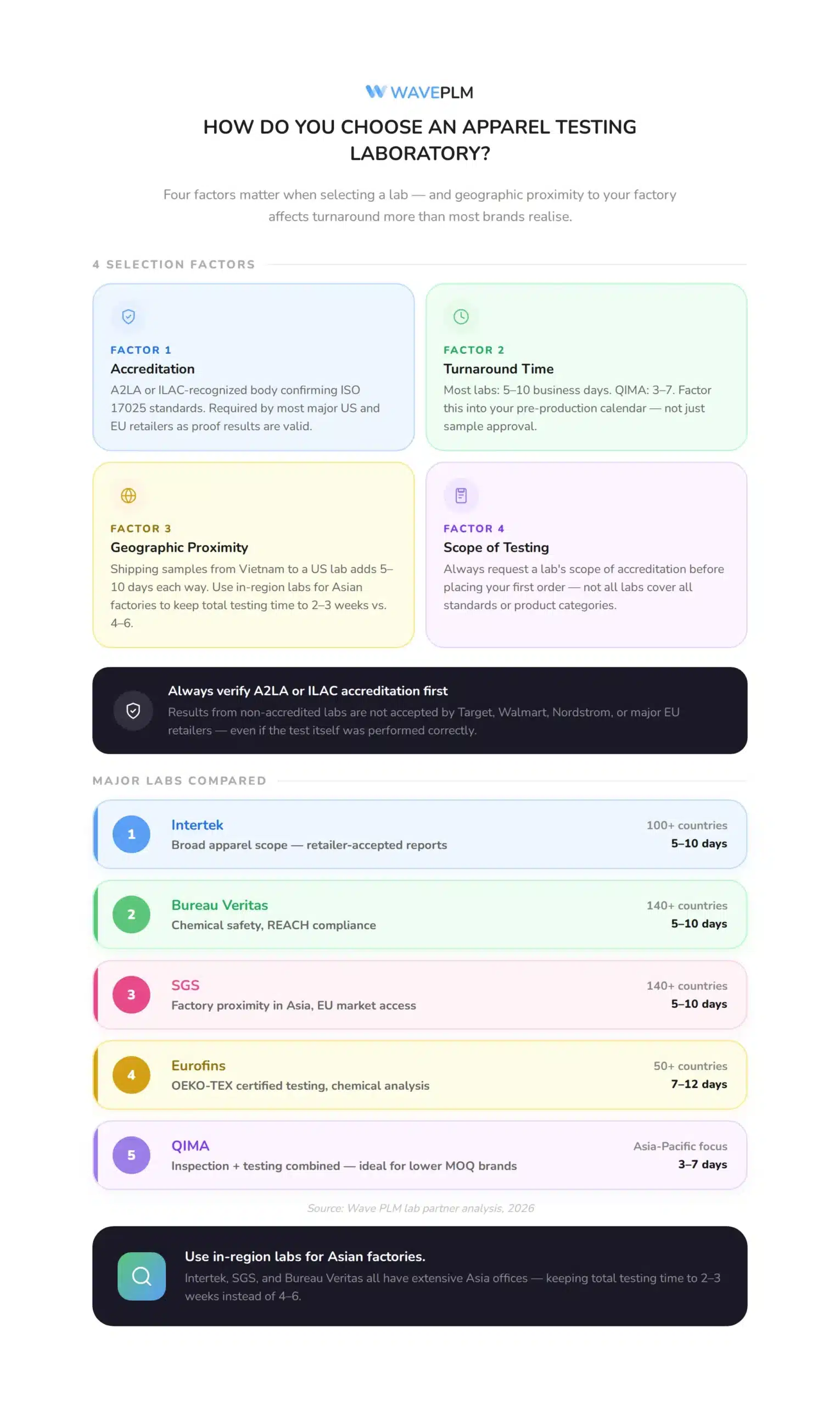
Four factors matter when selecting a lab: accreditation, turnaround time, geographic proximity to your factory, and scope of testing offered.
Specifically, accreditation by A2LA (American Association for Laboratory Accreditation) or ILAC-recognized bodies confirms the lab meets ISO 17025 quality standards. This accreditation is required by most major US and EU retailers as proof that test results are valid. Therefore, always request a lab’s scope of accreditation before placing your first order.
| Lab | Global offices | Typical turnaround | Known for |
|---|---|---|---|
| Intertek | 100+ countries | 5–10 business days | Broad apparel scope, retailer-accepted reports |
| Bureau Veritas | 140+ countries | 5–10 business days | Chemical safety, REACH compliance |
| SGS | 140+ countries | 5–10 business days | Factory proximity in Asia, EU market access |
| Eurofins | 50+ countries | 7–12 business days | OEKO-TEX certified testing, chemical analysis |
| QIMA | Asia-Pacific focus | 3–7 business days | Inspection + testing combined, lower MOQ brands |
Geographic proximity to your factory matters for turnaround. For example, shipping samples from Vietnam to a US lab adds 5–10 days each way. As a result, most brands working with Asian factories use in-region labs (Intertek, SGS, or Bureau Veritas have extensive Asia offices) to keep total testing time to 2–3 weeks rather than 4–6 weeks. This timing affects how testing fits into your factory onboarding and sample approval schedule.
How Does PLM Software Help Manage Apparel Product Testing?
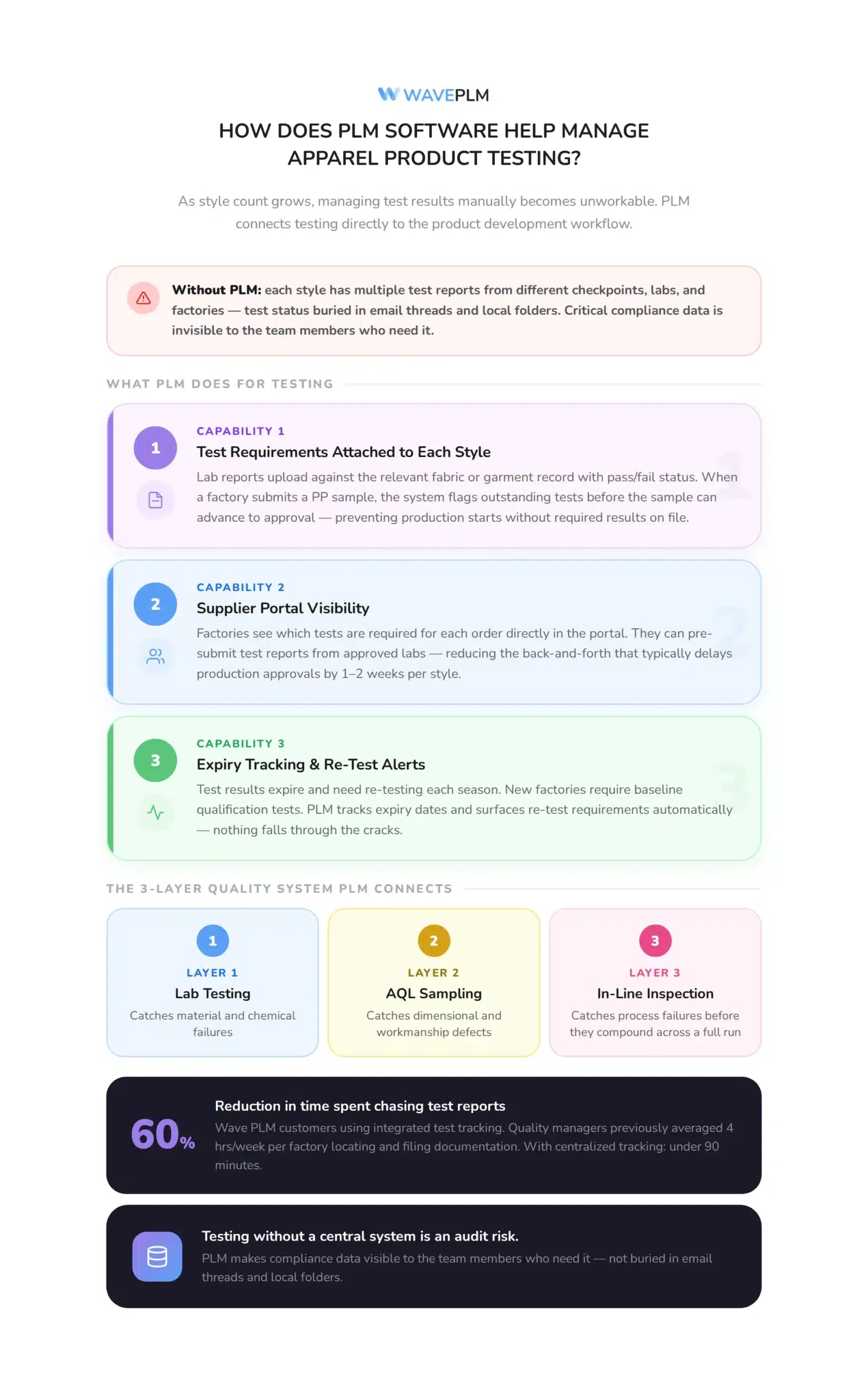
As a brand’s style count grows, managing test results manually becomes unworkable. In practice, each style has multiple test reports from different checkpoints, labs, and factories. Additionally, results expire and need re-testing each season. New factories require baseline qualification tests. Without a central system, test status is buried in email threads and local folders — and critical compliance data is invisible to the team members who need it.
Wave PLM connects apparel product testing directly to the product development workflow. Test requirements attach to each style in the system. Consequently, lab reports upload against the relevant fabric or garment record with pass/fail status. Specifically, when a factory submits a PP sample, the system flags which tests are outstanding before the sample can move to approval status. This prevents samples from advancing to production without required test results on file.
Additionally, PLM helps with AQL inspection planning and quality control more broadly. Together, lab testing, AQL sampling, and in-line inspection form a three-layer quality system. Each layer catches different defect types. Lab tests catch material and chemical failures. AQL inspection catches dimensional and workmanship defects. In-line inspection catches process failures before they compound across a full production run.
The supplier portal in Wave PLM gives factories direct visibility into which tests are required for each order. Consequently, factories can pre-submit required test reports from approved labs — reducing the back-and-forth that typically delays production approvals by one to two weeks per style.
Our finding: Wave PLM customers using integrated test tracking report a 60% reduction in time spent chasing test reports. Previously, quality managers averaged 4 hours per week per factory locating and filing test documentation. With centralized tracking, that time drops to under 90 minutes.
Frequently Asked Questions
What is apparel product testing?
Apparel product testing is the process of submitting fabric and garment samples to accredited laboratories before approving bulk production. Labs measure physical properties — colorfastness, shrinkage, tensile strength, pilling resistance — and chemical safety against standards set by AATCC, ASTM, ISO, and regulatory bodies. Results confirm whether a garment meets the performance specifications in the tech pack and complies with import regulations in the target market.
Which apparel product tests are required by US retailers?
Most major US retailers — Target, Walmart, Nordstrom, and others — require documented results for colorfastness (AATCC 61), shrinkage (AATCC 135), and seam strength (ASTM D1683) as part of vendor qualification. Children’s apparel additionally requires CPSC flammability compliance (16 CFR 1610/1615). Specific requirements vary by retailer and product category — always request the vendor compliance manual before sourcing fabric.
How much does apparel product testing cost?
A basic physical test battery — colorfastness, shrinkage, tensile strength, and pilling — typically costs $300–$700 per style at labs like Intertek, SGS, or Bureau Veritas. Adding fiber content analysis adds $80–$150. Chemical safety testing (OEKO-TEX Standard 100 or REACH) adds $500–$2,000 depending on scope. For most SMB brands, budget $500–$1,500 per style for a complete pre-production test package.
When should apparel testing happen in the production process?
Apparel product testing has two critical checkpoints. First, fabric approval: test colorfastness, fiber content, shrinkage, and pilling before cutting begins. Catching problems at this stage costs a fraction of testing finished goods. Second, pre-production (PP) sample approval: test seam strength and validate fit against the tech pack before placing the production order. For regulated categories like children’s apparel, additional compliance tests are required on every production run.
What is OEKO-TEX certification and do I need it?
OEKO-TEX Standard 100 is a certification confirming that a garment or fabric has been tested for 100+ harmful substances and meets defined safety thresholds. It is widely required by European retailers and increasingly requested by US sustainable brands. The certification costs $800–$2,000 per fabric or garment and is valid for one year. Brands selling to EU markets, children’s categories, or sustainability-positioned retailers should treat it as a baseline requirement rather than a differentiator.
What is the difference between apparel product testing and AQL inspection?
Apparel product testing measures the physical and chemical properties of fabric and finished garments in a laboratory — colorfastness, shrinkage, tensile strength, and chemical safety. AQL inspection is a statistical sampling method that evaluates finished goods for defects — wrong measurements, stitching errors, misplaced labels, or visual flaws — at the factory before shipment. Both are necessary: lab testing catches material failures; AQL inspection catches workmanship failures. They serve different roles in a complete quality system.
Apparel product testing is not a budget line to optimize away. It is the checkpoint between a spec on paper and a product your customers will actually keep. The 7 tests in this guide cover the most common failure modes — and each one costs a fraction of the return, chargeback, or compliance penalty it prevents.
Wave PLM connects testing requirements directly to your product development workflow — so test status is visible at every stage, from fabric approval through pre-production sign-off. See how Wave PLM manages apparel quality from first sample to final shipment →





Leave a Reply