
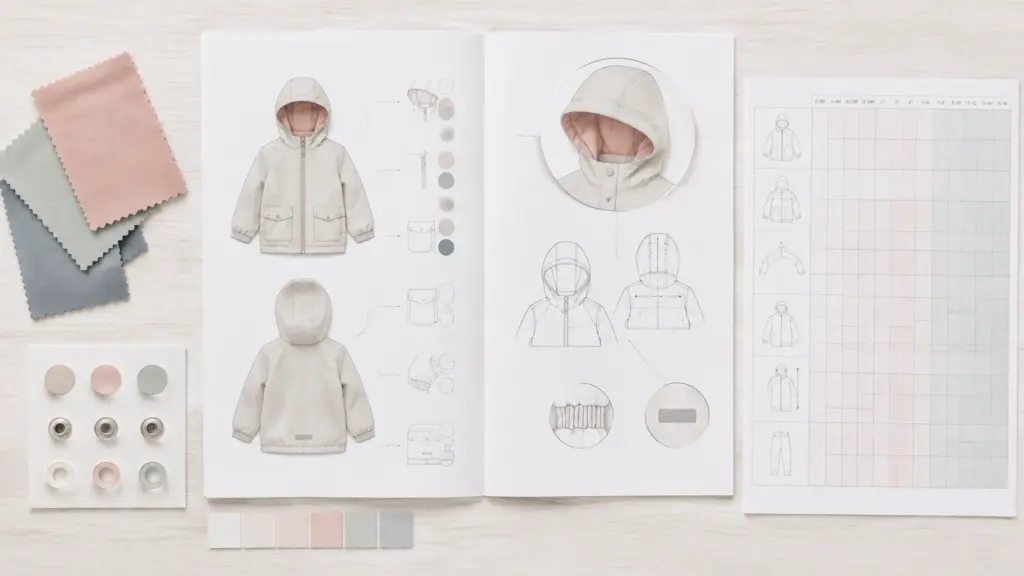
PLM for kids apparel brands has to manage three things an adult-focused setup can mostly skip. First, federal safety rules that apply only to specific size ranges. Second, a size grading system that splits into several unrelated age bands. Third, licensing or collaboration approvals that can block a style until sign-off arrives. None of these are optional add-ons. Miss one, and a style either fails a compliance check, or ships with a design element a licensor never approved.
This guide covers why size grading gets harder once a line spans infant through kids sizes. It also walks through a safety rule most brands miss entirely. That rule, a federal ban on neck and hood drawstrings, sits outside standard CPSIA chemical testing. From there, it explains how CPSIA and PFAS compliance both apply to kids’ apparel. It also covers where character licensing adds its own approval step. Finally, it covers what a connected style record should track for a children’s line specifically.
What Does PLM for Kids Apparel Brands Need to Handle Differently?
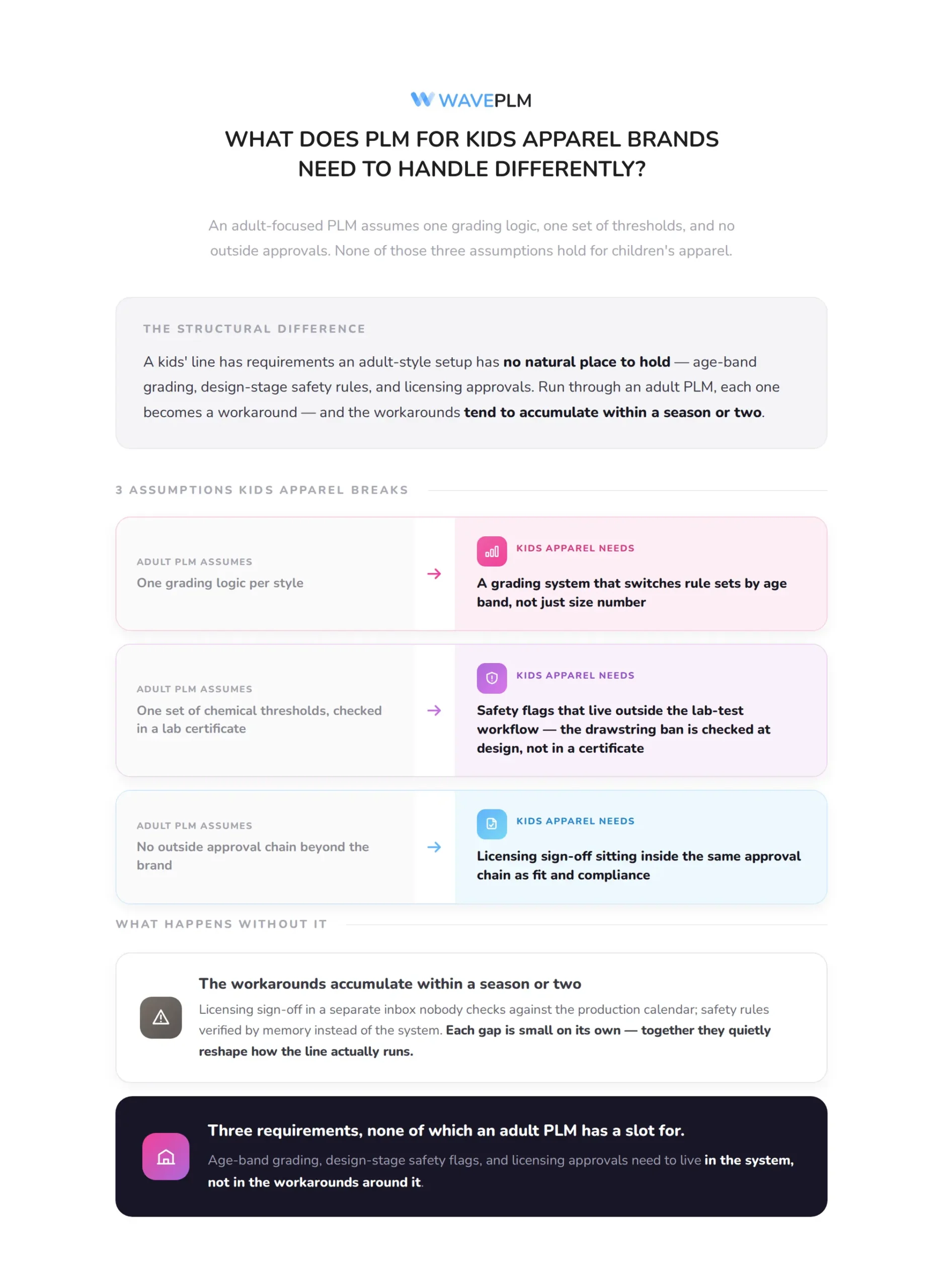
An adult-focused PLM setup generally assumes one grading logic per style, one set of chemical thresholds, and no outside approval chain beyond the brand itself. None of those assumptions hold for children’s apparel. Specifically, PLM for kids apparel brands needs a grading system flexible enough to switch rule sets by age band, not just by size number. It also needs safety flags that live outside a standard lab-test workflow, since rules like the drawstring ban get checked at the design stage, not in a certificate.
On top of that, licensing sign-off has to sit inside the same approval chain as fit and compliance. Otherwise, it lives in a separate inbox that nobody checks against the production calendar. Together, these three requirements are why a kids’ apparel line run through an adult-style PLM setup tends to accumulate workarounds. Usually, that happens within a season or two.
Why Is Size Grading Harder for Children’s Apparel Than Adult Apparel?
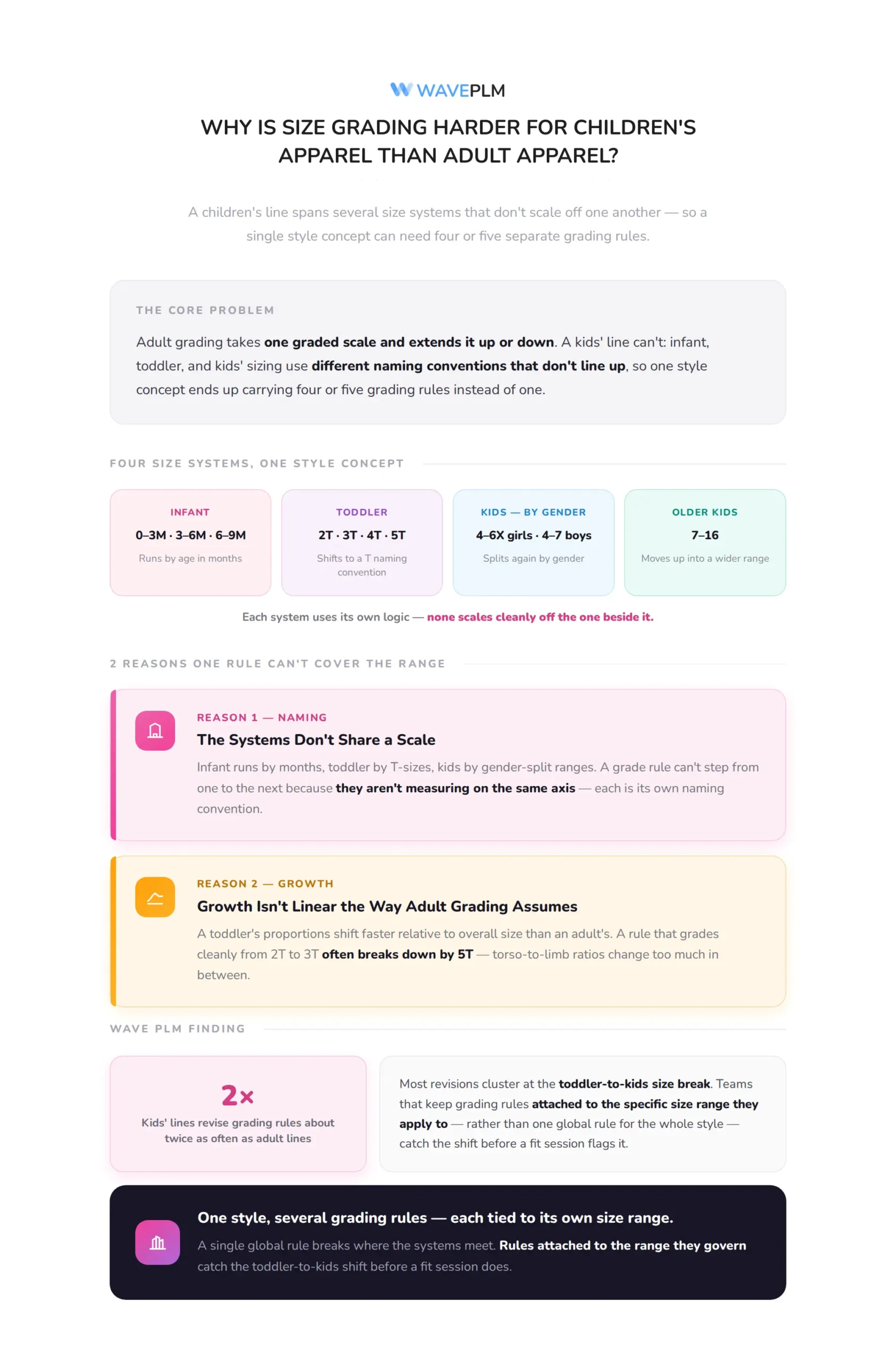
A children’s line typically spans several size systems that do not scale off one another. Infant sizes run by age in months: 0-3M, 3-6M, 6-9M, and so on. Toddler sizes shift to a 2T-5T naming convention instead. Kids’ sizes then split again by age and gender. Common ranges are 4-6X for girls and 4-7 for boys, moving up to 7-16 for older kids. As a result, a single style concept can require four or five separate grading rules. That is a real difference from one graded scale simply extended up or down.
On top of that, growth patterns are not linear the way adult grading assumes. A toddler’s proportions shift faster relative to overall size than an adult’s do. This means a grade rule that works cleanly between 2T and 3T often breaks down by 5T. Torso-to-limb ratios simply change too much in between. Brands that reuse adult grading logic across kids’ sizes typically end up with a fit problem. It shows up at the upper or lower end of the range, and it usually surfaces during a fit session, not before.
Our finding: Wave PLM customers running kids’ lines revise grading rules roughly twice as often as their adult lines, most commonly at the toddler-to-kids size break. Teams that keep grading rules attached to the specific size range they apply to, rather than one global rule for the whole style, catch this shift before a fit session flags it.
What Safety Rules Apply to Kids’ Apparel Beyond CPSIA Chemical Limits?
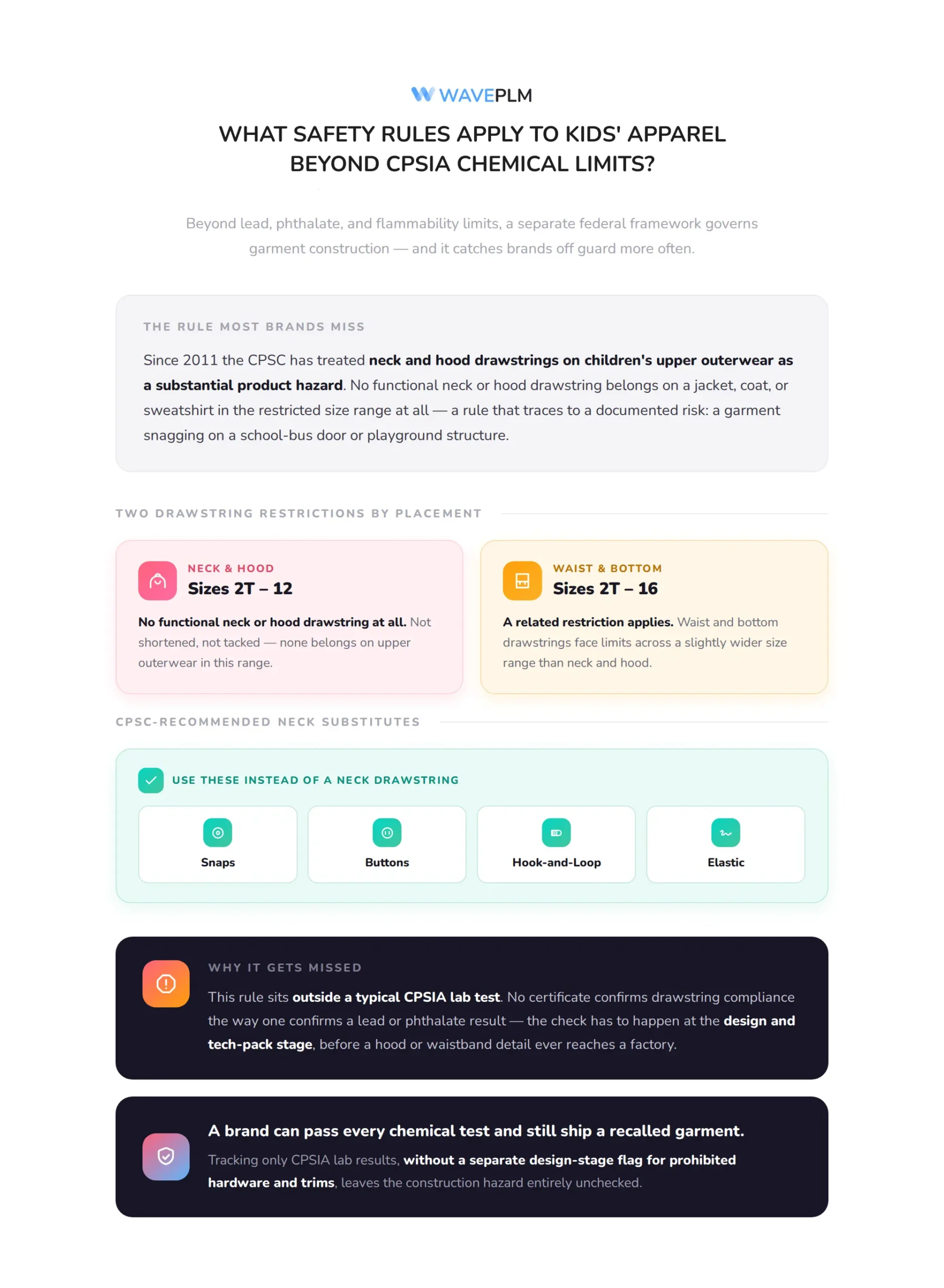
CPSIA’s lead, phthalate, and sleepwear flammability thresholds are chemical and material rules, and our CPSIA compliance guide covers those in detail. A separate federal safety framework covers garment construction itself, and it catches brands off guard more often. Since 2011, the U.S. Consumer Product Safety Commission has treated neck or hood drawstrings on children’s upper outerwear, sizes 2T to 12, as a substantial product hazard. In practice, no functional neck or hood drawstring belongs on a jacket, coat, or sweatshirt in that size range at all. Waist and bottom drawstrings face a related restriction on sizes 2T to 16. That restriction traces back to a documented risk: a garment snagging on a school bus door or a playground structure.
Industry data: The CPSC’s underlying standard, ASTM F1816, was developed after documented strangulation and dragging incidents involving drawstrings caught on playground equipment, cribs, escalators, and vehicle doors. The agency recommends snaps, buttons, hook-and-loop closures, or elastic as direct substitutes at the neck.
This rule sits outside a typical CPSIA lab test, which is exactly why it gets missed. No lab certificate confirms drawstring compliance the way one confirms a lead or phthalate result. Instead, the check has to happen at the design and tech pack stage. That has to occur before a hood or waistband construction detail ever reaches a factory. A brand that only tracks CPSIA lab results, without a separate flag for prohibited hardware and trims, can pass every chemical test. Even so, it can still ship a recalled garment.
Does PFAS Compliance Work Differently for Children’s Apparel?
Not by size. Our PFAS compliance guide covers the state-by-state rules now restricting PFAS in apparel generally. None of the state thresholds we found carve out a lower bar or an earlier deadline specifically for children’s sizes. That is worth flagging precisely because it is easy to assume otherwise. CPSIA does not cover PFAS at all. So a style can carry a valid Children’s Product Certificate for lead, phthalates, and flammability, and still contain PFAS above a state’s textile threshold. A durable water repellent finish on a kids’ rain jacket needs the same total organic fluorine testing an adult version of that jacket would need. Treating CPSIA clearance as full chemical compliance is the gap that shows up first.
How Do Character Licensing and Collaborations Complicate Kids’ Apparel Production?
Character and brand licensing runs through a large share of kids’ apparel. This has no real equivalent in most adult categories. A licensed graphic, logo placement, or colorway typically needs sign-off from the licensor before a style can move to bulk production. That approval sits on top of the usual internal fit and quality sign-offs a style already needs. Consequently, a delayed licensor approval can hold up an entire production slot. This can happen even after a factory is ready to cut.
Licensing agreements also frequently restrict where and how a mark can appear. Exact placement and minimum size on the garment are typically specified in the agreement. A print vendor working from an outdated spec can introduce a violation on its own. That violation has nothing to do with fit or chemical safety. Instead, it is purely a contractual and brand-approval issue. Brands that track licensing approval status alongside fit and compliance sign-off catch a stalled approval early. Otherwise, that status lives in a separate email thread with the licensor’s team, and the gap surfaces only once it becomes a missed production window.
What Should a Kids’ Apparel Style Record Actually Track?
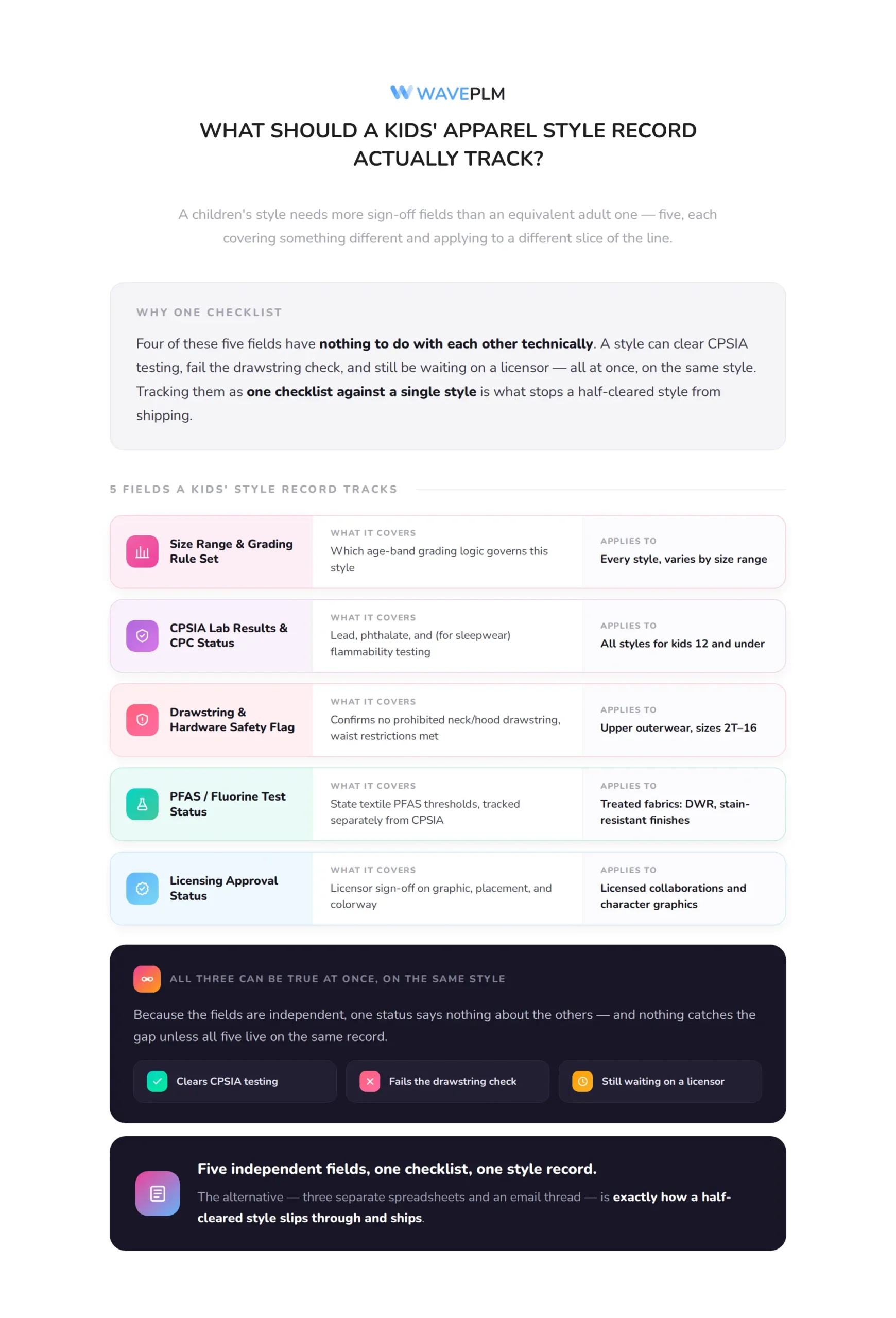
Pulling the requirements above together, a children’s apparel style needs more sign-off fields than an equivalent adult style. The table below summarizes what each one covers and where it applies.
| Tracked field | What it covers | Applies to |
|---|---|---|
| Size range and grading rule set | Which age-band grading logic governs this style | Every style, varies by size range |
| CPSIA lab results and CPC status | Lead, phthalate, and (for sleepwear) flammability testing | All styles for kids 12 and under |
| Drawstring and hardware safety flag | Confirms no prohibited neck/hood drawstring, waist drawstring restrictions met | Upper outerwear, sizes 2T-16 |
| PFAS / total organic fluorine test status | State textile PFAS thresholds, tracked separately from CPSIA | Treated fabrics: DWR, stain-resistant finishes |
| Licensing approval status | Licensor sign-off on graphic, placement, and colorway | Licensed collaborations and character graphics |
Notably, four of these five fields have nothing to do with each other technically. A style can clear CPSIA testing, fail the drawstring check, and still be waiting on a licensor’s approval. All three can happen at the same time, on the same style. Tracking them as one checklist against a single style is what actually prevents a half-cleared style from shipping. The alternative, three separate spreadsheets and an email thread, is exactly how that gap opens.
How Does Wave PLM Support Kids’ Apparel Brands Specifically?
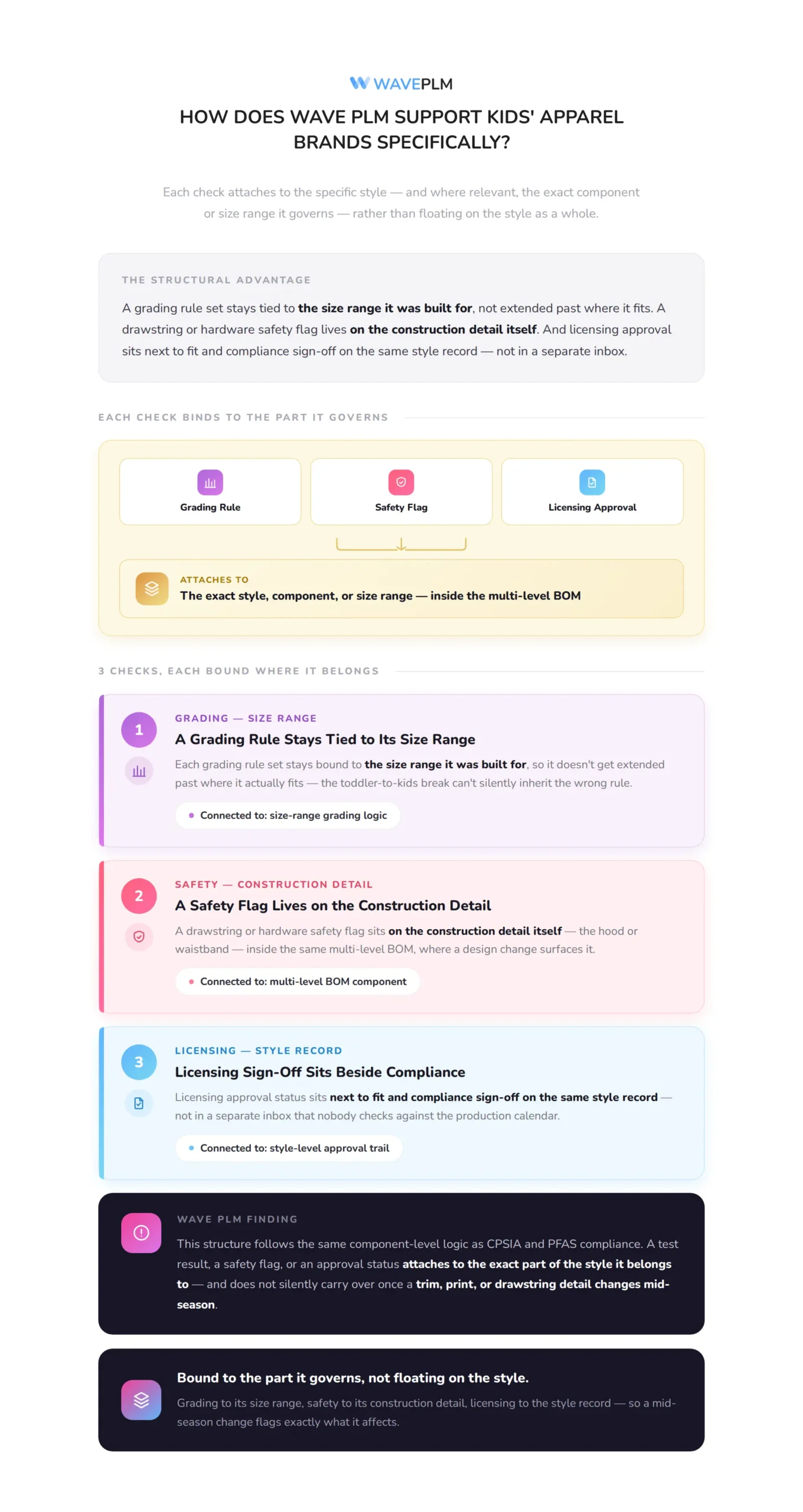
Wave PLM attaches each of these checks to the specific style, and where relevant, to the specific component or size range it governs. A grading rule set stays tied to the size range it was built for. It does not get extended past where it actually fits. Similarly, a drawstring or hardware safety flag lives on the construction detail itself. That detail sits inside the same multi-level BOM used for costing and sourcing. Licensing approval status, meanwhile, sits next to fit and compliance sign-off on the same style record, instead of in a separate inbox.
This structure follows the same component-level logic covered in our CPSIA compliance guide and our PFAS compliance guide. A test result, a safety flag, or an approval status attaches to the exact part of the style it belongs to. It does not silently carry over once a trim, print, or drawstring detail changes mid-season.
Frequently Asked Questions
What makes PLM different for kids apparel brands?
PLM for kids apparel brands has to manage size grading across several unrelated age bands, safety rules like the drawstring ban that sit outside standard chemical testing, and licensing approvals for character or brand collaborations. None of these apply the same way to adult-focused apparel lines.
Are drawstrings banned on children’s clothing?
Neck and hood drawstrings are treated as a substantial product hazard on children’s upper outerwear sizes 2T to 12, under a standard the CPSC has enforced since 2011. Waist and bottom drawstrings face a related restriction on sizes 2T to 16 due to a snagging and dragging risk.
Is the drawstring rule part of CPSIA testing?
No. CPSIA covers chemical and flammability testing, verified through a lab and a Children’s Product Certificate. The drawstring rule is a construction and design requirement, checked at the tech pack stage rather than through a lab certificate.
Does CPSIA cover PFAS in kids’ clothing?
No. CPSIA regulates lead, phthalates, and sleepwear flammability, but not PFAS. State PFAS textile rules apply to children’s apparel the same way they apply to adult apparel, so a valid Children’s Product Certificate does not by itself confirm PFAS compliance.
Why does size grading change so much between toddler and kids sizes?
Children’s proportions shift faster relative to overall size than an adult’s do. A grading rule built for toddler sizes like 2T-3T often does not scale cleanly to kids’ sizes like 5T-6X, so most brands need a separate grading rule set for each age band.
How does character licensing affect kids’ apparel production timelines?
A licensed graphic, logo, or colorway typically needs sign-off from the licensor before bulk production starts, on top of standard fit and quality approvals. Delayed licensor approval can hold up a production slot even when the factory and materials are otherwise ready.
If you cannot currently pull a list of every drawstring-equipped or licensed style in your kids’ line within a few minutes, that gap is worth closing. Otherwise, a recall notice or a licensor audit ends up forcing the question instead. Get in touch with the Wave PLM team to see how style-level safety and licensing flags work in practice.



Leave a Reply