
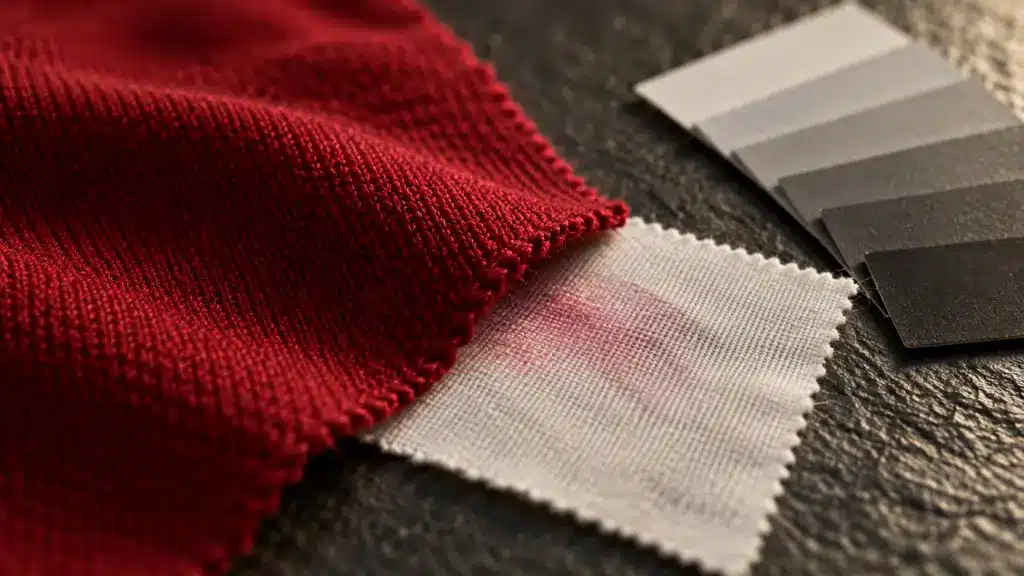
Colorfastness is a fabric’s ability to keep its colour without fading or bleeding. It covers washing, rubbing, sweat, and light. Labs grade it on a 1–5 grey scale, where 5 means no change, and grade light fastness on a separate 1–8 blue wool scale. For an apparel brand, however, the definition is the easy part. The real questions are which grades to write into the tech pack and what to do when a fabric fails.
This guide answers exactly that. First, it maps the main tests to what they simulate. Next, it gives typical pass grades by product type. Finally, it explains the most common reasons for a failure and how to fix them before bulk.
What Does Colorfastness Measure?
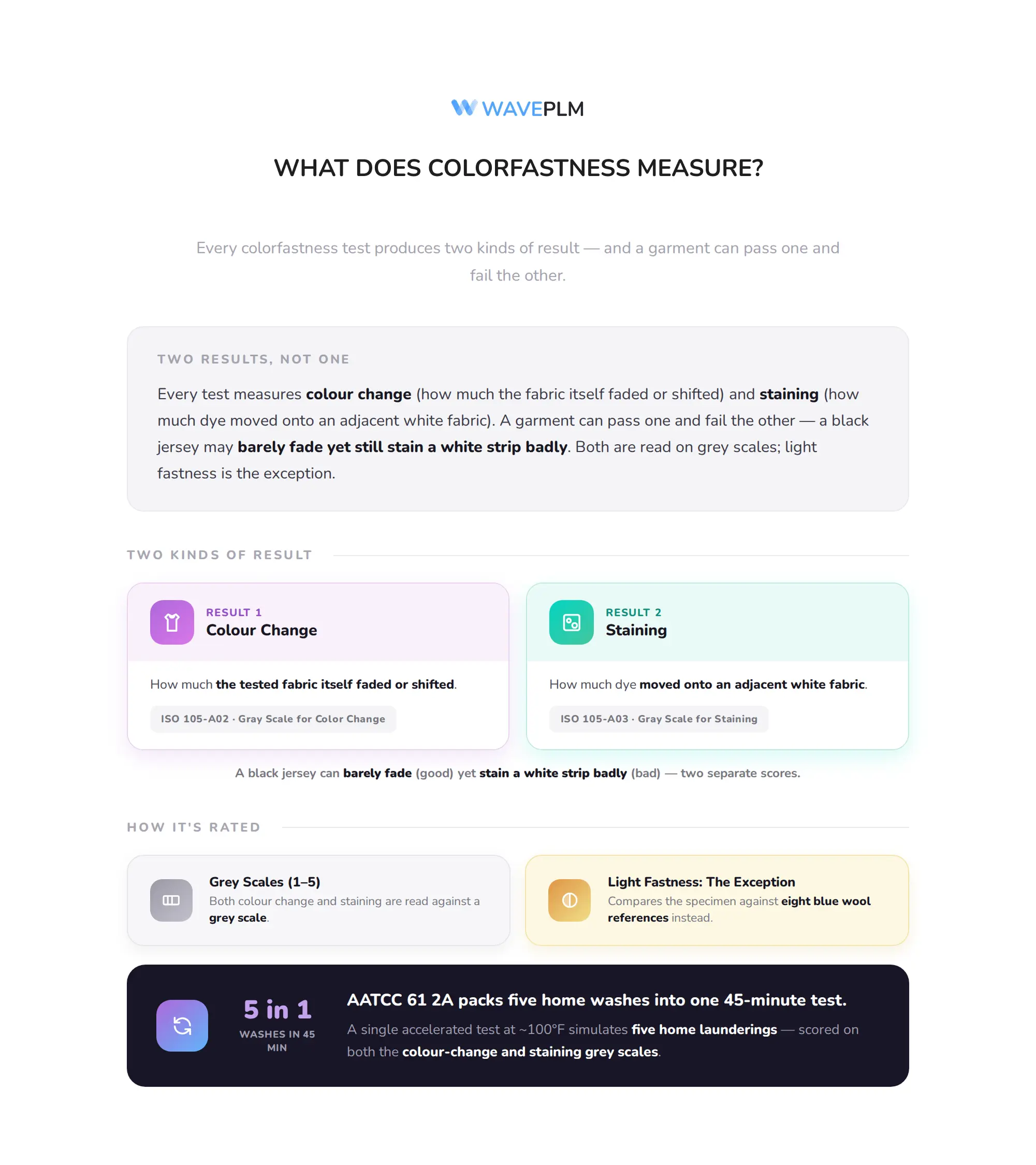
Every colorfastness test produces two kinds of result. The first is colour change: how much the tested fabric itself faded or shifted. The second is staining: how much dye moved onto an adjacent white fabric. A garment can pass one and fail the other. For example, a black jersey may barely fade in the wash yet still stain a white multifibre strip badly.
Both results use grey scales. Specifically, ISO 105-A02 (or AATCC’s Gray Scale for Color Change) rates colour change, and ISO 105-A03 (or AATCC’s Gray Scale for Staining) rates staining. Light fastness is the exception, because it compares the specimen against eight blue wool references instead.
Industry data: AATCC 61 Method 2A is designed to replicate five home launderings in a single 45-minute test at about 100°F, with results rated on the Gray Scale for Color Change and the Gray Scale for Staining (Arc Wear testing summary of AATCC 61).
Which Colorfastness Tests Does Your Product Need?
Not every style needs every test. Instead, match the test to how the garment will actually be worn and cared for.
| Test | What it simulates | AATCC method | ISO method | Grading |
|---|---|---|---|---|
| Washing | Repeated home laundering | AATCC 61 | ISO 105-C06 | Grey scale 1–5 |
| Crocking (rubbing) | Dye rubbing off onto skin, bags, or seats | AATCC 8 | ISO 105-X12 | Staining scale 1–5, dry and wet |
| Light | Fading in sunlight or shop lighting | AATCC 16.3 | ISO 105-B02 | Blue wool 1–8 |
| Perspiration | Acid and alkaline sweat contact | AATCC 15 | ISO 105-E04 | Grey scale 1–5 |
| Water | Wet contact, rain, damp storage | AATCC 107 | ISO 105-E01 | Grey scale 1–5 |
| Chlorinated water | Swimming pool exposure | AATCC 162 | ISO 105-E03 | Grey scale 1–5 |
In practice, US retailers usually ask for AATCC methods, while European buyers tend to specify ISO 105. However, the two families are not interchangeable result for result. Therefore, name the exact method in the tech pack rather than writing “colorfastness to washing: pass.”
AATCC or ISO: Which Colorfastness Standard Should You Use?
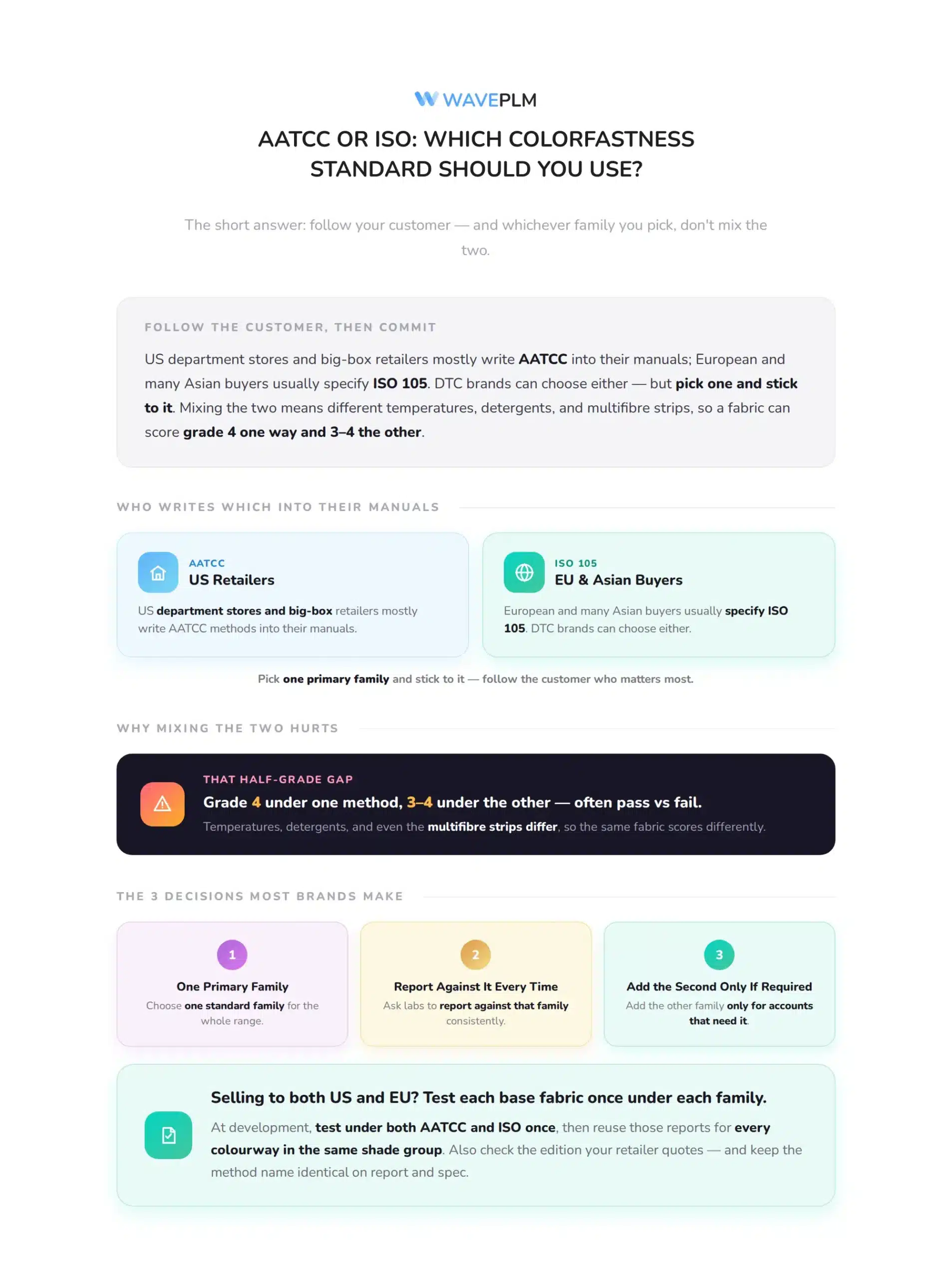
The short answer is to follow your customer. US department stores and big-box retailers mostly write AATCC methods into their manuals. In contrast, European and many Asian buyers usually specify ISO 105. Direct-to-consumer brands can choose either, but they should pick one and stick to it.
Mixing the two creates real problems. The wash temperatures differ. The detergents differ too. Even the multifibre strips are not identical. As a result, a fabric can earn grade 4 under one method and grade 3–4 under the other. That half grade is often the difference between a pass and a fail.
For this reason, most brands make three simple decisions:
- Choose one primary standard family for the whole range.
- Ask labs to report against that family every time.
- Add the second family only for accounts that require it.
Also, check which edition your retailer quotes. Test methods are revised over time, and a report against an older edition may be rejected. Finally, keep the method name on the report and in the spec identical. Small mismatches like “C06 A1S” versus “C06 A2S” cause most of the back-and-forth with labs.
Our finding: Brands that sell to both US and EU retailers save the most time by testing each base fabric once under each family at development, then reusing those reports for every colourway in the same shade group.
What Colorfastness Grades Should You Require?
There is no single legal minimum for most apparel. Instead, retailers and brands set their own requirements. Even so, buyer manuals tend to land in a similar range. The table below is a practical starting point for writing colorfastness specs.
| Product type | Wash (colour change / staining) | Crocking (dry / wet) | Light (blue wool) | Extra tests |
|---|---|---|---|---|
| Light-coloured basics | 4 / 3–4 | 4 / 4 | 4 | Perspiration |
| Dark knits and wovens | 4 / 3–4 | 4 / 3 | 4 | Perspiration |
| Indigo denim | 3–4 / 3 | 3 / 2–3 | 4 | Customer care label warning |
| Swimwear | 4 / 3–4 | 4 / 3 | 5 | Chlorinated and sea water |
| Outdoor and activewear | 4 / 3–4 | 4 / 3 | 5–6 | Perspiration |
Notably, wet crocking is where dark shades fail most often. Industry guidance typically accepts grade 2–3 wet rubbing for dark, reactive-dyed cotton, while light shades should reach grade 4. For that reason, many brands write a separate dark-shade tolerance into the spec instead of holding every colour to the same line.
Our finding: Colorfastness disputes rarely start with a bad fabric. They usually start with a tech pack that says “colorfastness: good” with no method and no grade, so the mill, the lab, and the brand each read a different standard into it.
When Should You Test Colorfastness?
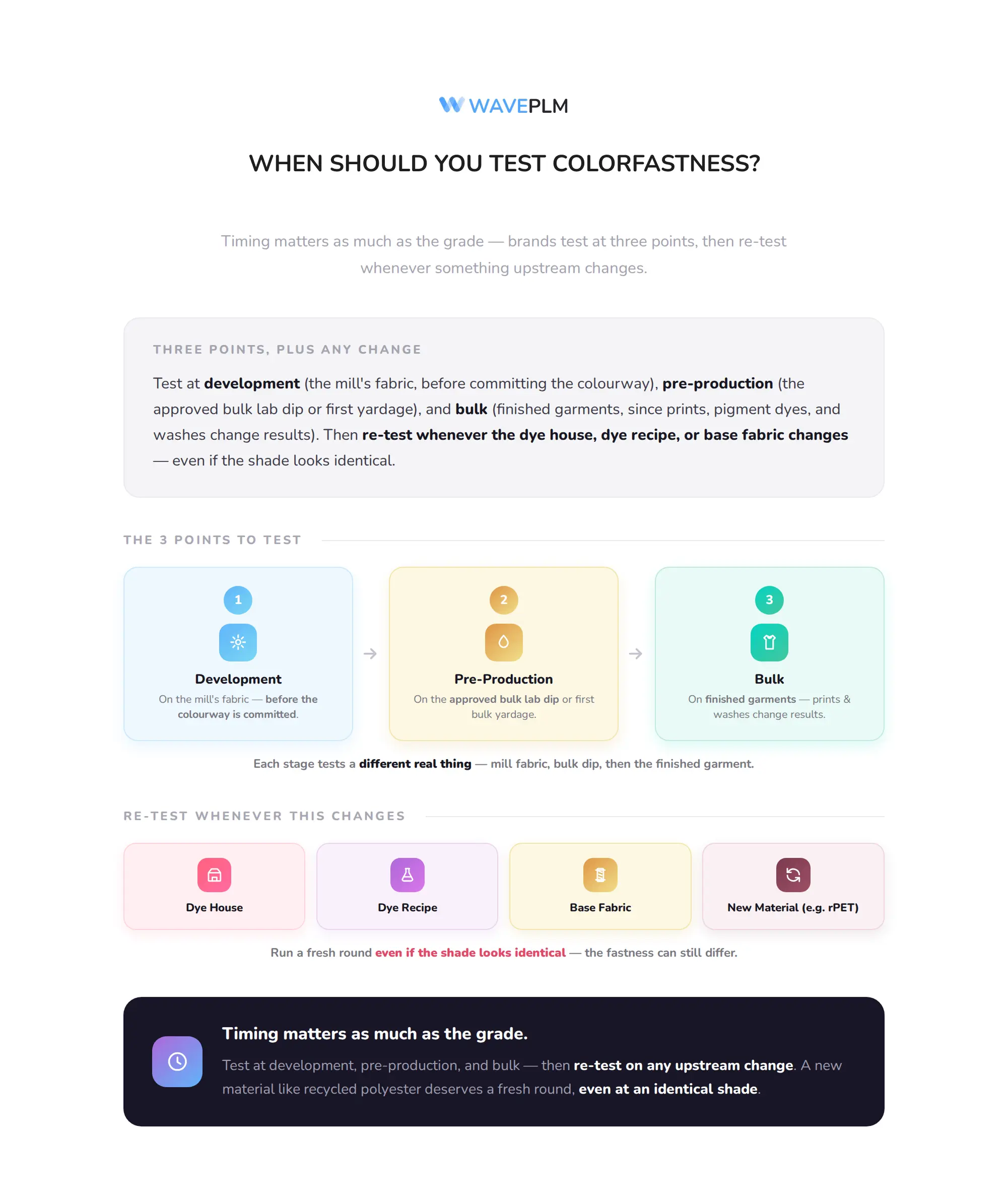
Timing matters as much as the grade. Generally, brands test colorfastness at three points:
- Development: on the mill’s fabric quality, ideally before the colourway is committed to the line.
- Pre-production: on the approved bulk lab dip or first bulk yardage. Our pre-production checklist shows where this sits.
- Bulk: on finished garments, because prints, pigment dyes, and garment washes can change results.
In addition, repeat the test whenever the dye house, dye recipe, or base fabric changes. Similarly, a switch to a new material such as recycled polyester fabric deserves a fresh round, even if the shade looks identical. Colorfastness sits alongside shrinkage and seam strength in the wider set of tests in our apparel product testing guide.
Why Does Fabric Fail Colorfastness Tests?
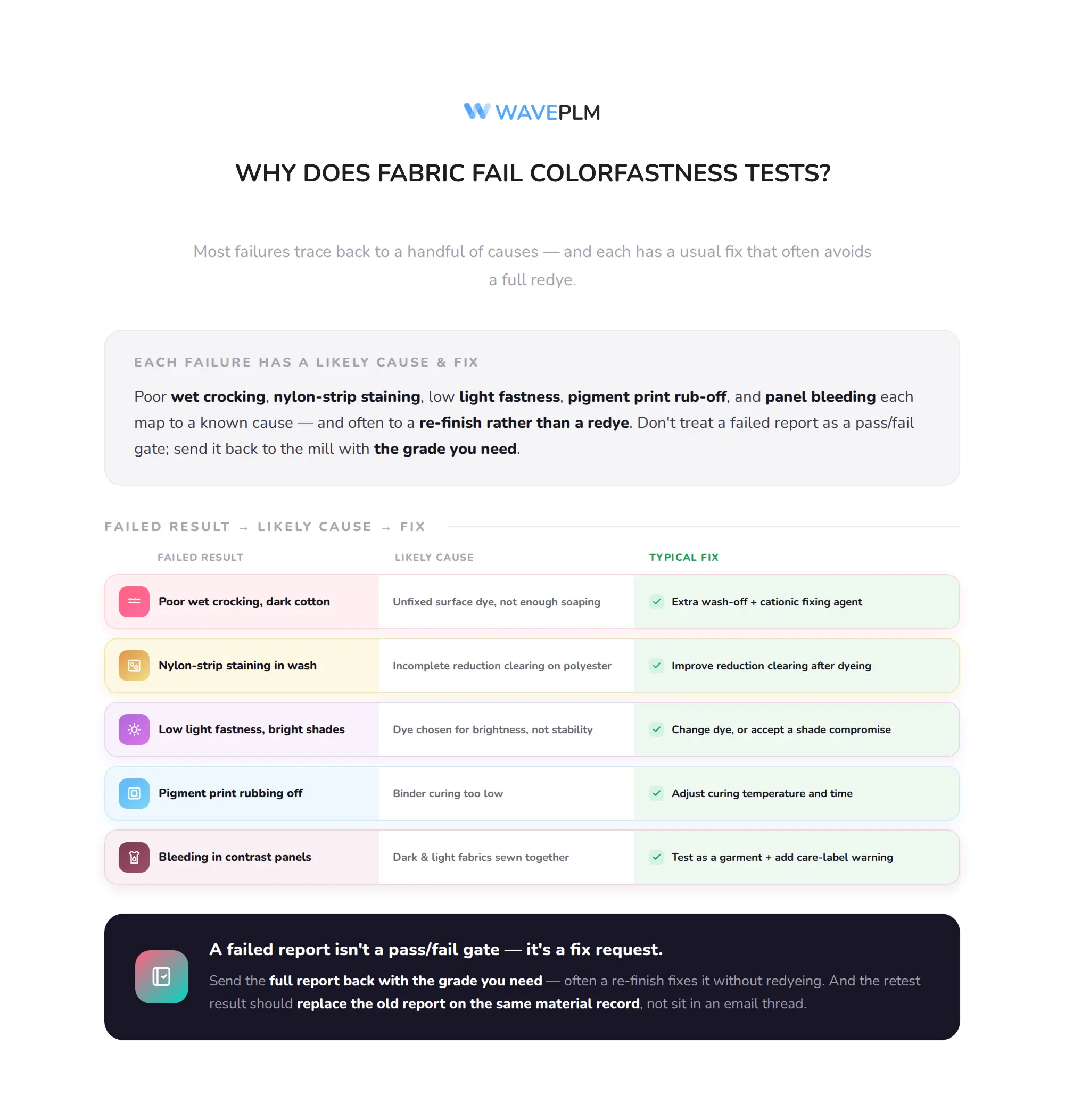
Most failures trace back to a handful of causes. The table below links each common result to its likely cause and the usual fix.
| Failed result | Likely cause | Typical fix |
|---|---|---|
| Poor wet crocking on dark cotton | Unfixed surface dye, not enough soaping | Extra wash-off, cationic fixing agent |
| Staining on nylon strip in wash test | Incomplete reduction clearing on polyester | Improve reduction clearing after dyeing |
| Low light fastness on bright shades | Dye class chosen for brightness, not stability | Change dye selection or accept shade compromise |
| Pigment print rubbing off | Binder curing too low | Adjust curing temperature and time |
| Bleeding in contrast panels | Dark and light fabrics sewn together | Test as a garment, add care label warning |
Above all, do not treat a failed colorfastness report as a simple pass/fail gate. Instead, send the full report back to the mill with the grade you need. In many cases, a re-finish fixes the problem without redyeing. Importantly, the retest result should replace the old report on the same material record, not sit in a separate email thread.
How Do You Write Colorfastness Into a Tech Pack?
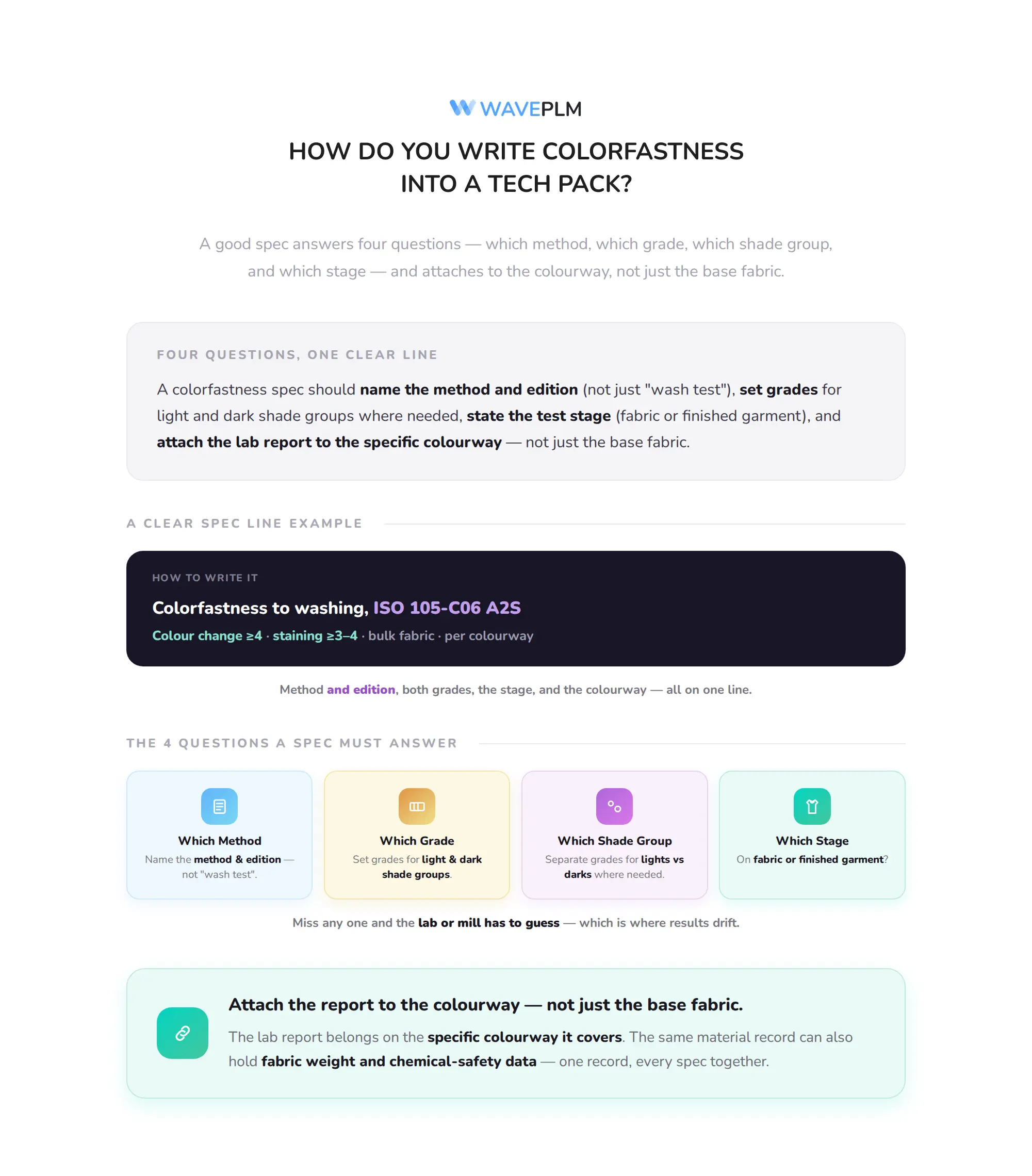
A good colorfastness spec answers four questions: which method, which grade, which shade group, and which stage. Here is a clear example: “Colorfastness to washing, ISO 105-C06 A2S.” Below it, list “colour change ≥4, staining ≥3–4, bulk fabric, per colourway.”
- Name the method and edition, not just “wash test”.
- Set separate grades for light and dark shade groups where needed.
- State whether the test runs on fabric or on finished garments.
- Attach the lab report to the specific colourway, not just the base fabric.
Usefully, the same material record can hold fabric weight and chemical safety data as well. Our guides to fabric GSM and OEKO-TEX certification cover those two specs. If you need a starting layout, our tech pack template shows where test requirements belong.
Categories Where Colorfastness Matters Most
Some categories put far more stress on dyes than everyday basics. Swimwear faces chlorine, salt, and sun at once, which is why our swimwear PLM guide treats chlorine fastness as a core spec. Meanwhile, activewear adds sweat and frequent hot washing. Denim, by contrast, is the one category where some colour loss is expected, so the risk shifts to crocking onto bags, sofas, and light-coloured tops.
Frequently Asked Questions
What is colorfastness in fabric?
Colorfastness is a fabric’s resistance to fading, colour change, and dye transfer when exposed to washing, rubbing, light, water, or perspiration. Labs grade it from 1 (poor) to 5 (excellent) on a grey scale, and light fastness from 1 to 8 on the blue wool scale.
What is a good colorfastness grade?
For most apparel, brands require grade 4 or higher for colour change after washing and around 3–4 for staining. Dry crocking is usually set at grade 4, while dark shades often get a grade 3 or 2–3 tolerance for wet crocking. Light fastness of 4 is common for everyday apparel and 5 or higher for outdoor products.
How do labs test colorfastness to washing?
Labs wash a specimen together with a multifibre strip under controlled temperature, detergent, and mechanical action, using AATCC 61 or ISO 105-C06. They then grade colour change on the specimen and staining on the strip. AATCC 61 Method 2A simulates five home launderings in about 45 minutes.
What is the difference between dry and wet crocking?
Both tests rub the fabric against a white cotton cloth. Dry crocking uses a dry cloth, while wet crocking uses a damp one, which releases more loose dye. As a result, wet crocking grades are usually lower, especially for dark cotton shades and indigo denim.
Can you test colorfastness at home?
A quick home check, such as rubbing a damp white cloth on a hidden seam, can flag obvious bleeding. However, it cannot replace a lab colorfastness report, because brands and retailers need a standard method and a graded result to accept bulk production.
Who is responsible when a garment fails colorfastness?
Usually the supplier, if the tech pack stated the method and grade before production. When the spec was vague, responsibility becomes a negotiation. That is why a clear colorfastness requirement in the tech pack protects the brand as much as the test itself.
When the Lab Report Lives in Someone’s Inbox
If your team has ever re-tested a reorder because nobody could find last season’s colorfastness report, the problem was not the fabric. Each lost report costs a new lab fee and a week of waiting, and it repeats with every colourway. Wave PLM keeps test methods, grades, and reports on the material and colourway they belong to, so the next reorder starts with the evidence already in place. See how Wave PLM organises lab test records.




Leave a Reply