
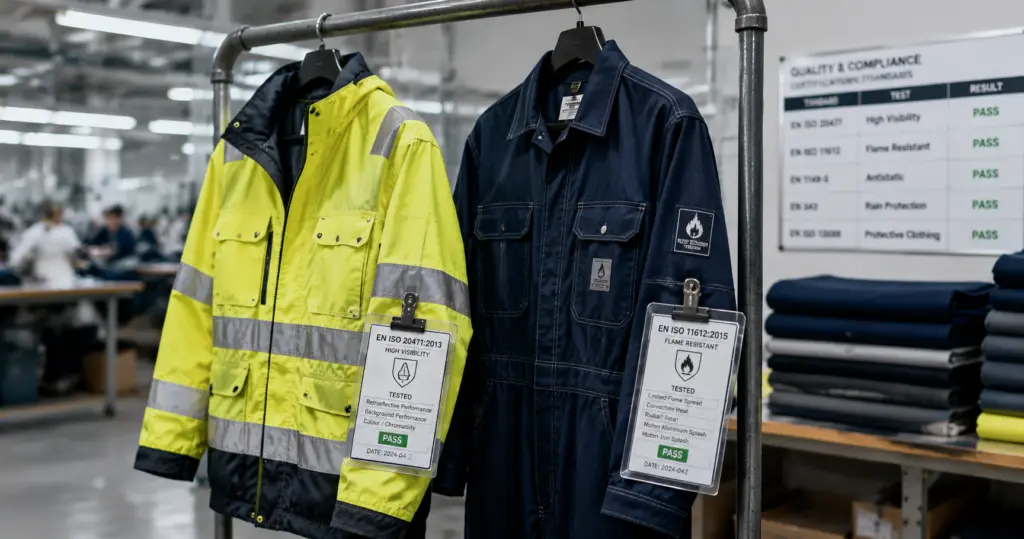
Workwear PLM software has to manage a production model that looks almost nothing like seasonal fashion. In practice, a single uniform style can stay in a client’s catalog for five or ten years unchanged. Safety certifications like ANSI/ISEA 107 and NFPA 2112 require testing that fashion apparel never touches. On top of that, a single reorder has to match a fabric lot dyed years earlier. Generic fashion-focused PLM tools assume short style lifecycles and one-time seasonal testing. Neither assumption holds for a workwear or corporate uniform program.
This guide covers what actually separates workwear and uniform production from seasonal apparel. It also explains the two safety certification families that matter most: high-visibility standards and flame-resistant standards. From there, it covers how certification retesting works after industrial laundering. It explains why that differs from a standard apparel QA check. Finally, it covers what a workwear style record needs to track, and where PFAS compliance still applies even in this category.
What Does Workwear PLM Software Need to Handle Differently?
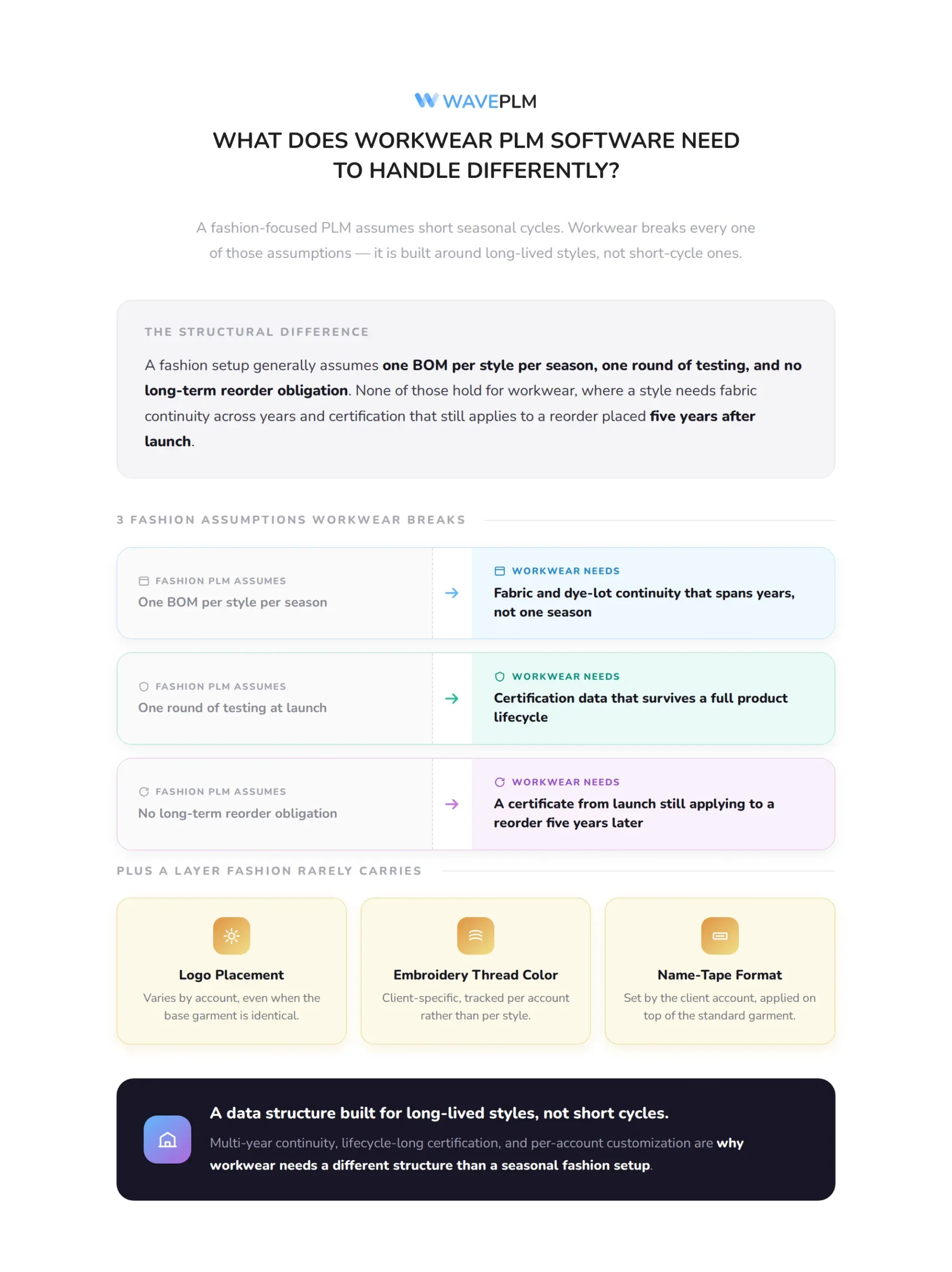
A fashion-focused PLM setup generally assumes one BOM per style per season, one round of testing, and no long-term reorder obligation. None of those assumptions hold for workwear PLM software. Specifically, a workwear style needs fabric and dye-lot continuity that spans years, not one season. It also needs certification data that survives a full product lifecycle, since a certificate issued at launch still has to apply to a reorder placed five years later.
On top of that, most workwear programs carry client-specific customization. A logo placement, an embroidery thread color, or a name-tape format can vary by account, even when the base garment stays identical. Together, these requirements are why workwear PLM software needs a different data structure than a seasonal fashion setup, one built around long-lived styles rather than short-cycle ones.
What Makes Workwear and Uniform Production Different From Seasonal Fashion?
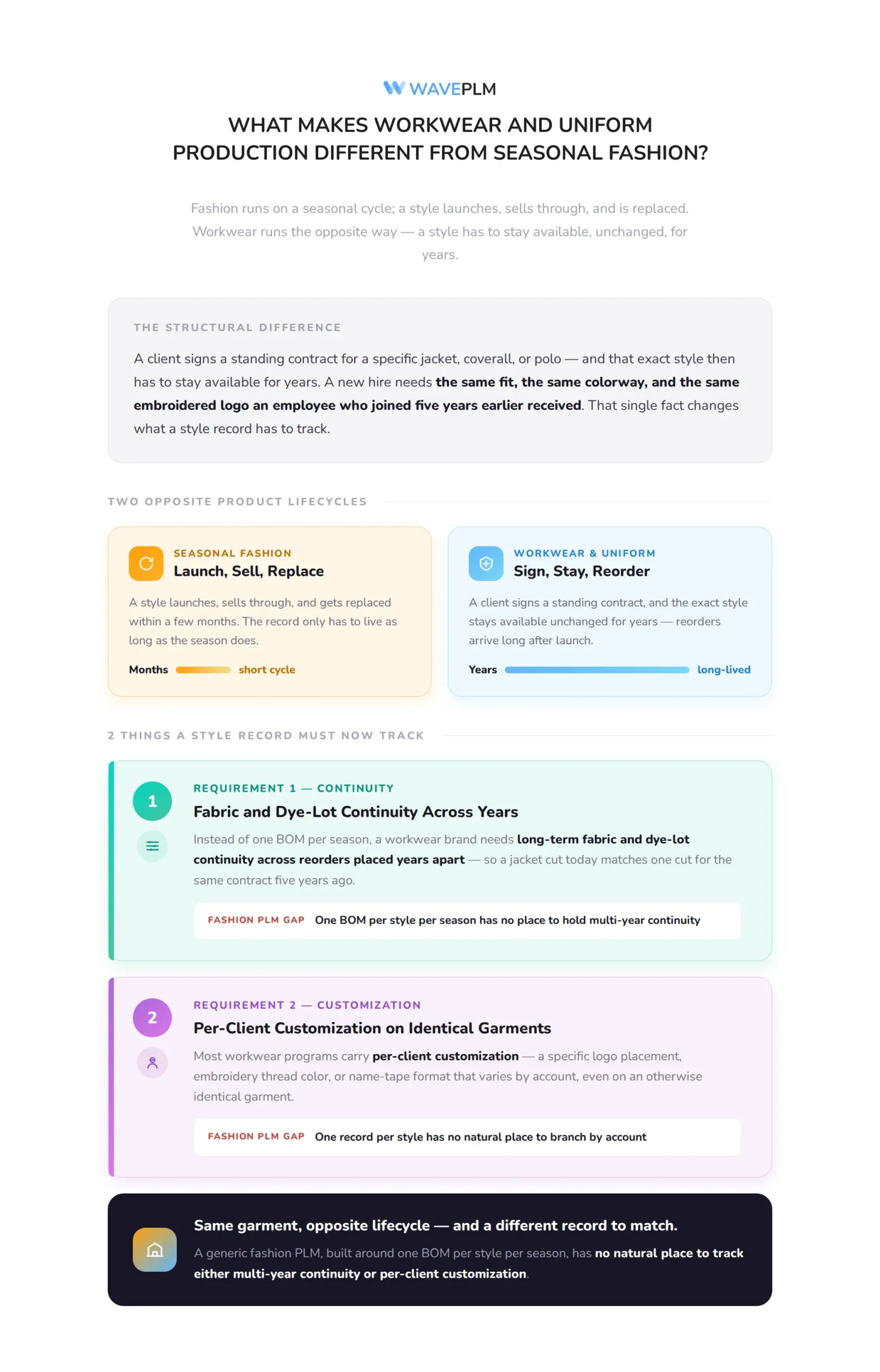
Fashion apparel typically runs on a seasonal cycle. A style launches, sells through, and gets replaced within a few months. Workwear and corporate uniform programs run the opposite way. A client signs a standing contract for a specific jacket, coverall, or polo. That exact style then needs to stay available, unchanged, for years. New hires need the same fit, the same colorway, and the same embroidered logo an employee who joined five years earlier received.
As a result, that requirement changes what a style record has to track. Instead of one BOM per season, a workwear brand needs long-term fabric and dye-lot continuity across reorders placed years apart. Additionally, most workwear programs carry per-client customization. A specific logo placement, an embroidery thread color, or a name-tape format can vary by account, even on an otherwise identical garment. A generic fashion PLM setup, built around one BOM per style per season, simply has no natural place to track either requirement.
What Safety Certifications Apply to Workwear?
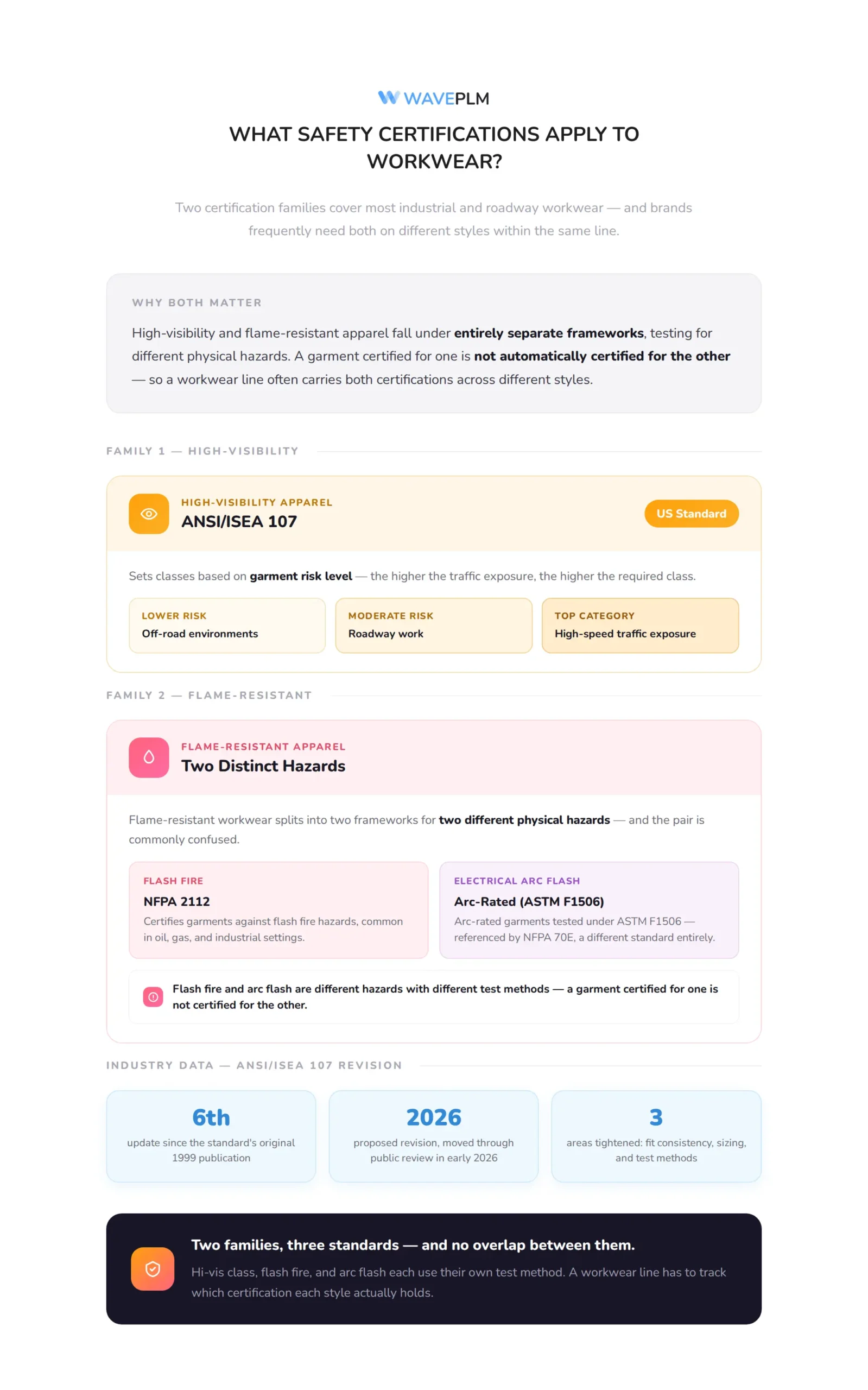
Two certification families cover most industrial and roadway workwear. Notably, brands frequently need both on different styles within the same line. High-visibility apparel falls under ANSI/ISEA 107 in the U.S. This standard sets classes based on garment risk level: lower-risk off-road environments, moderate-risk roadway work, and a top category for workers exposed to high-speed traffic. A revision to this standard moved through public review in early 2026. That revision proposes updated colorfastness and tear-resistance test methods, tighter sizing consistency requirements, and an optional nighttime luminance test method.
Industry data: The proposed 2026 revision to ANSI/ISEA 107 is the sixth update since the standard’s original 1999 publication. It specifically tightens fit-consistency and sizing measurement guidelines, alongside updated colorfastness and dimensional-stability test methods.
Flame-resistant workwear falls under a separate framework entirely. NFPA 2112 certifies garments against flash fire hazards, common in oil and gas and other industrial settings. Importantly, it should not be confused with NFPA 70E. That standard instead references arc-rated garments, tested under ASTM F1506, for electrical arc flash hazards. Notably, flash fire and arc flash are different physical hazards. Each uses different test methods, so a garment certified for one is not automatically certified for the other.
How Does Certification Retesting Differ From Standard Apparel QA?
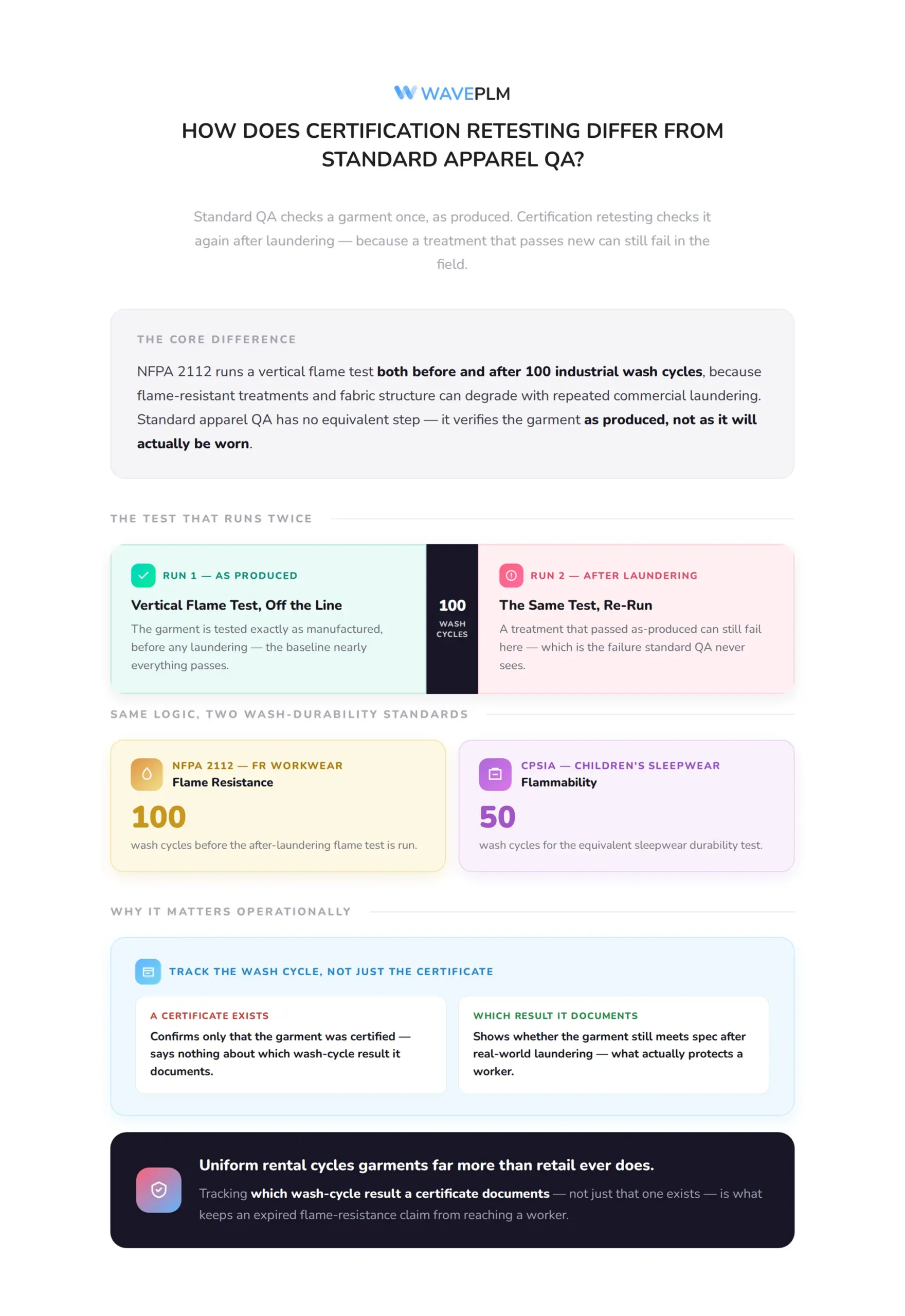
NFPA 2112 testing includes a vertical flame test, run both before and after 100 industrial wash cycles. This is necessary because flame-resistant treatments and fabric structure can degrade with repeated commercial laundering. That pattern will look familiar to anyone tracking children’s apparel compliance. Our CPSIA compliance guide covers a similar wash-durability requirement for sleepwear, tested after 50 wash cycles instead of 100. In both cases, the underlying logic matches. A fabric treatment that passes as-produced can still fail once it goes through the wash cycles the garment will actually see in the field.
This distinction matters operationally. A workwear brand that only retains the original, as-produced test certificate has no record of whether the garment still meets spec after real-world laundering. Uniform rental and industrial laundering programs, in particular, put garments through far more wash cycles per year than typical retail apparel does. As a result, tracking which wash-cycle result a certificate actually documents, not just whether a certificate exists, is what prevents an expired flame-resistance claim from reaching a worker.
Why Do Workwear Programs Need Different Reorder Tracking Than Fashion Lines?
A standing uniform contract can generate reorders for the same style every few months. That said, it sometimes continues for years after the original launch. Each reorder needs to match the original fabric composition, colorway, and certification closely enough that a new batch still qualifies under the same certificate. In practice, that means the fabric lot, dye recipe, and trim sourcing all need traceable records. A general spec sheet alone is not enough; the record has to tie back to the original certified sample.
Our finding: Wave PLM customers running standing workwear or uniform programs typically need to trace three things across every reorder: the exact certified fabric lot, the client-specific embroidery or logo variant, and the current certification status. Brands that track these at the style level, rather than reconstructing them from the original purchase order each time, cut reorder lead time noticeably compared to teams starting from scratch on every repeat order.
Does PFAS Compliance Apply to Workwear Too?
Yes, and it is easy to assume otherwise. Workwear compliance already spends most of its attention on flame resistance and hi-vis certification. Even so, outdoor and utility workwear frequently uses the same durable water repellent finishes covered in our PFAS compliance guide. A weatherproof work jacket, sold in a state with a textile PFAS threshold, needs the same total organic fluorine testing a consumer rain jacket needs. Neither NFPA 2112 nor ANSI/ISEA 107 tests for PFAS content. Consequently, a garment can pass both safety certifications and still exceed a state’s PFAS limit on its water-repellent treatment.
What Should a Workwear Style Record Track?
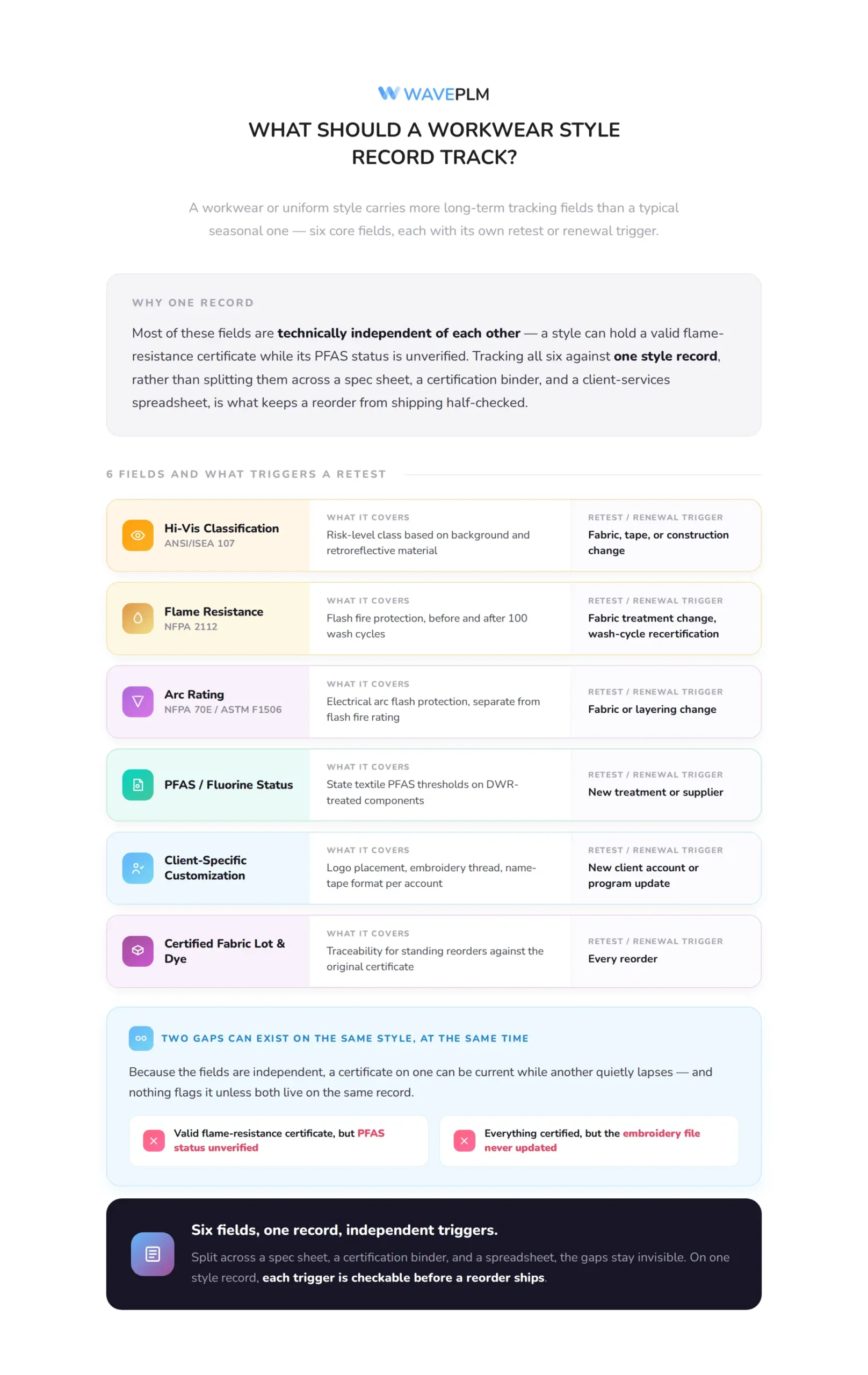
Pulling the requirements above together, a workwear or uniform style carries more long-term tracking fields than a typical seasonal style. The table below summarizes the core fields and what each one depends on.
| Tracked field | What it covers | Retest or renewal trigger |
|---|---|---|
| Hi-vis classification (ANSI/ISEA 107) | Risk-level class based on background and retroreflective material | Fabric, tape, or construction change |
| Flame resistance certification (NFPA 2112) | Flash fire protection performance, before and after 100 wash cycles | Fabric treatment change, wash-cycle recertification |
| Arc rating (NFPA 70E / ASTM F1506) | Electrical arc flash protection, separate from flash fire rating | Fabric or layering change |
| PFAS / total organic fluorine status | State textile PFAS thresholds on DWR-treated components | New treatment or supplier |
| Client-specific customization | Logo placement, embroidery thread, name-tape format per account | New client account or program update |
| Certified fabric lot and dye recipe | Traceability for standing reorders against the original certificate | Every reorder |
Notably, most of these fields are independent of each other technically. A style can hold a valid flame-resistance certificate while its PFAS status is unverified. Meanwhile, a specific client’s embroidery file might not have been updated for a new logo yet. In fact, both gaps can exist on the same style, at the same time. Tracking all six fields against one style record, instead of splitting them across a spec sheet, a certification binder, and a client-services spreadsheet, is what keeps a reorder from shipping half-checked.
How Does Wave PLM Support Workwear and Uniform Brands?
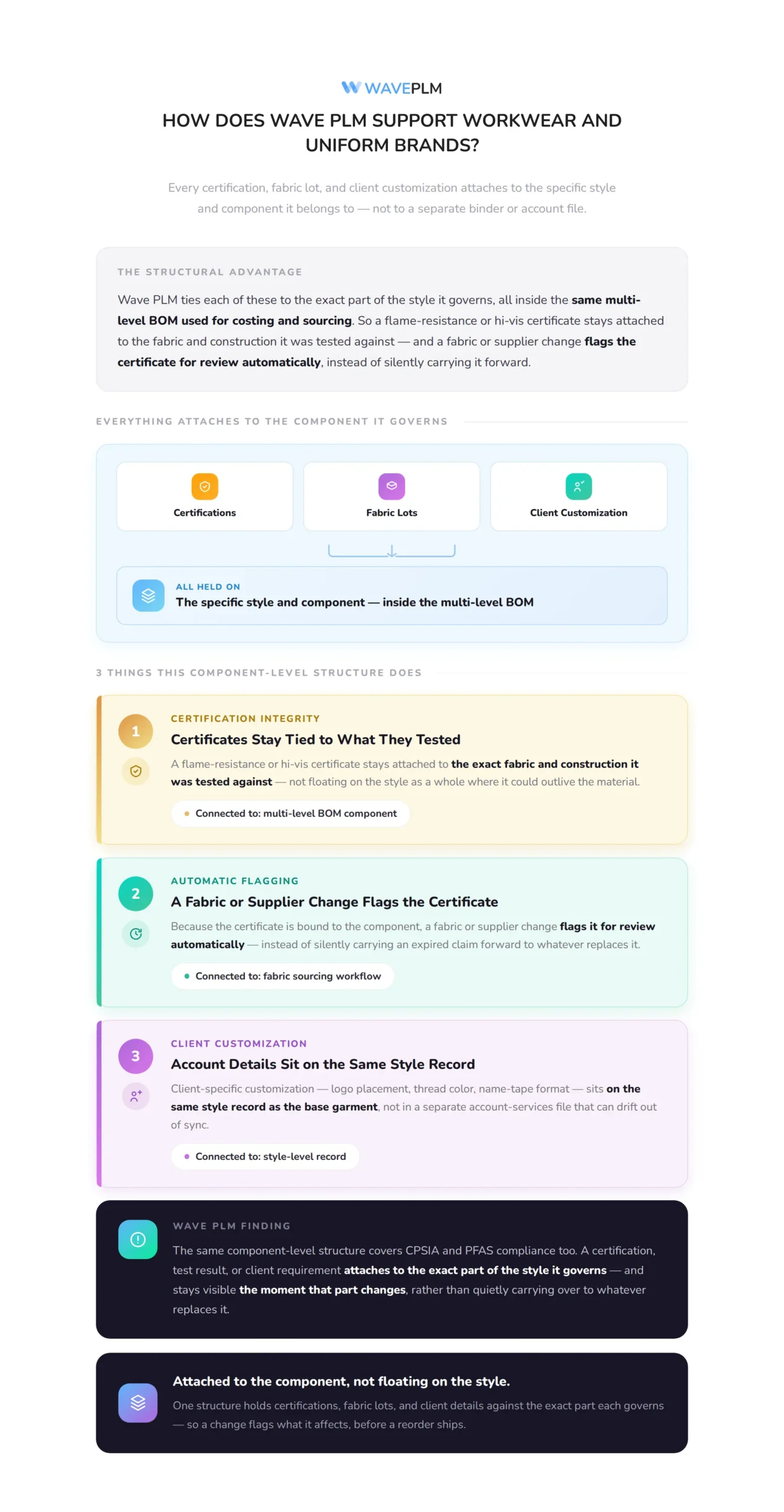
Wave PLM ties each certification, fabric lot, and client customization to the specific style and component it belongs to. This lives inside the same multi-level BOM used for costing and sourcing. Specifically, a flame-resistance or hi-vis certificate stays attached to the fabric and construction it was tested against. As a result, a fabric or supplier change flags the certificate for review automatically, instead of silently carrying it forward. Client-specific customization details sit on the same style record as the base garment, rather than in a separate account-services file.
This follows the same component-level structure covered in our CPSIA compliance guide and our PFAS compliance guide. A certification, a test result, or a client requirement attaches to the exact part of the style it governs. It stays visible the moment that part changes, rather than quietly carrying over to whatever replaces it.
Frequently Asked Questions
What does workwear PLM software need to handle differently?
Workwear PLM software needs to manage long-lived styles that stay unchanged for years. It also needs safety certifications like ANSI/ISEA 107 and NFPA 2112, per-client customization such as embroidery and logo placement, and fabric-lot traceability across reorders placed years apart.
What is the difference between NFPA 2112 and NFPA 70E?
NFPA 2112 certifies garments against flash fire hazards common in oil, gas, and industrial settings. NFPA 70E instead references arc-rated garments tested under ASTM F1506 for electrical arc flash hazards. These are different physical hazards, so a garment certified for one is not automatically certified for the other.
Why does flame-resistant workwear get tested after 100 wash cycles?
Flame-resistant treatments and fabric structure can degrade with repeated industrial laundering, so NFPA 2112 requires a vertical flame test both before and after 100 wash cycles. A garment that passes as-produced can still fail once it goes through the laundering it will see in the field.
Does PFAS compliance apply to workwear and uniforms?
Yes. Outdoor and utility workwear often uses durable water repellent finishes that fall under the same state PFAS textile thresholds covered in general apparel. Neither NFPA 2112 nor ANSI/ISEA 107 tests for PFAS, so a garment can pass both safety certifications and still exceed a state’s PFAS limit.
What are the ANSI/ISEA 107 high-visibility classes?
ANSI/ISEA 107 sets classes based on a garment’s risk level. A lower class covers off-road or low-speed environments, a moderate class covers general roadway work, and the highest class applies to workers exposed to high-speed traffic. Notably, a proposed 2026 revision updates test methods and sizing consistency requirements.
Why is fabric lot tracking important for workwear reorders?
A standing uniform program can generate reorders years after a style’s original launch. Each reorder needs to match the original fabric, dye recipe, and certification closely enough to qualify under the same certificate. As a result, without traceable fabric-lot records, a reorder risks falling outside the certified spec.
Wave PLM customers running standing workwear and uniform programs recertify a resourced or recolored style in days rather than weeks. That is possible because the certification history travels with the exact fabric lot it was tested against. Start a conversation with the Wave PLM team about how that structure would work for your current program.



Leave a Reply