
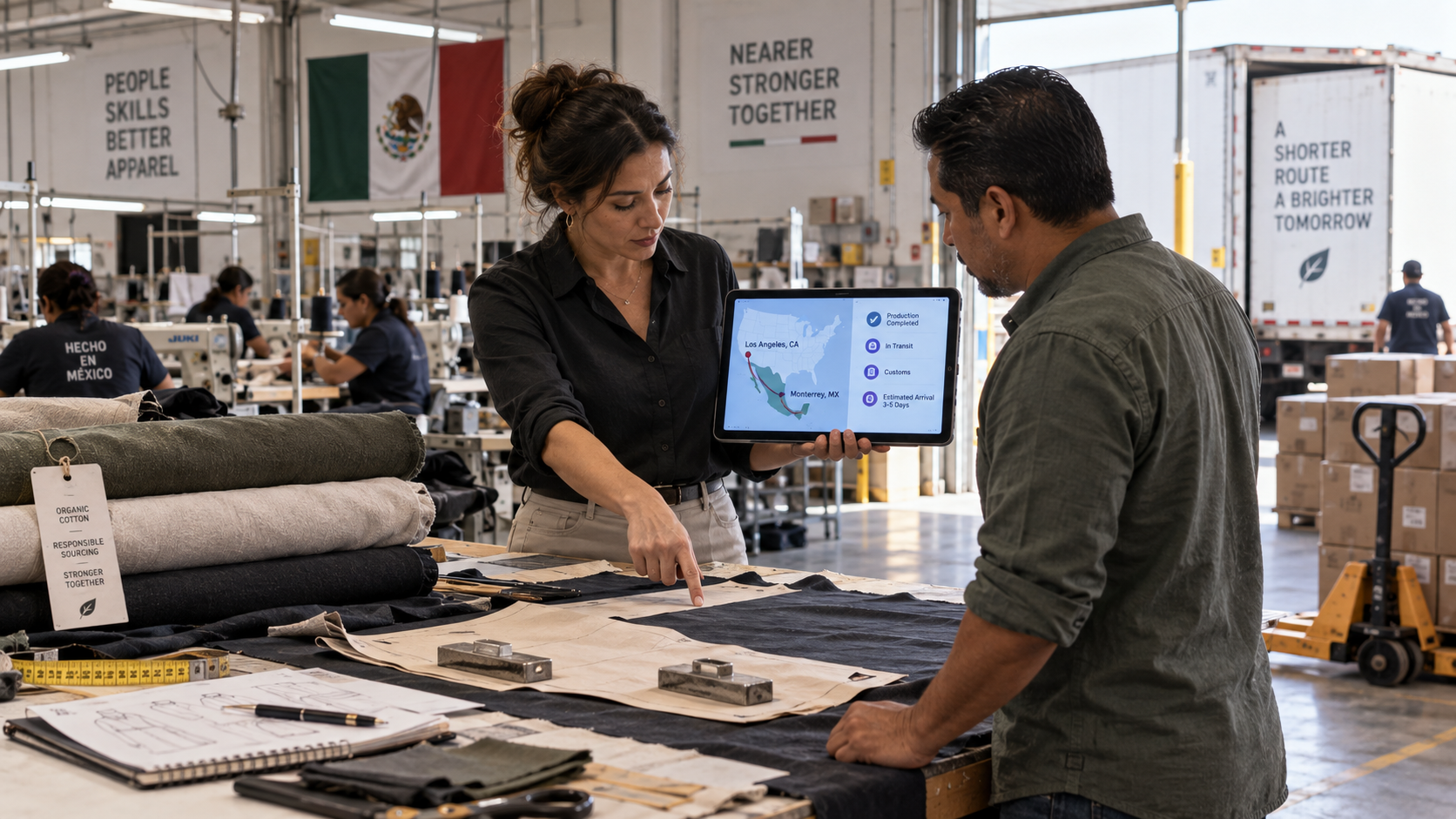
Nearshoring to Mexico should be an easy call on paper. Apparel imports from Mexico carried just a 1.6 percent tariff rate in July 2025, thanks to USMCA. Meanwhile, many Asian suppliers faced rates several times higher. Despite that advantage, US apparel imports from Mexico grew by just 0.5 percent that year. The benefits of nearshoring mexico are clear, yet brands are cautious.
This modest growth highlights the complexities of nearshoring.
In other words, the nearshoring boom that trade press keeps predicting has not actually shown up in the trade data yet. This guide covers what nearshoring to Mexico genuinely offers a fashion brand, including the benefits of nearshoring mexico. It also covers why the shift has been slower than expected. Additionally, it covers what changes in a sourcing team‘s PLM workflow, if a brand decides to move forward anyway.
This guide explores the advantages of nearshoring mexico, including its impact on production speed and cost efficiency.
What Does Nearshoring Actually Mean for Apparel Sourcing?
Nearshoring means moving production closer to the end market. Typically, that means shifting from Asia to Mexico or Central America for a US-focused brand. It differs from reshoring, which means bringing production fully back to the home country instead.
For apparel specifically, nearshoring to Mexico usually means shifting cut-and-sew production. Meanwhile, sourcing decisions about fabric origin stay a separate question entirely, one that matters just as much, as the next section explains.
Many companies are evaluating the benefits of nearshoring mexico as they reassess their sourcing strategies.

How Much Faster Is Mexico Than Asia, Really?
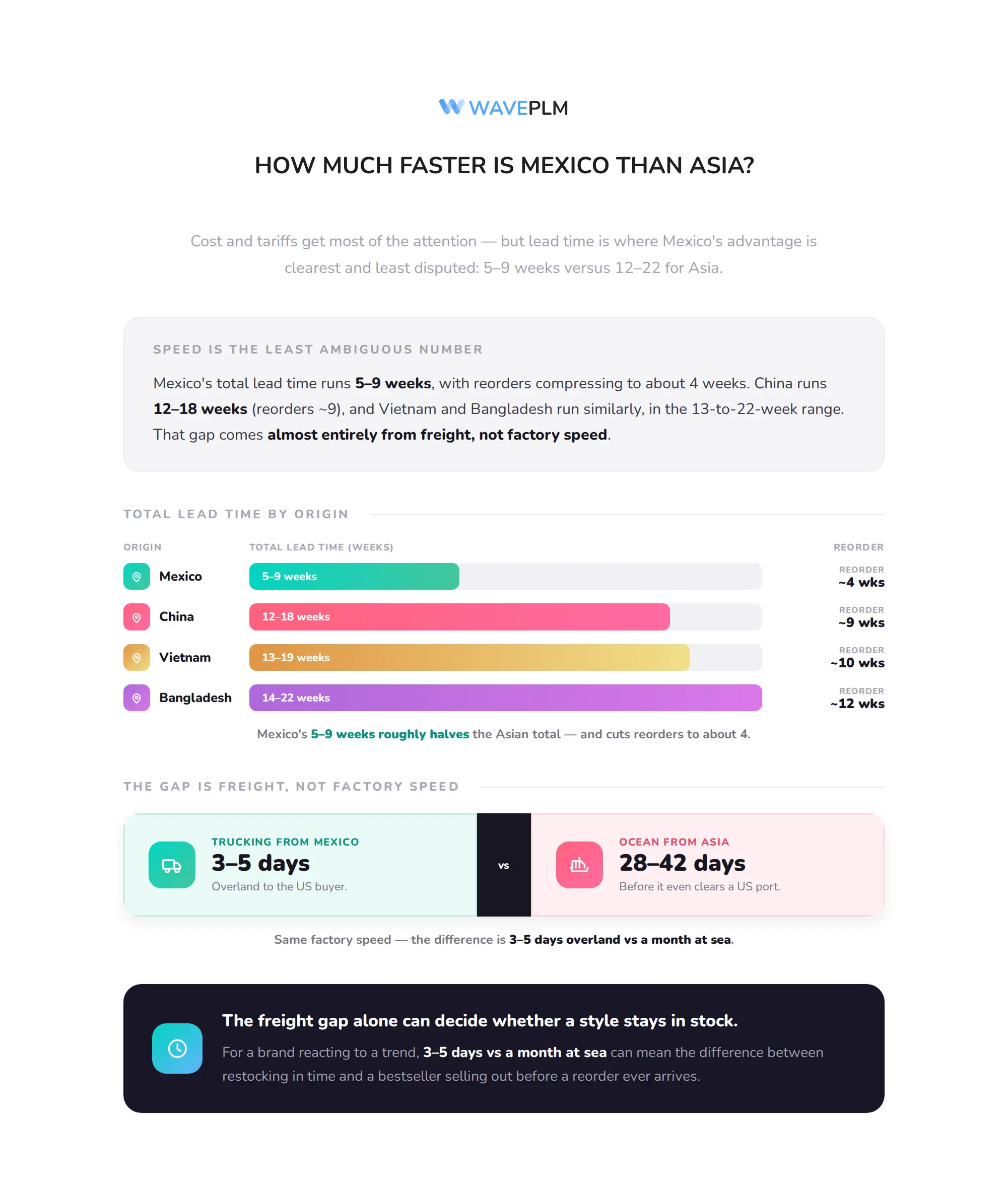
Cost and tariffs get most of the attention in nearshoring discussions. Speed, however, is where the numbers are least ambiguous. The nearshoring mexico trend shows a significant reduction in lead time.
Lead time is where Mexico’s advantage is clearest and least disputed. Mexico’s typical total lead time runs 5 to 9 weeks, with reorders compressing to about 4 weeks. China, by comparison, runs 12 to 18 weeks total, with reorders around 9 weeks (OneAim Apparel). Vietnam and Bangladesh run similarly to China, both in the 13-to-22-week range.
| Origin | Total Lead Time | Reorder Lead Time |
|---|---|---|
| Mexico | 5-9 weeks | ~4 weeks |
| China | 12-18 weeks | ~9 weeks |
| Vietnam | 13-19 weeks | ~10 weeks |
| Bangladesh | 14-22 weeks | ~12 weeks |
Understanding nearshoring mexico is essential for brands looking to optimize their supply chain logistics.
That gap comes almost entirely from freight, not factory speed. Trucking a shipment from Mexico takes 3 to 5 days. An ocean container from Asia, meanwhile, takes 28 to 42 days before it even clears a US port.
For a brand reacting to a trend, that freight difference alone can decide whether a style stays in stock. Similarly, it can decide whether a bestseller sells out before a reorder ever arrives.
Is the Tariff Advantage Real?
Cost is the other half of the nearshoring pitch, and here the data holds up well too.
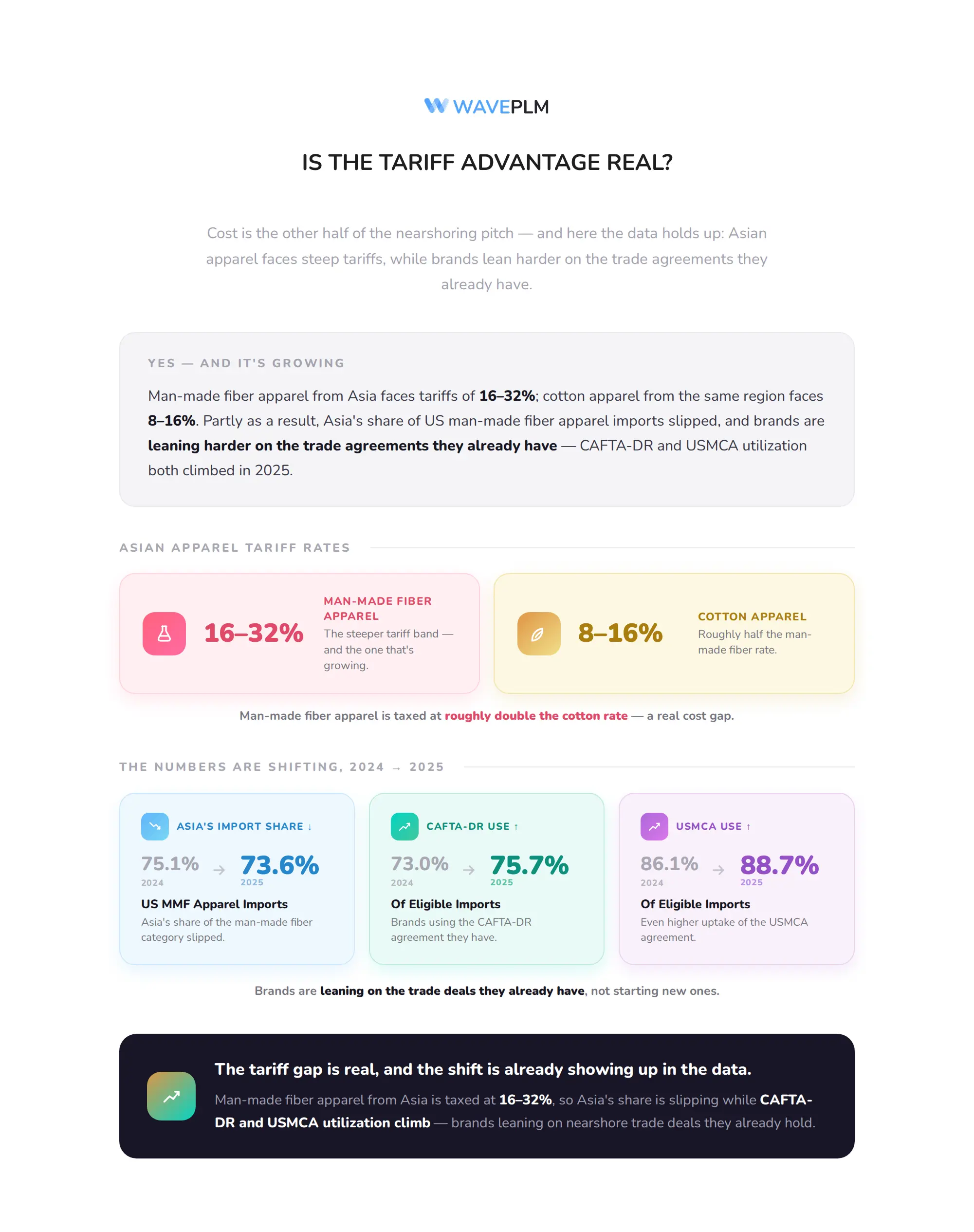
Yes, and it has been growing. Man-made fiber apparel from Asia faces tariffs of 16 to 32 percent. Cotton apparel from the same region, by comparison, faces 8 to 16 percent. Partly as a result, Asia’s overall share of US man-made fiber apparel imports slipped. It fell from 75.1 percent in 2024 to 73.6 percent in 2025 (Sheng Lu, FASH455). Meanwhile, brands are leaning harder on the trade agreements they already have, rather than starting new ones. CAFTA-DR utilization climbed to 75.7 percent of eligible apparel imports in 2025, up from 73.0 percent. Likewise, USMCA utilization reached 88.7 percent, up from 86.1 percent the year before.
Industry data: Asia’s share of US man-made fiber apparel imports fell from 75.1% to 73.6% between 2024 and 2025, while USMCA utilization among eligible importers climbed to 88.7% (Sheng Lu, FASH455).
Industry data: Asia’s share of US man-made fiber apparel imports fell from 75.1% to 73.6% between 2024 and 2025, while USMCA utilization among eligible importers climbed to 88.7% (Sheng Lu, FASH455).
Industry data: Asia’s share of US man-made fiber apparel imports fell from 75.1% to 73.6% between 2024 and 2025, while USMCA utilization among eligible importers climbed to 88.7% (Sheng Lu, FASH455).
The trend of nearshoring mexico highlights the strategic shifts brands are making in response to global supply chain challenges.
Industry data: Asia’s share of US man-made fiber apparel imports fell from 75.1% to 73.6% between 2024 and 2025, while USMCA utilization among eligible importers climbed to 88.7% (Sheng Lu, FASH455).
Industry data: Nearshoring mexico has become a focal point for brands seeking to reduce costs while maintaining quality.
Brands must recognize that nearshoring mexico is not just about cost, but also about agility and market responsiveness.
So Why Hasn’t Nearshoring Taken Off Yet?
Brands that already qualify for USMCA are using it more fully. However, brands are not necessarily moving new production to Mexico to take advantage of it.
Mexico’s 0.5 percent apparel import growth in 2025 points to a specific obstacle, despite its tariff and lead-time advantages: tariff policy uncertainty.
For brands looking to mitigate risk, nearshoring mexico offers a strategic alternative to traditional sourcing in Asia.
Specifically, repeated changes to US tariff rates have made brands reluctant to commit. Shifting a supply chain requires a multi-year investment, and few want to make that bet twice.
Building a new factory relationship takes real time. So does qualifying fabric sources, and training a Mexico-based team.
This is the honest state of nearshoring mexico right now. The advantages are real and measurable.
This is the honest state of nearshoring right now. The advantages are real and measurable.
The actual shift, though, has been cautious rather than sweeping. As a result, a brand evaluating this option should plan around that caution, not around the more dramatic headlines.
Nearshoring Mexico offers real advantages, but the implementation requires careful consideration.

What Is the USMCA Yarn-Forward Rule, and Why Does It Matter?
USMCA’s tariff benefit is not automatic just because a garment gets cut and sewn in Mexico.
The agreement uses a yarn-forward rule of origin. This means the yarn itself, not just the finished garment, generally needs to originate in the US, Mexico, or Canada.
In conclusion, nearshoring mexico stands out as a strategic advantage for brands aiming to remain competitive in today’s market.
In evaluating their options, many brands are turning to nearshoring mexico as a viable solution for their production needs.

Is Central America a Nearshoring Alternative Too?
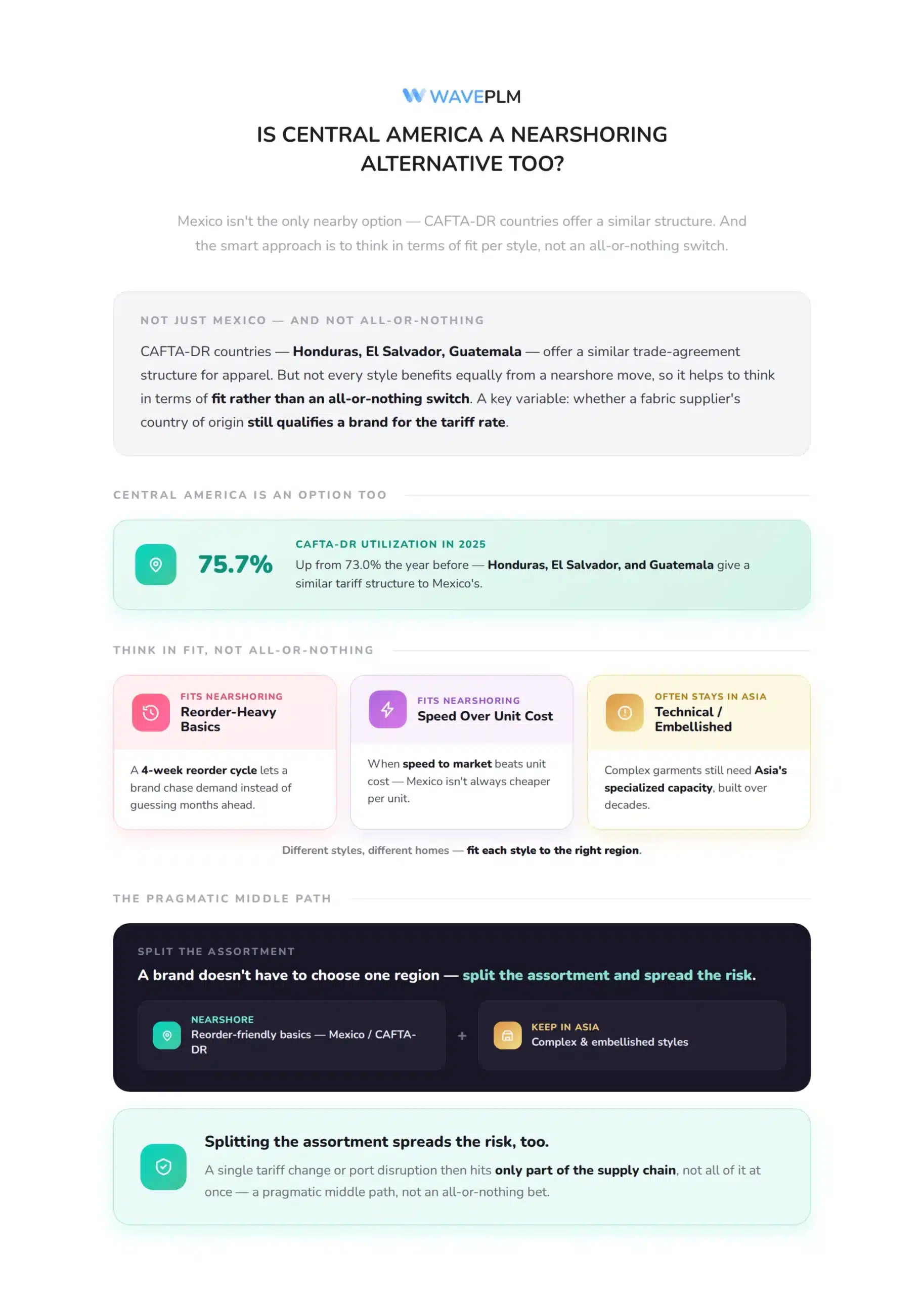
Mexico is not the only nearby option. CAFTA-DR countries, including Honduras, El Salvador, and Guatemala, offer a similar trade-agreement structure for apparel.
CAFTA-DR utilization among eligible apparel imports climbed to 75.7 percent in 2025, up from 73.0 percent the year before.
Our fabric sourcing guide covers how MOQ and lead-time tradeoffs already shape sourcing decisions. Nearshoring adds a new variable to that same decision. Namely, whether a fabric supplier’s country of origin still qualifies a brand for the tariff rate that made nearshoring worth considering in the first place.
Not every style benefits equally from a move to Mexico, so it helps to think in terms of fit rather than an all-or-nothing switch.
Nearshoring to Mexico tends to fit two situations best: reorder-heavy basics and styles where speed to market matters more than unit cost.
Not every style benefits equally from a move to Mexico, so it helps to think in terms of fit rather than an all-or-nothing switch.
Nearshoring to Mexico tends to fit two situations best. First, reorder-heavy basics fit well, since the 4-week reorder cycle lets a brand chase demand instead of guessing months in advance. Second, styles where speed to market matters more than unit cost fit well too. That is because Mexico’s labor cost per unit is not always lower than Asia’s, once volume and specialization are factored in. Highly technical or heavily embellished garments, by contrast, often still require the specialized capacity that established Asian manufacturing clusters have built over decades. Notably, a brand does not need to choose one region exclusively. Splitting an assortment, with reorder-friendly basics nearshored and complex styles staying in Asia, is a common and pragmatic middle path. In practice, that split also spreads risk. A single tariff change, or a single port disruption, then affects only part of a brand’s supply chain, instead of all of it at once.
With the implementation of nearshoring mexico, brands can expect greater flexibility and responsiveness in their supply chains.
How Does Nearshoring Change a Brand’s PLM and Vendor Workflow?
As brands navigate the complexities of sourcing, the advantages of nearshoring mexico will continue to play a pivotal role in their strategies.
Moving even part of production to Mexico means onboarding new vendors from scratch.
Our vendor onboarding guide covers the documentation and setup checklist that process requires.
Wave PLM and Nearshoring Readiness
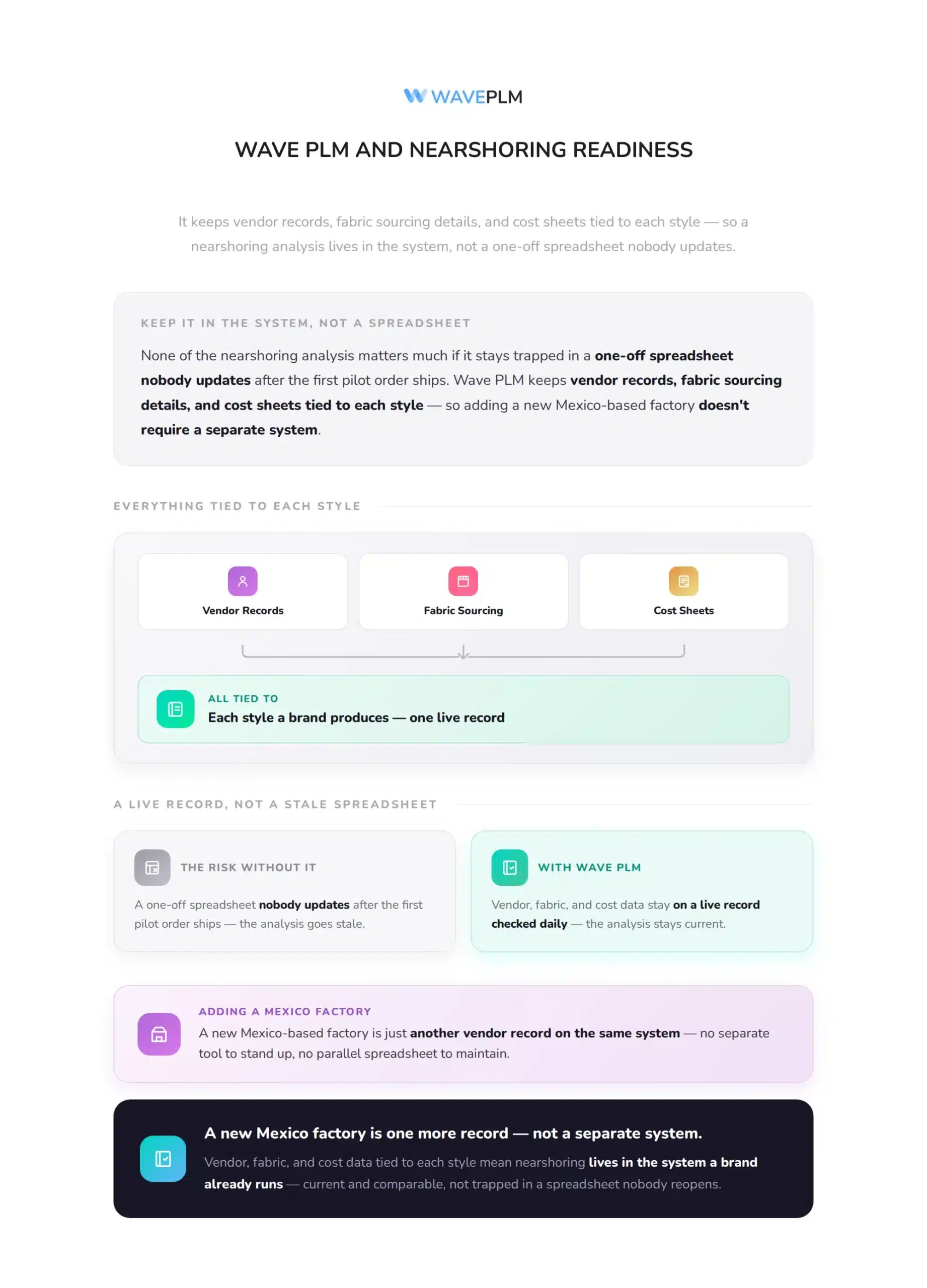
None of this analysis matters much if it stays trapped in a one-off spreadsheet that nobody updates after the first pilot order ships.
Wave PLM keeps vendor records, fabric sourcing details, and cost sheets tied to each style a brand produces.
Ultimately, nearshoring mexico presents an opportunity for brands to enhance their supply chain while being responsive to market demands.
Adding a new Mexico-based factory does not require a separate system.
Frequently Asked Questions
What is nearshoring in apparel manufacturing?
Nearshoring means moving production closer to the end market. For a US-focused brand, that typically means shifting apparel manufacturing from Asia to Mexico. It differs from reshoring, which brings production fully back to the home country.
How much faster is Mexico than China for apparel production?
Mexico’s typical lead time runs 5 to 9 weeks, with reorders in about 4 weeks. China runs 12 to 18 weeks, with reorders around 9 weeks. Most of that gap comes from freight time: 3 to 5 days by truck from Mexico versus 28 to 42 days by ocean from Asia.
Does Mexico have a tariff advantage under USMCA?
Yes. Qualifying apparel imports from Mexico carried a 1.6 percent tariff rate in July 2025. Many Asian suppliers, meanwhile, faced significantly higher rates, particularly on man-made fiber apparel.
Has nearshoring to Mexico actually increased?
Only modestly so far. US apparel imports from Mexico grew just 0.5 percent in 2025, despite real tariff and lead-time advantages. Largely, this is because tariff policy uncertainty has made brands hesitant to commit to the multi-year investment nearshoring requires.
What is the USMCA yarn-forward rule?
The yarn-forward rule requires that the yarn used in a garment, not just the cut-and-sew step, generally originate in the US, Mexico, or Canada. Only then does that garment qualify for USMCA’s preferential tariff treatment.
Which apparel categories are best suited for nearshoring to Mexico?
Reorder-heavy basics benefit most from Mexico’s fast reorder cycle. Highly technical or heavily embellished garments often still require the specialized capacity built up in established Asian manufacturing clusters.
Nearshoring to Mexico offers a real lead-time advantage and a real tariff advantage, backed by trade data rather than marketing claims.
What it does not offer, at least not yet, is a dramatic industry-wide shift that a brand can simply follow.
Instead, nearshoring works best as a deliberate, category-by-category decision, weighed against yarn-forward sourcing rules and a rebuilt cost sheet, not a wholesale replacement for existing Asia relationships.
Wave PLM keeps that comparison in one place, making evaluating the Mexico option straightforward.






Leave a Reply