

A lot of blog posts make the same claim. They say the EU Packaging and Packaging Waste Regulation already caps empty space in shipping boxes at 40 percent, starting in 2026. That figure is wrong on two counts. The official text sets the limit at 50 percent, not 40. Specifically, that limit does not apply until 2030, not 2026. This guide walks through what the EU Packaging and Packaging Waste Regulation actually requires for fashion e-commerce packaging. Specifically, it uses the regulation’s own text, rather than repeating a number that has spread across compliance blogs unchecked.
PPWR, short for the EU Packaging and Packaging Waste Regulation, is Regulation (EU) 2025/40. Most of its provisions apply from 12 August 2026 across every EU member state. Unlike a labeling law, PPWR does not touch the garment itself. Instead, it regulates the box, mailer, and filler material a brand ships that garment in.
What Is the EU Packaging and Packaging Waste Regulation?
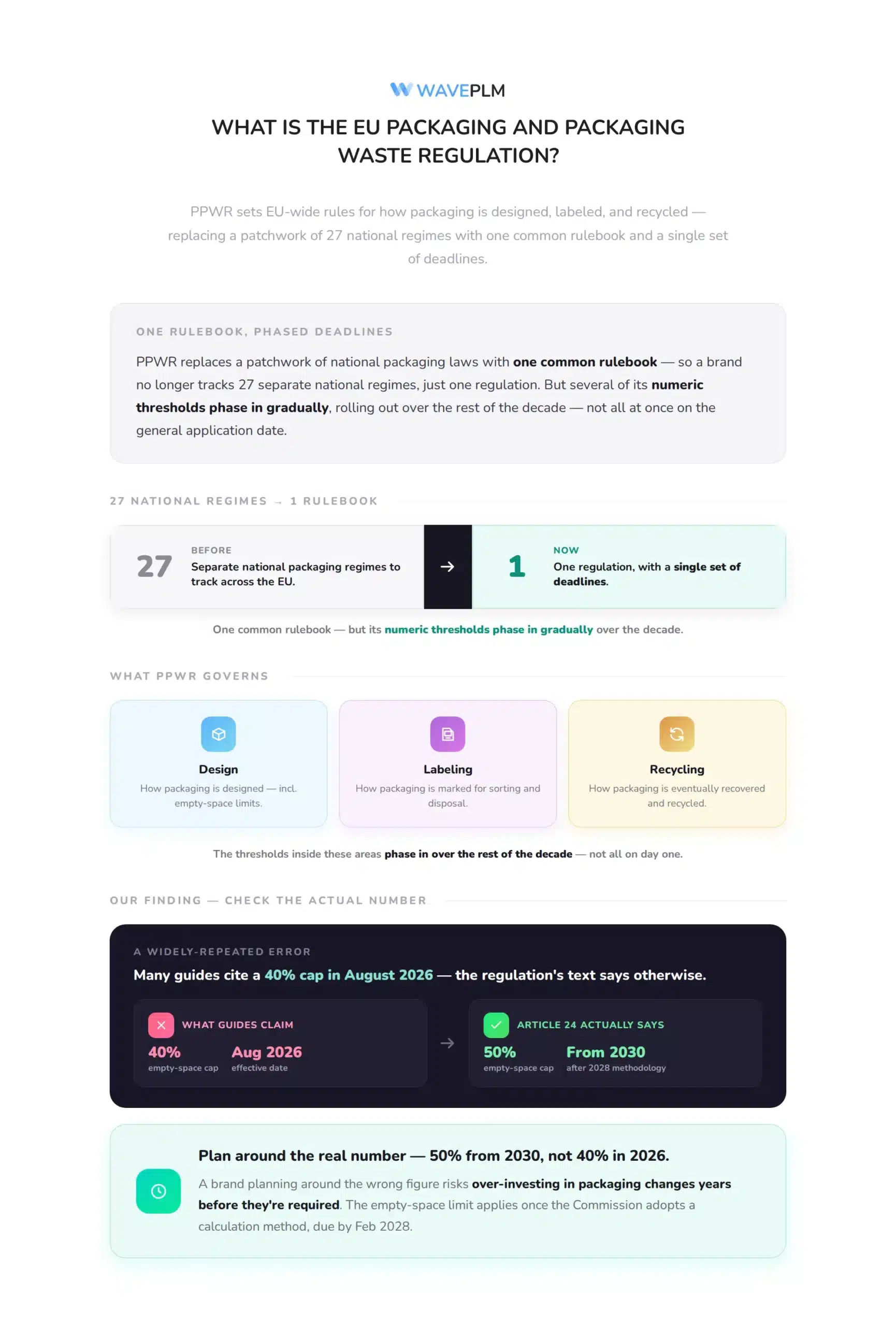
PPWR sets EU-wide rules for how packaging gets designed, labeled, and eventually recycled. Notably, it replaces a patchwork of national packaging laws with one common rulebook. As a result, a brand no longer needs to track 27 separate national packaging regimes, just one regulation with a single set of deadlines. That said, several of PPWR’s specific numeric thresholds phase in gradually. They roll out over the rest of this decade, not all at once on the general application date. This is exactly the detail that gets lost when a blog post compresses the whole regulation into one headline number.
Our finding: Several compliance guides describe a 40 percent empty-space cap taking effect in August 2026. We checked the regulation’s actual text. Article 24 sets the limit at 50 percent, and it applies from 2030, once the European Commission adopts a calculation methodology due by February 2028. A brand planning around the wrong number risks over-investing in packaging changes years before they are actually required.
How Much Empty Space Can a Shipping Box Actually Have?
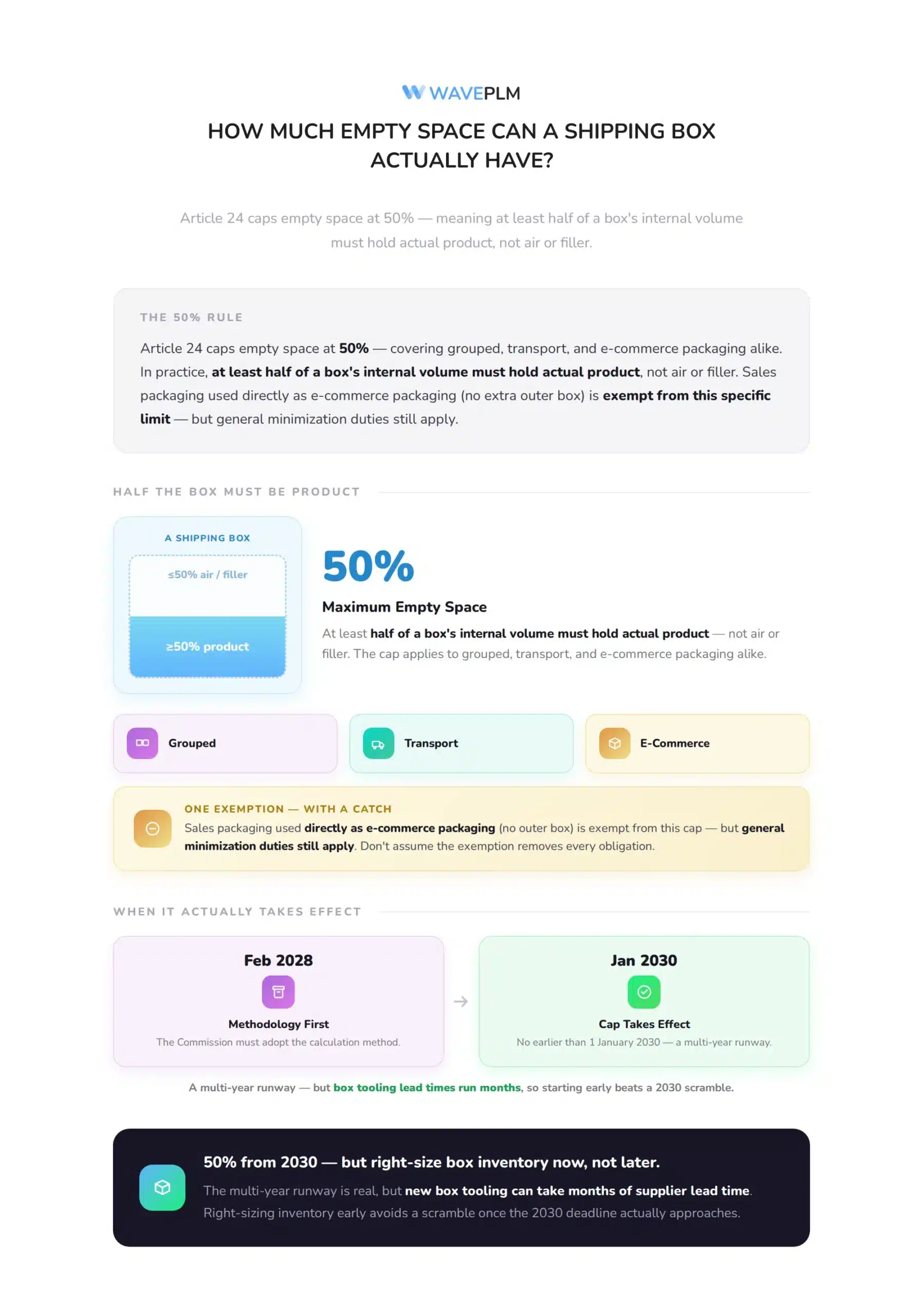
Article 24 of the regulation caps empty space at 50 percent. Specifically, that limit covers grouped, transport, and e-commerce packaging alike (Official Journal of the EU, Regulation 2025/40). In practice, that means at least half of a box’s internal volume must hold actual product, not air or filler. However, sales packaging used directly as e-commerce packaging, without an extra outer box, is exempt from this specific limit. General minimization duties still apply to it regardless, and brands should not assume the exemption removes every obligation.
This requirement does not start on the general application date. Instead, it takes effect no earlier than 1 January 2030, and the European Commission must first adopt the calculation methodology by 12 February 2028. For a fashion brand shipping DTC orders to the EU today, that leaves a multi-year runway. Even so, right-sizing box inventory now avoids a scramble once the 2030 deadline actually approaches. Supplier lead times for new box tooling can run several months on their own, which argues for starting early rather than waiting.
Does Packaging Need Recycled Content Now?
Yes, and this part of PPWR is often understated. Plastic packaging carries specific minimum recycled-content percentages, phased in by material type. “Other plastic packaging” is the category most poly mailers and plastic garment bags fall under. It needs 35 percent minimum recycled content from 2030. That figure rises to 65 percent by 2040 (Coolset). Meanwhile, contact-sensitive PET packaging follows the same 30-to-65 percent path. Non-plastic materials get their own targets too: 70 percent for paper and cardboard, 50 percent for glass, and 25 percent for metal.
For a brand still sourcing virgin-plastic poly mailers, that 2030 threshold is closer than it looks than the calendar suggests. Supplier contracts for packaging materials often run one to two years, so locking in a recycled-content-compliant supplier now avoids a rushed switch later.
What About Recyclability Grades?
Separately from recycled content, PPWR grades packaging on how recyclable it is, using a five-tier system from A through E. Grade A requires at least 95 percent recyclability by weight, Grade B needs 80 percent, and Grade C needs 70 percent. Anything below that falls into Grade D or E (Coolset). From 1 January 2030, only Grades A, B, and C may still enter the EU market. From 2038, Grade C also gets phased out, leaving only A and B.
Notably, multi-layer laminates and certain coated papers, both common in fashion packaging for their moisture resistance, often fall into the lower grades. By 2035, packaging must also prove it is recyclable “in practice and at scale,” through real recycling infrastructure, not just a lab test. In other words, a garment bag can be technically recyclable in theory. Without an actual recycling stream in most EU countries, it still will not clear that bar.
What About Digital Labeling on Packaging?
Beyond empty space and recycled content, PPWR also introduces harmonized labeling requirements. These are expected to phase in around 2027 to 2028, pending the Commission’s implementing acts. In practice, this means a QR code or similar digital identifier on packaging, linking to material composition and recyclability instructions. For a brand that currently prints a single generic care icon on its shipping box, this is a bigger change than it first appears. Custom-printed packaging artwork, ordered months in advance for a full season, needs updating before this deadline lands, not after.
How Is PPWR Different From the EU Digital Product Passport?
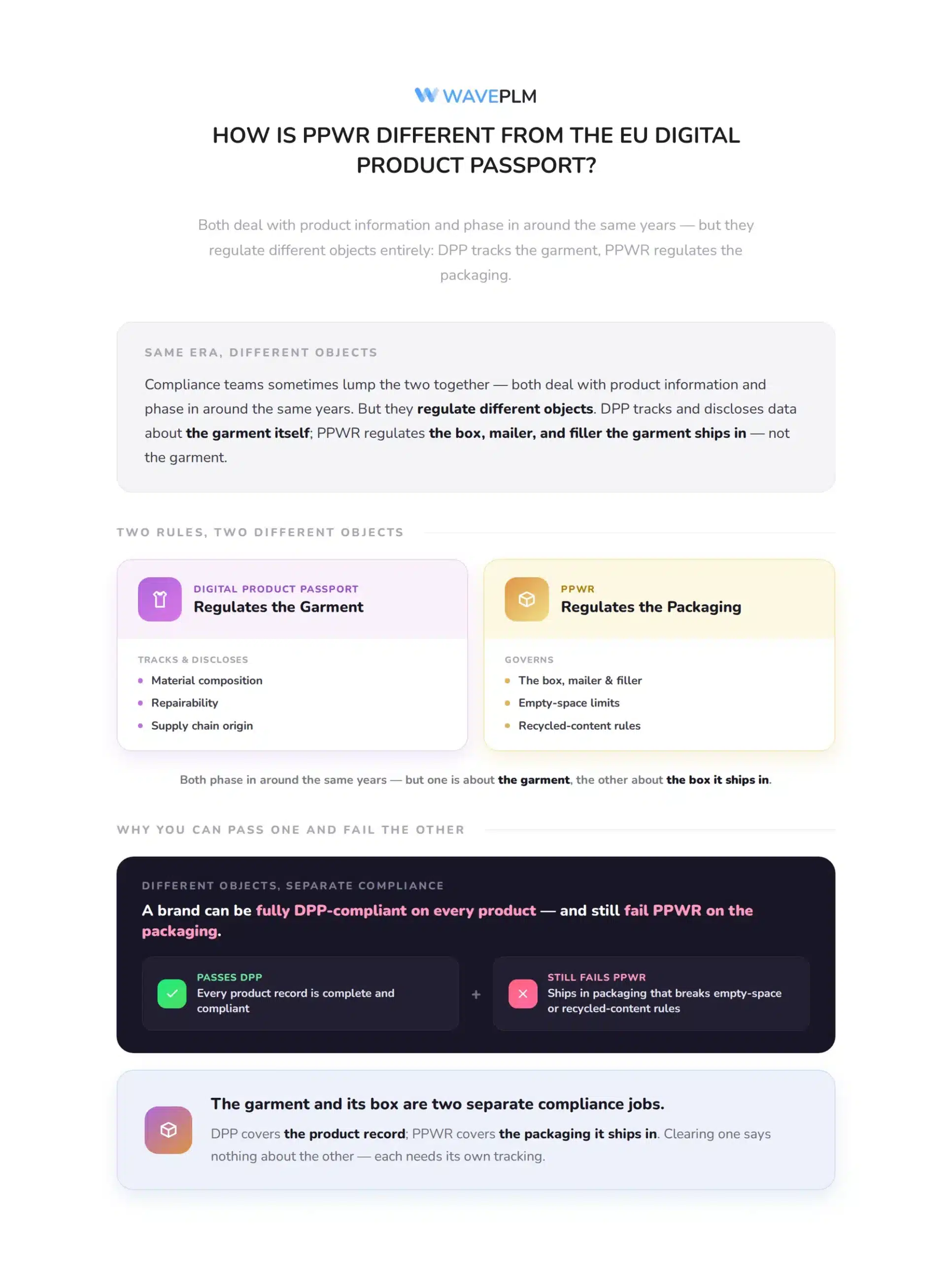
Fashion compliance teams sometimes lump PPWR in with the EU Digital Product Passport. Both deal with product information. Both also phase in around the same years. They regulate different objects, though. DPP tracks and discloses data about the garment itself: material composition, repairability, and supply chain origin. PPWR regulates the box, mailer, and filler the garment ships in, not the garment. As a result, a brand can be fully DPP-compliant on every product record. That same brand can still ship those products in packaging that fails PPWR’s empty-space or recycled-content rules.
What Happens If a Brand Doesn’t Comply?
Unlike the EU deforestation regulation’s uniform EU-wide fine, PPWR leaves specific penalty amounts to each member state. Instead, the regulation only requires states to introduce their own enforcement measures. Those measures must be “effective, proportionate, and dissuasive.” In practice, that mirrors the same decentralized pattern already seen under CSRD. National authorities set their own fine schedules. No single number applies EU-wide. Non-compliant packaging can also be pulled from the market directly, alongside potential product delisting by marketplaces and reputational fallout with EU retail partners.
How Should Fashion Brands Prepare Now?
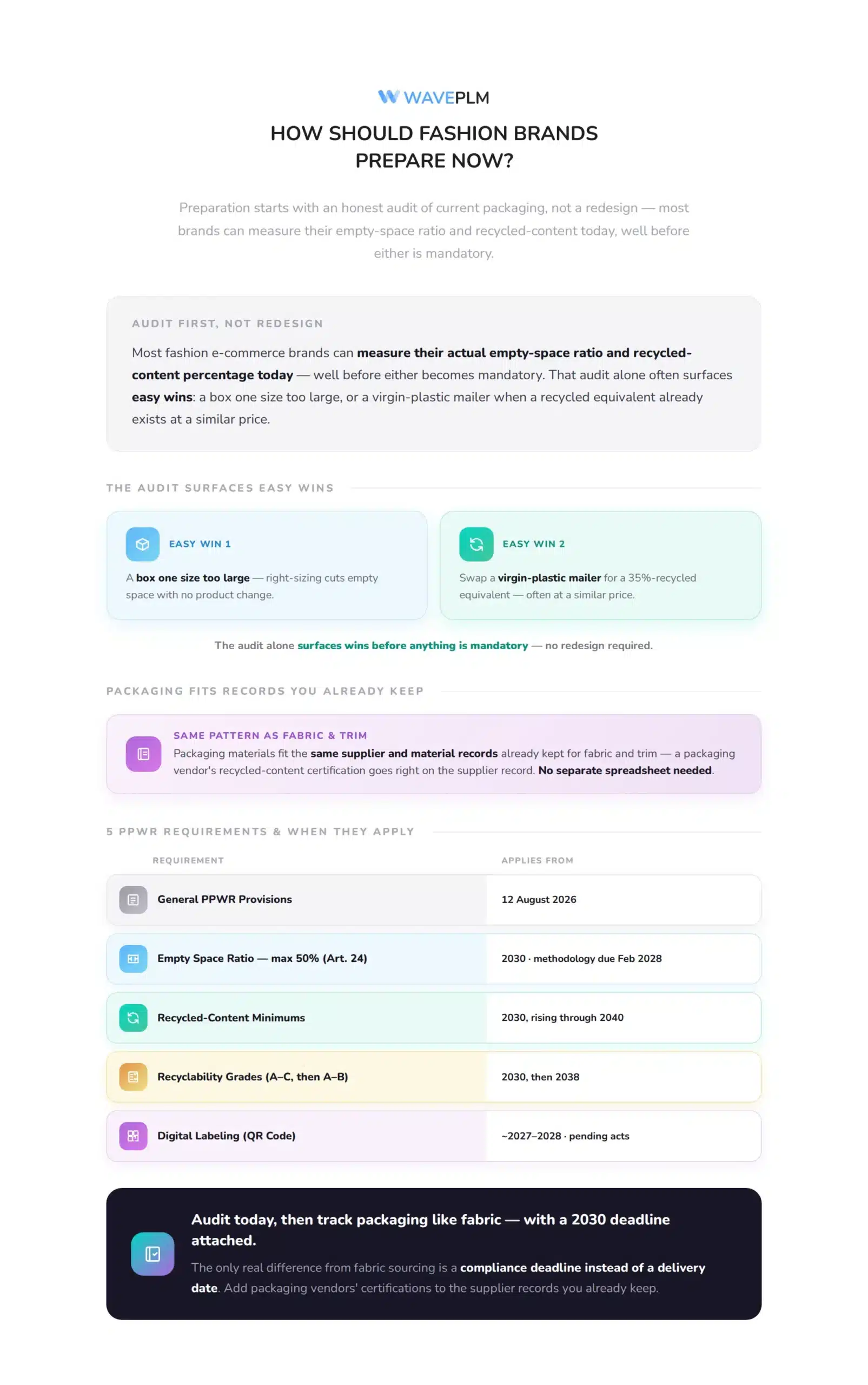
Preparation starts with an honest audit of current packaging, not a redesign. Most fashion e-commerce brands can measure their actual empty-space ratio and recycled-content percentage today, well before either becomes mandatory. In fact, that audit alone often surfaces easy wins. A box one size too large is one example. A poly mailer sourced from 100 percent virgin plastic, when a 35-percent-recycled equivalent already exists at a similar price, is another.
From there, packaging decisions belong in the same supplier and material records a brand already keeps for fabric and trim sourcing. Our fabric sourcing workflow guide covers how MOQ and lead-time tracking already works for fabric. Packaging materials fit the same pattern. The only real difference is a 2030 compliance deadline attached instead of a delivery date. Brands that already run supplier documentation through a supplier portal have a natural place to add a packaging vendor’s recycled-content certification. There is no need for a separate spreadsheet just for packaging.
| Requirement | Applies from |
|---|---|
| General PPWR provisions | 12 August 2026 |
| Empty space ratio, max 50% (Article 24) | 2030, methodology due Feb 2028 |
| Recycled content minimums (plastic, paper, glass, metal) | 2030, rising through 2040 |
| Recyclability grades A-C only, then A-B only | 2030, then 2038 |
| Digital labeling (QR code) | ~2027-2028, pending implementing acts |
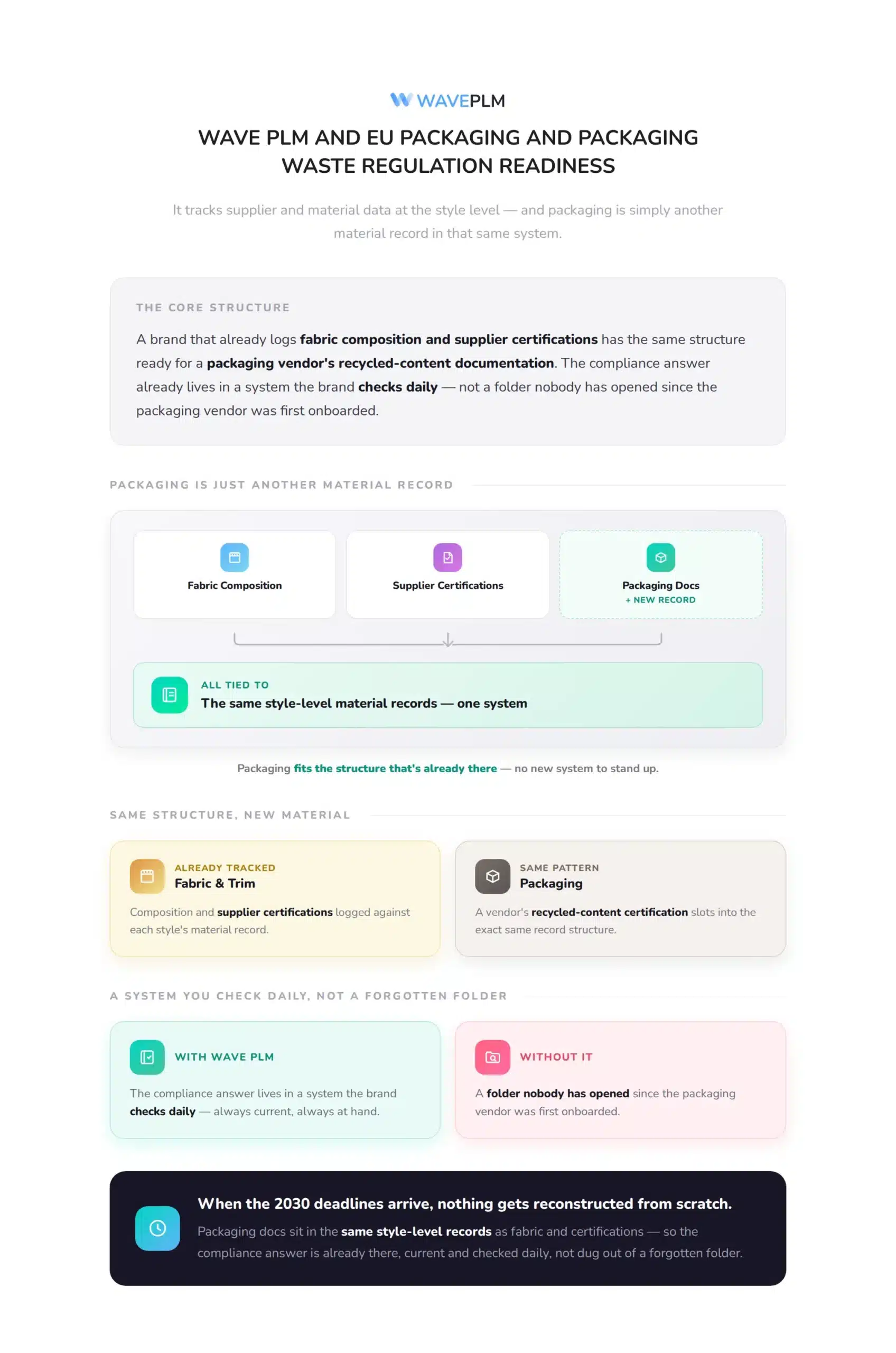
Wave PLM and EU Packaging and Packaging Waste Regulation Readiness
Wave PLM tracks supplier and material data at the style level, and packaging is simply another material record in that system. A brand that already logs fabric composition and supplier certifications has the same structure ready for a packaging vendor’s recycled-content documentation. That way, the compliance answer already lives in a system the brand checks daily. It does not sit in a folder nobody has opened since the packaging vendor was first onboarded. As a result, when the 2030 deadlines for the EU Packaging and Packaging Waste Regulation actually arrive, nothing needs to be reconstructed from scratch.
Frequently Asked Questions
Does the EU Packaging and Packaging Waste Regulation cap empty space at 40% starting in 2026?
No. That claim circulates widely but is inaccurate on two points. The regulation’s Article 24 sets the actual limit at 50%, not 40%. It also applies from 2030 at the earliest, not 2026. That start date depends on the European Commission adopting a calculation methodology, due by February 2028.
Does packaging need recycled content under PPWR?
Yes. Most plastic poly mailers fall under “other plastic packaging,” which needs at least 35% recycled content from 2030, rising to 65% by 2040. Paper and cardboard packaging needs 70% recycled content, glass needs 50%, and metal needs 25%.
What are the PPWR recyclability grades?
Packaging is graded A through E based on recyclability by weight. Specifically, Grade A needs 95% or more, Grade B needs 80%, and Grade C needs 70%. From 2030, only Grades A, B, and C may enter the EU market. From 2038, only A and B remain permitted, which rules out most Grade C options within a decade.
When does the EU Packaging and Packaging Waste Regulation actually apply?
Most provisions apply from 12 August 2026. However, the specific empty-space limit under Article 24 applies from 2030, and the recycled-content and recyclability-grade thresholds also phase in mainly from 2030 through 2040.
How is PPWR different from the EU Digital Product Passport?
The Digital Product Passport tracks data about the garment itself, such as material composition and origin. PPWR regulates the packaging the garment ships in, covering empty space, recycled content, and recyclability. A brand can meet one requirement without automatically meeting the other.
What is the penalty for not complying with PPWR?
The regulation itself does not set one EU-wide fine. Instead, it requires each member state to introduce its own “effective, proportionate, and dissuasive” enforcement measures, similar to how CSRD penalties also vary by country.
The EU Packaging and Packaging Waste Regulation gets misreported often, and the 40-percent-in-2026 claim is the clearest example. The real numbers, 50 percent from 2030, plus recycled-content and recyclability thresholds phased through 2040, give fashion e-commerce brands real lead time, not an emergency. That lead time is only useful if a brand starts tracking packaging supplier data now, the same way it already tracks fabric and trim. Wave PLM keeps that data in one place, ready well before 2030 arrives.







Leave a Reply