
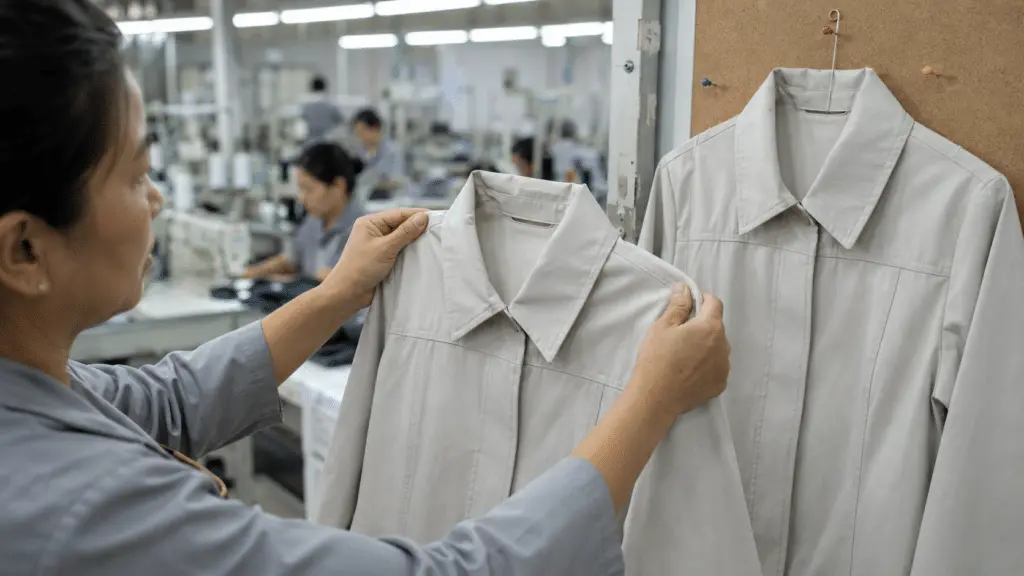
The Top of Production Sample (TOP) serves as the final approval gate before bulk production commences, ensuring that all key aspects of the garment meet the established standards. The top sample must be meticulously examined to verify color accuracy, fabric quality, and overall craftsmanship. Relying solely on photographs for approval undermines the integrity of this critical step, often leading to discrepancies that can significantly impact production timelines and costs. Therefore, a physical TOP sample is essential for a reliable and effective approval process.
This thorough examination process not only safeguards quality but also fosters collaboration among design, production, and sourcing teams. By maintaining clear documentation of feedback and approvals, companies can streamline communication and address any concerns promptly. Additionally, having a tangible reference point enhances accountability, as all stakeholders can refer back to the agreed-upon standards. Ultimately, investing in a robust TOP sample approval process can lead to more successful product launches and higher customer satisfaction.
A top of production sample, often shortened to TOP sample, is the first finished garment pulled from the actual bulk manufacturing line. It does not come from a sample room. Its job is simple. It proves the factory can mass-produce goods that match the pre-production sample a brand already approved. If the two do not line up, however, the line can stop. That happens before the rest of the order gets cut, sewn, and packed the same way.
This guide covers what a TOP sample actually checks, and where it sits in the broader sampling sequence. It also covers what happens when a TOP sample fails, and where brands most often lose the thread on this final approval step.
What Is a Top of Production Sample?
A TOP sample is a garment randomly pulled from the active sewing line once bulk production has started. Unlike a prototype or fit sample, it is not made by a specialized sample room under ideal conditions. Instead, it comes off the same machines, at the same speed, using the same operators the rest of the order will run through. That distinction matters. A sample room can produce a beautiful one-off garment that a factory floor, running at full production speed, cannot consistently replicate.
The TOP sample gets checked against the previously approved pre-production sample, often called a PP sample or a sew-by. A brand’s quality team, or its sourcing agent, reviews sizing, stitching, fabric hand, color, branding, and packaging. Each of these needs to match the approved standard closely enough to sign off on the full run.
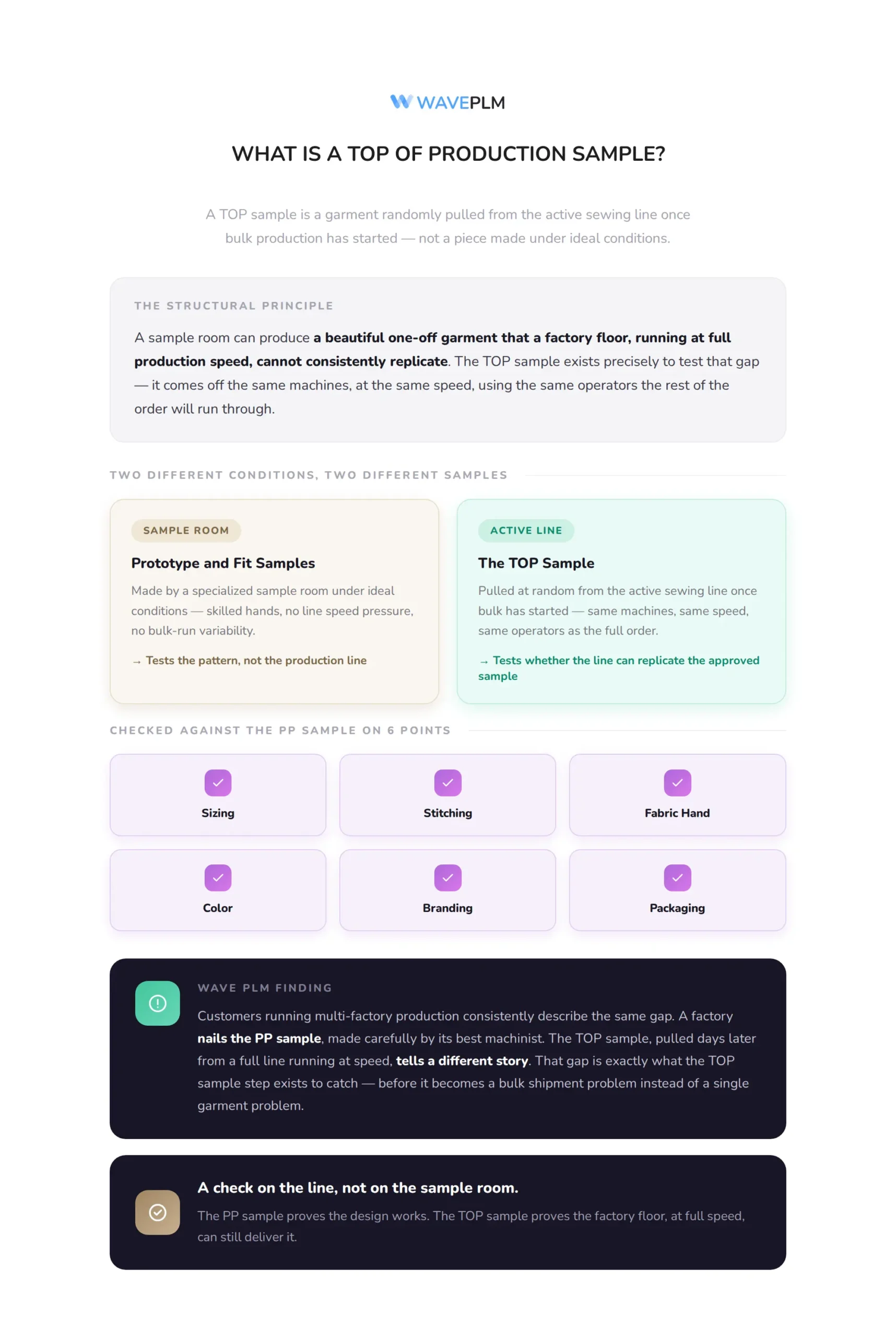
Our finding: Wave PLM customers running multi-factory production consistently describe the same gap. A factory nails the PP sample, made carefully by its best machinist. The TOP sample, pulled days later from a full line running at speed, tells a different story. That gap is exactly what the TOP sample step exists to catch, before it becomes a bulk shipment problem instead of a single garment problem.
How Is a TOP Sample Different From a Pre-Production Sample?
A pre-production sample confirms a factory can build the style correctly at all. It happens before bulk cutting begins, and a brand typically approves it once, per style, per color. A TOP sample confirms something else entirely: that the factory’s actual production line, running under real conditions, reproduces that same standard consistently. In other words, the PP sample tests capability. The TOP sample tests execution.
This distinction connects directly to fit session management, which governs how fit comments and approvals get resolved earlier in development. By the time a TOP sample gets pulled, fit issues should already be closed. Instead, a TOP sample review focuses specifically on production consistency, not on whether the garment fits correctly in the first place.
How Is a TOP Sample Different From a Shipment Sample?
A shipment sample, sometimes called a pre-shipment sample, gets pulled after the entire order finishes production, right before it leaves the factory. In other words, it is a final check, not an early one. A TOP sample, by contrast, gets pulled while the bulk line is still running. This timing gap matters enormously. A shipment sample failure means the whole order already exists in its current, flawed state. A TOP sample failure, however, still leaves most of the run ahead of the factory, correctable before it repeats across every unit.
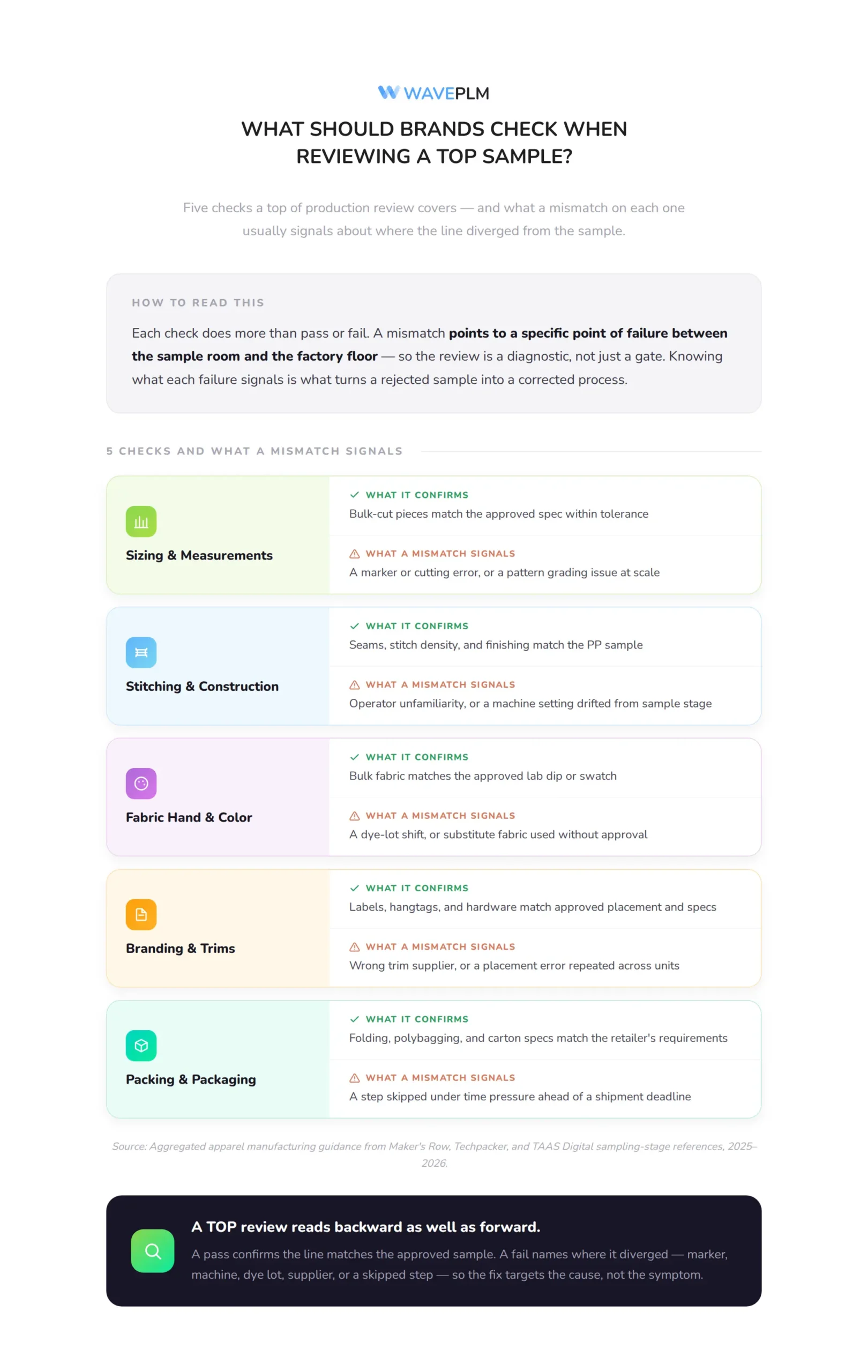
What Should Brands Check When Reviewing a TOP Sample?
The table below maps the checks a top of production sample review typically covers, alongside what a mismatch usually signals. Notably, each check ties back to a specific point of failure between the sample room and the factory floor.
| Check | What it confirms | What a mismatch usually signals |
|---|---|---|
| Sizing and measurements | Bulk-cut pieces match the approved spec within tolerance | Marker or cutting error, or a pattern grading issue at scale |
| Stitching and construction | Seams, stitch density, and finishing match the PP sample | Operator unfamiliarity, or a machine setting drifted from the sample stage |
| Fabric hand and color | Bulk fabric matches the approved lab dip or swatch | A dye-lot shift, or substitute fabric substituted without approval |
| Branding and trims | Labels, hangtags, and hardware match approved placement and specs | Wrong trim supplier, or a placement error repeated across units |
| Packing and packaging | Folding, polybagging, and carton specs match the retailer’s requirements | A step skipped under time pressure ahead of a shipment deadline |
Source: Aggregated apparel manufacturing guidance from Maker’s Row, Techpacker, and TAAS Digital sampling-stage references, 2025–2026.
Where Does the TOP Sample Sit in the Sampling Sequence?
Industry data: Apparel sourcing references consistently describe the same order of stages: a prototype or fit sample first, then a pre-production sample confirming the factory can build the approved style, then the TOP sample pulled from the live bulk line, and finally a size-set sample confirming grading across the full size range. Skipping the TOP sample step means a brand only finds out whether the line matched the standard once the finished goods already arrive.
What Happens If a TOP Sample Fails?
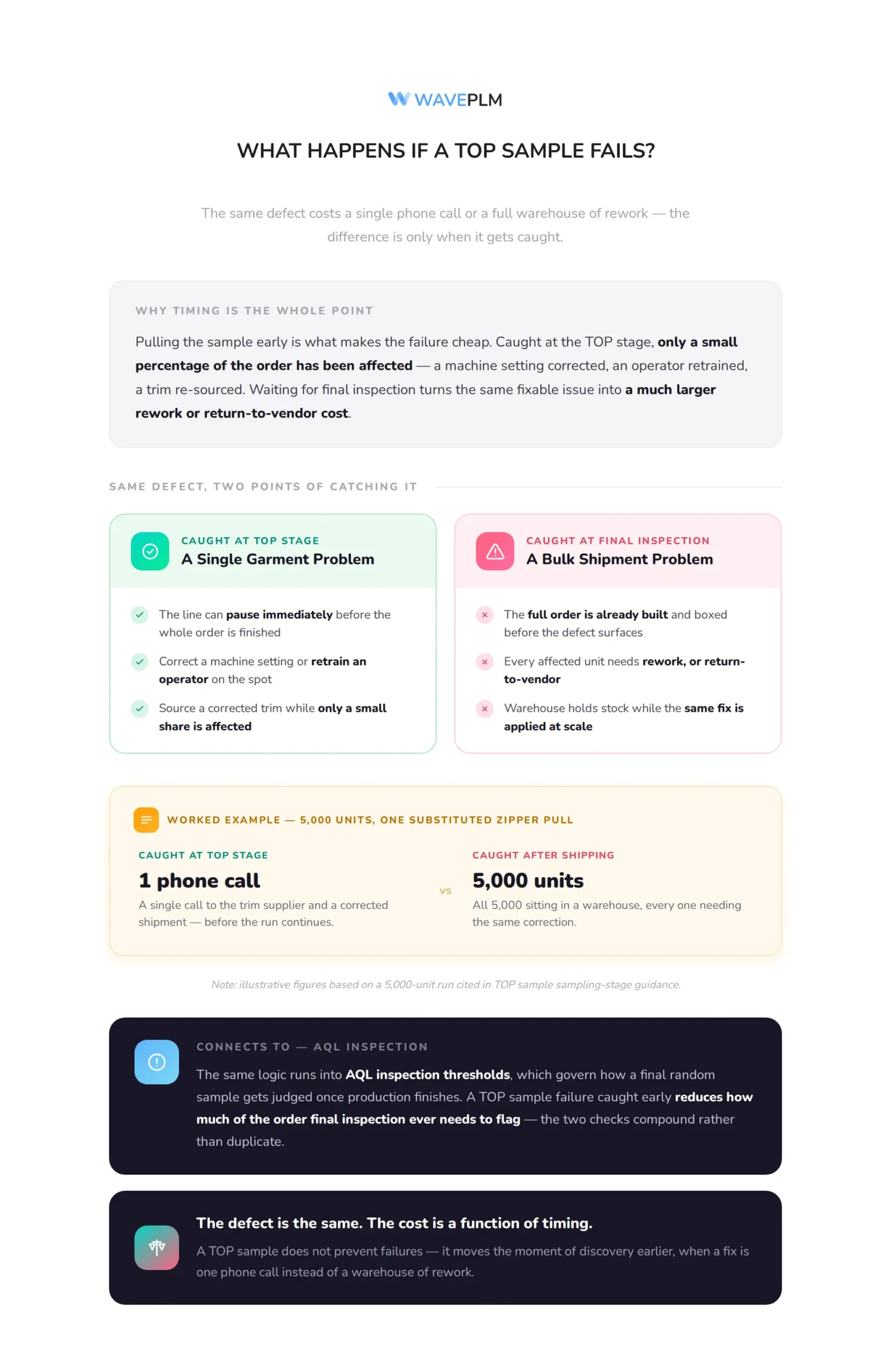
When a TOP sample reveals a defect or a deviation from the approved standard, the production line can pause immediately. That is, in fact, the entire point of pulling the sample early. Otherwise, a brand would wait for a final random inspection once the whole order is finished. A factory can correct a machine setting or retrain an operator. It can also source a corrected trim, all while only a small percentage of the order has been affected. Waiting until later in the run, however, turns the same fixable issue into a much larger rework or return-to-vendor cost.
For example, consider a factory running 5,000 units. It discovers, through the TOP sample, that a trim supplier substituted a slightly different zipper pull without telling anyone. Caught at the TOP sample stage, that is a single phone call and a corrected shipment from the trim supplier. Caught only once the full order ships, it is 5,000 units sitting in a warehouse, all needing the same fix.
This same logic connects to AQL inspection thresholds, which govern how a final random sample gets judged once production finishes. A TOP sample failure caught early reduces how much of the order that final inspection ever needs to flag.
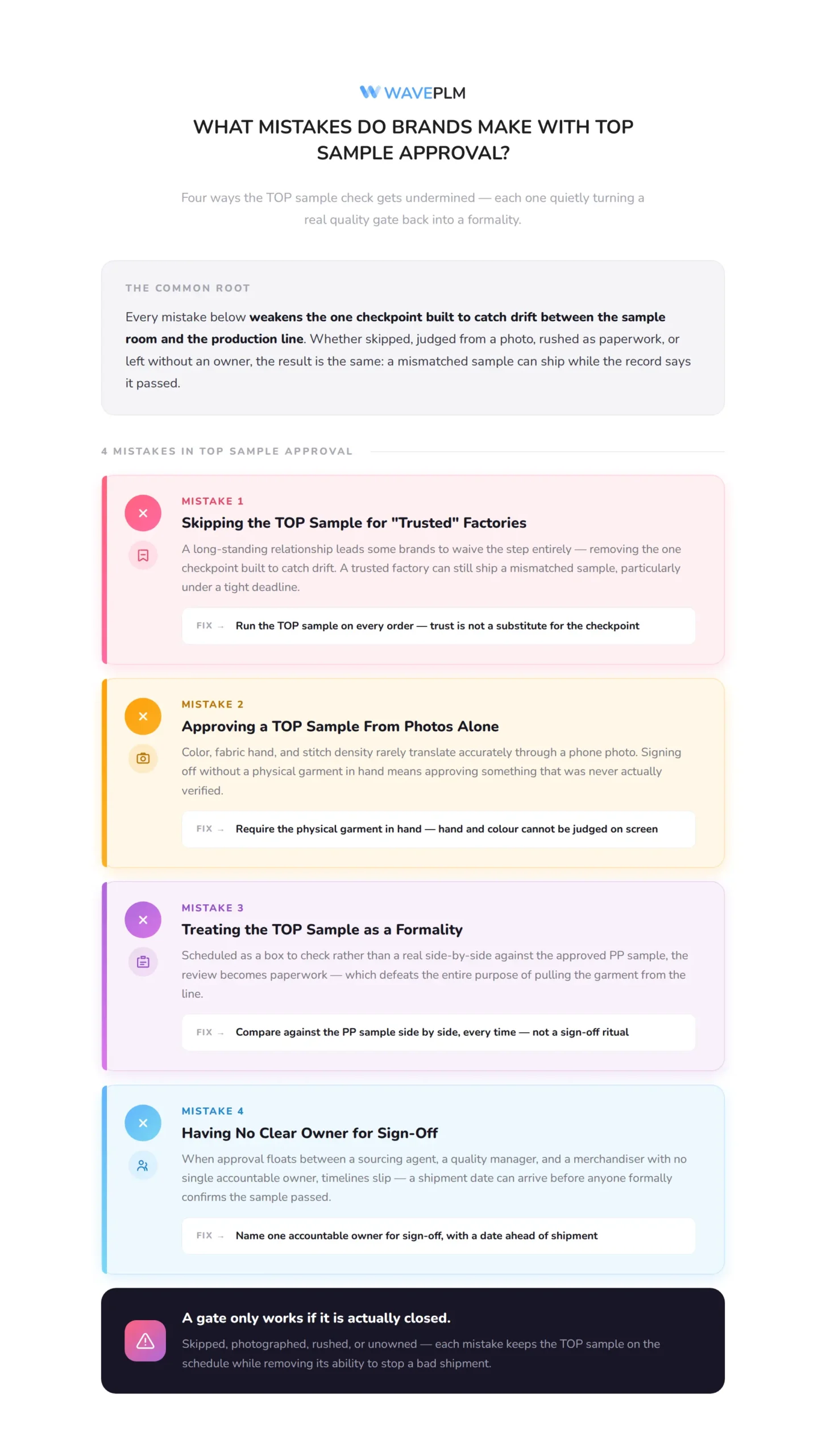
What Mistakes Do Brands Make With TOP Sample Approval?
Skipping the TOP Sample for “Trusted” Factories
A long-standing factory relationship sometimes leads a brand to waive the TOP sample step entirely. That shortcut removes the one checkpoint built specifically to catch drift between a careful sample-room garment and a full production line. A trusted factory can still ship a mismatched TOP sample, particularly under a tight deadline.
Approving a TOP Sample From Photos Alone
Color, fabric hand, and stitch density rarely translate accurately through a phone photo. A brand that signs off on a TOP sample without a physical garment in hand is approving something it has not actually verified.
Treating the TOP Sample as a Formality
Some teams schedule the TOP sample review as a box to check. It becomes a formality, rather than a real comparison against the approved PP sample side by side. That habit turns a meaningful quality gate into paperwork. It also defeats the purpose of pulling the sample from the line in the first place.
Having No Clear Owner for TOP Sample Sign-Off
When TOP sample approval floats between a sourcing agent, a quality manager, and a merchandiser without a single accountable owner, sign-off timelines slip. A shipment date can arrive before anyone formally confirms the TOP sample actually passed.
What Should Brands Set Up for TOP Sample Approval?
A few concrete practices keep this step meaningful rather than symbolic. First, require a physical TOP sample, not a photo, for every style and colorway in a production run. Second, compare it directly against the retained PP sample, side by side, rather than from memory. Third, assign one clear owner per style who signs off before the line continues at full volume. Finally, log the TOP sample decision and any corrective action taken, so the same issue does not resurface unnoticed on a reorder.
How Does Wave PLM Support TOP Sample Approval?
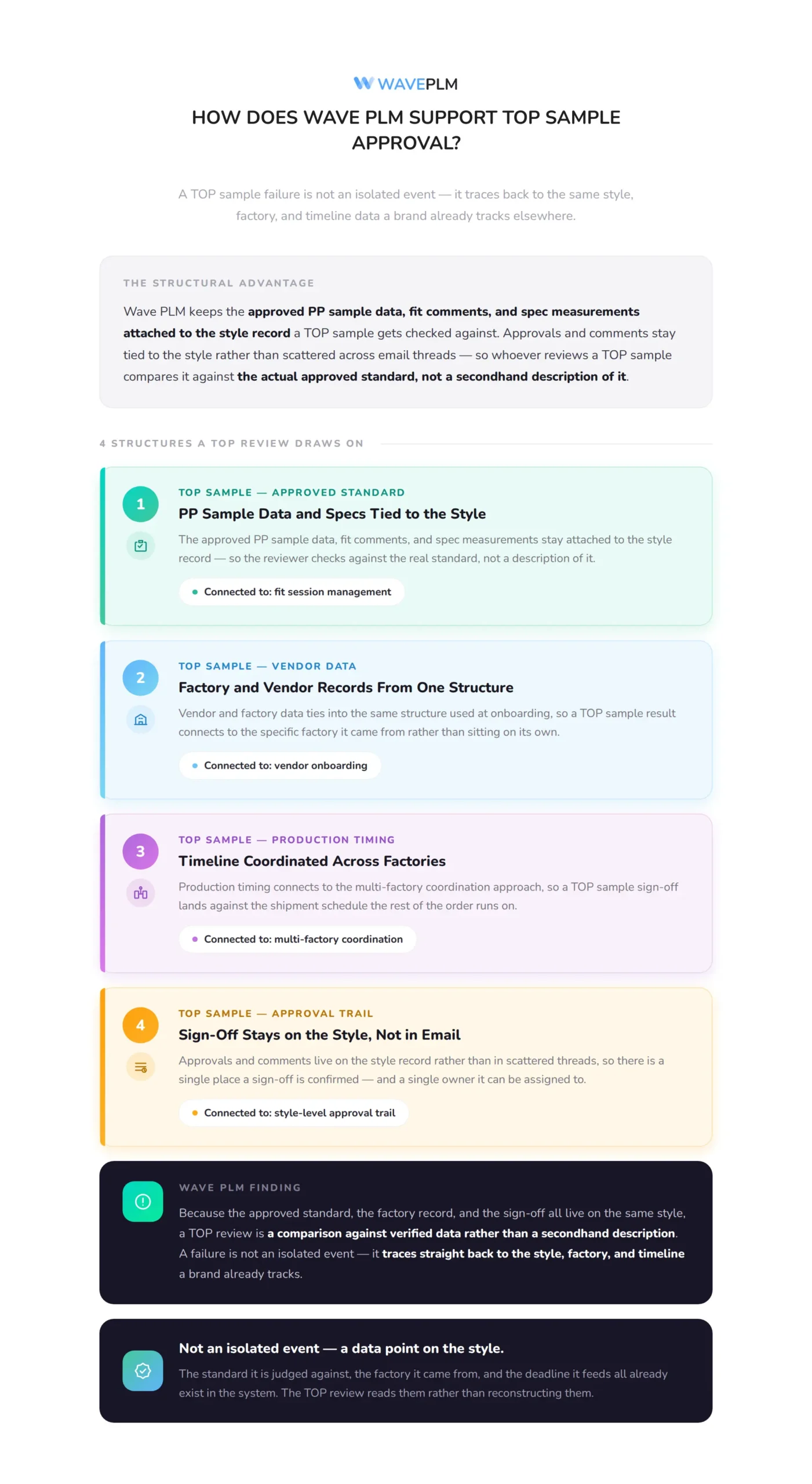
Wave PLM keeps the approved PP sample data, fit comments, and spec measurements attached to the style record a TOP sample gets checked against. This follows the same structure covered in our guide to fit session management. There, approvals and comments stay tied to the style, rather than scattered across email threads. As a result, whoever reviews a TOP sample is comparing it against the actual approved standard, not a secondhand description of it.
Vendor and factory data, similarly, ties into the same structure covered in our vendor onboarding guide. Production timing, in turn, connects to the coordination approach in our guide to multi-factory production coordination. A top of production sample failure, in other words, is not an isolated event. It traces back to the same style, factory, and timeline data a brand already tracks elsewhere.
Frequently Asked Questions
What is a top of production sample?
A top of production sample, or TOP sample, is the first finished garment pulled from the actual bulk manufacturing line. It confirms the factory can consistently reproduce the previously approved pre-production sample at full production speed.
What is the difference between a PP sample and a TOP sample?
A pre-production, or PP, sample confirms a factory can build a style correctly before bulk cutting starts. A TOP sample confirms the live production line, running at speed, actually reproduces that same standard once bulk manufacturing is underway.
What does a TOP sample review check?
During a TOP sample review, checks typically cover sizing, stitching, fabric hand, and color. Branding, trims, and packing specifications get checked too, all against the approved pre-production sample.
What happens if a TOP sample fails inspection?
If a TOP sample reveals a defect or deviation, the production line can pause immediately. The factory then corrects the issue, such as a machine setting or a trim substitution. Only a small share of the order has been affected at that point.
Where does the TOP sample fit in the overall sampling process?
The typical sequence runs from a prototype or fit sample, to a pre-production sample. After that comes the top of production sample, pulled from the live bulk line. Finally, a size-set sample confirms grading across the full size range.
Can a TOP sample be approved from photos instead of a physical garment?
Color accuracy, fabric hand, and stitch density are difficult to verify from a photo. Approving a TOP sample without a physical garment in hand means signing off on something that has not actually been checked.
Most brands find out whether a TOP sample step actually worked only when a shipment arrives looking different from what they approved. By then, the fix costs far more than it would have during the line’s first hour of running. A physical garment, checked side by side against the approved standard, with one clear owner signing off, is what keeps this step meaningful. See how Wave PLM keeps approval data connected from fit comments through TOP sample sign-off.




Leave a Reply