

Every fashion brand operates under the same constraint: a fixed delivery window that does not move. The fashion product development process must fit inside that window. This sequence of stages takes a design from concept to approved bulk production — and when delays accumulate, the window does not move. When sampling runs long, labdip rounds pile up, or costing comes back wrong, the calendar does not reset. Instead, subsequent stages compress, get skipped, or fail under pressure.
The fashion product development process is essential for timely deliveries. Understanding the fashion product development process is vital for every brand.
This guide covers the fashion product development process as a calendar management problem. Each of the six stages has a realistic duration range, a specific set of outputs, and a characteristic failure mode. Understanding all three is what separates brands that consistently ship on time from those that spend every season in controlled crisis.
Mastering the fashion product development process can set a brand apart.
Six Stages, One Fixed Deadline
The fashion product development process has evolved significantly. Each aspect of the fashion product development process requires careful attention. Efficiency in the fashion product development process leads to better results.
The fashion product development process runs in six sequential stages. Each stage depends on outputs from the previous one. Therefore, a delay in Stage 2 is not an isolated problem — it is a debt that every subsequent stage must absorb. The six stages are: concept and range planning; design and tech pack development; and material sourcing and colorway approvals. These are followed by sampling and fit approval, costing and commercial confirmation, and bulk production with pre-shipment inspection.
The fashion product development process should start as early as possible. Rethinking the fashion product development process can yield substantial benefits. Understanding the fashion product development process is crucial for success. Brands often overlook key elements of the fashion product development process.
Industry data: According to McKinsey’s State of Fashion report (2024), the average fashion brand’s development calendar has compressed by 25% over the past decade. Meanwhile, average SKU count per brand has grown by 30%. Consequently, the tolerance for error at each development stage is smaller than it has ever been.
Industry data: According to McKinsey’s State of Fashion report (2024), the average fashion brand’s development calendar has compressed by 25% over the past decade. Meanwhile, average SKU count per brand has grown by 30%. Consequently, the tolerance for error at each development stage is smaller than it has ever been.
Stage-by-Stage Timeline and Failure Points
A full fashion product development cycle typically runs 7 to 14 months, from initial concept through approved bulk production. The table below shows realistic duration ranges, the key output of each stage, and where time is most commonly lost.
| Stage | Duration | Key Output | Where Time Is Lost |
|---|---|---|---|
| 1. Concept and range planning | 3–6 weeks | Style count, colorway map, price tier targets | Range too large for development capacity |
| 2. Design and tech pack development | 4–8 weeks | Approved tech packs, BOM per style | Incomplete specs producing wrong first samples |
| 3. Material sourcing and colorway approvals | 6–12 weeks | Approved labdips, confirmed fabric orders | Multiple labdip correction rounds per colorway |
| 4. Sampling and fit approval | 8–16 weeks | Approved pre-production sample per style | Rejection rounds caused by Stage 2 spec gaps |
| 5. Costing and commercial confirmation | 2–4 weeks | Confirmed landed cost, finalized style lineup | Styles cut after sampling spend is already sunk |
| 6. Bulk production and pre-shipment approval | 6–12 weeks | Packed goods, passed PSI report | Quality deviations from unapproved spec versions |
Stages 1 and 2: Where the Calendar Is Won or Lost Before Sampling Starts
Most brands think of the fashion product development process as starting with sampling. In operational terms, however, it starts much earlier. Moreover, the decisions made in Stages 1 and 2 largely determine whether the rest of the calendar holds.
Stage 1, range planning, sets the development load. Every style added to the range commits the team to a full development cycle: patterns, tech packs, sampling rounds, labdip approvals, and a cost sheet. A range of 60 styles at 4 colorways each is 240 product records to manage simultaneously through every subsequent stage. Generally, the brands that finish development on time plan conservatively. For a first season, that means 6 to 12 styles. For an established brand, 15 to 25. Brands that expand the range and cut styles late absorb the calendar cost of every dropped style’s development spend.
Stage 2: The Most Consequential Gate in the Calendar
Each style goes through the fashion product development process systematically.
Stage 2, tech pack development, is the most consequential single stage in the entire process. A complete tech pack produces a correct first sample. An incomplete one produces a sample the factory interpreted as best it could. As a result, a correction round adds two to four weeks to the calendar. Furthermore, the bill of materials built at this stage determines whether material orders go out correctly and on time. Stage 2 errors are not isolated events; they propagate through Stages 3, 4, and sometimes 6.
The Labdip Problem: 120 Approvals Running in Parallel
Stage 3 is where many brands encounter their first serious calendar threat — and underestimate it. Colorway approvals run on a separate track from sampling, controlled by the mill’s dye schedule rather than the brand’s development calendar. Each colorway requires its own labdip submission: a small dyed swatch the mill produces for the brand’s approval against the target Pantone standard. Most colorways require two to four rounds before approval clears.
Adapting the fashion product development process can improve outcomes.
Each correction round costs 5 to 10 business days. For a brand running 40 styles at 3 colorways each, that is 120 parallel labdip approvals. Each carries its own status, correction notes, and open deadline. Meanwhile, fabric sourcing must coordinate delivery timing so that approved bulk fabric arrives at the factory before cutting begins. A labdip delay does not just push the colorway back; it idles the production line and compresses the remaining stages downstream.
Additionally, tracking 120 labdip approvals in email threads is structurally unreliable. Rounds get lost. Correction notes go to the wrong contact. Approvals land in an inbox on the day a buyer is traveling. The status of the overall colorway map becomes impossible to audit in real time — which means problems surface late, when fixing them is most expensive.

Sampling: Three Rounds, and Where Each One Fails
Cut-and-sew sampling runs three standard rounds per style. The first is a prototype or counter sample, often produced in a substitute fabric, used to test construction logic. A fit sample in the correct fabric follows — used for size grading and fit approval across the full size run. Finally, the factory submits a pre-production (PP) sample: the exact garment to be cut in bulk, which the brand formally approves before production begins.
In practice, many collections run four or five rounds on complex styles. Each rejected round adds two to four weeks to the calendar and direct costs in factory time, material, and international freight. This stage is where the fashion product development process loses the most calendar time. Moreover, the root cause of most rejections is not factory quality — it traces back to Stage 2. An incomplete or ambiguous tech pack produces a sample the factory built to its own interpretation. The correction round is the symptom; the spec gap is the cause.
Our finding: Wave PLM customers who manage tech packs within a structured workflow reduce first-sample rejection rates by approximately 40% compared to teams managing specs in shared drives and email. Over a 30-style collection, that translates to roughly 3 to 4 weeks of recovered calendar time per season.
Our finding: Wave PLM customers who manage tech packs within a structured workflow reduce first-sample rejection rates by approximately 40% compared to teams managing specs in shared drives and email. Over a 30-style collection, that translates to roughly 3 to 4 weeks of recovered calendar time per season.

The Real Cost of Running Costing After Sampling
Integrating technology can enhance the fashion product development process.
Stage 5, costing and commercial confirmation, is the gate where styles either proceed to bulk production or get cut from the collection. Once sampling is complete, the team confirms the total landed unit cost against the target retail price. This includes fabric, CMT, trim, freight, and duties. Styles that cannot achieve a viable margin at confirmed production cost are either renegotiated, redesigned, or dropped.
The fashion product development process impacts profitability significantly. Transparency in the fashion product development process fosters trust. What motivates changes in the fashion product development process? Each stage of the fashion product development process has its own challenges. The length of the fashion product development process can vary widely.
Why Timing Is the Real Costing Problem
Understanding the implications of the fashion product development process is essential.
The failure mode here is not the costing itself but its timing. Specifically, brands that run confirmed costing only after sampling is complete discover commercially unviable styles too late. By that point, they have already invested in three rounds of samples, factory time, and material. That investment is written off. Brands that run a preliminary garment costing check at Stage 2 — before confirming sampling — surface margin problems while they are still cheap to solve. Dropping a style before its first sample is a planning decision. Dropping it after its third sample is a write-off.
The fashion product development process can be broken down further into phases.
Understanding PLM’s role in the fashion product development process is vital.
Stage 6: What the Pre-Shipment Inspection Actually Tests
Bulk production covers cutting, sewing, finishing, and packing — followed by a pre-shipment inspection (PSI) before goods leave the factory. The PSI verifies that the bulk production conforms to the approved PP sample: measurements, construction, color, and finish are checked against the reference standard. Any deviation outside agreed tolerances requires rework, a price concession, or rejection of the shipment.
The most common source of Stage 6 failures is version drift on specs. When specs are distributed as PDF email attachments, factories frequently work from outdated versions. In those cases, bulk production does not match the approved sample. Building a structured supplier documentation process throughout development, with one authoritative source for every spec version, is the operational foundation that makes PSI outcomes predictable. Additionally, consistent quality reference standards ensure that inspectors across different factories apply the same benchmark. This requires one approved PP sample per colorway, physically retained or photographically documented.
Fashion design and the fashion product development process are different yet interconnected.

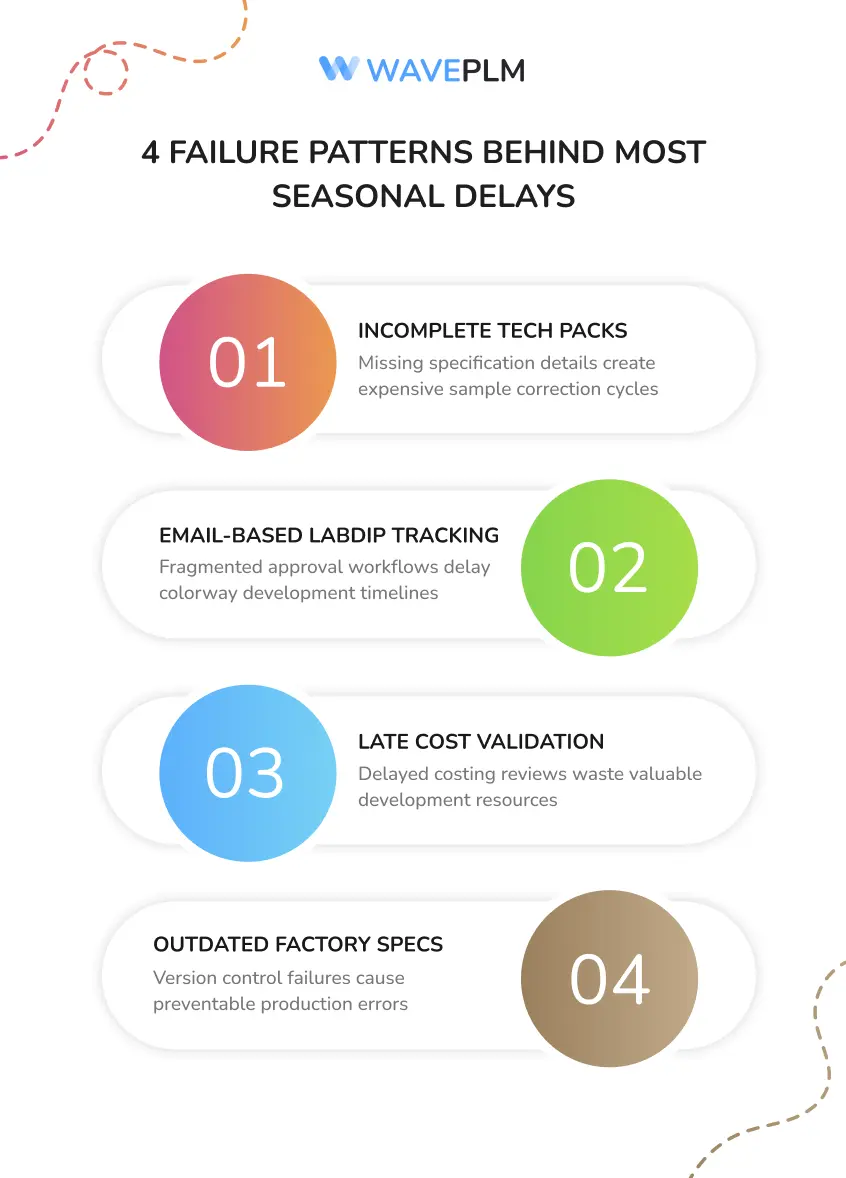
Four Failure Patterns Behind Most Seasonal Delays
Across all six stages, four specific failure patterns drive the majority of development delays and budget overruns in the fashion product development process. Each is predictable. Each is preventable with the right systems in place.
First, incomplete tech packs generate incorrect samples. When Stage 2 specifications are ambiguous, factories interpret them independently — and interpretation almost never matches designer intent. Consequently, every correction round that follows is a cost directly attributable to what was left unspecified. Second, labdip tracking in email loses rounds. When colorway approvals are tracked across email threads rather than in a centralized system, correction notes get missed and approvals get delayed. Consequently, the status of a full collection’s colorway map becomes invisible until deadlines are already broken.
Third, costing after sampling writes off development spend. Running confirmed cost checks only after a style is fully sampled means that commercially unviable styles absorb resources they should not have received. A preliminary check at Stage 2 costs nothing and prevents it. Fourth, outdated spec versions at the factory cause PSI failures. This is the most straightforward failure to prevent — and also the most common. When specs exist in one authoritative, versioned location accessible to the factory in real time, version drift becomes structurally impossible.
What Running the Fashion Product Development Process Through PLM Changes
A fashion PLM (product lifecycle management) system centralizes the fashion product development process in a single connected platform. It covers everything from the initial range plan through pre-shipment approval. It addresses each of those four failure patterns directly. Rather than scattering data across shared drives, spreadsheets, and email threads, PLM stores every stage’s outputs in structured records that connect to each other.
In practice, this means: tech packs live in versioned records — the factory always receives the current approved spec, never an outdated attachment. Labdip approvals run as structured workflows with live status visible to the entire team. Cost sheets link directly to BOM data, so preliminary costing is possible from the moment materials are confirmed. Additionally, when a spec changes, the update propagates to all connected records. This eliminates the version drift that causes Stage 6 failures. For brands entering custom manufacturing for the first time, adopting PLM from the start is significantly less disruptive than retrofitting it mid-scale.
Wave PLM customers managing 100 or more styles per season recover 3 to 5 weeks of development calendar time annually. This comes primarily through fewer sampling correction rounds and eliminated labdip tracking errors. If you want to see what that looks like across a real six-stage production cycle, a 30-minute demo walks through the full workflow.

Questions About the Development Calendar
What are the stages of the fashion product development process?
The fashion product development process runs six stages: concept and range planning; design and tech pack development; and material sourcing and colorway approvals. These are followed by sampling and fit approval, costing and commercial confirmation, and bulk production with pre-shipment inspection. Each stage produces documented outputs that feed directly into the next stage. Notably, delays at any stage cascade forward — they do not simply delay the final stage, they compress or eliminate intermediate ones.
How long does the full process take?
A full fashion product development cycle typically takes 7 to 14 months for a cut-and-sew collection, from initial concept to approved bulk production. Specifically, the wide range reflects differences in collection complexity, factory location, and the number of sampling rounds required. Brands producing simpler styles at nearby factories with experienced technical teams tend toward the shorter end. Complex multi-colorway collections with new fabric developments from overseas mills tend toward the longer end.
What is the 3-3-3 rule in fashion?
The 3-3-3 rule in fashion product development is a collection architecture guideline. Roughly one-third of styles should be carry-over — proven sellers from previous seasons. Another third should be updates or variations of existing styles. The remaining third should be new developments. This ratio balances commercial predictability against freshness, and it limits the development resource commitment on unproven new styles each season.
What are the 7 stages of product development in fashion?
Some frameworks expand the six-stage process by splitting costing into a preliminary cost phase (before sampling) and a confirmed cost phase (after fit approval). In that seven-stage model, the first two stages remain the same: concept and range planning, then design and tech pack development. Preliminary costing follows as a distinct gate. Next come material sourcing and colorway approvals, then sampling and fit approval, confirmed costing and commercial sign-off, and finally bulk production with pre-shipment approval. In summary, both frameworks describe the same underlying process. The split at costing simply makes the preliminary check a formal gate rather than an informal review.
What is the role of PLM in fashion product development?
PLM (product lifecycle management) software centralizes all fashion product development data in one connected system. This includes tech packs, BOMs, labdip approvals, sample records, cost sheets, and supplier documentation. It replaces the disconnected combination of spreadsheets, shared drives, and email that most brands use in early seasons. As a result, PLM reduces sampling correction rounds, eliminates labdip tracking errors, enables real-time cost visibility, and ensures factories always work from the current approved spec.
What is the difference between fashion product development and fashion design?
Fashion design is the creative activity of conceiving silhouettes, applying color, selecting fabrics, and developing the aesthetic of a collection. Fashion product development is the operational process of executing those decisions into a manufactured product. It runs through technical specification, sourcing, sampling, costing, and production management. In short, design drives the creative output. Product development, however, determines whether that output reaches the market on time, at the right cost, and at the required quality standard.



Leave a Reply