
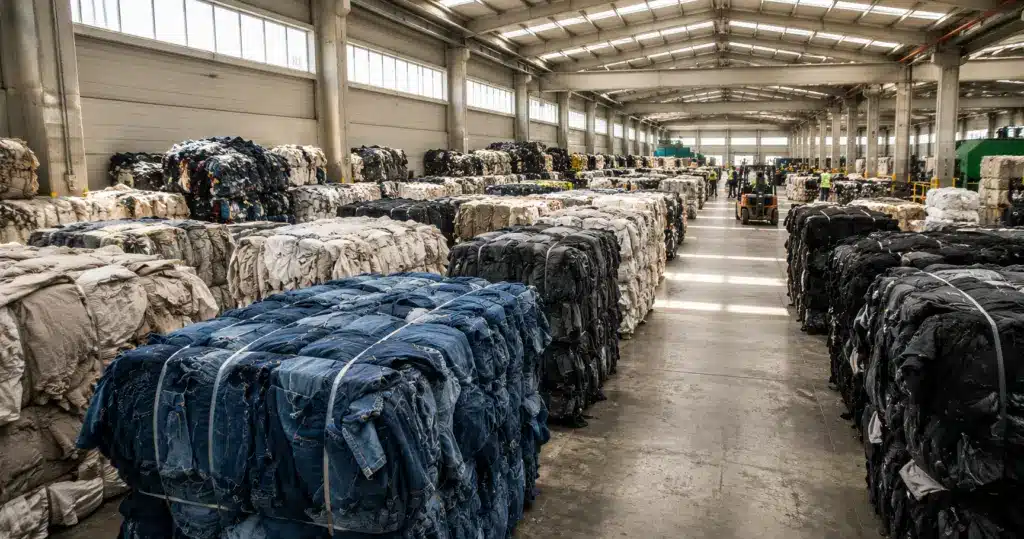
California SB 707 is the Responsible Textile Recovery Act of 2024, the first extended producer responsibility (EPR) law for textiles in the United States. It makes brands, importers, and retailers financially responsible for end-of-life collection, repair, and recycling. That responsibility attaches to any apparel and textile product they place on the California market. For fashion brands, SB 707 compliance is no longer a future item on a sustainability roadmap. Registration through the state’s approved program organization opened this year, and the first hard deadline for producers has already passed.
This guide covers what SB 707 actually requires, who counts as a “producer” under the law, and the compliance timeline brands are working against right now. It also covers where the underlying producer data already lives inside a connected PLM system.
What Is California SB 707?
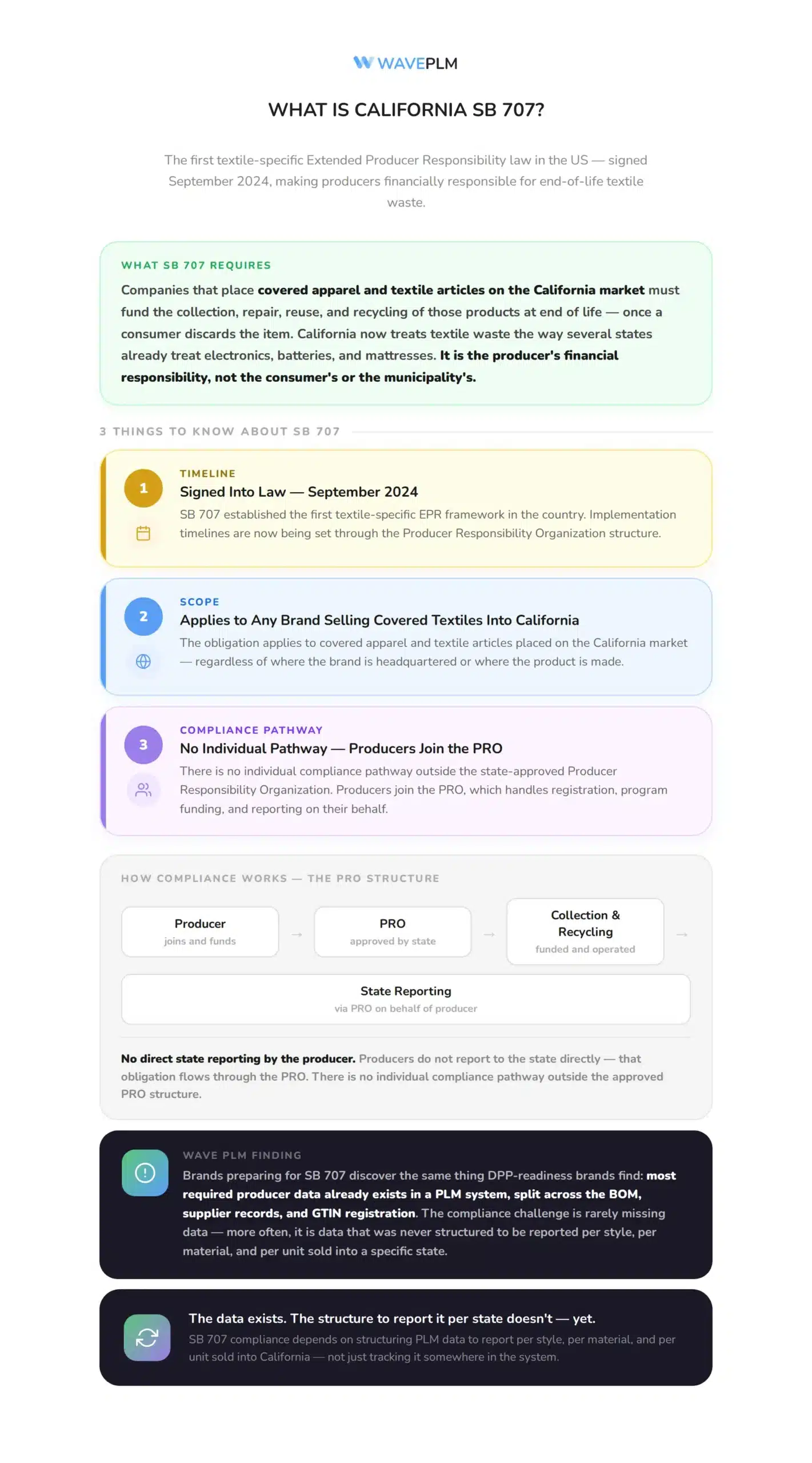
SB 707 requires companies that place covered apparel and textile articles on the California market to fund the collection, repair, reuse, and recycling of those products. Specifically, this obligation applies at end of life, once a consumer discards the item. Signed into law in September 2024, it established the first textile-specific EPR framework in the country. Consequently, California now treats end-of-life textile waste much like several states already treat electronics, batteries, and mattresses. It becomes the producer’s financial responsibility, not the consumer’s or the municipality’s.
The law works through a single, state-approved Producer Responsibility Organization, or PRO. Producers do not report to the state directly. Instead, they join the PRO, which handles registration, program funding, and reporting on their behalf. Notably, there is no individual compliance pathway outside the approved PRO.
Our finding: Wave PLM customers preparing for SB 707 tend to discover the same thing DPP-readiness brands find: most of the required producer data already exists somewhere in a PLM system, split across the BOM, supplier records, and GTIN registration. The compliance challenge is rarely missing data. More often, it is data that was never structured to be reported per style, per material, and per unit sold into a specific state.
Who Counts as a “Producer” Under SB 707?
SB 707 defines “producer” through a cascading chain of responsibility. The manufacturer holds the obligation first. If the manufacturer has no presence in California, responsibility shifts to its exclusive licensee. If neither has a California presence, it shifts again, this time to the product importer. Finally, if none of those three are in the state, the distributor, retailer, or wholesaler becomes the responsible party.
Two details catch brands off guard most often. First, having no physical California presence does not create an exemption. The law explicitly covers e-commerce and direct-to-consumer sales shipped into the state, regardless of where the brand is headquartered. Second, SB 707 exempts secondhand sellers and any company with less than one million dollars in annual aggregate global turnover. That threshold is global revenue, not California revenue specifically, so a small brand with modest California sales but strong revenue elsewhere still falls inside SB 707’s scope.
What Are the Key SB 707 Compliance Deadlines?
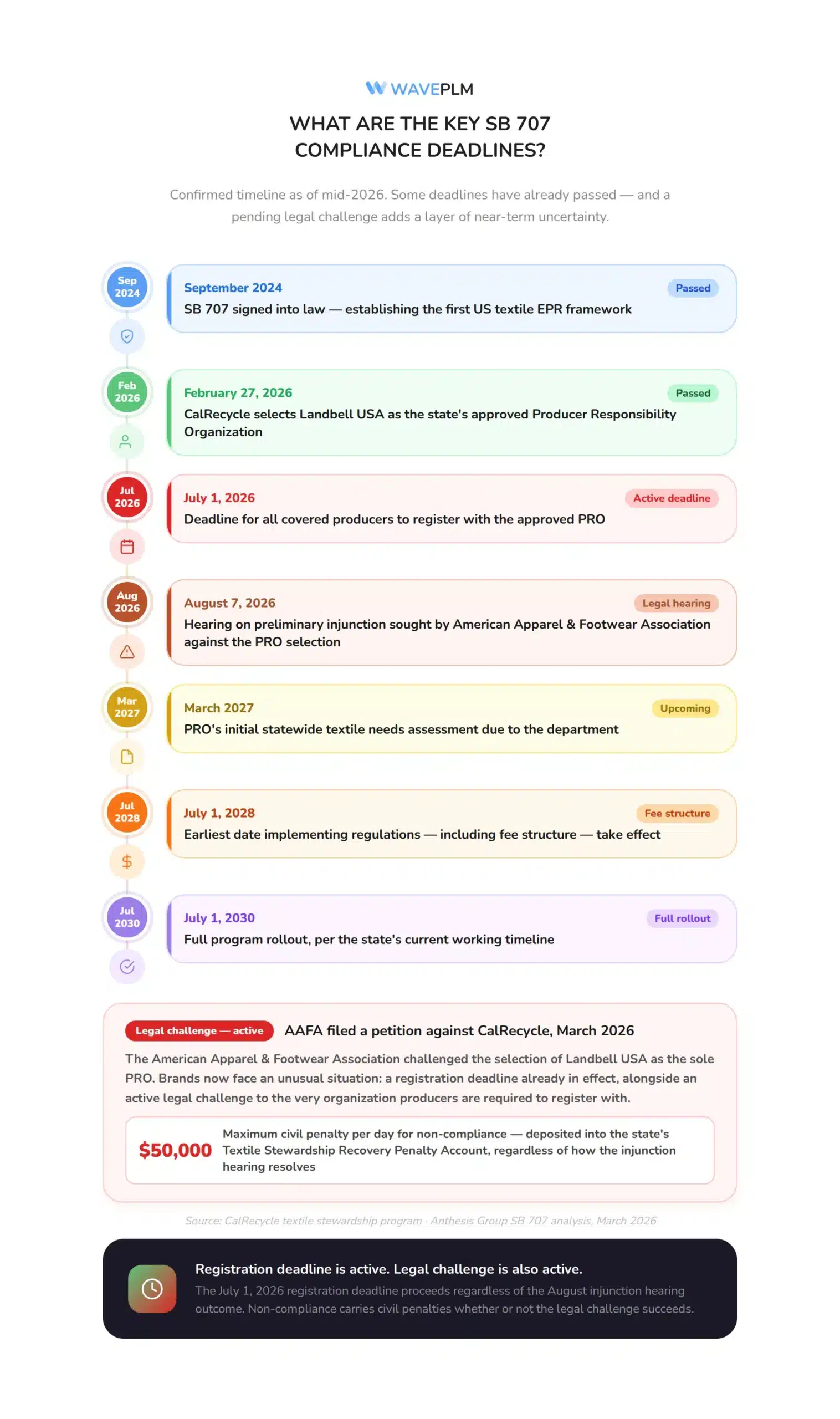
The table below maps the confirmed timeline as of mid-2026. Some deadlines have already passed, and a pending legal challenge adds a layer of near-term uncertainty.
| Date | Milestone |
|---|---|
| September 2024 | SB 707 signed into law, establishing the first US textile EPR framework |
| February 27, 2026 | CalRecycle selects Landbell USA as the state’s approved Producer Responsibility Organization |
| July 1, 2026 | Deadline for all covered producers to register with the approved PRO |
| August 7, 2026 | Hearing date for a preliminary injunction sought by the American Apparel & Footwear Association against the PRO selection |
| March 2027 | PRO’s initial statewide textile needs assessment due to the department |
| July 1, 2028 | Earliest date implementing regulations, including fee structure, take effect |
| July 1, 2030 | Full program rollout, per the state’s current working timeline |
Source: CalRecycle textile stewardship program; Anthesis Group SB 707 analysis, March 2026.
Industry data: The American Apparel & Footwear Association filed a legal petition against CalRecycle in March 2026, challenging its selection of Landbell USA as the sole PRO. As a result, brands face a genuinely unusual situation: a registration deadline already in effect, alongside an active legal challenge to the very organization producers are required to register with. Non-compliance still carries civil penalties of up to $50,000 per day, deposited into the state’s Textile Stewardship Recovery Penalty Account, regardless of how the injunction hearing resolves.
What Data Will Producers Need to Track?
California has not finalized detailed reporting rules yet. That said, based on the law’s text and the PRO’s initial planning work, producers should expect to track three categories of data. These are the total units or weight of covered products placed on the California market, and the product category, such as apparel, footwear, or home textiles. The third is material composition down to fiber type, including blended fabrics.
Fee structure is not final either, but it is expected to follow an eco-modulation model similar to Europe’s approach. In other words, producers using mono-material, more recyclable, or higher-recycled-content fabrics will likely pay lower per-unit fees than producers using blended, harder-to-recycle materials. This creates a direct incentive to track fiber composition accurately at the style level, well before the fee structure becomes final.
How Is SB 707 Different from the EU Digital Product Passport?
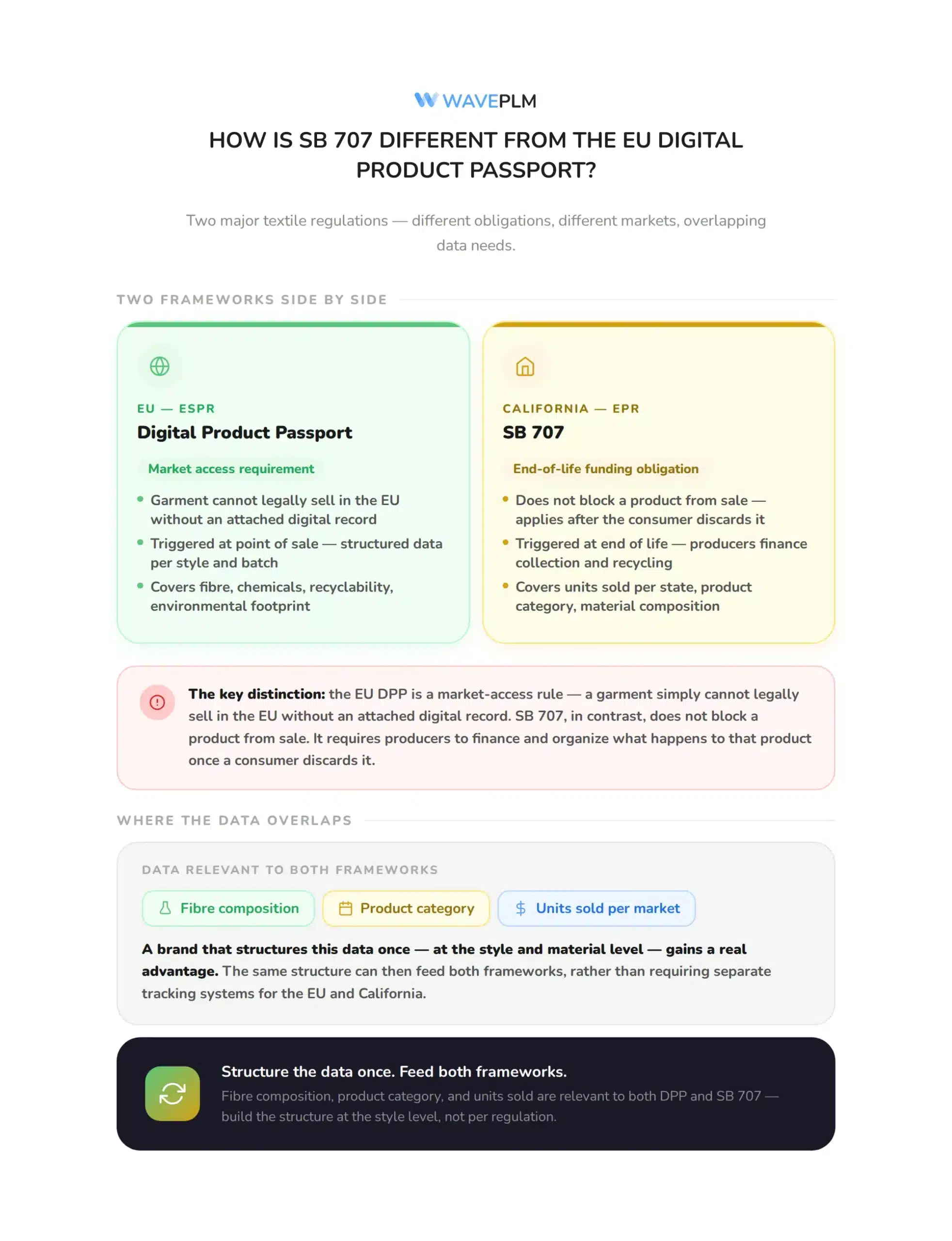
It helps to place SB 707 next to the other major textile regulation brands are already tracking. Our guide to the EU Digital Product Passport covers a market-access requirement instead. A garment simply cannot legally sell in the EU once its category falls under the rule, without an attached digital record. SB 707, in contrast, is an end-of-life funding and recycling obligation. It does not block a product from sale. Instead, it requires producers to finance and organize what happens to that product once a consumer discards it.
The two regulations do share overlapping data needs, however. Fibre composition, product category, and units sold are relevant to both a DPP record and an SB 707 report. A brand that structures this data once, at the style and material level, gains a real advantage. That same structure can then feed both frameworks, rather than requiring separate tracking systems for the EU and California.
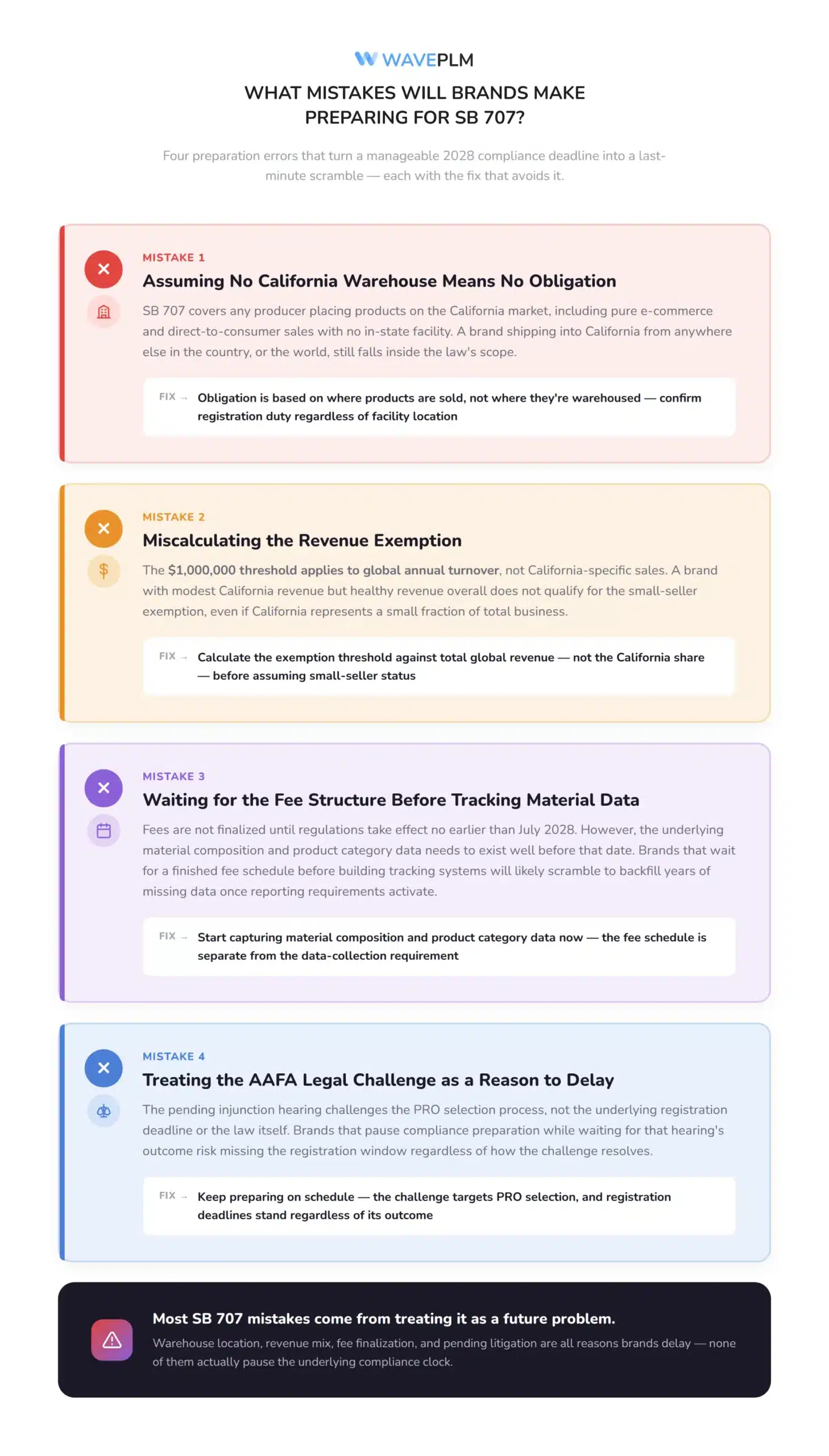
What Mistakes Will Brands Make Preparing for SB 707?
Assuming No California Warehouse Means No Obligation
SB 707 covers any producer placing products on the California market, including pure e-commerce and direct-to-consumer sales with no in-state facility. A brand shipping into California from anywhere else in the country, or the world, still falls inside the law’s scope.
Miscalculating the Revenue Exemption
The $1,000,000 threshold applies to global annual turnover, not California-specific sales. A brand with modest California revenue but healthy revenue overall does not qualify for the small-seller exemption, even if California represents a small fraction of total business.
Waiting for the Fee Structure Before Tracking Material Data
Fees are not finalized until regulations take effect no earlier than July 2028. However, the underlying material composition and product category data needs to exist well before that date. Brands that wait for a finished fee schedule before building tracking systems will likely scramble to backfill years of missing data once reporting requirements activate.
Treating the AAFA Legal Challenge as a Reason to Delay
The pending injunction hearing challenges the PRO selection process, not the underlying registration deadline or the law itself. Brands that pause compliance preparation while waiting for that hearing’s outcome risk missing the registration window regardless of how the challenge resolves.
What Should Brands Check First for SB 707 Readiness?
Beyond the deadline table above, a few practical checks separate genuine readiness from a false sense of security. First, confirm registration status directly with Landbell USA, rather than assuming a parent company or licensing partner already handled it. Second, pull a sample of current fiber composition records and check whether they specify exact blend ratios, not just a general fabric type. A tag that reads “cotton blend” will not satisfy future reporting requirements the way a specific “60% cotton, 40% polyester” record will. Third, map which styles actually ship into California specifically. Reporting will eventually need to be traceable to that market, rather than reported only at a company-wide level.
How Does Wave PLM Support SB 707 Readiness?
Wave PLM already structures the product and material data SB 707 reporting is likely to require. Fibre composition and blend ratios live in the multi-level BOM, tied to the same component records used for costing. Product category and unit-level identification follow the same GS1 and GTIN records brands already maintain for retail readiness. This data sits at the style and component level, not scattered across spreadsheets. As a result, brands preparing for SB 707 reporting can pull from the same structured source they already use for garment costing and DPP readiness.
Frequently Asked Questions
What is California SB 707?
California SB 707, the Responsible Textile Recovery Act of 2024, is the first US extended producer responsibility law for textiles. It requires producers of covered apparel and textile products to fund and organize collection, repair, and recycling at end of life.
Who has to register for SB 707 compliance?
Manufacturers, or their exclusive licensee, importer, distributor, retailer, or wholesaler in a cascading chain of responsibility, depending on who has a California presence. E-commerce and direct-to-consumer sellers shipping into California are covered even without a physical location in the state.
When was the SB 707 producer registration deadline?
Producers were required to register with the approved Producer Responsibility Organization, Landbell USA, by July 1, 2026. CalRecycle selected Landbell USA on February 27, 2026.
Are small brands exempt from SB 707?
SB 707 exempts secondhand sellers and companies with less than one million dollars in annual aggregate global turnover. That threshold applies to total global revenue, not revenue generated in California specifically.
What is the penalty for SB 707 non-compliance?
Non-compliance carries civil penalties of up to $50,000 per day. Penalty funds are deposited into California’s Textile Stewardship Recovery Penalty Account.
Is SB 707 the same as the EU Digital Product Passport?
No. SB 707 is an end-of-life recycling and collection funding obligation in California. The EU Digital Product Passport is a market-access requirement tied to a scannable product record. They share overlapping data needs, such as fibre composition, but address different regulatory goals.
Is the SB 707 PRO selection still being challenged?
Yes. The American Apparel & Footwear Association filed a legal petition against CalRecycle’s selection of Landbell USA in March 2026. A preliminary injunction hearing is scheduled for August 7, 2026, though the underlying registration deadline has already passed.
Whether a brand needs to act on SB 707 right now comes down to one question: has it already registered with Landbell USA, the state’s approved PRO? The July 1 deadline has passed, and the fee structure is still years from final. Even so, the material composition and unit-level data SB 707 will eventually require takes real time to assemble from scratch. Brands preparing for the EU Digital Product Passport are already learning that same lesson. Talk to the Wave PLM team about what SB 707 and DPP readiness actually looks like for a brand your size.







Leave a Reply