
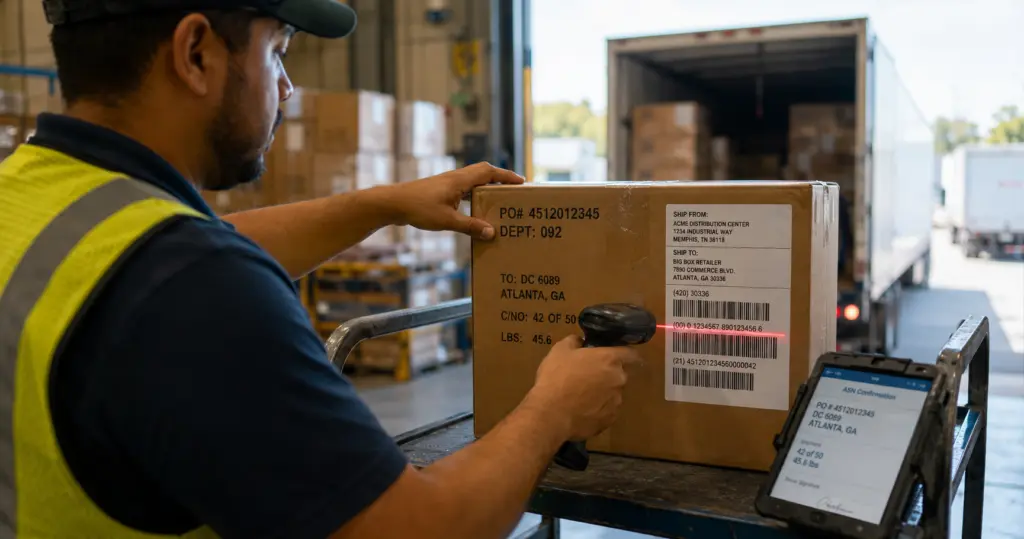
Retail chargebacks are fees a retailer deducts directly from a vendor’s payment when a shipment fails to meet the retailer’s vendor compliance manual. For fashion brands selling wholesale, vendor compliance covers the specific rules around EDI documents, carton labeling, and shipment routing that each retailer sets. Get any one of those wrong, and the retailer simply subtracts the fee from what it pays. The brand ships the order either way. It just gets paid less for it.
This guide covers what actually triggers the most common retail chargebacks. It also walks through how the EDI document chain works between a brand and a retailer. Finally, it covers where brands most often lose money to fees that a cleaner process would have avoided entirely.
What Is Vendor Compliance in Retail?
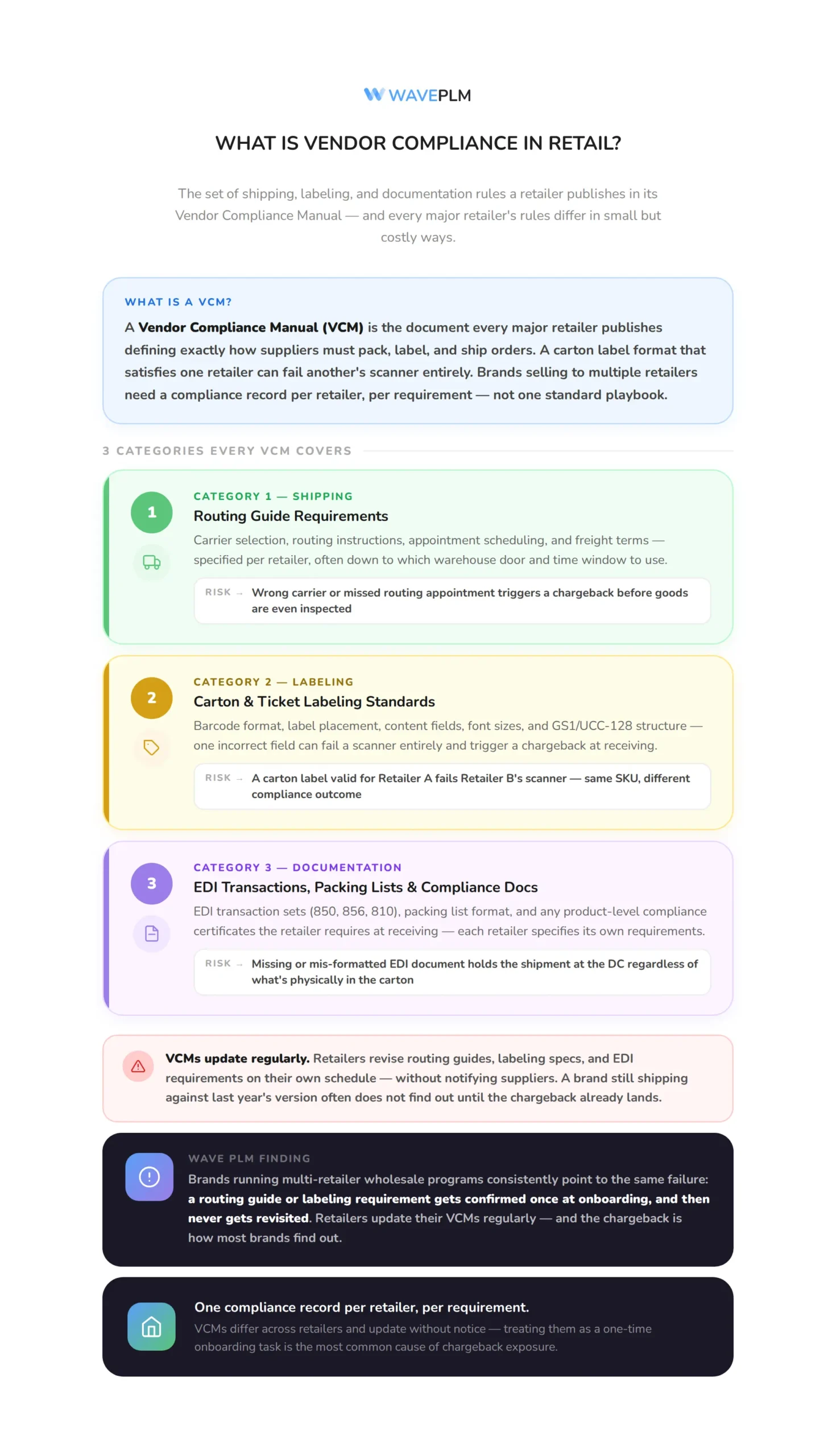
Vendor compliance is the set of shipping, labeling, and documentation rules a retailer publishes in its vendor compliance manual, often shortened to VCM. Every major retailer maintains one, and each retailer’s rules differ in small but costly ways. A carton label format that satisfies one retailer can fail another’s scanner entirely. As a result, brands selling to multiple retailers cannot simply follow one standard playbook. Instead, they need a compliance record per retailer, per requirement.
Our finding: Wave PLM customers running multi-retailer wholesale programs consistently point to the same failure pattern. A routing guide or labeling requirement gets confirmed once, during onboarding, and then never gets revisited. Retailers update their VCMs regularly, however, and a brand still shipping against last year’s routing guide often does not find out until the chargeback already lands.
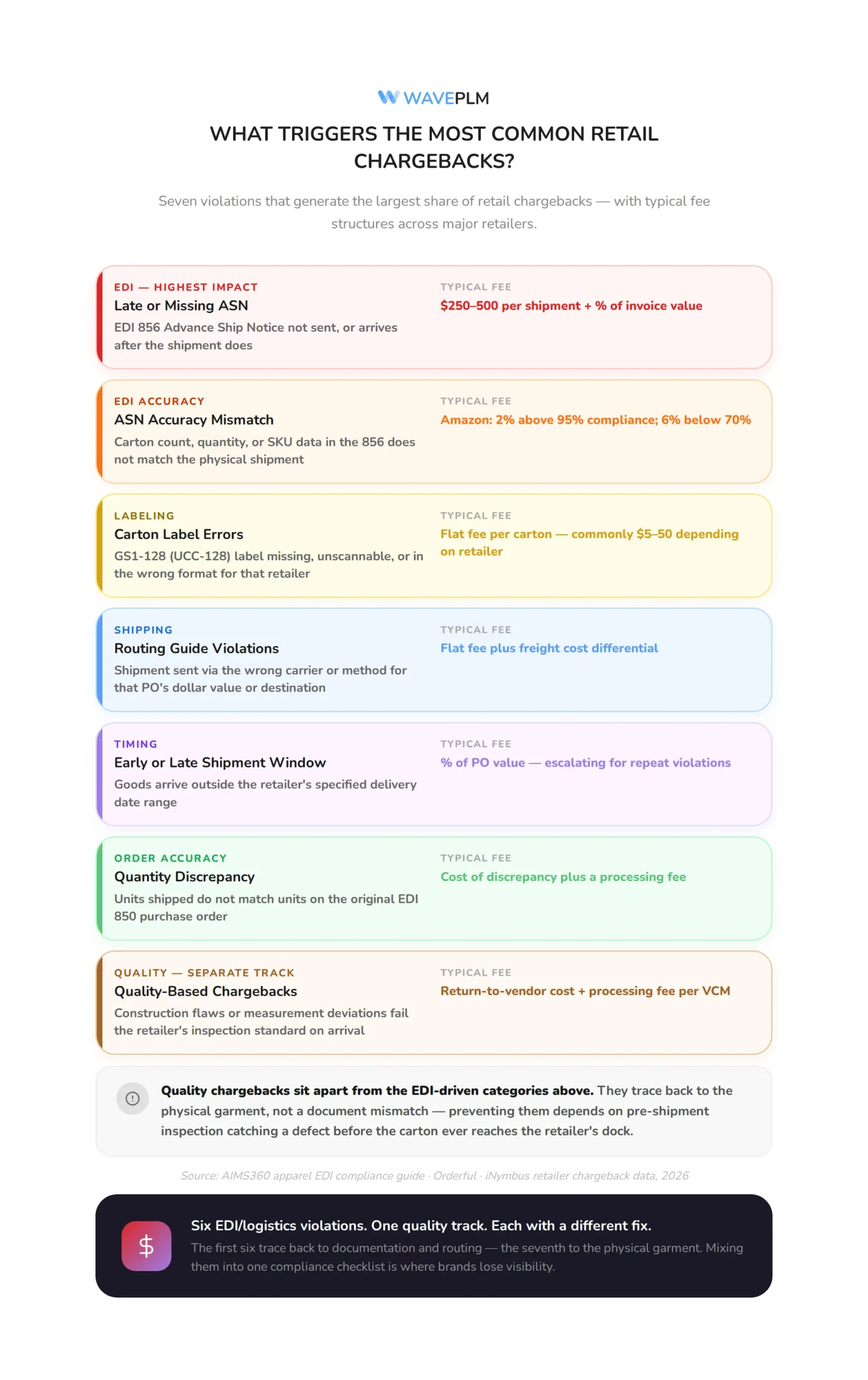
What Triggers the Most Common Retail Chargebacks?
The table below maps the violations that generate the largest share of retail chargebacks across major retailers.
| Violation | What goes wrong | Typical fee structure |
|---|---|---|
| Late or missing ASN | The EDI 856 Advance Ship Notice is not sent, or arrives after the shipment does | Commonly $250–500 per shipment, plus a percentage of invoice value |
| ASN accuracy mismatch | Carton count, quantity, or SKU data in the 856 does not match the physical shipment | Amazon: 2% of product cost above 95% compliance, rising to 6% below 70% |
| Carton label errors | GS1-128 (UCC-128) label missing, unscannable, or in the wrong format for that retailer | Flat fee per carton, commonly $5–50 depending on retailer |
| Routing guide violations | Shipment sent via the wrong carrier or method for that PO’s dollar value or destination | Flat fee plus freight cost differential |
| Early or late shipment window | Goods arrive outside the retailer’s specified delivery date range | Percentage of PO value, escalating for repeat violations |
| Quantity discrepancy | Units shipped do not match units on the original EDI 850 purchase order | Cost of the discrepancy plus a processing fee |
| Quality-based chargebacks | Garment construction flaws or measurement deviations fail the retailer’s inspection standard on arrival | Return-to-vendor cost plus a processing fee, per the retailer’s vendor compliance manual |
Source: AIMS360 apparel EDI compliance guide; Orderful; iNymbus retailer chargeback data, 2026.
Notice that quality-based chargebacks sit apart from the EDI-driven categories above. They trace back to the physical garment, not a document mismatch. As a result, preventing them depends on pre-shipment inspection data catching a defect before the carton ever reaches the retailer’s dock, rather than on cleaner EDI formatting.
How Do Chargeback Fees Vary by Retailer?
Industry data: Fee structures vary sharply by retailer. Nordstrom charges $5 per EDI error and $25 per paper invoice under its expense offset program. CVS Health’s February 2026 supplemental guide sets ASN errors at $50 per purchase order. Amazon scales its ASN accuracy chargeback by compliance rate: 2% of product cost above 95% compliance, 4% between 70 and 95%, and 6% below 70%. In other words, a brand with a poor compliance history pays a materially higher rate on every future shipment, not just the flagged one.
How Does the EDI Document Chain Actually Work?
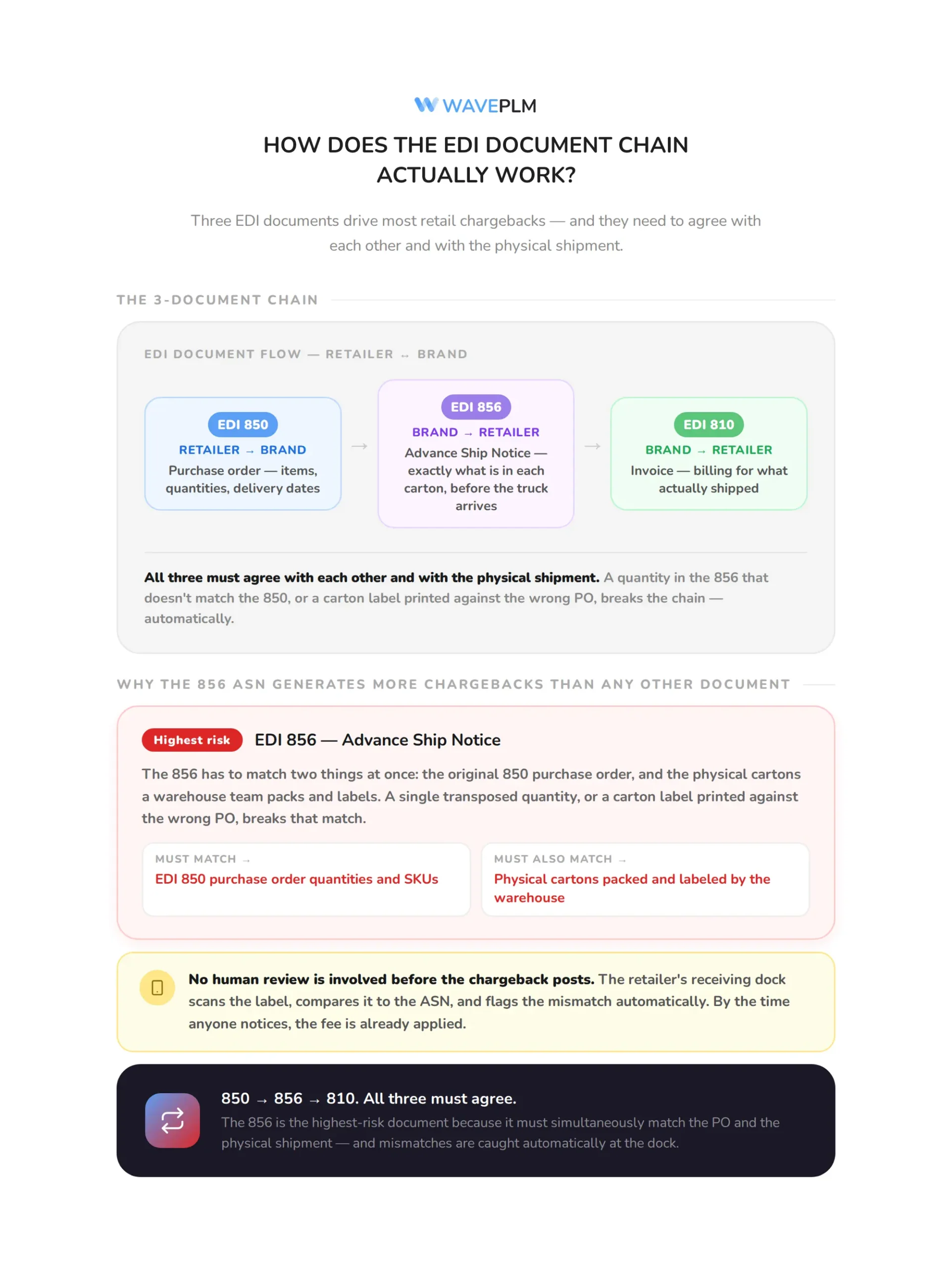
Three EDI documents drive most retail chargebacks, and they need to agree with each other and with the physical shipment. The retailer sends an EDI 850, the purchase order, specifying items, quantities, and delivery dates. The brand ships the order and sends an EDI 856, the Advance Ship Notice, describing exactly what is in each carton before the truck arrives. Finally, the brand sends an EDI 810, the invoice, billing for what actually shipped.
ASN errors generate more retail chargebacks than any other document in this chain. That is because the 856 has to match two things at once: the original 850 purchase order, and the physical cartons a warehouse team packs and labels. A single transposed quantity, or a carton label printed against the wrong PO, breaks that match. The retailer’s receiving dock scans the label, compares it to the ASN, and flags the mismatch automatically. No human review is typically involved before the chargeback posts.
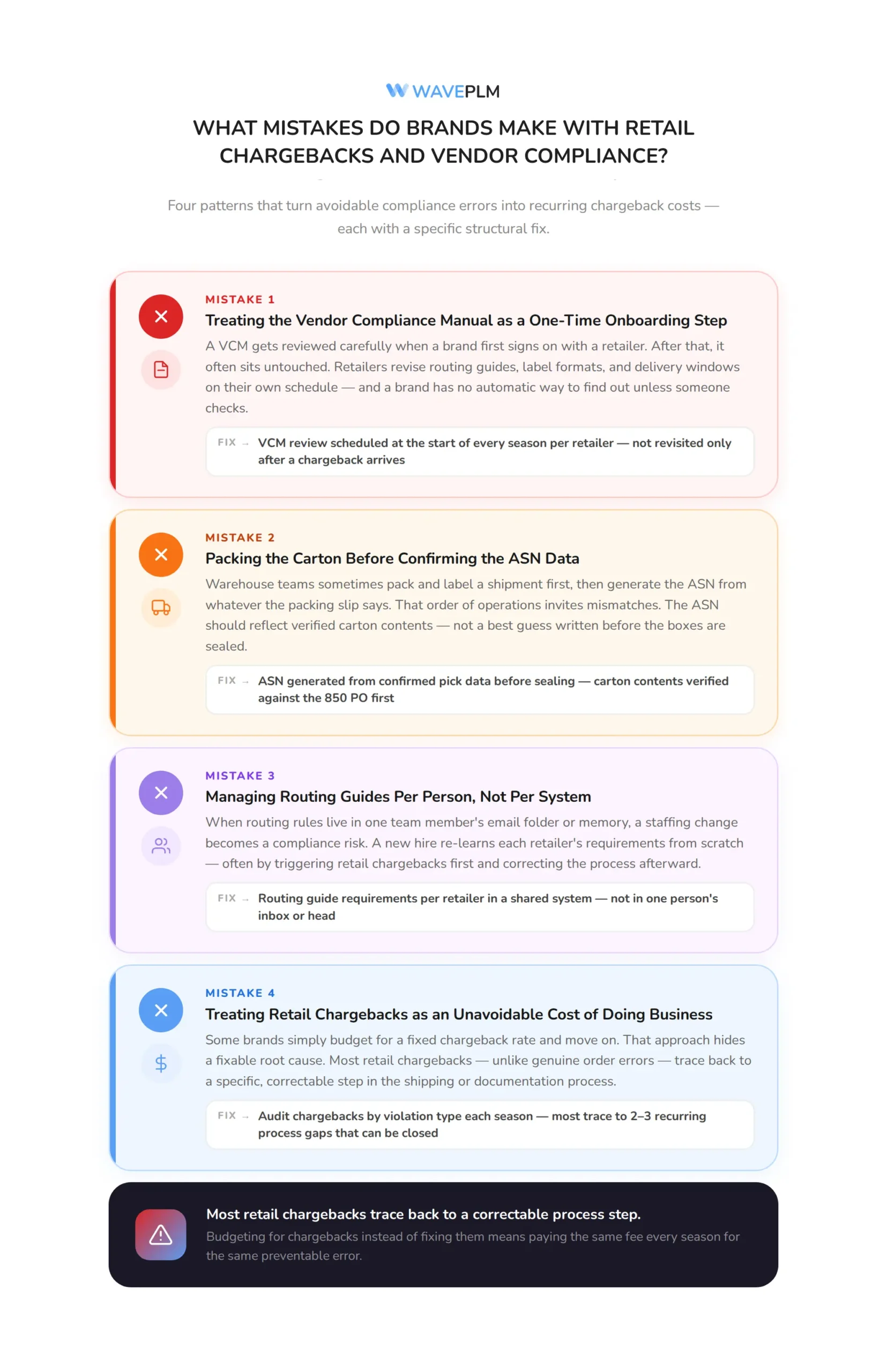
What Mistakes Do Brands Make With Retail Chargebacks and Vendor Compliance?
Treating the Vendor Compliance Manual as a One-Time Onboarding Step
A VCM gets reviewed carefully when a brand first signs on with a retailer. After that, it often sits untouched. Retailers revise routing guides, label formats, and delivery windows on their own schedule, however, and a brand has no automatic way to find out unless someone checks.
Packing the Carton Before Confirming the ASN Data
Warehouse teams sometimes pack and label a shipment first, then generate the ASN from whatever the packing slip says. That order of operations invites mismatches. The ASN should reflect verified carton contents, not a best guess written before the boxes are sealed.
Managing Routing Guides Per Person, Not Per System
When routing rules live in one team member’s email folder or memory, a staffing change becomes a compliance risk. A new hire re-learns each retailer’s requirements from scratch, often by triggering retail chargebacks first and correcting the process afterward.
Treating Retail Chargebacks as an Unavoidable Cost of Doing Business
Some brands simply budget for a fixed rate of retail chargebacks and move on. That approach hides a fixable root cause. Most retail chargebacks, unlike genuine order errors, trace back to a specific, correctable step in the shipping process.
What Should Brands Set Up When Onboarding a New Retail Account?
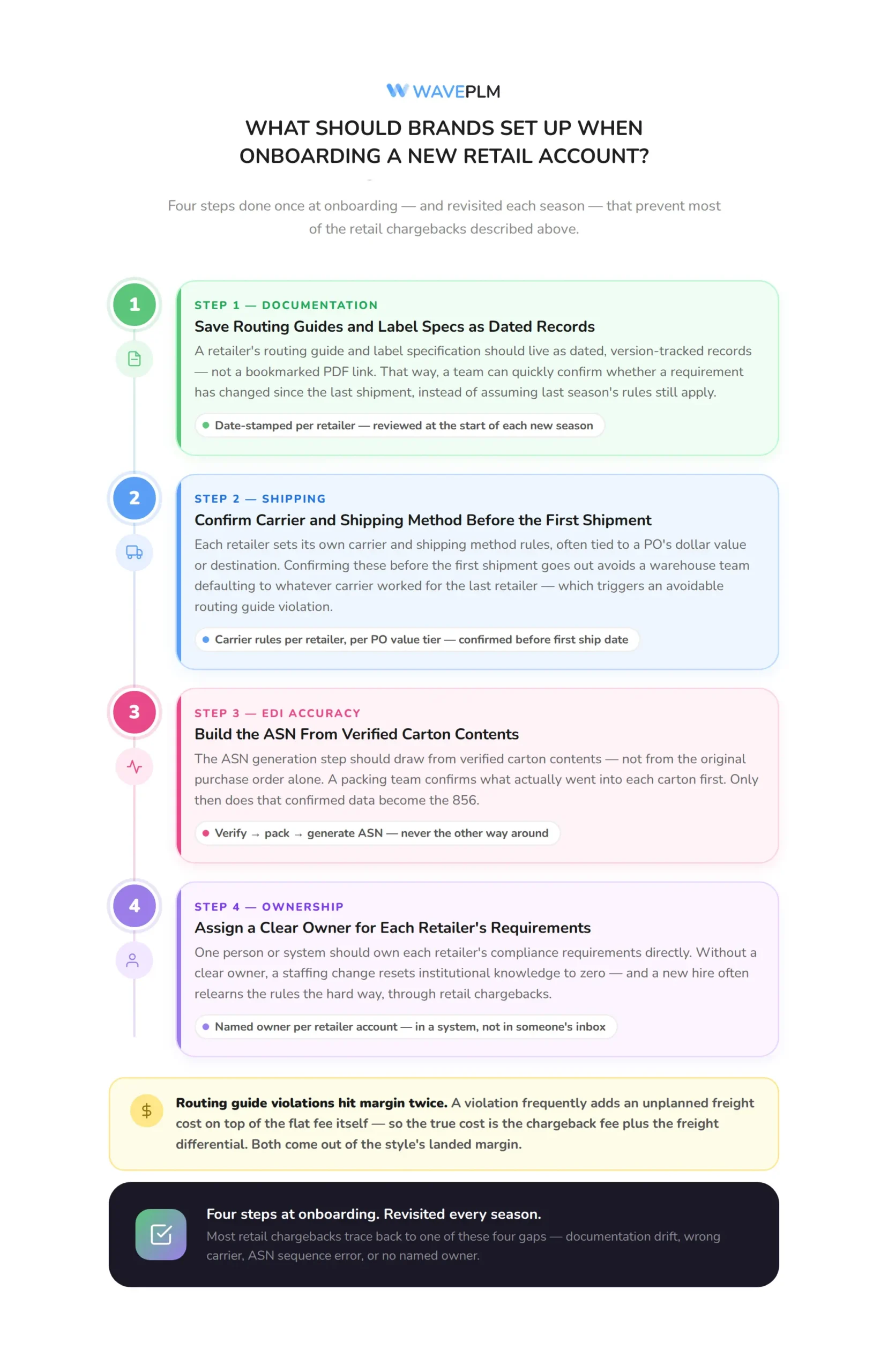
A few concrete steps, done once at onboarding and revisited each season, prevent most of the retail chargebacks described above.
Save Routing Guides and Label Specs as Dated Records
Specifically, a retailer’s routing guide and label specification should live as dated, version-tracked records, not just a bookmarked PDF link. That way, a team can quickly confirm whether a requirement has changed since the last shipment, instead of assuming last season’s rules still apply.
Confirm Carrier and Shipping Method Before the First Shipment
Additionally, each retailer sets its own carrier and shipping method rules, often tied to a PO’s dollar value or destination. Confirming these details before the first shipment goes out matters. Otherwise, a warehouse team may default to whatever carrier worked for the last retailer, which can trigger an avoidable routing guide violation.
Build the ASN From Verified Carton Contents
Similarly, the ASN generation step should draw from verified carton contents, not from the original purchase order alone. A packing team needs to confirm what actually went into each carton first. Only then should that confirmed data become the 856.
Assign a Clear Owner for Each Retailer’s Requirements
One person or system should own each retailer’s compliance requirements directly. Without a clear owner, a single staffing change can reset institutional knowledge back to zero. Consequently, a new hire often relearns the rules the hard way, through retail chargebacks.
Freight and routing costs deserve their own line of attention here too. Notably, a routing guide violation frequently adds an unplanned freight cost on top of the flat fee itself. Our landed cost guide covers how freight and routing costs factor into a style’s true margin. That connection matters directly when a routing violation quietly erodes a margin that looked solid on paper.
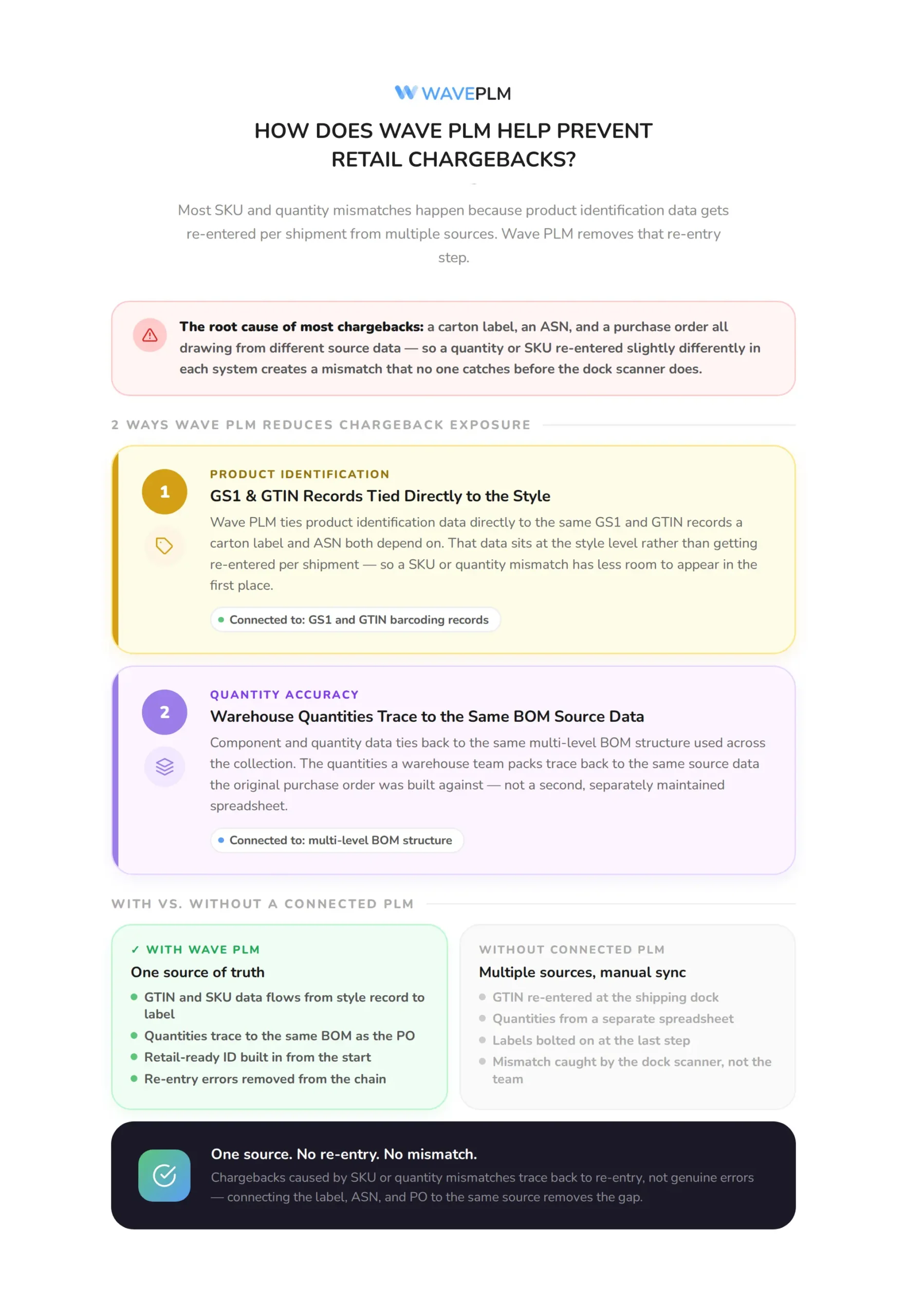
How Does Wave PLM Help Prevent Retail Chargebacks?
Wave PLM ties product identification data directly to the same GS1 and GTIN records a carton label and ASN both depend on. That data sits at the style level, rather than getting re-entered per shipment. Consequently, a SKU or quantity mismatch has less room to appear in the first place. This same structured approach follows the logic covered in our barcode guide for clothing brands. There, too, retail-ready identification gets built into the product record from the start, rather than bolted on at the shipping dock.
Component and quantity data, similarly, ties back to the same multi-level BOM structure used across a collection. As a result, the quantities a warehouse team packs trace back to the same source data. That source is the same one the original purchase order was built against, not a second, separately maintained spreadsheet.
Frequently Asked Questions
What are retail chargebacks?
Retail chargebacks are fees a retailer deducts from a vendor’s payment when a shipment violates its vendor compliance manual. Common triggers include late ASNs, carton label errors, and routing guide violations.
What is an ASN in retail vendor compliance?
An ASN, or Advance Ship Notice, is the EDI 856 document a vendor sends before a shipment arrives. It describes exact carton contents and quantities, and retailers compare it directly against the physical shipment at receiving.
How much do retail chargebacks typically cost?
Fees vary by retailer and violation type. Late or missing ASN fees commonly run $250 to $500 per shipment plus a percentage of invoice value, while some retailers charge flat per-error fees between $5 and $50.
What is a routing guide violation?
A routing guide violation happens when a vendor ships an order using a different carrier or shipping method than the retailer specifies. Typically, this applies to that purchase order’s dollar value or destination, and it results in a flat fee plus any freight cost difference.
Why do ASN errors cause more retail chargebacks than other EDI documents?
The ASN has to match both the original purchase order and the physical carton contents at once. A mismatch on either side gets caught automatically at the retailer’s receiving dock, generating retail chargebacks with no human review before they post.
Can vendor compliance chargebacks be avoided entirely?
Most chargeback categories trace back to a specific, correctable process step, such as generating the ASN before confirming carton contents. Brands that fix the root process typically reduce chargebacks significantly, though not necessarily to zero.
Most brands notice their chargeback problem on a deduction line in a retailer remittance report, well after the shipment has already gone out. By then, the fee is fixed and non-negotiable. The real leverage, instead, sits earlier: in whether the ASN, carton label, and routing choice were verified against current retailer requirements before the truck ever left the dock. That said, verification only works if the underlying product and shipment data was structured correctly from the start, not assembled under deadline pressure the night before a shipment. See how Wave PLM keeps retail-ready product data consistent from style setup through shipment.








Leave a Reply