

Fashion PLM implementation takes 6–14 weeks for most SMB apparel brands. That is significantly shorter than the 12–18 month enterprise rollouts cited for manufacturing or aerospace PLM. The shorter timeline is possible because fashion PLM solves a narrower problem set. It handles tech packs, BOMs, sample tracking, and vendor communication. It does not require CAD integrations, regulatory compliance trees, or factory floor automation. That said, 6–14 weeks is still a wide range. The difference between a 6-week go-live and a 14-week one is almost never the software. It is almost always the state of existing data, the availability of the internal team, and whether key decisions get made on time. This guide breaks down every phase of fashion PLM implementation and explains what causes delays at each one.
What Is Fashion PLM Implementation?
Fashion PLM implementation is the structured process of configuring a product lifecycle management system for an apparel brand’s specific workflow. It also includes migrating the team off their existing tools. Implementation is not simply installing software. It includes mapping how the brand’s product development process actually works, building templates that reflect that process, migrating historical data from spreadsheets and shared drives, training the team, and onboarding key vendors. A completed fashion PLM implementation means the team is running live seasons through the system. It does not mean running parallel processes as a safety net.
Fashion PLM implementation differs from enterprise PLM rollouts in scale and focus. SMB fashion brands — typically 10–200 employees managing 50–400 styles per season — need a system that handles design approvals, BOM management, and factory communication. They do not need the change-order workflows built for aerospace or automotive. As a result, cloud-based fashion PLM systems designed for SMBs can be configured and launched far faster than legacy enterprise platforms.
Our finding: Wave PLM customers who complete a structured data audit in their first week go live an average of 3 weeks earlier than those who begin migration without one. The audit reveals which spreadsheets are the actual source of truth — and which ones are duplicates no one has deleted.

How Long Does Fashion PLM Implementation Take?
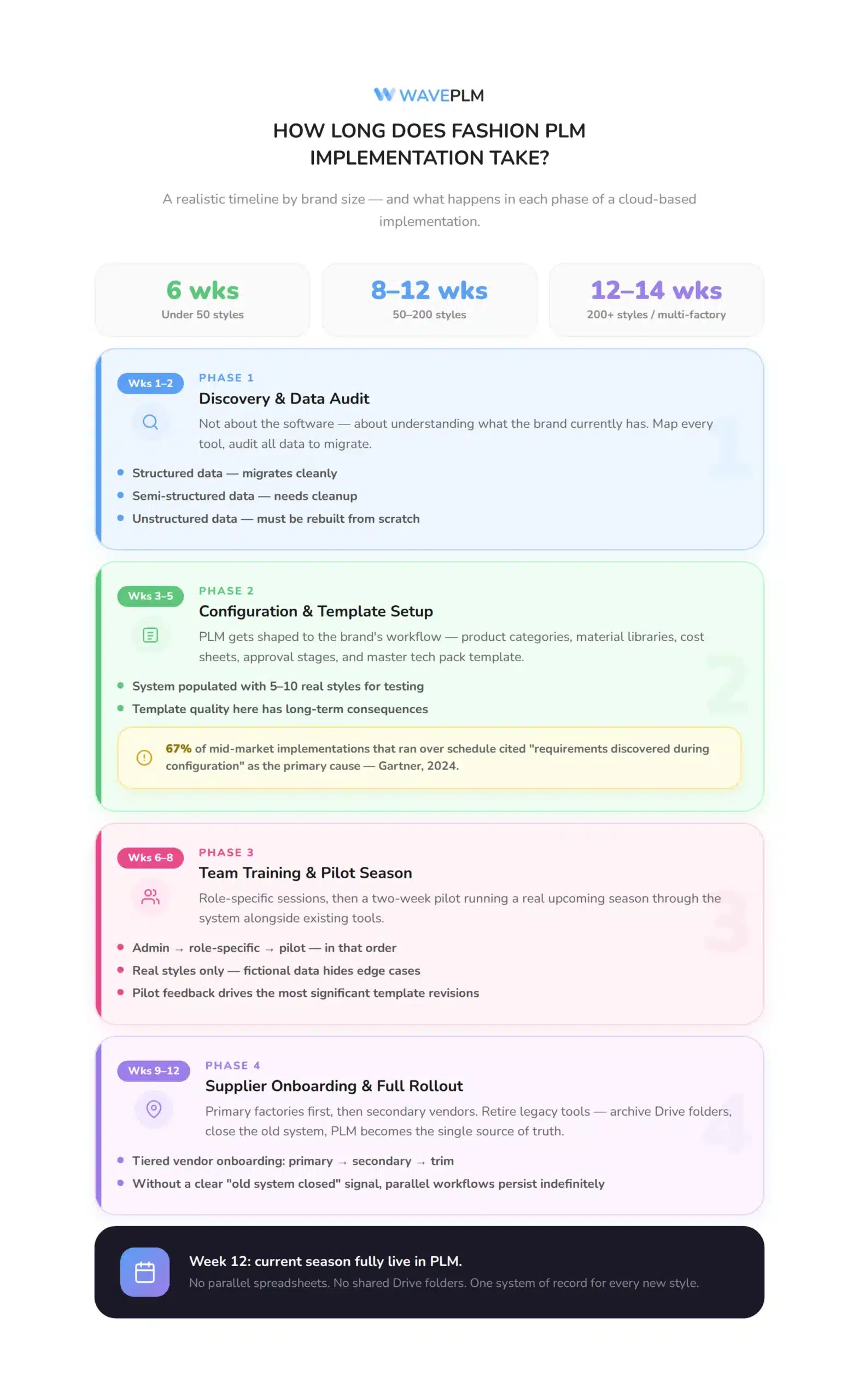
For a brand managing 50–200 styles per season with a team of 5–30 people, a realistic fashion PLM implementation runs 8–12 weeks. Smaller brands under 50 styles can often go live in 6 weeks. Brands above 200 styles or with complex multi-factory sourcing typically need 12–14 weeks. These figures assume a cloud-based fashion PLM platform. On-premise installations add 4–8 weeks for infrastructure setup alone.
The four phases below reflect how a typical SMB fashion PLM implementation runs at Wave PLM. Other cloud platforms follow a similar structure, though phase names and tooling differ.
Phase 1 — Discovery and Data Audit (Weeks 1–2)
The first two weeks are not about the software. They are about understanding what the brand currently has. The implementation team maps every tool in the current development workflow. Where do tech packs live? Who has edit access? How are BOMs versioned? What does a sample approval look like today, and where is it tracked?
Simultaneously, the team audits the data to be migrated. Most brands find three categories. First, structured data that migrates cleanly — finished tech packs in a standard format. Second, semi-structured data that needs cleanup — spreadsheets with inconsistent column names or merged cells. Third, unstructured data that must be rebuilt — specs that only exist as PDF annotations or email threads. Knowing the ratio of these three categories determines how much migration work lies ahead. Furthermore, this phase establishes the brand’s naming conventions. Style codes, colorway naming, and size range structures become the backbone of how PLM organizes every record going forward.
Phase 2 — Configuration and Template Setup (Weeks 3–5)
Phase 2 is where the PLM system gets shaped to the brand’s workflow. The vendor’s onboarding team configures the platform with the brand’s specific attributes: product categories, material libraries, cost sheet structures, approval stages, and user roles. For most fashion brands, this phase also involves building the master tech pack template. That template is the standard structure every new style will start from.
Template quality at this stage has long-term consequences. Specifically, a template that matches how the brand’s factories receive information significantly reduces back-and-forth about format. For brands that sell to wholesale accounts, additionally building a line sheet export at this stage saves time every season. By the end of Phase 2, the system should be configured and populated with 5–10 sample styles from a recent collection. That gives the team real work to test against, not placeholder data.
Industry data: According to a 2024 Gartner report on digital transformation in consumer industries, 67% of mid-market software implementations that exceeded their planned timeline cited “requirements discovered during configuration” as the primary delay cause. The fashion PLM equivalent is template revision — brands often realize mid-configuration that their size-run structure is more complex than initially described.
Phase 3 — Team Training and Pilot Season (Weeks 6–8)
Training in a fashion PLM implementation is not a one-day event. It is a structured sequence. First, an admin-level session covering system configuration and user management. Then, role-specific sessions for designers, technical designers, merchandisers, and sourcing managers. Finally, a two-week pilot in which the team runs a real upcoming season through the system alongside their existing tools.
The pilot season is the most important part of the entire fashion PLM implementation. It surfaces every gap between the configured workflow and how the team actually works. Consequently, the feedback from weeks 7 and 8 drives the most significant template revisions. Teams that skip the pilot period and go directly to live use encounter the same gaps under deadline pressure. That is a far more damaging context for fixes. Running the pilot on a real season is also important for another reason. Fictional styles do not reveal the edge cases that real colorway expansions, trim substitutions, and grading corrections do.
Phase 4 — Supplier Onboarding and Full Rollout (Weeks 9–12)
The final phase of fashion PLM implementation shifts focus from the internal team to external partners. Vendor onboarding into PLM typically follows a tiered approach. Primary factories that receive tech packs most frequently onboard first. Secondary vendors and trim suppliers follow. For brands using a supplier portal, this phase involves training factory contacts to log in, retrieve current specs, and submit comments directly in the system rather than via email.
Full rollout also means retiring the legacy tools. Specifically, this means archiving the shared Drive folders and notifying the team that PLM is now the system of record. This transition is as much a communication exercise as a technical one. Without a clear “old system is closed” signal, teams often run parallel workflows indefinitely. That defeats the purpose of implementation. By week 12, the brand should be running its current season entirely in PLM, with no parallel spreadsheet tracking for new styles.
What Slows Down a Fashion PLM Implementation?
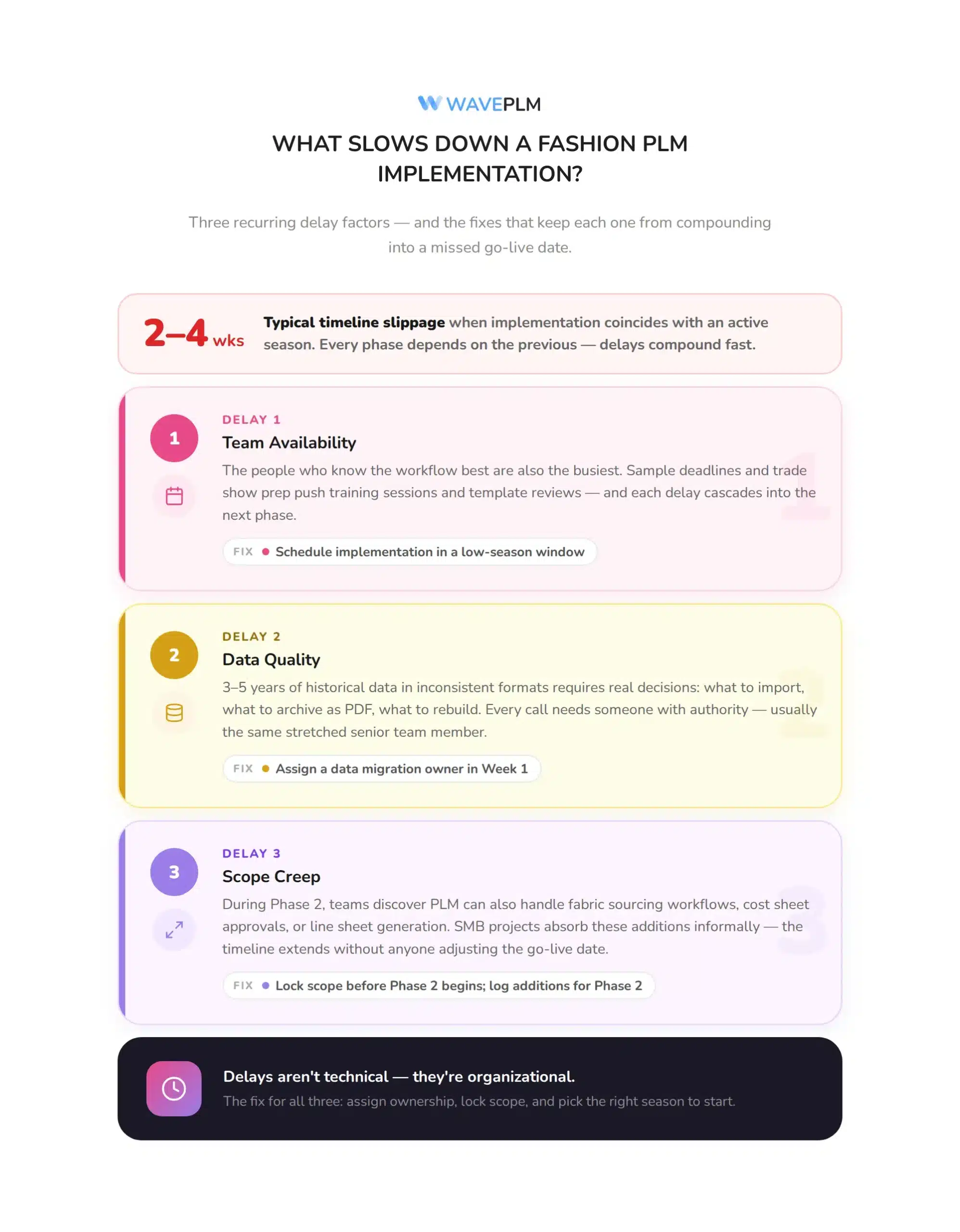
The most common delay in a fashion PLM implementation is not technical. It is availability. The team members who know the brand’s product development workflow best are also the busiest people during an active season. When implementation weeks coincide with sample deadlines or trade show prep, training sessions get rescheduled and template reviews are delayed. The cumulative effect is timeline slippage of 2–4 weeks. On a project where every phase depends on the previous one being complete, that compounds quickly.
Data quality is the second most common delay. Brands that have been operating for 3–5 years accumulate significant historical data in inconsistent formats. Migrating that data into PLM requires real decision-making. Which seasons to import? Which styles to leave as archived PDFs? Which records to rebuild from scratch? Additionally, every decision requires someone with authority over the brand’s product data. That person is typically the same senior team member already stretched during implementation. Establishing a clear data migration owner in week 1 significantly reduces this bottleneck.
A third delay factor is scope creep. Fashion PLM implementation projects frequently expand during Phase 2. Teams realize the system can also manage functions they hadn’t originally planned — fabric sourcing workflows, cost sheet approvals, or line sheet generation. In contrast to enterprise implementations with formal change-order processes, SMB projects often absorb these additions informally. Therefore, the timeline extends without anyone formally adjusting the go-live date.
How Many People Does a Fashion PLM Implementation Require?
A typical SMB fashion PLM implementation requires 2–4 people from the brand side, plus support from the vendor’s onboarding team. The brand-side team should include one project owner — often the head of product development or operations. It also needs one technical designer who will build and validate the master tech pack template. Finally, it needs one person with authority over vendor relationships who can drive supplier onboarding. For brands under 20 employees, these three roles are often filled by two people.
IT involvement is minimal for cloud-based fashion PLM. Typically it is 2–3 hours for SSO configuration and user provisioning if the brand uses Google Workspace or Microsoft 365. For brands implementing PLM alongside an ERP or inventory system, however, integration configuration requires additional technical resources. The PLM connector setup for ERP sync can add 2–4 weeks to the implementation timeline, depending on the ERP system involved.
What Does Fashion PLM Implementation Cost?
Fashion PLM implementation costs vary by vendor and by how much configuration and data migration support is included in the contract. Most cloud-based SMB fashion PLM vendors charge implementation fees in one of three models. A flat onboarding fee typically runs $2,000–$8,000 for SMBs. An hourly consulting rate for configuration work runs $150–$250/hr. Alternatively, some vendors include an implementation package bundled into the first year’s subscription.
The hidden cost of fashion PLM implementation is internal time. The 2–4 brand-side team members involved in implementation spend 5–15 hours per week on the project for 8–12 weeks. For a technical designer earning $75,000 per year, 10 hours per week over 10 weeks represents approximately $3,600 in internal labor. That is comparable to many vendor implementation fees. Planning for this internal time in the project budget prevents surprise strain on the team. For a fuller breakdown of what to expect across tiers, see the fashion PLM pricing guide.
How Do You Know When Fashion PLM Implementation Is Complete?
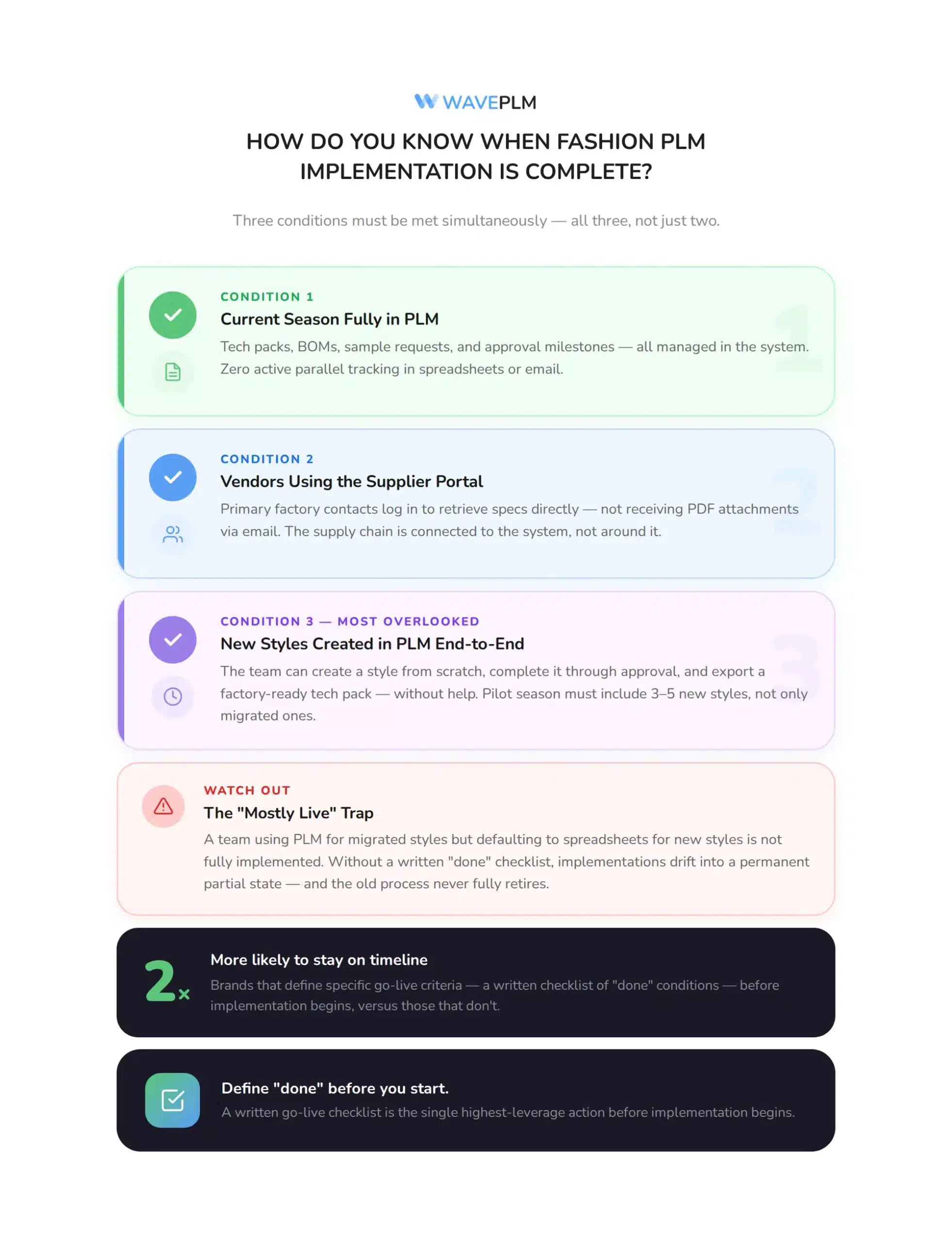
Fashion PLM implementation is complete when three conditions are met simultaneously. First, the entire current season is being managed in the system — tech packs, BOMs, sample requests, and approval milestones — with no active parallel tracking in spreadsheets or email. Second, the primary vendor contacts are logging into the supplier portal to retrieve specs rather than receiving PDF attachments via email. Third, the team can create a new style from scratch in PLM, complete it through approval, and generate a factory-ready tech pack without outside help.
That third condition is often overlooked. A team that successfully uses PLM for migrated styles — but still defaults to spreadsheets for any new style — is not fully implemented. Specifically, this pattern indicates that the new-style creation workflow is either too unfamiliar or too slow. Consequently, the pilot season in Phase 3 should include creating 3–5 styles from scratch, not only validating the migrated ones. Furthermore, measuring time to market for styles created in PLM versus the previous process gives the clearest signal that implementation has delivered its intended value.
Our finding: Wave PLM brands that define a specific go-live criteria — a written checklist of “done” conditions — before implementation begins are 2x more likely to stay on their original timeline. Without a definition of done, implementations drift into a permanent “mostly live” state where the system is used for some workflows but not others, and the old process never fully retires.
Frequently Asked Questions
How long does fashion PLM implementation take for a small apparel brand?
For a brand managing under 100 styles per season with a team of 5–15 people, fashion PLM implementation typically takes 6–8 weeks using a cloud-based platform. The main variables are data migration complexity and team availability during active season periods. Brands with well-organized existing tech packs in a consistent format go live faster than those migrating from scattered PDFs and email archives.
What are the phases of fashion PLM implementation?
Fashion PLM implementation typically runs in four phases. First is discovery and data audit in weeks 1–2. Second is system configuration and template setup in weeks 3–5. Third is team training and a pilot season in weeks 6–8. Fourth is supplier onboarding and full rollout in weeks 9–12. Each phase produces a concrete deliverable before the next phase begins.
Who should own the PLM implementation project at a fashion brand?
The implementation project owner should be someone with authority over product development decisions. This is typically the head of product development, VP of operations, or a senior technical designer. This person makes binding decisions about workflow design, naming conventions, and data migration scope. Without a single decision-maker, implementation slows whenever a configuration choice requires team consensus — which happens frequently during Phases 2 and 3.
What data do I need to prepare before fashion PLM implementation?
Before fashion PLM implementation begins, prepare four things. First, an inventory of where your current tech packs live — folder structure, file formats, and how many styles per season. Second, a list of active factory and vendor contacts who will need system access. Third, your standard size ranges per category. Fourth, your product category hierarchy — how you classify styles by category, collection, or season. You do not need everything perfectly organized before starting, as the discovery phase assesses your data. However, knowing roughly where everything lives reduces week 1 audit time significantly.
Can we implement PLM during an active season?
Yes, but with caveats. Fashion PLM implementation during an active season is possible, and many brands do it because there is no natural off-season window. The practical approach is to run the current season in the existing system while building and testing PLM with the next season’s styles. This means Phase 3’s pilot runs on a collection not yet under deadline pressure. Implementing PLM mid-season for a collection already in sampling is high risk and typically results in incomplete adoption.
What is the most common reason fashion PLM implementations fail?
The most common failure mode is adoption, not technology. Fashion PLM implementation fails most often when the system is configured and launched but the team continues using their old tools in parallel. This happens for three reasons. The PLM workflow is noticeably slower than the spreadsheet habit for common tasks. The team was not involved in template design and finds the system doesn’t match how they work. Or no one enforces the “PLM is the system of record” rule after go-live. The pilot season in Phase 3 is specifically designed to catch workflow friction before it becomes a post-launch problem.
How is fashion PLM implementation different from enterprise PLM implementation?
Fashion PLM implementation for SMB brands differs from enterprise PLM rollouts in three key ways. First, duration: 6–14 weeks versus 12–24 months. Second, team size: 2–4 people versus dedicated implementation squads. Third, scope: tech packs, BOMs, and vendor communication versus CAD integrations, engineering revision control, and manufacturing execution. Fashion PLM systems built for SMBs — like Wave PLM — include pre-built fashion-specific templates. Consequently, they eliminate the months of configuration that generic enterprise platforms require before they can handle a garment spec.
A realistic fashion PLM implementation timeline runs 8–12 weeks for most SMB apparel brands. The brands that land at the shorter end are not the ones with the simplest products. They are the ones that start with a data audit, assign a single project owner, and define in writing what “done” means before week 1. Additionally, they run a real-season pilot instead of skipping straight to go-live. That surfaces the workflow gaps that would otherwise appear mid-deadline. If you are evaluating PLM implementation strategies for your brand, the question is not whether 8 weeks is achievable — it almost always is. The question is whether your team has the availability to make it happen without running implementation alongside a peak sampling window.
To see how Wave PLM structures a fashion PLM implementation for brands at your scale, book a demo and we will walk through a realistic timeline for your collection size and team.





Leave a Reply