
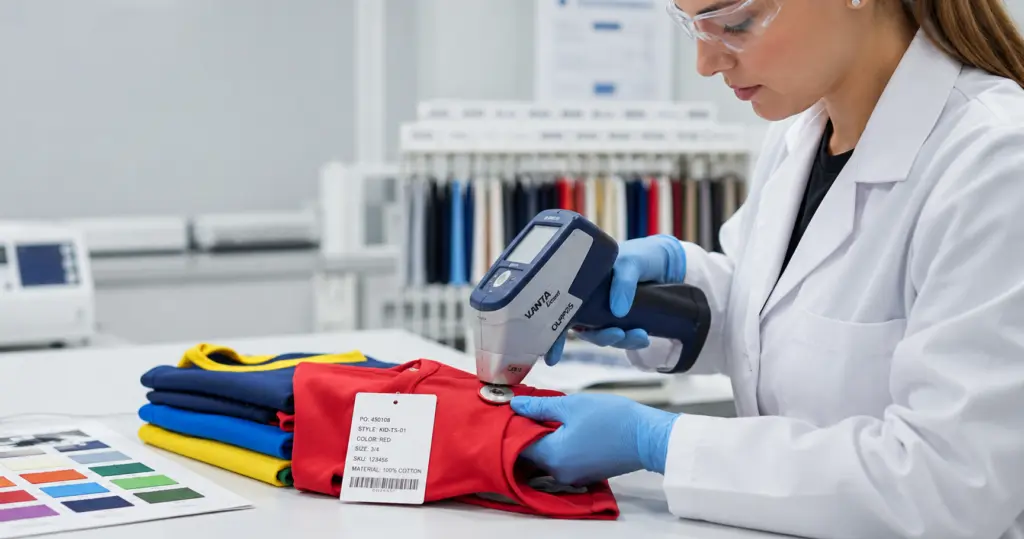
CPSIA compliance for children’s apparel means testing and certifying every style sold to kids 12 and under. Three federal requirements apply: total lead content, restricted phthalates in accessible plastic components, and, for sleepwear specifically, flammability performance. A general restricted substances check applies across an entire product line, regardless of age group. CPSIA testing works differently — it ties directly to a garment’s intended age range. Before a style can legally ship into the US market, it also needs a Children’s Product Certificate (CPC). That certificate documents results from a CPSC-accepted third-party lab.
For brands running adult and children’s categories side by side, the harder problem is rarely knowing that CPSIA exists. Instead, teams struggle to track exactly which components on a kids’ style fall inside its scope. A single snap, zipper pull, or screen-printed graphic can trigger a phthalate test on its own. This holds true even when the base fabric passes comfortably. That distinction gets lost quickly once a trim or print changes mid-season.
This guide covers what CPSIA actually requires for apparel. It walks through the numeric thresholds that separate a compliant style from a recalled one. Finally, it covers where brands most often lose track of test data. This typically happens once a supplier, trim, or print changes after the original certificate.
What Is CPSIA Compliance for Children’s Apparel?
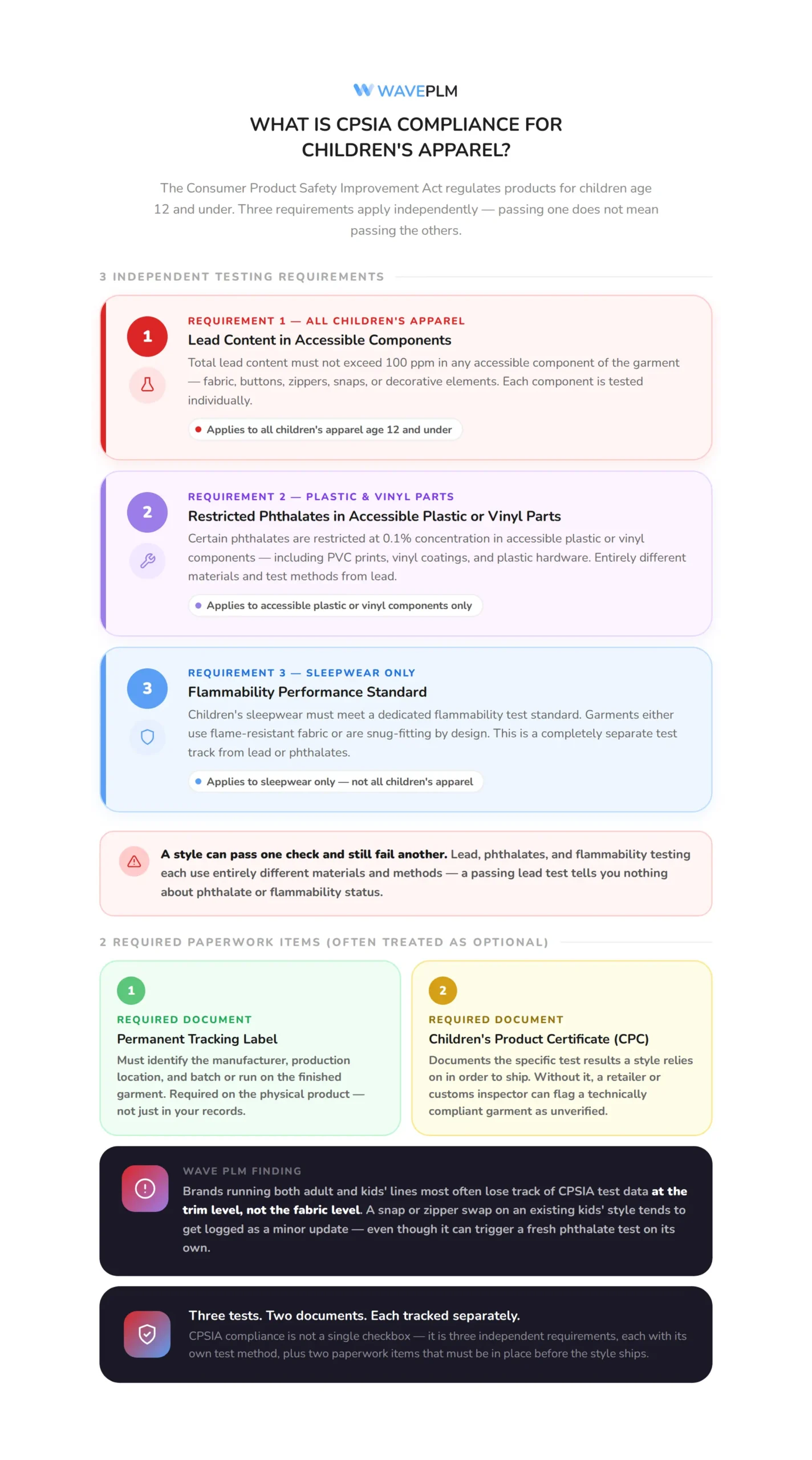
The Consumer Product Safety Improvement Act (CPSIA) is a federal law that regulates products intended for children age 12 and under. Apparel falls squarely within its scope. For clothing specifically, three requirements apply independently of one another. These cover total lead content in any accessible component and restricted phthalates in accessible plastic or vinyl parts. For sleepwear only, a third requirement applies: flammability performance under a dedicated test standard. As a result, a style can pass one of these checks and still fail another. Notably, lead, phthalates, and flammability testing each use entirely different materials and methods.
Beyond the lab testing itself, CPSIA also requires two pieces of paperwork that apparel brands sometimes treat as optional. First, a permanent tracking label on the finished garment must identify the manufacturer, production location, and batch or run. Second, a Children’s Product Certificate documents the specific test results a style relies on in order to ship. Without both pieces in place, a retailer’s compliance team or a customs inspector can flag a technically compliant garment as unverified. This can happen the moment they ask for documentation.
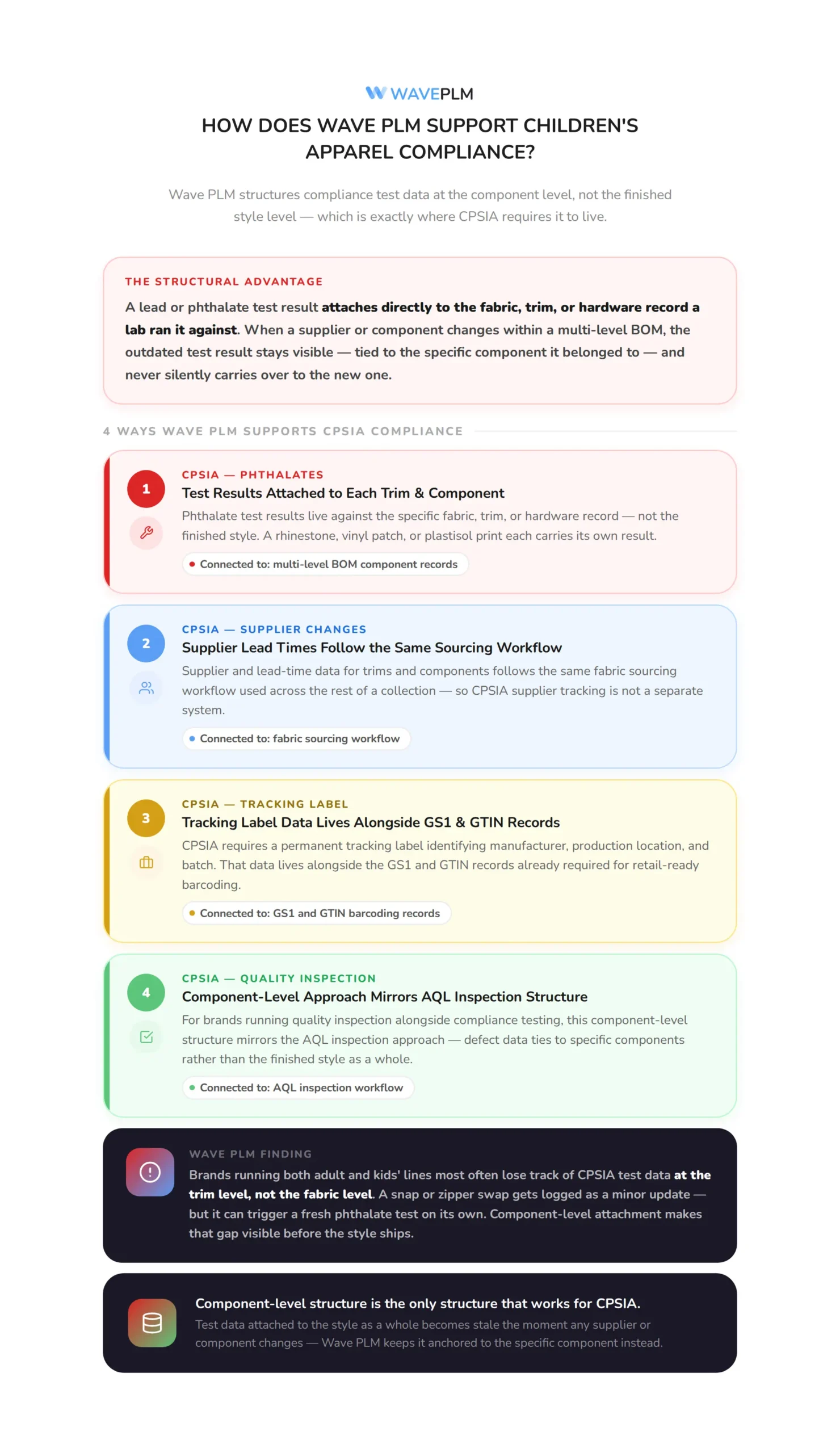
Our finding: Wave PLM customers running both adult and kids’ lines most often lose track of CPSIA test data at the trim level, not the fabric level. A snap or zipper swap on an existing kids’ style tends to get logged as a minor update. Even so, it can trigger a fresh phthalate test on its own.
Why Does Children’s Apparel Need Its Own Compliance Category?
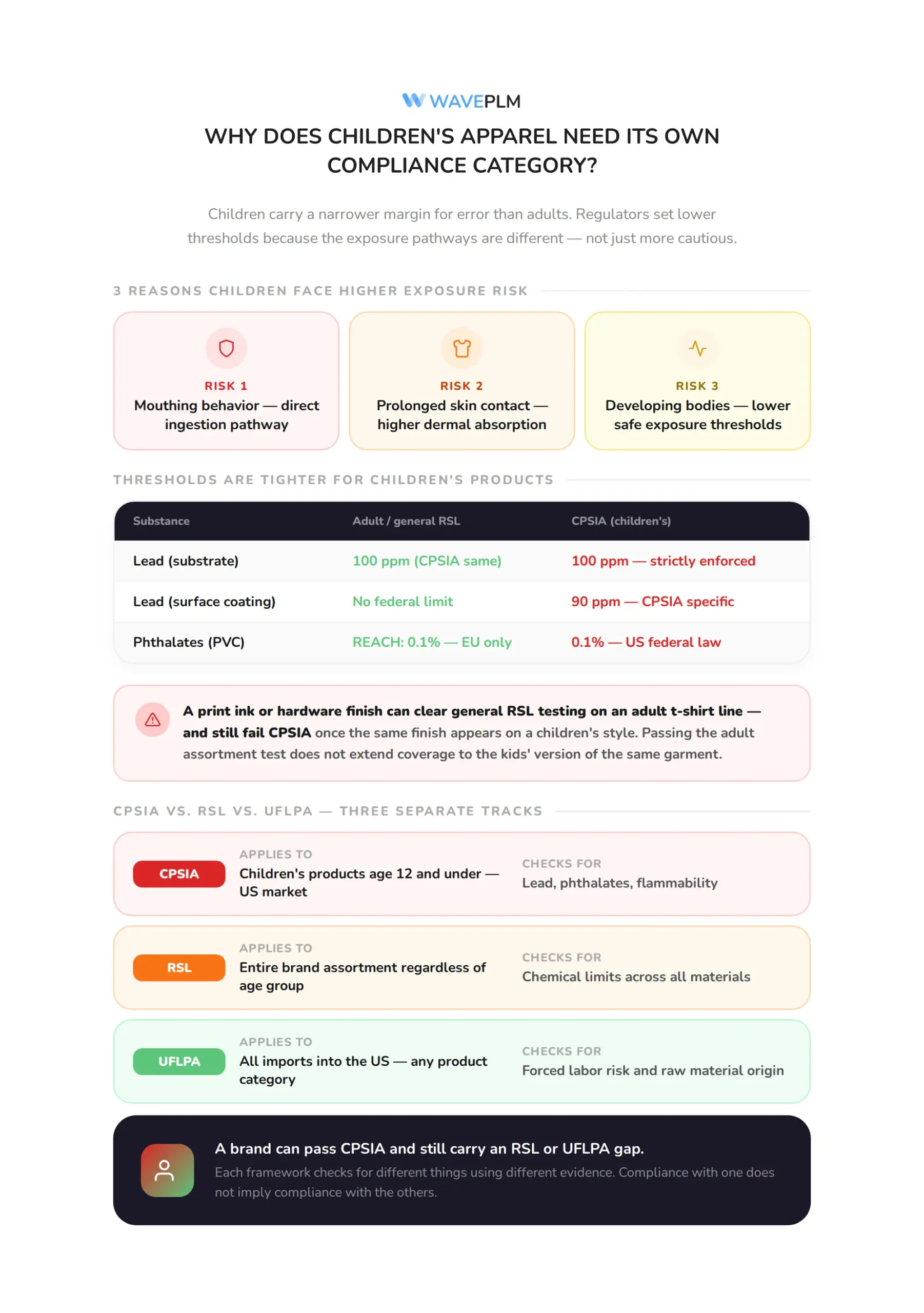
Children’s apparel carries a narrower margin for error than adult clothing. That is exactly why CPSIA treats it as a separate category, rather than folding it into general restricted substance rules. Regulators set lead and phthalate thresholds lower for kids’ products than for most adult apparel. The reason: higher exposure risk from mouthing, prolonged skin contact, and developing bodies. For example, a print ink or hardware finish can clear general restricted substance testing on an adult t-shirt line. However, that same finish will not automatically clear the tighter threshold once it appears on a children’s style.
It is worth separating CPSIA clearly from two other compliance frameworks that often get mentioned in the same conversation. A Restricted Substances List governs chemical limits across a brand’s entire assortment, regardless of who wears the garment. CPSIA, in contrast, applies specifically to products intended for children 12 and under. UFLPA covers a third, unrelated risk: forced labor and raw material origin. Consequently, a brand can pass CPSIA testing cleanly and still carry an unresolved UFLPA documentation gap. In other words, the two frameworks simply check for different things, using different evidence.
What Are the CPSIA Lead, Phthalate, and Flammability Thresholds?
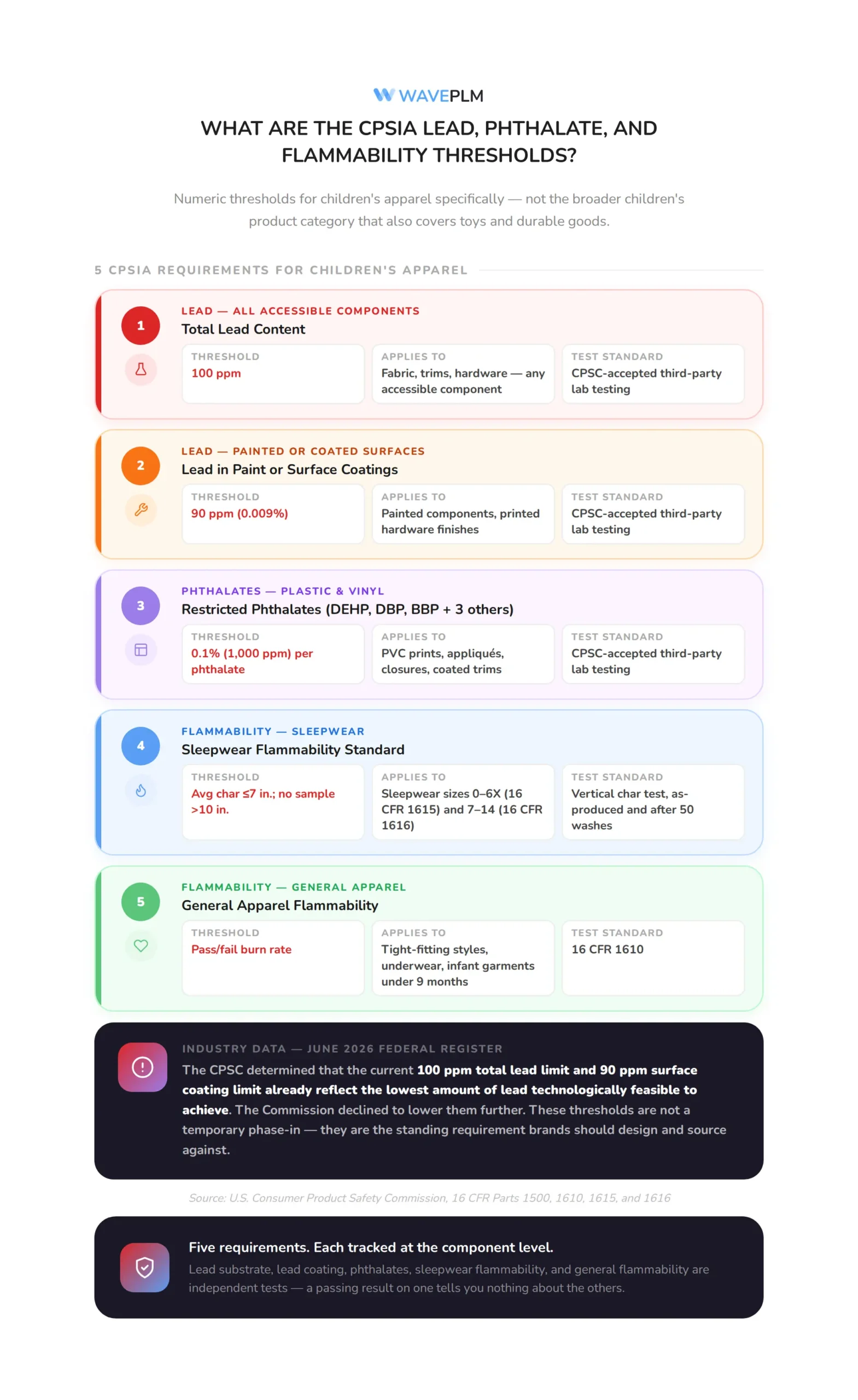
The table below maps the numeric thresholds that apply to children’s apparel specifically. This differs from the broader children’s product category, which also covers toys and durable goods.
| Requirement | Threshold | Applies to | Test standard |
|---|---|---|---|
| Total lead content | 100 ppm | Any accessible component (fabric, trims, hardware) | CPSC-accepted third-party lab testing |
| Lead in paint or surface coatings | 90 ppm (0.009%) | Painted or coated components, including printed hardware finishes | CPSC-accepted third-party lab testing |
| Restricted phthalates (DEHP, DBP, BBP, and three additional phthalates) | 0.1% (1,000 ppm) per phthalate | Accessible plastic or vinyl components: prints, appliqués, closures, coated trims | CPSC-accepted third-party lab testing |
| Sleepwear flammability | Average char length ≤7 in.; no single sample >10 in. | Sleepwear, sizes 0–6X (16 CFR 1615) and 7–14 (16 CFR 1616) | Vertical char length test, as-produced and after 50 washes |
| General apparel flammability | Pass/fail burn rate | Garments excepted from sleepwear rules: tight-fitting styles, underwear, infant garments under 9 months | 16 CFR 1610 |
Source: U.S. Consumer Product Safety Commission, 16 CFR Parts 1500, 1610, 1615, and 1616.
Industry data: In a June 2026 Federal Register notice, the CPSC determined that the current 100 ppm total lead limit and 90 ppm surface coating limit already reflect the lowest amount of lead technologically feasible to achieve. As a result, the Commission declined to lower them further. In other words, these thresholds are not a temporary phase-in figure. They are the standing requirement brands should design and source against.
Notice that phthalate restrictions apply only to accessible plastic or vinyl parts, not to the garment as a whole. A cotton t-shirt with no plastic components technically has nothing to test for phthalates. The same shirt with a plastisol-printed graphic or a vinyl appliqué introduces a test requirement instead. A fabric-only compliance check would miss it entirely.
How Does Sleepwear Flammability Testing Work?
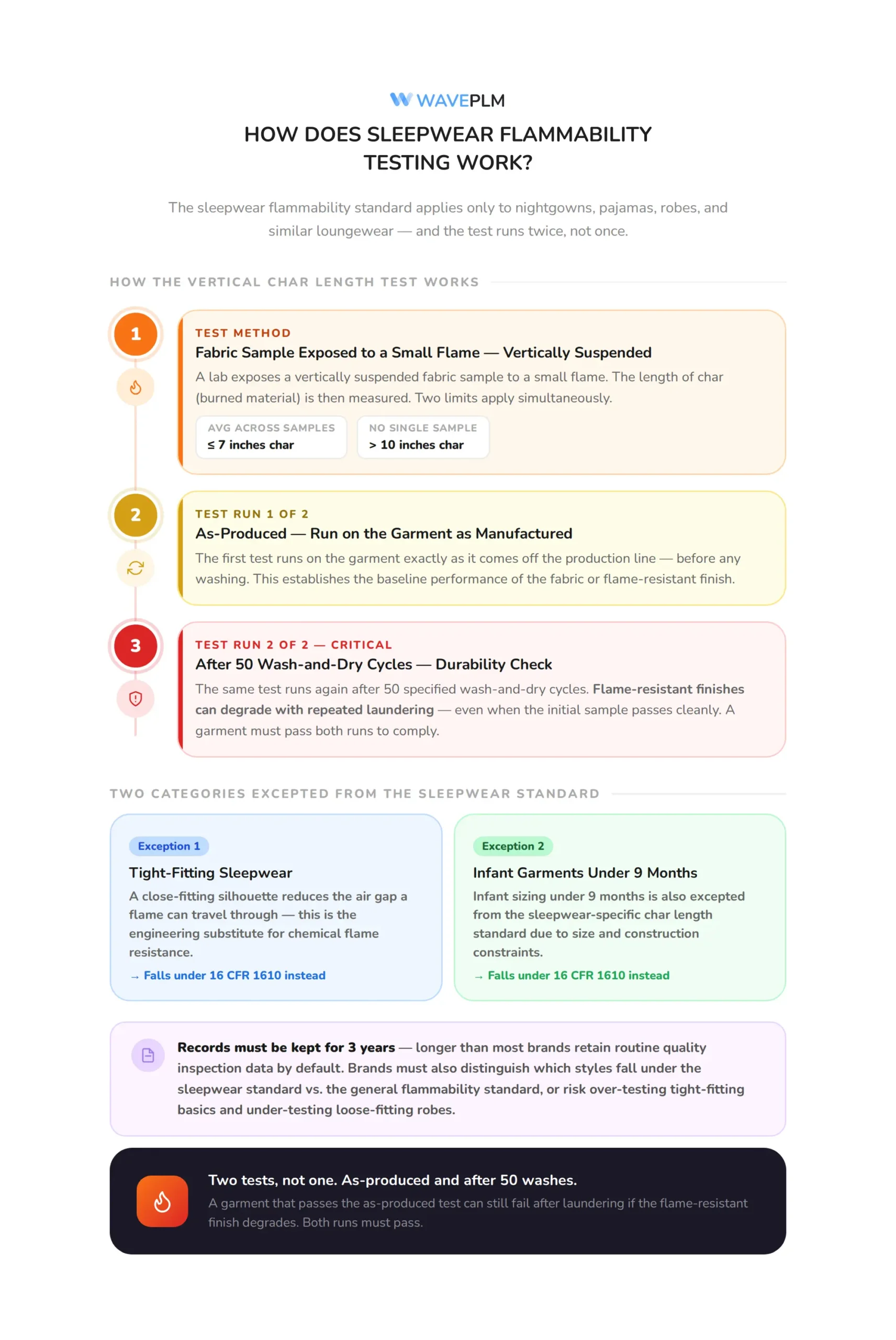
Sleepwear flammability is the one CPSIA-adjacent requirement that does not apply to children’s apparel broadly. It covers only nightgowns, pajamas, robes, and similar loungewear intended primarily for sleeping. The test itself measures char length. Specifically, a lab exposes a vertically suspended fabric sample to a small flame. The average char length across a set of samples must not exceed 7 inches. No single sample can exceed 10 inches. Importantly, labs run this test twice. First on the garment as produced, then again after the fabric goes through 50 specified wash-and-dry cycles. Flame-resistant finishes can degrade with repeated laundering, even when the initial sample passes cleanly.
Two categories of garments are excepted from this sleepwear-specific standard. Tight-fitting sleepwear has a close-fitting silhouette that reduces the air gap a flame can travel through. Infant garments sized under 9 months are the other exception. Both instead fall under the general apparel flammability standard, 16 CFR 1610. Notably, this distinction matters operationally. A brand that assumes every children’s sleepwear style needs the same test runs into two problems. It over-tests tight-fitting basics, and under-tests a loose-fitting robe that actually requires the stricter char length standard. Brands must also keep records of this testing for three years, longer than most retain routine quality inspection data by default.
What Mistakes Do Brands Make With Children’s Apparel Compliance?
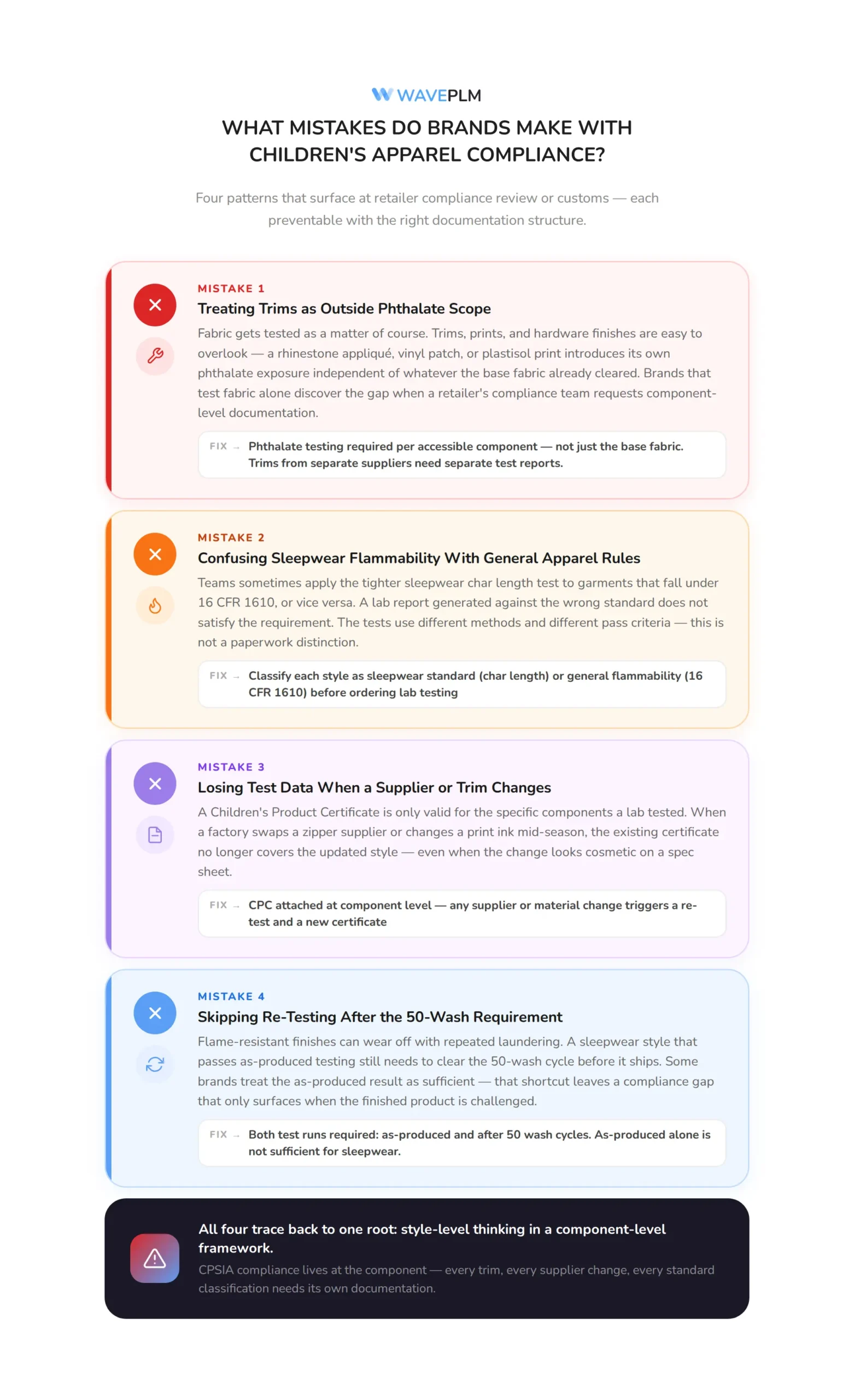
Treating Trims as Outside Phthalate Scope
Fabric usually gets tested as a matter of course. Trims, prints, and hardware finishes are easy to overlook instead. A separate supplier from the shell fabric frequently sources them. For example, a rhinestone appliqué, a vinyl patch, or a plastisol print introduces its own phthalate exposure. This holds independent of whatever the base fabric already cleared. Brands that test fabric alone, and assume trims are covered by extension, routinely discover the gap too late. Usually, a retailer’s compliance team surfaces it by requesting component-level documentation.
Confusing Sleepwear Flammability With General Apparel Rules
Because the two standards share a family resemblance, teams sometimes mix them up. They apply the tighter sleepwear char length test to garments that actually fall under 16 CFR 1610, or vice versa. This is not a minor paperwork distinction. The tests use different methods and different pass criteria. A lab report generated against the wrong standard simply does not satisfy the requirement that actually applies to the finished garment.
Losing Test Data When a Supplier or Trim Changes
A Children’s Product Certificate is only valid for the specific components a lab tested. When a factory swaps a zipper supplier or changes a print ink mid-season, the existing certificate no longer covers the updated style. This holds true even though the change looks cosmetic on a spec sheet. Brands that file compliance data against the finished style, rather than the specific component and lot tested, tend to keep shipping under an outdated certificate. Often, they never realize it.
Skipping Re-Testing After the 50-Wash Requirement
Flame-resistant finishes can wear off with repeated laundering. For that reason, a sleepwear style that passes as-produced testing still needs to clear the 50-wash cycle before it ships. Some brands treat the as-produced result as sufficient on its own, particularly under production deadline pressure. That shortcut leaves a compliance gap that only surfaces if someone challenges the finished product later.
How Does Wave PLM Support Children’s Apparel Compliance?
Wave PLM structures compliance test data at the component level, not the finished style level. That matters specifically for CPSIA’s trim-and-print-driven phthalate requirement. A lead or phthalate test result attaches directly to the fabric, trim, or hardware record a lab ran it against. This follows the same structure used for nickel and lead testing on accessories hardware. When a supplier or component changes within a multi-level BOM, the outdated test result stays visible. It stays tied to the specific component it belonged to, and never silently carries over to the new one.
This same connected structure extends to sourcing and retail readiness. Supplier and lead-time data for trims and components follows the same fabric sourcing workflow used across the rest of a collection. Tracking label data can live alongside the GS1 and GTIN records already required for retail-ready barcoding. For brands running quality inspection alongside compliance testing, this component-level approach mirrors our AQL inspection guide. There, too, defect data ties to specific components rather than a finished style as a whole.
Frequently Asked Questions
What is CPSIA compliance for children’s apparel?
CPSIA compliance for children’s apparel is the process of testing and certifying clothing for kids 12 and under. Specifically, it covers federal limits on total lead content, restricted phthalates in accessible plastic components, and, for sleepwear, flammability performance. Results get documented in a Children’s Product Certificate.
What is the CPSIA lead limit for children’s clothing?
Accessible components of children’s apparel must not exceed 100 ppm total lead content. Paint and surface coatings are held to a stricter limit of 90 ppm (0.009%). The CPSC reaffirmed both limits in June 2026 as the lowest technologically feasible thresholds.
What phthalates are restricted in children’s apparel?
CPSIA restricts six specific phthalates, including DEHP, DBP, and BBP, to a maximum of 0.1% (1,000 ppm) each. This limit applies to any accessible plastic or vinyl component, such as prints, appliqués, and coated closures. It does not apply to components with no plastic or vinyl content.
Does CPSIA flammability testing apply to all kids’ clothing?
No. Flammability testing under 16 CFR 1615 and 1616 applies specifically to children’s sleepwear, sizes 0–6X and 7–14. Tight-fitting sleepwear and infant garments under 9 months are tested instead under the general apparel flammability standard, 16 CFR 1610.
What is a Children’s Product Certificate?
A Children’s Product Certificate (CPC) is the document that certifies a children’s product complies with applicable CPSIA safety rules. A CPSC-accepted third-party laboratory performs the underlying testing. The certificate must reference the specific components and test results the style relies on to ship.
How is CPSIA different from the Restricted Substances List (RSL)?
An RSL governs chemical limits across a brand’s full assortment, regardless of age group. CPSIA, however, applies specifically to products intended for children 12 and under. Its lead and phthalate thresholds run tighter than most general RSL limits require.
CPSIA compliance for children’s apparel comes down to tracking test data at the component level, not the finished style. That means lead in any accessible part, phthalates in accessible plastic or vinyl, and flammability performance for sleepwear specifically. Brands that file certificates against a style as a whole, instead of the exact trim, print, or fabric lot tested, tend to keep shipping under outdated documentation. This happens the moment a single component changes.
Wave PLM attaches compliance test data directly to the component and lot it was tested against. As a result, a supplier or trim change never silently carries over an outdated certificate. See how Wave PLM supports children’s apparel compliance →







Leave a Reply