
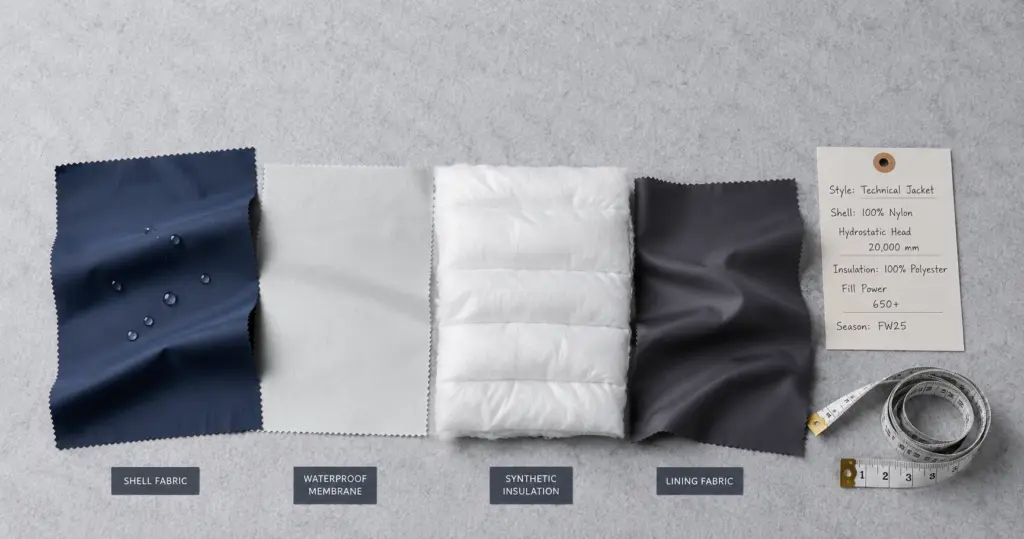
Outerwear PLM is product lifecycle management software configured for jackets, parkas, and shell garments. Specifically, it tracks waterproofing and breathability specs, insulation fill data, and construction that stacks three or more fabric layers, each with its own supplier. A generic apparel PLM handles styles, BOMs, and approvals well enough for a woven shirt. Outerwear PLM, however, adds a layer of technical data that is essential for high-performance garments. A system built around simple garments tends to treat that data as an afterthought, but outerwear PLM ensures that every detail is accounted for.
This guide covers what actually differs in outerwear development. It also walks through the performance data a category-specific PLM needs to track. Finally, it covers where brands most often lose control when they force-fit a generic system onto a technical jacket program.
Moreover, understanding outerwear PLM can significantly improve the efficiency and effectiveness of garment production, ensuring that brands maintain their competitive edge.
What Makes Outerwear PLM Different From Generic Fashion PLM?
In the context of outerwear PLM, it is crucial to recognize the unique challenges that arise from multi-layer designs.
Three things separate outerwear development from a basic woven or knit program. First, construction stacks multiple layers: a shell fabric, a waterproof or windproof membrane, insulation, and a lining. Each layer gets sourced separately, with its own spec. Second, performance fabric data needs structured fields, not free text. A lab measures waterproofing in hydrostatic head, by the millimeter, and breathability in moisture vapor transmission rate, in grams per square meter per 24 hours. Third, insulation adds a variable most apparel categories never touch. Fill power covers down, while fill weight in grams per square meter covers synthetic insulation. Notably, the two affect warmth independently of each other.
Our finding: Wave PLM customers building technical outerwear lines consistently point to seam taping as the detail that gets lost first. A waterproof shell is only as good as its taped seams. Yet that construction step often lives in a factory’s internal process notes instead of the tech pack, so a factory switch can quietly drop it.
Brands must leverage outerwear PLM to effectively manage the complexities of insulation and moisture control.
What Features Does Outerwear PLM Need?
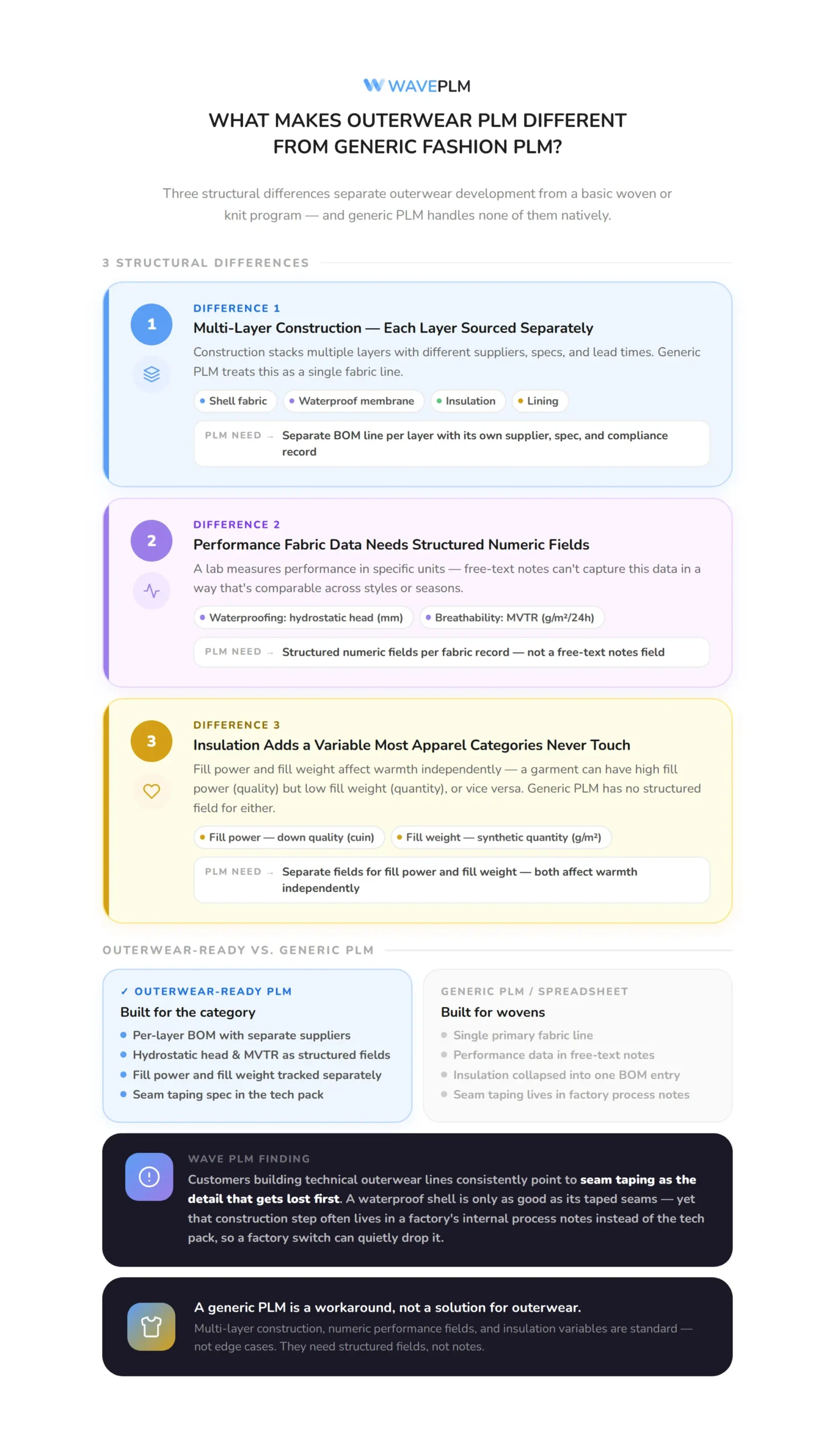
The right outerwear PLM system provides clear visibility into every stage of the production process. Beyond the standard style, BOM, and cost sheet functions common to any apparel PLM, outerwear development specifically needs the capabilities below.
Additionally, outerwear PLM can help brands identify potential pitfalls in their development cycles. Tracking metrics through outerwear PLM allows brands to stay ahead in performance and quality.
| Feature | Why outerwear needs it specifically | What breaks without it |
|---|---|---|
| Multi-layer BOM support | Shell, membrane, insulation, and lining each need separate specs and suppliers | A membrane or insulation change gets missed because it lives outside the main BOM |
| Hydrostatic head and MVTR fields | Waterproofing and breathability are separate, numeric performance specs | Fabric that fails a threshold ships before anyone catches it in a free-text note |
| Fill power and fill weight tracking | Warmth depends on both together, not fill power alone | A fill weight cut during costing silently changes the garment’s actual warmth rating |
| Seam construction detail | Taped or sealed seams are what make a waterproof shell actually waterproof | A factory switch drops the taping spec because it lived in notes, not the tech pack |
| Hardware and closure tracking | Water-resistant zippers, storm flaps, and drawcords each carry their own supplier and spec | A standard zipper substitution quietly undermines the garment’s waterproof rating |
Source: Wave PLM feature framework for technical outerwear brands, 2026.
Ultimately, outerwear PLM is an investment that pays dividends in the long run. As you evaluate your options, consider how outerwear PLM can align with your business goals.
How Does Multi-Layer BOM Work for Outerwear?
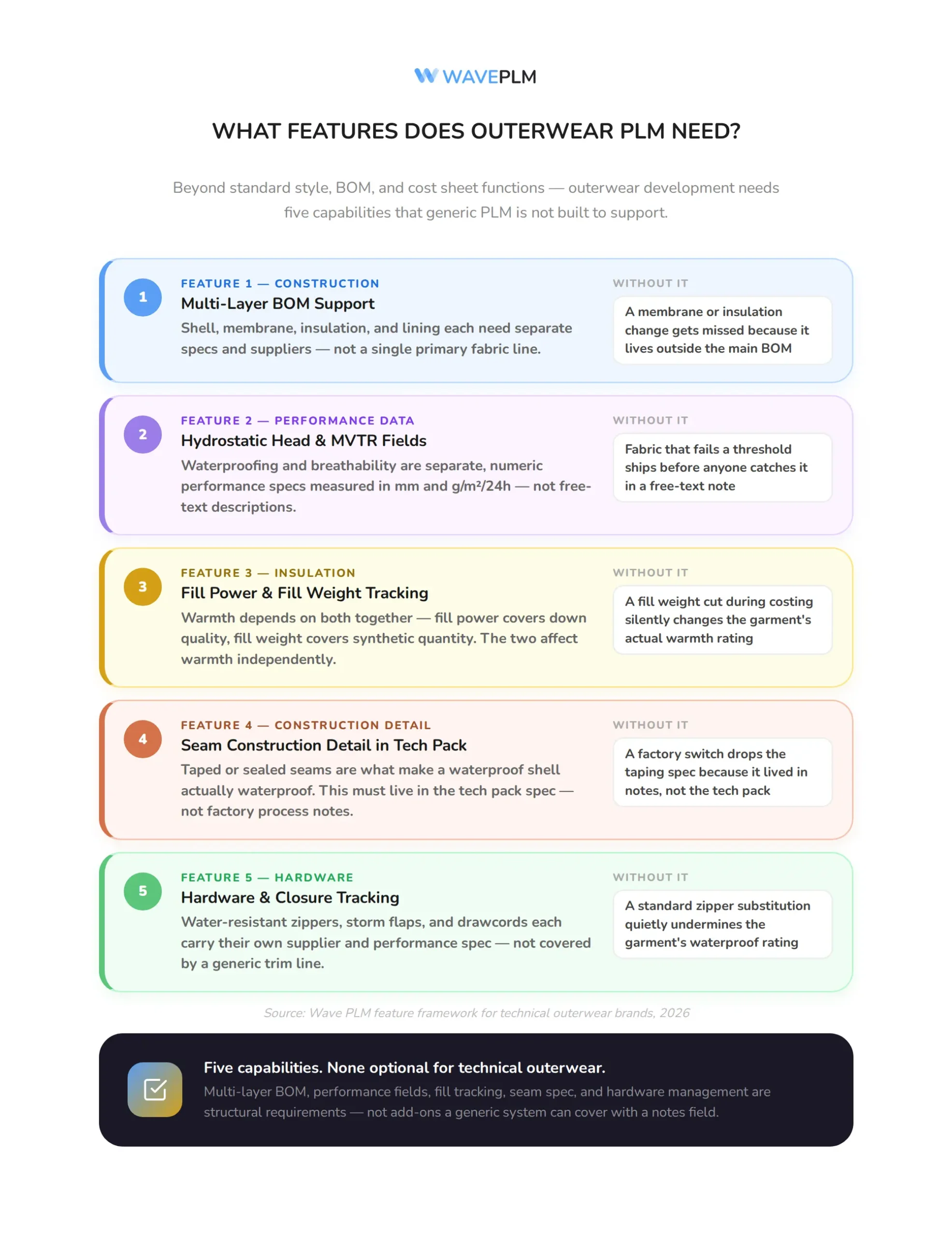
A basic garment BOM organizes around one fabric plus trims. Outerwear does not work that way. A typical technical jacket combines a shell fabric, a membrane or coating that provides the waterproofing, insulation, and a lining. Each of those four components can come from a different supplier, with its own lead time. Treating this structure as a flat BOM, the way a simple shirt is built, makes it difficult to catch a lead-time mismatch. It also hides a spec change until it delays an entire style. Our guide to multi-level BOM in fashion covers this underlying structure in more depth, and outerwear is one of the categories that needs it most.
Hardware follows the same logic. A water-resistant zipper, a storm flap, and a drawcord system each need their own supplier and spec record, not a shared “trim” line. A standard zipper substitution, made because the water-resistant version is backordered, looks minor on a spec sheet. In practice, it can undercut the entire garment’s waterproof claim.
What Waterproofing and Breathability Data Should Brands Track?
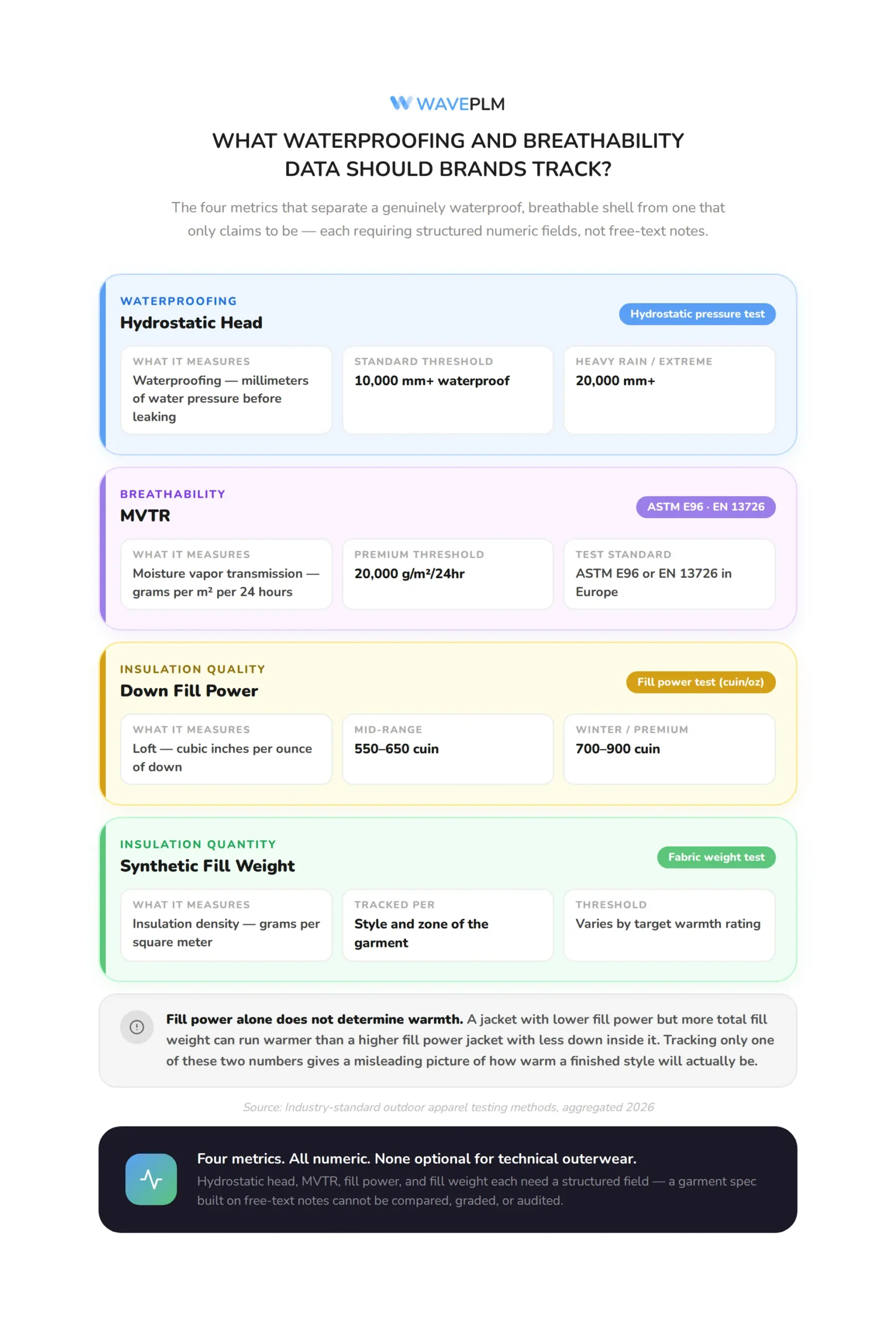
The table below maps the core performance thresholds that separate a genuinely waterproof, breathable shell from one that only claims to be.
| Metric | What it measures | General threshold | Test standard |
|---|---|---|---|
| Hydrostatic head | Waterproofing, in millimeters of water pressure before leaking | 10,000mm+ waterproof; 20,000mm+ for heavy rain or extreme conditions | Hydrostatic pressure test |
| MVTR (breathability) | Moisture vapor transmission, in grams per square meter per 24 hours | 20,000 g/m²/24hr is considered a premium score | ASTM E96, or EN 13726 in Europe |
| Down fill power | Loft, in cubic inches per ounce of down | 550–650 mid-range; 700–750 winter-weight; 800–900 premium | Fill power test (cuin/oz) |
| Synthetic fill weight | Insulation density, in grams per square meter | Varies by target warmth; tracked per style and per zone of the garment | Fabric weight test |
Source: Industry-standard outdoor apparel testing methods, aggregated 2026.
Notice that fill power alone does not determine warmth. A jacket with a lower fill power but more total fill weight can run warmer than a higher fill power jacket with less down inside it. As a result, tracking only one of these two numbers gives a misleading picture of how warm a finished style will actually be.
What Should Brands Look for When Evaluating Outerwear PLM Software?
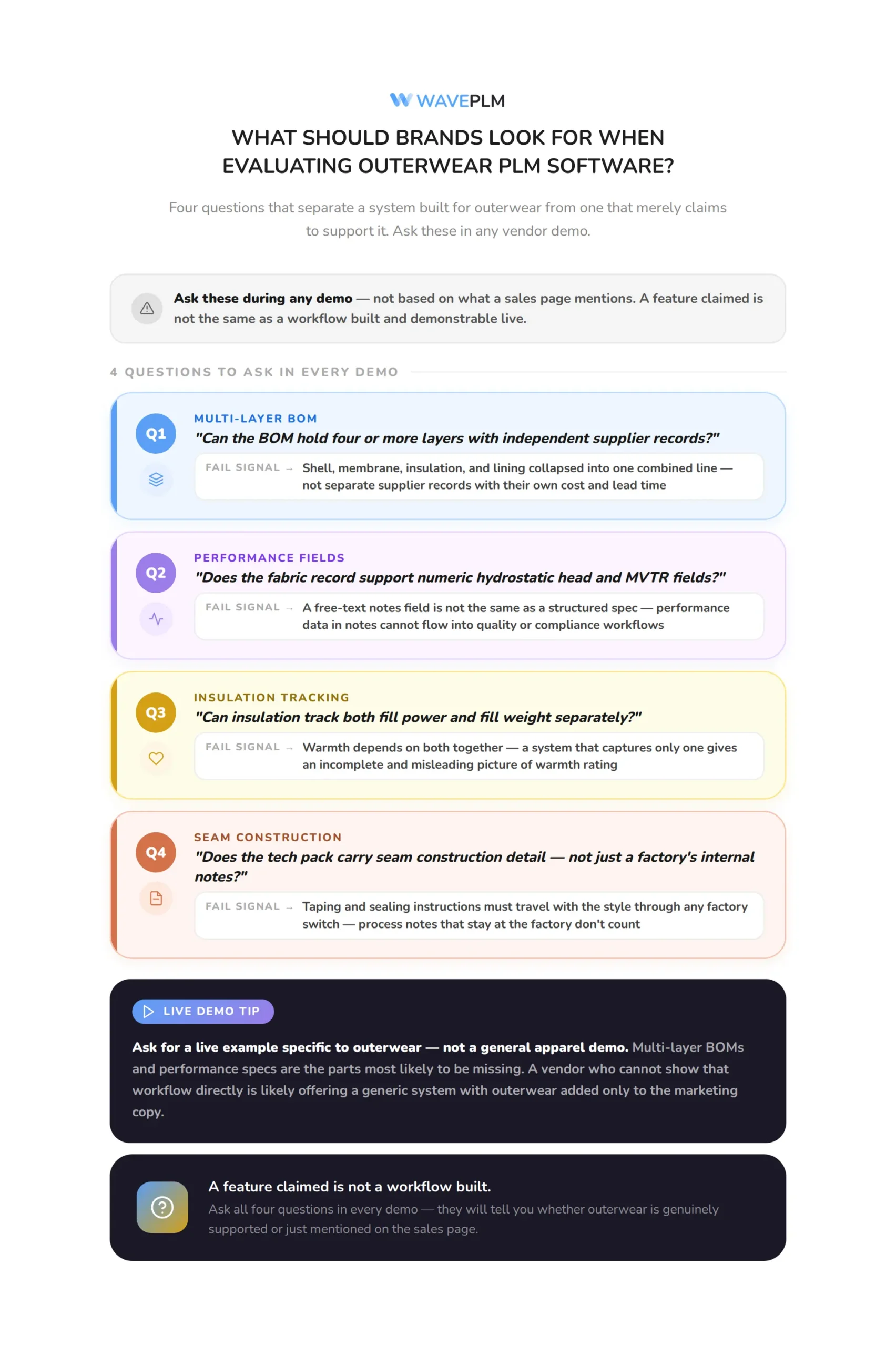
To maximize efficiency, ensure that every detail is captured in your outerwear PLM system. Beyond the feature list above, a few evaluation questions separate a system built for outerwear from one that merely claims to support it. Ask these directly during a vendor demo, rather than assuming a feature exists because a sales page mentions the category.
- Can the BOM hold four or more layers with independent supplier records? Shell, membrane, insulation, and lining each need their own supplier, cost, and lead time, not one combined line item.
- Does the fabric record support numeric hydrostatic head and MVTR fields? A free-text notes field is not the same as a structured spec that flows into quality and compliance data.
- Can insulation track both fill power and fill weight separately? Warmth depends on both together, and a system that only captures one gives an incomplete picture.
- Does the tech pack carry seam construction detail, not just a factory’s internal notes? Taping and sealing instructions need to travel with the style, especially through a factory switch.
Ask any vendor for a live example specific to outerwear, rather than a general apparel demo. Multi-layer BOMs and performance specs are the parts most likely to be missing. Consequently, a vendor who cannot show that workflow directly is likely offering a generic system, with outerwear added only to the marketing copy.
This commitment to outerwear PLM will safeguard your brand’s reputation for quality. Reflect on your approach to outerwear PLM to drive meaningful results in product development.
What Mistakes Do Brands Make Without Category-Specific Outerwear PLM?
Treating Insulation as a Generic Trim Line
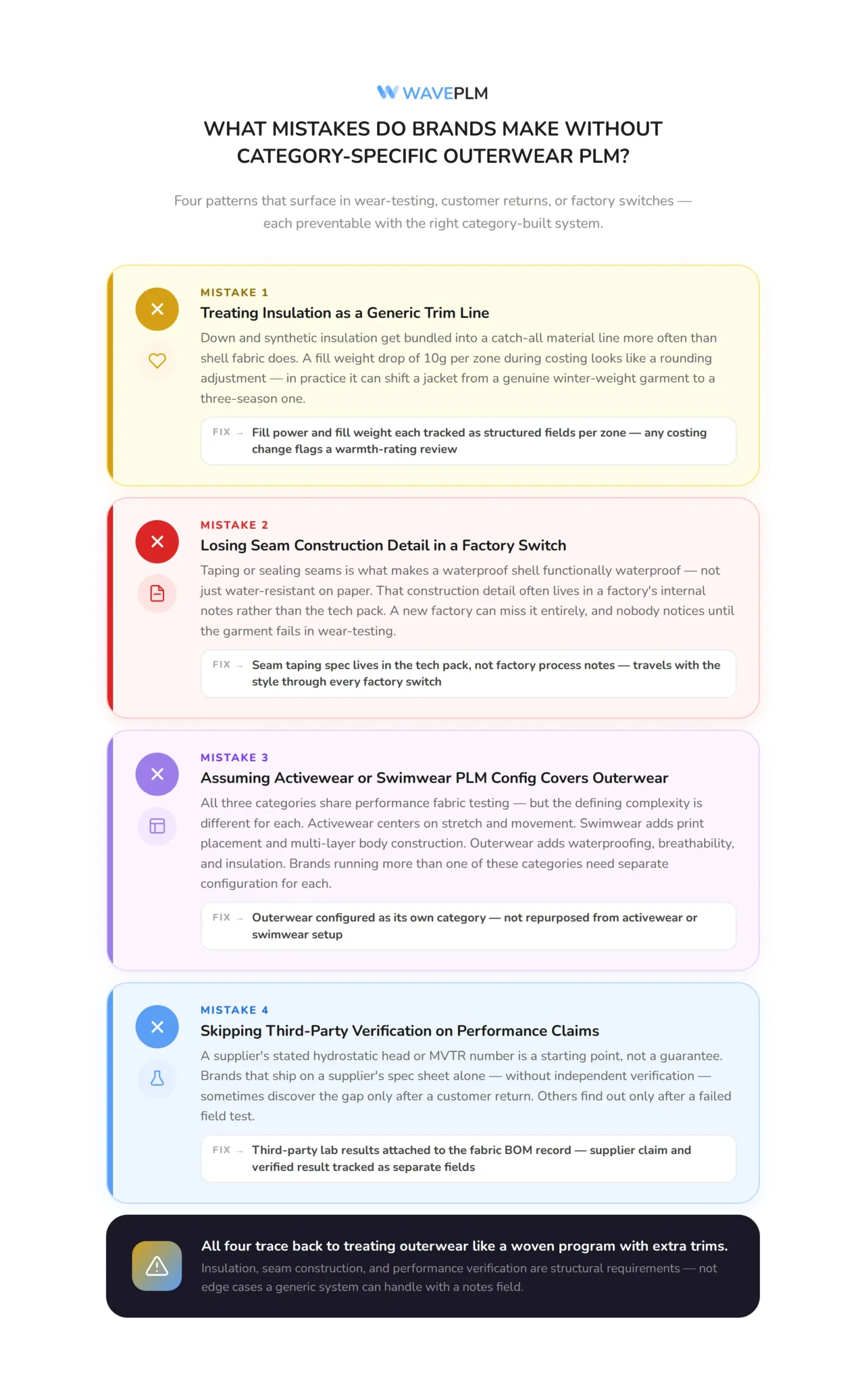
Down and synthetic insulation get bundled into a catch-all material line more often than shell fabric does. Consequently, a fill power or fill weight change during costing can slip through without triggering a review, even though it directly changes the garment’s warmth. For example, a sourcing team chasing a lower unit cost might quietly drop fill weight by 10 grams per zone. On paper, that looks like a rounding adjustment. In practice, however, it can shift a jacket from a genuine winter-weight garment to a three-season one.
Losing Seam Construction Detail in a Factory Switch
Taping or sealing seams is what makes a waterproof shell functionally waterproof, not just water-resistant on paper. That construction detail often lives in a factory’s internal notes rather than the tech pack. As a result, a new factory can miss it entirely, and nobody notices until the garment fails in wear-testing.
Assuming Activewear or Swimwear PLM Configuration Covers Outerwear
Outerwear shares some traits with activewear and swimwear, including performance fabric testing. Even so, the categories are not interchangeable. Activewear centers on stretch and movement. Swimwear centers on print placement and multi-layer construction around the body. Outerwear, meanwhile, adds waterproofing, breathability, and insulation as its defining complexity. Brands running more than one of these categories typically need separate configuration for each.
Skipping Third-Party Verification on Performance Claims
A supplier’s stated hydrostatic head or MVTR number is a starting point, not a guarantee. Brands that ship on a supplier’s spec sheet alone, without independent verification, sometimes discover the gap only after a customer return. Others find out only after a failed field test.
How Does Wave PLM Support Outerwear Brands?
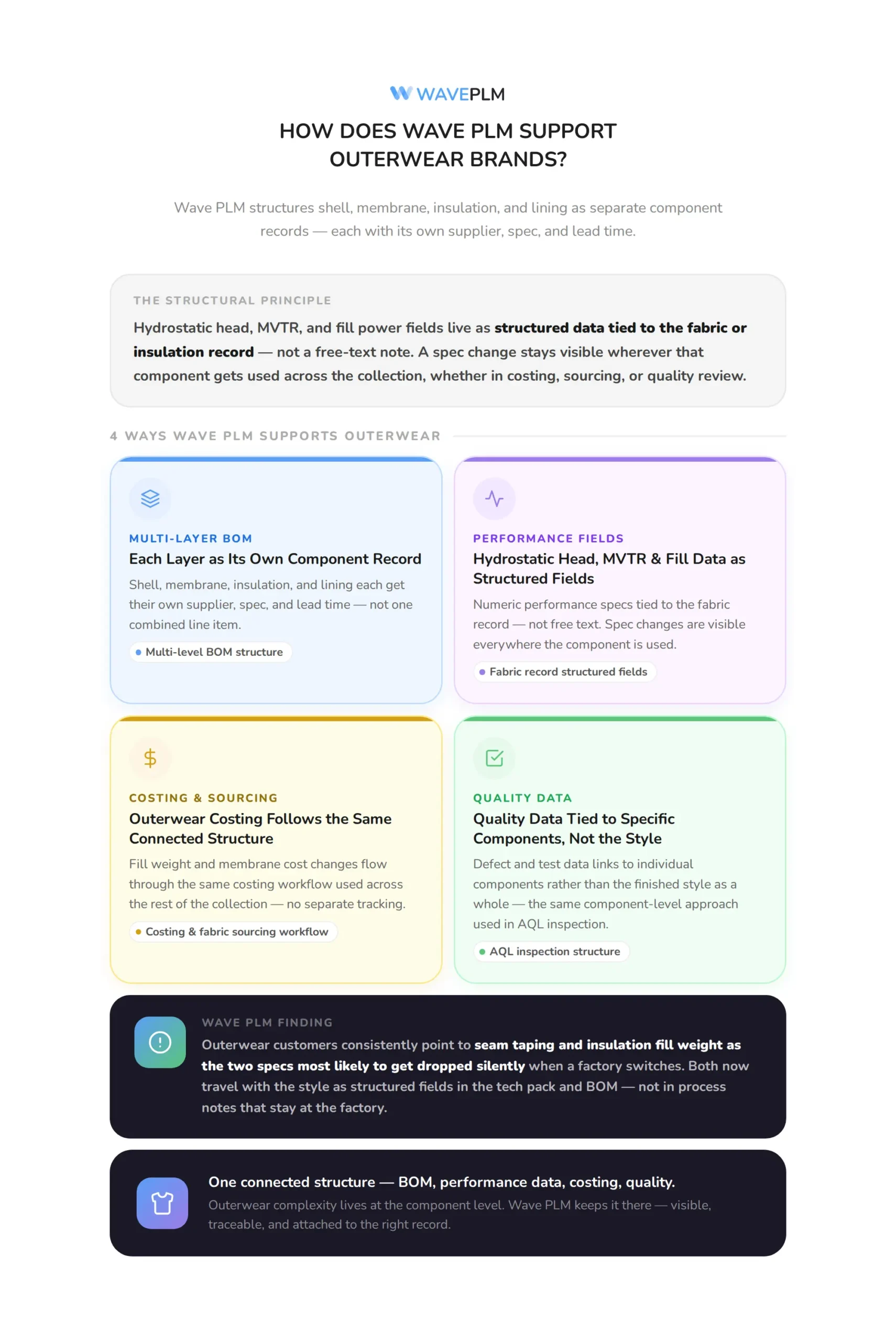
Wave PLM structures shell, membrane, insulation, and lining as separate component records within one style, each with its own supplier, spec, and lead time. This follows the same multi-level BOM structure used across complex categories. Hydrostatic head, MVTR, and fill power fields live as structured data tied to the fabric or insulation record, not a free-text note. As a result, a spec change stays visible wherever that component gets used. This same structure carries through to costing and fabric sourcing. Quality data, similarly, ties to specific components rather than a finished style as a whole, the same approach covered in our AQL inspection guide.
Frequently Asked Questions
What is technical outerwear PLM software?
Outerwear PLM is product lifecycle management software configured for jackets, parkas, and shell garments. It tracks multi-layer construction, waterproofing and breathability data, and insulation fill specs as structured fields rather than free text.
What is a good hydrostatic head rating for a waterproof jacket?
A hydrostatic head of 10,000mm or higher generally counts as waterproof. For heavy rain or extreme conditions, 20,000mm and above is recommended. Ratings below 10,000mm are water-resistant rather than fully waterproof.
What does MVTR mean for outerwear breathability?
MVTR, or moisture vapor transmission rate, measures how much sweat vapor a fabric releases, in grams per square meter per 24 hours. A rating around 20,000 g/m²/24hr is considered a premium breathability score.
Does higher fill power always mean a warmer jacket?
No. Fill power measures loft and warmth-to-weight ratio, not total warmth on its own. In fact, a jacket with lower fill power but more total fill weight can be warmer than a higher fill power jacket with less down inside it.
Can activewear PLM software handle technical outerwear?
Not fully. Activewear and outerwear both involve performance fabric testing. However, outerwear adds waterproofing, breathability, and insulation fill data as its defining complexity. Brands running both categories typically need separate configuration for each.
Why does seam taping matter for waterproof outerwear?
A waterproof fabric with un-taped seams still leaks at every stitch line. Taped or sealed seams are what make the finished garment functionally waterproof. For that reason, this construction detail needs to live in the tech pack, not a factory’s internal notes.
Most brands feel this gap first at the sampling stage. That is usually when insulation, membrane, and hardware specs start multiplying across a seasonal line, and a spreadsheet stops being able to hold them clearly. If that sounds like where your outerwear program is headed, a short walkthrough of Wave PLM shows exactly how the multi-layer BOM and performance data fields work in practice.








Leave a Reply